REVIEW 3 major objections 5 minor 96 references
Bayesian calibration of a chiral nuclear model finds viable parameters are rare but broad, with data constraining correlated combinations of couplings rather than individual ones.
Reviewed by Pith at T0; open to challenge. T0 means a machine referee read the full paper against a public rubric. the ladder, T0–T4 →
T0 review · deepseek-v4-flash
2026-08-02 05:38 UTC pith:J65IQWP7
load-bearing objection Useful methodological advance whose headline degeneracy claim is currently emulator-dependent; deserves peer review with a bounded request for exact-likelihood reweighting. the 3 major comments →
Neural-Accelerated Bayesian Calibration of Chiral Mean-Field Models to Nuclear Saturation and Vacuum Properties
The pith
A machine-rendered reading of the paper's core claim, the machinery that carries it, and where it could break.
Core claim
The paper shows that, under the generalized quartic vector self-interaction sector, Bayesian posterior samples consistent with vacuum baryon masses and nuclear saturation properties span a broad region in which the data constrain combinations of couplings more strongly than individual Lagrangian parameters. Viable solutions are rare (≫99% of uniformly sampled configurations are excluded), but the high-likelihood region is not localized; degeneracies allow very different parameter combinations to produce the same physical observables. The posterior shows no evidence of large-scale clustering or topological structure, yet local likelihood gradients reveal significant fine-scale structure. Cons
What carries the argument
The generalized quartic vector self-interaction sector, Eq. (13), built from the four linearly independent chiral-invariant trace structures of the vector nonet, and expressed in the diagonal singlet-octet basis (C0, C8, C08, C038) and physical-meson channels. This sector enlarges the CMF parameter space and correlates physical interaction channels, and the Bayesian framework with a neural-network emulator of the saturation map enables exploration. The emulator, trained with a clamping procedure, accelerates the mapping from parameters to saturation observables, and the iterative scheme expands training data in the relevant region.
Load-bearing premise
The neural-network emulator trained on clamped losses with limited training samples near the C1 point is accurate enough in the posterior region that no likelihood reweighting or exact recalculation is needed to support the paper's conclusions.
What would settle it
Directly recompute the saturation observables for a large set of high-likelihood posterior samples using the full CMF model and compare with emulator predictions; if the discrepancies are large enough to shift the posterior contours significantly, the emulator approximation would be invalid for the stated conclusions.
If this is right
- The inferred posterior, with its correlated combinations, can be propagated into neutron-star calculations to produce a wide range of mass-radius curves, even with purely nucleonic equations of state.
- The framework can be extended to include additional observables (correlated nuclear-matter constraints, neutron-matter calculations, heavy-ion information, astrophysical observations) to break the degeneracies.
- The generalized quartic vector self-interaction sector reduces to various interaction schemes used in the literature as limiting cases, so the constraints found here apply to a broader class of CMF parametrizations.
- The finding that distinct saturation-compatible models lead to qualitatively different neutron-star descriptions emphasizes that holding parameters fixed in Bayesian estimation can significantly affect conclusions.
Where Pith is reading between the lines
- The broad, topologically trivial posterior suggests that any low-dimensional projection of the posterior is likely to be prior-dominated, so using marginal posteriors to generate new model points would be misleading; only the full correlated sample set carries the physical information.
- The fine-scale structure in the likelihood, invisible in marginal distributions, implies that the effective number of degrees of freedom in the model is lower than the number of Lagrangian parameters, and that the data effectively constrain a few combinations (e.g., in the singlet-octet basis).
- The emulator's performance, even with limited training data near the C1 point, hints that the saturation map has a simpler structure in the relevant region than the full parameter space, but the posterior should still be interpreted as conditional on the emulator approximation.
- The inclusion of m0 as a free parameter, though degenerate with gS1, can yield larger maximum masses for compact stars, suggesting that the assumption of fully dynamical mass generation biases neutron-star predictions toward lower maximum masses.
Editorial analysis
A structured set of objections, weighed in public.
Referee Report
Summary. The paper presents a hierarchical Bayesian calibration framework for the chiral mean-field (CMF) model, combining an analytic vacuum stage constraining scalar-sector couplings from octet baryon masses with an emulator-accelerated in-medium stage constraining vector couplings and scalar parameters from nuclear saturation properties. The in-medium map is approximated by a neural network trained on CMF++ evaluations inside an iterative scheme. The authors introduce a generalized quartic vector self-interaction sector consistent with SU(3) flavor symmetry and conclude that viable CMF parameter sets are rare in the full space but broadly distributed in marginal projections, with data constraining correlated combinations of couplings rather than individual parameters. They further use posterior samples to explore neutron-star mass-radius predictions, finding a wide range of nucleonic EoS behavior, including acausal high-density extrapolations that are retained.
Significance. If the central inference claim survives scrutiny, the paper would provide the first Bayesian calibration of a full SU(3) chiral mean-field model, demonstrate a new and physically motivated quartic vector interaction basis, and offer a reusable modular pipeline (CMF++/Bilby/PyTorch) with public data-release plans. The vacuum-stage analysis is clean and identifies the m0-gS1 degeneracy explicitly; the emulator is trained on independent CMF++ evaluations, so the main inference is not circular. The paper's emphasis on parameter combinations rather than marginalized single couplings is a useful and potentially important message for dense-matter model calibration. However, the central posterior conclusions are made conditional on an emulator whose errors are comparable to or larger than the adopted likelihood widths, and the posteriors themselves are not demonstrated to have converged by the final iteration. These issues must be addressed before the broad-degeneracy and topological-triviality claims can be accepted as statements about the actual CMF model.
major comments (3)
- [§VI B 1, Tables V–VI] The load-bearing claim that viable solutions are rare but broadly distributed, with no large-scale structure, is established from a posterior computed with the neural-network emulator as the likelihood. Yet the reported emulator errors on unseen data at iteration 11 are comparable to, or larger than, the adopted likelihood uncertainties: for nsat the 68% interval is [-0.008, +0.013] fm^-3 versus sigma_nsat=0.005 fm^-3; for EB it is [-1.4, +1.35] MeV versus sigma_EB=0.6 MeV; for L it is [-26, +20] MeV versus sigma_L=20 MeV; and for K0 it is [-35, +98] MeV versus sigma_K0=100 MeV. Because the nested sampler uses this emulator as the likelihood, the marginal posteriors and topology tests are statements about the emulator-approximated posterior. The paper states in Sec. VI B 1 and Sec. VII that likelihood reweighting or direct recalculation should be done for a precision analysis, but it is
- [§IV B, Table I] The saturation likelihood is built from hand-synthesized 'effective target values' with independent Gaussian uncertainties, and the paper explicitly neglects the known J–L correlation. This is the likelihood that produces the claimed parameter degeneracies, so the qualitative conclusion that the data constrain combinations rather than individual parameters is conditioned on these choices. The authors correctly describe the analysis as exploratory, but to make the central claim robust they should provide a sensitivity study: vary the effective central values and widths, and include at least a J–L covariance, to show that the broad-degeneracy structure is not an artifact of the particular synthetic tolerances. Without such a check, the quantitative posterior widths and the 'data constrain combinations' statement are not uniquely determined by nuclear data.
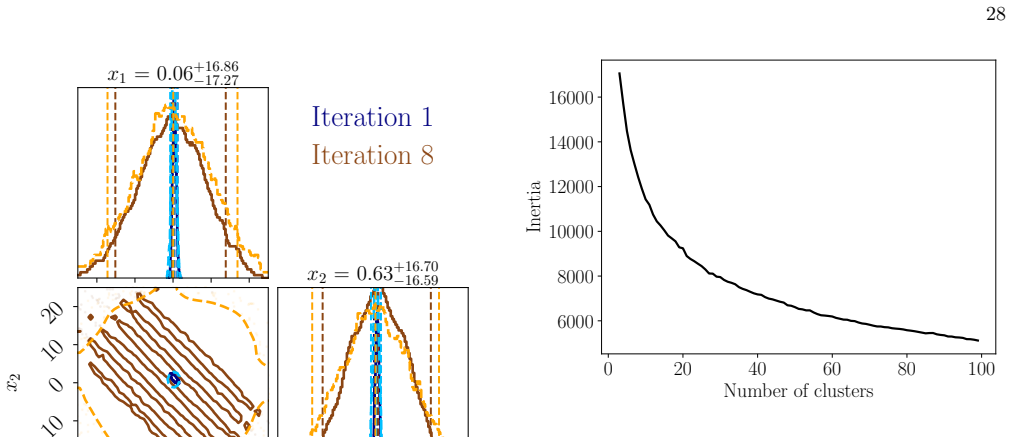
- [§VI B 1] The paper states that 'we do not find that the posterior has stabilized by iteration 11' and that the stopping iteration is 'somewhat arbitrary.' Since the posterior broadens as the prior is widened, the main conclusions about the breadth of viable parameter space depend on the arbitrary termination point of the iterative scheme. The authors should either continue the iterations until a defined convergence criterion is met (e.g., stability of the high-likelihood region and of derived claims), or explicitly quantify how the reported posterior regions and NS predictions depend on the iteration number. This is a load-bearing issue for broad-distribution conclusions, not a presentation detail.
minor comments (5)
- [Table V footnote] The table footnote refers to a 'clipping procedure' while the text (Sec. V A) defines 'clamping'; please use consistent terminology.
- [§VI B 2 / Fig. 8] The normalized derivatives in Fig. 8 are useful, but the discussion would benefit from stating explicitly how the posterior-standard-deviation sigma_theta_j is measured (which iteration's posterior) and from noting that these are median values over the emulator-approximated posterior.
- [§V B] The iterative algorithm description says prior widths are set to 'some multiple' of the previous posterior width; please specify the actual multipliers used in the runs and how the termination criterion dlogZ=0.4 was chosen relative to emulator error.
- [Appendix A 1] The statement that the m0 distribution is treated as 'uniform for use in the inference' is slightly ambiguous; clarify whether this is a prior choice after the Gaussian fit and how the y_S reparameterization is propagated to the emulator inputs.
- [§VI C] The inclusion of acausal EoSs in the mass-radius plots is clearly justified, but the fraction of acausal solutions is reported only for iteration 0 vs iteration 8; reporting it for the final iteration would help readers assess the prevalence of acausal extrapolations.
Circularity Check
No significant circularity: calibration is self-contained against external targets; emulator and prior-dependence are limitations, not circular reductions.
full rationale
The central derivation is not circular. Vacuum baryon masses are analytic functions of the scalar couplings (Eq. 21) and are compared to external effective targets (Table I); saturation observables are computed from direct CMF++ evaluations through the Saturation Properties module and compared to external empirical targets (Table I). The neural-network emulator is a surrogate for the expensive model map, trained on direct CMF++ outputs and checked against unseen data (Tables V–VI), and the paper explicitly labels the posterior as conditional on the emulator approximation (Sec. VI B 1); this is an accuracy limitation rather than a definitional reduction. Self-citations appear ([28] for the C1 initialization, [32] for agreement on local structure), but the load-bearing evidence is the paper's own likelihood evaluations and posterior analysis, and no uniqueness claim or ansatz is imported as proof. The statement that data constrain combinations more strongly than individual couplings follows from the posterior covariance under the a priori fixed linear reparametrization of Eq. (18), not from a quantity fitted to itself. The admitted prior-dependence and non-stabilization by iteration 11 ('posterior has not stabilized', 'choice of stopping iteration is somewhat arbitrary') weaken robustness but do not make any step circular. No step reduces an output to its input by construction.
Axiom & Free-Parameter Ledger
free parameters (4)
- effective target values and uncertainties =
nsat=0.155±0.005 fm^-3, EB=-16.0±0.6 MeV, K0=240±100 MeV, J=32.0±2.0 MeV, L=60.0±20.0 MeV
- hyperon mass systematic uncertainties =
7 MeV for Lambda, Sigma, Xi; 1 MeV for nucleon
- clamping ranges =
nsat [0.0,0.4], EB [-45,15], K0 [-150,650], J [-10,50], L [-50,150]
- initial prior widths for vector couplings =
g04_4=116.8±40.0, gN_omega=13.66±2.0, gN_rho=4.94±1.0; g13_4, g22_4, g220_4=0±10
axioms (5)
- domain assumption The CMF Lagrangian and its scalar sector are correct and complete enough for the inferences made.
- domain assumption The mean-field approximation and the neglect of hyperon/quark degrees of freedom at saturation are valid.
- domain assumption The independent Gaussian likelihood with effective tolerances correctly encodes the constraints from nuclear experiments.
- domain assumption The vacuum meson expectation values sigma0 and zeta0 are known exactly and do not change under parameter variation.
- ad hoc to paper The neural network emulator can be used as a stand-in for the exact CMF++ likelihood in the posterior region.
invented entities (1)
-
generalized quartic vector self-interaction sector (gij_4 couplings)
no independent evidence
read the original abstract
Chiral models of nuclear interactions provide approximate, phenomenological descriptions of dense matter that respect the symmetries of quantum chromodynamics. Their Lagrangian parameters, however, are difficult to calibrate because these models are not controlled effective theories. Furthermore, repeated model evaluations are computationally expensive, and most parameter choices fail to reproduce acceptable saturation properties or hadron masses in vacuum. To address this, we develop a Bayesian inference framework to identify parameter regions consistent with nuclear saturation properties and vacuum experimental constraints. We implement this framework through a neural-network surrogate approximation that accelerates the repeated mapping from model parameters to nuclear and particle observables. Our fully-modular, neural-accelerated Bayesian framework interfaces the open-source MUSES Calculation Engine, the Bilby inference library, and the PyTorch machine-learning toolkit. We then apply the framework to the chiral mean-field model with a new generalized quartic vector self-interaction sector. We find that viable solutions are rare but broadly distributed within certain regions of parameter space, with the data constraining combinations of couplings more strongly than individual Lagrangian parameters. The resulting degeneracies imply that distinct saturation-compatible models can lead to qualitatively different descriptions of dense nuclear matter and, thus, of neutron stars, highlighting the need to combine terrestrial and astrophysical information.
Figures



Reference graph
Works this paper leans on
-
[1]
V during practical application within our iterative scheme
Performance of the emulator We first discuss the performance of the emulator in- troduced in Sec. V during practical application within our iterative scheme. In general, we find that emulation of nuclear properties is possible at a comparable level of precision to experimental constraints, though ultimately the density of training data throughout paramete...
-
[2]
important
Inference results We now discuss the inferred posterior on all of the rel- evant CMF parameters for the nuclear model under the inference framework laid out in Sec. IV. To begin with, we discuss the parameters that have already been inferred under the first hierarchical step in Sec. VI A. We show the inferred posterior on the vacuum parameters after iter-...
1997
-
[3]
C. Drischler, J. W. Holt, and C. Wellenhofer, Chiral Ef- fective Field Theory and the High-Density Nuclear Equa- tion of State, Ann. Rev. Nucl. Part. Sci.71, 403 (2021), arXiv:2101.01709 [nucl-th]
Pith/arXiv arXiv 2021
-
[4]
J. M. Lattimer, The nuclear equation of state and neu- tron star masses, Ann. Rev. Nucl. Part. Sci.62, 485 (2012), arXiv:1305.3510 [nucl-th]
Pith/arXiv arXiv 2012
-
[5]
M. Oertel, M. Hempel, T. Kl¨ ahn, and S. Typel, Equa- tions of state for supernovae and compact stars, Rev. Mod. Phys.89, 015007 (2017), arXiv:1610.03361 [astro- ph.HE]
Pith/arXiv arXiv 2017
-
[6]
M¨ oller, W
P. M¨ oller, W. D. Myers, H. Sagawa, and S. Yoshida, New Finite-Range Droplet Mass Model and Equation-of-State Parameters, Phys. Rev. Lett.108, 052501 (2012)
2012
-
[7]
Weinberg, Nuclear forces from chiral Lagrangians, Phys
S. Weinberg, Nuclear forces from chiral Lagrangians, Phys. Lett. B251, 288 (1990)
1990
-
[8]
M. Kortelainen, T. Lesinski, J. More, W. Nazarewicz, J. Sarich, N. Schunck, M. V. Stoitsov, and S. Wild, Nu- clear Energy Density Optimization, Phys. Rev. C82, 024313 (2010), arXiv:1005.5145 [nucl-th]
Pith/arXiv arXiv 2010
-
[9]
B. T. Reed, F. J. Fattoyev, C. J. Horowitz, and J. Piekarewicz, Implications of PREX-2 on the Equation of State of Neutron-Rich Matter, Phys. Rev. Lett.126, 172503 (2021), arXiv:2101.03193 [nucl-th]
Pith/arXiv arXiv 2021
-
[10]
K. Oyamatsu, Nuclear masses and the equation of state of nuclear matter, PTEP2023, 063D03 (2023), arXiv:2209.01571 [nucl-th]
Pith/arXiv arXiv 2023
-
[11]
P. Danielewicz, R. Lacey, and W. G. Lynch, Determi- nation of the equation of state of dense matter, Science 298, 1592 (2002), arXiv:nucl-th/0208016
Pith/arXiv arXiv 2002
- [12]
-
[13]
extrapolations
This means the likelihood must have small scale structure. C. The nuclear matter EoS and neutron star properties Since our inference considers only properties defined for matter near saturation density, hyperons, quarks, or other degrees of freedom are not relevant at the level of the uncertainty of our posteriors. We now evaluate the CMF model more broad...
-
[14]
R. F. Sawyer, Bulk viscosity of hot neutron-star matter and the maximum rotation rates of neutron stars, Phys. Rev. D39, 3804 (1989)
1989
-
[15]
P. L. Espino, P. Hammond, D. Radice, S. Bernuzzi, R. Gamba, F. Zappa, L. F. Longo Micchi, and A. Perego, Neutrino Trapping and Out-of-Equilibrium Effects in Bi- nary Neutron-Star Merger Remnants, Phys. Rev. Lett. 132, 211001 (2024), arXiv:2311.00031 [astro-ph.HE]
Pith/arXiv arXiv 2024
-
[16]
J. D. Walecka, A theory of highly condensed matter., Annals of Physics83, 491 (1974)
1974
-
[17]
B. D. Serot and J. D. Walecka, The Relativistic Nuclear Many Body Problem, Adv. Nucl. Phys.16, 1 (1986)
1986
-
[18]
Ring, Relativistic mean field in finite nuclei, Prog
P. Ring, Relativistic mean field in finite nuclei, Prog. Part. Nucl. Phys.37, 193 (1996)
1996
-
[19]
M. Dutra, O. Louren¸ co, S. S. Avancini, B. V. Carlson, A. Delfino, D. P. Menezes, C. Providˆ encia, S. Typel, and J. R. Stone, Relativistic Mean-Field Hadronic Models un- der Nuclear Matter Constraints, Phys. Rev. C90, 055203 (2014), arXiv:1405.3633 [nucl-th]
Pith/arXiv arXiv 2014
-
[20]
P. Papazoglou, D. Zschiesche, S. Schramm, J. Schaffner- Bielich, H. Stoecker, and W. Greiner, Nuclei in a chiral SU(3) model, Phys. Rev. C59, 411 (1999), arXiv:nucl- th/9806087
arXiv 1999
-
[21]
V. A. Dexheimer and S. Schramm, A Novel Approach to Model Hybrid Stars, Phys. Rev. C81, 045201 (2010), arXiv:0901.1748 [astro-ph.SR]
Pith/arXiv arXiv 2010
-
[22]
C. N. Cruz Camacho, R. Kumar, M. Pelicer, T. Manning, R. Haas, V. Dexheimer, and J. Noronha-Hostler, Chiral Mean Field Model (CMF++) Equation of State module (2025)
2025
-
[23]
R. Kumar, Y. Wang, N. C. Camacho, A. Kumar, J. Noronha-Hostler, and V. Dexheimer, Modern nuclear and astrophysical constraints of dense matter in a rede- fined chiral approach, Phys. Rev. D109, 074008 (2024), arXiv:2401.12944 [nucl-th]
Pith/arXiv arXiv 2024
-
[24]
V. Dexheimer, R. O. Gomes, T. Kl¨ ahn, S. Han, and M. Salinas, GW190814 as a massive rapidly rotating neu- tron star with exotic degrees of freedom, Phys. Rev. C 103, 025808 (2021), arXiv:2007.08493 [astro-ph.HE]
Pith/arXiv arXiv 2021
-
[25]
R. Kumar, M. Kumar, V. Thakur, S. Kumar, P. Kumar, A. Sharma, B. K. Agrawal, and S. K. Dhiman, Obser- vational constraint from the heaviest pulsar PSR J0952- 0607 on the equation of state of dense matter in relativis- tic mean field model, Phys. Rev. C107, 055805 (2023), arXiv:2306.05097 [nucl-th]
Pith/arXiv arXiv 2023
-
[26]
S. Traversi, P. Char, and G. Pagliara, Bayesian Inference of Dense Matter Equation of State within Relativistic Mean Field Models using Astrophysical Measurements, Astrophys. J.897, 165 (2020), arXiv:2002.08951 [astro- ph.HE]
Pith/arXiv arXiv 2020
-
[27]
T. Malik, M. Ferreira, M. B. Albino, and C. Providˆ encia, Spanning the full range of neutron star properties within a microscopic description, Phys. Rev. D107, 103018 (2023), arXiv:2301.08169 [nucl-th]
Pith/arXiv arXiv 2023
-
[28]
L. Scurto, H. Pais, and F. Gulminelli, General predictions of neutron star properties using unified relativistic mean- field equations of state, Phys. Rev. D109, 103015 (2024), arXiv:2402.15548 [nucl-th]
Pith/arXiv arXiv 2024
-
[29]
W.-J. Xie and C.-J. Xia, Inverse-mapped density- dependent relativistic mean-field inference of the neutron-star equation of state with multi-messenger con- straints, (2026), arXiv:2603.06128 [nucl-th]
arXiv 2026
-
[30]
Y. Ma and J.-Y. Xiong, Neutron Star Structure and Nuclear Matter Properties from a General Walecka-type Model with Bayesian Analysis, Acta Phys. Polon. Supp. 19, 4 (2026), arXiv:2603.26205 [nucl-th]
arXiv 2026
-
[31]
V. Dexheimer, R. Negreiros, and S. Schramm, Reconcil- ing Nuclear and Astrophysical Constraints, Phys. Rev. C 92, 012801 (2015), arXiv:1503.07785 [astro-ph.HE]
Pith/arXiv arXiv 2015
-
[32]
V. Dexheimer, R. de Oliveira Gomes, S. Schramm, and H. Pais, What do we learn about vector interac- tions from GW170817?, J. Phys. G46, 034002 (2019), arXiv:1810.06109 [nucl-th]
Pith/arXiv arXiv 2019
-
[33]
T. Malik, V. Dexheimer, and C. Providˆ encia, Astro- physics and nuclear physics informed interactions in dense matter: Inclusion of PSR J0437-4715, Phys. Rev. D110, 043042 (2024), arXiv:2404.07936 [nucl-th]
Pith/arXiv arXiv 2024
-
[34]
Kloek and H
T. Kloek and H. K. van Dijk, Bayesian estimates of equa- tion system parameters: An application of integration by monte carlo, Econometrica46, 1 (1978)
1978
-
[35]
N. Cruz-Camacho, C. Conde-Ocazionez, V. Dexheimer, J. Noronha-Hostler, and N. Yunes, Sensitivity of neu- tron star observables to microscopic nuclear parameters of realistic equations of state, (2026), arXiv:2603.16019 [nucl-th]
arXiv 2026
-
[36]
P. Papazoglou, S. Schramm, J. Schaffner-Bielich, H. Stoecker, and W. Greiner, Chiral Lagrangian for 22 strange hadronic matter, Phys. Rev. C57, 2576 (1998), arXiv:nucl-th/9706024
Pith/arXiv arXiv 1998
-
[37]
V. Dexheimer and S. Schramm, Proto-Neutron and Neu- tron Stars in a Chiral SU(3) Model, Astrophys. J.683, 943 (2008), arXiv:0802.1999 [astro-ph]
Pith/arXiv arXiv 2008
-
[38]
N. Cruz-Camacho, R. Kumar, M. Reinke Pelicer, J. Peterson, T. A. Manning, R. Haas, V. Dexheimer, and J. Noronha-Hostler (MUSES), Phase stability in the three-dimensional open-source code for the chiral mean-field model, Phys. Rev. D111, 094030 (2025), arXiv:2409.06837 [nucl-th]
Pith/arXiv arXiv 2025
-
[39]
S. R. Coleman, J. Wess, and B. Zumino, Structure of phenomenological Lagrangians. 1., Phys. Rev.177, 2239 (1969)
1969
-
[40]
C. G. Callan, Jr., S. R. Coleman, J. Wess, and B. Zu- mino, Structure of phenomenological Lagrangians. 2., Phys. Rev.177, 2247 (1969)
1969
-
[41]
T. Miyatsu, M.-K. Cheoun, and K. Saito, Equation of state for neutron stars in SU(3) flavor symmetry, Phys. Rev. C88, 015802 (2013), arXiv:1304.2121 [nucl-th]
Pith/arXiv arXiv 2013
-
[42]
G. Colucci and A. Sedrakian, Equation of state of hy- pernuclear matter: impact of hyperon–scalar-meson cou- plings, Phys. Rev. C87, 055806 (2013), arXiv:1302.6925 [nucl-th]
Pith/arXiv arXiv 2013
-
[43]
Schechter, Effective Lagrangian with Two Color Sin- glet Gluon Fields, Phys
J. Schechter, Effective Lagrangian with Two Color Sin- glet Gluon Fields, Phys. Rev. D21, 3393 (1980)
1980
-
[44]
G. W. Carter, P. J. Ellis, and S. Rudaz, An Effective Lagrangian with broken scale and chiral symmetry: 2. Pion phenomenology, Nucl. Phys. A603, 367 (1996), [Erratum: Nucl.Phys.A 608, 514–514 (1996)], arXiv:nucl- th/9512033
arXiv 1996
-
[45]
E. K. Heide, S. Rudaz, and P. J. Ellis, An Effective La- grangian with broken scale and chiral symmetry applied to nuclear matter and finite nuclei, Nucl. Phys. A571, 713 (1994), arXiv:nucl-th/9308002
Pith/arXiv arXiv 1994
-
[46]
C. Sasaki and I. Mishustin, The Phase structure of a chiral model with dilatons in hot and dense matter, Phys. Rev. C85, 025202 (2012), arXiv:1110.3498 [hep-ph]
Pith/arXiv arXiv 2012
-
[47]
L. Bonanno and A. Drago, A Chiral lagrangian with Bro- ken Scale: Testing the restoration of symmetries in astro- physics and in the laboratory, Phys. Rev. C79, 045801 (2009), arXiv:0805.4188 [nucl-th]
Pith/arXiv arXiv 2009
-
[48]
Koch, Aspects of chiral symmetry, Int
V. Koch, Aspects of chiral symmetry, Int. J. Mod. Phys. E6, 203 (1997), arXiv:nucl-th/9706075
Pith/arXiv arXiv 1997
-
[49]
O. Cata and V. Mateu, Chiral perturbation theory with tensor sources, JHEP09, 078, arXiv:0705.2948 [hep-ph]
-
[50]
Aokiet al.(Flavour Lattice Averaging Group (FLAG)), FLAG review 2024, Phys
Y. Aokiet al.(Flavour Lattice Averaging Group (FLAG)), FLAG review 2024, Phys. Rev. D113, 014508 (2026), arXiv:2411.04268 [hep-lat]
Pith/arXiv arXiv 2024
-
[51]
Takahashiet al.(Particle Data Group), Review of Par- ticle Physics, Int
F. Takahashiet al.(Particle Data Group), Review of Par- ticle Physics, Int. J. Mod. Phys. A41, 2630011 (2026)
2026
-
[52]
S. Borsanyiet al.(BMW), Ab initio calculation of the neutron-proton mass difference, Science347, 1452 (2015), arXiv:1406.4088 [hep-lat]
Pith/arXiv arXiv 2015
-
[53]
Y. Yang, N. C. Camacho, M. Hippert, and J. Noronha- Hostler, Symmetry-energy expansion with strange dense matter, Phys. Rev. C113, 045805 (2026), arXiv:2504.18764 [nucl-th]
Pith/arXiv arXiv 2026
-
[54]
I. Danhoni, Y. Yang, M. Hippert, and J. Noronha- Hostler, Symmetry energy of 2+1 -flavor dense quark matter from perturbative QCD, Phys. Rev. C113, 045206 (2026), arXiv:2510.23984 [nucl-th]
arXiv 2026
-
[55]
W. G. Newton and G. Crocombe, Nuclear symmetry en- ergy from neutron skins and pure neutron matter in a Bayesian framework, Phys. Rev. C103, 064323 (2021), arXiv:2008.00042 [nucl-th]
Pith/arXiv arXiv 2021
-
[56]
J. W. Holt and Y. Lim, Universal correlations in the nu- clear symmetry energy, slope parameter, and curvature, Phys. Lett. B784, 77 (2018), arXiv:1805.01000 [nucl-th]
Pith/arXiv arXiv 2018
-
[57]
J. Margueron and F. Gulminelli, Effect of high-order em- pirical parameters on the nuclear equation of state, Phys. Rev. C99, 025806 (2019), arXiv:1807.01729 [nucl-th]
Pith/arXiv arXiv 2019
-
[58]
Navaset al.(Particle Data Group), Review of particle physics, Phys
S. Navaset al.(Particle Data Group), Review of particle physics, Phys. Rev. D110, 030001 (2024)
2024
-
[59]
J. M. Lattimer and Y. Lim, Constraining the Symme- try Parameters of the Nuclear Interaction, Astrophys. J. 771, 51 (2013), arXiv:1203.4286 [nucl-th]
Pith/arXiv arXiv 2013
-
[60]
D. Adhikariet al.(PREX), Accurate Determination of the Neutron Skin Thickness of 208Pb through Parity- Violation in Electron Scattering, Phys. Rev. Lett.126, 172502 (2021), arXiv:2102.10767 [nucl-ex]
Pith/arXiv arXiv 2021
-
[61]
Adhikariet al.(CREX), Precision Determination of the Neutral Weak Form Factor of Ca48, Phys
D. Adhikariet al.(CREX), Precision Determination of the Neutral Weak Form Factor of Ca48, Phys. Rev. Lett. 129, 042501 (2022), arXiv:2205.11593 [nucl-ex]
Pith/arXiv arXiv 2022
-
[62]
W. Nazarewicz, P. G. Reinhard, W. Satula, and D. Vrete- nar, Symmetry energy in nuclear density functional the- ory, Eur. Phys. J. A50, 20 (2014), arXiv:1307.5782 [nucl- th]
Pith/arXiv arXiv 2014
-
[63]
Pelicer, Saturation properties module (2026)
M. Pelicer, Saturation properties module (2026)
2026
-
[64]
T. A. Manning, MUSES Calculation Engine (2025)
2025
-
[65]
T. A. Manning, Muses calculation engine (2025)
2025
-
[66]
Reinke Peliceret al., Building neutron stars with the MUSES calculation engine, Phys
M. Reinke Peliceret al., Building neutron stars with the MUSES calculation engine, Phys. Rev. D111, 103037 (2025), arXiv:2502.07902 [nucl-th]
Pith/arXiv arXiv 2025
-
[67]
J. S. Speagle, DYNESTY: a dynamic nested sampling package for estimating Bayesian posteriors and evidences, Monthly Notices of the Royal Astronomical Society493, 3132 (2020), arXiv:1904.02180 [astro-ph.IM]
Pith/arXiv arXiv 2020
-
[68]
G. Ashton, M. H¨ ubner, P. D. Lasky, C. Talbot, K. Ack- ley, S. Biscoveanu, Q. Chu, A. Divakarla, P. J. Easter, B. Goncharov, F. Hernandez Vivanco, J. Harms, M. E. Lower, G. D. Meadors, D. Melchor, E. Payne, M. D. Pitkin, J. Powell, N. Sarin, R. J. E. Smith, and E. Thrane, BILBY: A User-friendly Bayesian Inference Library for Gravitational-wave Astronomy,...
Pith/arXiv arXiv 2019
-
[69]
Skilling, Nested sampling for general bayesian compu- tation, Bayesian Analysis1, 833 (2006)
J. Skilling, Nested sampling for general bayesian compu- tation, Bayesian Analysis1, 833 (2006)
2006
-
[70]
Pedregosa, G
F. Pedregosa, G. Varoquaux, A. Gramfort, V. Michel, B. Thirion, O. Grisel, M. Blondel, P. Prettenhofer, R. Weiss, V. Dubourg, J. Vanderplas, A. Passos, D. Cour- napeau, M. Brucher, M. Perrot, and E. Duchesnay, Scikit-learn: Machine learning in Python, Journal of Ma- chine Learning Research12, 2825 (2011)
2011
-
[71]
R. L. Thorndike, Who belongs in the family?, Psychome- trika18, 267–276 (1953)
1953
-
[72]
Edelsbrunner, D
H. Edelsbrunner, D. Letscher, and A. Zomorodian, Topo- logical persistence and simplification, Discrete and Com- putational Geometry28, 511 (2002)
2002
-
[73]
Zomorodian and G
A. Zomorodian and G. Carlsson, Computing persistent homology, Discrete and Computational Geometry33, 249 (2005)
2005
-
[74]
A. Jodelle Kemme and C. Amburo Agyingi, Persistent Homology: A Pedagogical Introduction with Biological Applications, arXiv e-prints , arXiv:2505.06583 (2025), arXiv:2505.06583 [math.AT]. 23
Pith/arXiv arXiv 2025
-
[75]
Bauer, Ripser: efficient computation of Vietoris-Rips persistence barcodes, J
U. Bauer, Ripser: efficient computation of Vietoris-Rips persistence barcodes, J. Appl. Comput. Topol.5, 391 (2021)
2021
-
[76]
A. W. Steiner, M. Hempel, and T. Fischer, Core-collapse supernova equations of state based on neutron star ob- servations, Astrophys. J.774, 17 (2013), arXiv:1207.2184 [astro-ph.SR]
Pith/arXiv arXiv 2013
-
[77]
A. W. Steiner, S. Gandolfi, F. J. Fattoyev, and W. G. Newton, Using Neutron Star Observations to Deter- mine Crust Thicknesses, Moments of Inertia, and Tidal Deformabilities, Phys. Rev. C91, 015804 (2015), arXiv:1403.7546 [nucl-th]
Pith/arXiv arXiv 2015
-
[78]
Steiner and S
A. Steiner and S. Roy, Crust-dft equation of state module (2025)
2025
-
[79]
C. Conde-Ocazionez, T. Yin, J. Noronha-Hostler, and N. Yunes, Highly-accurate neutron star modeling in the Hartle-Thorne approximation, Phys. Rev. D112, 044063 (2025), arXiv:2505.19400 [gr-qc]
Pith/arXiv arXiv 2025
-
[80]
R. C. Tolman, Static solutions of Einstein’s field equa- tions for spheres of fluid, Phys. Rev.55, 364 (1939)
1939
discussion (0)
Sign in with ORCID, Apple, or X to comment. Anyone can read and Pith papers without signing in.