REVIEW 4 major objections 6 minor 25 references
Agora claims multi-billion-parameter models can be pretrained permissionlessly over the internet by churning consumer GPUs, and demonstrates an 8.6B, 500B-token run at ~63% of a centralized H100 baseline's efficiency.
Reviewed by Pith at T0; open to challenge. T0 means a machine referee read the full paper against a public rubric. the ladder, T0–T4 →
2026-08-02 05:30 UTC pith:5O2NPYNF
load-bearing objection A credible existence proof for permissionless internet-scale pretraining, with real but fixable inconsistencies in the headline efficiency numbers. the 4 major comments →
Agora: Collective and Permissionless Internet-Scale Pretraining of Large Language Models
The pith
A machine-rendered reading of the paper's core claim, the machinery that carries it, and where it could break.
Core claim
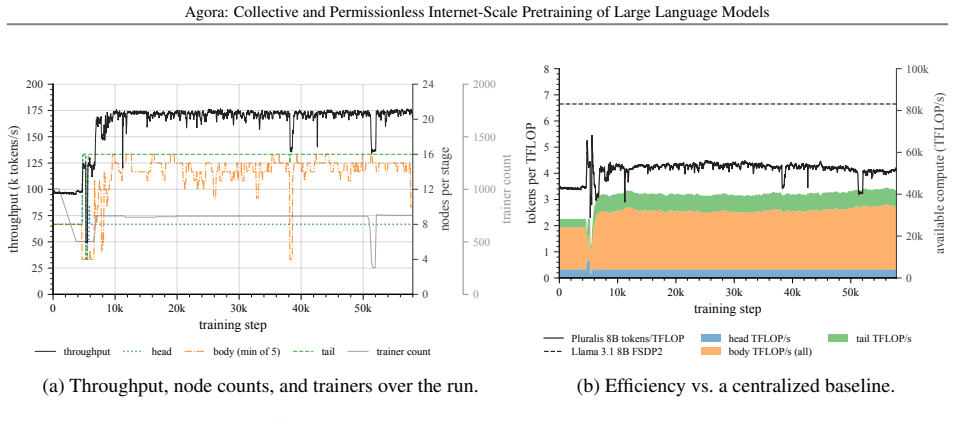
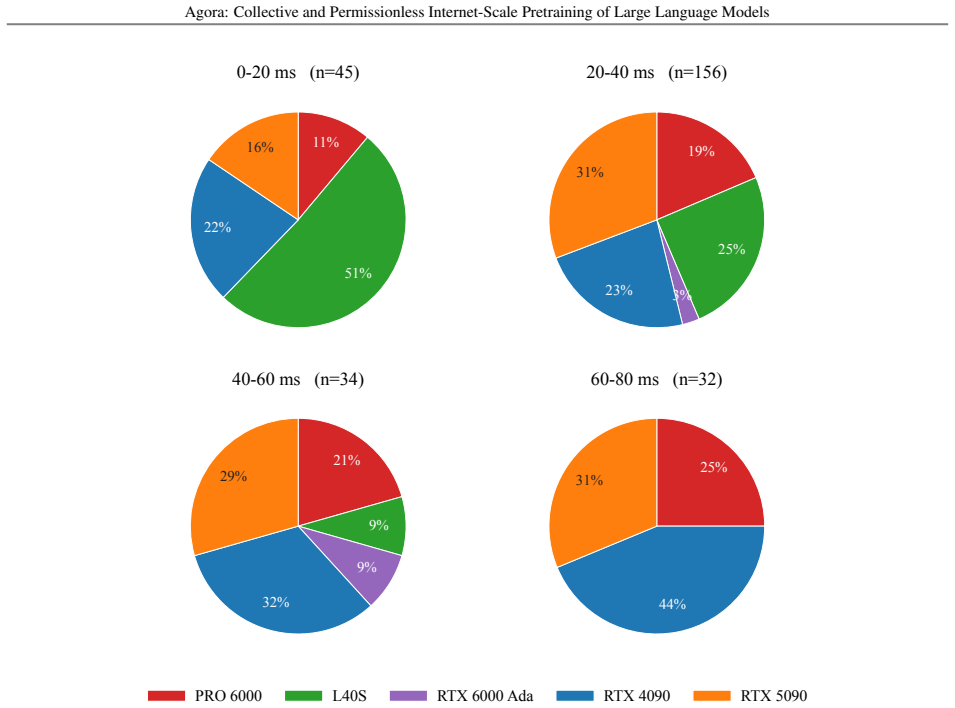
The paper reports the first full-scale demo of its protocol: an 8.6B-parameter decoder-only transformer with 32 layers sharded into seven pipeline stages, trained for 40 days on 500B tokens of an education-filtered web corpus. The compute pool mixed operator-run nodes with 330 external contributor nodes, predominantly consumer GPUs on internet links ranging from about 200 Mbit/s to several Gbit/s with up to 80 ms round-trip latency; 669 nodes joined and 607 departed during the run. The run sustained about 170k tokens/s, reached a steady-state 4.2 tokens per TFLOP of pooled compute (63% of a centralized H100 baseline), and converged to a final training loss of 2.41, close to a centralized ref
What carries the argument
The system rests on two communication-reduction mechanisms. First, reparameterized subspace networks: every layer's output projection and the trainable token embedding are factored through a fixed orthonormal basis, so all hidden states and gradients crossing a pipeline boundary live in a k-dimensional subspace (rank roughly 51 at hidden dimension 5120); a stage sends n×k coordinates per token instead of n×d, a roughly 100x cut in inter-stage traffic. Second, AsyncSPARTA: replicas of a stage take local optimizer steps and, every 20 steps, all-reduce a rotating 5% slice of their weights in the background rather than exchanging gradients before every step; a delta rule preserves each replica's
Load-bearing premise
The load-bearing premise is that confining every layer's output projection and the token embedding to a common low-dimensional subspace (rank ~51 at hidden dimension 5120) preserves model quality at scale; the paper validates this only against a reference run that also enforces the constraint and explicitly declines to claim a scaling law from two configurations.
What would settle it
Train the same 8.6B architecture on the same 500B tokens in a datacenter without the subspace constraint and compare final training loss with 2.41; if the unconstrained model is materially better, the compression premise fails. Alternatively, measure how the minimal usable subspace rank scales with hidden dimension: if rank grows proportionally to d instead of sublinearly (40 at d=2048 vs ~51 at d=5120), the 100x compression and the bandwidth-adequacy argument collapse at frontier scale.
If this is right
- Pretraining compute can be pooled from individually owned, geographically distributed, preemptible GPUs: the run held near-170k tokens/s through 669 joins and 607 departures, with about 60 contributors admitted at a time.
- The 63%-of-datacenter efficiency and near-centralized convergence indicate that the two communication cuts — subspace-compressed pipeline traffic and sparse asynchronous averaging — are enough to keep internet-grade links off the training critical path at the 8B scale.
- No node ever holds the full model: workers hold one pipeline stage and trainers hold none, so the trained model is collectively owned; the paper argues this opens an economically sustainable route to open frontier training.
- The paper's scaling analysis, which treats compression rate as fixed in the pessimistic case, indicates that bandwidth and latency constraints relax as hidden dimension and depth grow, so the protocol is claimed to become easier, not harder, to sustain at larger scale.
Where Pith is reading between the lines
- If the observed sublinear rank growth (rank 40 at d=2048, rank ~51 at d=5120) continues, the compression ratio improves with scale; if rank instead grows proportionally to width, the 100x compression and the admission-bandwidth floor would both need to be revisited.
- Because latency, not bandwidth or raw GPU FLOPs, governed contributor throughput in the reported measurements, a natural extension not tested here is geographic placement of trainers and reducers near contributors to shorten round trips.
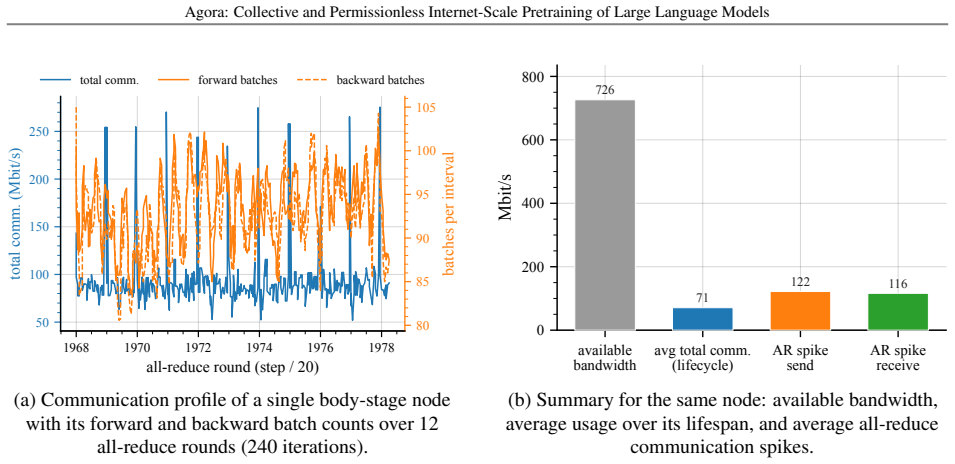
- The 200 Mbit/s / 80 ms admission floor means the practical 'permissionless' pool is limited to well-connected machines; reach would grow if the compression or averaging could tolerate slower residential links.
- The convergence comparison is against a reference that also uses subspace compression and sparse averaging, so the run demonstrates decentralized execution matching centralized execution of the same compressed architecture — not that the compressed architecture matches an uncompressed one.
Editorial analysis
A structured set of objections, weighed in public.
Referee Report
Summary. The paper presents Agora, a protocol and system for training large language models over a permissionless, heterogeneous, internet-connected pool of GPUs. It combines pipeline-parallel model sharding with reparameterized subspace networks (SSNs) to compress inter-stage activations/gradients, and asynchronous sparse weight averaging (AsyncSPARTA) to keep data-parallel replicas in consensus without per-step gradient all-reduce. The authors report a 40-day, 500B-token pretraining run of an 8.6B-parameter model, Pluralis-8B, on FineWeb-Edu, using ~330 contributor nodes with continuous churn, sustaining ~170k tokens/s and 4.2 tokens/TFLOP of pooled compute, which they state is 63% of a centralized H100 baseline, with training loss converging close to a centralized reference run. The paper also includes system design details, fault-tolerance mechanisms, a scaling analysis, and 1B-scale ablations on convergence robustness.
Significance. If the central claims hold, this is a significant systems contribution: it would be the first demonstration that a multi-billion-parameter LLM can be pretrained at scale over preemptible, individually owned, heterogeneous GPUs connected by the internet, with near-centralized convergence and modest efficiency loss. The engineering is substantial: fault-tolerant sparse all-reduce, admission control and sync phases, deterministic backward pinning, and a load-balanced pipeline over DHT-based peer discovery. The paper also makes code and a live dashboard available, which is a strength for reproducibility. However, the ML-level validation is currently incomplete: the subspace compression that underpins the system is validated only against other subspace-constrained runs, and the efficiency comparison is not model-matched. These gaps are load-bearing for the paper's headline claims and require either additional experiments or a careful restatement of the claims.
major comments (4)
- [§4.1, §5.5, Fig. 38] The claim that Pluralis-8B 'converged to within a small margin of a centralized reference' is not validated against a dense, unconstrained transformer. Equation (3) reparameterizes every output projection and the token embedding as W = Z U_k^T, confining the residual stream to a rank-k subspace (k≈51 at d=5120). All ablations and the central reference in Section 5.5 use the same subspace constraint, so they cannot reveal quality loss caused by the constraint itself. Because this premise is what makes the ~100× inter-stage compression and the entire pipeline-parallel design viable, a comparison to a dense baseline—or at least a small-scale dense run under Agora—is needed to separate architecture-induced degradation from system-induced degradation. Without it, the 'small margin' claim is incomplete.
- [§5.4, Table 4, §5.1] The 63% efficiency comparison is not model-matched. The centralized baseline is a dense Llama 3.1 8B trained with FSDP2 on H100s, whereas Pluralis-8B's reparameterized SSN has fewer trainable parameters (~8.6B vs ~12B dense-equivalent) and performs fewer FLOPs per token because output projections are low-rank. A higher tokens/TFLOP is therefore expected even at identical system efficiency, so the 63% figure conflates architectural FLOP reduction with system efficiency. Additionally, §5.1 reports 'measured 30.8 ZettaFLOPs (3.08×10^22)' for 500B tokens over 40 days, which implies ~16.2 tokens/TFLOP of actual compute, while Table 4 reports 4.31 tokens/TFLOP using C_pool = 39,749 TFLOP/s spec-sheet capacity. These two metrics should be reconciled; as written, the abstract's efficiency claim is ambiguous.
- [§4.2, Eq. (8), §4.2.2] AsyncSPARTA's convergence relies on the delay-corrected sparse averaging scheme, but the convergence guarantee is only cited to 'Maziane et al. (2026)' with no statement of assumptions or proof sketch. Given that the run's convergence under asynchronous averaging with partial all-reduce participation is a central empirical claim, the paper should at least state the conditions under which the guarantee holds (e.g., smoothness, bounded delay, averaging cadence) or provide a proof in an appendix. As it stands, the convergence argument is an appeal to a same-group reference that is not publicly identifiable.
- [§3.4.5, §4.1] The scaling analysis concludes that communication constraints relax as models grow, but this relies on the assumption that the required subspace rank grows more slowly than width. The paper explicitly says 'We do not claim a scaling law from two configurations' and reports only rank 40 at d=2048 and rank ≈51 at d=5120. With two points, the trend is not established. Since the introduction and conclusion frame Agora as a path to frontier-scale training, this extrapolation should be either supported with more data or clearly labeled as a conjecture rather than a demonstrated property.
minor comments (6)
- [§4.1, Eq. (2)–(3)] The notation for the basis U_k is inconsistent: Eq. (2) sends (X - PE - T_fixed) U_k and reconstructs with U_k^T, while Eq. (3) writes W = Z U_k^T. Clarify whether columns of U_k are the orthonormal basis and ensure the row/column convention is used consistently throughout.
- [§5.5] The centralized reference run is only 27k iterations, while Pluralis-8B runs for 60k steps. The paper should justify why a shorter reference is sufficient to support the 'small margin' convergence claim, especially since training dynamics change over the full schedule.
- [§3.4.5, §6] The scaling analysis says 'the rank we can use appears to grow more slowly than the width,' but the rank is described as a hyperparameter. Is U_k fixed and unlearned, or is it trained/updated? If fixed and arbitrary, this is a strong architectural assumption that should be stated explicitly and tested.
- [Abstract, §1] The term 'Unextractable Protocol Models (UPMs)' is introduced in the abstract/introduction but never defined or used in the system description or experiments. Either define the concept and its role, or remove it from the paper.
- [Throughout] Several core methods are cited to unpublished or same-group references without arXiv IDs or version information (Ramasinghe et al. 2025; Beton et al. 2025; Ajanthan et al. 2026; Long et al. 2025; Maziane et al. 2026). Full citations should be added so readers can verify the methods.
- [§2.2, §3.2] Typo: 'SW ARM parallelism' should be 'SWARM parallelism' (Section 3.2). Also check formatting of author names (e.g., 'V olz and Brazil, 2018').
Circularity Check
Load-bearing subspace premise is imported from same-group prior work and validated only against subspace-constrained references; the run-level empirical claims are not themselves circular.
specific steps
-
self citation load bearing
[Section 4.1, Eqs. (1)–(3); validation in Section 6.1 (Fig. 38) and Section 5.5]
"Subspace networks (SSNs) (Ramasinghe et al., 2025) reduce this cost by constraining the inter-stage signal to a single low-rank subspace shared across all stages... The reference is a TorchTitan run modified to use the same subspace-network reparameterization (Section 4.1) and SPARTA averaging (Section 4.2) as Pluralis-8B... The reference thus carries the same compression-induced effects on the loss, so any difference between the curves reflects the decentralized execution itself."
The 100x communication compression that makes internet-scale pipeline parallelism viable assumes all output projections and the token embedding can be confined to a shared rank-k≈51 subspace without an adverse quality effect. That premise is imported from the authors' own Ramasinghe et al. (2025), and the paper's only validation compares subspace-constrained variants: Fig. 38 compares reparameterized vs original SSN, and the Sec. 5.5 central reference uses the same subspace reparameterization. No dense, unconstrained baseline is compared, so the claim that the architecture change does not adversely affect convergence cannot be falsified by these experiments; the system-level convergence/efficiency claims inherit the untested premise from a same-group citation rather than from an independen
full rationale
The headline run-level claims—~170k tokens/s, 4.2 tokens/TFLOP, 63% of a centralized H100 baseline, and loss 2.41—are empirical measurements, not fitted predictions, and the efficiency definition η = TPS/C_pool is a convention rather than a self-fulfilling identity. The 100x communication compression is the algebraic identity W = Z U_k^T; under the stated subspace constraint the encode/decode in Eq. (2) is lossless by construction, which is a theorem rather than circularity. The convergence comparison in Sec. 5.5 deliberately uses a central reference modified to use the same subspace and SPARTA recipe, so it correctly isolates the effect of decentralized execution; the residual claim is measured, not constructed. The paper also includes honest caveats: 'We do not claim a scaling law from two configurations' and 'the rank is a hyperparameter' (Sec. 3.4.5). What prevents a clean 0–2 score is the load-bearing self-citation cluster: the untested premise that rank-k subspace confinement is behavior-preserving at 8B scale comes from Ramasinghe et al. (2025), whose authors overlap with the present paper, and the only convergence evidence for it compares subspace-constrained variants (Fig. 38 and the Sec. 5.5 reference). No dense baseline is reported, so the architecture's quality cost is neither measured nor falsified. AsyncSPARTA's convergence guarantee is likewise delegated to prior/work by Ajanthan et al. (2026) and Maziane et al. (2026), though in-paper 1B ablations provide some empirical support. This is a missing-control and self-citation verifiability gap in the derivation chain, not a definitional equivalence of two equations, hence score 4 rather than 6+.
Axiom & Free-Parameter Ledger
free parameters (5)
- Subspace rank k =
40 (1B ablations), ~51 (Pluralis-8B)
- SPARTA sparse share p and cadence N =
p = 5%, N = 20 steps
- Per-stage gradient clip thresholds =
1/√7 ≈ 0.3779 (head/body), 0.7558 (tail)
- Admission bandwidth/latency floor =
200 Mbit/s, 80 ms RTT, 24 GB VRAM, 80 GB RAM
- Sync-phase durations =
weight sync 400 steps, optimizer sync 100 steps
axioms (4)
- domain assumption Transformer residual streams can be confined, without material quality loss, to a shared k-dimensional subspace; every output projection and the token embedding factor through it (Eqs. 1-3).
- domain assumption AsyncSPARTA with the delay-corrected delta rule converges for smooth non-convex objectives under communication-computation overlap (Eqs. 6, 8).
- domain assumption Kademlia DHT coordination remains stable enough that all-reduce matchmaking groups form within timeouts at ~60-contributor scale.
- domain assumption A centralized run of the same SSN+SPARTA recipe adequately represents 'centralized training' for the convergence comparison.
invented entities (1)
-
Unextractable Protocol Models (UPMs)
no independent evidence
read the original abstract
Training large language models at the multi-billion to trillion parameter scale is confined to datacenters, where data-parallel (DP) and model-parallel (MP) techniques presume homogeneous accelerators, high-speed interconnects, and a single orchestrating entity. Frontier model development is thereby concentrated among the few groups able to assemble such clusters. Meanwhile, an enormous pool of compute remains unusable for training: consumer and professional GPUs that are heterogeneous, preemptible, individually owned, and connected only by the internet. We present Agora, a system that makes efficient use of this compute. Agora combines bandwidth-efficient pipeline-parallel model sharding over internet-grade links with multi-party, fault-tolerant collective operations. Each participant holds only one stage of the model, and no single party ever possesses the full weights. We term this setup Protocol Learning: it enables collectively trained, collectively owned models, opening a path to open-source frontier training with economic sustainability. This report presents the outcome of a research effort spanning communication-efficient parallelism, asynchronous optimization, and fault-tolerant systems design. It culminates in the first demonstration of its kind: Pluralis-8B, an open, permissionless pretraining run of an 8.6B-parameter model on 500B tokens of FineWeb-Edu. The model was trained over 40 days by 330 contributor nodes, predominantly consumer GPUs on internet connections, joining and leaving throughout. The run sustained ~170k tokens/s and 4.2 tokens per TFLOP of pooled compute, 63% of the efficiency of a centralized H100 baseline, and converged to within a small margin of a centralized reference run.
Figures










Reference graph
Works this paper leans on
-
[1]
Max Ryabinin and Tim Dettmers and Michael Diskin and Alexander Borzunov , title =
-
[2]
Subspace Networks: Scaling Decentralized Training with Communication-Efficient Model Parallelism , author=
-
[3]
Vogels, Thijs and Karimireddy, Sai Praneeth and Jaggi, Martin , booktitle = NeurIPS, year =
-
[4]
and Jaggi, Martin , booktitle = ICML, year =
Karimireddy, Sai Praneeth and Rebjock, Quentin and Stich, Sebastian U. and Jaggi, Martin , booktitle = ICML, year =. Error Feedback Fixes
-
[5]
Proceedings of 15th Annual Conference of the International Speech Communication Association (
Frank Seide and Hao Fu and Jasha Droppo and Gang Li and Dong Yu , title =. Proceedings of 15th Annual Conference of the International Speech Communication Association (
-
[6]
Modular, Collaborative and Decentralized Deep Learning (MCDC) Workshop at ICLR , year =
Improving the Efficiency of Distributed Training using Sparse Parameter Averaging , author =. Modular, Collaborative and Decentralized Deep Learning (MCDC) Workshop at ICLR , year =
-
[7]
and Shevchenko, Violetta and Zuo, Yan and Long, Alexander , journal =
Ajanthan, Thalaiyasingam and Ramasinghe, Sameera and Avraham, Gil and Mohaghegh Dolatabadi, Hadi and Hewa Koneputugodage, Chamin P. and Shevchenko, Violetta and Zuo, Yan and Long, Alexander , journal =
-
[8]
2025 , url=
Node0: Model Parallel Training over the Internet with Protocol Models , author=. 2025 , url=
2025
-
[9]
O'Reilly Media , year =
Julius Volz and Brian Brazil , title =. O'Reilly Media , year =
-
[10]
Guilherme Penedo and Hynek Kydl. The
-
[11]
Common Crawl Corpus (CC-MAIN-2025-13) , year=
2025
-
[12]
Wanchao Liang and Tianyu Liu and Less Wright and Will Constable and Andrew Gu and Chien-Chin Huang and Iris Zhang and Wei Feng and Howard Huang and Junjie Wang and Sanket Purandare and Gokul Nadathur and Stratos Idreos , title =
-
[13]
Grattafiori, Aaron and Dubey, Abhimanyu and Jauhri, Abhinav and Pandey, Abhinav and Kadian, Abhishek and Al-Dahle, Ahmad and Letman, Aiesha and Mathur, Akhil and Schelten, Alan and Vaughan, Alex and others , journal=. The
-
[14]
Liu, Aixin and Feng, Bei and Xue, Bing and Wang, Bingxuan and Wu, Bochao and Lu, Chengda and Zhao, Chenggang and Deng, Chengqi and Zhang, Chenyu and Ruan, Chong and others , journal=
-
[15]
Shoeybi, Mohammad and Patwary, Mostofa and Puri, Raul and LeGresley, Patrick and Casper, Jared and Catanzaro, Bryan , journal=
-
[16]
Hammond and Torsten Hoefler , title =
Zhiyi Hu and Siyuan Shen and Tommaso Bonato and Sylvain Jeaugey and Cedell Alexander and Eric Spada and James Dinan and Jeff R. Hammond and Torsten Hoefler , title =. Proceedings of the
-
[17]
Le and Yonghui Wu and Zhifeng Chen , title =
Yanping Huang and Youlong Cheng and Ankur Bapna and Orhan Firat and Dehao Chen and Mia Xu Chen and HyoukJoong Lee and Jiquan Ngiam and Quoc V. Le and Yonghui Wu and Zhifeng Chen , title =
-
[18]
Devanur and Gregory R
Deepak Narayanan and Aaron Harlap and Amar Phanishayee and Vivek Seshadri and Nikhil R. Devanur and Gregory R. Ganger and Phillip B. Gibbons and Matei Zaharia , title =. Proceedings of the
-
[19]
Proceedings of the
Shen Li and Yanli Zhao and Rohan Varma and Omkar Salpekar and Pieter Noordhuis and Teng Li and Adam Paszke and Jeff Smith and Brian Vaughan and Pritam Damania and Soumith Chintala , title =. Proceedings of the
-
[20]
Proceedings of the International Conference for High Performance Computing, Networking, Storage and Analysis (
Samyam Rajbhandari and Jeff Rasley and Olatunji Ruwase and Yuxiong He , title =. Proceedings of the International Conference for High Performance Computing, Networking, Storage and Analysis (
-
[21]
arXiv preprint arXiv:2304.11277 , year=
Pytorch fsdp: experiences on scaling fully sharded data parallel , author=. arXiv preprint arXiv:2304.11277 , year=
-
[22]
Unextractable Protocol Models: Collaborative Training and Inference without Weight Materialization , author =
-
[23]
Dirk Groeneveld and Iz Beltagy and Evan Pete Walsh and Akshita Bhagia and Rodney Kinney and Oyvind Tafjord and Ananya Harsh Jha and Hamish Ivison and Ian Magnusson and Yizhong Wang and Shane Arora and David Atkinson and Russell Authur and Khyathi Raghavi Chandu and Arman Cohan and Jennifer Dumas and Yanai Elazar and Yuling Gu and Jack Hessel and Tushar Kh...
-
[24]
Team OLMo and Pete Walsh and Luca Soldaini and Dirk Groeneveld and Kyle Lo and Shane Arora and Akshita Bhagia and Yuling Gu and Shengyi Huang and Matt Jordan and Nathan Lambert and Dustin Schwenk and Oyvind Tafjord and Taira Anderson and David Atkinson and Faeze Brahman and Christopher Clark and Pradeep Dasigi and Nouha Dziri and Michal Guerquin and Hamis...
-
[25]
arXiv preprint arXiv:2605.20866 , year =
Yassine Maziane and Ammar Mahran and Artavazd Maranjyan and Peter Richt. arXiv preprint arXiv:2605.20866 , year =
This paper was first reviewed by deepseek-v4-flash on August 2, 2026.
discussion (0)
Sign in with ORCID, Apple, or X to comment. Anyone can read and Pith papers without signing in.