REVIEW 4 major objections 5 minor 1 cited by
On-policy distillation works as an exploration catalyst, not a capability expander, and its success is governed by signal fidelity rather than teacher scale.
Reviewed by Pith at T0; open to challenge. T0 means a machine referee read the full paper against a public rubric. the ladder, T0–T4 →
T0 review · deepseek-v4-flash
2026-08-02 05:17 UTC pith:IP34FEZ2
load-bearing objection Useful empirical study of OPD's failure modes, but the formal mechanism for length exploitation assumes a sequence-averaged objective that the paper's own loss does not specify — as written, the derivation doesn't hold. the 4 major comments →
Demystifying On-Policy Distillation: Roles, Pathologies, and Regulations
The pith
A machine-rendered reading of the paper's core claim, the machinery that carries it, and where it could break.
Core claim
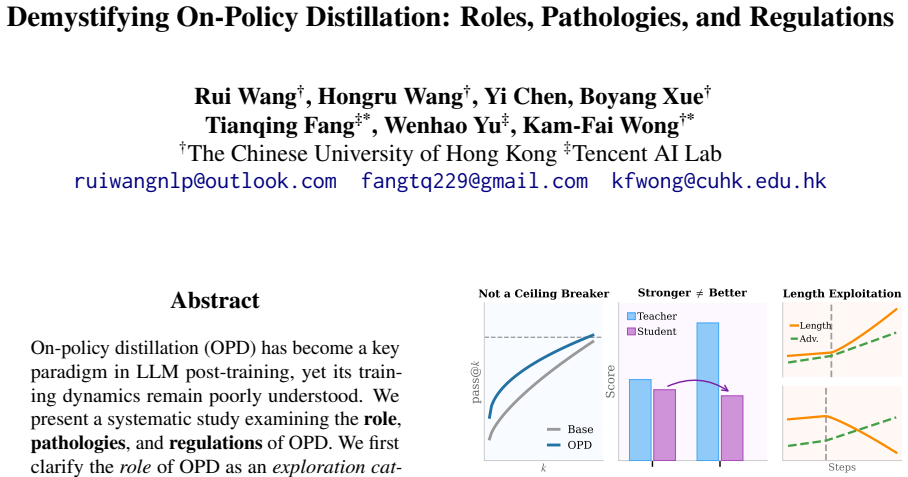
The paper claims that on-policy distillation does not inject new capabilities into the student; it re-weights the student's existing generative distribution so that correct reasoning paths are found faster in early sampling. Evidence: pass@k curves converge to the base model at high k, and prompt diversity beats per-prompt sampling depth under fixed compute. Because OPD is pure guidance, its effectiveness depends entirely on whether the per-token advantage ∆ℓ_t = log(π_T/π_θ) correlates with rollout correctness. Negative correlation (student-teacher mismatch) steers exploration wrong; length-dependence of the sequence-averaged advantage lets the student pad or truncate (length exploitation).
What carries the argument
The central object is the per-token distillation advantage ∆ℓ_t = log π_T(y_t|y_<t,x) − log π_θ(y_t|y_<t,x), evaluated on the student's own rollouts; it is the token-level reward that drives OPD. The key diagnostic is its sequence average ā = (1/T)Σ_t ∆ℓ_t, whose dependence on length T creates the two exploitation modes: padding increases T to dilute a negative total advantage, and truncation captures a favorable prefix before risky tokens. The regulatory mechanisms are hard clipping (clip(∆ℓ_t, cmin, cmax)) and soft log-scale compression (sign(∆ℓ_t)·log(1+|∆ℓ_t|)), which preserve the teacher's ordinal preference while suppressing outlier magnitudes.
Load-bearing premise
The load-bearing premise is that OPD optimizes the sequence-averaged token advantage ā = (1/T)Σ∆ℓ_t; if the objective instead sums per-token advantages, the padding-dilution and truncation incentives do not directly follow, and the identified pathologies could have a different cause.
What would settle it
Train the same student-teacher pair under OPD with a summed (not averaged) per-token advantage, holding all else fixed; if the student still drifts to endless padding or premature truncation, length exploitation is not caused by the averaging. Equivalently, compute ∂ā/∂T under the actual objective: if it cannot be made positive by padding or truncation, the proposed mechanism fails.
If this is right
- OPD should be treated as reward shaping, not knowledge transfer: scaling up the teacher will not help if its per-token signal is misaligned with the student's rollout distribution.
- Under a fixed compute budget, maximize prompt diversity (one rollout per prompt) rather than sampling depth per problem; the paper finds n=1 consistently beats n=8.
- The length-exploitation failure modes are objective-level, so any OPD implementation with sequence-averaged token advantages is vulnerable; regulating advantages in the loop is a zero-overhead defense.
- A well-matched, moderately sized teacher plus signal regulation can outperform a much larger teacher, so teacher selection should be guided by informativeness on student rollouts, not by benchmark score.
- Hard clipping is preferable to log-scale compression when the teacher-student gap is large; log-scale compression is better when the gap is small.
Where Pith is reading between the lines
- If OPD is purely an exploration catalyst, its natural partner is outcome-based RL: OPD accelerates the search, outcome rewards set the ceiling. Whether the two can be combined without the pathologies resurfacing is a testable next step the paper leaves open.
- The length-exploitation analysis assumes the objective averages per-token advantages; an implementation that sums them would weaken the padding-dilution incentive, so a controlled average-vs-sum comparison would isolate the mechanism.
- The informativeness metric I could be used as a cheap, pre-training screen for teacher selection, though it requires rollout accuracy labels, which may limit it to verifiable domains like math.
- The same regulations could transfer to other dense-reward settings (e.g., process reward models) where token-level signals are aggregated over variable-length sequences and similar length shortcuts may appear.
Editorial analysis
A structured set of objections, weighed in public.
Referee Report
Summary. The paper studies on-policy distillation (OPD) for LLM post-training. It argues that OPD acts as an exploration catalyst: it accelerates learning through dense token-level guidance but does not expand the student's capability ceiling. The authors support this with pass@k convergence experiments, a prompt-diversity-vs-rollout-depth comparison, and an analysis of teacher-student capability gaps. They identify two pathologies—Student-Teacher Mismatch and Length Exploitation—and propose two lightweight signal regulations: hard advantage clipping and soft log-scale compression. Experiments on seven math reasoning benchmarks show these regulations stabilize training and enable a 4B teacher to outperform prior methods that rely on a 30B teacher. The paper concludes that signal quality, not teacher scale, governs OPD success.
Significance. If the claims hold, the paper offers a useful reframing of OPD as exploration guidance rather than capability expansion, with practical implications for compute allocation and teacher selection. The proposed log-scale compression is a simple, parameter-free modification that appears to improve stability and accuracy, and the result that a regulated 4B teacher can beat methods using a 30B teacher is practically significant. The paper is clearly structured and the experimental configuration is reported with reasonable detail. However, the central claims currently rest on qualitative or incomplete quantitative evidence, and the formal derivation of Length Exploitation is not fully grounded in the stated objective. The work is potentially valuable but needs strengthening in these areas.
major comments (4)
- [§4.2, Eq. (3) and Eq. (5)] Length Exploitation is derived from the sequence-averaged advantage a_bar = (1/T)Σ a_t, stated in Eq. (5), but the policy-gradient objective in Eq. (3) is per-token and does not specify whether token advantages are summed or averaged over a sequence. The KL objective in Eq. (1) is an expectation of a sum of per-token log-ratios, not their mean. If the implementation sums advantages over tokens (or performs a batch-level mean), the padding-dilution mechanism in Eq. (5) does not follow: appending filler tokens would not asymptotically drive the gradient to zero. Similarly, the truncation inequality in Eq. (6) compares per-token means, which is not implied by a sum objective. The paper should either state explicitly that the implementation uses sequence-level averaging (and justify why this is the standard OPD objective), or re-derive the pathologies under the actual loss normalization. As
- [§3, Figure 3] The central claim that OPD accelerates exploration but does not raise the capability ceiling is supported by a single qualitative figure (Figure 3) with no benchmark specified and no numerical pass@k values. The text mentions testing pass@1024, but the figure caption and surrounding description do not say which dataset(s) were used, nor do they report the asymptotic accuracies of the base and trained models. Without quantitative evidence that the high-k performance of OPD-trained models converges to that of the base model, the 'exploration catalyst, not ceiling breaker' conclusion is not empirically verified. Please provide the benchmark names, the concrete pass@k values at large k, and ideally confidence intervals.
- [Tables 1 and 2; Figures 4, 5, 9] No error bars, standard deviations, or multiple-seed results are reported for the main experimental tables and figures. The paper repeatedly uses terms such as 'stably surpassing' and 'consistently', but with single runs it is impossible to assess stability. The avg@32 metric is averaged over 10 trials, but that only reduces evaluation noise, not training variance. Please report results over at least three seeds (or otherwise justify that training is deterministic enough) and provide mean±std for the key comparisons against baselines.
- [§5.1, Eq. (7); Limitations] The hard clipping regulation introduces two hyperparameters, cmin and cmax, whose values are never disclosed. The paper acknowledges in the Limitations that these require empirical tuning per teacher–student pair. This is a significant reproducibility concern: the claimed superiority of +Clip for the 4B-GRPO teacher may depend on carefully selected bounds. Please report the exact cmin and cmax used for each experiment, and ideally a sensitivity analysis over these bounds. The log-scale compression in Eq. (8) is parameter-free and should be highlighted as the more robust regulation if that is the intended message.
minor comments (5)
- [§4.1, Eq. (4)] The Informativeness metric I is defined post hoc using the teacher's log-ratio on correct versus incorrect rollouts. This is a reasonable diagnostic, but the paper should be careful not to overstate its predictive power: I is essentially a correlation measure and may not be causal. Consider discussing this limitation explicitly.
- [§3, Figure 5] The prompt-diversity experiment compares n=1, n=2, and n=8 under 'identical total compute', but the exact batch size and total number of prompts for each configuration are not stated in the main text. Please clarify how the budget is held fixed, e.g., whether the number of training steps is adjusted.
- [Appendix A] The training configuration mentions a 'block' prefix for non-thinking mode, but the actual token or template is not described. Please specify what this block is so that readers can reproduce the setup.
- [Throughout] Several equations use variables without explicit definitions: in Eq. (3), r_t is defined but ϵ is not; in Eq. (4), the expectation is over rollouts but the conditioning on y and r is implicit; in Eq. (5), a_filler is not formally defined. Please pass a notation table or clarify in text.
- [References] A few references appear to be in a non-standard format (e.g., 'and 1 others', 'and 41 others' in the reference list). These should be completed or condensed consistently with the journal style.
Circularity Check
Length Exploitation is derived from an assumed per-sequence-mean objective rather than from the paper's stated loss; the length shortcut is built into the normalization.
specific steps
-
other
[Section 4.2, Eq. (5) (also Eq. (6))]
"Crucially, because standard OPD objectives optimize the sequence-averaged advantage ¯a= 1 T PT t=1 at, the student discovers a degenerate shortcut to evade this penalty: appending low-information filler tokens to inflate the denominator T . Formally, suppose the core reasoning block terminates at step T0 with a cumulative negative signal Acore = PT0 t=1 at <0 . By continually generating redundant tokens up to a prolonged length T (T≫T 0), the aggregated advantage decomposes as: ¯a= Acore T + T−T 0 T ¯afiller. (5)"
The mechanism is not derived from the OPD loss the paper defines. Eq. (1) is an expectation of the sum of per-token log-ratios, and Eq. (3) is a PPO loss over tokens, with no per-sequence division by T. The paper instead asserts that 'standard OPD objectives optimize the sequence-averaged advantage'; once that per-sequence mean is assumed, the padding-dilution (Mode A) and prefix-truncation (Mode B, Eq. (6)) incentives follow algebraically. Thus the length-exploitation 'pathology' is contained in the assumed normalization, i.e., it is an artifact of the chosen definition rather than a consequence of the stated objective. The finding reduces to the premise.
full rationale
Most of the paper is a self-contained empirical study: the exploration-catalyst role is supported by pass@k convergence and prompt-diversity experiments against external baselines, and the regulation comparisons are reported against independent methods and teachers. The Informativeness metric is a post-hoc diagnostic rather than a fitted parameter, so I do not count it as circular. The one load-bearing circular/definitional step is the formal derivation of Length Exploitation, which assumes the very per-sequence length normalization that produces the length shortcut. Because one of the two central pathologies is thereby reduced to an unstated premise, the overall circularity score is 6 rather than 0-2. The cmin/cmax tuning limitation is a correctness/reproducibility concern, not circularity.
Axiom & Free-Parameter Ledger
free parameters (2)
- cmin (lower clipping bound) =
not disclosed
- cmax (upper clipping bound) =
not disclosed
axioms (4)
- ad hoc to paper The training objective optimizes the sequence-averaged token advantage ā = (1/T) Σ a_t.
- domain assumption The teacher is fixed and the student samples its own rollouts (on-policy).
- standard math Reverse KL is the correct objective for distillation.
- domain assumption The capability ceiling can be measured by pass@k convergence at high k (e.g., k=1024).
invented entities (1)
-
Informativeness metric I
no independent evidence
read the original abstract
On-policy distillation (OPD) has become a key paradigm in LLM post-training, yet its training dynamics remain poorly understood. We present a systematic study examining the role, pathologies, and regulations of OPD. We first clarify the role of OPD as an exploration catalyst: it steers the student toward correct reasoning paths via dense token-level guidance, without expanding capability ceiling. We confirm this by showing that prompt diversity matters more than per-problem sampling numbers, and critically, that the effectiveness of OPD hinges entirely on the quality of its guiding signal. This dependency exposes two pathologies that derail exploration. The Student-Teacher Mismatch occurs when a large teacher-student distributional gap causes the guiding signal to misalign with task correctness, steering exploration in counterproductive directions. Length Exploitation arises when the aggregated token-level objective creates length-dependent shortcuts, allowing the student to game the reward landscape through response truncation or redundant padding, exploring degenerate length modes rather than reasoning strategies. To tame these pathologies, we investigate lightweight signal regulations: advantage clipping and log-scale compression, ensuring exploration is guided by faithful signals. Experiments across seven benchmarks demonstrate that these regulations alleviate length exploitation and enable effective distillation, stably surpassing OPD variants and RLVR baselines, thereby confirming that well-regulated signal quality, rather than mere teacher scale, governs successful exploration in OPD.
Figures


Forward citations
Cited by 1 Pith paper
-
Outcome-Confounded Local Supervision in On-Policy Distillation
In on-policy distillation, low teacher–student divergence on failed math trajectories dominates token mass, and local divergence plus a trajectory outcome cannot localize where failure became unrecoverable.
Reference graph
Works this paper leans on
-
[2]
Minillm: On-policy distillation of large language models.Preprint, arXiv:2306.08543. Dan Hendrycks, Collin Burns, Saurav Kadavath, Akul Arora, Steven Basart, Eric Tang, Dawn Song, and Jacob Steinhardt
-
[4]
Tao Huang, Shan You, Fei Wang, Chen Qian, and Chang Xu
Uni-opd: Unifying on-policy distilla- tion with a dual-perspective recipe.arXiv preprint arXiv:2605.03677. Tao Huang, Shan You, Fei Wang, Chen Qian, and Chang Xu
-
[6]
Entropy-aware on-policy distillation of language models.Preprint, arXiv:2603.07079. Aitor Lewkowycz, Anders Andreassen, David Dohan, Ethan Dyer, Henryk Michalewski, Vinay Ramasesh, Ambrose Slone, Cem Anil, Imanol Schlag, Theo Gutman-Solo, and 1 others
-
[7]
Solving quan- titative reasoning problems with language models. NeurIPS. Yaxuan Li, Yuxin Zuo, Bingxiang He, Jinqian Zhang, Chaojun Xiao, Cheng Qian, Tianyu Yu, Huan ang Gao, Wenkai Yang, Zhiyuan Liu, and Ning Ding. 2026a. Rethinking on-policy distillation of large language models: Phenomenology, mechanism, and recipe.Preprint, arXiv:2604.13016. Yuetai Li...
-
[9]
Demystifying opd: Length in- flation and stabilization strategies for large language models.Preprint, arXiv:2604.08527. MAA. 2026a. American invitational mathematics examination (AIME). https://www.maa.org/ math-competitions. MAA. 2026b. American mathematics com- petitions (AMC). https://www.maa.org/ math-competitions. Seyed-Iman Mirzadeh, Mehrdad Farajta...
-
[13]
Nemotron- cascade: Scaling cascaded reinforcement learning for general-purpose reasoning models.Preprint, arXiv:2512.13607. An Yang, Anfeng Li, Baosong Yang, Beichen Zhang, Binyuan Hui, Bo Zheng, Bowen Yu, Chang Gao, Chengen Huang, Chenxu Lv, Chujie Zheng, Day- iheng Liu, Fan Zhou, Fei Huang, Feng Hu, Hao Ge, Haoran Wei, Huan Lin, Jialong Tang, and 41 others
-
[14]
Wenkai Yang, Weijie Liu, Ruobing Xie, Kai Yang, Saiy- ong Yang, and Yankai Lin
Qwen3 technical report.Preprint, arXiv:2505.09388. Wenkai Yang, Weijie Liu, Ruobing Xie, Kai Yang, Saiy- ong Yang, and Yankai Lin. 2026a. Learning beyond teacher: Generalized on-policy distillation with re- ward extrapolation.Preprint, arXiv:2602.12125. Zhuolin Yang, Zihan Liu, Yang Chen, Wenliang Dai, Boxin Wang, Sheng-Chieh Lin, Chankyu Lee, Yangyi Chen...
-
[15]
Dapo: An open-source llm re- inforcement learning system at scale.Preprint, arXiv:2503.14476. Xinlei Yu, Gen Li, Qingyi Si, Guibin Zhang, Yuqi Xu, Congcong Wang, Shuai Dong, Kaiwen Tuo, Xi- angyu Zeng, Kaituo Feng, Qunzhong Wang, Yang Shi, Xiaobin Hu, Xiangyu Yue, Jiaqi Wang, and Shuicheng Yan
-
[16]
Yang Yue, Zhiqi Chen, Rui Lu, Andrew Zhao, Zhaokai Wang, Yang Yue, Shiji Song, and Gao Huang
Dopd: Dual on-policy dis- tillation.Preprint, arXiv:2606.30626. Yang Yue, Zhiqi Chen, Rui Lu, Andrew Zhao, Zhaokai Wang, Yang Yue, Shiji Song, and Gao Huang
-
[17]
Siqi Zhu, Xuyan Ye, Hongyu Lu, Weiye Shi, and Ge Liu
Does reinforcement learning really incentivize rea- soning capacity in llms beyond the base model? Preprint, arXiv:2504.13837. Siqi Zhu, Xuyan Ye, Hongyu Lu, Weiye Shi, and Ge Liu
-
[18]
A Experiment Configurations We implement the training pipeline using verl
The many faces of on-policy dis- tillation: Pitfalls, mechanisms, and fixes.Preprint, arXiv:2605.11182. A Experiment Configurations We implement the training pipeline using verl. For the OPD pipeline, policy optimization uses a total batch size of 128, 1 rollout for each prompt. For the GRPO baselines, the group advantage is calculated across a size of 12...
-
[2015]
Distilling the knowledge in a neural network. Preprint, arXiv:1503.02531. Wenjin Hou, Shangpin Peng, Weinong Wang, Zheng Ruan, Yue Zhang, Zhenglin Zhou, Mingqi Gao, Yifei Chen, Kaiqi Wang, Hongming Yang, and 1 oth- ers
-
[2017]
Prox- imal policy optimization algorithms.Preprint, arXiv:1707.06347. Zhihong Shao, Peiyi Wang, Qihao Zhu, Runxin Xu, Junxiao Song, Xiao Bi, Haowei Zhang, Mingchuan Zhang, Y . K. Li, Y . Wu, and Daya Guo
-
[2019]
John Schulman, Filip Wolski, Prafulla Dhariwal, Alec Radford, and Oleg Klimov
Improved knowl- edge distillation via teacher assistant.Preprint, arXiv:1902.03393. John Schulman, Filip Wolski, Prafulla Dhariwal, Alec Radford, and Oleg Klimov
Pith/arXiv arXiv 1902
-
[2022]
Knowledge distillation from a stronger teacher.Preprint, arXiv:2205.10536. Woogyeol Jin, Taywon Min, Yongjin Yang, Swanand Ravindra Kadhe, Yi Zhou, Dennis Wei, Nathalie Baracaldo, and Kimin Lee
-
[2024]
Deepseekmath: Pushing the limits of mathemati- cal reasoning in open language models.Preprint, arXiv:2402.03300. Boxin Wang, Chankyu Lee, Nayeon Lee, Sheng- Chieh Lin, Wenliang Dai, Yang Chen, Yangyi Chen, Zhuolin Yang, Zihan Liu, Mohammad Shoeybi, Bryan Catanzaro, and Wei Ping
-
[2025]
Small models struggle to learn from strong reasoners. InFind- ings of the Association for Computational Linguis- tics: ACL 2025, pages 25366–25394, Vienna, Austria. Association for Computational Linguistics. Zhaoyi Li, Xiangyu Xi, Zhengyu Chen, Wei Wang, Gangwei Jiang, Ranran Shen, Linqi Song, Ying Wei, and Defu Lian. 2026b. On the role of reasoning patte...
Pith/arXiv arXiv 2025
-
[2026]
Yuxian Gu, Li Dong, Furu Wei, and Minlie Huang
Glm-5: from vibe coding to agentic engineering.Preprint, arXiv:2602.15763. Yuxian Gu, Li Dong, Furu Wei, and Minlie Huang
discussion (0)
Sign in with ORCID, Apple, or X to comment. Anyone can read and Pith papers without signing in.