REVIEW 3 major objections 5 minor 42 references
Magnetic Weyl semimetals act as emergent inductors, with a magnetoelectric response that splits into dissipative and topological parts.
Reviewed by Pith at T0; open to challenge. T0 means a machine referee read the full paper against a public rubric. the ladder, T0–T4 →
T0 review · deepseek-v4-flash
2026-08-02 04:47 UTC pith:M7RPRYEK
load-bearing objection A genuinely useful analytic theory of emergent inductance in Weyl semimetals, with a new closed-form interband ME tensor; the mechanism is credible, but the quantitative mapping from the lattice model is under-validated. the 3 major comments →
Emergent induction in magnetic Weyl semimetals
The pith
A machine-rendered reading of the paper's core claim, the machinery that carries it, and where it could break.
Core claim
The central discovery is a general formula for the emergent inductance of a magnetic Weyl semimetal, built from two magnetoelectric tensors: C_O from intraband transport (Boltzmann) and C_I from interband transitions (Kubo). C_I is expressed analytically in closed form: C_I = (e|P|/16π²) M P Q I, where I is a momentum integral that reduces to a term proportional to the Weyl-node separation 2√(2mη)/v plus a correction from the region without Fermi arcs. The paper proves C_O ∝ τ μ² and C_I ∝ 1/v, so in the Weyl window the interband term dominates and gives positive longitudinal and Hall inductance. For the polar Weyl ferromagnet model, the Hall inductance direction coincides with the toroidal
What carries the argument
The load-bearing object is the effective two-band Weyl Hamiltonian H=(v k_x, v k_y, |k|²/2m − η) P·τ + S^T M τ, which hosts two Weyl points separated along k_z. The magnetoelectric tensors C_O and C_I are obtained by Boltzmann and Kubo approaches; the interband tensor involves the integral I in Eq. (9) whose first term is Fermi-arc controlled. The impedance formula Z = (l/A)(σ_DC + Σ(ω))^{-1} then yields the inductance L via the magnon propagation matrix H_m, the ME tensors, and the DC conductivity.
Load-bearing premise
The mapping from the microscopic four-band model of a polar Weyl ferromagnet to the effective two-band model relies on a single Γ-point expansion with parameter identifications; if higher-order terms or neglected orbital/spin mixing alter the interband magnetoelectric tensor, the quantitative inductance prediction would shift, even though the qualitative Weyl-region enhancement could survive.
What would settle it
Measure the complex impedance of a polar Weyl ferromagnet as a function of chemical potential (via gating or doping) and check whether the inductance peaks inside the predicted Weyl window |μ| < v√(2mη) and whether the Hall inductance scales with τ while the interband-dominated longitudinal inductance is τ-independent; the predicted 1/v scaling could be tested by comparing materials with different spin-orbit coupling strengths.
If this is right
- Magnetic Weyl semimetals generally exhibit emergent inductance whenever the Weyl fermion subspace contains spin degrees of freedom.
- The interband ME contribution is nondissipative and grows with Weyl-node separation / Fermi-arc length, so inductance can survive even without Fermi-surface dissipation.
- In polar Weyl ferromagnets, the Hall inductance appears along the toroidal moment direction, matching emergent toroidal induction.
- Chemical potential tuned into the Weyl regime enhances both the ME tensor and the inductance; this enhancement is robust because it comes from the low-energy band structure.
- Positive longitudinal inductance from the interband effect can arise even when longitudinal conductivity is suppressed, potentially enabling high quality factors.
Where Pith is reading between the lines
- The 1/v dependence of the interband ME tensor suggests that materials with weaker spin-orbit coupling (smaller v) could show larger inductance peaks, provided Weyl nodes still exist — an extension the paper does not test.
- The clean separation into C_O and C_I offers an experimental way to disentangle dissipative and geometric contributions by measuring inductance versus temperature or scattering time.
- The same mechanism could appear in other topological semimetals, such as Weyl fermions at phase boundaries between three-dimensional topological and trivial insulators, as the paper hints but does not develop.
- A practical corollary is that magnetization reversal could switch the sign or direction of the toroidal inductance, suggesting a memory or tunable-inductor application that the paper leaves implicit.
Editorial analysis
A structured set of objections, weighed in public.
Referee Report
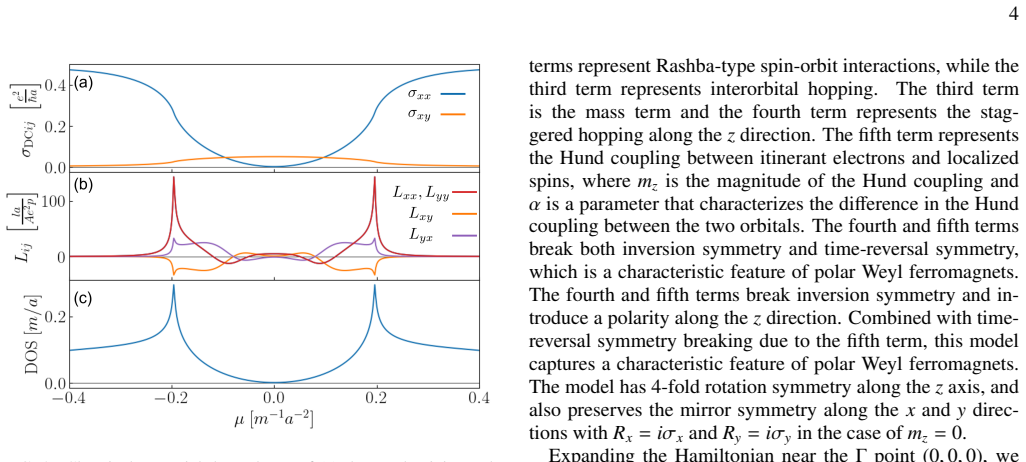
Summary. The paper develops a theory of emergent inductance in magnetic Weyl semimetals, driven by the magnetoelectric (ME) response of Weyl fermions to magnetization dynamics. The authors derive analytical expressions for the ME tensor, decomposing it into an intraband Fermi-surface contribution proportional to the relaxation time and the square of the chemical potential (Eq. (4)), and an interband contribution proportional to the Weyl-node separation/Fermi-arc length (Eq. (7), with the integral evaluated in Eq. (9)). These ME tensors are then used to construct an emergent inductance formula (Eq. (11)), which is applied to a model of polar Weyl ferromagnets (Eq. (15)) via a low-energy expansion around the Γ point (Appendix B). The paper claims that the inductance is enhanced when the chemical potential lies in the Weyl regime, reflecting the topological nature of the Weyl dispersion, and connects the results to the recent experimental observation of toroidal induction in PrAlGe (Ref. [38]).
Significance. If the central claims are correct, the paper provides a useful analytical framework for emergent inductance in magnetic Weyl semimetals, complementing numerical and experimental work. The decomposition into intraband and interband ME contributions, with the latter tied to Weyl-node separation, is a conceptually clean result that could guide future experiments. The paper includes detailed appendices (A and B) with explicit derivations of the interband integral and the parameter mapping for the lattice model, which is a strength. The connection to the companion experiment on polar Weyl ferromagnets is timely. However, the quantitative predictions rest on a low-energy two-band truncation whose validity is not quantitatively established, and the derivation of the inductance formula is only sketched. These gaps are significant for a paper claiming both a general theory and specific enhancement predictions.
major comments (3)
- [§IV, Appendix B (Eqs. (16)–(20), (B1)–(B7))] The mapping from the lattice model Eq. (15) to the effective two-band model Eq. (5) is performed by a leading-order expansion around the Γ point. The interband ME tensor C_I in Eq. (6)/(A7) is an integral over all momenta; although UV convergent, its value can receive significant contributions from regions away from Γ, including higher-order k terms and transitions to the other two bands of the 4-band model. The paper asserts in §V that the enhancement is 'robust and does not depend on details of the microscopic Hamiltonian,' but no numerical validation is provided (no full-BZ calculation of C_I for Eq. (15), no search for additional Weyl points). This assumption is load-bearing for the quantitative predictions in Fig. 3(c) and for the claimed explanation of the experiment Ref. [38]. I request a numerical check of C_I for the full lattice model or a controlled estimate of the neglected t
- [§III, Eq. (11)] The derivation of the spin-dynamics-mediated conductivity Σ(ω) and the resulting inductance formula is not presented. The expression for Σ(ω), with factors v and v_cell, and the step from the ME response to the impedance Z require a detailed derivation. In particular, the treatment of the magnon Green's function (-ωσ_y - H_m)^{-1}, the role of the removed z-row in C̃_O and C̃_I, and the signs in the combination (-C̃_O + C̃_I) vs (C̃_O + C̃_I) are not justified. Since the central claim of emergent inductance rests on Eq. (11), please provide the derivation in an appendix and clarify the assumptions (e.g., symmetry of H_m, linear response regime).
- [§II.B, Fig. 1(b)] The analytical expression for C_I in Eq. (7) is explicitly derived for the chemical potential at the Weyl points (µ=0). However, Fig. 1(b) and the discussion in §IV present the chemical-potential dependence of the interband ME contribution, which is central to the claimed Weyl-region enhancement. No finite-µ formula or numerical method is given. Please provide the expression used for finite µ (e.g., the generalization of Eq. (6) with f0(ξ-µ)) or describe the numerical integration procedure, so that Fig. 1(b) and Fig. 3(c) are reproducible.
minor comments (5)
- [§II.B, text near Eq. (9)] There is a missing phrase: 'Dividing the Brillouin zone into regions with and without Fermi arcs along the k_z direction (the arc length being ),' — the arc-length expression is absent. Please fill in the missing term or remove the parenthetical.
- [Throughout] Typos: 'consideter' (should be 'consider'), 'obatin' ('obtain'), 'proprortional' ('proportional'), 'semimentals' ('semimetals'). In §II.B, 'τ in Eq. (5) include spin degrees of freedom' is garbled; likely 'the Pauli matrices in Eq. (5)'.
- [Eqs. (7)–(11)] The indices on C_O and C_I are inconsistent (e.g., C^x_Ox vs C^x_Iy in the text). Please define the index convention clearly (first index = magnetization component, second = electric field direction, or vice versa) and use it consistently.
- [Figure captions] Parameters such as τ=10ma^2/ℏ and M diagonal elements m^{-1}a^{-2}ℏ^{-1} need explicit definitions of the units and of the mass parameter m in the effective model (Eq. (5)) to avoid confusion with the lattice mass M_w.
- [§III, Eq. (10)] The definition of impedance via the inverse of (σ_DC + Σ(ω)) may deserve a brief justification in terms of the sample geometry and the sign convention, especially since the inductance is extracted from the imaginary part of ∂_ω Z.
Circularity Check
No significant circularity: the ME tensors and inductance are derived from explicit model Hamiltonians; the only overlapping-author citations are contextual and not load-bearing.
full rationale
The paper's derivation chain is self-contained. The intraband ME tensor C_O is obtained from the Boltzmann equation for H=k^T K τ + S^T M τ (Eqs. (2)-(4)); the interband tensor C_I is obtained by evaluating the Kubo formula (6) for the two-node Hamiltonian (5), with the integral I carried out in Appendix A (Eqs. (A1)-(A26)). The inductance formula (11) follows algebraically from inverting the impedance (10), and the application to polar Weyl ferromagnets uses an explicit Γ-point expansion of the lattice model (15), with parameters listed in Eqs. (16)-(20)/(B1)-(B7). No fitted parameter is relabeled as a prediction, and no quoted result is defined in terms of the target quantity. The overlapping-author citations (Ref. 22 in a list of prior emergent-inductance work; Ref. 38 as the experimental discovery motivating the term 'emergent toroidal induction') are contextual rather than load-bearing: the theory does not depend on either citation for its derivation. The companion experiment is used as motivation and qualitative comparison, not as the source of the computed formulas. The Γ-point expansion neglects possible remote-band and higher-order contributions, and no full-Brillouin-zone Weyl-point search is reported; those are quantitative correctness/robustness risks, not circularity. The central claim—that the interband ME response scales with the Weyl-node separation and enhances emergent inductance in the Weyl regime—is an explicit analytic consequence of the model, not an input assumed by construction.
Axiom & Free-Parameter Ledger
free parameters (8)
- relaxation time τ =
τ = 10 ℏ/t₀ in Figs. 2–3 (10 m a²/ℏ in Fig. 1)
- Hund coupling m_z =
m_z = 3.5 t₀ in Fig. 3
- spin-orbit coupling λ =
λ = 0.3 t₀ in Fig. 3
- polar/antisymmetric hopping δt =
δt = 0.1 t₀ in Fig. 3
- orbital asymmetry α =
α = 0.3 in Fig. 3
- mass M_w =
M_w = 0.7 t₀ in Fig. 3
- effective mass m =
m = t₀⁻¹a⁻²/sinθ
- magnon stiffness H_m =
H_m = p I (identity; p not specified)
axioms (5)
- domain assumption Boltzmann transport equation with constant relaxation time τ for the intraband response (Eq. (3))
- domain assumption The magnetic dynamics is treated classically via localized spins S(t) whose coupling to electrons is the Hund term Sᵀ(t)Mτ (Eq. (2))
- domain assumption The inductance formula Eq. (11) is built from a linear-response conductivity Σ(ω) in which the spin propagator is (−iωσ_y − H_m)⁻¹
- ad hoc to paper The Γ-point low-energy expansion of the minimal model (Appendix B) faithfully represents the Weyl physics used for the inductance calculation
- standard math Kubo formula for the interband ME response (Eq. (6)) with chemical potential at the Weyl points
read the original abstract
We theoretically study emergent electromagnetic responses in Weyl semimetals. Focusing on magnetic Weyl semimetals, we develop a general theory of emergent induction driven by magnetic dynamics. We show that magnetoelectric (ME) responses in Weyl semimetals give rise to emergent induction mediated by magnetization dynamics. Using effective two-band models for magnetic Weyl semimetals, we derive a formula for the ME response that includes both intraband and interband contributions. The resulting formula shows that the intraband contribution is proportional to the relaxation time $\tau$, whereas the interband contribution is associated with the separation of the Weyl nodes. Applying the general formula to a model of polar Weyl ferromagnets, we demonstrate that the dynamics of the toroidal moment is closely related to the emergent inductive response in polar Weyl ferromagnets, as recently discovered by Suzuki et al. [Y. Suzuki et al. arXiv:2607.12322]. The chemical-potential dependence of the inductance indicates that the emergent electromagnetic response is enhanced in the energy range of the Weyl dispersion, reflecting the topological nature of Weyl semimetals.
Figures


Reference graph
Works this paper leans on
-
[1]
Case ofη≤mv 2/2 First, we consider the case ofη≤mv 2/2. We introduce x≡z+k 2 z−2mη+2m 2v2,(A9) b≡2mv q k2z−2mη+m 2v2.(A10) Then we can write I= Z ∞ −∞ dkz Z ∞ k2z +2m2v2−2mη dx 4m2v(−2mη+k 2 z ) (x2−b 2)3/2 .(A11) Settingx=b/cosθ, we obtain I= Z ∞ −∞ dkz 4m2v(−2mη+k 2 z ) b2 Z π 2 θ0 dθ cosθ sin2θ = Z ∞ −∞ dkz 4m2v(−2mη+k 2 z ) b2 " − 1 sinθ #π 2 θ0 ,(A12...
-
[2]
Case ofη>mv 2/2 For|k z|≥ p −m2v2 +2mη, thezintegral can be performed in the same way as in the previous subsection: I|kz|≥ √ −m2v2+2mη = Z ∞ −∞ − Z √ −m2v2+2mη − √ −m2v2+2mη dkz 4m2v(−2mη+k 2 z ) b2 × " −1+ k2 z +2m 2v2−2mη |k2z−2mη| # .(A21) Hence, we can write I|kz|> √ 2mη =2 Z ∞ √ 2mη dkz 2m2v k2z +m 2v2−2mη = 2m2vp −m2v2 +2mη log p ...
-
[3]
Murakami, New Journal of Physics9, 356 (2007)
S. Murakami, New Journal of Physics9, 356 (2007)
2007
-
[4]
N. P. Armitage, E. J. Mele, and A. Vishwanath, Rev. Mod. Phys.90, 015001 (2018)
2018
-
[5]
S.-Y . Xu, I. Belopolski, N. Alidoust, M. Neupane, G. Bian, C. Zhang, R. Sankar, G. Chang, Z. Yuan, C.-C. Lee, S.-M. Huang, H. Zheng, J. Ma, D. S. Sanchez, B. Wang, A. Bansil, F. Chou, P. P. Shibayev, H. Lin, S. Jia, and M. Z. Hasan, Sci- ence349, 613 (2015)
2015
-
[6]
X. Wan, A. M. Turner, A. Vishwanath, and S. Y . Savrasov, Phys. Rev. B83, 205101 (2011)
2011
-
[7]
Yang, Y .-M
K.-Y . Yang, Y .-M. Lu, and Y . Ran, Phys. Rev. B84, 075129 (2011)
2011
-
[8]
A. A. Zyuzin and A. A. Burkov, Phys. Rev. B86, 115133 (2012)
2012
-
[9]
A. A. Burkov, Phys. Rev. Lett.113, 187202 (2014)
2014
-
[10]
B. A. Bernevig, C. Felser, and H. Beidenkopf, Nature603, 41 (2022)
2022
-
[11]
Nagaosa, T
N. Nagaosa, T. Morimoto, and Y . Tokura, Nature Reviews Ma- terials5, 621 (2020)
2020
-
[12]
A. Ozawa, Y . Araki, K. Kobayashi, and K. Nomura, arXiv:2603.22568 (2026)
Pith/arXiv arXiv 2026
-
[13]
Araki, Annalen der Physik532, 1900287 (2020)
Y . Araki, Annalen der Physik532, 1900287 (2020)
2020
-
[14]
Araki and K
Y . Araki and K. Nomura, Phys. Rev. Appl.10, 014007 (2018)
2018
-
[15]
Y . G. Semenov and K. W. Kim, Phys. Rev. B107, 094434 (2023)
2023
-
[16]
Harada and H
A. Harada and H. Ishizuka, Phys. Rev. B107, 195202 (2023)
2023
-
[17]
Ozawa, Y
A. Ozawa, Y . Araki, and K. Nomura, Journal of the Physical Society of Japan93, 094704 (2024)
2024
-
[18]
Nagaosa, Jpn
N. Nagaosa, Jpn. J. Appl. Phys.58, 120909 (2019)
2019
-
[19]
Kurebayashi and N
D. Kurebayashi and N. Nagaosa, Commun. Phys.4, 260 (2021)
2021
-
[20]
Ieda and Y
J. Ieda and Y . Yamane, Phys. Rev. B103, L100402 (2021)
2021
-
[21]
Yamane, S
Y . Yamane, S. Fukami, and J. Ieda, Phys. Rev. Lett.128, 147201 (2022)
2022
-
[22]
Araki and J
Y . Araki and J. Ieda, Journal of the Physical Society of Japan 92, 074705 (2023)
2023
-
[23]
Oh and N
T. Oh and N. Nagaosa, Phys. Rev. Lett.132, 116501 (2024)
2024
-
[24]
Anan and T
T. Anan and T. Morimoto, Phys. Rev. B111, 184424 (2025)
2025
-
[25]
Yamada, D
R. Yamada, D. Kurebayashi, Y . Fujishiro, S. Okumura, D. Nakamura, F. S. Yasin, T. Nakajima, T. Yokouchi, A. Kikkawa, Y . Taguchi, Y . Tokura, O. A. Tretiakov, and M. Hirschberger, Nature Physics22, 239 (2026)
2026
-
[26]
Araki and J
Y . Araki and J. Ieda, Applied Physics Letters128, 092406 (2026)
2026
-
[27]
S. Wang, D. Zhu, Y . Jiang, A. Du, and W. Zhao, Nanoscale18, 11379 (2026)
2026
-
[28]
Yokouchi, F
T. Yokouchi, F. Kagawa, M. Hirschberger, Y . Otani, N. Na- gaosa, and Y . Tokura, Nature586, 232 (2020)
2020
-
[29]
Kitaori, N
A. Kitaori, N. Kanazawa, T. Yokouchi, F. Kagawa, N. Nagaosa, and Y . Tokura, Proceedings of the National Academy of Sci- ences118, e2105422118 (2021)
2021
-
[30]
Kitaori, J
A. Kitaori, J. S. White, N. Kanazawa, V . Ukleev, D. Singh, Y . Furukawa, T.-h. Arima, N. Nagaosa, and Y . Tokura, Phys. Rev. B107, 024406 (2023)
2023
-
[31]
Kitaori, J
A. Kitaori, J. S. White, V . Ukleev, L. Peng, K. Nakajima, N. Kanazawa, X. Yu, Y . ¯Onuki, and Y . Tokura, Communica- tions Physics7, 159 (2024)
2024
-
[32]
Matsushima, Z
Y . Matsushima, Z. Zhang, Y . Ohashi, T. Hatakeyama, G. Xiao, T. Funato, M. Matsuo, and H. Kaiju, Applied Physics Letters 124, 022404 (2024)
2024
-
[33]
Zhang, T
Z. Zhang, T. Hatakeyama, M. Matsuzaka, R. Iimori, Y . Mat- sushima, T. Funato, M. Matsuo, and H. Kaiju, AIP Advances 15, 085124 (2025)
2025
-
[34]
P. Li, W. Wu, Y . Wen, C. Zhang, J. Zhang, S. Zhang, Z. Yu, S. A. Yang, A. Manchon, and X.-x. Zhang, Nature Communications 9, 3990 (2018)
2018
-
[35]
K. Tang, Z. Wen, Y .-C. Lau, H. Sukegawa, T. Seki, and S. Mi- tani, Applied Physics Letters118, 062402 (2021)
2021
-
[36]
Bainsla, B
L. Bainsla, B. Zhao, N. Behera, A. M. Hoque, L. Sj ¨ostr¨om, A. Martinelli, M. Abdel-Hafiez, J. Åkerman, and S. P. Dash, Nature Communications15, 4649 (2024)
2024
-
[37]
Kurebayashi and K
D. Kurebayashi and K. Nomura, Scientific Reports9, 5365 (2019)
2019
-
[38]
Kurebayashi, Y
D. Kurebayashi, Y . Araki, and K. Nomura, Journal of the Phys- ical Society of Japan90, 084702 (2021)
2021
-
[39]
Meguro, A
T. Meguro, A. Ozawa, K. Kobayashi, Y . Araki, and K. Nomura, Phys. Rev. Res.7, L022065 (2025)
2025
-
[40]
Y . Suzuki, Y . Fujishiro, M. Mogi, J. Bouaziz, T. Anan, A. Kikkawa, D. Yamaguchi, M. T. Birch, Y . Kiyonaga, M. Kawamura, Y . Taguchi, T. Morimoto, N. Nagaosa, R. Arita, and Y . Tokura, (2026), arXiv:2607.12322 [cond-mat.mtrl-sci]
Pith/arXiv arXiv 2026
-
[41]
G. B. Hal ´asz and L. Balents, Phys. Rev. B85, 035103 (2012)
2012
-
[42]
Tokura, K
Y . Tokura, K. Yasuda, and A. Tsukazaki, Nature Reviews Physics1, 126 (2019)
2019
discussion (0)
Sign in with ORCID, Apple, or X to comment. Anyone can read and Pith papers without signing in.