REVIEW 3 major objections 6 minor 43 references
Robot policies lose inherited semantics during action-only fine-tuning; anchoring to a frozen encoder restores them and lifts real-robot success by 18.7 points in-distribution and 21.5 out-of-distribution.
Reviewed by Pith at T0; open to challenge. T0 means a machine referee read the full paper against a public rubric. the ladder, T0–T4 →
T0 review · deepseek-v4-flash
2026-08-02 04:42 UTC pith:URTKBP32
load-bearing objection A solid training-time regularizer for VLAs with a genuinely careful probe design; the real-robot headline numbers need stronger statistical grounding before being taken at face value. the 3 major comments →
Semantic Anchoring for Robotic Action Representations
The pith
A machine-rendered reading of the paper's core claim, the machinery that carries it, and where it could break.
Core claim
On the paper's own terms, the discovery is that the semantic structure of action representations is measurable and predictive, and that it can be actively preserved without altering the deployed model. The authors define alignment as bidirectional InfoNCE retrieval accuracy between the VLA's layer-10 action-token features and instruction embeddings from a frozen, separately pretrained encoder, and show this metric drops below its pretrained level during action-only fine-tuning, that its trajectory tracks out-of-distribution success (Spearman rho = 0.964) while in-distribution success keeps rising, and that per-trajectory values systematically separate successful from failed rollouts. On top
What carries the argument
The load-bearing object is the semantic anchor: a frozen text encoder (EgoHOD's text tower, applied at layer 10 of the VLA backbone) whose embedding space serves as a reference manifold. Each action-token feature is decomposed by two MLP encoders into a shared channel (intention-level semantics) and a private channel (execution-specific detail), with a reconstruction decoder and an angular decorrelation penalty keeping the channels separate; only the shared channel is attention-pooled and contrastively aligned to the instruction embedding via bidirectional InfoNCE. The auxiliary modules are trained alongside the native action loss and then discarded, so the inference graph is identical to th
Load-bearing premise
The method assumes the frozen EgoHOD text encoder is a valid and sufficient semantic manifold for robot action intentions; if its text space is not actually aligned with manipulation semantics, the objective would act as a generic regularizer and the mirror-neuron-inspired interpretation would be wrong even if the empirical gains persist.
What would settle it
Swap the frozen EgoHOD text encoder for a randomly initialized or semantically scrambled encoder of the same dimension, keeping all other hyperparameters fixed; if LIBERO and real-robot success still rise by the same margin, the gains are not caused by anchoring to a meaningful semantic manifold. A corroborating check: recompute the alignment-versus-OOD-success Spearman correlation over many training seeds and checkpoints; if it is not consistently near 0.96, the synchrony claim relies on a single trajectory.
If this is right
- The action-instruction alignment metric can serve as a training-time diagnostic: it tracks out-of-distribution success (Spearman rho = 0.964) and per-trajectory rollout outcome even when in-distribution success is high and flat.
- Because all auxiliary modules are discarded at inference, the deployed policy is identical to the action-only baseline, so the method adds no inference cost or latency.
- The gains transfer across an autoregressive VLA (SpatialVLA with LoRA) and a flow-matching VLA (pi0 fully fine-tuned), indicating the anchor mechanism is not backbone-specific.
- On the real bimanual platform, the method improves every task family and every OOD axis, with the largest gains on position and compositional-task generalization, the axes that demand reasoning beyond memorized demonstrations.
- The diagnostic implies that in-distribution success alone can be misleading: on LIBERO, ID success rises monotonically while OOD success and alignment both fall late in training, so benchmarks that only measure ID performance can miss representation collapse.
Where Pith is reading between the lines
- The alignment probe could be reused beyond training: as an early-stopping criterion, a data filter (down-weight demonstrations whose action features stay poorly aligned), or a reward signal for preference tuning; the paper does not test these uses.
- Layer k=10 is chosen for both backbones after a sweep on only SpatialVLA; the paper does not check whether the optimal layer tracks model depth (pi0 has 18 layers, SpatialVLA has 27), so a reader should not assume 10 is universally optimal.
- If the semantic-manifold explanation is the true cause, gains should grow when the frozen encoder's text space is fine-tuned on manipulation language or made even more manipulation-centric; a direct test would be to keep the encoder frozen but scramble its semantic ordering and measure how much of the gain remains.
- The mirror-neuron framing predicts that aligning to goal/intention embeddings should produce larger OOD gains than aligning to motion or effector embeddings; the paper's ablation of visual dynamics is consistent with but does not directly test this.
Editorial analysis
A structured set of objections, weighed in public.
Referee Report
Summary. The paper argues that action-only fine-tuning of Vision-Language-Action (VLA) models erodes the semantic structure of their action-token representations, and that this erosion is predictive of reduced out-of-distribution generalization and per-episode success. It introduces a training-time auxiliary objective that contrastively anchors mid-layer action-token features to a frozen semantic encoder (EgoHOD), with a shared/private decomposition intended to separate intention-level semantics from execution-specific detail. All auxiliary modules are discarded at inference, leaving the deployed policy identical to the baseline. The method is evaluated on π0 and SpatialVLA in LIBERO, SimplerEnv, LIBERO-Pro, and on a real bimanual platform, reporting consistent improvements, including headline gains of +18.7 percentage points in-distribution and +21.5 in OOD tasks on the real robot.
Significance. If the results hold, the paper makes a valuable practical contribution: a plug-and-play, inference-free regularizer that improves both in-distribution and OOD performance across two architecturally distinct VLA backbones. The diagnostic section is thoughtful, and the paper takes circularity seriously by using a different frozen encoder (Qwen3-VL-Embedding) for probing than for alignment (EgoHOD). The component ablations (Fig. 5) and encoder-choice ablations are informative and lend support to the proposed mechanism. The main weakness is the evidential status of the real-robot claims, which are underpowered and under-reported, and the transfer of the layer-k choice across backbones without a dedicated sweep. These issues are fixable and do not invalidate the core idea, but they currently make the strongest claims difficult to verify.
major comments (3)
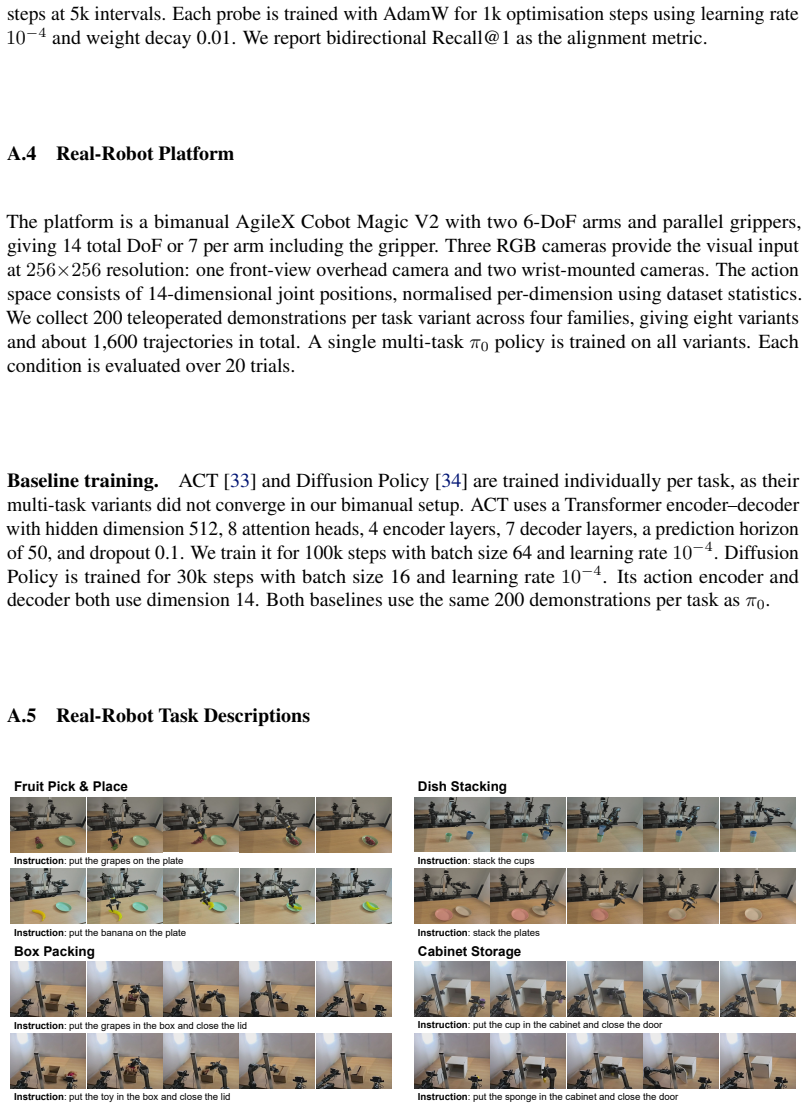
- [§4.2, Table 2, §A.4] The real-robot headline gains are not statistically grounded as reported. The caption says "20 trials each," but values such as 92.5, 67.5, 77.5, 60.0, and 57.5 are impossible for a single 20-trial Bernoulli experiment. The most plausible reading is that each cell pools 20 trials per variant (40 trials per condition), but the text is ambiguous. In any case, no confidence intervals, significance tests, or per-episode logs are provided. With 40 trials per cell, per-axis differences such as Position (32.5 vs. 57.5) are borderline significant at best, and the aggregate ID and OOD gains are averages over several axes whose significance depends on the pre-specified aggregation rule. Please clarify the trial count, report per-episode data, and add binomial/Fisher exact or bootstrap CIs for per-axis and aggregate comparisons. Without this, the +18.7/+21.5 claims in the abstract are not verifiabl
- [§4.3, Fig. 5c] The alignment-layer sweep is reported only for SpatialVLA. For π0, the paper simply sets k=10, citing this sweep and the diagnostic in §2. But π0 has 18 backbone layers while SpatialVLA has 27; the optimal layer index may not transfer across architectures. The diagnostic in §2 is a measurement, not evidence that layer 10 is the best attachment point for the training objective on π0. The cross-backbone generality claim would be substantially stronger with a k-sweep on π0, or at least a clear argument for why the same index should be optimal for both backbones.
- [§4.1, Table 1] Simulation results are reported as single numbers with no seed variance, number of evaluation rollouts, or confidence intervals. On LIBERO, the improvement of +3.1 percentage points over π0 (89.3→92.4) may be within run-to-run noise given the small 50-demonstration setting. On SimplerEnv, the per-task percentages (e.g., 45.8, 37.5) suggest a specific but unstated number of rollouts. Please report multiple seeds with means and standard deviations, or at least specify the evaluation protocol and whether the numbers are the best or mean run. This is load-bearing for the claim of consistent gains across benchmarks.
minor comments (6)
- [Table 2 caption] The caption "20 trials each" should state explicitly whether this means 20 trials per variant (giving 40 per condition) or 20 per condition. The decimal percentages imply the former, but the text should not leave this to inference.
- [Abstract and §4] The phrase "up to +18.7%" is ambiguous: these are percentage-point changes, not relative improvements. Use "percentage points" throughout to avoid inflating the perceived effect.
- [§3.4] λalign is reported as "≈0.1" and "≈0.5" rather than exact values. Please give the precise values or at least the ranges used in each experiment.
- [Eq. (3) and §A.2] The text says "learnable-query attention with eight heads before pooling," but Eq. (3) uses a single query q. Clarify whether the attention includes multi-head structure or whether "eight heads" refers to something else.
- [Fig. 2a] The y-axis label "Retrieval Acc. (%) / OOD Succ. (%)" is overloaded. Separate the two metrics on different axes or use a legend with explicit dual y-axes.
- [§A.2] The dimension of the shared/private subspace is stated as 512, but the backbone feature dimension differs (1024 for π0, 2304 for SpatialVLA). State whether the subspace dimension is fixed independent of d, and whether this choice was tuned.
Circularity Check
No circularity: the diagnostic probe uses a different frozen encoder than the alignment target, and all performance claims are externally evaluated.
full rationale
The paper's derivation chain is self-contained and does not reduce to its inputs. The diagnostic measurement (Sec. 2) uses the Qwen3-VL-Embedding text encoder as the semantic reference (Eq. 1), while the proposed training objective anchors to the EgoHOD text encoder (Sec. 3.1). App. A.3 explicitly states this choice 'to avoid circularity.' The probing heads are trained on task-disjoint LIBERO pairs and evaluated on held-out tasks, so the retrieval-accuracy metric is an external transfer measure rather than a restatement of the training loss. The hypothesized 'synchronization' between alignment and success is presented as an empirical correlation (Spearman rho=0.964) and is not used to define success. The method's final claims are success rates on LIBERO, SimplerEnv, LIBERO-Pro, and a real bimanual platform, all compared against baselines under the same protocol; these are external benchmarks not constructed from the alignment objective. No fitted parameter is renamed as a prediction: the alignment weight, layer, and subspace dimension are fixed hyperparameters, and layer k=10 is justified by external prior work [7,35] plus an ablation for SpatialVLA. The only overlapping-author citation ([42], Zhu et al.) is confined to related-work acknowledgment of a shared motivation and is not load-bearing for any conclusion. Ambiguities in real-robot trial counts and absence of confidence intervals are statistical-reporting concerns, not circularity, and are accordingly not scored here.
Axiom & Free-Parameter Ledger
free parameters (4)
- lambda_align =
~0.1 (pi0), ~0.5 (SpatialVLA)
- lambda_r =
0.01
- lambda_d =
0.075
- alignment layer k =
10
axioms (5)
- domain assumption Pretrained vision-language encoders (e.g., EgoHOD, Qwen3-VL-Embedding) capture a convergent semantic organization that is a valid reference for robot action intentions (Platonic Representation Hypothesis).
- domain assumption Mirror neuron theory implies observation and execution share an intention-level encoding, so aligning VLA action features to an observation-side semantic manifold is a sensible inductive bias.
- ad hoc to paper Action-token hidden states at layer k=10 retain the richest semantic structure for both pi0 (18 layers) and SpatialVLA (27 layers).
- domain assumption The DSN-style additive reconstruction with decorrelation can separate intention-level semantics from execution detail without discarding action-critical information (Eqs. 4-7).
- domain assumption EgoHOD's text-embedding space is a better semantic anchor for manipulation than CLIP or Qwen3-VL-Embedding.
read the original abstract
Vision-Language-Action (VLA) models inherit rich semantic representations from pretrained Vision-Language Models, yet fine-tuning on limited robot demonstrations degrades this structure and undermines generalization. A fundamental question therefore arises: what constitutes a good action representation? Inspired by the mirror neuron theory's insight that observation and execution share an intention-level encoding, we examine whether a robot's action representations preserve the semantic structure captured by pretrained encoders. Systematic probing confirms that this structure erodes during finetuning, and that its quality synchronizes with both task success and out-of-distribution generalization. We further introduce a plug-and-play method that anchors action representations to a semantic manifold while decomposing representations into a shared semantic channel and a private channel, all discarded at inference, leaving the deployed model unchanged. Validated on different VLA backbones across simulation and real-world benchmarks, our method yields up to +18.7% on real-world in-distribution tasks and +21.5% on out-of-distribution generalization.
Figures




Reference graph
Works this paper leans on
-
[1]
B. Liu, Y . Zhu, C. Gao, Y . Feng, Q. Liu, Y . Zhu, and P. Stone. Libero: Benchmarking knowledge transfer for lifelong robot learning.Advances in Neural Information Processing Systems, 36: 44776–44791, 2023
2023
-
[2]
Brohan, N
A. Brohan, N. Brown, J. Carbajal, Y . Chebotar, X. Chen, K. Choromanski, T. Ding, D. Driess, A. Dubey, C. Finn, et al. Rt-2: Vision-language-action models transfer web knowledge to robotic control. InConference on Robot Learning, pages 2165–2183. PMLR, 2023
2023
-
[3]
M. J. Kim, K. Pertsch, S. Karamcheti, T. Xiao, A. Balakrishna, S. Nair, R. Rafailov, E. P. Foster, P. R. Sanketi, Q. Vuong, T. Kollar, B. Burchfiel, R. Tedrake, D. Sadigh, S. Levine, P. Liang, and C. Finn. Openvla: An open-source vision-language-action model. InConference on Robot Learning (CoRL), pages 2679–2713, 2024
2024
-
[4]
K. Black, N. Brown, D. Driess, A. Esmail, M. Equi, C. Finn, N. Fusai, L. Groom, K. Hausman, B. Ichter, S. Jakubczak, T. Jones, L. Ke, S. Levine, A. Li-Bell, M. Mothukuri, S. Nair, K. Pertsch, L. X. Shi, J. Tanner, Q. Vuong, A. Walling, H. Wang, and U. Zhilinsky.π0: A vision-language- action flow model for general robot control.arXiv preprint arXiv:2410.24...
Pith/arXiv arXiv 2024
-
[5]
Geirhos, J.-H
R. Geirhos, J.-H. Jacobsen, C. Michaelis, R. Zemel, W. Brendel, M. Bethge, and F. A. Wichmann. Shortcut learning in deep neural networks.Nature Machine Intelligence, 2(11):665–673, 2020
2020
-
[6]
Y . Xing, X. Luo, J. Xie, L. Gao, H. Shen, and J. Song. Shortcut learning in generalist robot policies: The role of dataset diversity and fragmentation. InConference on Robot Learning (CoRL), 2025
2025
-
[7]
N. Kachaev, M. Kolosov, D. Zelezetsky, A. K. Kovalev, and A. I. Panov. Don’t blind your VLA: Aligning visual representations for OOD generalization.arXiv preprint arXiv:2510.25616, 2025
arXiv 2025
-
[8]
Black, N
K. Black, N. Brown, J. Darpinian, K. Dhabalia, D. Driess, A. Esmail, M. R. Equi, C. Finn, N. Fusai, M. Y . Galliker, D. Ghosh, L. Groom, K. Hausman, B. Ichter, S. Jakubczak, T. Jones, L. Ke, D. LeBlanc, S. Levine, A. Li-Bell, M. Mothukuri, S. Nair, K. Pertsch, A. Z. Ren, L. X. Shi, L. Smith, J. T. Springenberg, K. Stachowicz, J. Tanner, Q. Vuong, H. Walke...
2025
-
[9]
J. Bjorck, F. Castañeda, N. Cherniadev, X. Da, R. Ding, L. Fan, Y . Fang, D. Fox, F. Hu, S. Huang, J. Jang, Z. Jiang, J. Kautz, K. Kundalia, L. Lao, Z. Li, Z. Lin, K. Lin, G. Liu, E. Llontop, L. Magne, A. Mandlekar, A. Narayan, S. Nasiriany, S. Reed, Y . L. Tan, G. Wang, Z. Wang, J. Wang, Q. Wang, J. Xiang, Y . Xie, Y . Xu, Z. Xu, S. Ye, Z. Yu, A. Zhang, ...
Pith/arXiv arXiv 2025
-
[10]
Ghosh, H
Octo Model Team, D. Ghosh, H. Walke, K. Pertsch, K. Black, O. Mees, S. Dasari, J. Hejna, T. Kreiman, C. Xu, J. Luo, Y . L. Tan, L. Y . Chen, P. Sanketi, Q. Vuong, T. Xiao, D. Sadigh, C. Finn, and S. Levine. Octo: An open-source generalist robot policy. InRobotics: Science and Systems (RSS), 2024
2024
-
[11]
D. Qu, H. Song, Q. Chen, Y . Yao, X. Ye, J. Gu, Z. Wang, Y . Ding, B. Zhao, D. Wang, and X. Li. Spatialvla: Exploring spatial representations for visual-language-action model. InRobotics: Science and Systems (RSS), 2025
2025
-
[12]
L. Wang, X. Chen, J. Zhao, and K. He. Scaling proprioceptive-visual learning with hetero- geneous pre-trained transformers. InAdvances in Neural Information Processing Systems (NeurIPS), 2024. 9
2024
-
[13]
di Pellegrino, L
G. di Pellegrino, L. Fadiga, L. Fogassi, V . Gallese, and G. Rizzolatti. Understanding motor events: a neurophysiological study.Experimental Brain Research, 91(1):176–180, 1992
1992
-
[14]
Gallese, L
V . Gallese, L. Fadiga, L. Fogassi, and G. Rizzolatti. Action recognition in the premotor cortex. Brain, 119(2):593–609, 1996
1996
-
[15]
Rizzolatti and L
G. Rizzolatti and L. Craighero. The mirror-neuron system.Annual Review of Neuroscience, 27: 169–192, 2004
2004
-
[16]
Fadiga, L
L. Fadiga, L. Fogassi, G. Pavesi, and G. Rizzolatti. Motor facilitation during action observation: a magnetic stimulation study.Journal of Neurophysiology, 73(6):2608–2611, 1995
1995
-
[17]
Keysers and V
C. Keysers and V . Gazzola. Expanding the mirror: vicarious activity for actions, emotions, and sensations.Current Opinion in Neurobiology, 19(6):666–671, 2009
2009
-
[18]
Fogassi, P
L. Fogassi, P. F. Ferrari, B. Gesierich, S. Rozzi, F. Chersi, and G. Rizzolatti. Parietal lobe: from action organization to intention understanding.Science, 308(5722):662–667, 2005
2005
-
[19]
Rizzolatti and C
G. Rizzolatti and C. Sinigaglia. The functional role of the parieto-frontal mirror circuit: interpretations and misinterpretations.Nature Reviews Neuroscience, 11(4):264–274, 2010
2010
-
[20]
M. Huh, B. Cheung, T. Wang, and P. Isola. Position: The platonic representation hypothesis. In Proceedings of the 41st International Conference on Machine Learning (ICML), volume 235, pages 20617–20642. PMLR, 2024
2024
-
[21]
M. Reuss, H. Zhou, M. Rühle, Ö. E. Ya ˘gmurlu, F. Otto, and R. Lioutikov. FLOWER: De- mocratizing generalist robot policies with efficient vision-language-action flow policies. In Conference on Robot Learning (CoRL), 2025. arXiv:2509.04996
Pith/arXiv arXiv 2025
-
[22]
Zhang, Q
L. Zhang, Q. Yang, and A. Agrawal. Assessing and learning alignment of unimodal vision and language models. InProceedings of the Computer Vision and Pattern Recognition Conference, pages 14604–14614, 2025
2025
-
[23]
A. van den Oord, Y . Li, and O. Vinyals. Representation learning with contrastive predictive coding.arXiv preprint arXiv:1807.03748, 2018
Pith/arXiv arXiv 2018
-
[24]
X. Zhou, Y . Xu, G. Tie, Y . Chen, G. Zhang, D. Chu, P. Zhou, and L. Sun. Libero-pro: Towards robust and fair evaluation of vision-language-action models beyond memorization.arXiv preprint arXiv:2510.03827, 2025
Pith/arXiv arXiv 2025
-
[25]
B. Pei, Y . Huang, J. Xu, G. Chen, Y . He, L. Yang, Y . Wang, W. Xie, Y . Qiao, F. Wu, and L. Wang. Modeling fine-grained hand-object dynamics for egocentric video representation learning. In International Conference on Learning Representations (ICLR), 2025
2025
-
[26]
Bousmalis, G
K. Bousmalis, G. Trigeorgis, N. Silberman, D. Krishnan, and D. Erhan. Domain separation networks. InAdvances in Neural Information Processing Systems, 2016
2016
-
[27]
S. Yu, S. Kwak, H. Jang, J. Jeong, J. Huang, J. Shin, and S. Xie. Representation alignment for generation: Training diffusion transformers is easier than you think. InInternational Conference on Learning Representations (ICLR), 2025
2025
-
[28]
F. Li, W. Song, H. Zhao, J. Wang, P. Ding, D. Wang, L. Zeng, and H. Li. Spatial forcing: Implicit spatial representation alignment for vision-language-action model.arXiv preprint arXiv:2510.12276, 2025
arXiv 2025
-
[29]
X. Li, K. Hsu, J. Gu, K. Pertsch, O. Mees, H. R. Walke, C. Fu, I. Lunawat, I. Sieh, S. Kirmani, et al. Evaluating real-world robot manipulation policies in simulation. InConference on Robot Learning (CoRL), 2024. 10
2024
-
[30]
H. R. Walke, K. Black, T. Z. Zhao, Q. Vuong, C. Zheng, P. Hansen-Estruch, A. W. He, V . Myers, M. J. Kim, M. Du, et al. Bridgedata v2: A dataset for robot learning at scale. InConference on Robot Learning, pages 1723–1736. PMLR, 2023
2023
-
[31]
Pertsch, K
K. Pertsch, K. Stachowicz, B. Ichter, D. Driess, S. Nair, Q. Vuong, O. Mees, C. Finn, and S. Levine. FAST: Efficient action tokenization for vision-language-action models. InRobotics: Science and Systems (RSS), 2025
2025
-
[32]
M. Shukor et al. Smolvla: A vision-language-action model for affordable and efficient robotics. arXiv preprint arXiv:2506.01844, 2025
Pith/arXiv arXiv 2025
-
[33]
T. Z. Zhao, V . Kumar, S. Levine, and C. Finn. Learning fine-grained bimanual manipulation with low-cost hardware. InRobotics: Science and Systems (RSS), 2023
2023
-
[34]
C. Chi, Z. Xu, S. Feng, E. Cousineau, Y . Du, B. Burchfiel, R. Tedrake, and S. Song. Diffusion policy: Visuomotor policy learning via action diffusion. InRobotics: Science and Systems (RSS), 2023
2023
-
[35]
T. Kim, J. Lee, M. Koo, D. Kim, K. Lee, C. Kim, Y . Seo, and J. Shin. Contrastive representation regularization for vision-language-action models.arXiv preprint arXiv:2510.01711, 2025
Pith/arXiv arXiv 2025
-
[36]
Kumar, A
A. Kumar, A. Raghunathan, R. M. Jones, T. Ma, and P. Liang. Fine-tuning can distort pre- trained features and underperform out-of-distribution. InInternational Conference on Learning Representations (ICLR), 2022
2022
-
[37]
Aghajanyan, A
A. Aghajanyan, A. Shrivastava, A. Gupta, N. Goyal, L. Zettlemoyer, and S. Gupta. Better fine-tuning by reducing representational collapse. InInternational Conference on Learning Representations, 2021
2021
-
[38]
Radford, J
A. Radford, J. W. Kim, C. Hallacy, A. Ramesh, G. Goh, S. Agarwal, G. Sastry, A. Askell, P. Mishkin, J. Clark, et al. Learning transferable visual models from natural language supervision. InInternational Conference on Machine Learning (ICML), 2021
2021
-
[39]
S. Nair, A. Rajeswaran, V . Kumar, C. Finn, and A. Gupta. R3M: A universal visual representation for robot manipulation. InConference on Robot Learning (CoRL), pages 892–909, 2022
2022
-
[40]
Y . J. Ma, S. Sodhani, D. Jayaraman, O. Bastani, V . Kumar, and A. Zhang. VIP: Towards universal visual reward and representation via value-implicit pre-training. InInternational Conference on Learning Representations (ICLR), 2023
2023
-
[41]
Karamcheti, S
S. Karamcheti, S. Nair, A. S. Chen, T. Kollar, C. Finn, D. Sadigh, and P. Liang. Language-driven representation learning for robotics. InRobotics: Science and Systems (RSS), 2023
2023
-
[42]
W. Zhu, Z. Zhang, Y . Ren, Y . Huang, H. Xu, and Y . Wang. Embodied representation alignment with mirror neurons. InIEEE/CVF International Conference on Computer Vision (ICCV), 2025
2025
-
[43]
M. Li, Y . Zhang, D. Long, K. Chen, S. Song, S. Bai, Z. Yang, P. Xie, A. Yang, D. Liu, et al. Qwen3-vl-embedding and qwen3-vl-reranker: A unified framework for state-of-the-art multimodal retrieval and ranking.arXiv preprint arXiv:2601.04720, 2026. 11 A Implementation Details A.1 Backbone Training Hyperparameters We follow the official training recipe of ...
Pith/arXiv arXiv 2026
discussion (0)
Sign in with ORCID, Apple, or X to comment. Anyone can read and Pith papers without signing in.