REVIEW 3 major objections 5 minor 102 references
Automatically evolved, task-specific prompt guidelines let users recover most of the performance lost to underspecified prompts, with average gains of 15.5–81.7% across math, medical QA, and coding tasks.
Reviewed by Pith at T0; open to challenge. T0 means a machine referee read the full paper against a public rubric. the ladder, T0–T4 →
T0 review · deepseek-v4-flash
2026-08-02 14:40 UTC pith:ZEHR4M57
load-bearing objection The problem formulation is genuinely new and worth engaging with, but the headline gains are measured with a writer that sees the reference answer—so the user-facing claim is not yet supported. the 3 major comments →
Automatically Evolving Prompt Guidelines for Task-Specific Optimization
The pith
A machine-rendered reading of the paper's core claim, the machinery that carries it, and where it could break.
Core claim
The paper claims that a task's reference answers implicitly encode the specifications missing from underspecified user queries, and that these can be distilled into reusable, task-specific prompt guidelines. AGOPS operationalizes this with a prompt-writer LLM that turns a query plus reference answer into a self-contained prompt, a solver LLM that scores the prompt, and an evolutionary optimizer that refines the guideline text. A leakage constraint — n-gram overlap between prompt and answer — stops the guideline from encoding solutions. Across math, medical QA, and coding, following the evolved guidelines recovers 15.5–81.7% of the performance lost to underspecification, and embedding the gui
What carries the argument
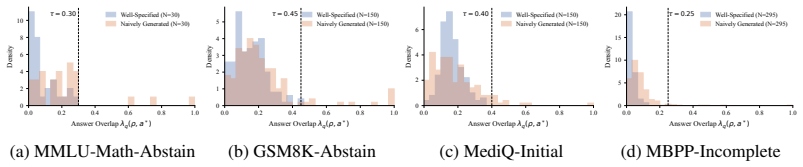
The load-bearing mechanism is prompt simulation with a leakage constraint: a prompt-writer LLM (given the guideline, the underspecified query, and the reference answer) generates candidate user prompts; those whose n-gram overlap with the reference answer exceeds a task-specific threshold are discarded; the surviving prompts are executed by the solver LLM and scored, and the scores feed an evolutionary prompt optimizer that mutates and refines the guideline text. The key observation powering the loop is that reference answers — reasoning traces or reference code — implicitly contain the behavioral constraints, context, and output criteria that make a prompt well-specified.
Load-bearing premise
The pipeline assumes that a real user, without seeing the reference answer, can supply the same task-specific details that the simulated prompt-writer extracted from the reference answer; the paper explicitly notes its guidelines have not been tested with real end-users.
What would settle it
Have non-expert users follow the evolved guidelines — without access to reference answers — on the same benchmarks; if their performance recovery is substantially below the simulated 15.5–81.7% (e.g., less than half of the gain), the central claim that guidelines help real users would be falsified.
If this is right
- Because reference answers encode the missing specifications, any task with a corpus of solved examples can have its own prompt guidelines evolved without manual curation.
- Because generic prompt optimizers cannot recover information absent from the prompt, the bottleneck moves upstream: the user must supply the missing knowledge, and guidelines are the vehicle.
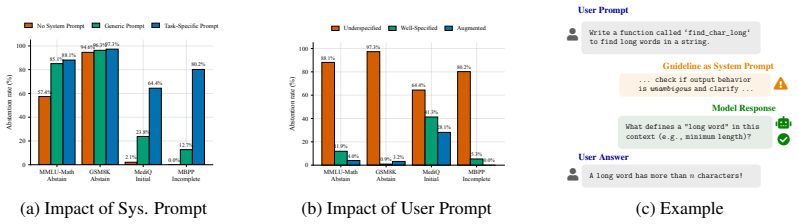
- Guidelines embedded as system prompts turn an LLM's failure to detect underspecification into active clarification — with reported gains of about +33 points on an incomplete coding benchmark and +14 accuracy points on a math word-problem benchmark after ten turns.
- Guidelines tailored to a solver model can outperform both generic and human-expert coding guidelines on well-specified benchmarks, with aggregate improvement roughly three to four times that of expert guidelines.
- The leakage constraint keeps guidelines specification-focused: adversarial reconstruction shows guideline-written prompts leak no more of the reference answer than fully specified prompts do.
Where Pith is reading between the lines
- We would expect the reported gains to shrink under real end-users, who may not articulate the exact details the simulated writer extracted; a natural extension is a user study measuring the gap between simulated and actual prompt quality.
- The method's dependence on reference answers suggests a boundary: for tasks without gold answers (open-ended writing, design, strategy), an alternative signal — a reward model or human preference model — could substitute, turning the approach into a general 'what to specify' engine.
- The strong model-dependence of the evolved guidelines (the paper shows the two tested models produce different guidelines for the same task) implies that guideline transfer across models is not free; testing cross-model reuse would clarify when a guideline is task-specific versus model-specific.
- If the leakage constraint is the main safeguard, adversarial paraphrasing could circumvent it; a stress test with a paraphrasing adversary would bound how much guidelines can encode answers in disguise.
Editorial analysis
A structured set of objections, weighed in public.
Referee Report
Summary. The paper introduces AGOPS, an evolutionary method that automatically generates task-specific prompt guidelines from a set of underspecified user queries paired with reference answers. The core idea is to simulate a user who has perfect latent knowledge, approximated by conditioning a prompt-writer LLM on the reference answer, and to evolve a guideline that maximizes the downstream solver accuracy while suppressing surface-level answer leakage. The authors evaluate on four underspecified benchmarks (MMLU-Math-Abstain, GSM8K-Abstain, MediQ-Initial, MBPP-Incomplete) with GPT-4.1-mini and Qwen3 32B, reporting large gains in solver accuracy relative to a no-guideline simulation (15.5–81.7 percentage points), as well as improved interactive information seeking when the guideline is embedded in the system prompt.
Significance. If the core assumption were valid — that a real user can supply the task-specific details that AGOPS extracts from reference answers — the paper would make a useful contribution: it defines a clear problem, provides a modular optimization scheme, and includes careful ablations of the rejection-sampling parameter, the leakage threshold, and its interaction with the optimizer. The adversarial reconstruction analysis is a thoughtful addition, and the paper is transparent about several limitations. However, the significance is currently conditional: the headline claim is about users, while every evaluation is a simulation in which the prompt writer sees the reference answer. The authors explicitly call this setup an upper bound and admit there is no real-user study. Without a no-reference condition or a real-user test, the reported gains measure the potential of a perfect-knowledge prompt writer, not the practical benefit to actual users. Because the problem is well-defined and the shortcoming is fixable by re-scoping the claims or adding experiments, the right outcome is major revision rather than rejection.
major comments (3)
- [3.2, Table 1, §5, A.2] The central user-facing claim is not established by the evaluation. All rows in the "Sim." block of Table 1 are generated by the prompt writer W_G(q,a*), which receives the reference answer, and the NOGUIDELINE baseline uses the same privileged access. Section A.2 explicitly calls this setting "an upper bound on prompt engineering performance" because users lack access to the expected answer, and Section 5 states "Our work has not evaluated the guidelines with real end-users." The gains of 15.5–81.7% therefore measure what a writer with perfect knowledge can do when given a guideline, not what users can achieve. Please add a no-reference condition (W_G(q) without a*), a real-user study, or substantially revise the abstract and conclusion to restrict the claim to the perfect-knowledge simulation.
- [3.2, Appendix B, Appendix D.2] The leakage constraint does not prevent solution-specific guideline content, and the appendix itself shows concrete instances. λq is a character n-gram overlap measure; Section B admits that rephrasing, paraphrasing, and search-space compression are not detected. The optimized MBPP guideline in D.2 instructs the writer to "Preserve the exact required function name and signature intent as implied by the reference" and to "Describe the exact algorithm/logic embodied by the reference answer," with per-function examples (word_len, answer). That is extraction from the reference answer, not general task knowledge a typical user would possess. The adversarial reconstruction result in Figure 5c does not refute this: ROUGE-L is a surface measure, and Figure 15d shows a distribution shift toward higher reconstruction on MBPP-Incomplete. This undermines the claim that the optimized guidelines are s
- [A.2, Figure 9, §4.3] The interactive information-seeking results inherit the same limitation. The conversation simulation is a teacher–student setup in which the simulated user is explicitly given the reference answer ("The teacher provided the following reference answer") and uses it to answer the solver's clarification requests. The reported gains — approximately +33 Pass@1 on MBPP-Incomplete and +14 accuracy points on GSM8K-Abstain — are therefore also upper-bound results for a privileged simulated user, not evidence about how well real users can clarify underspecified queries. Please either add a no-reference interactive condition or clearly label the information-seeking results as simulated upper bounds in the abstract and conclusion.
minor comments (5)
- [Abstract, §4.3] The abstract says "increasing performance between 15.5 to 81.7% on average"; these are percentage-point improvements in accuracy/pass@1 relative to the simulated NOGUIDELINE baseline, not relative gains. Please use consistent terminology.
- [Table 4, C.1] The setup for the well-specified coding benchmarks should state explicitly whether the prompt writer receives the reference solution. If it does, the same perfect-knowledge caveat applies and should be disclosed in the caption.
- [Figure 5] The caption for panel (c) should state the direction of the claimed effect (lower ROUGE-L is better). The text says "lower indicates the prompt is well-specified," but the axis/caption is ambiguous.
- [§3.2] The surrogate objective and leakage definition appear as unnumbered equations. Numbering these equations would make the paper easier to referee and to build on.
- [Figures 1, 4, 16] The manuscript contains rendering artifacts (e.g., "exclamati⌢n-triangle", "♂robot", and raw LaTeX "colorbox" strings in Section D.3). These should be cleaned before a camera-ready version.
Circularity Check
The user-facing regain claim is measured with an answer-conditioned prompt writer, so the headline gain is the fitted simulation's value rather than a user prediction.
specific steps
-
fitted input called prediction
[Abstract; Section 3.2 (Prompt Simulation); Section A.2; Table 1]
"Users following AGOPS guidelines can regain this loss (increasing performance between 15.5 to 81.7% on average) consistently across all benchmarks. ... The simulated setup simulates prompts written by a user with a given guideline. ... we condition the writer on the ground truth answer a∗ as a proxy. ... our simulation represents an upper bound on prompt engineering performance."
The headline gain is computed from the same WG(q,a*) used as the optimization objective: the surrogate is G* = arg max E[µ(LLM(WG(q,a*)),a*)] and Table 1's 'Sim.' rows evaluate WG(G,q,a*) on test queries. The 'user' in the evaluation is therefore the answer-conditioned writer that the guideline was fit to maximize, not a real user. Section A.2 explicitly calls this setup an upper bound and Section 5 concedes no real-user evaluation, yet the abstract presents the upper bound as the user-facing regain. The claimed prediction reduces to the fitted simulation by construction.
-
other
[Appendix D.2; Section 3.2; Section B]
"3) **Describe the exact algorithm/logic embodied by the reference answer**, including any early returns, loops, grouping, and conditions. ... During optimization, we enforce the constraint via rejection sampling ... λq(ρ,a∗) ... measures the fraction of answer-specific n-grams reproduced in the prompt ... Leakage due to search-space compression ... rephrasing, or paraphrasing of the answer are not detected."
The optimized guideline explicitly tells the prompt writer to transcribe the reference answer's algorithm and signature. At test time the writer still has a*, so the 'well-specified' prompts are produced by a process with privileged access to the target. The leakage filter only catches surface n-gram overlap and the paper admits rephrasing/paraphrase leakage is undetected; the adversarial-reconstruction check is performed on the same answer-conditioned prompts, so it does not establish that a user without a* could supply the extracted details.
full rationale
The technical optimization loop (guideline → WG(q,a*) → solver → score → GEPA evolution) is internally coherent, and the held-out test evaluation is a legitimate check of that loop. The circularity enters only when the abstract and conclusion rename the answer-conditioned simulation as a user-level prediction. The paper is transparent about this in A.2 ('upper bound') and Section 5 ('not evaluated with real end-users'), but those caveats are dropped from the headline claim, which is the central contribution. There is no notable self-citation circularity: the method builds on GEPA and external benchmarks, which are independent tools/data rather than a self-justifying uniqueness theorem. I therefore score the paper 6: the headline 'users can regain 15.5-81.7%' reduces by construction to the fitted WG(q,a*) simulation, while the underlying guideline-evolution method retains independent technical content.
Axiom & Free-Parameter Ledger
free parameters (3)
- Leakage threshold τ =
0.30 (MMLU-Math), 0.45 (GSM8K), 0.40 (MediQ), 0.25 (MBPP)
- n-gram size n for λq =
6
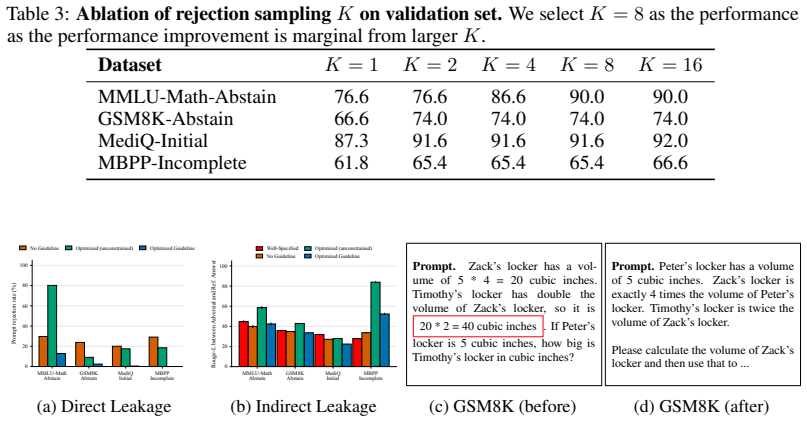
- Rejection sampling candidate count K =
8
axioms (4)
- domain assumption Reference answers implicitly encode the missing specification information required to complete underspecified queries
- domain assumption A real user's latent task knowledge is approximated by conditioning the prompt writer on the reference answer a*
- domain assumption The n-gram overlap constraint λq(ρ,a*) ≤ τ sufficiently prevents solution-specific content from entering generated prompts
- domain assumption The prompt writer LLM can extract task-specific knowledge from reference answers without copying or leaking solutions
read the original abstract
For Large Language Models to reliably answer user queries, users must clearly specify requirements, context, and constraints. In practice, however, user queries are often underspecified, forcing models to infer unstated assumptions that may misalign with the actual user intent. Existing prompt engineering guidelines aim to mitigate this issue, they are typically generic and task-agnostic, limiting their practical utility. Additionally, existing guidelines are formed manually and in a non-systematic way. To this end, we study prompt guideline optimization: the problem of automatically generating task-specific guidelines that help write better-specified prompts for a given task and model. Our key observation is that existing (completed) task examples (aka reference answers) often implicitly encode the missing information required to complete underspecified queries, including behavioral constraints, contextual assumptions, and evaluation criteria. We therefore propose AGOPS, an automatic approach that evolves task-specific guidelines via an optimization scheme that involves a prompt LLM writer, a solver LLM and prompt evolution, which maximize downstream effectiveness on a set of examples (user queries with reference answers). At inference time, our guidelines help users write well-specified prompts, boosting the effectiveness of LLMs. We show across mathematical reasoning, medical question answering, and coding tasks, that prompt underspecification leads to major drops (up to 95.3%) in downstream task performance (compared to well-specified prompts) and, perhaps more importantly, that this drop can hardly be recovered by existing prompt optimization techniques. Users following AGOPS guidelines can regain this loss (increasing performance between 15.5 to 81.7% on average) consistently across all benchmarks.
Figures




Reference graph
Works this paper leans on
-
[1]
Lakshya A. Agrawal, Shangyin Tan, Dilara Soylu, Noah Ziems, Rishi Khare, Krista Opsahl-Ong, Arnav Singhvi, Herumb Shandilya, Michael J. Ryan, Meng Jiang, Christopher Potts, Koushik Sen, Alexandros G. Dimakis, Ion Stoica, Daniel Klein, Matei Zaharia, and Omar Khattab. GEPA: reflective prompt evolution can outperform reinforcement learning.CoRR, abs/2507.19457,
-
[2]
Program synthesis with large language models.arXiv preprint arXiv:2108.07732, 2021
Jacob Austin, Augustus Odena, Maxwell Nye, Maarten Bosma, Henryk Michalewski, David Dohan, Ellen Jiang, Carrie Cai, Michael Terry, Quoc Le, et al. Program synthesis with large language models.arXiv preprint arXiv:2108.07732, 2021
Pith/arXiv arXiv 2021
-
[3]
Feldman, and Carolyn Jane Anderson
Hannah McLean Babe, Sydney Nguyen, Yangtian Zi, Arjun Guha, Molly Q. Feldman, and Carolyn Jane Anderson. Studenteval: A benchmark of student-written prompts for large language models of code. In Lun-Wei Ku, Andre Martins, and Vivek Srikumar, editors, Findings of the Association for Computational Linguistics, ACL 2024, Bangkok, Thailand and virtual meeting...
-
[4]
Thomas Bolander, Robin Engelhardt, and Thomas S. Nicolet. The curse of shared knowl- edge: Recursive belief reasoning in a coordination game with imperfect information.CoRR, abs/2008.08849, 2020. URLhttps://arxiv.org/abs/2008.08849
arXiv 2008
-
[5]
Smith, Yejin Choi, and Hanna Hajishirzi
Faeze Brahman, Sachin Kumar, Vidhisha Balachandran, Pradeep Dasigi, Valentina Pyatkin, Abhilasha Ravichander, Sarah Wiegreffe, Nouha Dziri, Khyathi Raghavi Chandu, Jack Hessel, Yulia Tsvetkov, Noah A. Smith, Yejin Choi, and Hanna Hajishirzi. The art of saying no: Contextual noncompliance in language models. In Amir Globersons, Lester Mackey, Danielle Belg...
2024
-
[6]
Lida Chen, Zujie Liang, Xintao Wang, Jiaqing Liang, Yanghua Xiao, Feng Wei, Jinglei Chen, Zhenghong Hao, Bing Han, and Wei Wang. Teaching large language models to express knowledge boundary from their own signals.CoRR, abs/2406.10881, 2024. doi: 10.48550/ ARXIV .2406.10881. URLhttps://doi.org/10.48550/arXiv.2406.10881
-
[7]
McAuley, Linda Ruth Petzold, and William Yang Wang
Zhiyu Chen, Jing Ma, Xinlu Zhang, Nan Hao, An Yan, Armineh Nourbakhsh, Xianjun Yang, Julian J. McAuley, Linda Ruth Petzold, and William Yang Wang. A survey on large language models for critical societal domains: Finance, healthcare, and law.Trans. Mach. Learn. Res., 2024, 2024. URLhttps://openreview.net/forum?id=upAWnMgpnH
2024
-
[9]
Training verifiers to solve math word problems.arXiv preprint arXiv:2110.14168, 2021
Karl Cobbe, Vineet Kosaraju, Mohammad Bavarian, Mark Chen, Heewoo Jun, Lukasz Kaiser, Matthias Plappert, Jerry Tworek, Jacob Hilton, Reiichiro Nakano, et al. Training verifiers to solve math word problems.arXiv preprint arXiv:2110.14168, 2021
Pith/arXiv arXiv 2021
-
[10]
Matthew Dahl, Varun Magesh, Mirac Suzgun, and Daniel E. Ho. Large legal fictions: Profiling legal hallucinations in large language models.CoRR, abs/2401.01301, 2024. doi: 10.48550/ ARXIV .2401.01301. URLhttps://doi.org/10.48550/arXiv.2401.01301
-
[11]
Yang Deng, Yong Zhao, Moxin Li, See-Kiong Ng, and Tat-Seng Chua. Don’t just say "i don’t know"! self-aligning large language models for responding to unknown questions with explanations. In Yaser Al-Onaizan, Mohit Bansal, and Yun-Nung Chen, editors,Proceedings of 10 the 2024 Conference on Empirical Methods in Natural Language Processing, EMNLP 2024, Miami...
-
[12]
Run-Ze Fan, Zengzhi Wang, and Pengfei Liu. Megascience: Pushing the frontiers of post- training datasets for science reasoning.CoRR, abs/2507.16812, 2025. doi: 10.48550/ARXIV . 2507.16812. URLhttps://doi.org/10.48550/arXiv.2507.16812
-
[13]
Prompt engineering 101 prompt engineering guidelines from a linguistic perspective
Wenjuan Han, Xiang Wei, Xingyu Cui, Ning Cheng, Guangyuan Jiang, Weinan Qian, and Chi Zhang. Prompt engineering 101 prompt engineering guidelines from a linguistic perspective. In Maosong Sun, Jiye Liang, Xianpei Han, Zhiyuan Liu, Yulan He, Gaoqi Rao, Yubo Chen, and Zhiliang Tian, editors,Chinese Computational Linguistics - 23rd China National Conference,...
-
[14]
Measuring massive multitask language understanding
Dan Hendrycks, Collin Burns, Steven Basart, Andy Zou, Mantas Mazeika, Dawn Song, and Jacob Steinhardt. Measuring massive multitask language understanding. In9th International Conference on Learning Representations, ICLR 2021, Virtual Event, Austria, May 3-7, 2021. OpenReview.net, 2021. URLhttps://openreview.net/forum?id=d7KBjmI3GmQ
2021
-
[15]
Measuring massive multitask language understanding
Dan Hendrycks, Collin Burns, Steven Basart, Andy Zou, Mantas Mazeika, Dawn Song, and Jacob Steinhardt. Measuring massive multitask language understanding. InInternational Conference on Learning Representations (ICLR), 2021. URL https://openreview.net/ forum?id=d7KBjmI3GmQ
2021
-
[16]
Pleak: Prompt leaking attacks against large language model applications
Bo Hui, Haolin Yuan, Neil Gong, Philippe Burlina, and Yinzhi Cao. Pleak: Prompt leaking attacks against large language model applications. In Bo Luo, Xiaojing Liao, Jun Xu, Engin Kirda, and David Lie, editors,Proceedings of the 2024 on ACM SIGSAC Conference on Computer and Communications Security, CCS 2024, Salt Lake City, UT, USA, October 14- 18, 2024, p...
arXiv 2024
-
[17]
Language models (mostly) know what they know.CoRR, abs/2207.05221, 2022
Saurav Kadavath, Tom Conerly, Amanda Askell, Tom Henighan, Dawn Drain, Ethan Perez, Nicholas Schiefer, Zac Hatfield-Dodds, Nova DasSarma, Eli Tran-Johnson, Scott Johnston, Sheer El Showk, Andy Jones, Nelson Elhage, Tristan Hume, Anna Chen, Yuntao Bai, Sam Bowman, Stanislav Fort, Deep Ganguli, Danny Hernandez, Josh Jacobson, Jackson Kernion, Shauna Kravec,...
-
[18]
Large language models must be taught to know what they don’t know
Sanyam Kapoor, Nate Gruver, Manley Roberts, Katie Collins, Arka Pal, Umang Bhatt, Adrian Weller, Samuel Dooley, Micah Goldblum, and Andrew Gordon Wilson. Large language models must be taught to know what they don’t know. In Amir Globersons, Lester Mackey, Danielle Belgrave, Angela Fan, Ulrich Paquet, Jakub M. Tomczak, and Cheng Zhang, edi- tors,Advances i...
2024
-
[19]
Reframing instructional prompts to gptk’s language
Daniel Khashabi, Chitta Baral, Yejin Choi, and Hannaneh Hajishirzi. Reframing instructional prompts to gptk’s language. In Smaranda Muresan, Preslav Nakov, and Aline Villavicencio, editors,Findings of the Association for Computational Linguistics: ACL 2022, Dublin, Ireland, May 22-27, 2022, Findings of ACL, pages 589–612. Association for Computational Lin...
2022
-
[20]
Joshi, Hanna Moazam, Heather Miller, Matei Zaharia, and Christopher Potts
Omar Khattab, Arnav Singhvi, Paridhi Maheshwari, Zhiyuan Zhang, Keshav Santhanam, Sri Vardhamanan, Saiful Haq, Ashutosh Sharma, Thomas T. Joshi, Hanna Moazam, Heather Miller, Matei Zaharia, and Christopher Potts. Dspy: Compiling declarative language model 11 calls into state-of-the-art pipelines. InThe Twelfth International Conference on Learning Represen...
2024
-
[21]
Polina Kirichenko, Mark Ibrahim, Kamalika Chaudhuri, and Samuel J. Bell. Abstentionbench: Reasoning llms fail on unanswerable questions.CoRR, abs/2506.09038, 2025. doi: 10.48550/ ARXIV .2506.09038. URLhttps://doi.org/10.48550/arXiv.2506.09038
-
[22]
A strategy for cost-effective large language model use at health system-scale.NPJ digital medicine, 7(1):320, 2024
Eyal Klang, Donald Apakama, Ethan E Abbott, Akhil Vaid, Joshua Lampert, Ankit Sakhuja, Robert Freeman, Alexander W Charney, David Reich, Monica Kraft, et al. A strategy for cost-effective large language model use at health system-scale.NPJ digital medicine, 7(1):320, 2024
2024
-
[23]
Wioleta Kucharska and G. Scott Erickson. Tacit knowledge acquisition & sharing, and its influence on innovations: A polish/us cross-country study.Int. J. Inf. Manag., 71:102647, 2023. doi: 10.1016/J.IJINFOMGT.2023.102647. URLhttps://doi.org/10.1016/j.ijinfomgt. 2023.102647
arXiv 2023
-
[24]
Maya Larbi, Amal Akli, Mike Papadakis, Rihab Bouyousfi, Maxime Cordy, Federica Sarro, and Yves Le Traon. When prompts go wrong: Evaluating code model robustness to ambiguous, contradictory, and incomplete task descriptions.CoRR, abs/2507.20439, 2025. doi: 10.48550/ ARXIV .2507.20439. URLhttps://doi.org/10.48550/arXiv.2507.20439
-
[25]
The power of scale for parameter-efficient prompt tuning
Brian Lester, Rami Al-Rfou, and Noah Constant. The power of scale for parameter-efficient prompt tuning. In Marie-Francine Moens, Xuanjing Huang, Lucia Specia, and Scott Wen-tau Yih, editors,Proceedings of the 2021 Conference on Empirical Methods in Natural Language Processing, EMNLP 2021, Virtual Event / Punta Cana, Dominican Republic, 7-11 November, 202...
doi:10.18653/v1/202 2021
-
[26]
Belinda Z. Li, Been Kim, and Zi Wang. Questbench: Can llms ask the right question to acquire information in reasoning tasks?CoRR, abs/2503.22674, 2025. doi: 10.48550/ARXIV .2503. 22674. URLhttps://doi.org/10.48550/arXiv.2503.22674
-
[27]
Koh, and Yulia Tsvetkov
Shuyue Stella Li, Vidhisha Balachandran, Shangbin Feng, Jonathan Ilgen, Emma Pierson, Pang Wei W. Koh, and Yulia Tsvetkov. Mediq: Question-asking llms and a benchmark for reliable interactive clinical reasoning. In Amir Globersons, Lester Mackey, Danielle Belgrave, Angela Fan, Ulrich Paquet, Jakub M. Tomczak, and Cheng Zhang, editors,Ad- vances in Neural ...
2024
-
[28]
Prefix-tuning: Optimizing continuous prompts for generation
Xiang Lisa Li and Percy Liang. Prefix-tuning: Optimizing continuous prompts for generation. In Chengqing Zong, Fei Xia, Wenjie Li, and Roberto Navigli, editors,Proceedings of the 59th Annual Meeting of the Association for Computational Linguistics and the 11th International Joint Conference on Natural Language Processing, ACL/IJCNLP 2021, (Volume 1: Long ...
-
[29]
ROUGE: A package for automatic evaluation of summaries
Chin-Yew Lin. ROUGE: A package for automatic evaluation of summaries. InText Summariza- tion Branches Out, pages 74–81, Barcelona, Spain, July 2004. Association for Computational Linguistics. URLhttps://aclanthology.org/W04-1013
2004
-
[30]
Chin-Yew Lin and Franz Josef Och. Automatic evaluation of machine translation quality using longest common subsequence and skip-bigram statistics. In Donia Scott, Walter Daelemans, and Marilyn A. Walker, editors,Proceedings of the 42nd Annual Meeting of the Association for Computational Linguistics, 21-26 July, 2004, Barcelona, Spain, pages 605–612. ACL, ...
arXiv 2004
-
[31]
Teaching models to express their uncertainty in words.Trans
Stephanie Lin, Jacob Hilton, and Owain Evans. Teaching models to express their uncertainty in words.Trans. Mach. Learn. Res., 2022, 2022. URL https://openreview.net/forum?id= 8s8K2UZGTZ
2022
-
[32]
Is your code generated by chatgpt really correct? rigorous evaluation of large language models for code generation
Jiawei Liu, Chunqiu Steven Xia, Yuyao Wang, and Lingming Zhang. Is your code generated by chatgpt really correct? rigorous evaluation of large language models for code generation. In Alice Oh, Tristan Naumann, Amir Globerson, Kate Saenko, Moritz Hardt, and Sergey Levine, editors,Advances in Neural Information Processing Systems 36: Annual Conference on Ne...
2023
-
[33]
Is your code generated by chatgpt really correct? rigorous evaluation of large language models for code generation
Jiawei Liu, Chunqiu Steven Xia, Yuyao Wang, and Lingming Zhang. Is your code generated by chatgpt really correct? rigorous evaluation of large language models for code generation. In Thirty-seventh Conference on Neural Information Processing Systems (NeurIPS), 2023. URL https://openreview.net/forum?id=1qvx610Cu7
2023
-
[34]
Do llms know when to NOT answer? investigating abstention abilities of large language models
Nishanth Madhusudhan, Sathwik Tejaswi Madhusudhan, Vikas Yadav, and Masoud Hashemi. Do llms know when to NOT answer? investigating abstention abilities of large language models. In Owen Rambow, Leo Wanner, Marianna Apidianaki, Hend Al-Khalifa, Barbara Di Eugenio, and Steven Schockaert, editors,Proceedings of the 31st International Conference on Computatio...
2025
-
[35]
Large language models in healthcare and medical applications: a review.Bioengineering, 12(6):631, 2025
Subhankar Maity and Manob Jyoti Saikia. Large language models in healthcare and medical applications: a review.Bioengineering, 12(6):631, 2025
2025
-
[36]
Alessandro Midolo, Alessandro Giagnorio, Fiorella Zampetti, Rosalia Tufano, Gabriele Bavota, and Massimiliano Di Penta. Guidelines to prompt large language models for code generation: An empirical characterization.CoRR, abs/2601.13118, 2026. doi: 10.48550/ARXIV .2601.13118. URLhttps://doi.org/10.48550/arXiv.2601.13118
-
[37]
Clarifygpt: A framework for enhancing llm-based code generation via requirements clarification.Proc
Fangwen Mu, Lin Shi, Song Wang, Zhuohao Yu, Binquan Zhang, Chenxue Wang, Shichao Liu, and Qing Wang. Clarifygpt: A framework for enhancing llm-based code generation via requirements clarification.Proc. ACM Softw. Eng., 1(FSE):2332–2354, 2024. doi: 10.1145/ 3660810. URLhttps://doi.org/10.1145/3660810
doi:10.1145/3660810 2024
-
[38]
Introducing gpt-4.1 in the api, 2025
OpenAI. Introducing gpt-4.1 in the api, 2025. URL https://openai.com/index/ gpt-4-1/
2025
-
[39]
GPT-5.2 series
OpenAI. GPT-5.2 series. https://openai.com/index/introducing-gpt-5-2/, 2025. Large language model series, released December 2025
2025
-
[40]
Ryan, Josh Purtell, David Broman, Christopher Potts, Matei Zaharia, and Omar Khattab
Krista Opsahl-Ong, Michael J. Ryan, Josh Purtell, David Broman, Christopher Potts, Matei Zaharia, and Omar Khattab. Optimizing instructions and demonstrations for multi-stage language model programs. In Yaser Al-Onaizan, Mohit Bansal, and Yun-Nung Chen, editors, Proceedings of the 2024 Conference on Empirical Methods in Natural Language Processing, EMNLP ...
-
[41]
Mediq: A bilingual hindi-english medical question-answering dataset, April 2026
ProxyAyush. Mediq: A bilingual hindi-english medical question-answering dataset, April 2026. URLhttps://doi.org/10.5281/zenodo.19364989
-
[42]
Reid Pryzant, Dan Iter, Jerry Li, Yin Tat Lee, Chenguang Zhu, and Michael Zeng. Automatic prompt optimization with "gradient descent" and beam search. In Houda Bouamor, Juan Pino, and Kalika Bali, editors,Proceedings of the 2023 Conference on Empirical Methods in Natural Language Processing, EMNLP 2023, Singapore, December 6-10, 2023, pages 7957–7968. Ass...
-
[43]
Prompt programming for large language models: Beyond the few-shot paradigm
Laria Reynolds and Kyle McDonell. Prompt programming for large language models: Beyond the few-shot paradigm. In Yoshifumi Kitamura, Aaron Quigley, Katherine Isbister, and Takeo Igarashi, editors,CHI ’21: CHI Conference on Human Factors in Computing Systems, Virtual Event / Yokohama Japan, May 8-13, 2021, Extended Abstracts, pages 314:1–314:7. ACM, 2021. ...
arXiv 2021
-
[44]
Prompt engineering guidelines for using large language models in requirements engineering
Krishna Ronanki, Simon Arvidsson, and Johan Axell. Prompt engineering guidelines for using large language models in requirements engineering. In Davide Taibi and Darja Smite, editors,Software Engineering and Advanced Applications - 51st Euromicro Conference, SEAA 2025, Salerno, Italy, September 10-12, 2025, Proceedings, Part III, Lecture Notes in Computer...
-
[45]
Let Guidelines Guide You: A Prescriptive Guideline-Centered Data Annotation Methodology
Federico Ruggeri, Eleonora Misino, Arianna Muti, Katerina Korre, Paolo Torroni, and Alberto Barrón-Cedeño. Let guidelines guide you: A prescriptive guideline-centered data annotation methodology.CoRR, abs/2406.14099, 2024. doi: 10.48550/ARXIV .2406.14099. URL https: //doi.org/10.48550/arXiv.2406.14099
work page internal anchor Pith review Pith/arXiv arXiv doi:10.48550/arxiv.2406.14099 2024
-
[46]
Teler: A general taxonomy of LLM prompts for benchmarking complex tasks
Shubhra Kanti Karmaker Santu and Dongji Feng. Teler: A general taxonomy of LLM prompts for benchmarking complex tasks. In Houda Bouamor, Juan Pino, and Kalika Bali, editors, Findings of the Association for Computational Linguistics: EMNLP 2023, Singapore, December 6-10, 2023, Findings of ACL, pages 14197–14203. Association for Computational Linguistics,
2023
-
[47]
Rupak Sarkar, Bahareh Sarrafzadeh, Nirupama Chandrasekaran, Nagu Rangan, Philip Resnik, Longqi Yang, and Sujay Kumar Jauhar. Conversational user-ai intervention: A study on prompt rewriting for improved LLM response generation.CoRR, abs/2503.16789, 2025. doi: 10.48550/ARXIV .2503.16789. URLhttps://doi.org/10.48550/arXiv.2503.16789
-
[48]
Kroiz, Feileen Li, Hudson Tao, Ashay Srivastava, Hevander Da Costa, Saloni Gupta, Megan L
Sander Schulhoff, Michael Ilie, Nishant Balepur, Konstantine Kahadze, Amanda Liu, Chenglei Si, Yinheng Li, Aayush Gupta, HyoJung Han, Sevien Schulhoff, Pranav Sandeep Dulepet, Saurav Vidyadhara, Dayeon Ki, Sweta Agrawal, Chau Pham, Gerson C. Kroiz, Feileen Li, Hudson Tao, Ashay Srivastava, Hevander Da Costa, Saloni Gupta, Megan L. Rogers, Inna Goncearenco...
-
[49]
The curious case of hallucinatory (un)answerability: Finding truths in the hidden states of over-confident large language models
Aviv Slobodkin, Omer Goldman, Avi Caciularu, Ido Dagan, and Shauli Ravfogel. The curious case of hallucinatory (un)answerability: Finding truths in the hidden states of over-confident large language models. In Houda Bouamor, Juan Pino, and Kalika Bali, editors,Proceedings of the 2023 Conference on Empirical Methods in Natural Language Processing, EMNLP 20...
2023
-
[50]
Qwen3 technical report.CoRR, abs/2505.09388, 2025
Qwen Team. Qwen3 technical report.CoRR, abs/2505.09388, 2025. doi: 10.48550/ARXIV . 2505.09388. URLhttps://doi.org/10.48550/arXiv.2505.09388
-
[51]
Katherine Tian, Eric Mitchell, Allan Zhou, Archit Sharma, Rafael Rafailov, Huaxiu Yao, Chelsea Finn, and Christopher D. Manning. Just ask for calibration: Strategies for eliciting calibrated confidence scores from language models fine-tuned with human feedback. In Houda Bouamor, Juan Pino, and Kalika Bali, editors,Proceedings of the 2023 Conference on Emp...
2023
-
[52]
Best practices for text annotation with large language models.CoRR, abs/2402.05129, 2024
Petter Törnberg. Best practices for text annotation with large language models.CoRR, abs/2402.05129, 2024. doi: 10.48550/ARXIV .2402.05129. URL https://doi.org/10. 48550/arXiv.2402.05129. 14
-
[53]
URL https://doi.org/10.18653/v1/ 2023.emnlp-main.220
doi: 10.18653/V1/2023.EMNLP-MAIN.220. URL https://doi.org/10.18653/v1/ 2023.emnlp-main.220
-
[54]
Chi, Quoc V
Jason Wei, Xuezhi Wang, Dale Schuurmans, Maarten Bosma, Brian Ichter, Fei Xia, Ed H. Chi, Quoc V . Le, and Denny Zhou. Chain-of-thought prompting elicits reasoning in large language models. In Sanmi Koyejo, S. Mohamed, A. Agarwal, Danielle Belgrave, K. Cho, and A. Oh, editors,Advances in Neural Information Processing Systems 35: Annual Conference on Neura...
2022
-
[55]
Jules White, Quchen Fu, Sam Hays, Michael Sandborn, Carlos Olea, Henry Gilbert, Ashraf Elnashar, Jesse Spencer-Smith, and Douglas C. Schmidt. A prompt pattern catalog to enhance prompt engineering with chatgpt.CoRR, abs/2302.11382, 2023. doi: 10.48550/ARXIV .2302. 11382. URLhttps://doi.org/10.48550/arXiv.2302.11382
-
[56]
Tao, Min Woo Sun, Alejandro Lozano, and James Zou
Kevin Wu, Eric Wu, Rahul Thapa, Kevin Wei, Angela Zhang, Arvind Suresh, Jacqueline J. Tao, Min Woo Sun, Alejandro Lozano, and James Zou. Medcasereasoning: Evaluating and learning diagnostic reasoning from clinical case reports.CoRR, abs/2505.11733, 2025. doi: 10.48550/ARXIV .2505.11733. URLhttps://doi.org/10.48550/arXiv.2505.11733
-
[57]
Multitask prompt tuning enables parameter-efficient transfer learning
Zhen Wang, Rameswar Panda, Leonid Karlinsky, Rogério Feris, Huan Sun, and Yoon Kim. Multitask prompt tuning enables parameter-efficient transfer learning. InThe Eleventh Interna- tional Conference on Learning Representations, ICLR 2023, Kigali, Rwanda, May 1-5, 2023. OpenReview.net, 2023. URLhttps://openreview.net/forum?id=Nk2pDtuhTq
2023
-
[58]
What prompts don’t say: Understanding and managing underspecification in LLM prompts
Chenyang Yang, Yike Shi, Qianou Ma, Michael Xieyang Liu, Christian Kästner, and Tongshuang Wu. What prompts don’t say: Understanding and managing underspecification in LLM prompts. CoRR, abs/2505.13360, 2025. doi: 10.48550/ARXIV .2505.13360. URLhttps://doi.org/ 10.48550/arXiv.2505.13360
-
[59]
Do large language models know what they don’t know? In Anna Rogers, Jordan L
Zhangyue Yin, Qiushi Sun, Qipeng Guo, Jiawen Wu, Xipeng Qiu, and Xuanjing Huang. Do large language models know what they don’t know? In Anna Rogers, Jordan L. Boyd-Graber, and Naoaki Okazaki, editors,Findings of the Association for Computational Linguistics: ACL 2023, Toronto, Canada, July 9-14, 2023, Findings of ACL, pages 8653–8665. Association for Comp...
-
[60]
J. D. Zamfirescu-Pereira, Richmond Y . Wong, Bjoern Hartmann, and Qian Yang. Why johnny can’t prompt: How non-ai experts try (and fail) to design LLM prompts. In Albrecht Schmidt, Kaisa Väänänen, Tesh Goyal, Per Ola Kristensson, Anicia Peters, Stefanie Mueller, Julie R. Williamson, and Max L. Wilson, editors,Proceedings of the 2023 CHI Conference on Human...
arXiv 2023
-
[61]
Le, Denny Zhou, and Xinyun Chen
Chengrun Yang, Xuezhi Wang, Yifeng Lu, Hanxiao Liu, Quoc V . Le, Denny Zhou, and Xinyun Chen. Large language models as optimizers. InThe Twelfth International Conference on Learning Representations, ICLR 2024, Vienna, Austria, May 7-11, 2024. OpenReview.net, 2024. URLhttps://openreview.net/forum?id=Bb4VGOWELI
2024
-
[62]
CLAMBER: A benchmark of identifying and clarifying ambiguous information needs in large language models
Tong Zhang, Peixin Qin, Yang Deng, Chen Huang, Wenqiang Lei, Junhong Liu, Dingnan Jin, Hongru Liang, and Tat-Seng Chua. CLAMBER: A benchmark of identifying and clarifying ambiguous information needs in large language models. In Lun-Wei Ku, Andre Martins, and Vivek Srikumar, editors,Proceedings of the 62nd Annual Meeting of the Association for Computationa...
2024
-
[63]
Xing, Hao Zhang, Joseph E
Lianmin Zheng, Wei-Lin Chiang, Ying Sheng, Siyuan Zhuang, Zhanghao Wu, Yonghao Zhuang, Zi Lin, Zhuohan Li, Dacheng Li, Eric P. Xing, Hao Zhang, Joseph E. Gonzalez, and Ion Stoica. Judging llm-as-a-judge with mt-bench and chatbot arena. In Alice Oh, Tristan Naumann, Amir Globerson, Kate Saenko, Moritz Hardt, and Sergey Levine, edi- tors,Advances in Neural ...
2023
-
[64]
Large language models are human-level prompt engineers
Yongchao Zhou, Andrei Ioan Muresanu, Ziwen Han, Keiran Paster, Silviu Pitis, Harris Chan, and Jimmy Ba. Large language models are human-level prompt engineers. InThe Eleventh International Conference on Learning Representations, ICLR 2023, Kigali, Rwanda, May 1-5,
2023
-
[65]
SW AG: A large-scale adversarial dataset for grounded commonsense inference
Rowan Zellers, Yonatan Bisk, Roy Schwartz, and Yejin Choi. SW AG: A large-scale adversarial dataset for grounded commonsense inference. In Ellen Riloff, David Chiang, Julia Hockenmaier, and Jun’ichi Tsujii, editors,Proceedings of the 2018 Conference on Empirical Methods in Natural Language Processing, Brussels, Belgium, October 31 - November 4, 2018, page...
-
[66]
I do not know. Please do not ask this question again
Terry Yue Zhuo et al. Bigcodebench: Benchmarking code generation with diverse function calls and complex instructions. InThe Thirteenth International Conference on Learning Representations (ICLR), 2025. URLhttps://openreview.net/forum?id=YrycTjllL0. 16 System prompt of the Prompt Writer LLM You are a prompt engineer. Your job is to convert a task descript...
2025
-
[69]
URLhttps://openreview.net/forum?id=92gvk82DE-
OpenReview.net, 2023. URLhttps://openreview.net/forum?id=92gvk82DE-
2023
-
[70]
From passive to active reasoning: Can large language models ask the right questions under incomplete information? InInternational Conference on Machine Learning, pages 78714–78758
Zhanke Zhou, Xiao Feng, Zhaocheng Zhu, Jiangchao Yao, Sanmi Koyejo, and Bo Han. From passive to active reasoning: Can large language models ask the right questions under incomplete information? InInternational Conference on Machine Learning, pages 78714–78758. PMLR, 2025
2025
-
[72]
These form your sufficiency criteria
Derive sufficiency criteria.Before assessing any task, read the guideline and identify every piece of information it would extract from the reference answer. These form your sufficiency criteria. The task description must provide all of them explicitly for you to proceed
-
[73]
A criterion is only met if the task description states it explicitly
Assess the task description.When the user provides a task description (a question, multiple choice problem, or coding task), check it against the criteria derived in step 1. A criterion is only met if the task description states it explicitly. If a criterion could take multiple plausible values, it is not met
-
[74]
Do not mention the reference answer or any internal process
Request missing information directly.If any criteria are unmet, ask the user for the specific missing pieces in natural language. Do not mention the reference answer or any internal process
-
[75]
task description
Answer the user prompt when ready.Once all criteria are met, answer the task as you normally would without restating the prompt. Figure 10:System prompt template given to the solver LLM during conversation simulation. preprocessed_guidelineis a placeholder for a preprocessed AGOPS guideline. A.3 Benchmarks We assemble a set of benchmarks with underspecifi...
-
[76]
coding challenge dataset
Treat {specification} as a minimal/possibly ambiguous competitive-programming style prompt. Infer the most likely expected behavior from common “coding challenge dataset” conventions. ,→ ,→
-
[77]
Match the EXACT function name requested in {specification}. If the prompt is underspecified, make the function \colorbox{red!30}{tolerant to extra positional parameters by accepting *args} and interpreting the most common extra parameters (e.g., n = prefix length to consider) rather than crashing. ,→ ,→ ,→ ,→
-
[78]
Prefer a single function definition
Do NOT add interactive input prompts. Prefer a single function definition. If you include a __main__ block, it must be non-intrusive (no required stdin) and should not affect judge execution. ,→ ,→
-
[79]
long word
Before coding, explicitly consider hidden-test conventions and edge cases; implement the convention most likely used by such datasets:,→ 24 MMLU-Math Abstain GSM8K Abstain MediQ Initial MBPP Incomplete 0 20 40 60 80 100Abstention rate (%) 57.4% 94.6% 2.1% 0.0% 85.1% 96.3% 23.8% 12.7% 88.1% 97.3% 64.4% 80.2% No System Prompt Generic Prompt Task-Specific Pr...
-
[80]
Identify all potentially relevant signals in the instruction: • numbers, entities, or phrases that could appear in the answer • constraints that restrict what the answer could be • hints about the reasoning steps or structure of the answer • formatting patterns (e.g., step-by-step reasoning, final statement)
-
[81]
Based on these signals, infer what the answer must look like: • what components it contains • how it is structured • any key values or conclusions
-
[82]
all bits set
Construct the most likely full answer that is consistent with all extracted clues. • If information is missing, infer the most plausible completion • Prefer a complete and coherent answer over a partial one You must make a best effort reconstruction, even if the clues are incomplete. Figure 17:Prompt template for the adversarial reconstruction. task_descr...
-
[83]
Numeric conversion caveat: some “conversion” tasks may use nonstandard constants. If the prompt/examples imply a specific numeric relationship (e.g., degree_radian(120) expected 6875.493541569878), reverse-engineer the constant/factor from that relationship and implement that exact mapping; document it in a short docstring. ,→ ,→ ,→ ,→
-
[84]
Avoid unnecessary printing
Determinism and libraries: use only the Python standard library. Avoid unnecessary printing. Avoid rounding unless the judge expects it; prefer computing with`math.pi`etc. in a direct expression to match float artifacts. ,→ ,→ ,→ Output format: - Enclose the entire solution in a single```python ...```block. - The script must be self-contained and runnable...
discussion (0)
Sign in with ORCID, Apple, or X to comment. Anyone can read and Pith papers without signing in.