REVIEW 4 major objections 6 minor 19 references
The paper claims that prompt weights in zero-shot ensembling must be class-specific, and that CARPRT's training-free per-class weights improve accuracy across benchmarks.
Reviewed by Pith at T0; open to challenge. T0 means a machine referee read the full paper against a public rubric. the ladder, T0–T4 →
Giving each class its own prompt weights, estimated from the model's own pseudo-labels on unlabeled test images, improves zero-shot CLIP classification over global prompt weights.
T0 review reviewed 2026-08-02 challenge →
load-bearing objection Useful extension of WPE with per-class weights and solid empirical gains, but the 'essential' claim rests on a pseudo-label quality assumption the paper doesn't prove. the 4 major comments →
CARPRT: Class-Aware Zero-Shot Prompt Reweighting for Black-Box Vision-Language Models
The pith
A machine-rendered reading of the paper's core claim, the machinery that carries it, and where it could break.
The reading
Core claim
The central claim is that the representable likelihood space of class-specific prompt weighting strictly contains that of class-agnostic weighting, and that unlabeled test images alone suffice to instantiate the class-specific version. CARPRT's weight for prompt i and class c is the average image-text similarity over images that prompt i pseudo-labels as class c, normalized by a softmax over prompts. At inference, a test image's score for class c is the weighted sum of its similarities under the per-class prompt weights. On the paper's benchmarks, this simple recipe beats global WPE by +2.32 (CLIP ViT-B/16), +2.57 (CLIP ResNet50), and +1.38 (DeCLIP ViT-B/32) percentage points on average, and
What carries the argument
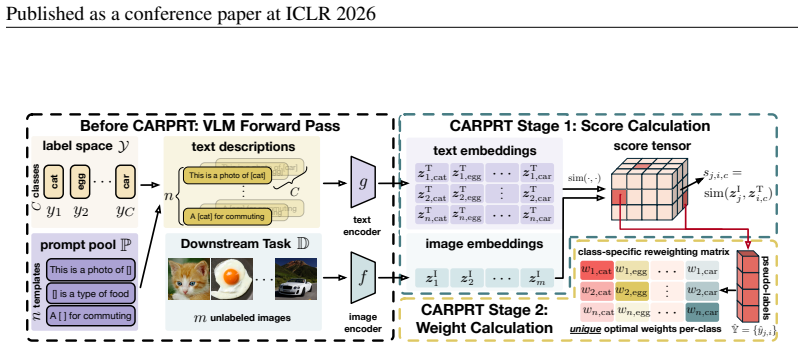
The score tensor S with entries s_{j,i,c} = sim(image_j, text_{i,c}) over all images, prompts, and classes is the central object. From it CARPRT computes pseudo-labels for each image-prompt pair, then forms the intermediate weight w'_{i,c} as the mean similarity over images whose pseudo-label under prompt i is class c, and finally normalizes with a softmax over prompts at temperature tau. This converts unlabeled test data into per-class prompt weights using only forward similarity queries. The probabilistic backing is an energy-based model view in which class-conditional likelihood is proportional to exp(weighted sum of prompt similarities), plus a proposition showing the class-agnostic weig
Load-bearing premise
The assumption that carries the whole method is that the group of images a prompt pseudo-labels as class c is mostly made of true class-c images, so the averaged similarity is a faithful measure of prompt-class affinity; when the base VLM is biased and pseudo-labels are poor, the reweights can amplify the error.
What would settle it
Run CARPRT and WPE on a dataset where the base model's per-class pseudo-label accuracy is at chance for at least one class (e.g., a class the VLM systematically mislabels), and construct the prompt pool so the correctly matched prompt for that class is obvious to a human. If CARPRT assigns that class a lower weight to the correct prompt than WPE does, or if CARPRT's overall accuracy falls below WPE's, the paper's claim that class-aware reweighting is 'essential' fails on that instance.
If this is right
- With a fixed prompt pool and unlabeled data, zero-shot classification accuracy can be improved by estimating per-class prompt weights, with no labels or gradient updates required.
- CARPRT's gains transfer across architectures (ViT, ResNet, DeCLIP) and across distribution shifts: weights estimated once on ImageNet improve ImageNet-A, -R, -Sketch, and -V2 over MPE and WPE.
- Class-aware reweighting can outperform human-selected prompt templates, reducing the need for manual prompt engineering per dataset.
- CARPRT acts as a plug-in: combining it with test-time adaptation, soft prompt tuning, and LLM-generated prompt augmentation yields further accuracy gains.
- Pseudo-label quality, not prompt count, is the main driver: filtering low-confidence pseudo-labels gives only marginal gains, while iterative refinement helps where initial pseudo-labels are good.
Where Pith is reading between the lines
- Editorial inference: CARPRT's weight formula can be read as an empirical conditional distribution P(prompt | class) over the unlabeled test set; if that interpretation holds, the weights should be reusable across datasets sharing the same classes, and class-neutral prompts should receive near-uniform weights.
- Editorial inference: The method's dependence on pseudo-labels means its advantage should shrink when the base model has systematic blind spots; on datasets like EuroSAT and Aircraft the paper already observes the iterative variant failing, suggesting a diagnostic threshold on pseudo-label accuracy below which class-aware weighting may hurt.
- Editorial inference: The per-class weights could be extended to per-cluster or per-image weights, which might capture intra-class variation (e.g., different breeds or viewpoints) that per-class averages smooth away.
- Editorial inference: A testable extension is to measure the mutual information between prompts and classes in the score tensor; the paper's mechanism predicts CARPRT's gains should correlate with such a statistic, and would vanish on prompt pools that are class-neutral.
Editorial analysis
A structured set of objections, weighed in public.
Referee Report
Summary. The paper proposes CARPRT, a training-free, black-box method for class-specific prompt reweighting in zero-shot classification with vision-language models. For each prompt and class, CARPRT averages the VLM's image-text similarity scores over images whose pseudo-label (under that prompt) equals the class, then softmax-normalizes these averages to obtain per-class prompt weights; inference then uses the weighted sum of similarities. The authors motivate the method with a probabilistic derivation (Sec. 3), an expressivity argument (Prop. 2), and a proof-of-concept experiment on Flower102. Empirically, they report consistent improvements over MPE, Majority Vote, and WPE across ten fine-grained benchmarks plus ImageNet, using CLIP-ViT-B/16, CLIP-ResNet50, and DeCLIP-ViT-B/32, with additional OOD transfer experiments, ablations (CARPRT-Uniform), and extensions to TTA, prompt tuning, and LLM-generated prompts. The central claim, stated in the abstract and Sec. 6, is that class-aware prompt reweighting is not only beneficial but essential for effective zero-shot prediction.
Significance. If the empirical claims withstand scrutiny, CARPRT is a simple and practical contribution: it requires only forward similarity queries, uses no external data or labels, and appears to improve on the existing class-agnostic WPE baseline across several architectures. The paper's strengths include the breadth of the evaluation (11 datasets, 3 backbones, OOD transfer, multiple downstream applications), the inclusion of an ablation isolating class-specificity (CARPRT-Uniform), and a clear presentation of the algorithm. However, the theoretical framework does not actually support the strongest claim of optimality or 'essential' class-awareness, because the method's core estimator is built from pseudo-labels whose quality is assumed but not guaranteed. The manuscript is honest enough to report failure modes in App. E.2, but those failures are not integrated into the main claims. As it stands, the paper is a solid empirical study with a plausible heuristic, not a theoretically grounded proof of the necessity of class-aware weighting.
major comments (4)
- [Sec. 4, Eq. 10; Prop. 1; App. E.2] The load-bearing step is w'_{i,c} = averaging s_{j,i,c} over images with pseudo-label c under prompt i. This is an unbiased estimate of prompt-class affinity only if those image sets are dominated by genuine class-c images. Prop. 1 does not establish this: Hoeffding's inequality only gives concentration of empirical pseudo-label frequencies around E[1{ŷ=c}], which equals Pr(y=c) only if the base VLM's pseudo-labels are unbiased. The paper's own App. E.2 concedes that on EuroSAT and Aircraft the iterative variant fails because initial pseudo-labels are poor, demonstrating that the required condition can fail. When it fails, Eq. 10 can amplify the model's errors. The manuscript needs either a formal condition under which the estimator is consistent, or a substantially more cautious statement of the 'essential' claim in Sec. 6.
- [Sec. 5.2, Table 1; App. G.3, Table 11] The main results table (Table 1) reports no error bars or significance tests, and several gains are very small (e.g., +0.21 on Cars with CLIP-ViT-B/16, +0.31 on ImageNet in Table 13). Table 11 reports standard deviations only for some entries and only for WPE and CARPRT, not for MPE. Given that the central claim is consistency of improvement, the authors should report standard deviations over at least 3 seeds for all methods in the main table, or otherwise show that the differences are not noise. This is particularly important because the method is deterministic except for batch ordering and floating-point nondeterminism, but the magnitudes of some gains are within typical run-to-run variation for CLIP evaluation.
- [Sec. 3, Prop. 2; App. I] Proposition 2 shows that the class-specific weight space contains a function not representable by any class-independent weighting, but the proof treats the per-prompt, per-class likelihoods a_{i,c} as independent free variables. In a fixed VLM, these values are not arbitrary; they are constrained by the shared image and text encoders. The expressivity argument therefore does not establish that the extra capacity of class-specific weights is realizable for CLIP-like similarity functions, nor that it translates into lower classification error. This is not fatal to the empirical contribution, but the paper should not claim that Prop. 2 'formally states' that class-aware weighting is necessary for performance.
- [Sec. 3, Eq. 5; Sec. 4, Eq. 10-11] There is a mismatch between the probabilistic derivation and the actual algorithm. Eq. 5 equates pseudo-label frequencies with true class probabilities, but Eq. 10 uses pseudo-labels that depend on both the prompt and the image. The text says 'Eq. 10 implements an empirical estimate of the class priors,' but the quantity in Eq. 10 is a conditional average of scores, not a class prior. Moreover, Eq. 11 applies a softmax to scores that are cosine similarities, which is an ad hoc transformation not derived from the EBM formulation in Sec. 3. The authors should either clarify what assumptions make these steps consistent or explicitly present CARPRT as an unsupervised heuristic rather than as a consequence of the probabilistic framework.
minor comments (6)
- [Sec. 5.2] The text says 'Tab. 15 shows...' but the main table is Table 1; the appendix also contains a duplicate Table 15. Please fix the cross-reference and avoid duplicating tables verbatim.
- [Sec. 4, Eq. 9 vs App. D.2] In the main text Eq. 9 defines s_{j,i,c} as a cosine similarity. In App. D.2, Eq. 9 is redefined as a softmax-normalized probability. These are inconsistent. The algorithm (and black-box claim) only needs similarity scores, so the appendix should not redefine the main equation.
- [Algorithm 1] Algorithm 1 lists a 'normalization scale λ' as input, but the algorithm body never uses λ. Either remove it or specify its role (e.g., in the softmax of Eq. 11).
- [Eq. 10] The denominator can be zero for a prompt-class pair that no image pseudo-labels to that class. The paper does not specify how such undefined weights are handled. Please state the convention (e.g., set weight to zero or use a small epsilon).
- [Sec. 5.2; Table 2] The OOD transfer experiment estimates weights on ImageNet and transfers to ImageNet-A/R/Sketch/V2. The claim 'CARPRT consistently surpasses' is supported, but the gains on ImageNet-R are only +0.35 over WPE and smaller than the reported standard deviations in Table 11. Please add error bars or a significance statement for Table 2 as well.
- [References] There are duplicate references for Qian et al. (2024a and 2024b) and for Menon & Vondrick (2023a and 2023b), which appear to be the same papers. Consolidate to avoid confusion.
Circularity Check
No significant circularity: CARPRT's central comparison is empirical and not forced by construction.
full rationale
CARPRT's central claim is that class-aware prompt reweighting outperforms class-agnostic reweighting on zero-shot classification benchmarks. This is an empirical comparison evaluated against ground-truth labels (Tables 1–2, Figure 3), not a quantity that is equal to the fitted weights by construction. The weights in Eqs. 9–11 are estimated from the unlabeled test set, but this is the explicitly stated transductive setting shared by the WPE baseline, and the reported accuracies are measured on true labels, so no fitted input is renamed as a prediction. Proposition 2 merely formalizes the definitional fact that class-specific weights are a superset of class-independent weights; this is a capacity-containment statement, not a derivation of the observed gains. Proposition 1, by contrast, overstates what Hoeffding's inequality shows: the pseudo-label frequency converges to its own expectation, which equals the true class probability only if the base VLM's pseudo-labels are unbiased. The paper itself acknowledges this fragility on EuroSAT and Aircraft in App. E.2. This is a correctness/robustness limitation, not a circularity, since the method's performance is not logically forced by the definition of the weights. Self-citations in the reference list (e.g., Li et al. 2024) are not load-bearing for the main derivation. The manuscript is self-contained against external benchmarks, so the honest finding is no significant circularity.
Axiom & Free-Parameter Ledger
free parameters (2)
- temperature tau =
1.0 (fine-grained), 1.5 (ImageNet)
- normalization scale lambda (Algorithm 1) =
unspecified
axioms (5)
- standard math Cosine similarity between image and text embeddings is an l2-normalized inner product, sim(a,b)=a^T b
- domain assumption VLM similarity scores can be interpreted as unnormalized class-conditional log-likelihoods (EBM with exp(sim) density)
- domain assumption Empirical pseudo-label frequencies converge to the true class prior (pseudo-labeling is asymptotically unbiased)
- domain assumption Per-prompt pseudo-labeled image groups provide faithful estimates of prompt-class affinity
- domain assumption The 247-prompt pool is a fair generic testbed for comparing class-aware vs class-agnostic weighting
Cite this review
Pith. "Pith review of CARPRT: Class-Aware Zero-Shot Prompt Reweighting for Black-Box Vision-Language Models." pith.science (2026). https://pith.science/paper/K4J3VQOQ
@misc{pith2026260714125,
  author       = {Pith},
  title        = {Pith review of: CARPRT: Class-Aware Zero-Shot Prompt Reweighting for Black-Box Vision-Language Models},
  year         = {2026},
  howpublished = {\url{https://pith.science/paper/K4J3VQOQ}},
  note         = {Machine review of arXiv:2607.14125}
}
read the original abstract
Pre-trained vision-language models (VLMs) enable zero-shot image classification by computing the similarity score between an image and textual descriptions, typically formed by inserting a class label (e.g., "cat") into a prompt (e.g., "a photo of a"). Since the score for a given image-class pair is sensitive to the choice of prompt, existing studies ensemble multiple prompts using a weighting vector to aggregate scores across different prompts. Yet, in current strategies, the weighting vector assigned to each prompt is shared across all classes, implicitly assuming that prompts are conditionally independent of classes, which often does not hold in practice, as a prompt like "an aerial view of" might be apt for "airport" but ill-suited for "apple". To address this, we propose class-aware zero-shot prompt reweighting (CARPRT). This scoring scheme adjusts the weighting vector for each class label by capturing the class-specific relevance of different prompts in a training-free manner. For each class label and every available prompt, we quantify their class-specific relevance by averaging image-text relevance scores over images predicted to that class under the given prompt. These estimates are then normalized to derive class-specific weights. Evaluations on standard image classification benchmarks show that CARPRT outperforms existing class-independent reweighting methods, confirming that modeling prompt-class dependencies is crucial for effective zero-shot prediction and even broader VLM-based application settings that rely on prompt ensembling. Our code is available at https://github.com/tmlr-group/CARPRT.
Figures



Reference graph
Works this paper leans on
-
[1]
Given a set of prompts P, for any prompt weighting scheme S (cf
29 Published as a conference paper at ICLR 2026 Proposition 3(cf.Proposition 2).Let X be the image space, Y be the class space. Given a set of prompts P, for any prompt weighting scheme S (cf. Eq. 1), define the representable likelihood set FS as: FS ={f:X × Y →R+|∃W∈ WS,P,s.t.f(x, y c)∝Pr(x|y c,W,P)}, where WS is the weight space under the scheme S. Let ...
2026
-
[3]
3We write CARPRT using a black-box scoring function Φ since the method only requires access to similarity scores (or logits) sj,i,c from a forward pass. Explicit access to the image/text encoders (and embeddings) is only needed if one wishes to optimize alternative objectives beyond such score queries (e.g., non-cosine similarity losses or representation-...
2026
-
[4]
Fine-grained visual classification of aircraft
Subhransu Maji, Esa Rahtu, Juho Kannala, Matthew Blaschko, and Andrea Vedaldi. Fine-grained visual classification of aircraft. InarXiv preprint arXiv:1306.5151,
-
[7]
no training
13 Published as a conference paper at ICLR 2026 A DETAILEDDISCUSSION ONRELATEDWORKS Prompt Tuning Methods.Prompt tuning adapts a pre-trained model by introducing learnable embeddings (prompt tokens) at the input stage. These tokens can be instantiated as textual prompts or visual prompts, enabling task-specific adaptation through the model’s input interfa...
2026
-
[11]
These two steps repeat until a predefined maximum number of iterations is reached. By alternating between pseudo-label prediction and weight re-estimation, iCARPRT creates a reinforcing cycle that continuously improves both the pseudo-labels and the class-aware prompt weights. 17 Published as a conference paper at ICLR 2026 Table 3: Accuracy (%) compariso...
arXiv 2026
-
[12]
From the result, we can observe that our method outperforms the other baselines in several datasets, achieving the highest average accuracy of 67.96% for CLIP-ViT-B/16 and 63.76% for CLIP-ResNet50. Specifically, for datasets like EuroSAT, Food101, and Flower102, our method shows significant improvements over the human-selected and WPE baselines. These imp...
arXiv 2026
-
[13]
15), for the following reasons
The im- provements on ImageNet and its variants datasets are smaller compared to those observed on the fine-grained datasets (shown in Tab. 15), for the following reasons. First, frequency bias is likely more pronounced in ImageNet and its variants. Given our use of a relatively small batch size of 512 and the exclusion of larger datasets such as LAION-40...
arXiv 2023
-
[15]
Table 13: Accuracy (%) comparison across different template pools using WPE and CARPRT methods on ImageNet classification. Pool Method ImageNet Acc. (%) Perf. Comparison Pool0 WPE 68.28 – CARPRT68.59+0.31 Pool1 WPE 68.35 – CARPRT68.61+0.26 Pool2 WPE 68.34 – CARPRT68.97+0.63 Pool1 targets more task-specific information by generating templates with respect ...
arXiv 2026
-
[16]
estimating
to the weights prior Pr(W|P). In the current zero-shot classification scenario addressed by CARPRT, there is no optimization-based process for “estimating” the weights, and as such, the weight prior Pr(W|P) does not play a role in the methodology. Nevertheless, our probabilistic framework is flexible enough to accommodate more general trainable settings, ...
2026
-
[18]
a low resolution photo of a{}
Thus, we need w1 = 2 for y1 while w1 = 1 for y2, immediately leading to a contradiction as w1 cannot simultaneously equal1and2. Therefore, no class-independent weighting scheme can represent the function f ∗ we constructed. We have proven that ∃f ∗ ∈ FCS such that ∀fCI ∈ FCI,∃x∈ X, y c ∈gY where f ∗(x, yc)̸= fCI(x, yc). 4unnormalized weights, just for ill...
2026
-
[19]
Human Selection
in highlighting useful prompts for the dataset, while also confirming the necessity of CARPRT’s class-aware weighting to fully capture intra-dataset variation. K USE OFLARGELANGUAGEMODELS(LLMS) In preparing this submission, we used LLMs solely as writing aids to improve readability. Specifically, LLMs were employed to correct grammar errors and polish the...
2026
-
[2009]
dataset using an exponential decay strategy to create various degrees of class imbalance. We use an imbalance factor β to describe the severity of the long-tailed distribution, defined as the ratio between the number of training samples in the most frequent class and the least frequent class. Specifically, β is given by: β= Nmax Nmin , where Nmax and Nmin...
2026
-
[2012]
ImageNet and its Variants.Following Allingham et al
(101 human action classes). ImageNet and its Variants.Following Allingham et al. (2023), we additionally evaluate on ImageNet and its commonly used robustness variants: ImageNet (Russakovsky et al.,
2023
-
[2013]
Visual classification via description from large language models
Aditya Menon and Carl V ondrick. Visual classification via description from large language models. InICLR, 2023a. 12 Published as a conference paper at ICLR 2026 Sachit Menon and Carl V ondrick. Visual classification via description from large language models. InICLR, 2023b. Microsoft. Phi-3 technical report: A highly capable language model locally on you...
Pith/arXiv arXiv 2026
-
[2015]
Christoph Schuhmann, Richard Vencu, Romain Beaumont, Robert Kaczmarczyk, Clayton Mullis, Aarush Katta, Theo Coombes, Jenia Jitsev, and Aran Komatsuzaki. Laion-400m: Open dataset of clip-filtered 400 million image-text pairs.arXiv preprint arXiv:2111.02114,
-
[2019]
(a re-collected test set). C.2 BASELINES To evaluate our method under a consistent setting, we compare CARPRT with representative baselines that operate within the same zero-shot classification protocol and fixed prompt set (Problem 1). Mean Prompt Ensembling (MPE).MPE averages predictions across prompts with uniform weights. For each class, the model enc...
2026
-
[2022]
Revisiting batch normalization for practical domain adaptation.arXiv preprint arXiv:1603.04779,
Yanghao Li, Naiyan Wang, Jianping Shi, Jiaying Liu, and Xiaodi Hou. Revisiting batch normalization for practical domain adaptation.arXiv preprint arXiv:1603.04779,
-
[2023]
Domain-adversarial training of neural networks
11 Published as a conference paper at ICLR 2026 Yaroslav Ganin, Evgeniya Ustinova, Hana Ajakan, Pascal Germain, Hugo Larochelle, Fran c ¸ois Laviolette, Mario March, and Victor Lempitsky. Domain-adversarial training of neural networks. Journal of machine learning research,
2026
-
[2024]
Maple: Multi-modal prompt learning
Muhammad Uzair Khattak, Hanoona Rasheed, Muhammad Maaz, Salman Khan, and Fahad Shahbaz Khan. Maple: Multi-modal prompt learning. InCVPR, 2023a. Muhammad Uzair Khattak, Syed Talal Wasim, Muzammal Naseer, Salman Khan, Ming-Hsuan Yang, and Fahad Shahbaz Khan. Self-regulating prompts: Foundational model adaptation without forgetting. InICCV, 2023b. Soomro Khu...
This paper was first reviewed by deepseek-v4-flash on August 2, 2026.
discussion (0)
Sign in with ORCID, Apple, or X to comment. Anyone can read and Pith papers without signing in.