REVIEW 3 major objections 5 minor 53 references
The paper argues that answers which carry a witness are self-certifying by source replay, so trust shrinks to a single interpreter, while 'no' answers must buy assurance from graded hops, independent routes, and certificates.
Reviewed by Pith at T0; open to challenge. T0 means a machine referee read the full paper against a public rubric. the ladder, T0–T4 →
T0 review · deepseek-v4-flash
2026-08-02 07:33 UTC pith:IKMHDRDX
load-bearing objection A genuinely novel and unusually honest paper on composing translation trust, with a machine-checked calculus core; its main soft spot is the empirically discharged interpreter-adequacy assumption that Theorem 3.17 reduces everything to. the 3 major comments →
Untrusted Authors, Trusted Answers: A Calculus of Fidelity-Graded Translations
The pith
A machine-rendered reading of the paper's core claim, the machinery that carries it, and where it could break.
Core claim
The paper's discovery: translation trust can be manufactured by architecture, not by trusting authors. Each translation is a 'pair' — translator, shared interpreters, and a target-to-source carry-back re-expressing target behaviors in source vocabulary — closing a directional square decidable per program on declared observables, with failures localizing to a hop, a step, and a named field. The central theorem: an existential answer is self-certifying, since replaying the carried-back witness at the source turns every translator and solver into a discovery device that can lose the witness but never fake it, while a universal answer needs every hop faithful, branch corroboration, and certified
What carries the argument
The central object is the 'pair': a translator between two languages plus a target-to-source interpreter (carry-back) that re-expresses target behaviors in source vocabulary, closing a directional commuting square checked per program on declared observables. Two theorems carry the argument — existential answers are self-certifying by source replay (trust collapses to interpreter adequacy); universal answers need faithful hops, corroboration across independent branches, and certified verdicts. Trust composes as the componentwise meet of contracts — assurance class, direction, kept observables, cost — so a route is as faithful as its weakest hop, with per-run re-establishment and branch agreem
Load-bearing premise
Everything rests on interpreter adequacy — that each language's interpreter really computes the language's reference semantics — which is discharged by differential testing at modest volume and, for Python, is circular because the pinned runtime is both the semantics and the interpreter; if it fails on any covered program, even a perfectly replayed witness can be wrong.
What would settle it
Run the reachability route on a covered RISC-V program, replay the carried-back witness in the source interpreter, and compare the exhibited behavior against an independently derived ISA reference simulator on the same inputs: a divergence would show interpreter adequacy fails and self-certification collapses for that fragment. Symmetrically, an 'unreachable' verdict that a formally verified certificate checker has re-validated, but which a later, different engine shows reachable, would falsify the universal half.
If this is right
- Witness-carrying answers (counterexamples, models, traces) can be made nearly free of trust: replay at the source interpreter reduces the user's trusted base to interpreter adequacy, so no translator, hub, or solver needs to be believed for the verdict to stand.
- Universal answers (unreachable, unsatisfiable) are exactly where assurance budgets belong: the route's guarantee is its weakest hop on every axis at once, so one unverified hop caps the whole chain no matter how strong the rest.
- Per-run square checks can temporarily re-establish a weak hop's fidelity: a reproducible or ungraded translator that passes the per-program oracle contributes, for that run, exactly what a checked hop contributes.
- Agreement between independently derived routes leaves only common-mode failure as the residual risk, and corroboration saturates at the finite supply of independent semantic anchors.
- The ratchet guarantees that growing the translation graph never silently invalidates prior verdicts: additive extensions preserve all earlier evidence, so coverage and trust only accumulate.
Where Pith is reading between the lines
- My reading, beyond the paper: the existential/universal asymmetry is a general engineering rule — whenever a toolchain can emit a checkable artifact, push final verification to the consumer's endpoint and treat every intermediate stage as a discovery device; reserve weakest-link graded guarantees for conclusions that cannot carry artifacts.
- The weakest-link contract algebra transfers to the broader question of trusting LLM-generated code: generative pipelines should expose per-hop fidelity declarations, and replayable evidence rather than generator reputation should carry conviction.
- A testable extension the authors leave implicit: carry certificate replay to the source level for universal verdicts, so that 'unreachable' claims undergo the same endpoint re-check that reachability enjoys — a source-level certificate checker would shrink the universal trusted base as dramatically as replay shrinks the existential one.
- The platform's own history — a checker adapter that accepted every outcome until a negative control ran — suggests every automated check in such a pipeline needs its own positive and negative controls; auditing the instruments may matter as much as the instruments.
Editorial analysis
A structured set of objections, weighed in public.
Referee Report
Summary. The paper proposes a calculus for composing program-translation steps of heterogeneous trustworthiness. A pair consists of a translator, shared interpreters, a projection, a declared direction, and a carry-back interpreter; faithfulness is a per-program decidable commuting-square check. Squares paste under a support condition, and a route's contract is the componentwise meet of its hops' contracts (assurance class, direction, kept observables, cost). Two end-to-end theorems organize the trust story: existential answers are self-certifying by source-level replay (Theorem 3.17), while universal answers require route fidelity, certificates, and specialization hypotheses (Theorem 3.18). The system hurdy-gurdy implements the calculus with LLM-built pairs, demand-driven graph growth, a ratchet, and a substantial evaluation snapshot, including machine-checked Lean 4 proofs of the compositional core.
Significance. If the advertised claims hold, this is a valuable contribution: it turns translation validation into a compositional graph calculus with decidable per-run checks, explicit loss/assurance bookkeeping, and a principled account of when independent routes corroborate one another. The Lean 4 mechanization with a clean axiom audit, the reproducible evaluation scripts, the negative controls, the mutation-based escape-rate experiments, and the unusually candid incident catalog are all genuine strengths. The central logical core — pasting, localization, the contract meet, per-run re-establishment, and the replay-based existential theorem — is sound given its stated hypotheses. The main weakness is that the most important trust-reduction claim rests on an empirical adequacy assumption that the paper itself shows can fail in practice, and the paper's headline language is stronger than what the evidence establishes.
major comments (3)
- [§3.7 / §3.1 / §6.6] Theorem 3.17 reduces the trusted base of existential verdicts to Assumption 1 (interpreter adequacy) plus a small replay harness. The paper is explicit that Assumption 1 is not proved and is discharged empirically 'at modest volume' (§4.2). Section 6.6 then documents a concrete failure of that very assumption: the RISC-V interpreter and the riscv-btor2 translator both mis-decoded MUL as ADD, so every square, branch agreement, and the derived benchmark agreed on the wrong semantics, and only manual audit found the defect. This is not a blemish in the proof but a puncture in the trust-reduction claim: a replayed witness for such a program can produce a false 'reachable' verdict, and the architecture's gates are structurally blind to the failure. The Python case (§4.2) is even weaker: the pinned runtime is both the semantics and the interpreter, making adequacy vacuous. The central asymmetr
- [§3.8 / Table 2 / Theorem 3.18] The universal half of the asymmetry is mechanized only in conditional form: clauses (iii) and (iv) of Theorem 3.18 enter the Lean statement as hypotheses, and the paper's tested surrogates are sampled commutation checks and per-verdict re-execution. The text correctly says 'sampling corroborates, it does not entail.' That epistemic language should be carried into the paper's summary claims about universal answers. The abstract's statement that universal answers are 'where grades, independent branches, and re-checked certificates earn their cost' is a design principle, not a theorem; the theorem itself is a conditional. I recommend making this conditional status prominent wherever Section 6 reports unreachable verdicts, and adding a per-row pointer to which hypotheses (i)–(iv) were actually discharged for each reported universal verdict. Currently Tables 4 and 5 report unreachable verdict
- [§4.2 / §6.3 / Assumption 1] The empirical discharge of Assumption 1 is too thin for the load it carries. The main differential evidence is 300 seeded RV64IMC programs against the Sail simulator, a 10-seed Csmith run, and 463 reference cases (§6.6), while the largest derived benchmark is 78 questions over 10 programs (§6.3). The 78-question benchmark's ground truth is produced by the very interpreter whose adequacy is at issue; the external Sail differential is separate, but it runs at modest volume and the paper's own history shows it missed the MUL/ADD fault until a human audit. I am not asking for SV-COMP scale, but for a quantitative adequacy campaign with construct-level coverage targets, mixed-sign and non-zero operands, and mutation-survival thresholds, so that the reader can see what 'adequacy' is being claimed. Without this, Theorem 3.17's trusted base remains an article of faith rather than a measured engi
minor comments (5)
- [§3.2, Definition 3.4] The phrase 'pure (as in Theorem 3.2)' should refer to Definition 3.2; purity is defined there, not as a theorem.
- [§2 and §5.2] The ratchet is introduced as 'Theorem 5.2' in §2 but is stated as Proposition 5.2 in §5.2. Please normalize the numbering.
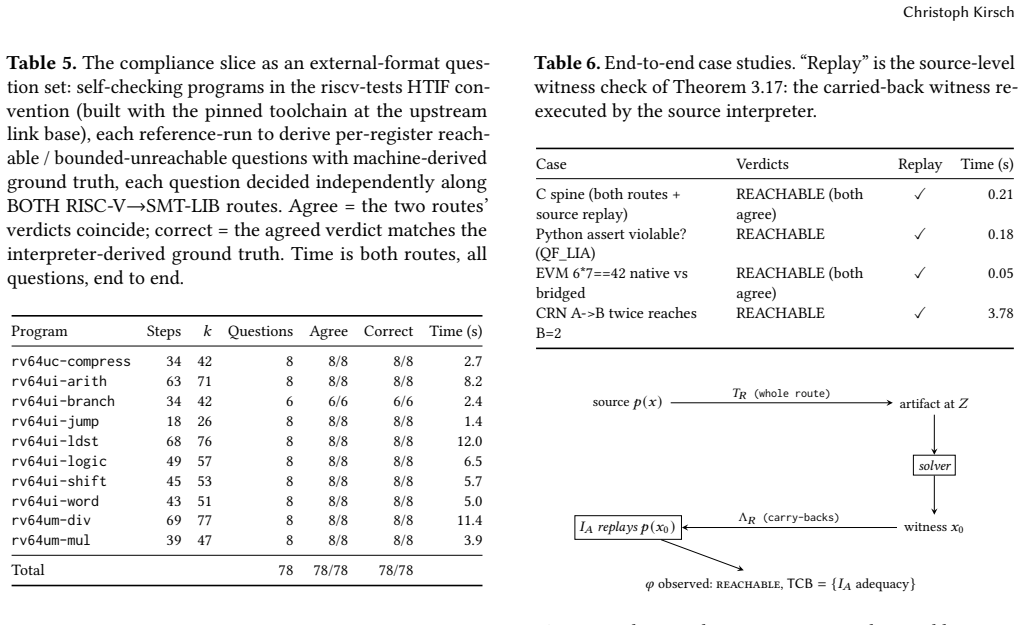
- [Figure 7] The figure's gate-stack labels are confusing: 51 killed, 0 killed, 4 killed, followed by '4 survive' and then 'escaped: 0'. The final survivor count should read 0 after the derived-benchmark gate; the current label seems to show the intermediate survivor count twice.
- [Table 3] The 'per-run' entries for predicted-grade hops are not conjoined coverage in the same sense as the other rows. Consider splitting the table or using a separate marker so the reader is not misled into comparing '96/96' with 'per-run' as if they were the same measurement.
- [§6.3] The compliance slice is a derived benchmark rather than upstream binaries taken verbatim; the paper says this plainly in the honesty notes, but the first sentence of §6.3 could state 'derived from riscv-tests under a re-created grading convention' even more prominently to avoid any impression that the upstream binaries were run unchanged.
Circularity Check
Core calculus is non-circular; two admitted by-construction cases (Python interpreter adequacy, LLM-player grading) keep the score at 3.
specific steps
-
self definitional
[§4.2 'Languages and reasoning hubs' (and §3.1, Assumption 1)]
"the Python subset against pinned CPython by construction — a circularity we note plainly: for this one language the pinned runtime is both the semantics and the interpreter, so adequacy has no independent reference"
For Python, the reference semantics ⟦·⟧_A is defined as the behavior of the pinned CPython runtime, and the interpreter I_A is the same runtime under an AST allow-list. Assumption 1 (I_A(p)=⟦p⟧_A on dom(I_A)) therefore holds by definition, not by empirical discharge. Since Theorem 3.17 reduces the trusted base for existential answers to exactly Assumption 1, the 'self-certifying' replay for Python reduces to the interpreter agreeing with itself: no independent check can fail. The paper explicitly calls this a circularity; it is a boundary case of the platform rather than of the calculus theorems, which take adequacy as an explicit hypothesis.
-
other
[§6.8 'The other direction: an LLM plays the platform' (limitations paragraph)]
"the grading is partly circular — ground truth is platform-established and arm B answers via the platform, so arm B can fail essentially only by mis-operating or misreading the tools"
The player experiment's headline result (both arms 12/12, and v2 arm B 8/8) is an evaluation claim, and its correctness criterion is ground truth established by the same platform through which arm B must answer. Success in arm B is therefore partly guaranteed by construction: the experiment measures whether the LLM can operate the platform's tools, not whether the platform's verdicts are independently correct. The paper discloses this limitation, and it affects the empirical player-ability claim rather than the formal derivation chain.
full rationale
The paper's load-bearing derivation — the directional square, pasting with the support condition, composition by componentwise meet, the existential/universal asymmetry (Theorems 3.7, 3.13, 3.14, 3.17, 3.18) — is not circular. Each theorem is stated with explicit hypotheses and mechanically checked in Lean; Theorem 3.17's proof is literally a three-token consequence of interpreter adequacy and the observed replay, so its trusted base is transparently Assumption 1. Assumption 1 is an assumption, not a derived result, and its empirical discharge against external oracles (Sail, riscv-tests, CBMC) is independent support; the MUL/ADD blind spot is a limitation of that empirical discharge, not a circular derivation. The two genuine by-construction cases are the ones the paper itself names: Python interpreter adequacy ('the pinned runtime is both the semantics and the interpreter') and the LLM-player grading ('ground truth is platform-established and arm B answers via the platform'). Both are openly disclosed, both affect specific platform/evaluation claims rather than the central calculus, and neither is disguised as an independent result. Accordingly the score is 3: not a clean 0-2, because the paper contains admitted self-definitional instances, but far from 6+, because the central trust-collapse theorem and its composition machinery do not reduce to those instances.
Axiom & Free-Parameter Ledger
free parameters (3)
- unrolling bound k (per question, chosen) =
e.g., k=25, k=505, k=60, k=30
- per-language construct inventories =
RV64IMC 96; A64 slice 33; Wasm 75; EVM 144; eBPF 126; Python subset 27; CRN 10; SMILES 17; BTOR2 56
- sampling size for specialization-commutation checks =
undisclosed in the paper
axioms (5)
- domain assumption Assumption 1: I_A(p) = ⟦p⟧_A for all p in dom(I_A)
- domain assumption Assumption 2: corroborating routes share no translator or carry-back on the diverse prefix, derived from independent semantic artifacts
- domain assumption Reference semantics are deterministic, finite-behavior functions; nondeterminism, divergence, and reactive I/O are outside scope
- ad hoc to paper Theorem 3.18(iv): translation commutes with input specialization; and (iii): solver artifacts relate to target semantics
- domain assumption Declared grade/projection/direction are trusted inputs
invented entities (3)
-
fidelity-graded translation pair (translator + interpreters + carry-back Λ + witness embedding W)
independent evidence
-
assurance classes A: none<replay<perrun<universal and grade set G
independent evidence
-
trusted-base ledger TCB(v)
independent evidence
read the original abstract
To answer a question about a program, move the program to where the question is decidable. Every such move is a translation, and every translation is a place to be wrong. We study translation as a graph -- many languages, a few reasoning targets, independently built routes of honestly different trustworthiness -- and give it a calculus: pairs of languages close commuting squares that are directional (exactness is the identity-embedding special case of over-approximation), checkable per program, and composable, a route's contract being the componentwise meet of its hops' contracts -- assurance class, direction, kept observables, measured cost. One asymmetry organizes trust: witness-carrying answers are self-certifying by replay at the source; universal answers are where grades, independent branches, and re-checked certificates earn their cost. The compositional core, lax telescope included, is mechanized in Lean 4. hurdy-gurdy implements the calculus as two planes meeting in one registry. The use plane reads declarations and produces evidence-carrying answers; its builders and its intended player are both LLMs, untrusted by construction. The evolution plane grows the graph: unmet questions are recorded as demand, pairs are recommended by evidence and registered by humans, and a ratchet keeps every prior verdict standing. Answers never write; growth never answers. Run indefinitely, the loop converges on every reducibly decidable question, at fidelity that only rises. We measure the July 2026 snapshot -- per-construct conjoined coverage, dual-route branch agreement for two ISAs, source-level witness replay, certified unreachability re-validated by a formally verified checker, escape rates for the gate itself -- and report the defects the architecture caught in its own authors' work.
Figures




Reference graph
Works this paper leans on
-
[1]
Bruno Andreotti, Hanna Lachnitt, and Haniel Barbosa. 2023. Carcara: An Efficient Proof Checker and Elaborator for SMT Proofs in the Alethe Format. InTACAS
2023
-
[2]
Gray, Robert M
Alasdair Armstrong, Thomas Bauereiss, Brian Campbell, Alastair Reid, Kathryn E. Gray, Robert M. Norton, Prashanth Mundkur, Mark Was- sell, Jon French, Christopher Pulte, Shaked Flur, Ian Stark, Neel Kr- ishnaswami, and Peter Sewell. 2019. ISA Semantics for ARMv8-A, RISC-V, and CHERI-MIPS.Proceedings of the ACM on Programming Languages3, POPL (2019), 71:1–71:31
2019
-
[3]
Algirdas Avižienis. 1985. The N-Version Approach to Fault-Tolerant Software.IEEE Transactions on Software EngineeringSE-11, 12 (1985), 1491–1501
1985
-
[4]
Dirk Beyer, Matthias Dangl, Daniel Dietsch, Matthias Heizmann, and Andreas Stahlbauer. 2015. Witness Validation and Stepwise Testifica- tion across Software Verifiers. InESEC/FSE
2015
-
[5]
Paul- son
Jasmin Christian Blanchette, Sascha Böhme, and Lawrence C. Paul- son. 2013. Extending Sledgehammer with SMT Solvers.Journal of Automated Reasoning51, 1 (2013), 109–128
2013
-
[6]
Clarke, Orna Grumberg, Somesh Jha, Yuan Lu, and Helmut Veith
Edmund M. Clarke, Orna Grumberg, Somesh Jha, Yuan Lu, and Helmut Veith. 2000. Counterexample-Guided Abstraction Refinement. InCA V (LNCS, Vol. 1855). 154–169
2000
-
[7]
Patrick Cousot and Radhia Cousot. 1977. Abstract Interpretation: A Unified Lattice Model for Static Analysis of Programs by Construction or Approximation of Fixpoints. InPOPL. 238–252
1977
-
[8]
Jean-Christophe Filliâtre and Andrei Paskevich. 2013. Why3 — Where Programs Meet Provers. InESOP
2013
-
[9]
Ronghui Gu, Jérémie Koenig, Tahina Ramananandro, Zhong Shao, Xiongnan (Newman) Wu, Shu-Chun Weng, Haozhong Zhang, and Yu Guo. 2015. Deep Specifications and Certified Abstraction Layers. In POPL
2015
-
[10]
Everett Hildenbrandt, Manasvi Saxena, Nishant Rodrigues, Xiaoran Zhu, Philip Daian, Dwight Guth, Brandon Moore, Daejun Park, Yi Zhang, Andrei Stefanescu, and Grigore Roşu. 2018. KEVM: A Complete Formal Semantics of the Ethereum Virtual Machine. InCSF
2018
-
[11]
Shoaib Kamil, Alvin Cheung, Shachar Itzhaky, and Armando Solar- Lezama. 2016. Verified Lifting of Stencil Computations. InPLDI
2016
-
[12]
Christoph M. Kirsch. 2017. Selfie and the Basics. InOnward!
2017
-
[13]
Gerwin Klein, Kevin Elphinstone, Gernot Heiser, June Andronick, David Cock, Philip Derrin, Dhammika Elkaduwe, Kai Engelhardt, Rafal Kolanski, Michael Norrish, Thomas Sewell, Harvey Tuch, and Simon Winwood. 2009. seL4: Formal Verification of an OS Kernel. In SOSP
2009
-
[14]
Knight and Nancy G
John C. Knight and Nancy G. Leveson. 1986. An Experimental Evalua- tion of the Assumption of Independence in Multiversion Programming. IEEE Transactions on Software EngineeringSE-12, 1 (1986), 96–109
1986
-
[15]
Jérémie Koenig and Zhong Shao. 2021. CompCertO: Compiling Certi- fied Open C Components. InPLDI
2021
-
[16]
Myreen, Michael Norrish, and Scott Owens
Ramana Kumar, Magnus O. Myreen, Michael Norrish, and Scott Owens
-
[17]
Robert P. Kurshan. 1994.Computer-Aided Verification of Coordinating Processes: The Automata-Theoretic Approach. Princeton University Press
1994
-
[18]
Xavier Leroy. 2009. Formal Verification of a Realistic Compiler.Com- mun. ACM52, 7 (2009), 107–115
2009
-
[19]
Lopes, Juneyoung Lee, Chung-Kil Hur, Zhengyang Liu, and John Regehr
Nuno P. Lopes, Juneyoung Lee, Chung-Kil Hur, Zhengyang Liu, and John Regehr. 2021. Alive2: Bounded Translation Validation for LLVM. InPLDI
2021
-
[20]
Jacob Matthews and Robert Bruce Findler. 2007. Operational Semantics for Multi-language Programs. InPOPL
2007
-
[21]
McConnell, Kurt Mehlhorn, Stefan Näher, and Pascal Schweitzer
Ross M. McConnell, Kurt Mehlhorn, Stefan Näher, and Pascal Schweitzer. 2011. Certifying Algorithms.Computer Science Review5, 2 (2011), 119–161
2011
-
[22]
McKeeman
William M. McKeeman. 1998. Differential Testing for Software.Digital Technical Journal10, 1 (1998), 100–107
1998
-
[23]
Myreen, Michael J
Magnus O. Myreen, Michael J. C. Gordon, and Konrad Slind. 2008. Machine-Code Verification for Multiple Architectures: An Application of Decompilation into Logic. InFMCAD
2008
-
[24]
Namjoshi
Kedar S. Namjoshi. 2001. Certifying Model Checkers. InCA V
2001
-
[25]
George C. Necula. 1997. Proof-Carrying Code. InPOPL
1997
-
[26]
George C. Necula. 2000. Translation Validation for an Optimizing Compiler. InPLDI. 27 Christoph Kirsch
2000
-
[27]
Georg Neis, Chung-Kil Hur, Jan-Oliver Kaiser, Craig McLaughlin, Derek Dreyer, and Viktor Vafeiadis. 2015. Pilsner: A Compositionally Verified Compiler for a Higher-Order Imperative Language. InICFP
2015
-
[28]
Aina Niemetz, Mathias Preiner, Clifford Wolf, and Armin Biere. 2018. Btor2, BtorMC and Boolector 3.0. InCA V
2018
-
[29]
Perconti and Amal Ahmed
James T. Perconti and Amal Ahmed. 2014. Verifying an Open Compiler Using Multi-language Semantics. InESOP
2014
-
[30]
Amir Pnueli, Michael Siegel, and Eli Singerman. 1998. Translation Validation. InTACAS
1998
-
[31]
Brian Randell. 1975. System Structure for Software Fault Tolerance. IEEE Transactions on Software EngineeringSE-1, 2 (1975), 220–232
1975
-
[32]
1999.Credible Compilation
Martin Rinard and Darko Marinov. 1999.Credible Compilation. Tech- nical Report MIT-LCS-TR-776. MIT Laboratory for Computer Science
1999
-
[33]
Grigore Roşu and Traian Florin Şerbănuţă. 2010. An Overview of the K Semantic Framework.Journal of Logic and Algebraic Programming 79, 6 (2010), 397–434
2010
-
[34]
John Rushby. 2005. An Evidential Tool Bus. InICFEM
2005
-
[35]
Saltzer, David P
Jerome H. Saltzer, David P. Reed, and David D. Clark. 1984. End-to-End Arguments in System Design.ACM Transactions on Computer Systems 2, 4 (1984), 277–288
1984
-
[36]
Michael Sammler, Simon Spies, Youngju Song, Emanuele D’Osualdo, Robbert Krebbers, Deepak Garg, and Derek Dreyer. 2023. DimSum: A Decentralized Approach to Multi-language Semantics and Verification. Proceedings of the ACM on Programming Languages7, POPL (2023)
2023
-
[37]
Schlichting and Fred B
Richard D. Schlichting and Fred B. Schneider. 1983. Fail-Stop Proces- sors: An Approach to Designing Fault-Tolerant Computing Systems. ACM Transactions on Computer Systems1, 3 (1983), 222–238
1983
-
[38]
Myreen, and Gerwin Klein
Thomas Arthur Leck Sewell, Magnus O. Myreen, and Gerwin Klein
-
[39]
Gordon Stewart, Lennart Beringer, Santiago Cuellar, and Andrew W. Appel. 2015. Compositional CompCert. InPOPL
2015
-
[40]
Chuyue Sun, Ying Sheng, Oded Padon, and Clark Barrett. 2024. Clover: Closed-Loop Verifiable Code Generation.arXiv preprint arXiv:2310.17807(2024)
Pith/arXiv arXiv 2024
-
[41]
Yong Kiam Tan, Marijn J. H. Heule, and Magnus O. Myreen. 2021. cake_lpr: Verified Propagation Redundancy Checking in CakeML. In TACAS
2021
-
[42]
Jean-Baptiste Tristan and Xavier Leroy. 2008. Formal Verification of Translation Validators: A Case Study on Instruction Scheduling Optimizations. InPOPL
2008
-
[43]
Tjark Weber, Sylvain Conchon, David Déharbe, Matthias Heizmann, Aina Niemetz, and Giles Reger. 2019. The SMT Competition 2015– 2018.Journal on Satisfiability, Boolean Modeling and Computation11, 1 (2019), 221–259
2019
-
[44]
Nathan Wetzler, Marijn J. H. Heule, and Warren A. Hunt Jr. 2014. DRAT-trim: Efficient Checking and Trimming Using Expressive Clausal Proofs. InSAT
2014
-
[45]
Claire Wolf. 2019. riscv-formal: A Framework for RISC-V Formal Verification.https://github.com/YosysHQ/riscv-formal
2019
-
[46]
Xuejun Yang, Yang Chen, Eric Eide, and John Regehr. 2011. Finding and Understanding Bugs in C Compilers. InPLDI
2011
-
[47]
Emily Yu, Armin Biere, and Keijo Heljanko. 2021. Progress in Certify- ing Hardware Model Checking Results. InCA V. A Proofs A.1 Pasting (Theorem 3.7) We spell out the chain, including the domain side conditions elided in the paper’s proof sketch. Let 𝑝∈dom(𝑃 2◦𝑃 1), i.e.𝑝∈dom(𝐼 𝐴)∩dom(𝑇 1),𝑞 :=𝑇 1(𝑝) ∈dom(𝑇 2),𝑟 := 𝑇2(𝑞),𝐼𝐶(𝑟) defined, Λ2(𝐼𝐶(𝑟))∈dom(Λ 1),...
2021
-
[50]
By faithfulness of 𝑃1 at𝑝 and 𝜋⊆𝜋 1, 𝜋(𝐼𝐴(𝑝))= 𝜋(Λ 1(𝐼𝐵(𝑞)))
-
[51]
By faithfulness of𝑃 2 at𝑞:𝜋 2(𝐼𝐵(𝑞))=𝜋 2(Λ2(𝐼𝐶(𝑟)))
-
[52]
By (𝜋2⇒𝜋) -support applied to step (2):𝜋(Λ 1(𝐼𝐵(𝑞)))= 𝜋(Λ 1(Λ2(𝐼𝐶(𝑟))))
Both𝐼𝐵(𝑞) and Λ2(𝐼𝐶(𝑟)) lie in dom(Λ 1) (the first by 𝑝∈dom(𝑃 1), the second by 𝑝∈dom(𝑃 2◦𝑃 1)). By (𝜋2⇒𝜋) -support applied to step (2):𝜋(Λ 1(𝐼𝐵(𝑞)))= 𝜋(Λ 1(Λ2(𝐼𝐶(𝑟))))
-
[53]
This form is machine-checked (lax_pasting; telescoped, DRoute
Chaining (1) and (3): 𝜋(𝐼𝐴(𝑝))=𝜋(Λ 1(Λ2(𝐼𝐶(𝑟)))) , which is faithfulness of𝑃 2◦𝑃 1 at𝑝w.r.t.𝜋.□ Directional pairs.For pairs with a non-identity witness embedding (Theorem 3.4), the same four steps run per closing valuation, the three legs closed at 𝑥,𝑊1(𝑝,𝑥) , and 𝑊2(𝑇1(𝑝),𝑊 1(𝑝,𝑥)) ; the composite’s square is then faithful- ness along𝑊2◦𝑊 1, with directi...
-
[2013]
Translation Validation for a Verified OS Kernel. InPLDI
-
[2014]
CakeML: A Verified Implementation of ML. InPOPL
discussion (0)
Sign in with ORCID, Apple, or X to comment. Anyone can read and Pith papers without signing in.