REVIEW 4 major objections 6 minor 124 references
A Khuri-Treiman model seeded by contact plus pion-exchange terms describes the exotic π1→3π signal and determines the relative strength and phase of the two production mechanisms.
Reviewed by Pith at T0; open to challenge. T0 means a machine referee read the full paper against a public rubric. the ladder, T0–T4 →
T0 review · deepseek-v4-flash
2026-08-02 02:30 UTC pith:SSAO3UPI
load-bearing objection First global KT fit to π1→3π with production Born terms; the Deck/contact separation is provisional because the single-channel elastic Omnes input is not under control at the top of the fitted range. the 4 major comments →
Production Effects and Final-state Interactions in π₁ to 3π
The pith
A machine-rendered reading of the paper's core claim, the machinery that carries it, and where it could break.
Core claim
The central claim is that the precise shape of the ρ meson peak inside the π1→3π decay is diagnostic of the production mechanism. In the proposed formalism, the isobar amplitude is the solution of a Khuri-Treiman integral equation whose driving term is a coherent sum of a constant short-range term and the pion-exchange Deck term, with no arbitrary subtraction polynomial. A global fit of this two-term amplitude to the freed-isobar data describes the Dalitz plots and extracts the bin-dependent complex normalizations; these turn out to be smooth functions of the 3π invariant mass with a pronounced peak at 1.6 GeV, and the relative phase between contact and Deck terms is nearly -π for most of th
What carries the argument
The Khuri-Treiman (KT) formalism, a dispersive framework that enforces two-body unitarity, analyticity, and crossing symmetry in three-body decays by iterating pairwise ππ rescattering to all orders. The core object is the unitarized isobar F(t, m²₃π; σ) expressed as a sum of two basis functions, F₁ (from a contact driving term) and F_Δ (from the P-wave projected one-pion-exchange Deck term), multiplied by complex normalizations N_c, N_d and exponential t-slopes. The basis functions are precomputed on a grid and the normalizations are fitted bin-by-bin, so that the only free parameters carry direct physical meaning as the strengths and phases of the two production mechanisms.
Load-bearing premise
The entire analysis rests on the assumption that the 3π dynamics in the 1 to 2.5 GeV region are governed by elastic two-body ππ rescattering, with a phase shift extrapolated to δ(∞)=π, and that genuine three-body forces and inelastic channels can be neglected.
What would settle it
Compute the same π1→3π amplitude with an independent method (e.g., a full three-body unitary coupled-channel calculation) and check whether the resulting ρ lineshape deformations match the KT predictions; if the data require a substantial three-body force, the extracted N_c and N_d curves would shift and the identification of the two production mechanisms would change.
If this is right
- The relative phase and strengths of the two production terms are fixed by data, showing almost-total destructive interference that persists over a wide mass range.
- The extracted m3π-dependent normalizations provide a model-based amplitude that can be analytically continued to search for the π1 pole, moving beyond simple bump-hunting.
- The method can be exported to other partial waves and processes, such as photoproduction, where the same production mechanisms are expected to appear.
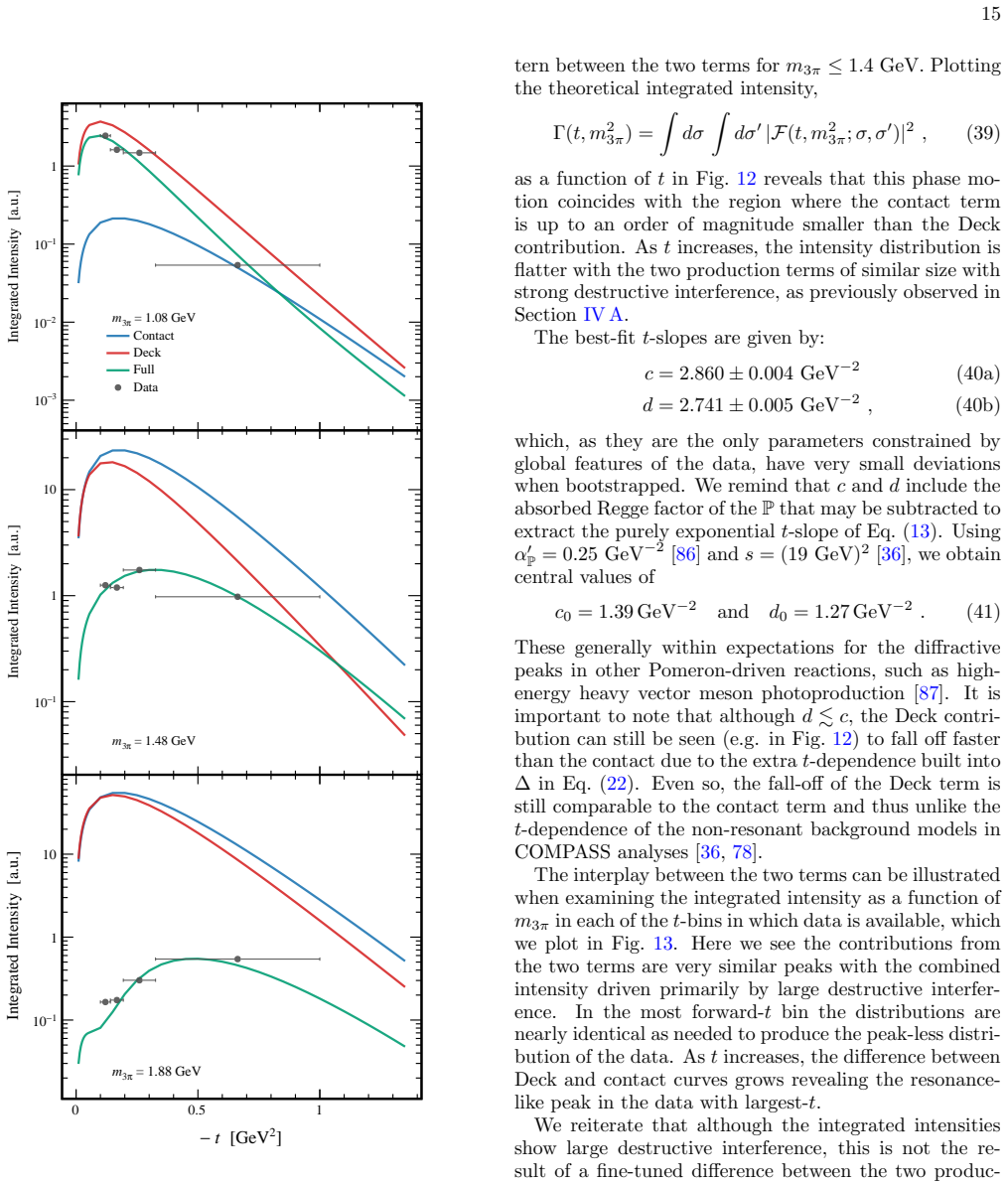
- The fit indicates that once production effects are included, the residual data-model discrepancies are uniform across the Dalitz plot, so the large χ² is likely dominated by underestimated experimental uncertainties rather than a missing dynamical feature.
Where Pith is reading between the lines
- Inference: If the 1.6 GeV peak in the normalizations indeed corresponds to a resonance, the near-constant -π phase difference between the two mechanisms means that the π1 couples to both contact and Deck production with opposite relative signs; this pattern could serve as a cross-check when pole parameters are extracted.
- Inference: The smooth extraction without any explicit continuity constraint is a strong consistency check; a more stringent test would be to extend the fit to the two lowest-mass bins (m3π ≈ 1.0 GeV) with an energy-dependent ρ mass, since the present model fails there with χ²/dof > 15.
- Inference: The formalism's reliance on elastic ππ rescattering could be tested by introducing an explicit three-body force term and observing whether the extracted N_c and N_d distributions change shape; a substantial shift would signal that genuine three-body dynamics are non-negligible.
Editorial analysis
A structured set of objections, weighed in public.
Referee Report
Summary. The paper extends the Khuri-Treiman formalism for the π1 → 3π amplitude in the J^PC = 1^-+ [ππ]_{1--} π P-wave to include two physically motivated production mechanisms: a short-range contact term and a one-pion-exchange Deck term. The KT equations are solved with these Born terms as driving terms, producing two precomputable basis functions F1 and FΔ, and the full amplitude is written as Eq. (30) with per-m3π bin normalizations and two common t-slopes. The model is fitted to COMPASS freed-isobar data on the 4-dimensional intensity (m3π, t, σa, σb), yielding smooth bin-wise normalizations that peak near 1.6 GeV, a relative phase close to -π, and t-slopes consistent with diffractive production. The authors interpret the extraction as evidence for a coherent superposition of contact and Deck production and as a stepping stone toward a future π1 pole extraction.
Significance. If the extraction is robust, this is a significant step: it provides the first production-aware, unitarized amplitude for the π1 → 3π channel that is directly comparable to the freed-isobar data, and it identifies the Deck mechanism as an essential ingredient beyond the standard subtraction-polynomial KT approach. Strengths of the paper include the transparent linear decomposition into parameter-free basis functions, the careful discussion of the isobar ambiguity and its resolution through the σ-dependent Deck term, and the use of a bootstrap procedure to estimate parameter uncertainties. The numerical convergence of the KT iteration and the public COMPASS data comparison make the analysis reproducible in principle. However, the quantitative claims rest on a fit with χ²/dof ≈ 3–4 and on an elastic single-channel Omnes function whose high-energy phase is acknowledged to be arbitrary; these issues must be addressed before the production-mechanism identification can be considered established.
major comments (4)
- [Section IV B, Fig. 11 and Tables I–II] The global fit yields χ²/dof ≈ 3.91 and bin-wise χ²/nσ values ranging from ~2 to above 10. The paper argues that the pull distributions show no systematic structure, but a χ²/dof of 4 with no systematics means the quoted parameter values (N_c, N_d, phase) are not statistically meaningful as a quantitative extraction. The bootstrap rescaling in Appendix E uses the local distance to the best-fit model as a proxy for systematics; this is not a substitute for an actual estimate of the freed-isobar analysis systematics. I recommend either obtaining systematic uncertainties from COMPASS or demonstrating that the extracted N_c,N_d distributions are stable under alternative weighting or under removal of the worst-fitting bins. Without this, the central identification of contact vs Deck production is not established at the claimed precision.
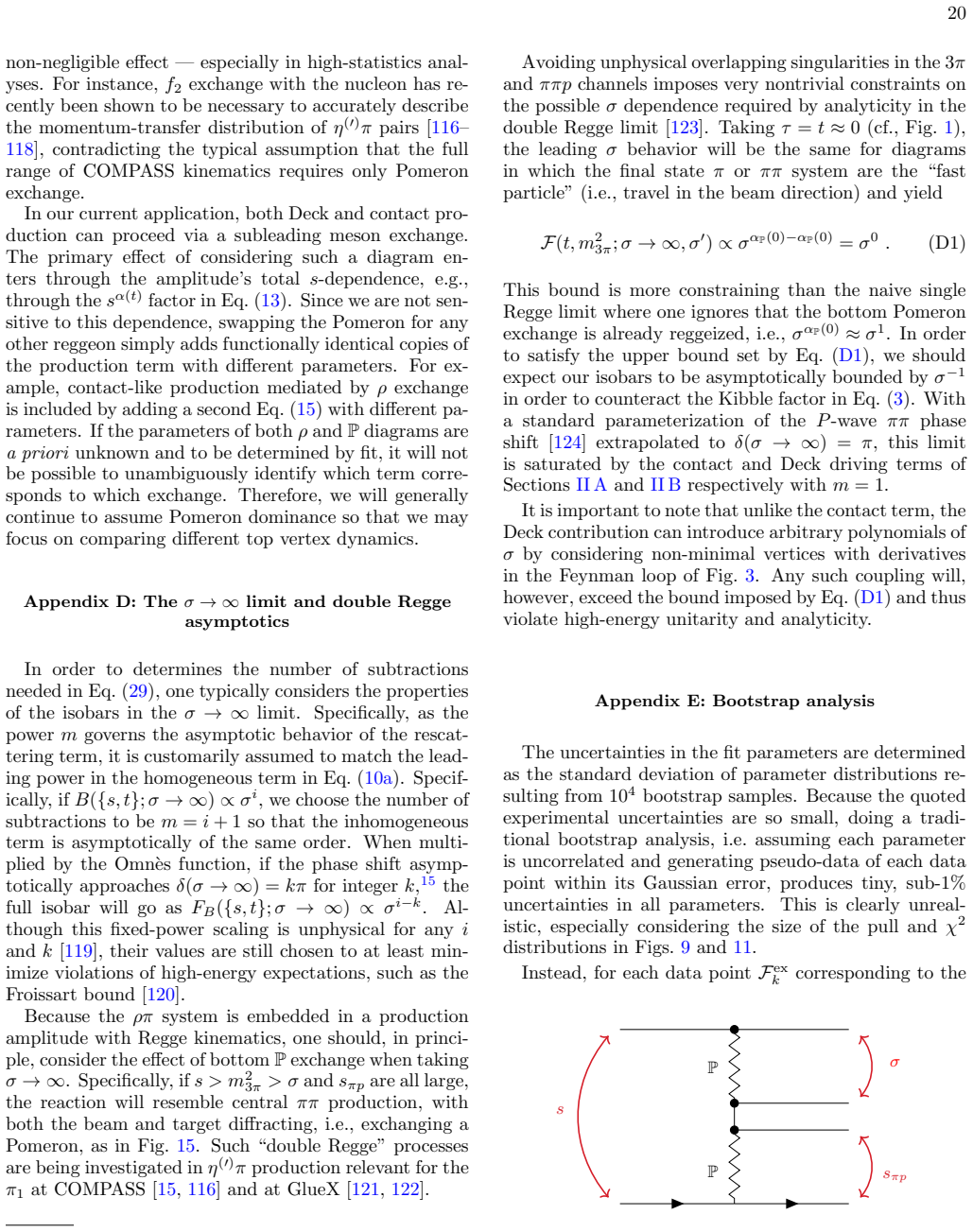
- [Section III, Eq. (29), and Appendix D] The KT equation is solved with a single-channel Omnes function built from the elastic ππ P-wave phase shift of Ref. [124], extrapolated to δ(∞)=π. The data extend to m3π = 2.48 GeV, well into the region of strong ππ inelasticity (KKbar, ρ(1450), etc.). Appendix D explicitly states that the asymptotic phase choice is 'largely arbitrary'. Since the Deck basis function FΔ is generated by iterating this Omnes kernel, any inelastic contribution or a different δ∞ will modify the σ-dependence of both basis functions and can be partially absorbed into the fitted N_c and N_d. The near-π relative phase and the 1.6 GeV peak in Fig. 10 are therefore contingent on this unchecked assumption. Please provide a concrete test of the sensitivity to δ∞ and to inelastic effects, for example by repeating the fit with a coupled-channel or inelasticity-modified Omnes function, and quantify the resulting shifts
- [Section IV B, bin exclusions] The two lowest m3π bins (0.96 and 1 GeV) are excluded because the nominal ρ mass appears shifted by ~30 MeV in these bins and the fits to them have χ²/dof > 15. This post-hoc exclusion is concerning because the low-mass region is precisely where the extracted |N_d| shows an apparent zero around 1.3 GeV and where the contact term is small. The paper should justify this exclusion more rigorously: for example, show that including these bins with an additional parameter (e.g., a small mass shift or a third production term) does not alter the main conclusions about the 1.6 GeV peak and the phase. As it stands, the reported smoothness of the normalizations is partly a consequence of the data selection.
- [Section II C and Eq. (32)] The conversion of the freed-isobar bin coefficients into 2D amplitudes relies on the zero-mode function Z(σ) being known with negligible uncertainty. The paper states this assumption but does not quantify it. If Z(σ) has non-negligible uncertainties, the reconstructed intensities and hence all fit parameters would shift. Please either provide a quantitative statement of the Z(σ) uncertainties from Ref. [36] or propagate them through the bootstrap. This is a load-bearing step in the data comparison.
minor comments (6)
- [Title and abstract] The title has a typographical issue: 'Production Effects and Final-state Interactions inπ 1 →3π' should have spaces around 'π'. Also, the abstract uses 'freed-isobar' but Section V uses 'free-isobar'; please unify.
- [Eq. (38)] The summation limits are unclear: '4n3π X k=0' presumably should be k=1 to 4n3π. Please clarify the indexing convention.
- [Section IV versus Appendix E] The main text says 10^3 pseudo-data sets are used for the 1D uncertainty estimates, while Appendix E says 10^4 bootstrap samples. Please make the numbers consistent and specify which number applies to Fig. 10.
- [Appendix references] In the text, references to 'Section B', 'Section C', and 'Section D' point to appendices. Use 'Appendix B' etc. for clarity.
- [Fig. 10] The error bars are too small to be visible. Please state explicitly that the uncertainties are smaller than the symbol size, or plot them on a log scale or with insets to make them visible.
- [Eq. (22) and surrounding text] The definition of ζ after Eq. (22) is written in a somewhat compressed way; expanding the relation between ζ, τ(0), |q|, and |k| would improve readability.
Circularity Check
No significant circularity: the KT basis functions are parameter-free inputs from external ππ phase shifts and a fixed Deck projection; the fitted normalizations are honest fit outputs, not predictions.
full rationale
The derivation chain is self-contained. The production Born terms are fixed functions: the contact term B_Contact in Eq. (15) and the Deck term B_Deck in Eq. (24), with Δ defined by the projected one-pion-exchange loop in Eq. (22). These Born terms enter the KT equation (29), whose kernel and Omnès function are constructed from the external ππ P-wave phase shift [124]. The basis functions F1 and FΔ are then precomputed with no free parameters, as stated in Sec. III A: “the basis functions contain no free parameters, they can be precomputed on an arbitrary grid of kinematic variables.” The only fitted quantities are the complex normalizations N_c, N_d and the t-slopes c, d in Eq. (30), which are compared with the COMPASS freed-isobar Dalitz data. The conclusion that the coherent CD model describes the data better than contact-only or Deck-only models is an empirical fit comparison, not a prediction derived from the same fitted parameters. The extracted smooth m3π dependence of |N_c| and |N_d| in Fig. 10 is explicitly a fit output, and the paper does not claim it as a parameter-free prediction; it even emphasizes that pole identification is left for future work. Appendix D acknowledges the elastic-unitarity extrapolation δ(∞)=π is “largely arbitrary,” and Sec. III A flags that the diagnostic statement holds “to the extent that we the isobar approximation holds and we can ignore inelastic effects.” These are stated assumptions or correctness risks, not circularity, because altering them changes inputs rather than revealing that an output was an input by construction. The self-citations (e.g., JPAC formalism, Refs. [52,59]) supply the general KT machinery and are not used to define or forbid the production strengths; under the review rules they do not raise the circularity score.
Axiom & Free-Parameter Ledger
free parameters (5)
- Per-bin contact normalizations |N_{c,k}|, k=1..36 =
Not tabulated; plotted in Fig. 10, peak near 1.6 GeV
- Per-bin Deck normalizations |N_{d,k}|, k=1..36 =
Not tabulated; plotted in Fig. 10, apparent zero near 1.3 GeV
- Per-bin relative phase φ_d − φ_c, k=1..36 =
Near −π for most bins; monotonic increase at low m3π (Fig. 10)
- Contact t-slope c =
2.860 ± 0.004 GeV^-2 (c0 = 1.39 after subtracting α'_P log s)
- Deck t-slope d =
2.741 ± 0.005 GeV^-2 (d0 = 1.27 after subtracting α'_P log s)
axioms (9)
- domain assumption Isobar approximation: 3π amplitude dominated by pairwise ππ P-wave interactions, giving the crossing-symmetric form of Eq. (5).
- domain assumption Elastic two-body unitarity of the ππ P-wave with a single-channel Omnes function; inelastic channels ignored.
- ad hoc to paper External ππ phase shift input from Ref. [124], with extrapolation δ(∞)=π.
- ad hoc to paper Double-Regge upper bound fixes the number of subtractions m=1.
- domain assumption Production is saturated by a Pomeron-mediated contact term plus a one-pion-exchange Deck term; ρ, f2, spin-flip, and other exchanges are negligible or absorbable.
- domain assumption s-channel helicity conservation at the nucleon vertex and sπp≈s in the single-Regge regime.
- domain assumption The COMPASS freed-isobar coefficients are related to the true intensity through the zero-mode function Z(σ) with negligible uncertainty.
- domain assumption Isospin limit and neglect of isospin breaking.
- domain assumption The left-hand-cut branch point of Δ is sufficiently far from the physical region and integration contour.
read the original abstract
We investigate the $\pi_1(1600)$ signal channel of $3\pi$ in the $J^{PC} = 1^{-+} \,[\pi\pi]_{1^{--}}\pi~P$-wave. This channel has recently been analyzed by the COMPASS collaboration using the ``freed-isobar" technique which provides direct experimental access to the lineshape modifications of the $P$-wave $\pi\pi$ sub-channel arising from both final state interactions and production processes such as the Deck mechanism. We motivate a unified formalism combining production effects and final state interactions using the Khuri-Treiman formalism, which is consistent with low-energy unitarity, analyticity, and crossing symmetry, seeded by an initial production amplitude. We demonstrate that the precise lineshape of the $\pi\pi$ mass spectrum can be used to determine the relative strength and complex phase of different production mechanisms contributing to the $3\pi$ final state. We conduct a global fit of the $\pi_1$ freed-isobar data set, yielding a multi-dimensional parameterization of the $\pi_1\to3\pi$ decay amplitude at COMPASS as a function of both decay and production variables. We identify the contributions from short-range production and the Deck mechanism and extract the total $3\pi$ invariant mass dependence which will be important for a future extraction of the $\pi_1$ pole position in the $\rho\pi$ channel.
Figures






Reference graph
Works this paper leans on
-
[1]
D. R. Thompsonet al.(E852), Phys. Rev. Lett.79, 1630 (1997), arXiv:hep-ex/9705011
Pith/arXiv arXiv 1997
-
[2]
S. U. Chunget al.(E852), Phys. Rev. D60, 092001 (1999), arXiv:hep-ex/9902003
Pith/arXiv arXiv 1999
-
[3]
G. S. Adamset al.(E862), Phys. Lett. B657, 27 (2007), arXiv:hep-ex/0612062
Pith/arXiv arXiv 2007
-
[4]
Abeleet al.(Crystal Barrel), Phys
A. Abeleet al.(Crystal Barrel), Phys. Lett. B423, 175 (1998)
1998
-
[5]
E. I. Ivanovet al.(E852), Phys. Rev. Lett.86, 3977 (2001), arXiv:hep-ex/0101058
Pith/arXiv arXiv 2001
-
[6]
Y. A. Khokhlov (VES), Nucl. Phys. A663, 596 (2000)
2000
-
[7]
Horn and J
D. Horn and J. Mandula, Phys. Rev. D17, 898 (1978)
1978
-
[8]
Isgur and J
N. Isgur and J. E. Paton, Phys. Rev. D31, 2910 (1985)
1985
-
[9]
M. S. Chanowitz and S. R. Sharpe, Nucl. Phys. B 222, 211 (1983), [Erratum: Nucl.Phys.B 228, 588–588 (1983)]
1983
-
[10]
Barnes, F
T. Barnes, F. E. Close, and F. de Viron, Nucl. Phys. B 224, 241 (1983)
1983
-
[11]
J. J. Dudek, R. G. Edwards, P. Guo, and C. E. Thomas (Hadron Spectrum), Phys. Rev. D88, 094505 (2013), arXiv:1309.2608 [hep-lat]
Pith/arXiv arXiv 2013
-
[12]
A. J. Woss, J. J. Dudek, R. G. Edwards, C. E. Thomas, and D. J. Wilson (Hadron Spectrum), Phys. Rev. D 103, 054502 (2021), arXiv:2009.10034 [hep-lat]
Pith/arXiv arXiv 2021
-
[13]
C. A. Meyer and Y. Van Haarlem, Phys. Rev. C82, 025208 (2010), arXiv:1004.5516 [nucl-ex]
Pith/arXiv arXiv 2010
-
[14]
C. A. Meyer and E. S. Swanson, Prog. Part. Nucl. Phys. 82, 21 (2015), arXiv:1502.07276 [hep-ph]
Pith/arXiv arXiv 2015
-
[15]
C. Adolphet al.(COMPASS), Phys. Lett. B740, 303 (2015), [Erratum: Phys.Lett.B 811, 135913 (2020)], arXiv:1408.4286 [hep-ex]
Pith/arXiv arXiv 2015
-
[16]
A. Rodaset al.(JPAC), Phys. Rev. Lett.122, 042002 (2019), arXiv:1810.04171 [hep-ph]
Pith/arXiv arXiv 2019
-
[17]
Albrechtet al.(Crystal Barrel), Eur
M. Albrechtet al.(Crystal Barrel), Eur. Phys. J. C80, 453 (2020), arXiv:1909.07091 [hep-ex]
Pith/arXiv arXiv 2020
-
[18]
B. Kopf, M. Albrecht, H. Koch, M. K¨ ußner, J. Py- chy, X. Qin, and U. Wiedner, Eur. Phys. J. C81, 1056 (2021), arXiv:2008.11566 [hep-ph]
Pith/arXiv arXiv 2021
-
[19]
F. Afzalet al.(GlueX), Phys. Rev. Lett.133, 261903 (2024), arXiv:2407.03316 [nucl-ex]
Pith/arXiv arXiv 2024
-
[20]
M. Mai and M. Doring, Phys. Rev. Lett.122, 062503 (2019), arXiv:1807.04746 [hep-lat]
Pith/arXiv arXiv 2019
-
[21]
R. A. Brice˜ no, M. T. Hansen, A. W. Jackura, R. G. Edwards, and C. E. Thomas, (2025), arXiv:2510.24894 [hep-lat]
arXiv 2025
-
[22]
M. T. Hansen, R. A. Brice˜ no, R. G. Edwards, C. E. Thomas, and D. J. Wilson (Hadron Spectrum), Phys. Rev. Lett.126, 012001 (2021), arXiv:2009.04931 [hep- 22 600 650 700 | cN|0 0.5 1 1.5 2 2.5 3 3 10×Entries 3.04 −3.02 −3 −2.98 −2.96 −c φ − dφ0 0.5 1 1.5 2 2.5 3 3 10×Entries FIG. 17. Bootstrapped distributions of the|N c|(left) and the phase difference (r...
Pith/arXiv arXiv 2021
-
[23]
T. D. Blanton, F. Romero-L´ opez, and S. R. Sharpe, Phys. Rev. Lett.124, 032001 (2020), arXiv:1909.02973 [hep-lat]
Pith/arXiv arXiv 2020
-
[24]
M. Fischer, B. Kostrzewa, L. Liu, F. Romero-L´ opez, M. Ueding, and C. Urbach, Eur. Phys. J. C81, 436 (2021), arXiv:2008.03035 [hep-lat]
Pith/arXiv arXiv 2021
-
[25]
S. M. Dawid, Z. T. Draper, A. D. Hanlon, B. H¨ orz, C. Morningstar, F. Romero-L´ opez, S. R. Sharpe, and S. Skinner, Phys. Rev. D112, 014505 (2025), arXiv:2502.17976 [hep-lat]
Pith/arXiv arXiv 2025
-
[26]
H. Yan, M. Mai, M. Garofalo, U.-G. Meißner, C. Liu, L. Liu, and C. Urbach, Phys. Rev. Lett.133, 211906 (2024), arXiv:2407.16659 [hep-lat]
Pith/arXiv arXiv 2024
-
[27]
H. Yan, M. Mai, M. Garofalo, Y. Feng, M. D¨ oring, C. Liu, L. Liu, U.-G. Meißner, and C. Urbach, (2025), arXiv:2510.09476 [hep-lat]
Pith/arXiv arXiv 2025
-
[28]
M. Mai, A. Alexandru, R. Brett, C. Culver, M. D¨ oring, F. X. Lee, and D. Sadasivan (GWQCD), Phys. Rev. Lett.127, 222001 (2021), arXiv:2107.03973 [hep-lat]
Pith/arXiv arXiv 2021
-
[29]
C. Culver, M. Mai, R. Brett, A. Alexandru, and M. D¨ oring, Phys. Rev. D101, 114507 (2020), arXiv:1911.09047 [hep-lat]
Pith/arXiv arXiv 2020
-
[30]
A. W. Jackura, Phys. Rev. D108, 034505 (2023), arXiv:2208.10587 [hep-lat]
Pith/arXiv arXiv 2023
-
[31]
A. W. Jackura, S. M. Dawid, C. Fern´ andez-Ram ´ ırez, V. Mathieu, M. Mikhasenko, A. Pilloni, S. R. Sharpe, and A. P. Szczepaniak, Phys. Rev. D100, 034508 (2019), arXiv:1905.12007 [hep-ph]
Pith/arXiv arXiv 2019
-
[32]
B. Ketzer, B. Grube, and D. Ryabchikov, Prog. Part. Nucl. Phys.113, 103755 (2020), [Erra- tum: Prog.Part.Nucl.Phys. 128, 104000 (2023)], arXiv:1909.06366 [hep-ex]
Pith/arXiv arXiv 2020
-
[33]
C. Adolphet al.(COMPASS), Phys. Rev. D95, 032004 (2017), arXiv:1509.00992 [hep-ex]
Pith/arXiv arXiv 2017
-
[34]
F. Krinner, D. Greenwald, D. Ryabchikov, B. Grube, and S. Paul, Phys. Rev. D97, 114008 (2018), arXiv:1710.09849 [hep-ph]
Pith/arXiv arXiv 2018
-
[35]
Krinner,Freed-Isobar Partial-Wave Analysis, Ph.D
F. Krinner,Freed-Isobar Partial-Wave Analysis, Ph.D. thesis, Munich, Tech. U. (2018)
2018
-
[36]
M. G. Alexeevet al.(COMPASS), Phys. Rev. D105, 012005 (2022), arXiv:2108.01744 [hep-ex]
Pith/arXiv arXiv 2022
-
[37]
N. N. Khuri and S. B. Treiman, Phys. Rev.119, 1115 23 (1960)
1960
-
[38]
P. Guo, I. V. Danilkin, C. Fern´ andez-Ram ´ ırez, V. Math- ieu, and A. P. Szczepaniak, Phys. Lett. B771, 497 (2017), arXiv:1608.01447 [hep-ph]
Pith/arXiv arXiv 2017
-
[39]
I. V. Danilkin, C. Fern´ andez-Ram ´ ırez, P. Guo, V. Math- ieu, D. Schott, M. Shi, and A. P. Szczepaniak, Phys. Rev. D91, 094029 (2015), arXiv:1409.7708 [hep-ph]
Pith/arXiv arXiv 2015
-
[40]
F. Niecknig, B. Kubis, and S. P. Schneider, Eur. Phys. J. C72, 2014 (2012), arXiv:1203.2501 [hep-ph]
Pith/arXiv arXiv 2014
-
[41]
A. Garcia-Lorenzo, M. Albaladejo, S. Gonzlez-Solis, N. Hammoud, V. Mathieu, G. Montana, A. Pilloni, D. Winney, and A. P. Szczepaniak (JPAC), (2025), arXiv:2505.15309 [hep-ph]
Pith/arXiv arXiv 2025
-
[42]
V. Bernard, S. Descotes-Genon, M. Knecht, and B. Moussallam, Eur. Phys. J. C84, 744 (2024), arXiv:2403.17570 [hep-ph]
Pith/arXiv arXiv 2024
-
[43]
M. Albaladejoet al.(JPAC), Phys. Rev. D108, 014035 (2023), arXiv:2304.09736 [hep-ph]
Pith/arXiv arXiv 2023
-
[44]
M. Albaladejo, I. Danilkin, S. Gonzalez-Solis, D. Win- ney, C. Fernandez-Ramirez, A. N. H. Blin, V. Mathieu, M. Mikhasenko, A. Pilloni, and A. Szczepaniak (JPAC), Eur. Phys. J. C80, 1107 (2020), arXiv:2006.01058 [hep- ph]
Pith/arXiv arXiv 2020
-
[45]
G. Colangelo, S. Lanz, H. Leutwyler, and E. Passemar, Eur. Phys. J. C78, 947 (2018), arXiv:1807.11937 [hep- ph]
Pith/arXiv arXiv 2018
-
[46]
X.-H. Cao, F.-K. Guo, C. Hanhart, and B. Kubis, (2025), arXiv:2512.00501 [hep-ph]
Pith/arXiv arXiv 2025
- [47]
-
[48]
I. J. R. Aitchison and R. Pasquier, Phys. Rev.152, 1274 (1966)
1966
-
[49]
I. J. R. Aitchison, J. Phys. G3, 121 (1977)
1977
-
[50]
Pasquier and J
R. Pasquier and J. Y. Pasquier, Phys. Rev.170, 1294 (1968)
1968
-
[51]
Pasquier and J
R. Pasquier and J. Y. Pasquier, Phys. Rev.177, 2482 (1969)
1969
-
[52]
M. Mikhasenko, Y. Wunderlich, A. Jackura, V. Math- ieu, A. Pilloni, B. Ketzer, and A. P. Szczepaniak, JHEP 08, 080, arXiv:1904.11894 [hep-ph]
Pith/arXiv arXiv 1904
-
[53]
D. Stamen, T. Isken, B. Kubis, M. Mikhasenko, and M. Niehus, Eur. Phys. J. C83, 510 (2023), [Erratum: Eur.Phys.J.C 83, 586 (2023)], arXiv:2212.11767 [hep- ph]
Pith/arXiv arXiv 2023
-
[54]
R. T. Deck, Phys. Rev. Lett.13, 169 (1964)
1964
-
[55]
Ascoli, L
G. Ascoli, L. M. Jones, B. Weinstein, and H. W. Wyld, Phys. Rev. D8, 3894 (1973)
1973
-
[56]
Ascoli, R
G. Ascoli, R. Cutler, L. M. Jones, U. Kruse, T. Roberts, B. Weinstein, and H. W. Wyld, Phys. Rev. D9, 1963 (1974)
1963
-
[57]
Aaron, R
R. Aaron, R. S. Longacre, and J. E. Sacco, Annals Phys. 117, 56 (1979)
1979
-
[58]
J. L. Basdevant and E. L. Berger, Phys. Rev. D16, 657 (1977)
1977
-
[59]
M. Albaladejo, D. Winney, I. V. Danilkin, C. Fern´ andez- Ram ´ ırez, V. Mathieu, M. Mikhasenko, A. Pilloni, J. A. Silva-Castro, and A. P. Szczepaniak (JPAC), Phys. Rev. D101, 054018 (2020), arXiv:1910.03107 [hep-ph]
Pith/arXiv arXiv 2020
-
[60]
T. W. B. Kibble, Phys. Rev.117, 1159 (1960)
1960
-
[61]
P. D. B. Collins,An Introduction to Regge Theory and High Energy Physics(Cambridge University Press, 1977)
1977
-
[62]
V. N. Gribov,The theory of complex angular momenta: Gribov lectures on theoretical physics, Cambridge Mono- graphs on Mathematical Physics (Cambridge University Press, 2007)
2007
-
[63]
D. Stamen, D. Winney, A. Rodas, C. Fern´ andez- Ram ´ ırez, V. Mathieu, G. Monta˜ na, A. Pilloni, and A. P. Szczepaniak, Phys. Rev. D110, 114023 (2024), arXiv:2409.09172 [hep-ph]
Pith/arXiv arXiv 2024
-
[64]
M. Hoferichter, B. Kubis, S. Leupold, F. Niecknig, and S. P. Schneider, Eur. Phys. J. C74, 3180 (2014), arXiv:1410.4691 [hep-ph]
Pith/arXiv arXiv 2014
-
[65]
A. Jackura, C. Fern´ andez-Ram ´ ırez, V. Mathieu, M. Mikhasenko, J. Nys, A. Pilloni, K. Salda˜ na, N. Sher- rill, and A. P. Szczepaniak (JPAC), Eur. Phys. J. C79, 56 (2019), arXiv:1809.10523 [hep-ph]
Pith/arXiv arXiv 2019
-
[66]
S. M. Dawid, M. H. E. Islam, and R. A. Brice˜ no, Phys. Rev. D108, 034016 (2023), arXiv:2303.04394 [nucl-th]
Pith/arXiv arXiv 2023
-
[67]
Omnes, Nuovo Cim.8, 316 (1958)
R. Omnes, Nuovo Cim.8, 316 (1958)
1958
-
[68]
N. I. Muskhelishvili,Singular Integral Equations (Wolters-Noordhoff Publishing, 1958)
1958
-
[69]
J. Stern, H. Sazdjian, and N. H. Fuchs, Phys. Rev. D 47, 3814 (1993), arXiv:hep-ph/9301244
Pith/arXiv arXiv 1993
-
[70]
M. Albaladejo and B. Moussallam, Eur. Phys. J. C77, 508 (2017), arXiv:1702.04931 [hep-ph]
Pith/arXiv arXiv 2017
-
[71]
F. E. Close and G. A. Schuler, Phys. Lett. B464, 279 (1999), arXiv:hep-ph/9905305
Pith/arXiv arXiv 1999
-
[72]
L. Lesniak and A. P. Szczepaniak, Acta Phys. Polon. B 34, 3389 (2003), arXiv:hep-ph/0304007
Pith/arXiv arXiv 2003
-
[73]
Jackuraet al.(JPAC, COMPASS), Phys
A. Jackuraet al.(JPAC, COMPASS), Phys. Lett. B 779, 464 (2018), arXiv:1707.02848 [hep-ph]
Pith/arXiv arXiv 2018
- [74]
-
[75]
V. Mathieu, J. Nys, C. Fern´ andez-Ram ´ ırez, A. Jackura, A. Pilloni, N. Sherrill, A. P. Szczepaniak, and G. Fox (JPAC), Phys. Rev. D97, 094003 (2018), arXiv:1802.09403 [hep-ph]
Pith/arXiv arXiv 2018
-
[76]
A. Aktaset al.(H1), Eur. Phys. J. C46, 585 (2006), arXiv:hep-ex/0510016
Pith/arXiv arXiv 2006
-
[77]
M. Derricket al.(ZEUS), Z. Phys. C69, 39 (1995), arXiv:hep-ex/9507011
Pith/arXiv arXiv 1995
-
[78]
M. Aghasyanet al.(COMPASS), Phys. Rev. D98, 092003 (2018), arXiv:1802.05913 [hep-ex]
Pith/arXiv arXiv 2018
-
[79]
Passarino and M
G. Passarino and M. J. G. Veltman, Nucl. Phys. B160, 151 (1979)
1979
-
[80]
T. Hahn and M. Perez-Victoria, Comput. Phys. Com- mun.118, 153 (1999), arXiv:hep-ph/9807565
Pith/arXiv arXiv 1999
discussion (0)
Sign in with ORCID, Apple, or X to comment. Anyone can read and Pith papers without signing in.