REVIEW 4 major objections 6 minor 12 references
Pre-training a multimodal masked autoencoder on unlabeled data from a single deployment environment matches or beats internet-scale generalist pre-training on tasks in that environment.
Reviewed by Pith at T0; open to challenge. T0 means a machine referee read the full paper against a public rubric. the ladder, T0–T4 →
Pre-training on unlabeled multimodal data from the deployment environment alone lets a vision model match or exceed internet-scale generalists on tasks in that environment.
T0 review reviewed 2026-08-02 challenge →
load-bearing objection A genuinely new setup with a plausible core result, but the headline claim overstates how 'test-only' the main pipeline is; the ScanNet++ win over DINOv2 needs the no-semantic ablation to be trusted. the 4 major comments →
Multimodality as Supervision: Self-Supervised Specialization to the Test Environment via Multimodality
The pith
A machine-rendered reading of the paper's core claim, the machinery that carries it, and where it could break.
The reading
Core claim
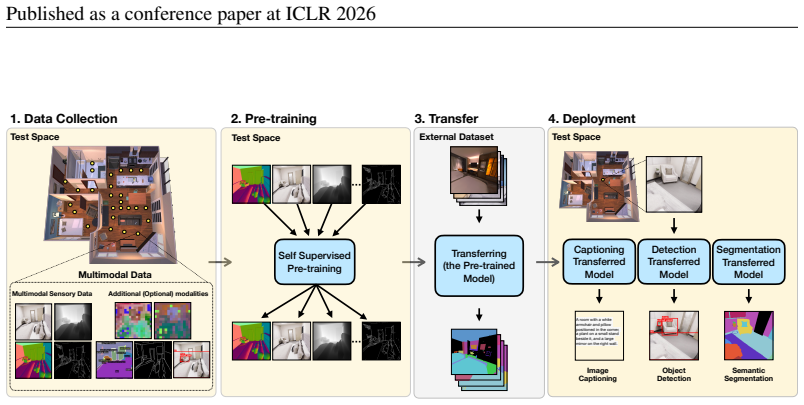
Test-Space Training (TST) is the paper's framework: collect unlabeled multimodal data from the test environment, pre-train a multimodal masked autoencoder to predict masked tokens of one modality from others, then fine-tune the encoder on a small external transfer set and evaluate in the test space. Its central discovery is that TST-MM, a ViT-B model pre-trained this way on test-space data, outperforms generalist pre-training (DINOv2, CLIP, 4M-21) and task specialist baselines on semantic segmentation, object detection, and captioning in the same test space, even when started from scratch and without text pre-training. When the modality dictionary is expanded with pseudo-modalities — outputs
What carries the argument
The central mechanism is a multimodal masked autoencoder trained with cross-modal predictive coding: each image in the test space is accompanied by several aligned modalities, some tokens are masked, and the model must reconstruct them from the visible tokens. The paper treats the modality dictionary as the main design lever; it includes hardware-derived modalities (RGB, depth, surface normals, edges) and, in the full TST-MM variant, pseudo-modalities produced by off-the-shelf networks (CLIP, ImageBind, SAM edges, ViTDet boxes, Mask2Former masks). This machinery converts the test space into a self-supervised training signal: predicting one sensor's response from another forces the representa
Load-bearing premise
The headline comparison holds only if mixing unlabeled RGB from the transfer set into pre-training and using task-family pseudo-labels (segmentation masks, boxes, edges) as target modalities are neutral choices rather than a form of task leakage.
What would settle it
Re-run the Table 1 evaluation with two changes: exclude the transfer-set RGB mix-in from pre-training (App. L) and drop all semantic pseudo-modalities — segmentation masks, boxes, edges (App. O) — keeping only hardware modalities. If the resulting TST models no longer exceed internet-pretrained generalists on test-space segmentation and detection, the claim that cross-modal learning from test-space data replaces external data is falsified. Compare across seeds and datasets with error bars.
If this is right
- A device that can collect multimodal data in its deployment environment may no longer need internet-scale pre-training data to be competitive on tasks in that environment; modality-rich local data can substitute for external data volume.
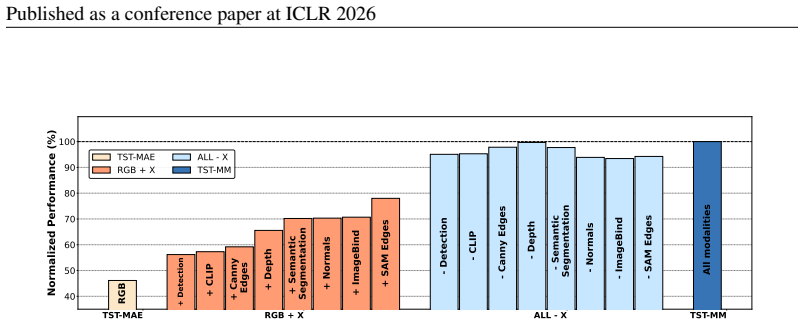
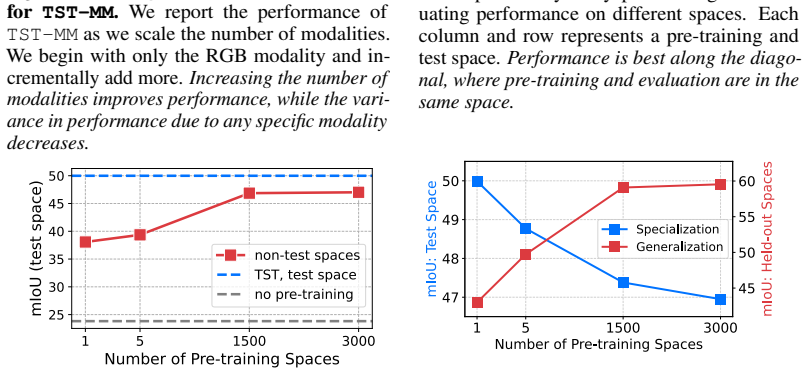
- Scaling the number of modalities within the test space yields larger gains than scaling unimodal data from external spaces, so richer sensor suites produce disproportionately better specialized models.
- Pre-training on the exact test space outperforms pre-training on thousands of similar but non-identical spaces, so deployment-specific data has an intrinsic value that cannot be replicated by scale alone.
- The same framework works as an adaptation mechanism: starting from an internet-pretrained generalist and fine-tuning it on test-space multimodal data improves its performance in that space.
- With a fixed total data/compute budget, adding external spaces improves held-out generalization while reducing test-space performance — a specialization-generalization tradeoff that can be dialed by choosing the mix of test-space and external data.
Where Pith is reading between the lines
- If the substitution of modalities for data holds, the natural extension is to non-visual sensors (IMU, microphone, radar), which the paper lists but does not evaluate; the principle would predict that any time-locked, physically aligned signal should carry similar self-supervised value.
- The paper's setup points toward an on-device loop — collect multimodal data, distill pseudo-modalities locally, and fine-tune a small specialist — that would avoid sending user data to a central server; only the data-collection piece of this loop is demonstrated.
- Because TST-MM outperforms the very internet-trained models whose outputs it uses as pseudo-modalities, the result suggests that distilling several pre-trained teachers on local data can yield a student that beats each teacher in that local distribution; if this 'local distillation beats global teachers' pattern holds, it could apply beyond vision, for instance to fine-tuning a language model on a
- The specialization-generalization tradeoff implies a deployment-time dial: a manufacturer could decide how much of a device's pre-training budget to spend on the user's specific space versus a generic corpus, depending on whether the device is expected to move between environments; the paper does not explore this product-level consequence.
Editorial analysis
A structured set of objections, weighed in public.
Referee Report
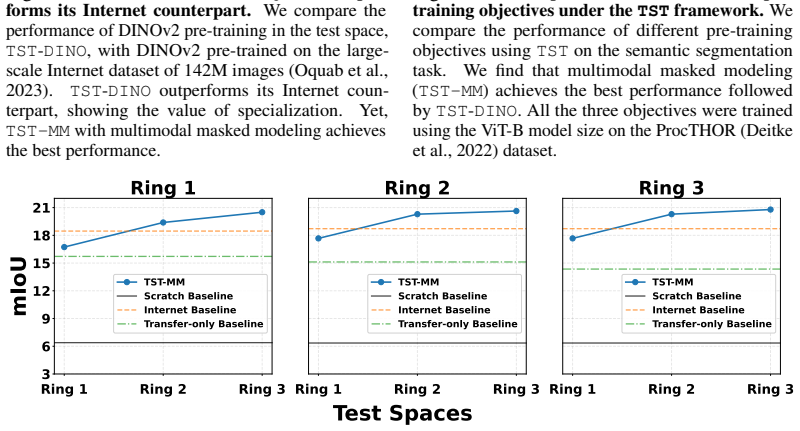
Summary. The paper proposes Test-Space Training (TST), a self-supervised specialization framework in which a model is pre-trained on unlabeled multimodal data collected in the deployment environment and then fine-tuned on a small external labeled transfer set for downstream tasks in that environment. Using multimodal masked modeling (TST-MM), the authors report that on ScanNet++, Replica, and ProcTHOR, test-space pre-training with sensory modalities alone is competitive with internet-scale baselines (Fig. 3, Fig. 11), and that when pseudo-label modalities from CLIP, ImageBind, SAM, ViTDet, and Mask2Former are added, TST-MM outperforms DINOv2, 4M-21, and task specialists on several segmentation/detection benchmarks (Tab. 1). Additional analyses examine modality scaling vs. external data scaling (Fig. 4), robustness to removal of individual modalities (Fig. 5), specialization-generalization tradeoffs (Fig. 9), continual learning and test-time training (Apps. S, T). The paper also releases code and an iOS sensor-collection app.
Significance. If the results hold, TST is a useful demonstration that deployment-specific pre-training can substitute for large internet pre-training in constrained environments, with practical implications for privacy and edge deployment. The controlled sandbox is a good idea, and the paper includes many useful ablations: Fig. 4, Fig. 5, App. L, App. O, App. T, and cross-modal retrieval results. Reproducibility artifacts (code, iOS app, detailed hyperparameters in App. W) are a strength. However, the headline claim depends on a configuration that mixes external transfer-set RGB into pre-training and uses task-aligned pseudo-label outputs as pre-training targets; the no-external-access result (sensor-only) is less strong and is not the configuration highlighted in the abstract. The contribution is therefore more nuanced than the abstract suggests, and requires re-scoping or additional experiments to be fully established.
major comments (4)
- [Abstract; Sec. 4.1; App. L] The abstract's phrase 'only from the test environment' is not supported by the main TST-MM configuration. Sec. 4.1 reports that 'mixing RGB images from the transfer was beneficial in pre-training,' and App. L (Tab. 4) shows the best configuration mixes transfer-set RGB with test-space data. The pure test-space row ('Test Space ✓ / Transfer ✗') gives 50.21 mIoU, but the headline results in Tab. 1 use the mixed configuration. Footnote 2 in Sec. 1 acknowledges external dependence, but the abstract and the 'TST vs generalists' section still attribute the gains to test-space-only cross-modal learning. Please either report Tab. 1 under test-space-only data or revise the abstract to distinguish the sensor-only 'no external access' claim from the mixed/pseudo-label claim.
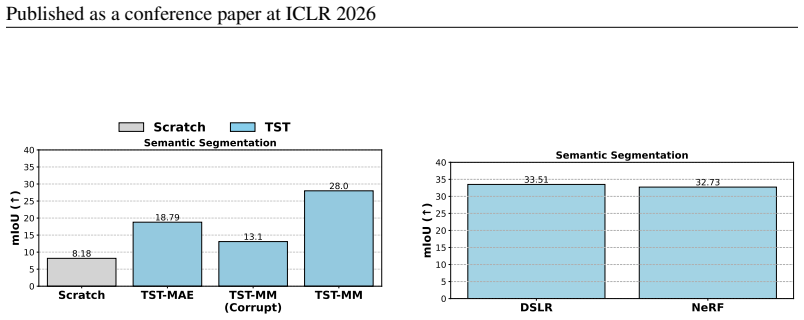
- [Sec. 4.3; App. O; Tab. 1] The headline comparison in Tab. 1 uses pseudo-label modalities from internet-trained, task-aligned networks: Mask2Former semantic masks, ViTDet boxes, and SAM edges. Pre-training to predict these outputs is a form of distillation of the same task families used in evaluation, not a neutral sensory modality. The only ablation that removes all such semantic modalities (App. O, Tab. 6) is on ProcTHOR, where TST-MM retains an edge over 4M-21 (55.39 vs 53.24 mIoU; 45.97 vs 41.43 mAP). This experiment should be repeated on ScanNet++ and Replica; without it, the ScanNet++ advantage over DINOv2 (34.49 vs 30.60) cannot be attributed to cross-modal learning rather than task-specific pseudo-label distillation.
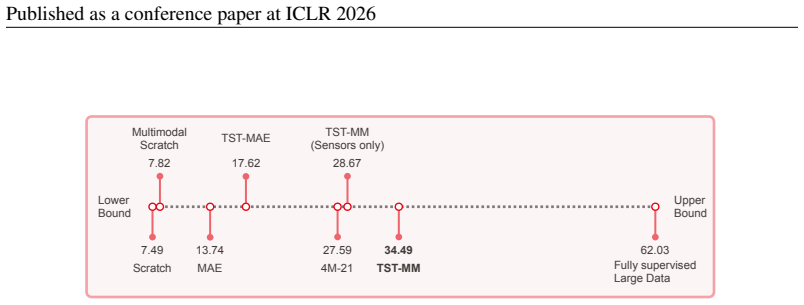
- [Tab. 1; Tabs. 3, 4, 6; Fig. 4] No error bars or multi-seed results are reported for any table. The main comparisons rest on modest margins (e.g., 34.49 vs 30.60 in Tab. 1; 50.21 vs 46.12 in Tab. 4; 28.67 vs 27.59 in Fig. 11). Since the paper's own analyses show sensitivity to sampling ratio (App. U) and modality composition (Fig. 5), the 'outperforms' wording is not statistically supported. Please provide mean and standard deviation over at least three seeds for the headline results, or clearly state that only one seed was used and discuss the implications for margins of this size.
- [Sec. 4.4; Fig. 4] The claim that 'scaling modalities in the test space can substitute external data' is tested only against additional ProcTHOR houses that are IID with the test space (750 or 3000 synthetic spaces). This is not the same regime as internet-scale diverse data (e.g., 142M images for DINOv2, CC12M for 4M-21). The result is interesting, but the conclusion in Sec. 4.4 generalizes beyond the tested distribution. Please restrict the claim to IID external data or include a comparison against a more heterogeneous external source.
minor comments (6)
- [Title] The rendered title 'MULTIMODALITY ASSUPERVISION' appears to be missing a space; correct to 'MULTIMODALITY AS SUPERVISION'.
- [Fig. 3] The bars are not annotated with exact values, making it difficult to verify the claim of being 'competitive' with DINOv2. Adding value labels or a small table would improve clarity.
- [Fig. 4] The circle sizes are not accompanied by a numeric legend or table. Since the claim is quantitative, please provide the exact mIoU values for each modality-count/space-count combination.
- [Fig. 11] The 'Fully supervised Large Data' upper bound is not defined in the text. Please specify how many images and what supervision protocol were used to produce this number.
- [App. O, Tab. 6] The table is difficult to parse because the checkmarks and row/column headers are ambiguous. Please reformat so the modality set for each method is unambiguous.
- [Throughout] There are several citation/typo issues: Sec. 2 cites 'et al., 2020' with no author name; App. J contains 'Thi suggests' instead of 'This suggests'; and some references such as 'Bachmann et al., 2023' are not clearly tied to the text. Please proofread the bibliography and inline citations.
Circularity Check
Headline TST-MM comparisons are partly by construction: the modality set includes same-task pseudo-labels (Mask2Former masks, ViTDet boxes); the paper acknowledges this as distillation, and the only ablation removing semantic modalities is on ProcTHOR, not the ScanNet++/DINOv2 comparison.
specific steps
-
fitted input called prediction
[Sec. 4.3 (Additional Modalities), Table 1, App. O]
"We create new modalities by pseudolabeling the collected RGB frames. We use neural network feature maps (Radford et al., 2021; Girdhar et al., 2023), SAM edges (Kirillov et al., 2023), bounding boxes from ViTDet (Li et al., 2022), and semantic segmentation masks from Mask2Former (Cheng et al.). ... Note that TST-MM, which leverages these additional modalities, no longer qualifies for no external access, as it is akin to distilling the off-the-shelf pseudolabeling networks which were trained on large-scale external data."
The headline Tab. 1 result supporting the abstract's 'competitive with generalist models' claim uses a modality set that includes outputs of internet-trained models for the exact task families used in downstream evaluation (semantic segmentation masks, detection boxes). Pre-training on test-space RGB to predict these targets means the representation is explicitly optimized to produce segmentation/detection-style outputs on test-space images, so the later segmentation/detection transfer is partly measuring reproduction of the teacher's task outputs rather than an emergent property of cross-modal sensory learning. The paper itself labels this 'distilling' and admits it does not qualify for 'no external access.' The only ablation removing these semantic modalities (App. O, Tab. 6) is reported
full rationale
There is no equation-level circularity, no fitted parameter renamed as a prediction, and no load-bearing self-citation chain in this paper. The 4M/MultiMAE self-citations are implementation and baseline references, not uniqueness arguments. The main circularity-adjacent issue is that the headline TST-MM configuration uses pseudo-labels from models trained for the same tasks as the evaluation (segmentation, detection), which makes part of the downstream performance a distillation effect rather than a purely emergent cross-modal property. The paper is transparent about this, and the sensors-only results (Sec. 4.2, Fig. 3) plus the ProcTHOR ablation without semantic modalities (App. O) provide independent evidence that test-space pre-training has value. The transfer-set RGB mix-in is acknowledged in a footnote and App. L, so the abstract's 'only from the test environment' phrasing is an overclaim/validity concern rather than a derivation-level circularity. On balance, the central claim retains independent content, but the featured ScanNet++/DINOv2 comparison is partially entangled with same-task pseudo-label targets, giving a moderate circularity score of 4.
Axiom & Free-Parameter Ledger
free parameters (3)
- Transfer-set RGB mix-in during pre-training =
on (with 1/1 sampling ratio for ViT-S; Tab. 8)
- Modality dictionary composition =
9 modalities: RGB, depth, normals, Canny, CLIP, ImageBind, SAM edges, ViTDet boxes, Mask2Former masks
- Test/transfer sampling ratio =
1/1 (base), 1/1 best for small
axioms (4)
- domain assumption Multimodal masked modeling (Bachmann et al. 2024) with mixture masking is an effective self-supervised objective for learning transferable representations.
- ad hoc to paper Pseudo-label outputs of internet-trained networks (CLIP, ImageBind, SAM, ViTDet, Mask2Former) can be treated as neutral 'modalities' without leaking downstream task supervision.
- domain assumption The agent has access to a sensory sampling function x∼p_space(x) that densely covers the test space, and the test space is the same during pre-training and evaluation.
- domain assumption A small labeled transfer set Dt from an external space is available for fine-tuning.
Cite this review
Pith. "Pith review of Multimodality as Supervision: Self-Supervised Specialization to the Test Environment via Multimodality." pith.science (2026). https://pith.science/paper/Q2G56H23
@misc{pith2026260714721,
  author       = {Pith},
  title        = {Pith review of: Multimodality as Supervision: Self-Supervised Specialization to the Test Environment via Multimodality},
  year         = {2026},
  howpublished = {\url{https://pith.science/paper/Q2G56H23}},
  note         = {Machine review of arXiv:2607.14721}
}
read the original abstract
Cross-modal learning, i.e., learning to predict one modality from another, is a fundamental mechanism for self-supervision via leveraging multimodality. Many practical applications, e.g., deploying a household robot, involve devices that are equipped with a rich set of sensors that enable multimodal sensing in their test environment. This presents an opportunity to apply cross-modal learning to the multimodal data sensed by these devices to learn representations. Findings in developmental psychology also suggest that biological agents leverage it to build an effective representation of their surroundings. To study this, we propose a controlled setup, where we restrict a user device to just a given test environment. It results in a specialization setup where we attempt to develop a performant model for this specific test environment. Under this setup, we develop Test-Space Training (TST), which performs multimodal data collection in the test environment and performs self-supervised pre-training on it. We evaluate these models on various downstream tasks in the same environment. Under this setup, we find various interesting insights, such as collecting rich multimodal data only from the test environment and leveraging cross-modal learning, we can achieve competitive results with generalist models (e.g., DINOv2 and CLIP) pre-trained on large-scale internet datasets. This enables an alternative scenario where the need for external Internet-scale datasets for pre-training models is reduced. We also present a set of analyses and ablations that raise intriguing points on substituting data with (multi)modality, and how varying pre-training data enables a tradeoff between a model's abilities to specialise to a test environment, and generalize to held-out spaces.
Figures









Reference graph
Works this paper leans on
-
[1]
• Pre-training dataset.We use 8 Scannet++ (Yeshwanth et al., 2023) scenes as our test space
Scannet++(Yeshwanth et al., 2023) is a large dataset of real-world indoor spaces containing sub-millimeter resolution laser scans, paired with DSLR and iPhone RGB images. • Pre-training dataset.We use 8 Scannet++ (Yeshwanth et al., 2023) scenes as our test space. We use a mix of iPhone and DSLR images for pre-training, with the iPhone containing 19165samp...
2023
-
[2]
Replica(Straub et al., 2019) provides high quality 3D reconstructions of real indoor spaces. • Pre-training dataset.We use Omnidata (Eftekhar et al., 2021), to densely sample Replica meshes corresponding to the 5 scenes to build our pre-training dataset, DP T, containing 84889 samples. We defer the details of the sampling procedure to Omnidata (Eftekhar e...
2019
-
[3]
We use 5 procedurally generated houses as our test space
ProcTHOR(Deitke et al., 2022) It includes procedurally generated house-like environments. We use 5 procedurally generated houses as our test space. • Pre-training dataset.We randomly sample various agent x, y, zpositions and orientations along its axis in the test space, and collect RGB-D images at these points. This sampling process yields a total of 163...
2022
-
[4]
**Spatial Positioning**: Describe all objects' positions and spatial relationships as visible in the image and ground-truth information to help locate them accurately. If multiple objects are present in the image (as indicated in ground-truth information), explicitly mention their count and explain their positional relationships with other objects in the image
-
[5]
Strictly avoid adding information about objects unless you are certain
**No Hallucinations!** Each generated concise caption must agree with the actual contents shown in the provided image. Strictly avoid adding information about objects unless you are certain. Only utilize the information visible in the image and the provided ground-truth class information. I will provide both the original image and the image with overlaid ...
2023
-
[7]
Exact training settings are provided in Tab
framework. Exact training settings are provided in Tab. 12. We evaluate object detection in the 8https://github.com/facebookresearch/dinov2 34 Published as a conference paper at ICLR 2026 Configuration Small Base Training length (ntokens) 100B Warmup length (ntokens) 10B Optimizer AdamW (Loshchilov & Hutter, 2019) Opt. momentum β1, β2 = 0.9,0.95 Base lear...
2026
-
[8]
Each caption must cover the global scene context and prominent objects
**Global Context but Concise**: The caption should be objective, describing the prominent objects and their spatial relationships within the scene. Each caption must cover the global scene context and prominent objects
-
[9]
Bounding box information is in the format `(upper left x coordinate, upper left y coordinate, width, height)`
**Use of Ground-Truth Classes**: Along with each image, ground-truth classes and bounding box information are provided. Bounding box information is in the format `(upper left x coordinate, upper left y coordinate, width, height)`. Use bounding box information for correct spatial relationships (such as left side, right side, top, below, etc.) between objects
-
[10]
**Bounding Boxes and Class Labels Visualized in Image**: The bounding boxes and class names are overlaid on the image, showing each detected class for better localization
-
[2019]
Minwoo Byeon, Beomhee Park, Haecheon Kim, Sungjun Lee, Woonhyuk Baek, and Saehoon Kim
doi: 10.1109/ARITH.2019.00022. Minwoo Byeon, Beomhee Park, Haecheon Kim, Sungjun Lee, Woonhyuk Baek, and Saehoon Kim. COYO- 700M: Image-text pair dataset.https://github.com/kakaobrain/coyo-dataset, 2022. Zhaowei Cai and Nuno Vasconcelos. Cascade R-CNN: Delving into high quality object detection.2018 IEEE/CVF Conference on Computer Vision and Pattern Recog...
arXiv 2019
-
[2022]
The results are presented in Tab
test space. The results are presented in Tab. 2. We also present qualitative examples in Fig. 14. Note that given our method TST-MM has access to the test space, it can retrieve RGB to Depth and Depth to RGB much more effectively than models based on external data like the Internet. We find that TST-MM substantially outperforms 4M-21 (Bachmann et al., 202...
2024
-
[2023]
have enabled realistic renderings of indoor spaces, opening up the potential for generating synthetic training data. In TST, we leverage existing indoor scene datasets (Yeshwanth et al., 2023; Straub et al., 2019), which include real RGB images captured with DSLR/iPhone cameras or rendered from 3D meshes, to develop specialized models for specific test sp...
arXiv 2023
This paper was first reviewed by deepseek-v4-flash on August 2, 2026.
discussion (0)
Sign in with ORCID, Apple, or X to comment. Anyone can read and Pith papers without signing in.