REVIEW 3 major objections 5 minor 56 references
This paper argues that structural-engineering LLM agents should be judged by the chain of executable artifacts they produce — model, validation records, solver outputs, code-check results, report — not by the final answer alone, and provide
Reviewed by Pith at T0; open to challenge. T0 means a machine referee read the full paper against a public rubric. the ladder, T0–T4 →
T0 review · deepseek-v4-flash
2026-08-02 00:45 UTC pith:EQRT7ENW
load-bearing objection A useful, unusually transparent systems/benchmark paper whose headline claim about artifact-centered evaluation being more rigorous than final-answer scoring isn't actually tested—the experiments compare two agent workflows under the same artifact assertions. the 3 major comments →
StructureClaw: Traceable LLM Agents and an Executable Benchmark for Structural Engineering Workflows
The pith
A machine-rendered reading of the paper's core claim, the machinery that carries it, and where it could break.
Core claim
The discovery, stated on the paper's own terms, is that an LLM engineering agent can be evaluated reliably only over the complete evidence chain, not over a single output. Success is defined conjunctively: a scenario passes only when all required assertions over routing, artifact existence and reference-fixture matching, backend execution, safe interaction, and reporting hold in one run. The measured consequence is a 31.8-point mean lift from generic-only execution (56.8%) to the full automatic workflow (88.6%) across ten configurations on the same 50 standard scenarios, with every configuration improving. The same diagnostics show invalid-value cases succeeding at 70.9% versus 91.0% overall
What carries the argument
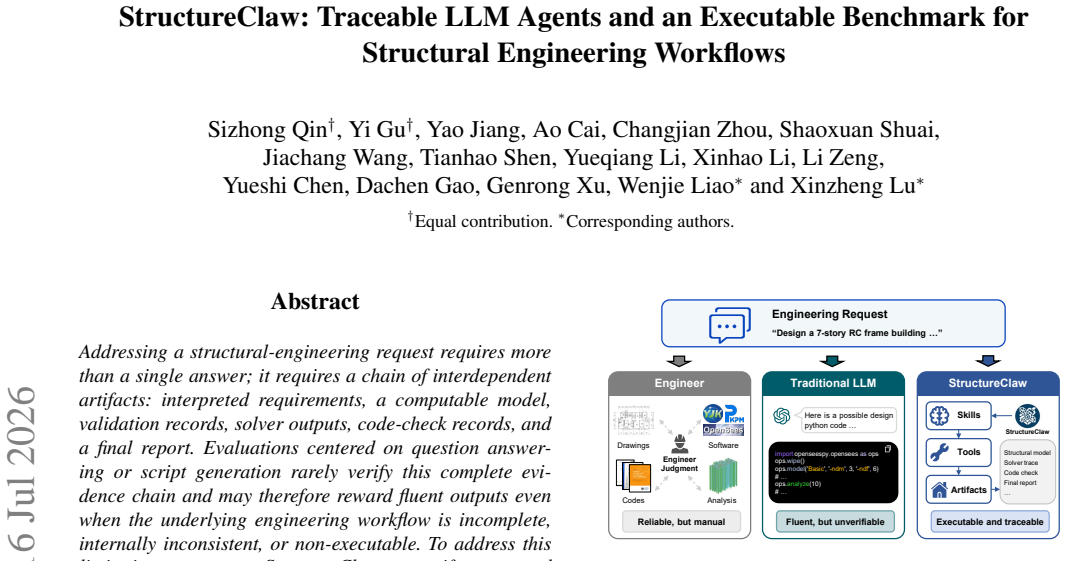
The central mechanism is the evidence chain: a linked sequence of typed artifacts — structural model, validation diagnostics, solver traces, code-check records, report — plus tool-call records, carried in shared artifact state across a reasoning–action execution loop. Domain skills declare triggers, input and output schemas, validation requirements, backend constraints, and artifact contracts; typed tools enforce runtime preconditions; provider bindings connect tool contracts to analysis backends. Evaluation uses typed assertions whose conjunction defines Success Rate, with negative evidence required for safety cases so that abstaining without a recorded reason does not count as success.
Load-bearing premise
The whole evaluation rests on the assumption that the benchmark's acceptance rules recognize engineering validity well enough that a passing scenario is actually a competent workflow — but the matching rule checks only lower-bound counts, coordinate spans within about half a meter, and total load within about twenty percent, and the report judge is an LLM with no reported human agreement.
What would settle it
Take any scenario, alter only model topology or support conditions so that an engineer would reject the result while node and element counts, coordinate spans, and total load still satisfy the fixture; if the agent's run still passes, the benchmark's claim to workflow-level rigor is contradicted. A systematic version is to have qualified engineers review all 150 scenarios' passing traces and measure agreement with the automated pass/fail labels.
If this is right
- Engineering agents should be scored by whether their trace supports the reported result, not by the plausibility of their prose; a fluent answer without a matching solver or code-check record should count as a failure.
- Structured domain skills as a system can move mean end-to-end success from roughly 57% to 89% on well-specified design-to-analysis requests across the evaluated models.
- Assertion diagnostics localize improvements: deterministic pre-execution checks for invalid numerical inputs and inspectable intermediate representations for image and DXF reconstruction are the two concrete intervention points the data exposes.
- Aggregate gains are not uniform; continuous-beam cases regress, so release criteria should include structure-family checks alongside mean Success Rate.
Where Pith is reading between the lines
- The evidence-chain criterion is portable: any discipline where a conclusion is valid only through an artifact trail — mechanical, civil, or architectural design — could reuse the same conjunctive-assertion setup, with the same failure-localization benefits the paper demonstrates for structures.
- The coarse matching rules are a lower-bound instrument; adding topology, support-equivalence, and member-by-member checks would make success harder to earn and would likely lower the quoted 88.6% figure, but it would also bring the benchmark closer to what a reviewing engineer accepts.
- Because every configuration–scenario pair is executed once, the quoted rates are single-attempt estimates; repeated runs would convert Success Rate into a distribution and could expose agents whose reliability is lower than their mean suggests.
Editorial analysis
A structured set of objections, weighed in public.
Referee Report
Summary. The paper introduces StructureClaw, an artifact-centered workbench for structural-engineering LLM agents, and StructureClaw-Bench, an executable benchmark of 150 scenarios. Success is defined as passing a conjunction of typed assertions over routing, artifacts, execution, interaction, and reporting in a single run (Eq. 1/5). On 50 standard cases, the bundled automatic workflow reaches 88.6% mean Success Rate versus 56.8% for a generic-only configuration, a 31.8-point gain. The paper also presents interactive-robustness and multimodal-reconstruction results and reports a continuous-beam regression in automatic mode. The central claim is that artifact-centered evaluation exposes workflow-level failures that are difficult to identify from final responses alone, thereby providing a more rigorous evaluation basis.
Significance. If the central comparative claim were supported, this would be a useful contribution to engineering-agent evaluation: the evidence chain is well specified, the benchmark is executable and released, unavailable outcomes count as failures under Eq. (4)/(5), and the authors are unusually transparent about single runs, regressions, and small subsets. The continuous-beam counterexample in §6/D.1 and the explicit validity boundaries in Table 9 are genuine strengths. However, the experiments do not actually test the headline comparative claim, and the artifact comparator has construct-validity limits that are acknowledged but not resolved. The work is a solid system-and-benchmark paper, but the abstract and conclusion currently assert more than the evaluation can support.
major comments (3)
- [Abstract; §5.1; Appendix C.4; Eq. (1), Eq. (7)] The headline comparison is automatic mode versus generic-only mode, not artifact-centered evaluation versus final-response evaluation. Both modes are scored with the same full assertion set over routing, artifacts, execution, interaction, and reporting; generic-only changes the agent's capability path, not the evaluation instrument. There is no condition in which only the final response is judged. The 88.6% versus 56.8% result therefore supports the claim that the bundled workflow improves behavior under artifact assertions, but not the abstract's claim that artifact-centered evaluation is 'more rigorous' than final-response evaluation. This is a missing control for a load-bearing claim. Please add a final-response-only baseline (e.g., grading only the final report text, or a QA-style judgment of the final answer) or qualify the claims throughout accordingly.
- [Appendix B.4; Table 6] The model-matching rule checks lower-bound node/element counts, coordinate spans to a 0.5 m tolerance, and approximate total load to a 20% tolerance. It does not compare topology, support equivalence, member-by-member connectivity, section, or material properties. The report-presence rule requires only more than 100 markdown characters, and the natural-language judge is an LLM with fixed settings and no reported human agreement. These coarse checks can accept artifacts that an engineer would reject, which directly weakens the 'more rigorous' claim. The authors disclose these limits, but they do not provide a human-rated equivalence sample or a stricter comparator to justify the rigor claim. Please either strengthen the comparator or narrow the claim to 'assertion-level consistency' rather than 'engineering rigor.'
- [§4.3; §C.6; Table 9] The central 31.8-point difference rests on a single run per configuration–scenario cell. The authors repeatedly call all subset comparisons 'descriptive' and disclose the single-run protocol, but the abstract and conclusion still present the point estimate as a headline finding. Without repeated trials or run variability, there is no stated uncertainty for the primary comparison. A small repeated-run stability analysis for at least the standard-workflow family, or an explicit move to 'illustrative point estimate' language, would be needed to make this quantity load-bearing.
minor comments (5)
- [Abstract] The GitHub URL has a missing space: 'athttps' should be 'at https'.
- [§2.2] Typo: 'V oyager' should be 'Voyager'.
- [Appendix B.1] Typo: 'scenariosis' should be 'scenarios is'.
- [Figure 4] The 50–100 radial zoom could mislead readers into over-reading small differences; the caption and text explain this, but a visual note on the figure itself would help.
- [Table 7] The 'Cases' column is easy to misread as total cases rather than per configuration; consider renaming to 'Cases per configuration'.
Circularity Check
No circular derivation found; the key comparative claim lacks a final-response-only control, but that is a validity gap, not circularity.
full rationale
StructureClaw is an empirical systems-and-benchmark paper. Its only formal derivation is the Success Rate definition in Eqs. (1), (4), and (5), which is computed from observed assertion outcomes; no fitted parameter is later renamed as a prediction, and no asserted result reduces to an input by construction. The headline result (88.6% vs 56.8%) compares two workflow configurations under the same assertion set, and the paper explicitly labels this a paired system-level comparison in Eq. (7) and Sec. C.4, with no component-level attribution. The automatic workflow was designed around the artifact protocol that the benchmark checks, but this is a same-team benchmark-alignment concern rather than a circular derivation: the preferred mode was not forced to win, as shown by the continuous-beam regression in Sec. D.1, and the benchmark and evaluation code are released for independent reruns. The abstract's comparative claim that artifact-centered evaluation is more rigorous than final-response-only evaluation is indeed untested, because no condition scores final responses alone; however, a missing control is a correctness/validity threat, not a circular reduction of the result to its own inputs. The paper's own Table 9 and Appendix C.6 acknowledge attribution and sampling limitations. Related-work self-citations (e.g., refs. [12], [13], [39]–[42]) are not load-bearing: they support the literature review, not the central benchmark claim. Therefore no circular step can be quoted, and the appropriate score is 0.
Axiom & Free-Parameter Ledger
free parameters (6)
- Model-matching coordinate tolerance =
0.5 m default
- Model-matching load tolerance =
20% relative
- Report presence threshold =
>100 markdown characters
- Minimum model completeness defaults =
2 nodes, 1 element
- Per-case timeout =
15 minutes
- Semantic judge settings =
temperature 0, 500-token limit, 30s timeout
axioms (5)
- domain assumption The typed assertion suite and reference-fixture comparators are adequate proxies for engineering workflow success.
- domain assumption OpenSeesPy solver results are acceptable as ground-truth analysis evidence.
- domain assumption The LLM judge produces valid natural-language behavior assessments.
- domain assumption The 150 scenarios are a useful, controlled diagnostic sample rather than a random sample of practice.
- domain assumption Generic-only mode is an informative control for automatic workflow comparison.
invented entities (2)
-
StructureClaw shared artifact protocol / evidence chain
independent evidence
-
StructureClaw-Bench scenario fixtures and assertions
independent evidence
read the original abstract
Addressing a structural-engineering request requires more than a single answer; it requires a chain of interdependent artifacts: interpreted requirements, a computable model, validation records, solver outputs, code-check records, and a final report. Evaluations centered on question answering or script generation rarely verify this complete evidence chain and may therefore reward fluent outputs even when the underlying engineering workflow is incomplete, internally inconsistent, or non-executable. To address this limitation, we present StructureClaw, an artifact-centered workbench in which LLM agents operate through governed engineering skills, typed tools, shared artifact state, and local analysis backends. We also introduce StructureClaw-Bench, an executable benchmark of 150 controlled scenarios spanning standard workflow execution, interactive robustness, and multimodal structural-model reconstruction. A scenario succeeds only when all required artifact- and execution-level assertions pass in a single run. Across ten agent-model configurations, each evaluated on the same 50 standard cases, the average Success Rate rises from 56.8% with the generic-skill baseline to 88.6% with the full automatic workflow. The interactive and multimodal evaluations identify two prominent remaining challenges: safe handling of invalid numerical inputs and fixture-consistent reconstruction of structural models. These findings show that artifact-centered evaluation can expose workflow-level failures that are difficult to identify from final responses alone, providing a more rigorous basis for evaluating and improving structural-engineering agents. The code and benchmark are available at https://github.com/structureclaw/structureclaw.
Figures


Reference graph
Works this paper leans on
-
[1]
Learning to simulate and design for structural engineering
Kai-Hung Chang and Chin-Yi Cheng. Learning to simulate and design for structural engineering. InProceedings of the 37th International Conference on Machine Learning, pages 1426–1436. PMLR, 2020. 3
2020
-
[2]
Multi-agent large language model framework for code-compliant automated design of rein- forced concrete structures.Automation in Construction, 177: 106331, 2025
Jinxin Chen and Yi Bao. Multi-agent large language model framework for code-compliant automated design of rein- forced concrete structures.Automation in Construction, 177: 106331, 2025. 2, 3
2025
-
[3]
RAMASC: A retrieval-augmented multi-agent framework for automated structural calculation.Advanced Engineering Informatics, 74:104698, 2026
Kichang Choi, Minwoo Jeong, Taegeon Kim, Seokhwan Kim, Seungwon Baek, and Hongjo Kim. RAMASC: A retrieval-augmented multi-agent framework for automated structural calculation.Advanced Engineering Informatics, 74:104698, 2026. 2, 3
2026
-
[4]
BIMgent: Towards autonomous building modeling via computer-use agents
Zihan Deng, Changyu Du, Stavros Nousias, and Andr ´e Bor- rmann. BIMgent: Towards autonomous building modeling via computer-use agents. InICML 2025 Workshop on Com- puter Use Agents, 2025. 3
2025
-
[5]
Text2BIM: Generating building models using a large language model-based multiagent framework.Journal of Computing in Civil Engineering, 40(2):04025142, 2026
Changyu Du, Sebastian Esser, Stavros Nousias, and Andr ´e Borrmann. Text2BIM: Generating building models using a large language model-based multiagent framework.Journal of Computing in Civil Engineering, 40(2):04025142, 2026. 3
2026
-
[6]
Dual generative adversarial networks for automated component layout design of steel frame-brace structures.Automation in Construction, 146:104661, 2023
Bochao Fu, Yuqing Gao, and Wei Wang. Dual generative adversarial networks for automated component layout design of steel frame-brace structures.Automation in Construction, 146:104661, 2023. 3
2023
-
[7]
Physical rule- guided generative adversarial network for automated struc- tural layout design of steel frame-brace structures.Journal of Building Engineering, 86:108943, 2024
Bochao Fu, Wei Wang, and Yuqing Gao. Physical rule- guided generative adversarial network for automated struc- tural layout design of steel frame-brace structures.Journal of Building Engineering, 86:108943, 2024. 3
2024
-
[8]
PAL: Program-aided language models
Luyu Gao, Aman Madaan, Shuyan Zhou, Uri Alon, Pengfei Liu, Yiming Yang, Jamie Callan, and Graham Neubig. PAL: Program-aided language models. InProceedings of the 40th International Conference on Machine Learning, pages 10764–10799. PMLR, 2023. 2, 4
2023
-
[9]
Ziheng Geng, Jiachen Liu, Ran Cao, Lu Cheng, Haifeng Wang, and Minghui Cheng. A lightweight large language model-based multi-agent system for 2D frame structural analysis.arXiv preprint arXiv:2510.05414, 2025. 3
arXiv 2025
-
[10]
Ziheng Geng, Ian Franklin, Santiago Martinez, Jiachen Liu, Yunhe Zhao, and Minghui Cheng. Agentic large language models for automated structural analysis of 3D frame sys- tems.arXiv preprint arXiv:2606.06525, 2026. 3
Pith/arXiv arXiv 2026
-
[11]
Ziheng Geng, Jiachen Liu, Ian Franklin, Ran Cao, Dan M. Frangopol, and Minghui Cheng. Automating structural anal- ysis across multiple software platforms using large language models.arXiv preprint arXiv:2604.09866, 2026. 3
Pith/arXiv arXiv 2026
-
[12]
Intel- ligent design of shear wall layout based on diffusion mod- els.Computer-Aided Civil and Infrastructure Engineering, 39(23):3610–3625, 2024
Yi Gu, Yuli Huang, Wenjie Liao, and Xinzheng Lu. Intel- ligent design of shear wall layout based on diffusion mod- els.Computer-Aided Civil and Infrastructure Engineering, 39(23):3610–3625, 2024. 2, 3
2024
-
[13]
In- telligent design of dimensions of reinforced concrete frame structure components using diffusion models.Computers in Industry, 175:104428, 2026
Yi Gu, Sizhong Qin, Wenjie Liao, and Xinzheng Lu. In- telligent design of dimensions of reinforced concrete frame structure components using diffusion models.Computers in Industry, 175:104428, 2026. 3
2026
-
[14]
Toward engineering AGI: Benchmarking the engineering design capabilities of LLMs
Xingang Guo, Yaxin Li, Xiangyi Kong, Yilan Jiang, Xiayu Zhao, Zhihua Gong, Yufan Zhang, Daixuan Li, Tianle Sang, Beixiao Zhu, et al. Toward engineering AGI: Benchmarking the engineering design capabilities of LLMs. InAdvances in Neural Information Processing Systems, 2025. Datasets and Benchmarks Track. 2, 4
2025
-
[15]
Enhancing reliability and automation of LLM- based structural analysis using a hybrid multi-agent pipeline
Seokjae Heo. Enhancing reliability and automation of LLM- based structural analysis using a hybrid multi-agent pipeline. Scientific Reports, 16:19458, 2026. 4
2026
-
[16]
Leveraging large language models for BIM-based automated compliance checking.Au- tomation in Construction, 182:106707, 2026
Odin Iversen and Lizhen Huang. Leveraging large language models for BIM-based automated compliance checking.Au- tomation in Construction, 182:106707, 2026. 3
2026
-
[17]
Deep reinforcement learn- ing for automated design of reinforced concrete structures
Jong-Hyun Jeong and Hongki Jo. Deep reinforcement learn- ing for automated design of reinforced concrete structures. Computer-Aided Civil and Infrastructure Engineering, 36 (12):1508–1529, 2021. 3
2021
-
[18]
SoK: Agentic skills – beyond tool use in LLM agents.arXiv preprint arXiv:2602.20867, 2026
Yanna Jiang, Delong Li, Haiyu Deng, Baihe Ma, Xu Wang, Qin Wang, and Guangsheng Yu. SoK: Agentic skills – beyond tool use in LLM agents.arXiv preprint arXiv:2602.20867, 2026. 4
Pith/arXiv arXiv 2026
-
[19]
Jimenez, John Yang, Alexander Wettig, Shunyu Yao, Kexin Pei, Ofir Press, and Karthik Narasimhan
Carlos E. Jimenez, John Yang, Alexander Wettig, Shunyu Yao, Kexin Pei, Ofir Press, and Karthik Narasimhan. SWE- bench: Can language models resolve real-world GitHub is- sues? InInternational Conference on Learning Representa- tions, 2024. 4
2024
-
[20]
A review of LLMs and their applications in the architecture, engineering and construction industry.Artificial Intelligence Review, 58:250,
Dimitrios Kampelopoulos, Athina Tsanousa, Stefanos Vrochidis, and Ioannis Kompatsiaris. A review of LLMs and their applications in the architecture, engineering and construction industry.Artificial Intelligence Review, 58:250,
-
[21]
Aleksei Kondratenko, Mussie Birhane, Houssame E. Hsain, and Guido Maciocci. AECV-Bench: Benchmarking multi- modal models on architectural and engineering drawings un- derstanding.arXiv preprint arXiv:2601.04819, 2026. 4
arXiv 2026
-
[22]
API-Bank: A comprehensive benchmark for tool-augmented LLMs
Minghao Li, Yingxiu Zhao, Bowen Yu, Feifan Song, Hangyu Li, Haiyang Yu, Zhoujun Li, Fei Huang, and Yongbin Li. API-Bank: A comprehensive benchmark for tool-augmented LLMs. InProceedings of the 2023 Conference on Empirical Methods in Natural Language Processing, pages 3102–3116, Singapore, 2023. Association for Computational Linguistics. 4
2023
-
[23]
Yinsheng Li, Zhen Dong, and Yi Shao. DrafterBench: Benchmarking large language models for tasks automation in civil engineering.arXiv preprint arXiv:2507.11527, 2025. 4
Pith/arXiv arXiv 2025
-
[24]
AECBench: A hierarchical benchmark for knowledge evaluation of large language models in the AEC field.Advanced Engineering Informatics, 71:104314, 2026
Chen Liang, Zhaoqi Huang, Haofen Wang, Fu Chai, Chuny- ing Yu, Huanhuan Wei, Zhengjie Liu, Yanpeng Li, Hongjun Wang, Ruifeng Luo, and Xianzhong Zhao. AECBench: A hierarchical benchmark for knowledge evaluation of large language models in the AEC field.Advanced Engineering Informatics, 71:104314, 2026. 4
2026
-
[25]
Haoran Liang, Mohammad Talebi Kalaleh, and Qipei Mei. Integrating large language models for automated structural analysis.arXiv preprint arXiv:2504.09754, 2025. 3
Pith/arXiv arXiv 2025
-
[26]
Haoran Liang, Yufa Zhou, Mohammad Talebi Kalaleh, and Qipei Mei. Automating structural engineering work- flows with large language model agents.arXiv preprint arXiv:2510.11004, 2025. 2, 3
arXiv 2025
-
[27]
Automated structural design of shear wall residential buildings using generative adversarial networks
Wenjie Liao, Xinzheng Lu, Yuli Huang, Zhe Zheng, and Yuanqing Lin. Automated structural design of shear wall residential buildings using generative adversarial networks. 10 Automation in Construction, 132:103931, 2021. 3
2021
-
[28]
Generative AI design for building structures.Au- tomation in Construction, 157:105187, 2024
Wenjie Liao, Xinzheng Lu, Yifan Fei, Yi Gu, and Yuli Huang. Generative AI design for building structures.Au- tomation in Construction, 157:105187, 2024. 2
2024
-
[29]
SkillAct: Using skill abstractions im- proves LLM agents
Anthony Zhe Liu, Jongwook Choi, Sungryull Sohn, Yao Fu, Jaekyeom Kim, Dong-Ki Kim, Xinhe Wang, Jaewon Yoo, and Honglak Lee. SkillAct: Using skill abstractions im- proves LLM agents. InICML 2024 Workshop on LLMs and Cognition, 2024. 4
2024
-
[30]
A large language model- empowered agent for reliable and robust structural analysis
Jiachen Liu, Ziheng Geng, Ran Cao, Lu Cheng, Paolo Bocchini, and Minghui Cheng. A large language model- empowered agent for reliable and robust structural analysis. Structure and Infrastructure Engineering, 2026. 2, 3
2026
-
[31]
AgentBench: Evaluating LLMs as agents
Xiao Liu, Hao Yu, Hanchen Zhang, Yifan Xu, Xuanyu Lei, Hanyu Lai, Yu Gu, Hangliang Ding, Kaiwen Men, Kejuan Yang, Shudan Zhang, Xiang Deng, Aohan Zeng, Zhengx- iao Du, Chenhui Zhang, Sheng Shen, Tianjun Zhang, Yu Su, Huan Sun, Minlie Huang, Yuxiao Dong, and Jie Tang. AgentBench: Evaluating LLMs as agents. InInternational Conference on Learning Representat...
2024
-
[32]
Large lan- guage model-driven code compliance checking in building information modeling.Electronics, 14(11):2146, 2025
Soumya Madireddy, Lu Gao, Zia Ud Din, Kinam Kim, Ahmed Senouci, Zhe Han, and Yunpeng Zhang. Large lan- guage model-driven code compliance checking in building information modeling.Electronics, 14(11):2146, 2025. 3
2025
-
[33]
Harsh Mankodiya, Chase Gallik, Theodoros Galanos, and Andriy Mulyar. AEC-Bench: A multimodal benchmark for agentic systems in architecture, engineering, and construc- tion.arXiv preprint arXiv:2603.29199, 2026. 2, 4
arXiv 2026
-
[34]
OpenSees: A framework for earthquake en- gineering simulation.Computing in Science & Engineering, 13(4):58–66, 2011
Frank McKenna. OpenSees: A framework for earthquake en- gineering simulation.Computing in Science & Engineering, 13(4):58–66, 2011. 2, 5
2011
-
[35]
Bharathi Kannan Nithyanantham, Tobias Sesterhenn, Ash- win Nedungadi, Sergio Peral Garijo, Janis Zenkner, Chris- tian Bartelt, and Stefan L¨udtke. MCP4IFC: IFC-based build- ing design using large language models.arXiv preprint arXiv:2511.05533, 2025. 3
arXiv 2025
-
[36]
Patil, Tianjun Zhang, Xin Wang, and Joseph E
Shishir G. Patil, Tianjun Zhang, Xin Wang, and Joseph E. Gonzalez. Gorilla: Large language model connected with massive APIs. InAdvances in Neural Information Process- ing Systems, pages 126544–126565, 2024. 4
2024
-
[37]
Patil, Huanzhi Mao, Fanjia Yan, Charlie Cheng- Jie Ji, Vishnu Suresh, Ion Stoica, and Joseph E
Shishir G. Patil, Huanzhi Mao, Fanjia Yan, Charlie Cheng- Jie Ji, Vishnu Suresh, Ion Stoica, and Joseph E. Gonzalez. The Berkeley function calling leaderboard (BFCL): From tool use to agentic evaluation of large language models. In Proceedings of the 42nd International Conference on Ma- chine Learning, pages 48371–48392. PMLR, 2025. 4
2025
-
[38]
Pizarro, Leonardo M
Pablo N. Pizarro, Leonardo M. Massone, Fabi ´an R. Rojas, and Rafael O. Ruiz. Use of convolutional networks in the conceptual structural design of shear wall buildings layout. Engineering Structures, 239:112311, 2021. 3
2021
-
[39]
Sizhong Qin, Hong Guan, Wenjie Liao, Yi Gu, Zhe Zheng, Hongjing Xue, and Xinzheng Lu. Intelligent design and opti- mization system for shear wall structures based on large lan- guage models and generative artificial intelligence.Journal of Building Engineering, 95:109996, 2024. 3
2024
-
[40]
AIstructure- Copilot: Assistant for generative AI-driven intelligent design of building structures.Smart Construction, 1(1):0001, 2024
Sizhong Qin, Wenjie Liao, Shengnan Huang, Kongguo Hu, Zhuang Tan, Yuan Gao, and Xinzheng Lu. AIstructure- Copilot: Assistant for generative AI-driven intelligent design of building structures.Smart Construction, 1(1):0001, 2024. 3
2024
-
[41]
Leveraging data-driven artificial intelligence in optimization design for building structures: A review.Engineering Struc- tures, 341:120810, 2025
Sizhong Qin, Yifan Fei, Wenjie Liao, and Xinzheng Lu. Leveraging data-driven artificial intelligence in optimization design for building structures: A review.Engineering Struc- tures, 341:120810, 2025. 2
2025
-
[42]
Intelligent design for compo- nent size generation in reinforced concrete frame structures using heterogeneous graph neural networks.Automation in Construction, 171:105967, 2025
Sizhong Qin, Wenjie Liao, Yuli Huang, Shulu Zhang, Yi Gu, Jin Han, and Xinzheng Lu. Intelligent design for compo- nent size generation in reinforced concrete frame structures using heterogeneous graph neural networks.Automation in Construction, 171:105967, 2025. 3
2025
-
[43]
ToolLLM: Facilitating large language models to mas- ter 16000+ real-world APIs
Yujia Qin, Shihao Liang, Yining Ye, Kunlun Zhu, Lan Yan, Yaxi Lu, Yankai Lin, Xin Cong, Xiangru Tang, Bill Qian, Sihan Zhao, Lauren Hong, Runchu Tian, Ruobing Xie, Jie Zhou, Mark Gerstein, Dahai Li, Zhiyuan Liu, and Maosong Sun. ToolLLM: Facilitating large language models to mas- ter 16000+ real-world APIs. InInternational Conference on Learning Represent...
2024
-
[44]
GPT models in construction industry: Oppor- tunities, limitations, and a use case validation.Developments in the Built Environment, 17:100300, 2024
Abdullahi Saka, Ridwan Taiwo, Nurudeen Saka, Ba- batunde Abiodun Salami, Saheed Ajayi, Kabiru Akande, and Hadi Kazemi. GPT models in construction industry: Oppor- tunities, limitations, and a use case validation.Developments in the Built Environment, 17:100300, 2024. 1
2024
-
[45]
Toolformer: Lan- guage models can teach themselves to use tools
Timo Schick, Jane Dwivedi-Yu, Roberto Dess `ı, Roberta Raileanu, Maria Lomeli, Eric Hambro, Luke Zettlemoyer, Nicola Cancedda, and Thomas Scialom. Toolformer: Lan- guage models can teach themselves to use tools. InAdvances in Neural Information Processing Systems, pages 68539– 68551, 2023. 4
2023
-
[46]
HuggingGPT: Solving AI tasks with ChatGPT and its friends in Hugging Face
Yongliang Shen, Kaitao Song, Xu Tan, Dongsheng Li, Weiming Lu, and Yueting Zhuang. HuggingGPT: Solving AI tasks with ChatGPT and its friends in Hugging Face. In Advances in Neural Information Processing Systems, pages 38154–38180, 2023. 4
2023
-
[47]
V oyager: An open-ended embodied agent with large language models.Transactions on Machine Learning Re- search, 2024
Guanzhi Wang, Yuqi Xie, Yunfan Jiang, Ajay Mandlekar, Chaowei Xiao, Yuke Zhu, Linxi Fan, and Anima Anandku- mar. V oyager: An open-ended embodied agent with large language models.Transactions on Machine Learning Re- search, 2024. 4
2024
-
[48]
OSWorld: Benchmarking multimodal agents for open-ended tasks in real computer environments
Tianbao Xie, Danyang Zhang, Jixuan Chen, Xiaochuan Li, Siheng Zhao, Ruisheng Cao, Toh Jing Hua, Zhoujun Cheng, Dongchan Shin, Fangyu Lei, Yitao Liu, Yiheng Xu, Shuyan Zhou, Silvio Savarese, Caiming Xiong, Victor Zhong, and Tao Yu. OSWorld: Benchmarking multimodal agents for open-ended tasks in real computer environments. InAd- vances in Neural Information...
2024
-
[49]
Narasimhan, and Yuan Cao
Shunyu Yao, Jeffrey Zhao, Dian Yu, Nan Du, Izhak Shafran, Karthik R. Narasimhan, and Yuan Cao. ReAct: Synergizing reasoning and acting in language models. InInternational Conference on Learning Representations, 2023. 2, 4, 5
2023
-
[50]
Narasimhan.τ-bench: A benchmark for tool-agent-user in- teraction in real-world domains
Shunyu Yao, Noah Shinn, Pedram Razavi, and Karthik R. Narasimhan.τ-bench: A benchmark for tool-agent-user in- teraction in real-world domains. InInternational Conference on Learning Representations, 2025. 2, 4
2025
-
[51]
End-to-end generation of structural topology for complex architectural layouts with graph neural networks
Chong Zhang, Mu-Xuan Tao, Chen Wang, and Jian-Sheng Fan. End-to-end generation of structural topology for complex architectural layouts with graph neural networks. Computer-Aided Civil and Infrastructure Engineering, 39 (5):756–775, 2024. 3 11
2024
-
[52]
Intelligent design of shear wall layout based on graph neural networks.Advanced Engineering Informatics, 55:101886, 2023
Pengju Zhao, Wenjie Liao, Yuli Huang, and Xinzheng Lu. Intelligent design of shear wall layout based on graph neural networks.Advanced Engineering Informatics, 55:101886, 2023
2023
-
[53]
Beam layout design of shear wall structures based on graph neural networks.Automation in Construction, 158:105223,
Pengju Zhao, Wenjie Liao, Yuli Huang, and Xinzheng Lu. Beam layout design of shear wall structures based on graph neural networks.Automation in Construction, 158:105223,
-
[54]
Dynamic prompt-based virtual assistant framework for BIM information search.Au- tomation in Construction, 155:105067, 2023
Junwen Zheng and Martin Fischer. Dynamic prompt-based virtual assistant framework for BIM information search.Au- tomation in Construction, 155:105067, 2023. 3
2023
-
[55]
StructDiffusion: End-to-end intelligent shear wall structure layout generation and analysis using diffusion model.Engineering Structures, 309:118068, 2024
Ying Zhou, Hao Leng, Shiqiao Meng, Hao Wu, and Zheng Zhang. StructDiffusion: End-to-end intelligent shear wall structure layout generation and analysis using diffusion model.Engineering Structures, 309:118068, 2024. 3
2024
-
[56]
Minjie Zhu, Frank McKenna, and Michael H. Scott. OpenSeesPy: Python library for the OpenSees finite element framework.SoftwareX, 7:6–11, 2018. 2, 5 12 A. Implementation and Trace Semantics StructureClaw is implemented around an explicit evidence chain rather than a single conversational output. The chain records what the agent was asked to do, which gover...
2018
discussion (0)
Sign in with ORCID, Apple, or X to comment. Anyone can read and Pith papers without signing in.