REVIEW 2 major objections 3 minor 86 references
In prediction-only self-distillation, an affine mix of teacher and pure-distilled student attains strictly lower ridge risk than the teacher for almost every pair of regularization levels.
Reviewed by Pith at T0; open to challenge. T0 means a machine referee read the full paper against a public rubric. the ladder, T0–T4 →
Mixing a deployed teacher's predictions with a pure-distilled student trained on fresh unlabeled pseudo-labels generically lowers ridge prediction risk, and the optimal mix weight is learnable from a small labeled calibration set.
T0 review reviewed 2026-08-01 challenge →
load-bearing objection A serious random-matrix theory paper proving that fresh-X prediction mixing generically beats the teacher in ridge regression; the main caveat is that the ridge results require commuting teacher and fresh covariances, which the abstract's 'general anisotropic covariance' overstates. the 2 major comments →
Prediction-Only Distillation in Linear and Logistic Regression
The pith
A machine-rendered reading of the paper's core claim, the machinery that carries it, and where it could break.
The reading
Core claim
The load-bearing identity is the oracle decomposition R*_pmsd = R − (R−C)²/D, where R and R_pd are the teacher and pure-distilled risks and C is their residual correlation; since D>0, the mixed risk beats the teacher exactly when R−C≠0. Under the assumption that the teacher covariance and the fresh-covariate covariance are simultaneously diagonalizable, the authors express R−C as a finite sum of rational terms in κs, the student fixed-point parameter. This makes the tie condition R−C=0 a polynomial equation in κs of degree at most m−1, so the set of λs for which improvement fails is finite; the exceptional λt for which improvement fails for all λs is also finite (at most 4m−1). Strict improv
What carries the argument
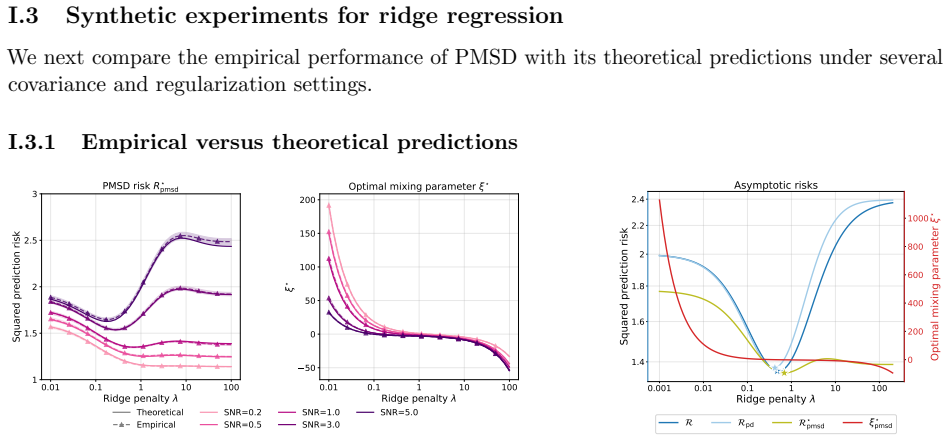
The machinery is the proportional-asymptotics deterministic equivalent built from two resolvents Gt=(Σt+κt I)⁻¹ and Gs=(Σs+κs I)⁻¹, with κt and κs the fixed points of the standard ridge equations. All risk functionals, residual correlations, and the optimal mixing weight are expressed as explicit traces and quadratic forms in these resolvents. The tie analysis reduces to the rational function H(κs)=Σ_j d_j/(σ̃_(j)+κs), which controls all non-improvement cases, and the oracle identity ξ*=(R−C)/D connects this function to the optimal mixing weight.
Load-bearing premise
The ridge results require the teacher's covariate covariance and the fresh covariates' covariance to be simultaneously diagonalizable (i.e., commute), and the logistic claims require unit-norm features with a constant within-class correlation and zero cross-class Gram correlation.
What would settle it
Simulate ridge distillation with two non-commuting anisotropic covariances (e.g., an AR1 teacher covariance and a fresh covariance rotated by a random orthogonal matrix) and test whether the finite-sample optimal mixed risk is still strictly below the teacher risk for all but finitely many λs; also test the isotropic prediction that improvement vanishes exactly at λt = γtσ²/r². If either fails, the strict-improvement claim is refuted.
If this is right
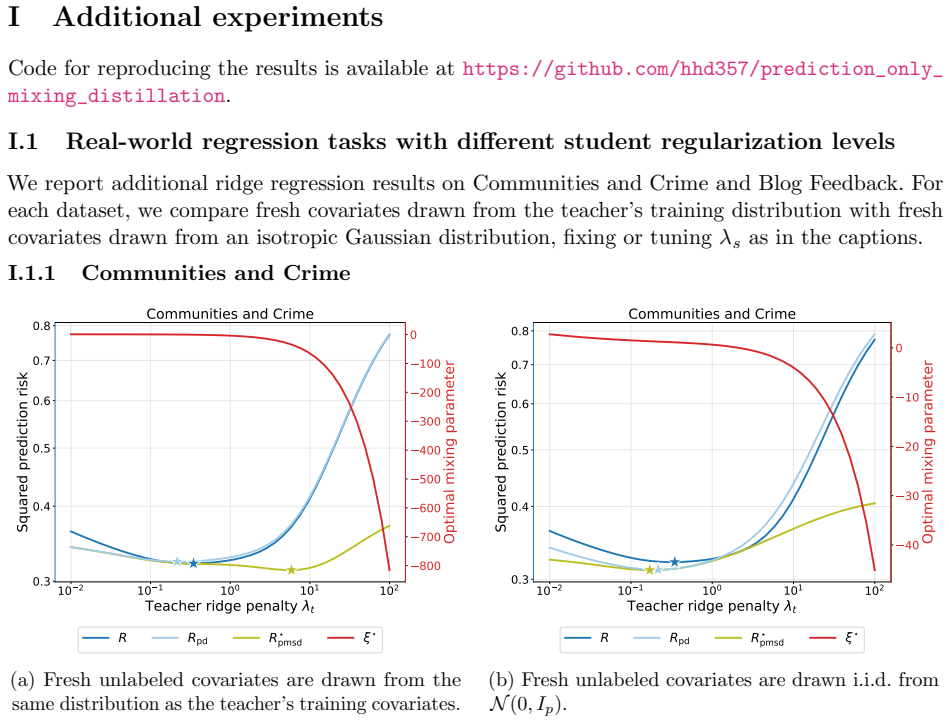
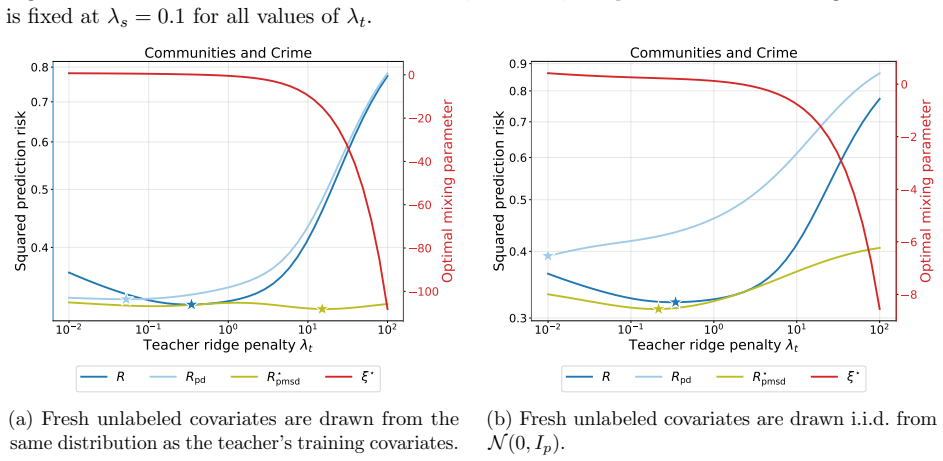
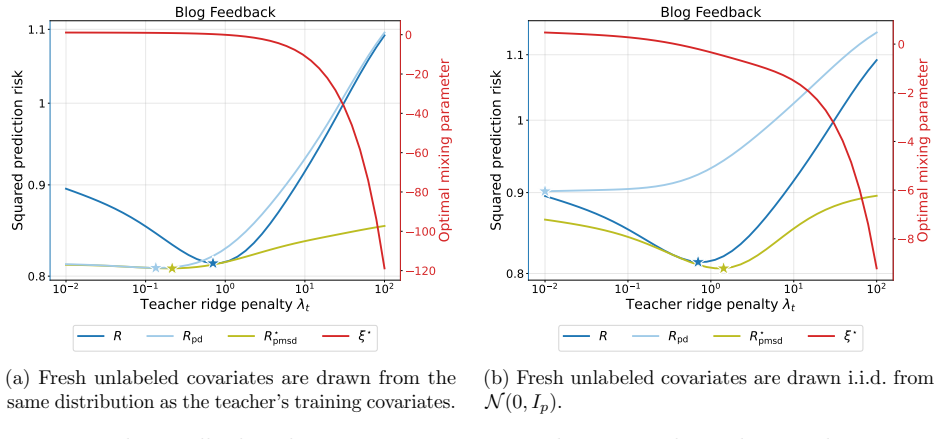
- In the fresh-X regime, prediction mixing turns any mistuned teacher into a better predictor for almost all student penalties, including when the fresh covariates are drawn from an isotropic distribution unrelated to the teacher's data.
- The mixing weight can be chosen in one pass from a small calibration set: evaluate the two predictors, compute three averages, plug in—no refitting, no cross-validation over ξ.
- The optimal mixed risk is unimodal in the fresh-sample aspect ratio, so more fresh data can hurt; in the isotropic same-λ case the maximum occurs at γs = 1 + λ.
- In the same-λ balanced regime, fresh-X mixing recovers the same-X tangent identity, tying the sign of the mixing weight to the derivative of the teacher risk curve.
- In logistic regression under the paper's assumptions, prediction mixing can achieve perfect population accuracy even when the pseudo-label noise rate exceeds 0.5, a regime where both teacher and pure-distilled students fail.
Where Pith is reading between the lines
- The commuting-covariance assumption is the main technical bridge to the polynomial argument; a natural testable extension is to check whether the generic strict-improvement claim survives near-commuting or mildly anisotropic OOD designs, where the finite-tie bound may be replaced by a measure-zero tie set.
- The calibration result appears to transfer to any fixed pair of predictors whose residuals have finite moments; as a practical recipe, one can apply the same one-shot mixing to ensemble-style predictors, not only ridge students, and select among finitely many candidates with the same calibration data.
- The non-identifiability result suggests that any fully unlabeled tuning rule must exploit additional structure (e.g., a known covariate distribution or symmetry) to approach the oracle; otherwise a labeled calibration set is quantitatively unavoidable.
- The classification extrapolation with ξ>1 points to a more general phenomenon: mixing beyond the [0,1] convex hull amplifies a weak corrective signal in a student—this could serve as a design principle for recovering corrupted labels in other base learners.
Editorial analysis
A structured set of objections, weighed in public.
Referee Report
Summary. The paper studies prediction-only self-distillation: a teacher ridge predictor is fixed, its original labeled data are unavailable, and a student is trained on fresh unlabeled covariates pseudo-labeled by the teacher; the final predictor is an affine combination of teacher and student predictions. Under proportional asymptotics and Assumption A (centered sub-Gaussian-type covariates, deterministic signal, and simultaneously diagonalizable teacher/fresh covariances), the paper derives deterministic equivalents for the teacher risk, the pure-distilled student risk, the teacher-student residual correlation, and the optimally mixed PMSD risk. It then shows that the limiting optimal PMSD risk is strictly smaller than the teacher risk for almost every pair of regularization levels, with the possible exception of finitely many values, and gives sharper results for isotropic, spiked, and monotone-spectrum settings. The paper also proves that the oracle mixing weight is not identifiable from unlabeled data alone, but can be consistently estimated from a small independent labeled calibration set, and it gives analogous prediction-mixing guarantees for binary logistic regression under a block-correlation feature model. The supplement contains proofs of all main results.
Significance. If the results are correct, the paper makes a substantial contribution to the theory of self-distillation. It moves beyond the same-X setting, where geometric identities cancel, and shows that fresh-X prediction mixing can generically improve a ridge teacher, even when the fresh covariates are isotropic and hence out-of-distribution in a strong sense. The explicit deterministic equivalents, the finite-exception strict-improvement bounds, and the one-shot calibration consistency result are concrete and falsifiable. The logistic results are more speculative because of the idealized feature correlation assumed, but they are proven and the extrapolation phenomenon (ξ>1 recovering 100% accuracy) is interesting. The supplement is carefully written and supplies derivations for the central formulas rather than leaving them as black boxes. The main weakness is that the advertised scope in the abstract is broader than the assumptions actually used.
major comments (2)
- [§3.3, Assumption A(c), Eq. (12), Propositions 4.1–4.2; abstract] The abstract and introduction advertise deterministic equivalents and strict-improvement guarantees under 'general anisotropic covariance' and for OOD fresh covariates. The theorems, however, require Σt and Σs to be simultaneously diagonalizable (Assumption A(c)). The deterministic equivalents in Lemma C.1 use insertions that must commute with Σt, and the spectral rewrite in Eq. (12) plus the finite-tie-set polynomial argument depend on a common eigenbasis; without Assumption A(c), Propositions 4.1 and 4.2 are not established for non-commuting fresh covariances. The real-data OOD experiments use Σs = Ip, which commutes with every Σt, so they do not test the general case. Please either extend the analysis to non-commuting Σs or rewrite the abstract/contributions so the commuting-covariance restriction is explicit.
- [§6, Assumption B; abstract] The logistic-regression claims in the abstract are unconditional, but Theorems 6.1–6.3 are proven only under Assumption B: unit-norm features, zero cross-class Gram correlation, and constant within-class correlation c. This is a strong idealized structure, and the proofs in Section F rely on it for the exact coefficient systems (68) and (73). The results are still interesting, but the abstract should either mention the assumption or state that the gains are established under this correlated-feature model.
minor comments (3)
- [§7.1] The claim that the analysis extends to negative regularization and that Propositions 4.1–4.2 hold regardless of signs is given without proof. If this is intended as a result, include the verification in the supplement; otherwise label it as a conjecture.
- [Theorem 6.3 / Section F.4] The notation λ_n is used inconsistently: in Theorems 6.1–6.2, λ_n = 2nλ is the scaled parameter, while Theorem 6.3 appears to use λ_n for the unscaled regularization sequence, and the proof in F.4 says λ_n = 2nλ_n with λ_n = Θ(1). Please clarify the scaling in the statement.
- [§4.3] The non-monotonicity formal result is stated only in Section H.1 of the supplement; the main text should either state the proposition or give a precise reference when claiming 'unimodal' behavior.
Circularity Check
No significant circularity: the fresh-X PMSD derivation is self-contained; the only self-citation (same-X teacher DE) is used as an external lemma with independent content.
full rationale
The central PMSD risk identity (10) is a direct consequence of minimizing a convex quadratic (Proposition 3.1), and the strict-improvement criterion R(λt) − C(λt, λs) ≠ 0 is then evaluated using newly derived deterministic equivalents for the fresh-X pure-distilled student and the teacher–student residual correlation (Theorem 3.2, Lemmas C.2–C.3). These DEs are not fitted to data, and no parameter is both fit and then renamed as a prediction. The only imported result is the same-X teacher-risk DE cited from Dang et al. (2026) in Lemma C.1 and Theorem 3.2; that result has its own stated assumptions, does not contain the fresh-X PMSD claim, and is used as a lemma rather than as the conclusion. The finite-tie-set arguments in Propositions 4.1–4.2 are polynomial-degree and sign-change arguments on the derived DE, not circular. The calibration estimator (Theorem 5.1) is a plug-in LLN estimator for fixed predictors, not a disguised fit. Assumptions A(c) and B restrict the scope of the 'general anisotropic' and logistic claims, but under-specification of scope is a correctness/robustness concern, not circularity.
Axiom & Free-Parameter Ledger
axioms (4)
- domain assumption Random i.i.d. design with bounded 4+μ moments and deterministic positive definite covariances (Assumption A(a),(b),(d))
- domain assumption Covariances Σt and Σs are simultaneously diagonalizable, i.e. they commute (Assumption A(c))
- domain assumption Logistic feature map has unit norm, zero cross-class Gram correlation, and constant within-class correlation c (Assumption B)
- standard math Standard random-matrix anisotropic local laws / resolvent deterministic equivalents (Rubio and Mestre 2011; Knowles and Yin 2017; Lemma C.5)
Cite this review
Pith. "Pith review of Prediction-Only Distillation in Linear and Logistic Regression." pith.science (2026). https://pith.science/paper/Z7KKSCLY
@misc{pith2026260715450,
  author       = {Pith},
  title        = {Pith review of: Prediction-Only Distillation in Linear and Logistic Regression},
  year         = {2026},
  howpublished = {\url{https://pith.science/paper/Z7KKSCLY}},
  note         = {Machine review of arXiv:2607.15450}
}
read the original abstract
Self-distillation (SD) is typically studied when the student is retrained on the teacher's original training inputs. In many practical deployments, however, the labeled training data are no longer available, and one has access only to the trained predictor and fresh unlabeled covariates. We study SD in this prediction-only regime through a fresh-X prediction-mixed scheme: a pure-distilled student is trained on fresh covariates pseudo-labeled by the teacher, and the final predictor is an affine combination of the teacher and student predictions. For ridge regression under proportional asymptotics, we derive deterministic equivalents for the optimally mixed prediction risk under general anisotropic covariance and deterministic signal. We show that this risk is strictly smaller than the teacher risk for almost every pair of teacher and student regularization levels, including when the fresh covariates are out-of-distribution and even when their covariance is isotropic. We further show that the optimal mixing weight cannot be identified from unlabeled data alone, but can be consistently estimated in a single post-training step using a small independent labeled calibration set, without additional model fitting. Finally, for binary logistic regression, we show that prediction mixing can outperform both the teacher and the pure-distilled classifier.
Figures







Reference graph
Works this paper leans on
-
[1]
International Conference on Machine Learning , year =
Rudrajit Das and Sujay Sanghavi , title =. International Conference on Machine Learning , year =
-
[2]
Du and Sewoong Oh , title =
Divyansh Pareek and Simon S. Du and Sewoong Oh , title =. Advances in Neural Information Processing Systems , year =
-
[3]
Emrullah Ildiz and Halil Alperen Gozeten and Ege Onur Taga and Marco Mondelli and Samet Oymak , title =
M. Emrullah Ildiz and Halil Alperen Gozeten and Ege Onur Taga and Marco Mondelli and Samet Oymak , title =. International Conference on Learning Representations , year =
-
[4]
Advances in Neural Information Processing Systems , year =
Behrad Moniri and Hamed Hassani , title =. Advances in Neural Information Processing Systems , year =
-
[5]
Advances in Neural Information Processing Systems , year =
Adel Javanmard and Rudrajit Das and Alessandro Epasto and Vahab Mirrokni , title =. Advances in Neural Information Processing Systems , year =
-
[6]
Advances in Neural Information Processing Systems , year =
Elvis Dohmatob and Yunzhen Feng and Julia Kempe , title =. Advances in Neural Information Processing Systems , year =
-
[7]
Bartlett , title =
Hossein Mobahi and Mehrdad Farajtabar and Peter L. Bartlett , title =. Advances in Neural Information Processing Systems , year =
-
[8]
Tibshirani , title =
Trevor Hastie and Andrea Montanari and Saharon Rosset and Ryan J. Tibshirani , title =. Annals of Statistics , number =. 2022 , url =
2022
-
[9]
International Conference on Machine Learning , year =
Tommaso Furlanello and Zachary Lipton and Michael Tschannen and Laurent Itti and Anima Anandkumar , title =. International Conference on Machine Learning , year =
-
[10]
2015 , url =
Geoffrey Hinton and Oriol Vinyals and Jeff Dean , title =. 2015 , url =
2015
-
[11]
Unifying distillation and privileged information , note =
David Lopez-Paz and L. Unifying distillation and privileged information , note =. 2015 , url =
2015
-
[12]
International Conference on Machine Learning , year =
Mary Phuong and Christoph Lampert , title =. International Conference on Machine Learning , year =
-
[13]
International Conference on Learning Representations , year =
Anvit Garg and Sohom Bhattacharya and Pragya Sur , title =. International Conference on Learning Representations , year =
-
[14]
I. S. Gradshteyn and I. M. Ryzhik , title =
-
[15]
Bartlett and Andrea Montanari and Alexander Rakhlin , title =
Peter L. Bartlett and Andrea Montanari and Alexander Rakhlin , title =. Acta Numerica , pages =. 2021 , url =
2021
-
[16]
Silverstein , title =
Zhidong Bai and Jack W. Silverstein , title =
-
[17]
2022 , url =
Linfeng Zhang and Chenglong Bao and Kaisheng Ma , title =. 2022 , url =
2022
-
[18]
Maybank and Dacheng Tao , title =
Jianping Gou and Baosheng Yu and Stephen J. Maybank and Dacheng Tao , title =. International Journal of Computer Vision , number =. 2021 , url =
2021
-
[19]
Conference on Computer Vision and Pattern Recognition , year =
Defang Chen and Jian-Ping Mei and Hailin Zhang and Can Wang and Yan Feng and Chun Chen , title =. Conference on Computer Vision and Pattern Recognition , year =
-
[20]
Advances in Neural Information Processing Systems , year =
Jimmy Ba and Rich Caruana , title =. Advances in Neural Information Processing Systems , year =
-
[21]
Advances in Neural Information Processing Systems , year =
Guangda Ji and Zhanxing Zhu , title =. Advances in Neural Information Processing Systems , year =
-
[22]
2023 , url =
Collin Burns and Pavel Izmailov and Jan Hendrik Kirchner and Bowen Baker and Leo Gao and Leopold Aschenbrenner and Yining Chen and Adrien Ecoffet and Manas Joglekar and Jan Leike and Ilya Sutskever and Jeff Wu , title =. 2023 , url =
2023
-
[23]
Advances in Neural Information Processing Systems , year =
Guobin Chen and Wongun Choi and Xiang Yu and Tony Han and Manmohan Chandraker , title =. Advances in Neural Information Processing Systems , year =
-
[24]
International Conference on Computer Vision , year =
Yuncheng Li and Jianchao Yang and Yale Song and Liangliang Cao and Jiebo Luo and Li-Jia Li , title =. International Conference on Computer Vision , year =
-
[25]
Lawrence and Zhenwen Dai , title =
Sungsoo Ahn and Shell Xu Hu and Andreas Damianou and Neil D. Lawrence and Zhenwen Dai , title =. Conference on Computer Vision and Pattern Recognition , year =
-
[26]
Advances in Neural Information Processing Systems , year =
Junnan Li and Ramprasaath Selvaraju and Akhilesh Gotmare and Shafiq Joty and Caiming Xiong and Steven Chu Hong Hoi , title =. Advances in Neural Information Processing Systems , year =
-
[27]
Journal of the Royal Statistical Society Series B: Statistical Methodology , pages =
Hengzhi He and Shirong Xu and Guang Cheng , title =. Journal of the Royal Statistical Society Series B: Statistical Methodology , pages =. 2026 , url =
2026
-
[28]
Nature , number =
Ilia Shumailov and Zakhar Shumaylov and Yiren Zhao and Nicolas Papernot and Ross Anderson and Yarin Gal , title =. Nature , number =. 2024 , url =
2024
-
[29]
International Conference on Learning Representations , year =
Elvis Dohmatob and Yunzhen Feng and Arjun Subramonian and Julia Kempe , title =. International Conference on Learning Representations , year =
-
[30]
International Conference on Learning Representations , year =
Sina Alemohammad and Josue Casco-Rodriguez and Lorenzo Luzi and Ahmed Imtiaz Humayun and Hossein Babaei and Daniel LeJeune and Ali Siahkoohi and Richard Baraniuk , title =. International Conference on Learning Representations , year =
-
[31]
Model compression , booktitle =
Cristian Bucilu. Model compression , booktitle =. 2006 , url =
2006
-
[32]
Roberts and Diyi Yang and David L
Matthias Gerstgrasser and Rylan Schaeffer and Apratim Dey and Rafael Rafailov and Tomasz Korbak and Henry Sleight and Rajashree Agrawal and John Hughes and Dhruv Bhandarkar Pai and Andrey Gromov and Daniel A. Roberts and Diyi Yang and David L. Donoho and Sanmi Koyejo , title =. Conference on Language Modeling , year =
-
[33]
2008 , url =
Saverio De Vito , title =. 2008 , url =
2008
-
[34]
2014 , url =
Krisztian Buza , title =. 2014 , url =
2014
-
[35]
2002 , url =
Michael Redmond , title =. 2002 , url =
2002
-
[36]
Conference on Computer Vision and Pattern Recognition , year =
Kaiming He and Xiangyu Zhang and Shaoqing Ren and Jian Sun , title =. Conference on Computer Vision and Pattern Recognition , year =
-
[37]
Annals of Statistics , number =
Edgar Dobriban and Stefan Wager , title =. Annals of Statistics , number =. 2018 , url =
2018
-
[38]
Proceedings of the National Academy of Sciences , number =
Mikhail Belkin and Daniel Hsu and Siyuan Ma and Soumik Mandal , title =. Proceedings of the National Academy of Sciences , number =. 2019 , url =
2019
-
[39]
Bartlett and Philip M
Peter L. Bartlett and Philip M. Long and G. Benign overfitting in linear regression , journal =. 2020 , url =
2020
-
[40]
Tibshirani , title =
Pratik Patil and Alessandro Rinaldo and Ryan J. Tibshirani , title =. International Conference on Artificial Intelligence and Statistics , year =
-
[41]
Tibshirani , title =
Pratik Patil and Yuting Wei and Alessandro Rinaldo and Ryan J. Tibshirani , title =. International Conference on Artificial Intelligence and Statistics , year =
-
[42]
Advances in Neural Information Processing Systems , year =
Pratik Patil and Jin-Hong Du , title =. Advances in Neural Information Processing Systems , year =
-
[43]
Trevor Hastie and Robert Tibshirani , title =
-
[44]
Stein , title =
Charles M. Stein , title =. Annals of Statistics , number =. 1981 , url =
1981
-
[45]
Journal of the American Statistical Association , number =
Bradley Efron , title =. Journal of the American Statistical Association , number =. 1983 , url =
1983
-
[46]
Journal of the American Statistical Association , number =
Bradley Efron , title =. Journal of the American Statistical Association , number =. 1986 , url =
1986
-
[47]
Probability Theory and Related Fields , number =
Antti Knowles and Jun Yin , title =. Probability Theory and Related Fields , number =. 2017 , url =
2017
-
[48]
Journal of Machine Learning Research , number =
Edgar Dobriban and Yue Sheng , title =. Journal of Machine Learning Research , number =. 2020 , url =
2020
-
[49]
Journal of Machine Learning Research , number =
Pratik Patil and Jin-Hong Du and Arun Kumar Kuchibhotla , title =. Journal of Machine Learning Research , number =. 2023 , url =
2023
-
[50]
2022 , url =
Pratik Patil and Arun Kumar Kuchibhotla and Yuting Wei and Alessandro Rinaldo , title =. 2022 , url =
2022
-
[51]
Statistics and Probability Letters , number =
Francisco Rubio and Xavier Mestre , title =. Statistics and Probability Letters , number =. 2011 , url =
2011
-
[52]
Tibshirani , title =
Pratik Patil and Jin-Hong Du and Ryan J. Tibshirani , title =. International Conference on Machine Learning , year =
-
[53]
Journal of the Royal Statistical Society Series B: Statistical Methodology , number =
Kamiar Rahnama Rad and Arian Maleki , title =. Journal of the Royal Statistical Society Series B: Statistical Methodology , number =. 2020 , url =
2020
-
[54]
International Conference on Machine Learning , year =
Alexander Wei and Wei Hu and Jacob Steinhardt , title =. International Conference on Machine Learning , year =
-
[55]
Journal of Machine Learning Research , number =
Qiyang Han and Xiaocong Xu , title =. Journal of Machine Learning Research , number =. 2026 , url =
2026
-
[56]
Bellec and Jin-Hong Du and Takuya Koriyama and Pratik Patil and Kai Tan , title =
Pierre C. Bellec and Jin-Hong Du and Takuya Koriyama and Pratik Patil and Kai Tan , title =. Journal of the Royal Statistical Society Series B: Statistical Methodology , number =. 2025 , url =
2025
-
[57]
Bellec , title =
Takuya Koriyama and Pratik Patil and Jin-Hong Du and Kai Tan and Pierre C. Bellec , title =. Annals of Statistics , number =. 2026 , url =
2026
-
[58]
Journal of Statistical Mechanics: Theory and Experiment , number =
Theodor Misiakiewicz and Andrea Montanari , title =. Journal of Statistical Mechanics: Theory and Experiment , number =. 2024 , url =
2024
-
[59]
Advances in Neural Information Processing Systems , year =
Nilesh Tripuraneni and Ben Adlam and Jeffrey Pennington , title =. Advances in Neural Information Processing Systems , year =
-
[60]
Advances in Neural Information Processing Systems , year =
Will Stephenson and Zachary Frangella and Madeleine Udell and Tamara Broderick , title =. Advances in Neural Information Processing Systems , year =
-
[61]
International Conference on Machine Learning , year =
Hien Dang and Pratik Patil and Alessandro Rinaldo , title =. International Conference on Machine Learning , year =
-
[62]
Le , title =
Qizhe Xie and Minh-Thang Luong and Eduard Hovy and Quoc V. Le , title =. Conference on Computer Vision and Pattern Recognition , year =
-
[63]
International Conference on Learning Representations , year =
Hyeonsu Jeong and Hye Won Chung , title =. International Conference on Learning Representations , year =
-
[64]
Advances in Neural Information Processing Systems , year =
Kaito Takanami and Takashi Takahashi and Ayaka Sakata , title =. Advances in Neural Information Processing Systems , year =
-
[65]
Kakade and Karthik Sridharan and Ambuj Tewari , title =
Sham M. Kakade and Karthik Sridharan and Ambuj Tewari , title =. Advances in Neural Information Processing Systems , year =
-
[66]
Annals of Statistics , number =
Vladimir Koltchinskii and Dmitry Panchenko , title =. Annals of Statistics , number =. 2002 , url =
2002
-
[67]
2024 , url =
Yanke Song and Sohom Bhattacharya and Pragya Sur , title =. 2024 , url =
2024
-
[68]
International Conference on Machine Learning , year =
Neil Rohit Mallinar and Austin Zane and Spencer Frei and Bin Yu , title =. International Conference on Machine Learning , year =
-
[69]
Duchi and Percy S
Yair Carmon and Aditi Raghunathan and Ludwig Schmidt and John C. Duchi and Percy S. Liang , title =. Advances in Neural Information Processing Systems , year =
-
[70]
Dhillon and Alessandro Epasto and Adel Javanmard and Jieming Mao and Vahab Mirrokni and Sujay Sanghavi and Peilin Zhong , title =
Rudrajit Das and Inderjit S. Dhillon and Alessandro Epasto and Adel Javanmard and Jieming Mao and Vahab Mirrokni and Sujay Sanghavi and Peilin Zhong , title =. International Conference on Machine Learning , year =
-
[71]
Le , title =
Hieu Pham and Zihang Dai and Qizhe Xie and Quoc V. Le , title =. Conference on Computer Vision and Pattern Recognition , year =
-
[72]
Solvable model for inheriting the regularization through knowledge distillation , booktitle =
Luca Saglietti and Lenka Zdeborov. Solvable model for inheriting the regularization through knowledge distillation , booktitle =. 2022 , url =
2022
-
[73]
International Conference on Machine Learning , year =
Diyuan Wu and Lehan Chen and Theodor Misiakiewicz and Marco Mondelli , title =. International Conference on Machine Learning , year =
-
[74]
Brooks and D
Thomas F. Brooks and D. Stuart Pope and Michael A. Marcolini , title =. 1989 , url =
1989
-
[75]
2009 , url =
Alex Krizhevsky , title =. 2009 , url =
2009
-
[76]
2007 , url =
Gregory Griffin and Alex Holub and Pietro Perona , title =. 2007 , url =
2007
-
[77]
Byrd and Peihuang Lu and Jorge Nocedal and Ciyou Zhu , title =
Richard H. Byrd and Peihuang Lu and Jorge Nocedal and Ciyou Zhu , title =. 1995 , url =
1995
-
[78]
2025 , url =
Rylan Schaeffer and Joshua Kazdan and Alvan Caleb Arulandu and Sanmi Koyejo , title =. 2025 , url =
2025
-
[79]
2026 , url =
Radu Lecoiu and Debarghya Mukherjee and Pragya Sur , title =. 2026 , url =
2026
-
[80]
Advances in Neural Information Processing Systems , year =
Denny Wu and Ji Xu , title =. Advances in Neural Information Processing Systems , year =
This paper was first reviewed by deepseek-v4-flash on August 1, 2026.
discussion (0)
Sign in with ORCID, Apple, or X to comment. Anyone can read and Pith papers without signing in.