REVIEW 3 major objections 5 minor 32 references
Seek scene anomalies to explore: 90% coverage, half the error.
Reviewed by Pith at T0; open to challenge. T0 means a machine referee read the full paper against a public rubric. the ladder, T0–T4 →
Modeling exploration as geometric anomaly minimization improves both volumetric coverage and 3D reconstruction quality over frontier and next-best-view baselines in simulated indoor scenes.
T0 review reviewed 2026-08-01 challenge →
load-bearing objection The coverage gains look real; the 'half the error' reconstruction-quality number is partly an artifact of full-scene Chamfer, which rewards coverage. the 3 major comments →
Beyond Frontiers: Scene-Anomaly Guided Autonomous Exploration
The pith
A machine-rendered reading of the paper's core claim, the machinery that carries it, and where it could break.
The reading
Core claim
This paper claims that autonomous exploration of unknown indoor spaces is best posed as geometric anomaly minimization. The authors introduce SCAGE, which maintains a learned prior over typical indoor structure via ∆-Net, a denoising autoencoder built on Point Transformer V3. Trained without skip connections on clean 4096-point chunks from Matterport3D, degraded with noise, scaling, and masking, the network learns to predict a per-point displacement that restores an observed partial chunk to its expected architectural form. At run time the magnitude of this displacement is the anomaly score; clustered anomalies seed candidate 6-DoF views, and a utility function blending volume gain, anomaly
What carries the argument
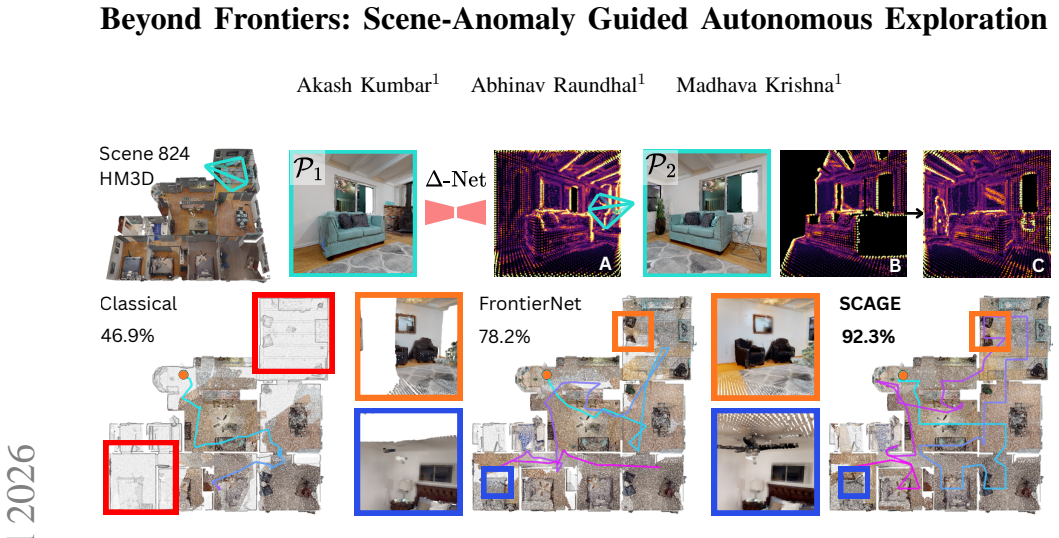
The central mechanism is ∆-Net, a denoising autoencoder with an information bottleneck: the encoder compresses a 4096-point chunk to a 512-channel latent, and because there are no skip connections, the decoder must reconstruct the clean geometry purely from that latent, forcing it to internalize what a typical indoor structure looks like. Its output is a point-wise displacement vector ∆ρ; adding that vector to the noisy input yields the denoised point set whose discrepancy from the ground-truth chunk is penalized by the Chamfer distance. During exploration, the Euclidean norm of ∆ρ, normalized across the current global point cloud, becomes the anomaly score that drives viewpoint selection. V
Load-bearing premise
The system assumes that the artificial degradations used during training — Gaussian noise, anisotropic scaling, and random masking — faithfully mimic the incompleteness a real depth sensor produces during exploration, so that the network's reconstruction error highlights exactly the regions that need a new viewpoint.
What would settle it
Take a scene from the training distribution, observe it fully from a dense set of viewpoints so the accumulated point cloud matches the ground truth, then run SCAGE's anomaly detector on this complete scan; if any region is still flagged as high-anomaly, the signal is not a faithful indicator of under-reconstruction.
If this is right
- Under the anomaly-minimization objective, volumetric coverage and reconstruction quality improve together, so the perceived trade-off between them is not fundamental.
- The learned indoor prior transfers across datasets: trained on Matterport3D, the network generalizes to unseen HM3D scenes without fine-tuning.
- The method tolerates imperfect depth: with Metric3D v2-estimated depth, coverage only falls by a few points and reconstruction error stays about 60% lower than the baseline.
- Real-world deployment on a wheeled robot with a consumer depth camera reproduces the anomaly-driven behavior, including flagging incomplete chairs and partitions not seen in training.
Where Pith is reading between the lines
- The anomaly score effectively acts as a learned uncertainty proxy: if the network can predict where the geometry 'should' be, the magnitude of its correction is a direct, learnable signal for where to look next, a principle that could transfer to active object mapping or inspection.
- A testable extension is to replace the learned prior with a trivial prior (e.g., a network trained to predict a fixed displacement regardless of input); if exploration performance is statistically unchanged, then the specific architectural knowledge matters less than the act of predicting a displacement.
- The encoder's emergent semantic clustering, shown in the PCA visualization, suggests the learned latent could serve as an off-the-shelf indoor feature extractor for zero-shot segmentation or object-goal navigation, though the paper does not itself demonstrate these tasks.
Editorial analysis
A structured set of objections, weighed in public.
Referee Report
Summary. The paper proposes SCAGE, an autonomous 3D exploration framework that replaces pure frontier/information-gain objectives with a geometric anomaly-minimization objective. A Point Transformer V3-based denoising autoencoder (Δ-Net) is trained on clean Matterport3D chunks corrupted by noise, anisotropic scaling, and masking to predict a per-point deviation from learned indoor structural priors. During exploration, this deviation is thresholded, clustered, and used to generate candidate 6-DoF viewpoints; a two-term utility combining expected volumetric gain, mean anomaly score, and traversal cost selects the next target. The method is evaluated in simulation on 10 HM3D scenes against a classical frontier method, NBVP, and FrontierNet, with both perfect and Metric3D v2 noisy depth, plus a qualitative real-world deployment on a P3DX with a RealSense D455. The authors report ~90% volumetric coverage, a ~15% improvement over the best baseline, and a Chamfer distance less than half that of the best baseline, and claim that this demonstrates seamless coupling of spatial discovery with high-fidelity reconstruction.
Significance. The reframing of exploration as anomaly minimization is original and plausible: instead of treating all unknown space equally, the robot is drawn to geometry that violates learned architectural priors, which could indeed target occluded or under-sampled structures. The paper has concrete strengths: cross-dataset training/evaluation (Matterport3D to HM3D), adherence to a recent standardized evaluation protocol, an ablation of the utility function, low variance across starting poses, and a real-world deployment beyond simulation. If the reconstruction-quality claim survives scrutiny, the method would be a useful addition to the exploration toolbox. However, the central 'high-fidelity mapping' claim is currently supported by a metric that conflates coverage with local geometric accuracy, and the comparison omits the neural-implicit and Gaussian-splatting exploration methods that the Related Work section itself identifies as emerging state of the art. The contribution is significant but needs corrective evidence before the paper's headline claims can be accepted.
major comments (3)
- [Section IV-B, Table I] The Chamfer Distance used for reconstruction quality is not defined in the evaluation setup. If it is standard full-scene bidirectional Chamfer between the accumulated point cloud and the ground-truth scene mesh, then the ground-truth-to-prediction term is minimized simply by covering more surface. SCAGE's 89.7% coverage versus FrontierNet's 72.3% therefore mechanically reduces this term, so the reported 0.91e-3 versus 3.02e-3 is largely a restatement of the coverage advantage, not evidence that anomaly-guided viewpoints improve local geometric fidelity. This is load-bearing for the 'high-fidelity reconstruction' half of the central claim. Please report a coverage-normalized fidelity metric, e.g., Chamfer restricted to surfaces observed by both methods, or per-surface precision/recall at matched coverage, or a separate accuracy metric on commonly observed regions.
- [Related Work and Table I] Section II discusses neural implicit representations [17,18] and 3D Gaussian methods [19–21] as emerging exploration frameworks, but none are included in the quantitative comparison. The abstract and introduction claim 'state-of-the-art baselines' and 'higher 3D reconstruction quality compared to state-of-the-art baselines.' Without at least one representative implicit or Gaussian-splatting exploration baseline, or a clear justification for their exclusion (e.g., incompatible evaluation protocol), the SOTA claim is not supported. Since the paper explicitly positions SCAGE as a new paradigm relative to these methods, the comparison should include them or the claims should be scoped to the evaluated baselines.
- [Section III-B, Eqs. (2)–(4)] The core mechanism—that Δ-Net's deviation magnitude is a reliable proxy for reconstruction error—is not directly validated. The anomaly threshold τ=0.5 is described as 'empirically selected' with no sensitivity analysis, and the utility function's reliance on s_k presupposes that high anomaly score means 'needs another viewpoint.' A direct test would be to correlate per-point anomaly scores with per-voxel truncation error against ground truth during an exploration episode, or to replace the learned anomaly score in Eq. (4) with oracle local reconstruction error and show similar behavior. Without such evidence, the utility gain over ordinary information gain could arise from other properties of the network (e.g., implicit smoothing) rather than genuine anomaly detection. I request at least an anomaly-score-versus-error correlation analysis or a threshold-sweep/robustness experiment.
minor comments (5)
- [Section IV-A] The evaluation setup refers to 'identical subset of HM3D validation scenes' and 'exact scene-specific maximum step budgets' from FrontierNet, but these step budgets and scene identifiers are not listed. For reproducibility, include a table of scene IDs and budgets, or a reference to a public configuration.
- [Eq. (1) and Table I] The same term 'Chamfer Distance' is used for the training loss, which is appropriately bidirectional, and for the evaluation metric, but the evaluation metric's computation (meshes? point clouds? downsampling? units?) is unspecified. Please define it explicitly, including whether it is full-scene or restricted.
- [Fig. 1 and Fig. 4 captions] Fig. 1 says the starting position is marked by an orange dot, while Fig. 4 says it is marked by a cyan point. Inconsistencies like this make qualitative comparisons harder to parse.
- [Section IV-C] The real-world validation is purely qualitative. Since the paper motivates the method for real-world use and includes a noisy-depth simulation variant, a quantitative real-world metric (even approximate, e.g., coverage fraction or reconstruction error against a reference scan) would strengthen the claim.
- [Section III-B] The line 'we skip re-processing points lying in low-anomaly neighborhoods' is vague; it is unclear how 'low-anomaly' is determined before processing and whether this affects the global normalization in Eq. (2). Please specify the criterion and its effect.
Circularity Check
No significant circularity: the learned anomaly prior is trained on Matterport3D, evaluated on unseen HM3D scenes, and the final reconstructions are raw accumulated sensor points rather than the network's denoised output.
full rationale
The paper's central derivation is not circular. Delta-Net is trained on Matterport3D ground-truth chunks corrupted by Gaussian noise, anisotropic scaling, and random masking; it is never trained on the HM3D validation scenes or on the exploration trajectories. During exploration, the anomaly score is the normalized magnitude of the predicted point-wise shift, but the final map is built by merging raw backprojected depth points, not by applying the network's denoised coordinates. The exploration utility combines the anomaly score with standard volumetric information gain and traversal cost; no coefficient or parameter is fitted to the reported test results, and the threshold tau=0.5 is fixed. The comparison against FrontierNet, NBVP, and classical frontiers on an external HM3D benchmark provides independent evidence that the behavior is not forced by construction. The only notable caveat is that the reported Chamfer distance may conflate coverage with fidelity if it is computed over the full scene rather than only commonly observed surfaces, since higher coverage mechanically lowers the ground-truth-to-prediction term. However, the paper does not specify the evaluation equation, and this is a metric-validity concern rather than a circular derivation. No self-citation chain is load-bearing, no uniqueness theorem is imported from the authors' prior work, and no known result is renamed as a new contribution. The derivation is self-contained and externally validated.
Axiom & Free-Parameter Ledger
free parameters (5)
- anomaly threshold tau =
0.5
- voxel downsampling resolution =
0.05m
- minimum standoff distance d_min =
not reported
- chunk size N and corruption parameters =
N=4096; noise/scaling/masking ranges not reported
- epsilon in utility denominator =
not reported
axioms (6)
- domain assumption Matterport3D point-cloud chunks represent complete, clean indoor geometry and are a valid prior for HM3D indoor architecture.
- domain assumption The stochastic corruptions (noise, anisotropic scaling, random masking) faithfully simulate sensor-induced partial observability.
- domain assumption Chamfer distance is a valid metric for 3D reconstruction quality and aligns with the exploration goal.
- ad hoc to paper Min-max normalized deviation magnitude with threshold 0.5 separates unresolved from resolved regions.
- ad hoc to paper The multiplicative utility form g(T_k)*s_k/d(T_k) balances coverage, anomaly resolution, and travel cost.
- domain assumption A Point Transformer V3 trained from scratch on 4096-point chunks can learn transferable indoor structural priors.
invented entities (1)
-
scene anomaly score
no independent evidence
Cite this review
Pith. "Pith review of Beyond Frontiers: Scene-Anomaly Guided Autonomous Exploration." pith.science (2026). https://pith.science/paper/7UYLZDCM
@misc{pith2026260715828,
  author       = {Pith},
  title        = {Pith review of: Beyond Frontiers: Scene-Anomaly Guided Autonomous Exploration},
  year         = {2026},
  howpublished = {\url{https://pith.science/paper/7UYLZDCM}},
  note         = {Machine review of arXiv:2607.15828}
}
read the original abstract
Autonomous exploration of unknown 3D environments is traditionally driven by coverage-maximizing geometric heuristics. However, these methods typically determine exploration targets without considering the underlying structural context. This leads to inefficient trajectories often limiting the fidelity of the final 3D reconstruction. To bridge the gap between spatial coverage and reconstruction quality, we introduce a novel paradigm: reframing exploration as a geometric anomaly minimization problem. We present SCAGE: SCene Anomaly Guided Exploration, a novel autonomous exploration framework that operates directly on unstructured 3D point clouds. Instead of blindly chasing volumetric boundaries, we equip the robot with a foundational understanding of standard indoor architecture. As the robot navigates, it continuously evaluates its live 3D observations against these learned expectations. When the incoming geometry contradicts the learned priors of a typical indoor environment, such as a fragmented wall or a partial table, the system flags these regions as scene anomalies. These geometric inconsistencies act as a guiding signal, naturally drawing the robot to investigate and resolve these structural anomalies from optimal vantage points. By actively targeting poorly reconstructed regions rather than just empty space, our approach seamlessly couples spatial discovery with high-fidelity mapping. Extensive evaluations demonstrate that SCAGE achieves superior volumetric coverage (~90% in all scenes) and higher 3D reconstruction quality compared to state-of-the-art baselines.
Figures


Reference graph
Works this paper leans on
-
[1]
Cerberus: Autonomous legged and aerial robotic exploration in the tunnel and urban circuits of the darpa subterranean challenge,
M. Tranzatto, F. Mascarich, L. Bernreiter, C. Godinho, M. Camurri, S. Khattak, T. Dang, V . Reijgwart, J. L¨oje, D. Wisthet al., “Cerberus: Autonomous legged and aerial robotic exploration in the tunnel and urban circuits of the darpa subterranean challenge,”Field Robotics, vol. 2, pp. 274–324, 2022
2022
-
[2]
Aerial image-based inter-day registration for precision agriculture,
C. Gao, F. Daxinger, L. Roth, F. Maffra, P. Beardsley, M. Chli, and L. Teixeira, “Aerial image-based inter-day registration for precision agriculture,” in2024 IEEE International Conference on Robotics and Automation (ICRA). IEEE, 2024, pp. 11 862–11 868
2024
-
[3]
Semantic belief behavior graph: Enabling autonomous robot inspection in unknown environments,
M. F. Ginting, D. D. Fan, S.-K. Kim, M. J. Kochenderfer, and A.- A. Agha-Mohammadi, “Semantic belief behavior graph: Enabling autonomous robot inspection in unknown environments,” in2024 IEEE/RSJ International Conference on Intelligent Robots and Systems (IROS). IEEE, 2024, pp. 7604–7610
2024
-
[4]
A frontier-based approach for autonomous exploration,
B. Yamauchi, “A frontier-based approach for autonomous exploration,” inProceedings 1997 IEEE International Symposium on Computational Intelligence in Robotics and Automation CIRA’97. ’Towards New Com- putational Principles for Robotics and Automation’. IEEE, 1997, pp. 146–151
1997
-
[5]
An improved frontier-based approach for autonomous exploration,
W. Gao, M. Booker, A. Adiwahono, M. Yuan, J. Wang, and Y . W. Yun, “An improved frontier-based approach for autonomous exploration,” in 2018 15th international conference on control, automation, robotics and vision (ICARCV). IEEE, 2018, pp. 292–297
2018
-
[6]
Receding horizon
A. Bircher, M. Kamel, K. Alexis, H. Oleynikova, and R. Siegwart, “Receding horizon” next-best-view” planner for 3d exploration,” in 2016 IEEE international conference on robotics and automation (ICRA). IEEE, 2016, pp. 1462–1468
2016
-
[7]
An efficient sampling-based method for online informative path planning in unknown environments,
L. Schmid, M. Pantic, R. Khanna, L. Ott, R. Siegwart, and J. Nieto, “An efficient sampling-based method for online informative path planning in unknown environments,”IEEE Robotics and Automation Letters, vol. 5, no. 2, pp. 1500–1507, 2020
2020
-
[8]
Frontiernet: Learning visual cues to explore,
B. Sun, H. Chen, S. Leutenegger, C. Cadena, M. Pollefeys, and H. Blum, “Frontiernet: Learning visual cues to explore,”IEEE Robotics and Automation Letters, vol. 10, no. 7, pp. 6576–6583, 2025
2025
-
[9]
Fast frontier detection in indoor environment for monocular slam,
S. Upadhyay, K. M. Krishna, and S. Kumar, “Fast frontier detection in indoor environment for monocular slam,” inProceedings of the Tenth Indian Conference on Computer Vision, Graphics and Image Processing, 2016, pp. 1–8
2016
-
[10]
Learning to explore indoor environments using autonomous micro aerial vehicles,
Y . Tao, E. Iceland, B. Li, E. Zwecher, U. Heinemann, A. Cohen, A. Avni, O. Gal, A. Barel, and V . Kumar, “Learning to explore indoor environments using autonomous micro aerial vehicles,” in2024 IEEE International Conference on Robotics and Automation (ICRA). IEEE, 2024, pp. 15 758–15 764
2024
-
[11]
L. Schmid, M. N. Cheema, V . Reijgwart, R. Siegwart, F. Tombari, and C. Cadena, “Sc-explorer: Incremental 3d scene completion for safe and efficient exploration mapping and planning,”arXiv preprint arXiv:2208.08307, 2022
Pith/arXiv arXiv 2022
-
[12]
Seer: Safe efficient exploration for aerial robots using learning to predict information gain,
Y . Tao, Y . Wu, B. Li, F. Cladera, A. Zhou, D. Thakur, and V . Kumar, “Seer: Safe efficient exploration for aerial robots using learning to predict information gain,”arXiv preprint arXiv:2209.11034, 2022
Pith/arXiv arXiv 2022
-
[13]
Point transformer v3: Simpler faster stronger,
X. Wu, L. Jiang, P.-S. Wang, Z. Liu, X. Liu, Y . Qiao, W. Ouyang, T. He, and H. Zhao, “Point transformer v3: Simpler faster stronger,” inProceedings of the IEEE/CVF conference on computer vision and pattern recognition, 2024, pp. 4840–4851
2024
-
[14]
Fast frontier-based information-driven autonomous exploration with an mav,
A. Dai, S. Papatheodorou, N. Funk, D. Tzoumanikas, and S. Leuteneg- ger, “Fast frontier-based information-driven autonomous exploration with an mav,” in2020 IEEE international conference on robotics and automation (ICRA). IEEE, 2020, pp. 9570–9576
2020
-
[15]
Efficient autonomous exploration planning of large-scale 3-d environments,
M. Selin, M. Tiger, D. Duberg, F. Heintz, and P. Jensfelt, “Efficient autonomous exploration planning of large-scale 3-d environments,” IEEE Robotics and Automation Letters, vol. 4, no. 2, pp. 1699–1706, 2019
2019
-
[16]
Tare: A hierarchical framework for efficiently exploring complex 3d environments
C. Cao, H. Zhu, H. Choset, and J. Zhang, “Tare: A hierarchical framework for efficiently exploring complex 3d environments.” in Robotics: Science and Systems, vol. 5, 2021, p. 2
2021
-
[17]
Active neural mapping,
Z. Yan, H. Yang, and H. Zha, “Active neural mapping,” inProceedings of the IEEE/CVF International Conference on Computer Vision, 2023, pp. 10 981–10 992
2023
-
[18]
Uncer- tainty guided policy for active robotic 3d reconstruction using neural radiance fields,
S. Lee, L. Chen, J. Wang, A. Liniger, S. Kumar, and F. Yu, “Uncer- tainty guided policy for active robotic 3d reconstruction using neural radiance fields,”IEEE Robotics and Automation Letters, vol. 7, no. 4, pp. 12 070–12 077, 2022
2022
-
[19]
Ag-slam: Active gaussian splatting slam,
W. Jiang, B. Lei, K. Ashton, and K. Daniilidis, “Ag-slam: Active gaussian splatting slam,”arXiv preprint arXiv:2410.17422, 2024
Pith/arXiv arXiv 2024
-
[20]
Fisherrf: Active view selection and mapping with radiance fields using fisher information,
W. Jiang, B. Lei, and K. Daniilidis, “Fisherrf: Active view selection and mapping with radiance fields using fisher information,” inEuro- pean Conference on Computer Vision. Springer, 2024, pp. 422–440
2024
-
[21]
Rt-guide: Real-time gaussian splatting for information-driven explo- ration,
Y . Tao, D. Ong, V . Murali, I. Spasojevic, P. Chaudhari, and V . Kumar, “Rt-guide: Real-time gaussian splatting for information-driven explo- ration,”IEEE Robotics and Automation Letters, 2025
2025
-
[22]
Finding things in the unknown: Semantic object- centric exploration with an mav,
S. Papatheodorou, N. Funk, D. Tzoumanikas, C. Choi, B. Xu, and S. Leutenegger, “Finding things in the unknown: Semantic object- centric exploration with an mav,” in2023 IEEE International Confer- ence on Robotics and Automation (ICRA). IEEE, 2023, pp. 3339– 3345
2023
-
[23]
Rayfronts: Open-set semantic ray frontiers for online scene understanding and exploration,
O. Alama, A. Bhattacharya, H. He, S. Kim, Y . Qiu, W. Wang, C. Ho, N. Keetha, and S. Scherer, “Rayfronts: Open-set semantic ray frontiers for online scene understanding and exploration,” in2025 IEEE/RSJ International Conference on Intelligent Robots and Systems (IROS). IEEE, 2025, pp. 5930–5937
2025
-
[24]
Raven: Resilient aerial navigation via open-set semantic memory and behavior adaptation,
S. Kim, O. Alama, D. Kurdydyk, J. Keller, N. Keetha, W. Wang, Y . Bisk, and S. Scherer, “Raven: Resilient aerial navigation via open-set semantic memory and behavior adaptation,”arXiv preprint arXiv:2509.23563, 2025
arXiv 2025
-
[25]
D. S. Chaplot, E. Parisotto, and R. Salakhutdinov, “Active neural localization,”arXiv preprint arXiv:1801.08214, 2018
Pith/arXiv arXiv 2018
-
[26]
Seal: Self-supervised embodied active learning using exploration and 3d consistency,
D. S. Chaplot, M. Dalal, S. Gupta, J. Malik, and R. R. Salakhutdinov, “Seal: Self-supervised embodied active learning using exploration and 3d consistency,”Advances in neural information processing systems, vol. 34, pp. 13 086–13 098, 2021
2021
-
[27]
Vlfm: Vision- language frontier maps for zero-shot semantic navigation,
N. Yokoyama, S. Ha, D. Batra, J. Wang, and B. Bucher, “Vlfm: Vision- language frontier maps for zero-shot semantic navigation,” in2024 IEEE International Conference on Robotics and Automation (ICRA). IEEE, 2024, pp. 42–48
2024
-
[28]
How to not train your dragon: Training-free embodied object goal navigation with semantic frontiers,
J. Chen, G. Li, S. Kumar, B. Ghanem, and F. Yu, “How to not train your dragon: Training-free embodied object goal navigation with semantic frontiers,”arXiv preprint arXiv:2305.16925, 2023
Pith/arXiv arXiv 2023
-
[29]
Ippon: Common sense guided informative path planning for object goal navigation,
K. Qu, J. Tan, T. Zhang, F. Xia, C. Cadena, and M. Hutter, “Ippon: Common sense guided informative path planning for object goal navigation,”arXiv preprint arXiv:2410.19697, 2024
Pith/arXiv arXiv 2024
-
[30]
Matterport3d: Learning from rgb-d data in indoor environments,
A. Chang, A. Dai, T. Funkhouser, M. Halber, M. Niessner, M. Savva, S. Song, A. Zeng, and Y . Zhang, “Matterport3d: Learning from rgb-d data in indoor environments,”arXiv preprint arXiv:1709.06158, 2017
Pith/arXiv arXiv 2017
-
[31]
Sampling-based algorithms for optimal motion planning,
S. Karaman and E. Frazzoli, “Sampling-based algorithms for optimal motion planning,”The international journal of robotics research, vol. 30, no. 7, pp. 846–894, 2011
2011
-
[32]
Metric3d v2: A versatile monocular geometric foundation model for zero-shot metric depth and surface normal estimation,
M. Hu, W. Yin, C. Zhang, Z. Cai, X. Long, H. Chen, K. Wang, G. Yu, C. Shen, and S. Shen, “Metric3d v2: A versatile monocular geometric foundation model for zero-shot metric depth and surface normal estimation,”IEEE Transactions on Pattern Analysis and Machine Intelligence, vol. 46, no. 12, pp. 10 579–10 596, 2024
2024
This paper was first reviewed by deepseek-v4-flash on August 1, 2026.
discussion (0)
Sign in with ORCID, Apple, or X to comment. Anyone can read and Pith papers without signing in.