REVIEW 3 major objections 5 minor 59 references
Property-dependent material times
T0 review · 3 major / 5 minor · reviewed 2026-08-01 · deepseek-v4-flash
Pith's one-line read After large temperature up-jumps, each aging observable in a glass-forming liquid collapses best when time is reparameterized by that observable's own material time, not by a single universal clock.
desk verdict A careful, honest simulation study showing that property-specific material times — especially for the MSD — improve collapse of aging data after large up-jumps, though the Cuu and ISF comparisons are partly in-sample. read the letter →
The pith
A machine-rendered reading of the paper's core claim, the machinery that carries it, and where it could break.
The reading
What carries the argument
The triangular relation (C_A(t1,t3) as a function of C_A(t1,t2) and C_A(t2,t3)) is the necessary condition for defining a material time from a two-time autocorrelation function: it guarantees that the correlation is determined by the material-time difference. The paper also employs the iterative construction of ξ_A from the condition that a fixed decorrelation level a corresponds to one unit of material time, and an L2-norm based collapse measure col[f](ξ1) that compares aging curves with the equilibrium curve at the same material-time difference.
What would settle it
An even larger up-jump (e.g., from T=0.34 to T=0.48) or a new observable could test the claim: if the triangular-relation violations for the MSD grow beyond equilibrium noise and the MSD's own material time no longer yields the best collapse, the central claim fails. More concretely, if the ranking of collapse qualities changes when the decorrelation level a is varied within a reasonable range, the existence of a single 'own' best material time is called into question.
Extended reading notes
Core claim
The paper's central claim is that the aging response following large temperature up-jumps is property-dependent: no single material time can collapse all observables, so each two-time function should be assigned its own clock. The material time ξ_A for observable A is defined by requiring C_A(t1,t2) = φ_A_eq(ξ_A(t2)-ξ_A(t1)), where φ_A_eq is the equilibrium correlation function; this requires the triangular relation to hold during aging. The authors test the triangular relation via pixel-binned statistics and find it obeyed within noise for the MSD, while the potential-energy autocorrelation and the intermediate scattering function show deviations up to 2.3 and 5.6 times the equilibrium stan
Load-bearing premise
The triangular relation is assumed to hold closely enough during aging for each observable to define a material time; for the potential-energy and scattering functions after the largest jump the deviations reach 2.3 to 5.6 times the equilibrium noise, and the paper does not specify how large a deviation still allows a meaningful material time.
Editorial extensions
If this is right
- The single-universal-material-time assumption (the TN formalism) has limited validity for large temperature up-jumps; property-specific clocks extend the aging description.
- The mean-square displacement is the most reliable observable for defining a material time: it obeys the triangular relation best and collapses best under its own reparameterization.
- The triangular relation provides a practical, quantitative test for whether an observable can be assigned a meaningful material time during aging.
- Material-time definitions depend on the chosen decorrelation level a; an explicit specification of a is needed for reproducibility.
- The results motivate exploring spatially resolved 'local clocks' as an alternative route to improving collapse for large jumps.
Reading between the lines
- If property-dependent clocks hold generally, experiments that simultaneously monitor two observables during a large up-jump (e.g., enthalpy and volume) should reveal different material times; detecting such differences would confirm the multi-clock picture.
- The special status of the MSD hints that a clock defined from the slowest particles—e.g., a 'harmonic inherent MSD'—might collapse other observables even better; this is a natural testable extension.
- The observed sensitivity to the choice of a suggests that material time is not uniquely defined; an automated optimization of a to minimize col[f] would make the concept more predictive, but this goes beyond the paper.
Signed reviews
Editorial analysis
A structured set of objections, weighed in public.
Referee Report
Summary. The paper uses simulation data from large temperature up-jumps in a binary Lennard-Jones mixture to test whether assigning a separate 'material time' to each observable improves data collapse compared with a universal Tool-Narayanaswamy time. The authors examine the potential-energy autocorrelation, the self-intermediate scattering function, and the mean-square displacement. They verify the Cugliandolo-Kurchan triangular relation for each observable, iteratively construct a material time for each property using a threshold decorrelation value a, and compare collapses with an L2-based metric. They report that each property collapses best under its own material time, most strongly for the MSD, and conclude that material times are property-dependent.
Significance. The question of whether the Tool-Narayanaswamy material time is universal or property-dependent is important for the physics of aging. The paper provides a transparent and detailed analysis of triangular-relation violations, including heat maps, standard-deviation distributions, and complementary cumulative distribution functions, and introduces a clear collapse metric. The MSD result—where the triangular relation holds within equilibrium noise and the improvement from the own material time is substantial—is a valuable positive finding. However, the claim of property-dependent material times for all three observables is weakened by the in-sample nature of the comparison and by the threshold dependence of the construction for the potential-energy autocorrelation and the ISF. As it stands, the paper is stronger as a diagnostic study than as a demonstration of property-dependent clocks.
major comments (3)
- [§IV–V, Eq. (5), Fig. 6] The comparison 'own material time best' is partly tautological. Since ξ_A is constructed from C_A itself via Eq. (5), which imposes C_A(t1,t2)=φ_A_eq(ξ_A(t2)-ξ_A(t1)), the collapse of A under ξ_A is enforced by construction whenever the triangular relation holds. The observation that col_A(ξ_A)<col_A(ξ_B) therefore mainly measures the degree of triangular-relation violation and the sensitivity of ξ_A to the arbitrary threshold a, not an independent physical fact. To support the abstract's claim for all three properties, an out-of-sample test is needed—for example, constructing ξ_A on one subset of the 50 simulations and testing collapse on the remaining subsets—or a direct test of whether ξ_A(t)/ξ_B(t) is constant. Without such a test, the result for Cuu and ISF is not secure.
- [§IV, Fig. 2(d-e,g-h)] For C_uu and F_s after the T=0.37→0.48 jump, the per-pixel standard deviation reaches 2.3 and 5.6 times the equilibrium noise, and the text concedes that 'what is to be regarded as a "large" deviation ... is debatable.' This concession is load-bearing because Eq. (5) defines a unique material time only when the triangular relation Eq. (4) holds; otherwise ξ_A depends on the chosen a and on the time ladder, as Appendix C shows. The authors should either restrict the main claim to the MSD (where violations stay at the equilibrium baseline) or provide a statistical criterion for what counts as an acceptable violation. The current conclusion that 'the triangular relation is obeyed to a good approximation' for all three properties is too permissive for Cuu and ISF.
- [§V, Eq. (6), Fig. 6] The collapse measure and the claim 'the best collapse is always obtained' need an error assessment. Figure 6 shows that the improvement is not always sizable and is 'occasionally worse' at some ξ_1 values; Appendix C further shows that for small a the collapse curves become oscillatory. Without error bars or a paired statistical comparison across the 50 independent simulations, the statement that 'for all properties' the own material time is best is not quantitatively supported, especially in the intermediate-ξ_1 regime where the collapse behavior is most informative.
minor comments (5)
- [References] Cugliandolo and Kurchan's 1994 paper is cited twice, as Ref. [39] and Ref. [44], with identical bibliographic details. Please merge or distinguish them.
- [Abstract and Introduction] Minor grammar issues: 'was recently shown to becomes less effective' in the abstract; 'Not that while we here regard...' should be 'Note that while we here regard...' in Section III.
- [Figure 2 caption] The caption labels panels '(d,e,h)' and then '(d-f)' and '(g-i)' inconsistently. Please align the panel references with the actual layout.
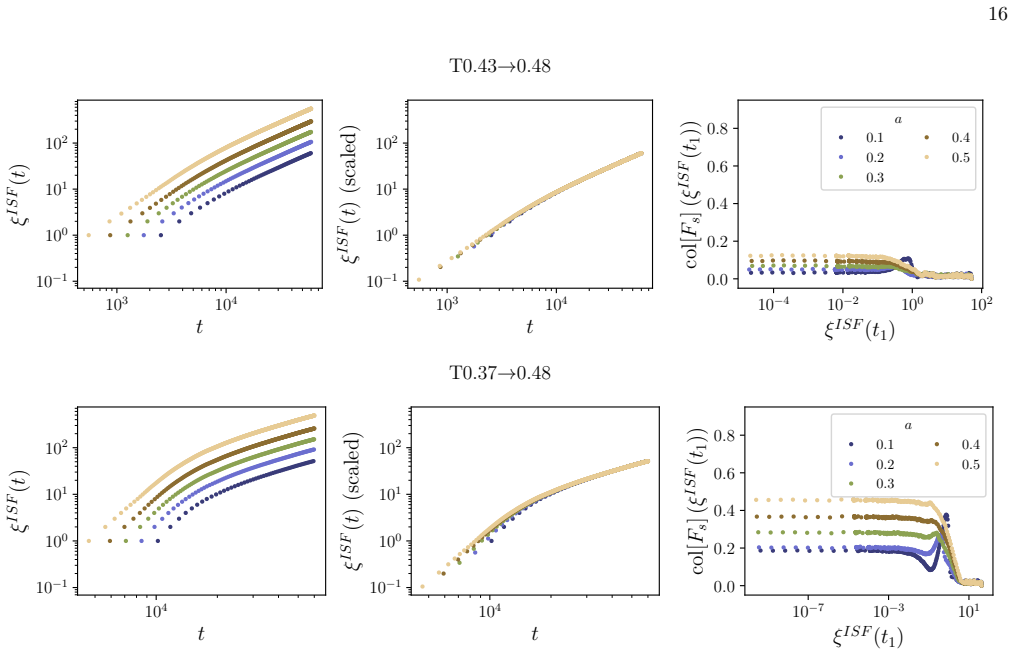
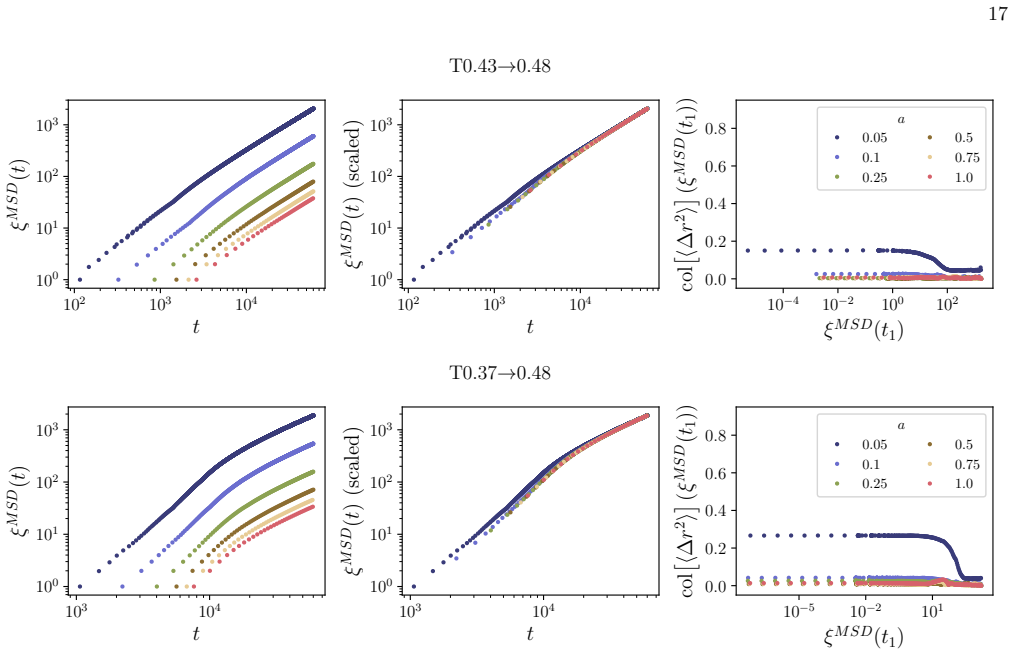
- [§IV, threshold choice] The choice a=0.1 for ξ_u and ξ_ISF and a=0.75 for ξ_MSD is made to achieve comparable material-time units, but the authors state this choice does not give the very best collapse. This sensitivity to a is discussed in an appendix; a brief statement in the main text would help readers weigh the robustness of Fig. 6.
- [§I, non-monotonic observables] The exclusion of the dynamic susceptibility and non-Gaussian parameter is justified in one sentence. A slightly longer explanation of why non-monotonicity prevents a well-defined material-time mapping would be helpful.
Circularity Check
Own-material-time diagonal in Fig. 6 is partly built in: Eq. (5) defines ξ_A from C_A, so C_A collapsing under ξ_A is not an independent test; for C_uu and F_s the triangular-relation precondition is violated (2.3–5.6× noise).
-
self definitional
[Section IV, Eq. (5) and threshold construction; Section V, Fig. 6 caption]
"we can now define a material time by C_A12 = φ_eq^A(ξ_A(t2)-ξ_A(t1)). (5) ... First a value a is chosen; when the system has decorrelated to a, by definition one unit of material time has elapsed ... The best collapse is always obtained by reparametrizing a two-time function by its own material time, as shown by the smallest values of col[f](ξ_A) obtained from ξ_B when A=B."
The diagonal of Fig. 6 (C_A vs ξ_A) is not an out-of-sample prediction: ξ_A is constructed from the same two-time function C_A via Eq. (5) and the a-threshold ladder. If Eq. (4) held exactly, Eq. (5) would make the diagonal collapse exact by definition. The paper's own Figs. 2(d–e,g–h) show Eq. (4) is violated for C_uu and F_s (max σ up to 2.3 and 5.6 times the equilibrium noise), so for those observables ξ_A is effectively a fit to C_A's own two-time surface. The conclusion that each property collapses best under its own material time is therefore partly in-sample; only the off-diagonal comparisons and the MSD case (where Eq. (4) holds) provide independent evidence.
full rationale
The paper is self-contained and transparent: it reanalyzes data from the authors' earlier Ref. 31, which is normal practice and not itself circular. The independent content lies in the triangular-relation test and the off-diagonal collapse comparisons (e.g., C_uu under ξ_ISF or ξ_MSD). However, the headline claim—that each observable collapses best under its own material time—is read from the diagonal of Fig. 6, where ξ_A was defined from C_A itself. Equation (5) defines ξ_A so that C_A matches the equilibrium function in material time; for an exactly obeyed triangular relation this diagonal collapse would be tautological. The paper finds the triangular relation is violated for C_uu and the ISF by up to 2.3–5.6 times the equilibrium noise and concedes that what counts as a 'large' deviation is debatable, so for those two observables ξ_A is a fitted, in-sample clock rather than an independently validated one. The MSD result is substantially more secure because its triangular relation holds at the equilibrium baseline and the collapse under other clocks is markedly worse. No load-bearing self-citation chain or imported uniqueness theorem was found. Overall, the central 'own material time is best' claim is partially circular for two of the three observables, warranting a score of 6 rather than 0–2.
Assumptions & free parameters
free parameters (2)
- decorrelation threshold a for material-time unit =
a=0.1 (ξ_u, ξ_ISF); a=0.75 (ξ_MSD)
- long-time scaling of material times =
slight multiplicative scaling to agree at long times (Fig. 3b)
assumptions (4)
- domain assumption The triangular relation (Eq. 4) holds during aging for the three observables, so a material time can be defined from each by Eq. (5).
- domain assumption A material time exists such that normalized relaxation functions are unique functions of material-time differences (TN/CK assumptions).
- domain assumption The mBLJ binary mixture is a representative glass former whose aging behavior transfers to experimental glasses.
- ad hoc to paper Non-monotonic observables (dynamic susceptibility, non-Gaussian parameter) can be omitted because they cannot be mapped to a monotone material time.
Cite this review
Pith. "Pith review of Property-dependent material times." pith.science (2026). https://pith.science/paper/QVFVCMJV
@misc{pith2026260715920,
  author       = {Pith},
  title        = {Pith review of: Property-dependent material times},
  year         = {2026},
  howpublished = {\url{https://pith.science/paper/QVFVCMJV}},
  note         = {Machine review of arXiv:2607.15920}
}
read the original abstract
We analyze simulations of physical aging following large temperature up-jumps from equilibrated, slowly relaxing states. Specifically, we consider up-jumps from temperatures T=0.43 and T=0.37 to T=0.48 in a binary Lennard-Jones mixture. The Tool-Narayanaswamy (TN) concept of a universal material time was recently shown to become less effective in rationalizing the aging response for such large jumps [Amari et al., Phys. Rev. E 113, 045411 (2026)]. Here, we investigate whether the performance of the TN formalism can be improved by assigning a separate material time to each observable. We examine the potential-energy time-autocorrelation function, the self-intermediate scattering function, and the time-dependent mean-square displacement. As part of this study, we perform a detailed analysis of the extent to which the triangular relation, a necessary condition for the existence of a material time, is satisfied. We find that, for all three properties, the best data collapse is obtained when each property is parameterized by its own material time. The degree of improvement varies considerably among the observables, however; it is most pronounced for the mean-square displacement.
Figures


Figures from the paper (10 more)


Reference graph
Works this paper leans on
-
[1]
B. Ruta, E. Pineda, and Z. Evenson, Relaxation processes and physical aging in metallic glasses, J. Phys.: Condens. Matter 29, 503002 (2017)
2017
-
[2]
L. Song, W. Xu, J. Huo, F. Li, L.-M. Wang, M. D. Ediger, and J.-Q. Wang, Activation entropy as a key factor controlling the memory effect in glasses, Phys. Rev. Lett.125, 135501 (2020)
2020
-
[4]
G. W. Scherer,Relaxation in Glass and Composites(Wiley, New York, 1986)
1986
-
[5]
The statistics ofC A 13 per pixel is presented in Fig. 2. In equilibrium Eq. (4) is strictly satisfied and therefore the numerical noise from equilibrium can be used as a baseline for the data during aging. Figures 2(a-c) show the mean value per pixel ofC A 13 as a function ofC A 12 for fixed values ofC A
-
[6]
The curves go from light to dark with increasing values ofC A
This is done forC uu, ISF, and MSD at equilibrium (full line) and during aging after the moderate (open squares) and the large (open circles) temperature up jumps. The curves go from light to dark with increasing values ofC A
-
[7]
own material
The orange curve in Fig. 7(b) illustrates where one curve comes from. While the functionF A depends on the observableA, it is identical at equilibrium and during aging as shown by the good collapse. Small fluctuations are visible in these plots between equilibrium and aging, but the general conclusion is that panels (a)-(c) are consistent with the triangu...
-
[8]
triangles
falls into one pixel, and in this way each pixel contains a distribution of “triangles” with sides (C A 12, CA 23, CA 13). We ignored pixels with fewer than 10 triangles, leaving 2500-10000 pixels. For those pixels, we calculated the average and standard deviation ofC 13. The averages are shown in the figures of the main paper. The quality of these result...
-
[9]
Riechers, L
B. Riechers, L. A. Roed, S. Mehri, T. S. Ingebrigtsen, T. Hecksher, J. C. Dyre, and K. Niss, Predicting nonlinear physical aging of glasses from equilibrium relaxation via the material time, Sci. Adv.8, eabl9809 (2022)
2022
Show all 59 references
-
[10]
L. C. E. Struik, Physical aging in plastics and other glassy materials, Polym. Eng. Sci.17, 165 (1977)
1977
-
[11]
I. M. Hodge, Physical aging in polymer glasses, Science267, 1945 (1995)
1945
-
[12]
Likewise,t 3 −t 2 is a function ofC A 23 andt 3 −t 1 is a function ofC A
-
[13]
Sincet 3 −t 1 = (t2 −t 1) + (t3 −t 2), this means that in equilibriumC A 13 is a function ofC A 12 andC A
-
[14]
J. C. Mauro,Materials Kinetics: Transport and Rate Phenomena(Elsevier, Amsterdan, Netherlands, 2021)
2021
-
[15]
N. B. Olsen, J. C. Dyre, and T. Christensen, Structural relaxation monitored by instantaneous shear modulus, Phys. Rev. Lett.81, 1031 (1998)
1998
-
[16]
Hecksher, N
T. Hecksher, N. B. Olsen, K. Niss, and J. C. Dyre, Physical aging of molecular glasses studied by a device allowing for rapid thermal equilibration, J. Chem. Phys.133, 174514 (2010)
2010
-
[17]
L. A. Roed, T. Hecksher, J. C. Dyre, and K. Niss, Generalized single-parameter aging tests and their application to glycerol, J. Chem. Phys.150, 044501 (2019)
2019
-
[18]
K. Sun, G. Wang, Y. Wang, H. Chen, L. Yan, S. Pauly, Y. Wu, H. Weber, Q. Wang, B. Huang,et al., Structural rejuvenation and relaxation of a metallic glass induced by ion irradiation, Scripta Materialia180, 34 (2020)
2020
-
[19]
Alfinelli, F
E. Alfinelli, F. Caporaletti, F. Dallari, A. Martinelli, G. Monaco, B. Ruta, M. Sprung, M. Zanatta, and G. Baldi, Amorphous-amorphous transformation induced in glasses by intense x-ray beams, Physical Review B107, 054202 (2023)
2023
-
[20]
Cangialosi, V
D. Cangialosi, V. M. Boucher, A. Alegria, and J. Colmenero, Physical aging in polymers and polymer nanocomposites: recent results and open questions, Soft Matter9, 8619 (2013)
2013
-
[21]
G. B. McKenna and S. L. Simon, 50th anniversary perspective: Challenges in the dynamics and kinetics of glass-forming polymers, Macromolecules50, 6333 (2017)
2017
-
[22]
Richert and J
R. Richert and J. P. Gabriel, Fast vs slow physical aging of a glass forming liquid, The Journal of Chemical Physics159 (2023). 16 103 104 t 10□1 100 101 102 ξISF (t) 103 104 t 10□1 100 101 102 ξISF (t) (scaled) 10□4 10□2 100 102 ξISF (t1) 0.0 0.2 0.4 0.6 0.8 col[Fs] (ξISF (t1...
2023
-
[23]
The idea is now that the very same relation applies during aging [33, 44–46]
In other words: C A 13 =F A(C A 12, CA 23).(4) This is the triangular relation [44, 45]; note that the functionF A in general depends on the propertyA. The idea is now that the very same relation applies during aging [33, 44–46]. Not that while we here regard the triangular re...
-
[24]
Johari, Effects of electric field on the entropy, viscosity, relaxation time, and glass-formation, The Journal of Chemical Physics138(2013)
G. Johari, Effects of electric field on the entropy, viscosity, relaxation time, and glass-formation, The Journal of Chemical Physics138(2013)
2013
-
[25]
Lee and M
H.-N. Lee and M. D. Ediger, Mechanical rejuvenation in poly(methyl methacrylate) glasses? molecular mobility after deformation, Macromolecules43, 5863 (2010), https://doi.org/10.1021/ma1006649
2010 doi
-
[26]
Bennin, E
T. Bennin, E. Xing, J. Ricci, and M. Ediger, Rejuvenation versus overaging: the effect of cyclic loading/unloading on the segmental dynamics of poly (methyl methacrylate) glasses, Macromolecules53, 8467 (2020)
2020
-
[27]
Malek, How to distinguish nonexponentiality and nonlinearity in isothermal structural relaxation of glass-forming ma- terials, J
J. Malek, How to distinguish nonexponentiality and nonlinearity in isothermal structural relaxation of glass-forming ma- terials, J. Phys. Chem. B128, 8074 (2024). 17 102 103 104 t 100 101 102 103 ξMSD (t) 102 103 104 t 100 101 102 103 ξMSD (t) (scaled) 10□4 10□2 100 102 ξMSD ...
2024
-
[28]
Mehri, L
S. Mehri, L. Costigliola, and J. C. Dyre, Single-parameter aging in the weakly nonlinear limit, Thermo2, 160 (2022)
2022
-
[29]
Di Leonardo, T
R. Di Leonardo, T. Scopigno, G. Ruocco, and U. Buontempo, Spectroscopic cell for fast pressure jumps across the glass transition line, Review of scientific instruments75, 2631 (2004)
2004
-
[30]
A. D. Phan, A. Jedrzejowska, M. Paluch, and K. Wakabayashi, Theoretical and experimental study of compression effects on structural relaxation of glass-forming liquids, ACS omega5, 11035 (2020)
2020
-
[31]
time-reparametrization softness
from which we analyze the data. Then in Section III we discuss the Cugliandolo-Kurchan triangular relation 3 0.0 0.2 0.4 0.6 Cuu(t1,t 2) (a) T0.43→0.48 (b) T0.37→0.48 0.00 0.25 0.50 0.75 Fs(t1,t 2) (c) (d) 100 102 104 t2−t1 10□2 10□1 100 101 ⟨∆r2⟩(t1,t 2) (e) 100 102 104 t2−t1...
1994
-
[32]
Luthra,Impact of optimum annealing on chemical stabilization of model amorphous pharmaceuticals(University of Connecticut, 2007)
S. Luthra,Impact of optimum annealing on chemical stabilization of model amorphous pharmaceuticals(University of Connecticut, 2007)
2007
-
[33]
Lyubimova and E
O. Lyubimova and E. Solonenko, Thermo-mechanical relaxation of stresses in a glass-metal junction, inJournal of Physics: Conference Series, Vol. 754 (IOP Publishing, 2016) p. 082002
2016
-
[34]
Henot, X
M. Henot, X. A. Nguyen, and F. Ladieu, Crossing the frontier of validity of the material time approach in the aging of a molecular glass, J. Phys. Chem. Lett.15, 3170 (2024)
2024
-
[35]
A. J. Kovacs, Transition vitreuse dans les polymeres amorphes. Etude phenomenologique, Fortschr. Hochpolym.-Forsch. 3, 394 (1963)
1963
-
[36]
K. Niss, J. C. Dyre, and T. Hecksher, Long-time structural relaxation of glass-forming liquids: Simple or stretched expo- nential?, J. Chem. Phys.152, 041103 (2020)
2020
-
[37]
J. C. Dyre, The glass transition and elastic models of glass-forming liquids, Rev. Mod. Phys.78, 953 (2006)
2006
-
[38]
Berthier and G
L. Berthier and G. Biroli, Theoretical perspective on the glass transition and amorphous materials, Rev. Mod. Phys.83, 587 (2011)
2011
-
[39]
A. Y. Amari, L. Costigliola, and J. C. Dyre, Large temperature-up-jump simulations of a binary lennard-jones system, Phys. Rev. E113, 045411 (2026)
2026
-
[40]
Hecksher, N
T. Hecksher, N. B. Olsen, and J. C. Dyre, Communication: Direct tests of single-parameter aging, J. Chem. Phys.142, 241103 (2015)
2015
-
[41]
I. M. Douglass and J. C. Dyre, Distance-as-time in physical aging, Phys. Rev. E106, 054615 (2022)
2022
-
[42]
Richert, Perspective: Nonlinear approaches to structure and dynamics of soft materials, The Journal of chemical physics 149(2018)
R. Richert, Perspective: Nonlinear approaches to structure and dynamics of soft materials, The Journal of chemical physics 149(2018)
2018
-
[43]
Sellar` es, J
J. Sellar` es, J. Ca˜ nadas, J. Diego, M. Mudarra, and J. Belana, Application of the tool–narayanaswamy–moynihan model to the study of the alpha relaxation by thermally stimulated depolarization currents, arXiv preprint cond-mat/0503749 (2005)
2005 arXiv
-
[44]
Giovambattista, C
N. Giovambattista, C. A. Angell, F. Sciortino, and H. E. Stanley, Structural relaxation in the glass transition region of water, Physical Review E—Statistical, Nonlinear, and Soft Matter Physics72, 011203 (2005)
2005
-
[45]
K. Moch, C. Gainaru, and R. B¨ ohmer, Nonlinear susceptibilities and higher-order responses related to physical ag- ing: Wiener-volterra approach and extended tool-narayanaswamy-moynihan models, Journal of Chemical Physics161, 10.1063/5.0207122 (2024)
2024 doi
-
[46]
Hecksher and K
T. Hecksher and K. Niss, Single parameter aging and density scaling, J. Chem. Phys.161, 194504 (2024)
2024
-
[48]
Kob and H
W. Kob and H. C. Andersen, Testing mode-coupling theory for a supercooled binary Lennard-Jones mixture I: The van Hove correlation function, Phys. Rev. E51, 4626 (1995). 18
1995
-
[49]
U. R. Pedersen, T. B. Schrøder, and J. C. Dyre, Phase diagram of Kob-Andersen-type binary Lennard-Jones mixtures, Phys. Rev. Lett.120, 165501 (2018)
2018
-
[50]
E. D. Zanotto, Effect of liquid phase separation on crystal nucleation in glass-formers. case closed, Ceramics International 46, 24779 (2020)
2020
-
[51]
T. B. Schrøder and J. C. Dyre, Solid-like mean-square displacement in glass-forming liquids, J. Chem. Phys.152, 141101 (2020)
2020
-
[52]
L. F. Cugliandolo and J. Kurchan, On the out-of-equilibrium relaxation of the Sherrington-Kirkpatrick model, J. Phys. A: Math. Gen.27, 5749 (1994)
1994
-
[53]
Kurchan, Time-reparametrization invariances, multithermalization and the Parisi scheme, SciPost Phys
J. Kurchan, Time-reparametrization invariances, multithermalization and the Parisi scheme, SciPost Phys. Core6, 001 (2023)
2023
-
[54]
J. C. Dyre, Narayanaswamy’s 1971 aging theory and material time, J. Chem. Phys.143, 114507 (2015)
1971
-
[55]
O. S. Narayanaswamy, A model of structural relaxation in glass, J. Amer. Ceram. Soc.54, 491 (1971)
1971
-
[56]
Moynihan, A
C. Moynihan, A. Easteal, M. DeBolt, and J. Tucker, Analysis of structural relaxation in glass using rate heating data, J Am Ceram Soc59, 12 (1976)
1976
-
[57]
B¨ ohmer, J
T. B¨ ohmer, J. P. Gabriel, L. Costigliola, J.-N. Kociok, T. Hecksher, J. C. Dyre, and T. Blochowicz, Time reversibility during the ageing of materials, Nat. Phys.20, 637 (2024)
2024
-
[58]
H. E. Castillo and A. Parsaeian, Local fluctuations in the ageing of a simple structural glass, Nature Physics3, 26 (2007)
2007
-
[59]
H. E. Castillo, C. Chamon, L. F. Cugliandolo, J. Luis-Iguain, and M. P. Kennett, Spatially heterogeneous ages in glassy dynamics, Phys. Rev. B https://doi.org/10.1103/PhysRevB.68.134442 (2003)
2003 doi
-
[60]
H. E. Castillo, C. Chamon, L. F. Cugliandolo, and M. P. Kennett, Heterogeneous Aging in Spin Glasses, Phys. Rev. Lett. 88, 237201 (2002)
2002
-
[61]
S. M. Ross, S. M. Ross, S. M. Ross, S. M. Ross, and E.-U. Math´ ematicien,A first course in probability, Vol. 6 (Prentice Hall Upper Saddle River, NJ, 1998)
1998
Reviewed August 1, 2026 · model on record in the stance chip above.
Discussion (0). Continue with ORCID to comment.