REVIEW 3 major objections 5 minor 64 references
Gauging two symmetries in a cubic-anomaly theory forces the remaining symmetry to extend by condensation defects, yielding an ordinary extension or a higher-group.
Reviewed by Pith at T0; open to challenge. T0 means a machine referee read the full paper against a public rubric. the ladder, T0–T4 →
T0 review · deepseek-v4-flash
2026-08-01 21:22 UTC pith:SY5R2Y7I
load-bearing objection The n=1 extension mechanism is solid and the partition-function check is a nice payoff, but the advertised n≥2 higher-group examples rest on an unproved, dimensionally suspect condensation-defect identification. the 3 major comments →
Symmetry extension by condensation defects II: general dimensions and higher-groups
The pith
A machine-rendered reading of the paper's core claim, the machinery that carries it, and where it could break.
Core claim
The central claim: after gauging A^{(p)}×B^{(q)}, the theory is governed by the background constraint δD_{n+r} = (−1)^{p+q} t_{n+r+1}(C), where D_{n+r} is the background for a D^{(n+r−1)} symmetry generated by condensation defects U_d of the dual A-hat×B-hat symmetry with discrete torsion. The torsion makes the fusion rules of U_d invertible, so D is a genuine symmetry. For n=1, C and D form an ordinary extension 1→D^{(r)}→Γ^{(r)}→C^{(r)}→1; for n≥2 they form an (r+n)-group. Charged objects are triple-linking configurations of two A-hat- and B-hat-charged operators, carrying fractional C-charge.
What carries the argument
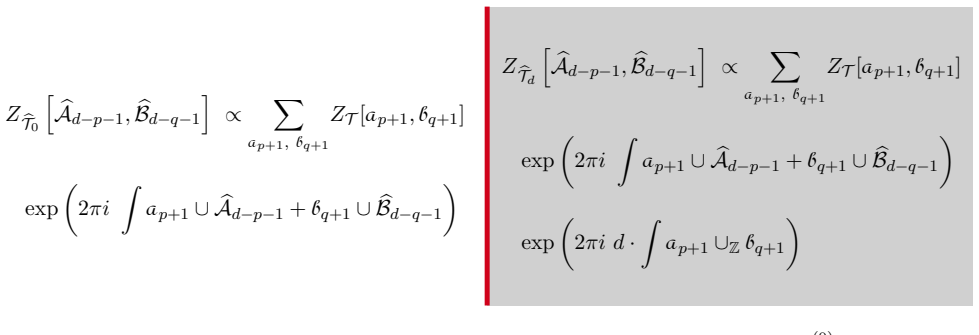
The central object is the condensation defect U_d[Σ_{p+q+2}]: a higher-gauging of the dual A-hat^{(d-p-2)}×B-hat^{(d-q-2)} symmetry on a submanifold, with a discrete torsion term that makes its fusion invertible and labeled by the finite Abelian group D. The carrying identity is the background constraint δD_{n+r}=(−1)^{p+q} t_{n+r+1}(C), which forces C to sit inside a larger structure Γ. The action on operators is mediated by the triple-linking number L_3, replacing the usual two-component linking of standard higher-form symmetries.
Load-bearing premise
The load-bearing premise is that the torsion-twisted condensation defect U_d is a genuine invertible topological operator with fusion rules labeled by D, and for r≥1 that the characteristic class is activated by the assumed non-generic junctions; if either fails, the extension/higher-group conclusion collapses into non-invertible defect structure.
What would settle it
Compute the fusion of two U_d defects in a concrete lattice or TFT realization of the higher-gauging, or compute the S^1×S^2×S^2 partition function of 5d SO(3) SYM with electric and instantonic fluxes: if the fusion is non-invertible, or if the fugacity periodicity is 2π rather than 4π in a flux sector that should show the extension, the central claim is falsified.
If this is right
- Every theory with an anomaly of the form (2.1), in any spacetime dimension, acquires an extended symmetry after gauging A×B: an ordinary extension for n=1 and an (r+n)-group for n≥2, with the extension class fixed by the anomaly.
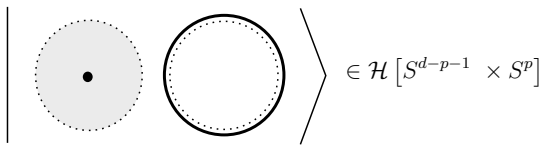
- The charged spectrum of the gauged theory must include triple-linking configurations of two operators; these carry fractional C-charge, so any Hilbert space that captures the extension must contain such link states.
- In 5d N=1 SYM with gauge group SO(3), the instantonic symmetry U(1)_I is extended by Z_2, so the fugacity on S^1×S^2×S^2 has period 4π rather than 2π, visible in the supersymmetric partition function.
- In the E1 SCFT, gauging a Z_2×Z_2 subgroup of the instantonic symmetry produces a 3-group between a Z_2 one-form symmetry and a Z_2 two-form symmetry generated by a condensation defect.
- The n=0 limit of the same framework reproduces the known non-invertible defect structures, so the construction interpolates between non-invertible defects and invertible extension/higher-group symmetries.
Where Pith is reading between the lines
- If the invertibility of the condensation defect fusion holds generally, the same mechanism should apply to any cubic anomaly whose characteristic class takes values in a finite Abelian group, including cases with continuous C; verifying the fusion in a lattice model would sharpen the claim.
- The authors' expectation that classes in H^{r+2}(B^{r+1}C,D)/Ker(Φ_r) are activated by non-generic junctions means the extension class may be computable purely from group cohomology; checking this map explicitly for r≥1 would turn the structural result into a practical formula.
- The triple-linking charge suggests that in holographic or symmetry-TFT descriptions the extended symmetry should be visible as a bulk boundary condition; one could test the construction by deriving the same extension from an anomaly inflow TFT on a slab.
- The doubled-periodicity prediction in 5d SYM is directly testable in the existing supersymmetric partition function literature; if the 4π periodicity fails for some background fluxes, the extension claim would be narrowed.
Editorial analysis
A structured set of objections, weighed in public.
Referee Report
Summary. The paper studies a class of QFTs with a cubic mixed anomaly of the form (2.1), involving two finite Abelian higher-form symmetries A^{(p)}, B^{(q)} and a characteristic class t_{n+r+1}(C^{(r)}) for a third symmetry C^{(r)}. After gauging A^{(p)} × B^{(q)}, the authors derive a constraint δD_{n+r} = (−1)^{p+q} t_{n+r+1}(C) on the background field D_{n+r} of a new D^{(n+r−1)} symmetry generated by operators U_d[Σ_{p+q+2}] = exp(2πi d·∫ a∪b). They argue that for n=1 this gives an ordinary group extension 1→D^{(r)}→Γ^{(r)}→C^{(r)}→1, and for n≥2 a higher (r+n)-group. They describe charged operators as triple-linking configurations of operators charged under the dual bA × bB symmetries, and they present examples in scalar QED3, T(SU(N)), 5d SYM, and the E1 SCFT. The paper is the second in a series and advertises a general-dimensional, higher-group generalization of the five-dimensional construction of [1].
Significance. If the central construction is valid, the paper provides a general and unifying statement: any cubic anomaly of the form (2.1) leads, upon gauging A×B, to an invertible symmetry generated by the operators U_d of (2.9) that mixes with C in a way controlled by the characteristic class. This goes beyond the previously studied n=0 non-invertible cases and the n=1 five-dimensional example, and it is supported by several explicit examples. Strengths of the manuscript include: the clean gauge-invariance derivation of the background constraint (2.15) and the modified transformation (2.18); the reproduction of known n=0 and n=1 results in special cases; and an independent check in §3.3 using the 5d supersymmetric partition function, which exhibits the predicted doubled fugacity periodicity. These are significant assets. However, as detailed below, the general-dimensional claim rests on a condensation-defect identification that is not established and appears, in part of the parameter space, to be obstructed by elementary dimensional counting.
major comments (3)
- [§2.1, Eq. (2.10)] The identification of U_d[Σ_{p+q+2}] with a condensation defect of the higher-gauging type is not valid as written for general p,q,n,r. To gauge a (d−p−2)-form symmetry on a submanifold of dimension p+q+2, the dual gauge field of degree d−p−1 must restrict to that submanifold, which requires d−p−1 ≤ p+q+2, i.e. p ≥ n+r−1, and similarly q ≥ n+r−1. In the E1 example of §3.4, p=q=0, n=2, r=1, d=5, so the dual gauge fields have degree 4 while Σ_{p+q+2} is 2-dimensional; the ordinary restriction vanishes. The notation ba_{q+1}=ba_{d−p−1−(d−p−q−2)} suggests a reduction through normal directions, but no such operation is defined. Thus the advertised 'condensation defect' presentation, and the consequent interpretation of the D symmetry as generated by condensation defects, is not established in the very regime (n≥2) that the paper emphasizes. The authors should either define a well-behaved rest
- [§2.1.2 and §2.1.3, Eqs. (2.32), (2.37)] The extension/higher-group statements for r≥1 rely on the assertion that the characteristic class t_{n+r+1} is activated by non-generic junctions of C^{(r)} defects through the homomorphism Φ_r. The paper itself says this is 'expected' ('we expect that the simple, non-generic junction ... still exists', §2.1.2) and 'we rely on the homomorphism (2.32)' (§2.1.3). No proof or detailed construction of the junction is given. Because the central claim for general dimensions and in particular the n=2, r=1 example of §3.4 depends on this step, a derivation (or at least a precise hypothesis specifying which classes lie in Im Φ_r and how the junction realizes them) is necessary. Without it, the higher-group interpretation for r≥1 is not fully supported.
- [§2.2.3] The construction of charged operators and states for the n=2 (r+2)-group case is only sketched. The paper states that the argument is a 'straightforward adaptation' of the standard higher-group analysis and that interfaces 'will be allowed' to carry projective representations of C^{(r)}. Unlike the n=1 case, no operator equation analogous to (A.4) or (A.7) is derived for the condensation-defect higher-group. Given that the n≥2 regime is the advertised new result, the paper should provide either a concrete derivation of the projective action, or clearly label this part as conjectural and identify which observables would test it. This is especially important because the E1 example in §3.4 is presented as a concrete application of exactly this structure.
minor comments (5)
- [§2.1, Eq. (2.10)] The notation ba_{q+1} and bb_{p+1} is confusing: the displayed degrees are obtained by subtracting d−p−q−2 from the dual gauge-field degrees, but the reader is not told what this subtraction means geometrically. Even if the expression is a formal device, it should be defined explicitly, or replaced by a notation that does not suggest an ordinary restriction.
- [Figures 2 and 3] The figures rely on color (yellow, blue, orange, etc.). Since the text refers to colors, please ensure the figures are legible in grayscale or add labels/patterns.
- [Table 1] The table caption lists the choices of J,J′ but does not explain the columns and rows in enough detail. A reader cannot easily see which entries are the 'several choices of background instantonic fluxes that enforce an extended 4π periodicity'. Please spell out the criterion and point to at least one explicit row/column combination.
- [§3.3] The sentence 'From these evaluations we can see that there are several choices ...' is weaker than the rest of the paper. Since this is an advertised independent check, it would help to state precisely which values of n force the period doubling and why the table is exhaustive at the shown order.
- [§2.1.2] The same symbol d is used for the spacetime dimension and for an element of D. This is momentarily confusing in the discussion around (2.28) and (2.38); consider using a different letter for the group element.
Circularity Check
No significant circularity: the symmetry structure is derived from gauge invariance of the gauged partition function, and self-citations are not load-bearing.
full rationale
The central derivation is self-contained. The symmetry structure is obtained from the gauged partition function (2.12): coupling the dual gauge fields to a new background D and requiring invariance of the summand under dynamical and background gauge transformations yields δD_{n+r}=(-1)^{p+q}t_{n+r+1}(C) (eq. 2.15) and the modified transformation (2.18). This is a direct consistency computation, not a fit. The group-like operators U_d=exp(2πi d·∫Σ a∪b) (2.9) manifestly fuse invertibly, and eqs. (2.43)-(2.46) derive their triple-linking action and the resulting representations directly from (2.9) and the flatness defects, without importing the extension class. The n=0 limit is benchmarked against the independent non-invertible results [6,7], while the 5d n=1 case is re-verified using the external partition-function computation [22]; the n=2 example is built on external anomaly matching [2,4]. The self-citation to [1] appears only for the normalization of the condensation-defect presentation (2.10), and the central constraint (2.15) does not depend on that presentation. The paper itself flags its unproven points: in §2.1.2 it says 'we expect that the simple, non-generic junction ... still exists', and in §2.1.3 it says 'when r≥1 we rely on the homomorphism (2.32)'; it also states in §2.1.2 that it does 'not attempt a description of the full set of topological defects and their fusions.' These are limitations or possible gaps, not circular reductions. The general condensation-defect expression (2.10), with higher-degree dual gauge fields restricted to a lower-dimensional Σ, is not defined in all advertised regimes (e.g. §3.4), but this is a rigor gap in an ancillary presentation: the U_d operators and the derived constraints stand on their own. No step reduces a claimed prediction to an input by construction or to a self-citation chain.
Axiom & Free-Parameter Ledger
axioms (5)
- ad hoc to paper The condensation defect (2.10), with the discrete torsion term, is topological and has invertible fusion rules described by the Abelian group D.
- domain assumption The anomaly inflow (2.1) captures the complete mixed anomaly between A, B, and C, with no additional anomaly terms affecting the gauged theory.
- domain assumption For r ≥ 1, the characteristic class t_{n+r+1} is activated by the non-generic junction of two (n=1) or three (n=2) C^{(r)} defects via the homomorphism Φ_r of (2.32).
- domain assumption The gauging sum (2.12) uses the minimal coupling a ∪ b ∪ D; no additional discrete torsion is turned on in the gauging of A × B itself.
- standard math Standard cohomological machinery: cup products, Bockstein homomorphisms, Eilenberg–MacLane spaces, the identification H^n(B^{k+1}C,D) ≅ [K(C',k'+1), K(D,n)], and the map Φ_k (2.32).
invented entities (1)
-
D^{(n+r−1)} symmetry generated by condensation defects U_d
independent evidence
read the original abstract
We discuss a class of symmetry structures in general spacetime dimension that arise when gauging symmetries in theories with a cubic 't Hooft anomaly. The anomaly mixes two Abelian discrete symmetries $A$ and $B$ with a characteristic class for an additional symmetry $C$, and we gauge $A\times B$. The novelty of this construction is that the resulting symmetry structure involves certain condensation defects of the dual symmetry $\widehat{A}\times\widehat{B}$. Specifically, these defects generate an invertible symmetry that extends $C$, either as an ordinary group extension or as a higher-group, depending on the characteristic class. We describe the corresponding charged operators and states, and illustrate the mechanism in several examples.
Figures




Reference graph
Works this paper leans on
-
[1]
M. Bertolini, L. Di Pietro, S.C. Lanza, P. Niro and A. Santaniello,Symmetry extension by condensation defects in five-dimensional gauge theories,JHEP03(2026) 238 [2509.16165]. 1, 2, 4, 7, 13, 33, 36
arXiv 2026
-
[2]
P. Benetti Genolini and L. Tizzano,Instantons, symmetries and anomalies in five dimensions,JHEP04(2021) 188 [2009.07873]. 1, 4, 13, 36
Pith/arXiv arXiv 2021
-
[3]
S. Gukov, P.-S. Hsin and D. Pei,Generalized global symmetries ofT[M]theories. Part I, JHEP04(2021) 232 [2010.15890]
Pith/arXiv arXiv 2021
-
[4]
P. Benetti Genolini and L. Tizzano,Comments on Global Symmetries and Anomalies of5d SCFTs,2201.02190. 1, 4, 30
-
[5]
L. Bhardwaj and Y. Tachikawa,On finite symmetries and their gauging in two dimensions, JHEP03(2018) 189 [1704.02330]. 2
Pith/arXiv arXiv 2018
-
[6]
Tachikawa,On gauging finite subgroups,SciPost Phys.8(2020) 015 [1712.09542]
Y. Tachikawa,On gauging finite subgroups,SciPost Phys.8(2020) 015 [1712.09542]. 9, 12
Pith/arXiv arXiv 2020
-
[7]
J. Kaidi, K. Ohmori and Y. Zheng,Kramers-Wannier-like Duality Defects in (3+1)D Gauge Theories,Phys. Rev. Lett.128(2022) 111601 [2111.01141]. 9, 10
Pith/arXiv arXiv 2022
-
[8]
Y. Choi, C. Córdova, P.-S. Hsin, H.T. Lam and S.-H. Shao,Non-invertible duality defects in3 + 1dimensions,Phys. Rev. D105(2022) 125016 [2111.01139]. 2
Pith/arXiv arXiv 2022
-
[9]
Sharpe,Notes on generalized global symmetries in QFT,Fortsch
E. Sharpe,Notes on generalized global symmetries in QFT,Fortsch. Phys.63(2015) 659 [1508.04770]. 3
Pith/arXiv arXiv 2015
-
[10]
C. Córdova, T.T. Dumitrescu and K. Intriligator,Exploring 2-Group Global Symmetries, JHEP02(2019) 184 [1802.04790]. 14, 31
Pith/arXiv arXiv 2019
-
[11]
F. Benini, C. Córdova and P.-S. Hsin,On 2-Group Global Symmetries and their Anomalies,JHEP03(2019) 118 [1803.09336]. 3, 14, 51
Pith/arXiv arXiv 2019
-
[12]
V.B. Petkova and J.B. Zuber,Generalized twisted partition functions,Phys. Lett. B504 (2001) 157 [hep-th/0011021]. 3
Pith/arXiv arXiv 2001
-
[13]
J. Frohlich, J. Fuchs, I. Runkel and C. Schweigert,Kramers-Wannier duality from conformal defects,Phys. Rev. Lett.93(2004) 070601 [cond-mat/0404051]
Pith/arXiv arXiv 2004
-
[14]
J. Frohlich, J. Fuchs, I. Runkel and C. Schweigert,Duality and defects in rational conformal field theory,Nucl. Phys. B763(2007) 354 [hep-th/0607247]. 53
Pith/arXiv arXiv 2007
-
[15]
C.-M. Chang, Y.-H. Lin, S.-H. Shao, Y. Wang and X. Yin,Topological Defect Lines and Renormalization Group Flows in Two Dimensions,JHEP01(2019) 026 [1802.04445]
Pith/arXiv arXiv 2019
-
[16]
R. Thorngren and Y. Wang,Fusion category symmetry. Part I. Anomaly in-flow and gapped phases,JHEP04(2024) 132 [1912.02817]. 3
Pith/arXiv arXiv 2024
-
[17]
K. Roumpedakis, S. Seifnashri and S.-H. Shao,Higher Gauging and Non-invertible Condensation Defects,Commun. Math. Phys.401(2023) 3043 [2204.02407]. 3
Pith/arXiv arXiv 2023
-
[18]
Y. Choi, C. Cordova, P.-S. Hsin, H.T. Lam and S.-H. Shao,Non-invertible Condensation, Duality, and Triality Defects in 3+1 Dimensions,Commun. Math. Phys.402(2023) 489 [2204.09025]. 3
Pith/arXiv arXiv 2023
-
[19]
P. Putrov, J. Wang and S.-T. Yau,Braiding Statistics and Link Invariants of Bosonic/Fermionic Topological Quantum Matter in 2+1 and 3+1 dimensions,Annals Phys.384(2017) 254 [1612.09298]. 3
Pith/arXiv arXiv 2017
-
[20]
J. Kaidi, K. Ohmori and Y. Zheng,Symmetry TFTs for Non-invertible Defects,Commun. Math. Phys.404(2023) 1021 [2209.11062]. 3
Pith/arXiv arXiv 2023
-
[21]
D. Gaiotto and E. Witten,S-Duality of Boundary Conditions In N=4 Super Yang-Mills Theory,Adv. Theor. Math. Phys.13(2009) 721 [0807.3720]. 4, 32
Pith/arXiv arXiv 2009
-
[22]
H. Kim, J. Manschot, G.W. Moore, R. Tao and X. Zhang,Path Integral Derivations Of K-Theoretic Donaldson Invariants,2509.23042. 4, 33, 34, 35, 36
-
[23]
Seiberg,Five-dimensional SUSY field theories, nontrivial fixed points and string dynamics,Phys
N. Seiberg,Five-dimensional SUSY field theories, nontrivial fixed points and string dynamics,Phys. Lett. B388(1996) 753 [hep-th/9608111]. 4, 36
Pith/arXiv arXiv 1996
-
[24]
Z. Wan, J. Wang and Y.-Z. You,Topological Responses of the Standard Model Gauge Group,2412.21196. 5
-
[25]
J. Davis and P. Kirk,Lecture Notes in Algebraic Topology, vol. 35 ofGraduate Studies in Mathematics, American Mathematical Society, Providence, R.I. (2001), 10.1090/gsm/035. 5, 12
-
[26]
Y. Choi, H.T. Lam and S.-H. Shao,Noninvertible Global Symmetries in the Standard Model,Phys. Rev. Lett.129(2022) 161601 [2205.05086]. 9
Pith/arXiv arXiv 2022
-
[27]
A. Kapustin and R. Thorngren,Anomalies of discrete symmetries in various dimensions and group cohomology,1404.3230. 9 54
-
[28]
A. Kapustin and R. Thorngren,Topological Field Theory on a Lattice, Discrete Theta-Angles and Confinement,Adv. Theor. Math. Phys.18(2014) 1233 [1308.2926]. 9
Pith/arXiv arXiv 2014
-
[29]
D.-C. Lu, Z. Sun and Z. Zhang,Exploring G-ality defects in 2-dim QFTs,JHEP11(2025) 081 [2406.12151]. 10
arXiv 2025
-
[30]
Vandermeulen,Lower-Form Symmetries,2211.04461
T. Vandermeulen,Lower-Form Symmetries,2211.04461. 10
-
[31]
D. Aloni, E. García-Valdecasas, M. Reece and M. Suzuki,Spontaneously broken (-1)-form U(1) symmetries,SciPost Phys.17(2024) 031 [2402.00117]. 10
Pith/arXiv arXiv 2024
-
[32]
Sheckler,Generalized Instanton Symmetry Induced by Monopoles,2510.23718
A. Sheckler,Generalized Instanton Symmetry Induced by Monopoles,2510.23718. 13
-
[33]
L. Bhardwaj, L.E. Bottini, L. Fraser-Taliente, L. Gladden, D.S.W. Gould, A. Platschorre et al.,Lectures on generalized symmetries,Phys. Rept.1051(2024) 1 [2307.07547]. 14
Pith/arXiv arXiv 2024
-
[34]
T. Bartsch, M. Bullimore and A. Grigoletto,Higher representations for extended operators, 2304.03789. 14, 37
-
[35]
L. Bhardwaj and S. Schafer-Nameki,Generalized charges, part I: Invertible symmetries and higher representations,SciPost Phys.16(2024) 093 [2304.02660]. 14, 18, 37
Pith/arXiv arXiv 2024
-
[36]
J. Kaidi, E. Nardoni, G. Zafrir and Y. Zheng,Symmetry TFTs and anomalies of non-invertible symmetries,JHEP10(2023) 053 [2301.07112]. 17
Pith/arXiv arXiv 2023
-
[37]
A. Antinucci and F. Benini,Anomalies and gauging of U(1) symmetries,Phys. Rev. B111 (2025) 024110 [2401.10165]. 17
Pith/arXiv arXiv 2025
-
[38]
A. Arbalestrier, R. Argurio and L. Tizzano,U(1) gauging, continuous TQFTs, and higher symmetry structures,SciPost Phys.19(2025) 032 [2502.12997]. 17
Pith/arXiv arXiv 2025
-
[39]
Z. Komargodski, A. Sharon, R. Thorngren and X. Zhou,Comments on Abelian Higgs Models and Persistent Order,SciPost Phys.6(2019) 003 [1705.04786]. 23
Pith/arXiv arXiv 2019
-
[40]
N. Mekareeya and M. Sacchi,Mixed anomalies, two-groups, non-invertible symmetries, and 3d superconformal indices,JHEP01(2023) 115 [2210.02466]. 32
Pith/arXiv arXiv 2023
-
[41]
O. DeWolfe, A. Hanany, A. Iqbal and E. Katz,Five-branes, seven-branes and five-dimensional E(n) field theories,JHEP03(1999) 006 [hep-th/9902179]. 36
Pith/arXiv arXiv 1999
-
[42]
H.-C. Kim, S.-S. Kim and K. Lee,5-dim Superconformal Index with Enhanced En Global Symmetry,JHEP10(2012) 142 [1206.6781]. 55
Pith/arXiv arXiv 2012
-
[43]
D. Bashkirov,A comment on the enhancement of global symmetries in superconformal SU(2) gauge theories in 5D,1211.4886
-
[44]
D. Rodríguez-Gómez and G. Zafrir,On the 5d instanton index as a Hilbert series,Nucl. Phys. B878(2014) 1 [1305.5684]
Pith/arXiv arXiv 2014
-
[45]
Y. Tachikawa,Instanton operators and symmetry enhancement in 5d supersymmetric gauge theories,PTEP2015(2015) 043B06 [1501.01031]
Pith/arXiv arXiv 2015
-
[46]
S. Cremonesi, G. Ferlito, A. Hanany and N. Mekareeya,Instanton Operators and the Higgs Branch at Infinite Coupling,JHEP04(2017) 042 [1505.06302]
Pith/arXiv arXiv 2017
-
[47]
C. Closset, M. Del Zotto and V. Saxena,Five-dimensional SCFTs and gauge theory phases: an M-theory/type IIA perspective,SciPost Phys.6(2019) 052 [1812.10451]
Pith/arXiv arXiv 2019
-
[48]
F. Apruzzi, S. Schafer-Nameki, L. Bhardwaj and J. Oh,The Global Form of Flavor Symmetries and 2-Group Symmetries in 5d SCFTs,SciPost Phys.13(2022) 024 [2105.08724]
Pith/arXiv arXiv 2022
-
[49]
P. Benetti Genolini, M. Honda, H.-C. Kim, D. Tong and C. Vafa,Evidence for a Non-Supersymmetric 5d CFT from Deformations of 5dSU(2)SYM,JHEP05(2020) 058 [2001.00023]
Pith/arXiv arXiv 2020
-
[50]
M. Bertolini and F. Mignosa,Supersymmetry breaking deformations and phase transitions in five dimensions,JHEP10(2021) 244 [2109.02662]
Pith/arXiv arXiv 2021
-
[51]
M. Bertolini, F. Mignosa and J. van Muiden,On non-supersymmetric fixed points in five dimensions,JHEP10(2022) 064 [2207.11162]
Pith/arXiv arXiv 2022
-
[52]
M. Akhond, M. Honda and F. Mignosa,5d SCFTs and their non-supersymmetric cousins, SciPost Phys.16(2024) 036 [2307.13724]
Pith/arXiv arXiv 2024
-
[53]
M. Del Zotto, I. García Etxebarria and S. Schafer-Nameki,2-Group Symmetries and M-Theory,SciPost Phys.13(2022) 105 [2203.10097]
Pith/arXiv arXiv 2022
-
[54]
M. Cvetič, J.J. Heckman, M. Hübner and E. Torres,0-form, 1-form, and 2-group symmetries via cutting and gluing of orbifolds,Phys. Rev. D106(2022) 106003 [2203.10102]
Pith/arXiv arXiv 2022
-
[55]
C. Closset and H. Magureanu,Reading between the rational sections: Global structures of 4dN= 2KK theories,SciPost Phys.16(2024) 137 [2308.10225]. 56
Pith/arXiv arXiv 2024
-
[56]
Acharya,Confinement in Five Dimensions,2407.03171
B.S. Acharya,Confinement in Five Dimensions,2407.03171
- [57]
-
[58]
D. Gaiotto, A. Kapustin, N. Seiberg and B. Willett,Generalized Global Symmetries,JHEP 02(2015) 172 [1412.5148]. 37
Pith/arXiv arXiv 2015
-
[59]
A. Arbalestrier, E. Paznokas and S. Vitouladitis,The state/defect correspondence, 2606.12560. 37
-
[60]
J.A. Damia, R. Argurio and S. Chaudhuri,When the moduli space is an orbifold: spontaneous breaking of continuous non-invertible symmetries,JHEP03(2024) 042 [2309.06491]. 46
Pith/arXiv arXiv 2024
-
[61]
P.-S. Hsin, R. Kobayashi and C. Zhang,Fractionalization of coset non-invertible symmetry and exotic Hall conductance,SciPost Phys.17(2024) 095 [2405.20401]
Pith/arXiv arXiv 2024
-
[62]
P.-S. Hsin, R. Kobayashi and C. Zhang,Anomalies of coset non-invertible symmetries, SciPost Phys.20(2026) 006 [2503.00105]. 46
arXiv 2026
-
[63]
Bott and L.W
R. Bott and L.W. Tu,Differential forms in algebraic topology, vol. 82 ofGraduate Texts in Mathematics, Springer-Verlag, New York (1982). 47
1982
-
[64]
Y. Tanizaki and T. Sulejmanpasic,Anomaly and global inconsistency matching:θ-angles, SU(3)/U(1) 2 nonlinear sigma model,SU(3)chains and its generalizations,Phys. Rev. B 98(2018) 115126 [1805.11423]. 52 57
Pith/arXiv arXiv 2018
discussion (0)
Sign in with ORCID, Apple, or X to comment. Anyone can read and Pith papers without signing in.