REVIEW 3 minor 2 cited by
Higher-form gauge theories admit a one-to-one mapping from states to p-dimensional defects via anomaly-generated charges.
Reviewed by Pith at T0; open to challenge. T0 means a machine referee read the full paper against a public rubric. the ladder, T0–T4 →
T0 review · grok-4.3
2026-06-27 08:42 UTC pith:7J4I2ZHG
load-bearing objection The paper sketches a state-defect correspondence in higher-form theories built from mixed-anomaly charges and an extended Kac-Moody algebra, but the claim rests on derivations that need to be checked in the full text.
The state/defect correspondence
The pith
A machine-rendered reading of the paper's core claim, the machinery that carries it, and where it could break.
Core claim
We formulate a one-to-one correspondence between states and defects for higher-form gauge theories in arbitrary dimensions. The correspondence relies on the existence of infinitely many conserved charges associated with the mixed anomaly of electric and magnetic higher-form symmetries. In p-form Maxwell theory, these charges generate an extended Kac-Moody algebra that acts simultaneously on states and on extended operators. This algebra organizes the Hilbert space on S^p × S^{d-p-1} into highest-weight representations allowing a direct identification between states and p-dimensional defects. In particular, Wilson-'t Hooft defects dressed with local gauge-invariant operators are mapped to squ
What carries the argument
The extended Kac-Moody algebra generated by the conserved charges of the mixed anomaly between electric and magnetic higher-form symmetries; the algebra acts simultaneously on the Hilbert space and on extended operators to produce the state-defect identification.
Load-bearing premise
The existence of infinitely many conserved charges associated with the mixed anomaly of electric and magnetic higher-form symmetries.
What would settle it
An explicit calculation of the action of the proposed charges on the Hilbert space of p-form Maxwell theory on S^p × S^{d-p-1} that fails to produce highest-weight representations or to map dressed Wilson-'t Hooft defects onto squeezed energy eigenstates would falsify the claimed correspondence.
If this is right
- The Hilbert space on S^p × S^{d-p-1} decomposes into highest-weight representations under the algebra.
- Dressed Wilson-'t Hooft defects are identified with specific squeezed energy eigenstates.
- The state-defect correspondence extends to a class of interacting non-linear electrodynamics theories.
- The same charges generate higher-spin currents in addition to the Kac-Moody structure.
Where Pith is reading between the lines
- Questions about the spectrum of local and extended operators can be translated into questions about the energy eigenstates via the algebra action.
- The construction suggests that similar anomaly-driven correspondences may exist in other theories possessing mixed higher-form symmetries.
- Low-dimensional examples of the theory could be diagonalized explicitly to test whether the predicted squeezing of mapped states occurs.
Editorial analysis
A structured set of objections, weighed in public.
Referee Report
Summary. The manuscript formulates a one-to-one correspondence between states and defects in higher-form gauge theories in arbitrary dimensions. It relies on infinitely many conserved charges arising from the mixed anomaly between electric and magnetic higher-form symmetries; these charges generate an extended Kac-Moody algebra that acts on both the Hilbert space and extended operators. The algebra organizes the Hilbert space on S^p × S^{d-p-1} into highest-weight representations, permitting a direct identification of states with p-dimensional defects. In particular, Wilson-'t Hooft defects dressed by local gauge-invariant operators are mapped to squeezed energy eigenstates. The construction is shown to extend to a class of interacting non-linear electrodynamics theories.
Significance. If the central construction holds, the result supplies a symmetry-based dictionary between states and defects that does not require conformal invariance and applies to non-conformal higher-form theories. The explicit use of an extended Kac-Moody algebra generated by anomaly-derived charges to realize highest-weight representations, together with the persistence of the construction in selected interacting models, constitutes a concrete organizing principle for the Hilbert space that could be useful for further work on generalized symmetries.
minor comments (3)
- [Abstract] The abstract introduces the term 'squeezed energy eigenstates' without a preliminary definition or reference; a short clarifying sentence or footnote in the introduction would improve readability.
- The manuscript would benefit from an explicit low-dimensional example (e.g., p=1 Maxwell theory in d=4) that lists the first few generators of the extended Kac-Moody algebra and shows the corresponding state-defect map.
- Notation for the higher-form symmetries and their charges should be standardized early; occasional shifts between electric/magnetic labels and p-form indices can be confusing.
Simulated Author's Rebuttal
We thank the referee for their positive summary and assessment of the manuscript's significance. The recommendation for minor revision is noted, but the report contains no specific major comments requiring point-by-point response. We are pleased that the construction is viewed as supplying a useful organizing principle for the Hilbert space in generalized symmetries.
Circularity Check
No significant circularity identified
full rationale
The abstract and available description formulate the state/defect correspondence as relying on the pre-existing mixed anomaly between electric and magnetic higher-form symmetries, which generate infinitely many conserved charges and an extended Kac-Moody algebra. This algebra is presented as acting on both states and operators to organize the Hilbert space into highest-weight representations, enabling the identification. No step is shown to define the charges or algebra in terms of the correspondence itself, nor does any prediction reduce by construction to a fitted input or self-citation chain. The derivation is therefore self-contained against external benchmarks of anomaly theory.
Axiom & Free-Parameter Ledger
axioms (1)
- domain assumption Existence of infinitely many conserved charges associated with the mixed anomaly of electric and magnetic higher-form symmetries
read the original abstract
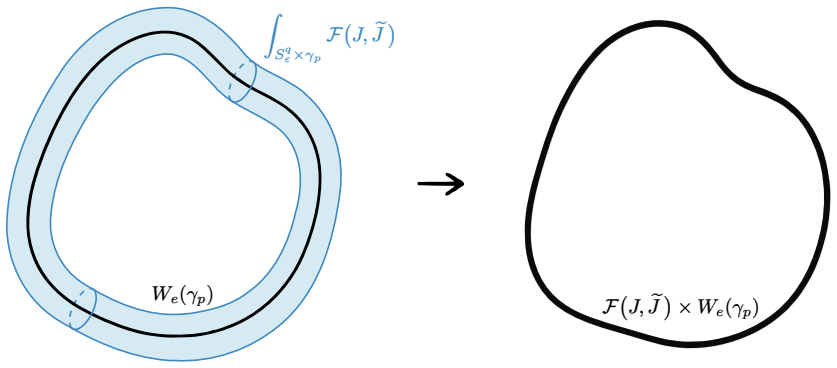
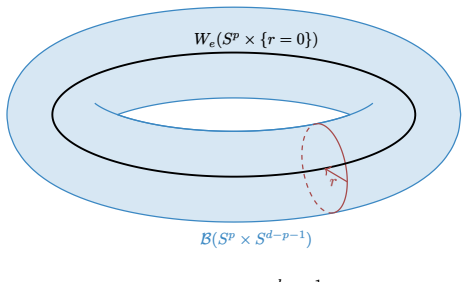
We formulate a one-to-one correspondence between states and defects for higher-form gauge theories in arbitrary dimensions. The correspondence is not predicated on conformal invariance, as these theories are in general not conformal. Instead, it relies on the existence of infinitely many conserved charges associated with the mixed anomaly of electric and magnetic higher-form symmetries. In $p$-form Maxwell theory, these charges generate an extended Kac-Moody algebra that acts simultaneously on states and on extended operators. We show that this algebra organizes the Hilbert space on $S^p \times S^{d-p-1}$ into highest-weight representations allowing for a direct identification between states and $p$-dimensional defects. In particular, Wilson-'t Hooft defects dressed with local gauge-invariant operators are mapped to squeezed energy eigenstates. We further relate these novel symmetries to higher-spin currents and demonstrate that their construction persists in a class of interacting non-linear electrodynamics theories.
Figures
Forward citations
Cited by 2 Pith papers
-
Symmetry extension by condensation defects II: general dimensions and higher-groups
Gauging A×B under a cubic mixed anomaly extends C (n=1) or folds C into a higher-group (n≥2), with the new factor generated by condensation defects and detected via triple-linking.
-
Axions on de Sitter space
Quantization of axions on dS_D yields Hilbert space H = L^2(S^1) ⊗ F with zero-mode U(1) charge, producing non-dS-invariant charged sectors and Hadamard Wightman functions that become asymptotically invariant.
Reference graph
Works this paper leans on
-
[1]
P. W. Anderson.Absence of Diffusion in Certain Random Lattices, Phys. Rev. 109 (1958), 1492–1505
1958
-
[2]
Kondo.Resistance Minimum in Dilute Magnetic Alloys, Prog
J. Kondo.Resistance Minimum in Dilute Magnetic Alloys, Prog. Theor. Phys. 32.1 (1964), 37–49. 44
1964
-
[3]
A. C. HewsonandP. Coleman.The Kondo problem to heavy fermions, Contemporary Physics 34 (1993), 221–221
1993
-
[4]
Sachdev,C
S. Sachdev,C. Buragohain, andM. Vojta.Quantum Impurity in a Nearly Critical Two-Dimensional Antiferromagnet, Science 286.5449 (1999)
1999
-
[5]
M. Vojta,C. Buragohain, andS. Sachdev.Quantum Impurity Dynamics in Two- Dimensional Antiferromagnets and Superconductors, Physical Review B 61.22 (2000), 15152– 15184
2000
-
[6]
Genons, twist defects, and projective non-Abelian braiding statistics
M. Barkeshli,C. -M. Jian, andX. -L. Qi.Twist defects and projective non-Abelian braiding statistics, Phys. Rev. B 87.4 (2013), 045130. arXiv:1208.4834 [cond-mat.str-el]
work page internal anchor Pith review Pith/arXiv arXiv 2013
-
[7]
J. L. Cardy.Conformal Invariance and Surface Critical Behavior, Nucl. Phys. B 240 (1984), 514–532
1984
-
[8]
AffleckandA
I. AffleckandA. W. W. Ludwig.Universal Noninteger Ground State Degeneracy in Critical Quantum Systems, Phys. Rev. Lett. 67 (1991), 161–164
1991
- [9]
-
[10]
Wen.Vacuum Degeneracy of Chiral Spin States in Compactified Spaces, Phys
X.-G. Wen.Vacuum Degeneracy of Chiral Spin States in Compactified Spaces, Phys. Rev. B 40 (1989), 7387–7390. [11]X.-G. Wen.Topological Orders in Rigid States, Int. J. Mod. Phys. B 4 (1990), 239–271
1989
-
[11]
Anyons in an exactly solved model and beyond
A. Kitaev.Anyons in an Exactly Solved Model and Beyond, Annals Phys. 321 (2006), 2–111. arXiv:cond-mat/0506438
work page internal anchor Pith review Pith/arXiv arXiv 2006
-
[12]
C. Nayak,S. H. Simon,A. Stern,M. Freedman, andS. Das Sarma.Non-Abelian Anyons and Topological Quantum Computation, Rev. Mod. Phys. 80 (2008), 1083–1159. arXiv:0707.1889 [cond-mat.str-el]. [14]K. G. Wilson.Confinement of Quarks, Phys. Rev. D 10 (1974), 2445–2459
work page internal anchor Pith review Pith/arXiv arXiv 2008
-
[13]
’t Hooft.On the Phase Transition Towards Permanent Quark Confinement, Nucl
G. ’t Hooft.On the Phase Transition Towards Permanent Quark Confinement, Nucl. Phys. B 138 (1978), 1–25
1978
-
[14]
A. M. Polyakov.Thermal Properties of Gauge Fields and Quark Liberation, Phys. Lett. B 72 (1978), 477–480
1978
-
[15]
A Brief Introduction to Wilson Loops and Large N
Y. Makeenko.A Brief Introduction to Wilson Loops and Large N, Phys. Atom. Nucl. 73 (2010), 878–894. arXiv:0906.4487 [hep-th]
work page internal anchor Pith review Pith/arXiv arXiv 2010
-
[16]
Wilson-'t Hooft operators in four-dimensional gauge theories and S-duality
A. Kapustin.Wilson-’t Hooft Operators in Four-Dimensional Gauge Theories and S-Duality, Phys. Rev. D 74 (2006), 025005. arXiv:hep-th/0501015
work page internal anchor Pith review Pith/arXiv arXiv 2006
-
[17]
Gauge Theory, Ramification, And The Geometric Langlands Program
S. GukovandE. Witten.Gauge Theory, Ramification, and the Geometric Langlands Program, Commun. Num. Theor. Phys. 1 (2007), 35–180. arXiv:hep-th/0612073
work page internal anchor Pith review Pith/arXiv arXiv 2007
-
[18]
M. Billo,V. Goncalves,E. Lauria, andM. Meineri.Defects in conformal field theory, JHEP 04 (2016), 091. arXiv:1601.02883 [hep-th]
work page internal anchor Pith review Pith/arXiv arXiv 2016
- [19]
- [20]
-
[21]
A. Antinucci,C. Copetti,G. Galati, andG. Rizi.Topological constraints on defect dynamics, Phys. Rev. D 111.6 (2025), 065025. arXiv:2412.18652 [hep-th]
-
[22]
Dirichlet-Branes and Ramond-Ramond Charges
J. Polchinski.Dirichlet-Branes and Ramond-Ramond Charges, Phys. Rev. Lett. 75 (1995), 4724–4727. arXiv:hep-th/9510017
work page internal anchor Pith review Pith/arXiv arXiv 1995
-
[23]
C. P. Bachas.D-Brane Dynamics, Phys. Lett. B 374 (1996), 37–42. arXiv: hep-th/9511043
work page internal anchor Pith review Pith/arXiv arXiv 1996
-
[24]
Brane Dynamics and Gauge Theory
A. GiveonandD. Kutasov.Brane Dynamics and Gauge Theory, Rev. Mod. Phys. 71 (1999), 983–1084. arXiv:hep-th/9802067
work page internal anchor Pith review Pith/arXiv arXiv 1999
-
[25]
G. W. Gibbons.Born-Infeld particles and Dirichlet p-branes, Nucl. Phys. B 514 (1998), 603–639. arXiv:hep-th/9709027. 45
work page internal anchor Pith review Pith/arXiv arXiv 1998
-
[26]
J. M. Maldacena.Wilson Loops in Large N Field Theories, Phys. Rev. Lett. 80 (1998), 4859–4862. arXiv:hep-th/9803002
work page internal anchor Pith review Pith/arXiv arXiv 1998
-
[27]
S.-J. ReyandJ. -T. Yee.Macroscopic Strings as Heavy Quarks in Large N Gauge Theory and Anti-de Sitter Supergravity, Eur. Phys. J. C 22 (2001), 379–394. arXiv: hep-th/9803001
work page internal anchor Pith review Pith/arXiv arXiv 2001
-
[28]
J. M. Maldacena.The Large N limit of superconformal field theories and supergravity, Adv. Theor. Math. Phys. 2 (1998), 231–252. arXiv:hep-th/9711200
work page internal anchor Pith review Pith/arXiv arXiv 1998
-
[29]
Anti De Sitter Space And Holography
E. Witten.Anti de Sitter space and holography, Adv. Theor. Math. Phys. 2 (1998), 253–291. arXiv:hep-th/9802150
work page internal anchor Pith review Pith/arXiv arXiv 1998
-
[30]
Holography and Defect Conformal Field Theories
O. DeWolfe,D. Z. Freedman, andH. Ooguri.Holography and Defect Conformal Field Theories, Phys. Rev. D 66 (2002), 025009. arXiv:hep-th/0111135
work page internal anchor Pith review Pith/arXiv arXiv 2002
-
[31]
T. Takayanagi.Holographic Dual of BCFT, Phys. Rev. Lett. 107 (2011), 101602. arXiv: 1105.5165 [hep-th]
work page internal anchor Pith review Pith/arXiv arXiv 2011
-
[32]
Holographic Action for the Self-Dual Field
D. BelovandG. W. Moore.Holographic Action for the Self-Dual Field, (2006). arXiv: hep-th/0605038
work page internal anchor Pith review Pith/arXiv arXiv 2006
-
[33]
D. Gaiotto,A. Kapustin,N. Seiberg, andB. Willett.Generalized Global Symmetries, JHEP 02 (2015), 172. arXiv:1412.5148 [hep-th]
work page internal anchor Pith review Pith/arXiv arXiv 2015
-
[34]
McGreevy,Generalized Symmetries in Condensed Matter,Ann
J. McGreevy.Generalized Symmetries in Condensed Matter, Ann. Rev. Condensed Matter Phys. 14 (2023), 57–82. arXiv:2204.03045 [cond-mat.str-el]
-
[35]
Snowmass White Paper: Generalized Symmetries in Quantum Field Theory and Beyond
C. Cordova,T. T. Dumitrescu,K. Intriligator, andS. -H. Shao.Snowmass White Paper: Generalized Symmetries in Quantum Field Theory and Beyond.Snowmass 2021. (2022). arXiv:2205.09545 [hep-th]
work page internal anchor Pith review Pith/arXiv arXiv 2021
-
[36]
T. D. BrennanandS. Hong.Introduction to Generalized Global Symmetries in QFT and Particle Physics, (2023). arXiv:2306.00912 [hep-ph]
work page Pith review arXiv 2023
-
[37]
P. R. S. Gomes.An introduction to higher-form symmetries, SciPost Phys. Lect. Notes (2023), 74
2023
-
[38]
On 2-Group Global Symmetries and Their Anomalies
F. Benini,C. C ´ordova, andP. -S. Hsin.On 2-Group Global Symmetries and their Anomalies, JHEP 03 (2019), 118. arXiv:1803.09336 [hep-th]
work page internal anchor Pith review Pith/arXiv arXiv 2019
-
[39]
Exploring 2-Group Global Symmetries
C. C ´ordova,T. T. Dumitrescu, andK. Intriligator.Exploring 2-Group Global Symmetries, JHEP 02 (2019), 184. arXiv:1802.04790 [hep-th]
work page internal anchor Pith review Pith/arXiv arXiv 2019
- [40]
-
[41]
A. Arbalestrier,R. Argurio, andL. Tizzano.U(1) gauging, continuous TQFTs, and higher symmetry structures, SciPost Phys. 19.2 (2025), 032. arXiv:2502.12997 [hep-th]
-
[42]
On finite symmetries and their gauging in two dimensions
L. BhardwajandY. Tachikawa.On finite symmetries and their gauging in two dimensions, JHEP 03 (2018), 189. arXiv:1704.02330 [hep-th]
work page Pith review arXiv 2018
-
[43]
C.-M. Chang,Y. -H. Lin,S. -H. Shao,Y. Wang, andX. Yin.Topological Defect Lines and Renormalization Group Flows in Two Dimensions, JHEP 01 (2019), 026. arXiv: 1802.04445 [hep-th]
work page internal anchor Pith review Pith/arXiv arXiv 2019
-
[44]
Heidenreich,J
B. Heidenreich,J. McNamara,M. Montero,M. Reece,T. Rudelius, andI. Valen- zuela.Non-invertible global symmetries and completeness of the spectrum, Journal of High Energy Physics 2021.9 (2021)
2021
-
[45]
J. Kaidi,K. Ohmori, andY. Zheng.Kramers-Wannier-like Duality Defects in (3+1)D Gauge Theories, Phys. Rev. Lett. 128.11 (2022), 111601. arXiv:2111.01141 [hep-th]
work page Pith review arXiv 2022
-
[46]
Y. Choi,C. Cordova,P. -S. Hsin,H. T. Lam, andS. -H. Shao.Noninvertible duality defects in 3+1 dimensions, Phys. Rev. D 105.12 (2022), 125016. arXiv:2111.01139 [hep-th]
work page internal anchor Pith review Pith/arXiv arXiv 2022
-
[47]
Higher Gauging and Non-invertible Condensation Defects
K. Roumpedakis,S. Seifnashri, andS. -H. Shao.Higher Gauging and Non-invertible Condensation Defects, Commun. Math. Phys. 401.3 (2023), 3043–3107. arXiv:2204.02407 [hep-th]. 46
work page internal anchor Pith review Pith/arXiv arXiv 2023
-
[48]
Y. Choi,C. Cordova,P. -S. Hsin,H. T. Lam, andS. -H. Shao.Non-invertible Con- densation, Duality, and Triality Defects in 3+1 Dimensions, Commun. Math. Phys. 402.1 (2023), 489–542. arXiv:2204.09025 [hep-th]
work page Pith review arXiv 2023
- [49]
-
[50]
A. Antinucci,G. Galati, andG. Rizi.On continuous 2-category symmetries and Yang- Mills theory, JHEP 12 (2022), 061. arXiv:2206.05646 [hep-th]
-
[51]
A. Antinucci,F. Benini,C. Copetti,G. Galati, andG. Rizi.The holography of non-invertible self-duality symmetries, JHEP 03 (2025), 052. arXiv: 2210.09146 [hep-th]
- [52]
-
[53]
Paznokas.Non-invertible SO(2) symmetry of 4d Maxwell from continuous gaugings, JHEP 06 (2025), 014
E. Paznokas.Non-invertible SO(2) symmetry of 4d Maxwell from continuous gaugings, JHEP 06 (2025), 014. arXiv:2501.14419 [hep-th]
-
[54]
P. Di Francesco,P. Mathieu, andD. Senechal.Conformal Field Theory. Graduate Texts in Contemporary Physics. New York: Springer-Verlag (1997). [57]D. Tong.String Theory, (2009). arXiv:0908.0333 [hep-th]
work page internal anchor Pith review Pith/arXiv arXiv 1997
-
[55]
FriedanandS
D. FriedanandS. H. Shenker.The Analytic Geometry of Two-Dimensional Conformal Field Theory, Nucl. Phys. B 281 (1987), 509–545
1987
-
[56]
G. W. MooreandN. Seiberg.Classical and Quantum Conformal Field Theory, Commun. Math. Phys. 123 (1989), 177
1989
-
[57]
Classification of abelian spin Chern-Simons theories
D. BelovandG. W. Moore.Classification of Abelian spin Chern-Simons theories, (2005). arXiv:hep-th/0505235
work page internal anchor Pith review Pith/arXiv arXiv 2005
-
[58]
Bounding scalar operator dimensions in 4D CFT
R. Rattazzi,V. S. Rychkov,E. Tonni, andA. Vichi.Bounding scalar operator dimen- sions in 4D CFT, JHEP 12 (2008), 031. arXiv:0807.0004 [hep-th]
work page internal anchor Pith review Pith/arXiv arXiv 2008
-
[59]
Poland,S
D. Poland,S. Rychkov, andA. Vichi.The Conformal Bootstrap: Theory, Numerical Techniques, and Applications, Rev. Mod. Phys. 91 (2019), 015002. arXiv: 1805 . 04405 [hep-th]
2019
- [60]
-
[61]
Snowmass White Paper: The Numerical Conformal Bootstrap,
D. PolandandD. Simmons-Duffin.Snowmass White Paper: The Numerical Conformal Bootstrap.Snowmass 2021. (2022). arXiv:2203.08117 [hep-th]
-
[62]
Polchinski.String theory
J. Polchinski.String theory. Vol. 1: An introduction to the bosonic string. Cambridge Monographs on Mathematical Physics. Cambridge University Press (2007)
2007
-
[63]
State Operator Correspondence and Entanglement in AdS_2/CFT_1
A. Sen.State Operator Correspondence and Entanglement in AdS2/CFT 1, Entropy 13 (2011), 1305–1323. arXiv:1101.4254 [hep-th]
work page internal anchor Pith review Pith/arXiv arXiv 2011
-
[64]
Black hole microstates in AdS$_4$ from supersymmetric localization
F. Benini,K. Hristov, andA. Zaffaroni.Black hole microstates in AdS 4 from super- symmetric localization, JHEP 05 (2016), 054. arXiv:1511.04085 [hep-th]
work page internal anchor Pith review Pith/arXiv arXiv 2016
-
[65]
A. Cabo-Bizet,D. Cassani,D. Martelli, andS. Murthy.Microscopic origin of the Bekenstein-Hawking entropy of supersymmetric AdS 5 black holes, JHEP 10 (2019), 062. arXiv:1810.11442 [hep-th]. [69]A. Belin,J. de Boer, andJ. Kruthoff.Comments on a state-operator correspondence for the torus, SciPost Phys. 5 (2018), 060
-
[66]
Infinite Dimensional Topological-Holomorphic Symmetry in Three-Dimensions
H. ChenandJ. Liniado.Infinite Dimensional Topological-Holomorphic Symmetry in Three-Dimensions, (2025). arXiv:2507.01858 [hep-th]
work page internal anchor Pith review Pith/arXiv arXiv 2025
-
[67]
S. Vitouladitis.Higher-form anomalies and state-operator correspondence beyond confor- mal invariance, SciPost Phys. 20.1 (2026), 011. arXiv:2507.01104 [hep-th]
- [68]
-
[69]
T. He,P. Mitra,A. P. Porfyriadis, andA. Strominger.New Symmetries of Massless QED, JHEP 10 (2014), 112. arXiv:1407.3789 [hep-th]
work page internal anchor Pith review Pith/arXiv arXiv 2014
-
[70]
Comments on Symmetry Operators, Asymptotic Charges and Soft Theorems
L. Tizzano.Comments on Symmetry Operators, Asymptotic Charges and Soft Theorems, (2026). arXiv:2604.06088 [hep-th]
work page internal anchor Pith review Pith/arXiv arXiv 2026
-
[71]
What Maxwell Theory in D<>4 teaches us about scale and conformal invariance
S. El-Showk,Y. Nakayama, andS. Rychkov.What Maxwell theory in d̸= 4teaches us about scale and conformal invariance, Nucl. Phys. B 848 (2011), 578–593. arXiv: 1101.5385 [hep-th]
work page internal anchor Pith review Pith/arXiv arXiv 2011
-
[72]
Tutorial on Scale and Conformal Symmetries in Diverse Dimensions
R. JackiwandS. . -. Pi.Tutorial on Scale and Conformal Symmetries in Diverse Dimen- sions, J. Phys. A 44 (2011), 223001. arXiv:1101.4886 [math-ph]
work page internal anchor Pith review Pith/arXiv arXiv 2011
-
[73]
Scale invariance vs conformal invariance
Y. Nakayama.Scale invariance vs conformal invariance, Phys. Rept. 569 (2015), 1–93. arXiv:1302.0884 [hep-th]
work page internal anchor Pith review Pith/arXiv arXiv 2015
-
[74]
E. Cremmer,B. Julia,H. Lu, andC. N. Pope.Dualization of dualities. 1.Nucl. Phys. B 523 (1998), 73–144. arXiv:hep-th/9710119
work page internal anchor Pith review Pith/arXiv arXiv 1998
-
[75]
Dualisation of Dualities, II: Twisted self-duality of doubled fields and superdualities
E. Cremmer,B. Julia,H. Lu, andC. N. Pope.Dualization of dualities. 2. Twisted self-duality of doubled fields, and superdualities, Nucl. Phys. B 535 (1998), 242–292. arXiv: hep-th/9806106
work page internal anchor Pith review Pith/arXiv arXiv 1998
-
[76]
P. Gorantla,H. T. Lam,N. Seiberg, andS. -H. Shao.Low-energy limit of some exotic lattice theories and UV/IR mixing, Physical Review B 104.23 (2021), 235116. arXiv: 2108.00020 [cond-mat.str-el]
-
[77]
Global Dipole Symmetry, Compact Lifshitz Theory, Tensor Gauge Theory, and Fractons
P. Gorantla,H. T. Lam,N. Seiberg, andS. -H. Shao.Global dipole symmetry, compact Lifshitz theory, tensor gauge theory, and fractons, Physical Review B 106.4 (2022), 045112. arXiv:2201.10589 [cond-mat.str-el]
work page Pith review arXiv 2022
- [78]
- [79]
-
[80]
S. D. Pace,G. Delfino,H. T. Lam, and ¨O. M. Aksoy.Gauging modulated symmetries: Kramers-Wannier dualities and non-invertible reflections, SciPost Physics 18.1 (2025), 021. arXiv:2406.12962 [cond-mat.str-el]
work page Pith review arXiv 2025
discussion (0)
Sign in with ORCID, Apple, or X to comment. Anyone can read and Pith papers without signing in.