REVIEW 3 major objections 4 minor 60 references
Wave-function-based embedding with sample-based quantum diagonalization can drive molecular geometry optimization on real quantum hardware, reaching 33-orbital fragments (70 qubits) and matching classical references within a few picometers.
Reviewed by Pith at T0; open to challenge. T0 means a machine referee read the full paper against a public rubric. the ladder, T0–T4 →
T0 review · deepseek-v4-flash
2026-08-01 21:01 UTC pith:Y6LNL62F
load-bearing objection First real-hardware EWF-SQD geometry optimization, with a careful workflow and honest scope; the 'sub-4-pm' accuracy claim is agreement between approximate methods, not absolute accuracy. the 3 major comments →
Quantum-Centric Geometry Optimization with Wave-Function-Based Embedding
The pith
A machine-rendered reading of the paper's core claim, the machinery that carries it, and where it could break.
Core claim
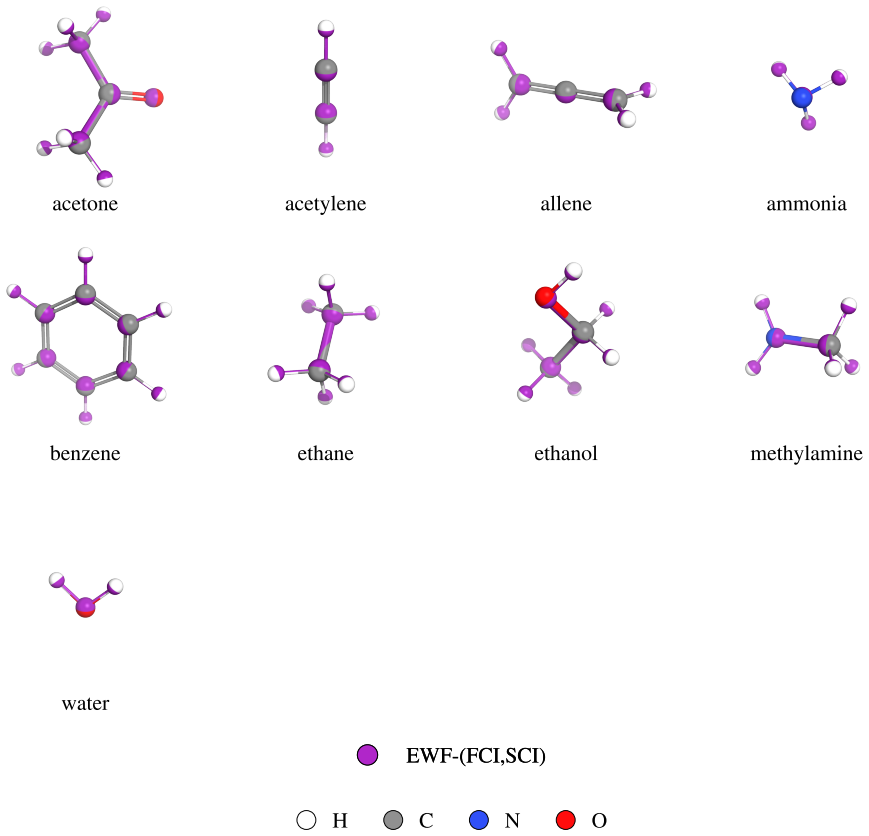
The paper reports that EWF-SQD geometry optimization converges on real quantum hardware. On a standard organic test set, EWF with an SCI solver reproduces unfragmented SCI geometries with RMSDs mostly below 0.02 Å (worst case allene, 0.033 Å). Replacing the SCI solver on large fragments with SQD—sampling single-layer LUCJ circuits, configuration recovery, ext-SQD expansion, then classical diagonalization—agrees with the EWF-SCI reference to 0.014 Å RMSD in the worst case and below 0.01 Å for most molecules. The largest fragments use 33 molecular orbitals (70 qubits) for benzidine and 30 (64 qubits) for menthone, molecules with 82 and 73 total MOs. The authors conclude SQD matches the classic
What carries the argument
The load-bearing mechanism is the energy-and-gradient assembly, not the quantum circuit itself. EWF fragments the molecule into atomic clusters with bath orbitals from a Schmidt decomposition of the mean-field density matrix, expanded with MP2 natural orbitals; clusters with ≤12 MOs are solved exactly with FCI, larger clusters with SCI or SQD. Because the assembled density is non-variational, the paper solves the Λ equations for effective cluster amplitudes and builds the analytic gradient from the relaxed density, using a corrected two-particle density to remove a spurious self-interaction term. SQD provides candidate configurations by sampling single-layer LUCJ circuits on hardware, applyi
Load-bearing premise
The accuracy claims rest on the truncated SCI reference (ε=10^-3) and the EWF fragmentation being unbiased; the allene benchmark, with a 0.04 Å maximum displacement in the fragmentation comparison and 0.018 Å in the SQD comparison, shows the 'few picometers' headline does not hold uniformly, so if those two errors share a systematic geometry bias the quoted accuracy overstates agreement with true equilibrium structures.
What would settle it
Optimize allene with unfragmented SCI at ε=10^-4 or ε=10^-5, or with a standard high-level method in the same basis, and compare with the reported EWF-(FCI,SCI) and EWF-(FCI,SQD) geometries; if the deviations shrink, the discrepancy is a reference-truncation artifact, and if they persist, the EWF/SQD geometry error itself is larger than the quoted few-picometer accuracy.
If this is right
- Geometry optimization with SQD inside EWF is feasible on real quantum hardware, not just simulators, for molecules up to 29 atoms in the STO-3G basis.
- The largest SQD fragments reach 70 qubits / 33 MOs (benzidine) and 64 qubits / 30 MOs (menthone), putting systems beyond exact diagonalization within reach of quantum-centric potential-energy-surface exploration.
- Replacing the classical SCI solver with SQD inside EWF does not change the required number of geometry-optimization steps by more than one, so the quantum solver is not the bottleneck in the optimization loop.
- The analytic-gradient construction via Λ-relaxed densities makes the optimizer's convergence check and displacement step self-consistent, a prerequisite for stable minimization and, by extension, for molecular dynamics.
- Within the stated limitations (STO-3G basis, single-layer ansatz, default optimizer threshold), the method's geometry accuracy is comparable to the classical SCI reference for all tested molecules except allene, where deviations are visibly larger.
Where Pith is reading between the lines
- If the same Λ-equation gradient machinery is portable, it should also supply harmonic frequencies and response properties, which require the same relaxed-density technology; benchmarking those would test the gradient's accuracy more stringently than geometry optimization alone.
- The per-step cost is 100,000 hardware shots per SQD fragment, and geometry scans accumulate many steps; reusing or warm-starting recovered bitstrings across nearby geometries is a natural cost-reduction experiment the paper does not run.
- Allene repeatedly shows the largest deviations (0.033 Å fragmentation error, 0.014–0.018 Å SQD error), so it is the sharpest test case for whether the quoted few-picometer accuracy is an average artifact; re-running it with tighter SCI thresholds or a different reference method would clarify the source.
- Fragmentation error and SQD solver error appear roughly additive in the worst case, suggesting that sub-picometer geometries will likely require improving the embedding bath and the ext-SQD expansion together, not just the quantum circuit.
Editorial analysis
A structured set of objections, weighed in public.
Referee Report
Summary. The paper reports the first geometry optimizations using wave-function-based embedding (EWF) with sample-based quantum diagonalization (SQD) executed on real IBM quantum hardware. The workflow combines IAO-based fragmentation, MP2 natural-orbital bath expansion, FCI for fragments up to 12 MOs, SCI or SQD for larger fragments, assembled density-matrix gradients with Lambda-equation response, and the Sella optimizer. The authors benchmark EWF-(FCI,SCI) against unfragmented SCI for the first ten Baker-set molecules (Table 1), and then EWF-(FCI,SQD) against EWF-(FCI,SCI) for nine molecules, including menthone and benzidine, with the largest EWF fragment containing 33 MOs and mapped to 70 qubits (Table 2). They report sub-4 pm agreement between EWF-(FCI,SCI) and unfragmented SCI, and roughly 2 pm agreement between EWF-(FCI,SQD) and EWF-(FCI,SCI), concluding that quantum-centric EWF-SQD geometry optimization is feasible for molecules beyond exact diagonalization.
Significance. If the results hold, this is a substantive step toward using quantum-centric methods for potential-energy-surface exploration: it is the first EWF-SQD geometry optimization, it extends fragment-based QPU geometry optimization to 29-atom systems and to 70-qubit fragments, and it uses real IBM Heron processors rather than simulators. The manuscript is unusually transparent about numerical thresholds, circuit construction, shot counts, hardware choice, optimizer settings, and the software stack, and it includes an explicit disclaimer that quantum advantage is not demonstrated. These strengths are genuine. The main caveat, discussed below, is that the numerical accuracy claims are measured against an approximate classical reference that shares approximations with the tested method; this does not invalidate the feasibility demonstration but does require the accuracy statements to be qualified or backed by an independent reference.
major comments (3)
- [Results and Discussion, Tables 1 and 2; Eq. (3)] The central accuracy claim (sub-4 pm, and roughly 2 pm between SQD and SCI) is an agreement-with-reference statement, not an absolute accuracy statement. For the ten small molecules the reference is unfragmented SCI with epsilon_SCI = 1.0e-3 (Eq. 3); for menthone and benzidine the only reference is EWF-(FCI,SCI), which uses the same SCI truncation in each fragment. If the SCI truncation or the EWF fragmentation introduces a systematic geometry bias, the two methods could agree while both deviating from the true equilibrium geometry. The allene row already shows the error-chain magnitude: 0.040 A (4.0 pm) deviation between EWF-(FCI,SCI) and unfragmented SCI (Table 1), and 0.018 A (1.8 pm) between EWF-(FCI,SQD) and EWF-(FCI,SCI) (Table 2). The authors should either add an independent external reference for at least a subset of the small molecules (e.g., FCI or CCSD(T) geometries in STO-3G)
- [Methods, LUCJ Ansatz and Circuit Execution, Eqs. (5)-(6)] The LUCJ circuit parameters used to generate the SQD configurations are initialized from and then classically optimized against CCSD t2 amplitudes. The SQD sampling distribution is therefore not independent of a high-level classical calculation. The reported agreement between EWF-(FCI,SQD) and EWF-(FCI,SCI) validates the SQD protocol as deployed, including the classical initialization, but it does not by itself characterize the accuracy of the quantum-hardware-generated sampling. This is not fatal in view of the paper's explicit 'no quantum advantage' disclaimer, but it should be stated as a limitation. A useful control would be a comparison against classically simulated LUCJ sampling or against circuits with randomized/unoptimized parameters, to separate the hardware contribution from the classical CCSD-driven initialization.
- [Table 2 and Conclusions] For menthone and benzidine, no unfragmented reference is reported at all, so the scalability claim for these two systems rests entirely on the approximate chain unfragmented-SCI -> EWF-(FCI,SCI) -> EWF-(FCI,SQD). The paper should clearly state in the Results or Conclusions that the accuracy of the large-molecule geometries is not independently benchmarked, and that the 2-pm SQD/SCI agreement only measures the difference between two fragmented approximate solvers. This is a load-bearing point because the large-molecule demonstrations are the main scalability evidence.
minor comments (4)
- [Results, paragraph before Table 3] 'As can be seen from Table 2, all of the SQD simulations use more than 30 qubits' should refer to Table 3, which contains the qubit counts.
- [Methods, LUCJ Ansatz and Circuit Execution] The text says 'ibm marrakesh is utilized in simulations of benzamidine and menthone', but the molecule studied is benzidine throughout the rest of the paper. Please correct the name.
- [Eq. (6)] The citation number '54' appears inside the equation; move the citation to the surrounding text to avoid confusion with mathematical notation.
- [References] Reference 4 duplicates Reference 2; consider consolidating or citing one version.
Circularity Check
No identity-level circularity: SQD is benchmarked against an independently constructed SCI reference, and the only fitted input (LUCJ initialization from CCSD t2) is not asserted as the predicted output.
full rationale
The paper is an empirical benchmark, not a derivation that reduces to its inputs. The EWF energy and gradient follow a standard Lagrangian/Z-vector construction (Eq. 7 and the Lambda-equation section); the "EWF-consistent" density is constructed so its contraction reproduces E[gamma1, lambda2] by design, which is a consistency condition in gradient theory, not a scientific prediction. The only fitted element is the LUCJ parameter initialization from classical CCSD t2 amplitudes (Eqs. 5-6), but the SQD result is obtained by diagonalizing the Hamiltonian in the sampled subspace and is compared to an independently generated SCI reference; nothing in the equations forces these two geometry optimizations to coincide. The benchmark for menthone/benzidine uses EWF-(FCI,SCI) as reference, which shares the EWF fragmentation and the epsilon_SCI=1e-3 truncation (Eq. 3), so absolute accuracy for those two molecules is not independently certified; this is a benchmarking limitation and correctness risk rather than circularity. The stated "two/four picometer" deviations also appear inconsistent with the tabulated allene values (max 0.018 A = 18 pm in Table 2), another correctness issue, not circularity. Self-citations to prior EWF/SQD work are contextual and not load-bearing, and no uniqueness theorem or external ansatz is invoked to force the authors' choices.
Axiom & Free-Parameter Ledger
free parameters (6)
- Bath occupation threshold η =
1×10^-5
- SCI selection cutoff ε_SCI =
1.0×10^-3
- LUCJ circuit parameters (U, J) =
Optimized via L-BFGS-B to match classical CCSD t2 amplitudes (Eq. 6)
- ext-SQD CI coefficient threshold =
c > 1×10^-5
- SQD recovery convergence thresholds =
1×10^-8 (energy), 1×10^-5 (occupancy)
- LUCJ layer count L =
1
axioms (5)
- domain assumption The EWF fragment+bath decomposition from mean-field density and MP2 natural orbitals is systematically improvable and converges to the full molecule as η→0.
- domain assumption SCI with ε_SCI = 1×10^-3 is an adequate reference for optimized geometries.
- ad hoc to paper A one-layer LUCJ circuit initialized from CCSD t2 amplitudes samples the configurations needed for near-FCI energies in each fragment.
- domain assumption The EWF density assembled from fragment RDMs, relaxed via Λ equations, yields a gradient accurate enough for Sella convergence.
- domain assumption The STO-3G minimal basis set is sufficient to demonstrate geometry-optimization feasibility.
read the original abstract
The EWF-(FCI,SQD) method, a wave-function-based embedding approach combining full configuration interaction (FCI) and sample-based quantum diagonalization (SQD), is a promising new tool for the simulation of molecular systems. However, applications of EWF-(FCI,SQD) have so far been limited to single-point calculations, whereas the study of complex chemical processes requires the ability to explore potential energy surfaces. In this work, we demonstrate geometry optimization with EWF-(FCI,SQD), scaling our simulations to molecules as large as menthone and benzidine within the STO-3G basis set. Without fragmentation, these systems comprise 73 and 82 molecular orbitals respectively, presenting an intractable Hilbert space for conventional exact or high-level subspace solvers and establishing a clear necessity for fragmentation-based methodologies. The underlying fragment SQD simulations in the EWF-(FCI,SQD) geometry optimizations use up to 70 qubits. The resulting geometries show exceptional accuracy relative to the classical reference, with deviations below 4 picometers.
Figures



Reference graph
Works this paper leans on
-
[1]
Sung and Maika Takita and Minh C
Javier Robledo-Moreno and Mario Motta and Holger Haas and Ali Javadi-Abhari and Petar Jurcevic and William Kirby and Simon Martiel and Kunal Sharma and Sandeep Sharma and Tomonori Shirakawa and Iskandar Sitdikov and Rong-Yang Sun and Kevin J. Sung and Maika Takita and Minh C. Tran and Seiji Yunoki and Antonio Mezzacapo , title =. Science Advances , volume...
2025
-
[2]
Systematic Improvability in Quantum Embedding for Real Materials , author =. Phys. Rev. X , volume =. 2022 , month =. doi:10.1103/PhysRevX.12.011046 , url =
-
[3]
Pople, J. A. and Krishnan, R. and Schlegel, H. B. and Binkley, J. S. , title =. International Journal of Quantum Chemistry , year=. doi:https://doi.org/10.1002/qua.560160825 , url =
-
[4]
2017 , month =
Hjorth Larsen, Ask and Jørgen Mortensen, Jens and Blomqvist, Jakob and Castelli, Ivano E and Christensen, Rune and Dułak, Marcin and Friis, Jesper and Groves, Michael N and Hammer, Bjørk and Hargus, Cory and Hermes, Eric D and Jennings, Paul C and Bjerre Jensen, Peter and Kermode, James and Kitchin, John R and Leonhard Kolsbjerg, Esben and Kubal, Joseph a...
2017
-
[5]
2025 , eprint=
Closed-loop calculations of electronic structure on a quantum processor and a classical supercomputer at full scale , author=. 2025 , eprint=
2025
-
[6]
Motta, Mario and Sung, Kevin J. and Whaley, K. Birgitta and Head-Gordon, Martin and Shee, James , title =. Chemical Science , volume =. 2023 , month =. doi:10.1039/d3sc02516k , url =
-
[7]
Garrison and Jennifer R
Abdullah Ash Saki and Stefano Barison and Bryce Fuller and James R. Garrison and Jennifer R. Glick and Caleb Johnson and Antonio Mezzacapo and Javier Robledo-Moreno and Max Rossmannek and Paul Schweigert and Iskandar Sitdikov and Kevin J. Sung , title =
-
[8]
2024 , eprint=
Quantum-centric computation of molecular excited states with extended sample-based quantum diagonalization , author=. 2024 , eprint=
2024
-
[9]
Wan-Hsuan Lin and Fangchun Liang and Mario Motta and Haimeng Zhang and Kenneth M. Merz Jr. and Kevin J. Sung , title =. arXiv preprint arXiv:2511.22476 , year =
-
[10]
2026 , eprint=
ffsim: Faster simulation of fermionic quantum circuits , author=. 2026 , eprint=
2026
-
[11]
2026 , eprint=
Crossing the 12,000-atom barrier with heterogeneous quantum-classical supercomputing: quantum chemistry of protein-ligand complexes , author=. 2026 , eprint=
2026
-
[12]
and Jette, Morris A
Yoo, Andy B. and Jette, Morris A. and Grondona, Mark. SLURM: Simple Linux Utility for Resource Management. Job Scheduling Strategies for Parallel Processing. 2003
2003
-
[13]
2026 , eprint=
Quantum Computations on Fusion Blanket Molten Salts , author=. 2026 , eprint=
2026
-
[14]
2026 , eprint=
GPU-Accelerated Selected Basis Diagonalization with Thrust for SQD-based Algorithms , author=. 2026 , eprint=
2026
-
[15]
2026 , month =
MPICH User's Guide, Version 5.0.1 , author =. 2026 , month =
2026
-
[16]
2024 , organization =
Clang: A C-Language Family Frontend for LLVM, Version 18.1.8 , author =. 2024 , organization =
2024
-
[17]
2023 , organization =
NVIDIA CUDA Toolkit, Version 12.3 , author =. 2023 , organization =
2023
-
[18]
2025 , note =
Xianyi Zhang and Martin Kroeker and. 2025 , note =
2025
-
[19]
Quantum-selected configuration interaction: Classical diagonalization of Hamiltonians in subspaces selected by quantum computers , author =. Phys. Rev. Res. , volume =. 2026 , month =. doi:10.1103/dmn4-snfx , url =
-
[20]
Sung and Maika Takita and Minh C
Javier Robledo-Moreno and Mario Motta and Holger Haas and Ali Javadi-Abhari and Petar Jurcevic and William Kirby and Simon Martiel and Kunal Sharma and Sandeep Sharma and Tomonori Shirakawa and Iskandar Sitdikov and Rong-Yang Sun and Kevin J. Sung and Maika Takita and Minh C. Tran and Seiji Yunoki and Antonio Mezzacapo , title =. Sci. Adv. , volume =. 202...
2025
-
[21]
Accurate quantum-centric simulations of intermolecular interactions , author=. Commun. Phys. , volume=. 2025 , publisher=
2025
-
[22]
Quantum-Centric Computational Study of Methylene Singlet and Triplet States , author=. J. Chem. Theory Comput. , volume=. 2025 , publisher=
2025
-
[23]
Nützel, Ludwig and Gresch, Alexander and Hehn, Lukas and Marti, Lucas and Freund, Robert and Steiner, Alex and Marciniak, Christian D and Eckstein, Timo and Stockinger, Nina and Wolf, Stefan and Monz, Thomas and Kühn, Michael and Hartmann, Michael J , title =. 2025 , month =. doi:10.1088/2058-9565/ad9ed3 , url =
-
[24]
Implicit solvent sample-based quantum diagonalization , author=. J. Phys. Chem. , volume=. 2025 , publisher=
2025
-
[25]
Hamiltonian simulation-based quantum-selected configuration interaction for large-scale electronic structure calculations with a quantum computer , author=. Phys. Chem. Chem. Phys. , volume=. 2025 , publisher=
2025
-
[26]
arXiv preprint arXiv:2508.02578 , year=
Quantum chemistry with provable convergence via randomized sample-based quantum diagonalization , author=. arXiv preprint arXiv:2508.02578 , year=
-
[27]
ACS omega , volume=
Enhancing Accuracy of Quantum-Selected Configuration Interaction Calculations Using Multireference Perturbation Theory: Application to Aromatic Molecules , author=. ACS omega , volume=. 2025 , publisher=
2025
-
[28]
arXiv preprint arXiv:2510.23154 , year=
Size-consistent implementation of Hamiltonian simulation-based quantum-selected configuration interaction method for the supramolecular approach , author=. arXiv preprint arXiv:2510.23154 , year=
-
[29]
ACS Omega , volume =
Shirai, Soichi and Tseng, Shih-Yen and Iwakiri, Hokuto and Horiba, Takahiro and Hirai, Hirotoshi and Koh, Sho , title =. ACS Omega , volume =. 2025 , doi =
2025
-
[30]
arXiv e-prints , pages=
Surface reaction simulations for battery materials through sample-based quantum diagonalization and local embedding , author=. arXiv e-prints , pages=
-
[31]
and Van, Richard and Pickard, Frank C
Shivpuje, Saurabh and Gujarati, Tanvi P. and Van, Richard and Pickard, Frank C. IV and Friedhoff, Triet and Liepuoniute, Ieva and Davis, Wade and Jones, Gavin O. and Galda, Alexey , title =. Journal of Chemical Theory and Computation , volume =. 2026 , doi =
2026
-
[32]
arXiv preprint arXiv:2505.00914 , year=
Symmetry-adapted sample-based quantum diagonalization: Application to lattice model , author=. arXiv preprint arXiv:2505.00914 , year=
-
[33]
arXiv preprint arXiv:2512.04962 , year=
Convergence of sample-based quantum diagonalization on a variable-length cuprate chain , author=. arXiv preprint arXiv:2512.04962 , year=
-
[34]
arXiv preprint arXiv:2512.01012 , year=
From Promise to Practice: Benchmarking Quantum Chemistry on Quantum Hardware , author=. arXiv preprint arXiv:2512.01012 , year=
-
[35]
Badar, Mohammad Sufian and Shamsi, Shazmeen and Ahmed, Jawed and Alam, Md. Afshar. Molecular Dynamics Simulations: Concept, Methods, and Applications. Transdisciplinarity. 2022. doi:10.1007/978-3-030-94651-7_7
-
[36]
Journal of Computational Chemistry , volume =
Alvarez, Jorge Alberto Sanchez and Calaminici, Patrizia , title =. Journal of Computational Chemistry , volume =. doi:https://doi.org/10.1002/jcc.70243 , url =. https://onlinelibrary.wiley.com/doi/pdf/10.1002/jcc.70243 , year =
-
[37]
Journal of Chemical Theory and Computation , volume=
Geometry optimization: a comparison of different open-source geometry optimizers , author=. Journal of Chemical Theory and Computation , volume=. 2023 , publisher=
2023
-
[38]
Journal of Chemical Theory and Computation , year=
Quantum-centric alchemical free energy calculations , author=. Journal of Chemical Theory and Computation , year=
-
[39]
arXiv preprint arXiv:2604.09857 , year=
Protein-Ligand Free Energy Perturbation on Quantum Hardware , author=. arXiv preprint arXiv:2604.09857 , year=
-
[40]
Proceedings of the National Academy of Sciences of the United States of America , volume=
Localized sample-based quantum diagonalization for strongly correlated chemistry , author=. Proceedings of the National Academy of Sciences of the United States of America , volume=
-
[41]
Toward quantum-centric simulations of extended molecules: Sample-based quantum diagonalization enhanced with density matrix embedding theory , author=. J. Chem. Theory Comput. , volume=. 2025 , publisher=
2025
-
[42]
Shajan, Akhil and Kaliakin, Danil and Liang, Fangchun and Pellegrini, Thaddeus and Doga, Hakan and Bhowmik, Subhamoy and Das, Susanta and Mezzacapo, Antonio and Motta, Mario and Merz, Kenneth M. Jr. , title =. Journal of Chemical Theory and Computation , volume =. 2026 , doi =
2026
-
[43]
arXiv preprint arXiv:2511.22158 , year=
Quantum Simulation of Ligand-like Molecules through Sample-based Quantum Diagonalization in Density Matrix Embedding Framework , author=. arXiv preprint arXiv:2511.22158 , year=
-
[44]
Bierman, Joel and Liu, Yuan , title =. Digital Discovery , volume =. 2026 , month =. doi:10.1039/d5dd00416k , url =
-
[45]
, title =
Nusspickel, Max and Ibrahim, Basil and Booth, George H. , title =. J. Chem. Theory Comput. , volume =. 2023 , doi =
2023
-
[46]
Journal of Computational Chemistry , volume =
Baker, Jon , title =. Journal of Computational Chemistry , volume =. doi:https://doi.org/10.1002/jcc.540140910 , url =. https://onlinelibrary.wiley.com/doi/pdf/10.1002/jcc.540140910 , year =
-
[47]
Journal of Chemical Theory and Computation , volume=
Large-Scale Efficient Molecule Geometry Optimization with Hybrid Quantum--Classical Computing , author=. Journal of Chemical Theory and Computation , volume=. 2026 , publisher=
2026
-
[48]
, title =
Eriksen, Janus J. , title =. The Journal of Physical Chemistry Letters , volume =. 2021 , doi =
2021
-
[49]
and Freeman, C
Tubman, Norm M. and Freeman, C. Daniel and Levine, Daniel S. and Hait, Diptarka and Head-Gordon, Martin and Whaley, K. Birgitta , title =. Journal of Chemical Theory and Computation , volume =. 2020 , doi =
2020
-
[50]
Coupled-cluster theory in quantum chemistry , author =. Rev. Mod. Phys. , volume =. 2007 , month =. doi:10.1103/RevModPhys.79.291 , url =
-
[51]
and Sargsyan, Khachik and Najm, Habib N
Hermes, Eric D. and Sargsyan, Khachik and Najm, Habib N. and Zádor, Judit , title =. Journal of Chemical Theory and Computation , volume =. 2022 , doi =
2022
-
[52]
and Ma, Dongxia and Olsen, Jeppe and Gagliardi, Laura and de Jong, Wibe A
Vogiatzis, Konstantinos D. and Ma, Dongxia and Olsen, Jeppe and Gagliardi, Laura and de Jong, Wibe A. , title = ". The Journal of Chemical Physics , volume =. 2017 , month =. doi:10.1063/1.4989858 , url =
-
[53]
Journal of Chemical Theory and Computation , volume =
Gao, Hong and Imamura, Satoshi and Kasagi, Akihiko and Yoshida, Eiji , title =. Journal of Chemical Theory and Computation , volume =. 2024 , doi =
2024
-
[54]
Scott and Martínez, Todd J
Fales, B. Scott and Martínez, Todd J. , title =. Journal of Chemical Theory and Computation , volume =. 2020 , doi =
2020
-
[55]
Dynamical decoupling for superconducting qubits: A performance survey , author=. Phys. Rev. Appl. , volume=. 2023 , publisher=
2023
-
[56]
PyCI: A Python-scriptable library for arbitrary determinant CI , author=. J. Chem. Theory Comput. , volume=. 2024 , publisher=
2024
-
[57]
Wiley Interdisciplinary Reviews: Computational Molecular Science , volume=
PySCF: the Python-based simulations of chemistry framework , author=. Wiley Interdisciplinary Reviews: Computational Molecular Science , volume=. 2018 , publisher=
2018
-
[58]
The Journal of chemical physics , volume=
Recent developments in the PySCF program package , author=. The Journal of chemical physics , volume=. 2020 , publisher=
2020
-
[59]
Forces in Molecules , author =. Phys. Rev. , volume =. 1939 , month =. doi:10.1103/PhysRev.56.340 , url =
-
[60]
Journal of molecular modeling , volume=
The Hellmann-Feynman theorem: a perspective , author=. Journal of molecular modeling , volume=. 2018 , publisher=
2018
discussion (0)
Sign in with ORCID, Apple, or X to comment. Anyone can read and Pith papers without signing in.