REVIEW 3 major objections 5 minor 300 references
One learned persistence coefficient per sparse feature turns a token-wise sparse autoencoder into a model that separates local detectors from a persistent semantic state.
Reviewed by Pith at T0; open to challenge. T0 means a machine referee read the full paper against a public rubric. the ladder, T0–T4 →
T0 review · deepseek-v4-flash
2026-08-01 18:57 UTC pith:7RF6GU46
load-bearing objection Useful SAE variant with clean fast/slow separation, but the 'learns for how long' claim outruns the 256-token training window. the 3 major comments →
Persistent Sparse Autoencoders: Learning Feature Timescales in Language Models
The pith
A machine-rendered reading of the paper's core claim, the machinery that carries it, and where it could break.
Core claim
The paper's central claim, stated plainly in its conclusion, is that Persistent SAEs learn, from reconstruction alone, which sparse features should retain information across tokens and for how long. The discovery is that a simple diagonal recurrence over the sparse evidence — h_j,t = λ_j h_j,t−1 + (1−λ_j) a_j,t — is sufficient for the timescale to emerge. Features with large λ carry evidence forward and end up forming a compact semantic state that clusters by topic, while features with small λ stay fast and locally interpretable. The paper demonstrates this through competitive reconstruction quality, subject-probing efficiency (the slowest 1% of features nearly matches a label-supervised ran
What carries the argument
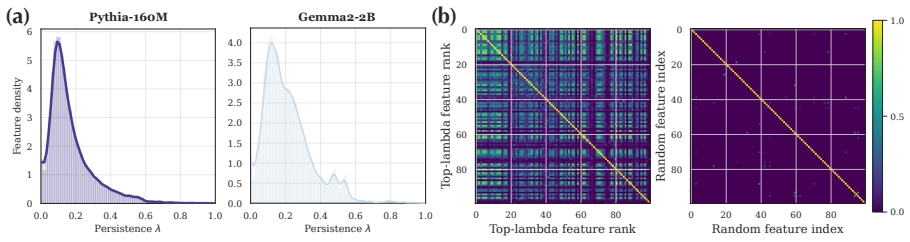
The central object is the per-feature persistence coefficient λ_j, parameterized as a sigmoid over an unconstrained logit and capped below 1, embedded in a diagonal exponential-moving-average recurrence. This recurrence has three properties that carry the argument: the (1−λ_j) factor keeps the persistent state bounded under constant evidence; the diagonal structure preserves feature-level attribution; and because λ_j is learned by gradient descent on reconstruction loss, the model's own optimization discovers which features should persist. The resulting timescale is exponential, with effective memory −1/log(λ_j) tokens, so the paper reads a learned spectrum directly off λ.
Load-bearing premise
The load-bearing assumption is that a 256-token training sequence is long enough for the reconstruction objective to reward persistence at the scales later evaluated; if useful long-range carry depends on correlations beyond that window, the learned coefficients at 350 tokens are extrapolations and the monitoring advantage could be an artifact of finite-window averaging rather than genuine learned persistence.
What would settle it
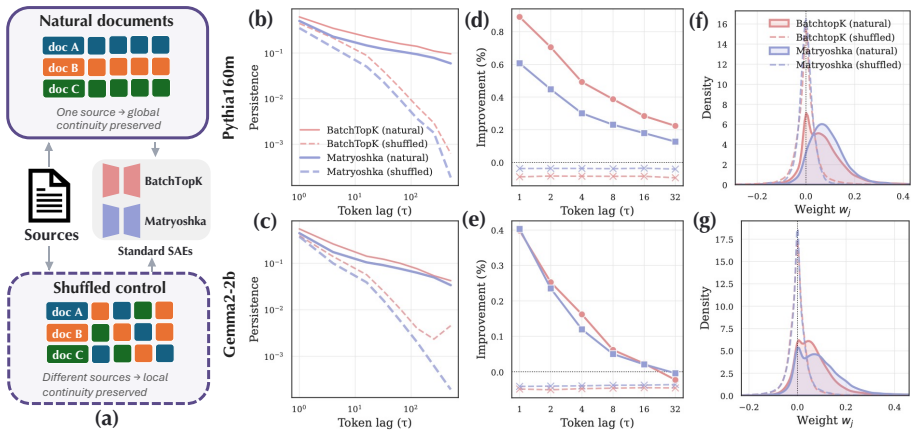
Retrain Persistent SAEs on the same activations with the same budget but replace the contiguous training sequences with truncated windows or with a shuffled control that breaks global continuity; if the slow-feature advantage in subject probing and in 350-token injection monitoring persists, it is likely an artifact of averaging rather than learned persistence. Alternatively, measure whether the learned λ values predict held-out reconstruction gain at lags beyond the training window — if a feature whose λ implies a 1000-token timescale shows no measurable benefit past 256 tokens, the paper's c
If this is right
- If correct, standard sparse-autoencoder training can be upgraded to produce a per-feature timescale at no extra supervision, separating token-local evidence from a persistent semantic state.
- Slow features give an unsupervised criterion for selecting a compact topic-representing subspace; ranking features by λ recovers most of the subject-probing signal from a small fraction of the dictionary.
- In monitoring settings, slow-feature directions maintain both decodability and causal influence long after local evidence has disappeared, which matters for agents that act only after many tokens.
- The persistent state does not degrade reconstruction quality: it matches or approaches token-specific sparse-autoencoder baselines while adding temporal structure.
Where Pith is reading between the lines
- The paper's design choice of 256-token training windows means the learned λ values are rewarded for persistence only within that horizon; whether slow features genuinely capture timescales beyond 256 tokens remains an open extension.
- Because the recurrence is diagonal and fixed per feature, it cannot model abrupt resets or interactions between features; a learned gating term is a natural extension that could handle topic shifts.
- The slow-state representation could serve as a reusable context readout for other long-horizon tasks, such as tracking instruction adherence or factual consistency, beyond prompt-injection detection.
- The causal steering result suggests a testable extension: intervene on slow-feature directions in the acting agent itself, not just an external monitor, to see whether long-range behaviour changes.
Editorial analysis
A structured set of objections, weighed in public.
Referee Report
Summary. The paper introduces Persistent Sparse Autoencoders, an extension of BatchTopK SAEs in which each feature has a learned persistence coefficient λ_j controlling an exponential moving average of its sparse evidence across tokens. Training only from reconstruction loss, the method separates fast, locally interpretable features from slow features that carry topic-level or injection-relevant information over long contexts. The empirical sections show: (1) standard SAE features already exhibit temporal persistence that a shuffled control does not; (2) Persistent SAEs retain roughly competitive reconstruction quality while producing a spectrum of timescales; (3) slow features form subject-specific clusters and support topic probing almost as well as a supervised feature ranking; (4) in a prompt-injection monitoring case study, a probe trained at the injection point transfers better to later tokens when using slow features, and steering directions from slow features shift a monitor's judgment at distances up to 350 tokens.
Significance. If the findings hold, Persistent SAEs are a useful unsupervised mechanism for exposing persistent semantic state in LLM activations, with plausible applications in interpretability and safety monitoring. The paper includes several well-controlled diagnostics: a shuffled-document control that isolates global continuity, held-out probe evaluation, and a causal intervention in a monitor model. The central claim — that reconstruction alone can induce per-feature timescales — is interesting and partially supported for timescales within the training window. However, the mismatch between the 256-token training horizon and the 350-token evaluation, together with unmatched probe dimensionality and missing error bars, means the strongest claims in the abstract and conclusion are not fully supported as stated.
major comments (3)
- [§4, Eq. (5) / Appendix B.1 vs. §6] Training uses eight sequences of context length 256 per step, so the reconstruction gradient for λ_j at position t cannot reward retention beyond the 256-token window. Section 6 nonetheless evaluates slow features at distances up to 350 tokens, and the conclusion claims the model learns "for how long" features persist. For τ > 256, the λ_j values are not identified by the training objective; any λ high enough to survive the window is nearly equivalent within training, especially with the λmax=0.999 cap. The slow-feature advantage at d=350 may reflect the recurrence mechanics rather than learned timescales. This undermines the central claim as stated. Please retrain with longer contexts (e.g., 1024 tokens) or verify the empirical decay, and at minimum qualify the claim to timescales ≤256.
- [§6 / Appendix H] The slow-state probe uses the largest 1% of h_t coordinates (≈164 dimensions), while the baseline SAE representations are evaluated at their full 16,384-dimension sparse activation vectors. Logistic regression on high-dimensional inputs with no explicit regularization can overfit at d=0 and fail to transfer, making the slow-state advantage at d=350 partly an artifact of dimensionality. No error bars or cross-validation details are reported for the probe or the intervention. Please match the dimensionality (e.g., use top-1% features for all representations), use regularized probes with cross-validated hyperparameters, and report confidence intervals across trajectory folds or model seeds.
- [§5.1 / Table 1] On Gemma-2-2B, the Persistent SAE achieves FVE 0.66 and cosine similarity 0.75 versus 0.72/0.79 for BatchTopK, a material gap that the text calls "competitive." No error bars or multiple seeds are reported, so this claim is not statistically supported. The same applies to the AUC comparisons in Figure 6, where differences at low feature budgets may be sensitive to run-to-run variation. Please report variance or justify the trade-off in reconstruction quality as acceptable for the persistence benefits.
minor comments (5)
- [Figure 4 caption] "a broad range of timescales of λ" should read "timescales of λ_j".
- [Appendix B.3] "We initialise the λj to 0.5" should be "λ_j to 0.5".
- [Discussion] Typo: "from a slow features that retains" should be "from slow features that retain".
- [References] The entry "monology. 2023. Pile uncopyrighted. Hugging Face dataset." is not in standard citation format; provide full author/version details. Also, the Pythia reference lists "and 1 others" instead of the complete author list.
- [Discussion] The 256-token training horizon is not listed as a limitation. Even if the experiments are kept, this should be acknowledged and its consequences for the long-context claims discussed.
Circularity Check
No significant circularity: persistence coefficients are learned from reconstruction and downstream claims rest on held-out evaluations, not on fitted outcomes.
full rationale
The paper's central derivation is not circular. Persistent SAEs parameterize each feature's persistence as λ_j and learn it by minimizing reconstruction loss over contiguous sequences (Eq. 5; Appendix B.1). The claim that 'high-λ features carry information across tokens' is a direct, explicit consequence of the recurrence h_t = λ ⊙ h_{t-1} + (1−λ) ⊙ a_t, not a disguised prediction: the paper states that large λ yields slow features and that past evidence is attenuated by λ_j^k. This is model definition, not a fitted result renamed as a discovery. The empirical contributions—topic clustering, probe transfer, and causal steering—are evaluated on held-out data (MMLU, AgentDojo) using features ranked by λ learned on Pile; the probe in Section 6 is trained only at d=0 and evaluated later without retraining, so it is a genuine transfer test rather than a fit to the evaluated distances. The slow-feature advantage at long distances could be viewed as partly inherited from the recurrence, but the paper never claims otherwise; its claim is that reconstruction alone learns which features should have this property, and that the resulting slow state contains useful semantic/monitoring information. There is no load-bearing self-citation: the only author self-citation (Luo & Specia 2024) is a background survey reference. One could raise a correctness concern that the 256-token training window limits identifiability of timescales beyond 256 tokens, but that is an extrapolation/support issue, not a circularity. Overall, the derivation chain is self-contained and the main results are not equivalent to the training objective by construction.
Axiom & Free-Parameter Ledger
free parameters (4)
- Per-feature persistence coefficients λ_j =
learned; range (0, 0.999) after sigmoid and λmax cap
- λmax hard cap =
0.999
- BatchTopK budget k =
20
- Persistence logit initialization =
λ = 0.5
axioms (5)
- domain assumption Per-feature exponential moving average (Eq. 5) is a sufficient model of temporal persistence in LLM hidden states.
- domain assumption 256-token contiguous training sequences provide enough signal to estimate persistence coefficients claimed to be valid at 350-token distances.
- domain assumption The shuffled-control dataset preserves local continuity while breaking only global continuity.
- domain assumption gpt-4o-mini judge explanations are a valid proxy for feature interpretability.
- standard math Standard SAE reconstruction objective and BatchTopK sparsity mechanism from prior work are adopted unchanged.
read the original abstract
Sparse autoencoders (SAEs) decompose language model activations into sparse features, but standard SAEs encode each token independently and do not expose information that persists across a sequence. We introduce Persistent Sparse Autoencoders (Persistent SAEs), which extend standard SAEs by learning a persistence coefficient for each feature, allowing the model to learn which features should persist and for how long. Our experiments show that they retain competitive reconstruction quality while learning a spectrum of feature timescales: fast features behave as locally interpretable detectors, whereas slow features concentrate topic-level information in a persistent state. Moreover, as shown in a prompt-injection monitoring case study, slow features preserve detection signals and remain causally effective over long contexts. These results suggest that Persistent SAEs open up new opportunities for interpreting and monitoring language models through persistent semantic representations.
Figures




Reference graph
Works this paper leans on
-
[1]
The Fourteenth International Conference on Learning Representations , year=
Temporal Sparse Autoencoders: Leveraging the Sequential Nature of Language for Interpretability , author=. The Fourteenth International Conference on Learning Representations , year=
-
[2]
The Thirteenth International Conference on Learning Representations , year=
Concept Bottleneck Large Language Models , author=. The Thirteenth International Conference on Learning Representations , year=
-
[3]
Jinqi Luo and Tianjiao Ding and Kwan Ho Ryan Chan and Darshan Thaker and Aditya Chattopadhyay and Chris Callison-Burch and Rene Vidal , booktitle=. Pa. 2024 , url=
2024
-
[4]
and Mihalcea, Rada , title =
Lee, Andrew and Bai, Xiaoyan and Pres, Itamar and Wattenberg, Martin and Kummerfeld, Jonathan K. and Mihalcea, Rada , title =. Proceedings of the 41st International Conference on Machine Learning , articleno =. 2024 , publisher =
2024
-
[5]
Model Editing as a Robust and Denoised variant of
Rheeya Uppaal and Apratim Dey and Yiting He and Yiqiao Zhong and Junjie Hu , booktitle=. Model Editing as a Robust and Denoised variant of. 2025 , url=
2025
-
[6]
Advances in Neural Information Processing Systems , volume=
Inference-time intervention: Eliciting truthful answers from a language model , author=. Advances in Neural Information Processing Systems , volume=
-
[7]
Transformer Feed-Forward Layers Build Predictions by Promoting Concepts in the Vocabulary Space
Geva, Mor and Caciularu, Avi and Wang, Kevin and Goldberg, Yoav. Transformer Feed-Forward Layers Build Predictions by Promoting Concepts in the Vocabulary Space. Proceedings of the 2022 Conference on Empirical Methods in Natural Language Processing. 2022. doi:10.18653/v1/2022.emnlp-main.3
-
[8]
Transformer Feed-Forward Layers Are Key-Value Memories
Geva, Mor and Schuster, Roei and Berant, Jonathan and Levy, Omer. Transformer Feed-Forward Layers Are Key-Value Memories. Proceedings of the 2021 Conference on Empirical Methods in Natural Language Processing. 2021. doi:10.18653/v1/2021.emnlp-main.446
-
[9]
2024 , eprint=
From Understanding to Utilization: A Survey on Explainability for Large Language Models , author=. 2024 , eprint=
2024
-
[10]
Locating and Editing Factual Associations in
Kevin Meng and David Bau and Alex J Andonian and Yonatan Belinkov , booktitle=. Locating and Editing Factual Associations in. 2022 , url=
2022
-
[11]
Concept Sliders: LoRA Adaptors for Precise Control in Diffusion Models , year =
Gandikota, Rohit and Materzy\'. Concept Sliders: LoRA Adaptors for Precise Control in Diffusion Models , year =. Computer Vision – ECCV 2024: 18th European Conference, Milan, Italy, September 29–October 4, 2024, Proceedings, Part XL , pages =. doi:10.1007/978-3-031-73661-2_10 , abstract =
-
[12]
The Eleventh International Conference on Learning Representations , year=
Label-free Concept Bottleneck Models , author=. The Eleventh International Conference on Learning Representations , year=
-
[13]
The Twelfth International Conference on Learning Representations , year=
Concept Bottleneck Generative Models , author=. The Twelfth International Conference on Learning Representations , year=
-
[14]
The Eleventh International Conference on Learning Representations , year=
Post-hoc Concept Bottleneck Models , author=. The Eleventh International Conference on Learning Representations , year=
-
[15]
Proceedings of the 37th International Conference on Machine Learning , pages =
Concept Bottleneck Models , author =. Proceedings of the 37th International Conference on Machine Learning , pages =. 2020 , editor =
2020
-
[16]
Advances in Neural Information Processing Systems , editor=
Concept Embedding Models , author=. Advances in Neural Information Processing Systems , editor=. 2022 , url=
2022
-
[17]
Thirty-seventh Conference on Neural Information Processing Systems , year=
Learning to Receive Help: Intervention-Aware Concept Embedding Models , author=. Thirty-seventh Conference on Neural Information Processing Systems , year=
-
[18]
Concept whitening for interpretable image recognition , volume=
Chen, Zhi and Bei, Yijie and Rudin, Cynthia , year=. Concept whitening for interpretable image recognition , volume=. Nature Machine Intelligence , publisher=. doi:10.1038/s42256-020-00265-z , number=
-
[19]
1998 , publisher =
The Atomic Components of Thought , author =. 1998 , publisher =
1998
-
[20]
2004 , publisher =
On Intelligence , author =. 2004 , publisher =
2004
-
[21]
Position: We Can
John Hewitt and Robert Geirhos and Been Kim , booktitle=. Position: We Can. 2025 , url=
2025
-
[22]
First Conference on Language Modeling , year=
Guiding Language Model Reasoning with Planning Tokens , author=. First Conference on Language Modeling , year=
-
[23]
The Twelfth International Conference on Learning Representations , year=
Think before you speak: Training Language Models With Pause Tokens , author=. The Twelfth International Conference on Learning Representations , year=
-
[24]
2025 , url=
Tianzhe Chu and Yuexiang Zhai and Jihan Yang and Shengbang Tong and Saining Xie and Dale Schuurmans and Quoc V Le and Sergey Levine and Yi Ma , booktitle=. 2025 , url=
2025
-
[25]
Ouyang, Long and Wu, Jeff and Jiang, Xu and Almeida, Diogo and Wainwright, Carroll L. and Mishkin, Pamela and Zhang, Chong and Agarwal, Sandhini and Slama, Katarina and Ray, Alex and Schulman, John and Hilton, Jacob and Kelton, Fraser and Miller, Luke and Simens, Maddie and Askell, Amanda and Welinder, Peter and Christiano, Paul and Leike, Jan and Lowe, R...
2022
-
[26]
Transactions on Machine Learning Research , issn=
Emergent Abilities of Large Language Models , author=. Transactions on Machine Learning Research , issn=. 2022 , url=
2022
-
[27]
doi:10.48550/arXiv.2503.09532 , abstract =
Karvonen, Adam and Rager, Can and Lin, Johnny and Tigges, Curt and Bloom, Joseph and Chanin, David and Lau, Yeu-Tong and Farrell, Eoin and McDougall, Callum and Ayonrinde, Kola and Wearden, Matthew and Conmy, Arthur and Marks, Samuel and Nanda, Neel , month = mar, year =. doi:10.48550/arXiv.2503.09532 , abstract =
-
[28]
Makelov, Aleksandar and Lange, George and Nanda, Neel , month = may, year =. Towards. doi:10.48550/arXiv.2405.08366 , abstract =
-
[29]
The Thirteenth International Conference on Learning Representations , year=
Scaling and evaluating sparse autoencoders , author=. The Thirteenth International Conference on Learning Representations , year=
-
[30]
Hendel, Roee and Geva, Mor and Globerson, Amir , month = oct, year =. In-
-
[31]
Universal and transferable adversarial attacks on aligned language models , author=. arXiv:2307.15043 , year=
-
[32]
Adversarial Attacks on LLMs
Weng, Lilian. Adversarial Attacks on LLMs. lilianweng.github.io. 2023
2023
-
[33]
2024 , note=
Many-shot Jailbreaking , author=. 2024 , note=
2024
-
[34]
2024 , journal=
Causal Abstraction: A Theoretical Foundation for Mechanistic Interpretability , author=. 2024 , journal=
2024
-
[35]
2023 , journal=
Towards Monosemanticity: Decomposing Language Models With Dictionary Learning , author=. 2023 , journal=
2023
-
[36]
Forty-first International Conference on Machine Learning,
Tamar Rott Shaham and Sarah Schwettmann and Franklin Wang and Achyuta Rajaram and Evan Hernandez and Jacob Andreas and Antonio Torralba , title =. Forty-first International Conference on Machine Learning,. 2024 , url =
2024
-
[37]
Zhengxuan Wu and Aryaman Arora and Zheng Wang and Atticus Geiger and Dan Jurafsky and Christopher D Manning and Christopher Potts , booktitle=. Re. 2024 , url=
2024
-
[38]
2009 , edition=
Causality: Models, Reasoning, and Inference , author=. 2009 , edition=
2009
-
[39]
Investigating Gender Bias in Language Models Using Causal Mediation Analysis , booktitle =
Vig, Jesse and Gehrmann, Sebastian and Belinkov, Yonatan and Qian, Sharon and Nevo, Daniel and Singer, Yaron and Shieber, Stuart , editor =. Investigating Gender Bias in Language Models Using Causal Mediation Analysis , booktitle =. 2020 , volume =
2020
-
[40]
Causal Abstractions of Neural Networks , url =
Geiger, Atticus and Lu, Hanson and Icard, Thomas and Potts, Christopher , booktitle =. Causal Abstractions of Neural Networks , url =
-
[41]
https://arxiv.org/abs/2303.02536
Finding Alignments Between Interpretable Causal Variables and Distributed Neural Representations , author=. arXiv:2303.02536 , url="https://arxiv.org/abs/2303.02536", year =
-
[42]
Locating and editing factual associations in
Meng, Kevin and Bau, David and Andonian, Alex and Belinkov, Yonatan , editor =. Locating and editing factual associations in. Advances in Neural Information Processing Systems , publisher =
-
[43]
Alignment Forum , year=
Causal scrubbing: A method for rigorously testing interpretability hypotheses , author=. Alignment Forum , year=
-
[44]
Localizing model behavior with path patching , author=. arXiv:2304.05969 , year=
-
[45]
and Potts, Christopher , editor =
Geiger, Atticus and Wu, Zhengxuan and Lu, Hanson and Rozner, Josh and Kreiss, Elisa and Icard, Thomas and Goodman, Noah D. and Potts, Christopher , editor =. Inducing Causal Structure for Interpretable Neural Networks , volume =. International Conference on Machine Learning,
-
[46]
2024 , journal=
A Geometric Notion of Causal Probing , author=. 2024 , journal=
2024
-
[47]
Giulianelli, Mario and Harding, Jack and Mohnert, Florian and Hupkes, Dieuwke and Zuidema, Willem. Under the Hood: Using Diagnostic Classifiers to Investigate and Improve how Language Models Track Agreement Information. Proceedings of the 2018 EMNLP Workshop B lackbox NLP : Analyzing and Interpreting Neural Networks for NLP. 2018. doi:10.18653/v1/W18-5426
-
[48]
Interpretability in the Wild: a Circuit for Indirect Object Identification in
Wang, Kevin Ro and Variengien, Alexandre and Conmy, Arthur and Shlegeris, Buck and Steinhardt, Jacob , urldate =. Interpretability in the Wild: a Circuit for Indirect Object Identification in. The Eleventh International Conference on Learning Representations,
-
[49]
Extracting Latent Steering Vectors from Pretrained Language Models
Subramani, Nishant and Suresh, Nivedita and Peters, Matthew. Extracting Latent Steering Vectors from Pretrained Language Models. Findings of the Association for Computational Linguistics: ACL 2022. 2022. doi:10.18653/v1/2022.findings-acl.48
-
[50]
Autoencoding beyond pixels using a learned similarity metric , booktitle =
Anders Boesen Lindbo Larsen and S. Autoencoding beyond pixels using a learned similarity metric , booktitle =. 2016 , url =
2016
-
[51]
2016 , journal=
Sampling Generative Networks , author=. 2016 , journal=
2016
-
[52]
Distributed Representations of Words and Phrases and their Compositionality , booktitle =
Tom. Distributed Representations of Words and Phrases and their Compositionality , booktitle =. 2013 , url =
2013
-
[53]
and Saligrama, Venkatesh and Kalai, Adam T
Bolukbasi, Tolga and Chang, Kai-Wei and Zou, James Y. and Saligrama, Venkatesh and Kalai, Adam T. , editor =. Man is to computer programmer as woman is to homemaker?. Advances in Neural Information Processing Systems , publisher =
-
[54]
G lo V e: Global Vectors for Word Representation
Pennington, Jeffrey and Socher, Richard and Manning, Christopher. G lo V e: Global Vectors for Word Representation. Proceedings of the 2014 Conference on Empirical Methods in Natural Language Processing ( EMNLP ). 2014. doi:10.3115/v1/D14-1162
-
[55]
Gardner and Geoff Pleiss and Robert Pless and Noah Snavely and Kavita Bala and Kilian Q
Paul Upchurch and Jacob R. Gardner and Geoff Pleiss and Robert Pless and Noah Snavely and Kavita Bala and Kilian Q. Weinberger , title =. 2017. 2017 , url =. doi:10.1109/CVPR.2017.645 , timestamp =
-
[56]
Implicit Semantic Data Augmentation for Deep Networks , booktitle =
Yulin Wang and Xuran Pan and Shiji Song and Hong Zhang and Gao Huang and Cheng Wu , editor =. Implicit Semantic Data Augmentation for Deep Networks , booktitle =. 2019 , url =
2019
-
[57]
Decoding The Thought Vector , author=
-
[58]
Alignment Forum , year =
Alexander Matt Turner and Peli Grietzer and Ulisse Mini and Monte M and David Udell , title =. Alignment Forum , year =
-
[59]
Alignment Forum , year =
Alexander Matt Turner and Peli Grietzer and Lisa Thiergart , title =. Alignment Forum , year =
-
[60]
2024 , journal=
Steering Language Models With Activation Engineering , author=. 2024 , journal=
2024
-
[61]
2023 , journal=
Understanding and Controlling a Maze-Solving Policy Network , author=. 2023 , journal=
2023
-
[62]
Advances in Neural Information Processing Systems , author =
Inference-Time Intervention: Eliciting Truthful Answers from a Language Model , volume =. Advances in Neural Information Processing Systems , author =. 2024 , langid =
2024
-
[63]
2024 , journal=
The Geometry of Truth: Emergent Linear Structure in Large Language Model Representations of True/False Datasets , author=. 2024 , journal=
2024
-
[64]
Andy Zou and Long Phan and Sarah Chen and James Campbell and Phillip Guo and Richard Ren and Alexander Pan and Xuwang Yin and Mantas Mazeika and Ann-Kathrin Dombrowski and Shashwat Goel and Nathaniel Li and Michael J. Byun and Zifan Wang and Alex Mallen and Steven Basart and Sanmi Koyejo and Dawn Song and Matt Fredrikson and J. Zico Kolter and Dan Hendryc...
-
[65]
Zou , title =
Sheng Liu and Haotian Ye and Lei Xing and James Y. Zou , title =. Forty-first International Conference on Machine Learning,. 2024 , url =
2024
-
[66]
2024 , journal=
Extending Activation Steering to Broad Skills and Multiple Behaviours , author=. 2024 , journal=
2024
-
[67]
2024 , journal=
Improving Steering Vectors by Targeting Sparse Autoencoder Features , author=. 2024 , journal=
2024
-
[68]
Steering Llama 2 via Contrastive Activation Addition
Rimsky, Nina and Gabrieli, Nick and Schulz, Julian and Tong, Meg and Hubinger, Evan and Turner, Alexander. Steering Llama 2 via Contrastive Activation Addition. Proceedings of the 62nd Annual Meeting of the Association for Computational Linguistics (Volume 1: Long Papers). 2024. doi:10.18653/v1/2024.acl-long.828
-
[69]
2024 , journal=
Can sparse autoencoders be used to decompose and interpret steering vectors? , author=. 2024 , journal=
2024
-
[70]
Sparse autoencoders match supervised features for model steering on the
Makelov, Aleksandar , booktitle=. Sparse autoencoders match supervised features for model steering on the. 2024 , url=
2024
-
[71]
2024 , journal=
Steering Language Model Refusal with Sparse Autoencoders , author=. 2024 , journal=
2024
-
[72]
2024 , url =
Esin Durmus and Alex Tamkin and Jack Clark and Jerry Wei and Jonathan Marcus and Joshua Batson and Kunal Handa and Liane Lovitt and Meg Tong and Miles McCain and Oliver Rausch and Saffron Huang and Sam Bowman and Stuart Ritchie and Tom Henighan and Deep Ganguli , title =. 2024 , url =
2024
-
[73]
2023 , url=
Experiments in Evaluating Steering Vectors , author=. 2023 , url=
2023
-
[74]
A Structural Probe for Finding Syntax in Word Representations
Hewitt, John and Manning, Christopher D. A Structural Probe for Finding Syntax in Word Representations. Proceedings of the 2019 Conference of the North A merican Chapter of the Association for Computational Linguistics: Human Language Technologies, Volume 1 (Long and Short Papers). 2019. doi:10.18653/v1/N19-1419
-
[75]
Conneau, Alexis and Kruszewski, German and Lample, Guillaume and Barrault, Lo. What you can cram into a single \ & ! \# * vector: Probing sentence embeddings for linguistic properties. Proceedings of the 56th Annual Meeting of the Association for Computational Linguistics (Volume 1: Long Papers). 2018. doi:10.18653/v1/P18-1198
-
[76]
What do Neural Machine Translation Models Learn about Morphology?
Belinkov, Yonatan and Durrani, Nadir and Dalvi, Fahim and Sajjad, Hassan and Glass, James. What do Neural Machine Translation Models Learn about Morphology?. Proceedings of the 55th Annual Meeting of the Association for Computational Linguistics (Volume 1: Long Papers). 2017. doi:10.18653/v1/P17-1080
-
[77]
acting: A trade-off between world modeling & agent modeling , author=
Predicting vs. acting: A trade-off between world modeling & agent modeling , author=. arXiv preprint arXiv:2407.02446 , year=
-
[78]
International Conference on Learning Representations , year=
Towards a Unified View of Parameter-Efficient Transfer Learning , author=. International Conference on Learning Representations , year=
-
[79]
pyvene: A Library for Understanding and Improving P y T orch Models via Interventions
Wu, Zhengxuan and Geiger, Atticus and Arora, Aryaman and Huang, Jing and Wang, Zheng and Goodman, Noah and Manning, Christopher and Potts, Christopher. pyvene: A Library for Understanding and Improving P y T orch Models via Interventions. Proceedings of the 2024 Conference of the North American Chapter of the Association for Computational Linguistics: Hum...
-
[80]
Proceedings of the 34th International Conference on Machine Learning - Volume 70 , pages =
Sundararajan, Mukund and Taly, Ankur and Yan, Qiqi , title =. Proceedings of the 34th International Conference on Machine Learning - Volume 70 , pages =. 2017 , publisher =
2017
discussion (0)
Sign in with ORCID, Apple, or X to comment. Anyone can read and Pith papers without signing in.