REVIEW 4 major objections 4 minor 32 references
Two individually safe prompts can make a text-to-video model render harmful frames in between, and the authors show this attack is cheap enough for black-box use.
Reviewed by Pith at T0; open to challenge. T0 means a machine referee read the full paper against a public rubric. the ladder, T0–T4 →
T0 review · deepseek-v4-flash
2026-08-01 18:29 UTC pith:VPO2DKGK
load-bearing objection The paper demonstrates a real and cheap jailbreak against four commercial T2V models using benign start/end prompts, but it never shows that temporal interpolation is the mechanism — that gap is load-bearing for the novelty claim. the 4 major comments →
Between Safe Boundaries: Exploiting Temporal Consistency for Jailbreaking Text-To-Video Generation Models
The pith
A machine-rendered reading of the paper's core claim, the machinery that carries it, and where it could break.
Core claim
On the paper's own terms, the central discovery is that temporal consistency is an exploitable attack surface. Given a harmful target prompt, BSB isolates the harmful event and replaces it with two descriptions of the states just before and just after that event; each description is safe on its own and can pass text filters. Because the model denoises the whole video as a joint latent tensor under a single condition encoding both boundaries, the authors argue the model is encouraged to evolve smoothly from the first state to the second, so the semantics of the omitted harmful event can re-emerge in intermediate frames. The attack succeeds when an external evaluator flags those intermediate f
What carries the argument
The mechanism is the boundary pair d=(p−,p+): two safe prompts, one describing the state before the harmful event and one after, fused into a single text input through a canonical temporal template. The authors' generative argument is that joint denoising of the latent video tensor (equation 1) makes each frame depend on both boundaries, so the model interpolates rather than picks one side. Around that mechanism, BSB builds a search loop: an LLM decomposes the harmful intent into boundary states; MCTS rewrites candidate pairs in text space, guided by a reward that combines filter-passing, semantic relevance, and inferred harmfulness; and sparse video generation on the top-k leaves re-anchors
Load-bearing premise
The load-bearing premise is that conditioning a black-box T2V model on a single text string encoding two safe boundary states forces genuine semantic interpolation between them, so that intermediate frames traverse the harmful region; if models instead hard-cut, default to one boundary, or hallucinate unrelated content, the attack's mechanism collapses into ordinary prompt-level jailbreaking.
What would settle it
Generate videos for BSB boundary pairs and label every sampled frame for harmfulness. If harmful content appears abruptly in a single frame or matches one boundary rather than emerging gradually, or if the same boundary pairs succeed on a video model without joint temporal denoising (e.g., frame-by-frame generation), the interpolation explanation is refuted.
If this is right
- If the mechanism holds, current T2V safety filters—which check the prompt and sample frames independently—are insufficient; defenses must score the semantic trajectory across time.
- The attack's cost (~2.5 video generations per attempt) makes it practical in paid black-box APIs where heavy query optimization is infeasible.
- The boundary-pair trick transfers to any video model that denoises the clip as one joint spatio-temporal tensor; models that generate frames independently would not share the vulnerability.
- Reported gains concentrate in event categories (violence, gore, illegal activities), suggesting that attacks built from before/after states are harder for filters to catch than those requiring recognizable identities or trademarks.
- The same temporal reasoning could be inverted into a defense: a detector that flags videos whose intermediate frames jump through forbidden semantics between benign start and end states.
Where Pith is reading between the lines
- The paper's mechanism claims are stronger than its evidence: ASR alone does not show that frames evolve gradually from one boundary to the other, so a frame-level trajectory analysis would test the interpolation premise directly.
- The two-tier search recipe (cheap textual proxy plus sparse expensive verification) is a general attack template for any black-box generative model with a high query cost, not just T2V systems.
- If the interpolation claim is correct, the boundary-pair idea could also be used constructively—steering a video model to produce a desired transition by specifying only the first and last frames in text.
- The dependence on an LLM for decomposition makes the LLM's ability to find natural pre/post states an upper bound on attack transferability; different LLMs should yield different ASR.
Editorial analysis
A structured set of objections, weighed in public.
Referee Report
Summary. The paper proposes BSB, a black-box jailbreak framework for text-to-video (T2V) models. The core idea is to replace a harmful target prompt with two individually benign boundary prompts (a pre-event prompt p− and a post-event prompt p+), which are concatenated into a single text condition via a "canonical temporal template." The authors argue that temporal consistency in video diffusion models forces the generated trajectory to interpolate between these two boundary states, so intermediate frames can contain harmful content even though both boundary prompts pass safety filters. BSB searches for effective boundary pairs using Monte Carlo Tree Search in a text proxy space, with periodic sparse video-based calibration. Experiments on Veo 3.1, Sora 2, Seedance, and Kling v1 report average attack success rates of 69.6%, 60.4%, 61.3%, and 64.6%, respectively, an 18.6% average relative improvement over the strongest baseline, at roughly 2.5 video queries per attack. Ablations on Veo 3.1 show that removing temporal boundary decomposition drops ASR from 69.6% to 45.2%.
Significance. If the claims hold, BSB identifies a genuinely understudied attack surface: temporal consistency as a mechanism for generating policy-violating content from safe boundary conditions. The paper has concrete strengths: it evaluates on multiple commercial black-box T2V APIs, demonstrates a query-efficient search design (~2.5 video queries per attack), and includes component ablations showing that the boundary-pair construction and MCTS search both contribute to the reported ASR. The empirical gains over T2I-adapted and scene-splitting baselines are large in several high-risk categories. However, the central mechanistic claim—that harmless boundary prompts cause the model to interpolate through harmful intermediate states—is not directly verified, and the evaluation has statistical and evaluator-coupling concerns. The significance is therefore conditional: the paper would be a valuable contribution if the interpolation mechanism and independent evaluation were established, but in its current form the novelty and reported success rates are not fully supported.
major comments (4)
- [§3.2, Eq. (1)] The central mechanism is asserted rather than demonstrated. Immediately after Eq. (1), the paper claims that conditioning on d=(p−,p+) 'encourages' the model to generate a temporally coherent sequence that 'implicitly explores the semantic space between the two boundary states.' This interpolation premise is load-bearing: it is what distinguishes BSB from earlier scene-composition or prompt-level jailbreaks. Yet no frame-level trajectory analysis is provided. The w/o TBD ablation (Table 2) shows that boundary pairs help ASR, but not that harm emerges smoothly during a transition; it could arise from a hard cut, from the model defaulting to the terminal boundary p+, or from unrelated hallucination. The operationalization of d through a 'canonical temporal template' is deferred to a supplementary not included in v1, so the actual conditioning is not inspectable. A concrete fix: for success
- [§3.3 Eq. (5), §4.1] There is a partial reward–evaluator circularity. The text-side reward Rharm(p′) in Eq. (5) uses an LLM harmfulness score to guide the search, and the final ASR is measured by GPT-5 safety judgment on sampled frames (§4.1). The auxiliary LLM for rewriting and reward is GPT-5.2, i.e., the same model family as the evaluator. The attack is therefore partly tuned to the same judgment function that scores success. This is not full circularity—success still requires real video output from commercial APIs—but it can inflate ASR. Please report the specific model versions, and re-evaluate with an independent judge (e.g., an open-weight moderation model or human annotation) for either the search reward or the final metric, and quantify the difference.
- [Table 1] The statistical evidence for 'consistently highest' ASR is weak. Each cell is based on 50 prompts, and no confidence intervals, error bars, significance tests, or random-seed control are reported. At n=50, a binomial 95% CI at 50% is roughly ±14 percentage points, so several reported gaps are within noise. For example, on Sora 2, Sequential Action is 54% (BSB) vs 68% (SceneSplit); on Seedance, Misinformation is 56% vs 58%; on Kling v1, Misinformation is 62% vs 66%. The 18.6% average relative gain over the strongest baseline is dominated by large gains in a subset of categories and does not establish uniform superiority. Report per-category confidence intervals or significance tests, and clarify how many random seeds / prompt samples underlie each number.
- [§3.4, Table 2] The query-efficiency claim is not compared against baselines. The paper reports that BSB uses 2.46 video queries per attack but does not report the query cost of TSB, DACA, or SceneSplit under the same budget, nor ASR-at-fixed-budget curves. Without this comparison, the claim that BSB is 'more feasible' or 'query-efficient' in practical black-box settings is not established against the strongest baseline. Additionally, the termination criterion 'If a successful attack is detected... the procedure terminates' and the thresholds for promoting candidates to the calibration set are stated only by reference to an absent supplementary; please specify them explicitly.
minor comments (4)
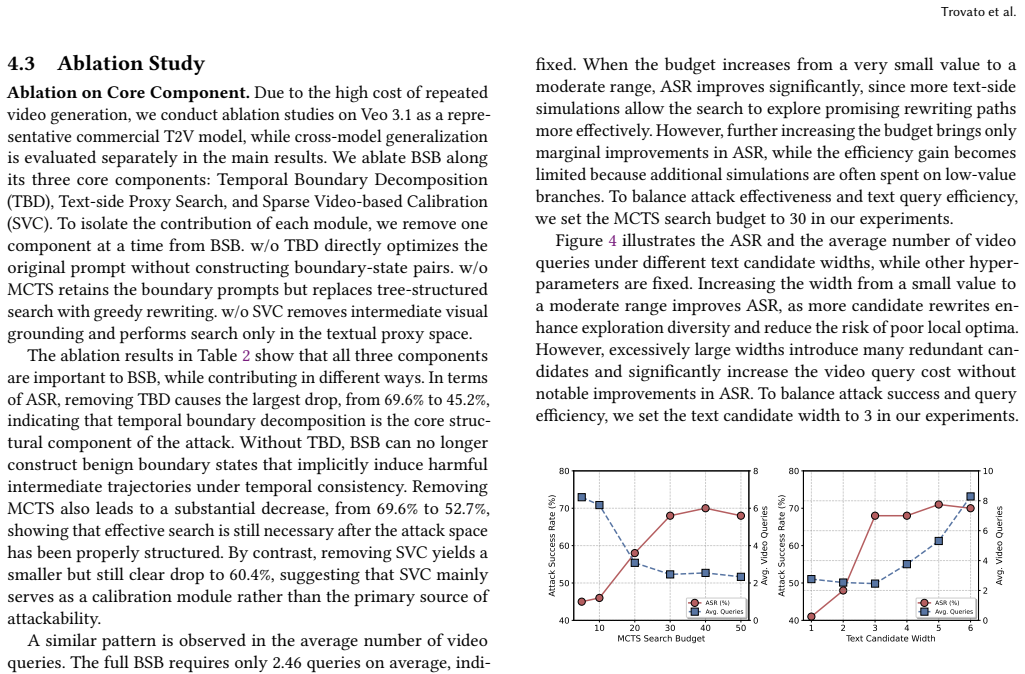
- [Figure 4] Two consecutive paragraphs both say 'Figure 4 illustrates...' for different hyperparameter sweeps (MCTS budget and text candidate width). Label the panels as (a) and (b) and reference them distinctly.
- [Notation, Eq. (6) and Fig. 2] Fig. 2 writes the reward as R(a) = ℒ_filter(λ_r ℒ_ref + λ_h ℒ_harm), while Eq. (6) defines R(s,a) with R_filter·(...). Align the notation to avoid confusion between the indicator R_filter and the weighting expression.
- [Eq. (1)] The notation pθ(z_{0:Td−1}|d) with subscript Td is not defined. Clarify whether Td is the number of denoising steps or the video length, and fix the indexing if needed.
- [General] The running author header reads 'Trovato et al.', which does not match the listed authors. Please correct this template artifact before resubmission.
Circularity Check
No significant circularity: ASR is grounded in real video output; the interpolation premise is asserted rather than derived, which is an evidence gap, not a circular reduction.
full rationale
The paper's central mechanism—that conditioning on two safe boundary prompts p−, p+ makes the T2V model 'implicitly explore the semantic space between the two boundary states' (§3.2, after Eq. 1)—is an empirical assumption about how commercial T2V models behave, not a consequence of any equation in the paper. Eq. (1) is the standard joint-denoising factorization and does not by itself define semantic interpolation; the 'canonical temporal template' is deferred to a missing supplementary. That is a gap in evidence/proof, but not circularity: no output quantity is definitionally equal to an input quantity. The MCTS reward (Eqs. 5–6, 9–10) does use an LLM harmfulness score, and final ASR is judged by GPT-5, so there is evaluator alignment; however, success additionally requires generated videos from Veo 3.1/Sora 2/Seedance/Kling that bypass LlamaGuard/VideoLLaMA2 filters and contain visible harmful frames (Fig. 3). ASR is not defined as the reward, so the attack is not equivalent to its search signal. References [13,14] have overlapping authors but are used as related work/baselines, not as load-bearing support for the interpolation claim; no uniqueness theorem or external derivation is imported. The w/o TBD ablation shows component importance but not the interpolation mechanism, a validity concern rather than circularity.
Axiom & Free-Parameter Ledger
free parameters (5)
- reward weights λ_r, λ_h =
0.5, 0.5
- UCT exploration coefficient c =
1.4
- MCTS search budget =
30 simulations
- candidate width / top-k / stages =
k=3, branching factor 4, 3 stages
- prompts per category =
50 (700 total)
axioms (6)
- domain assumption T2V latent diffusion conditioned on a text sequence encoding (p−, p+) semantically interpolates between the two boundary states during generation.
- ad hoc to paper A 'canonical temporal template' can faithfully encode two boundary prompts into the single-prompt interface of black-box T2V models.
- domain assumption GPT-5-family LM judgments of harmfulness are a valid ground-truth proxy for content-policy violation.
- domain assumption LlamaGuard3-8b and VideoLLaMA2-7B are adequate surrogates for the unknown text/video filters of commercial models.
- domain assumption Uniform random 50-prompt sampling per category is representative of the safety benchmark.
- standard math UCT selection, cosine text similarity, and joint-denoising factorization (Eq. 1) are standard background results used as tools.
invented entities (2)
-
Boundary-state pair (p−, p+)
no independent evidence
-
Implicit intermediate state p' / 'implicit bridge of harmful intent'
no independent evidence
read the original abstract
Recently, text-to-video (T2V) models have been widely deployed, sparking growing concerns over their robustness against jailbreak attacks. Existing jailbreak methods, mostly adapted from text-to-image attacks, suffer notable drawbacks when applied to T2V systems. They fail to fully leverage temporal consistency, an inherent characteristic of video generation. Besides, these methods demand heavy video query optimization, which is infeasible in practical black-box scenarios. Their adversarial prompt search is also driven by heuristic local signals, lacking principled structured exploration strategies. To tackle these limitations, we propose BSB, a structured, query-efficient jailbreak framework for T2V models. BSB harnesses temporal consistency by encoding harmful intent as the transition between two individually harmless boundary states. Under this paradigm, the attack targets boundary-state pairs whose interpolation tends to produce unsafe intermediate frames during video generation. Directly evaluating all candidate pairs within the video space incurs prohibitive computation cost. Instead, BSB conducts Monte Carlo Tree Search (MCTS) in a cheaper textual proxy space and regularly calibrates search outcomes with sparse video-level evaluations. We conduct comprehensive experiments on mainstream commercial T2V models including Veo 3.1, Sora 2, Seedance and Kling v1. Results show BSB surpasses all existing jailbreak baselines, delivering an average 18.6% relative gain in attack success rate over the strongest competitor across evaluated models. Our findings identify temporal consistency as an understudied yet vital attack surface for T2V models and verify that structured search facilitates effective vulnerability discovery under constrained query budgets.
Figures


Reference graph
Works this paper leans on
-
[1]
Zhongjie Ba, Jieming Zhong, Jiachen Lei, Peng Cheng, Qinglong Wang, Zhan Qin, Zhibo Wang, and Kui Ren. 2024. SurrogatePrompt: Bypassing the Safety Filter of Text-to-Image Models via Substitution. InProceedings of the 2024 on ACM SIGSAC Conference on Computer and Communications Security, CCS 2024, Salt Lake City, UT, USA, October 14-18, 2024, Bo Luo, Xiaoj...
arXiv 2024
-
[2]
Andreas Blattmann, Robin Rombach, Huan Ling, Tim Dockhorn, Seung Wook Kim, Sanja Fidler, and Karsten Kreis. 2023. Align Your Latents: High-Resolution Video Synthesis with Latent Diffusion Models. InIEEE/CVF Conference on Com- puter Vision and Pattern Recognition, CVPR 2023, Vancouver, BC, Canada, June 17-24, 2023. IEEE, 22563–22575. doi:10.1109/CVPR52729....
arXiv 2023
-
[3]
Haoxin Chen, Yong Zhang, Xiaodong Cun, Menghan Xia, Xintao Wang, Chao Weng, and Ying Shan. 2024. VideoCrafter2: Overcoming Data Limitations for High-Quality Video Diffusion Models. InIEEE/CVF Conference on Computer Vision and Pattern Recognition, CVPR 2024, Seattle, W A, USA, June 16-22, 2024. IEEE, 7310–7320. doi:10.1109/CVPR52733.2024.00698
arXiv 2024
-
[4]
Zesen Cheng, Sicong Leng, Hang Zhang, Yifei Xin, Xin Li, Guanzheng Chen, Yongxin Zhu, Wenqi Zhang, Ziyang Luo, Deli Zhao, and Lidong Bing. 2024. VideoLLaMA 2: Advancing Spatial-Temporal Modeling and Audio Understanding in Video-LLMs. arXiv:2406.07476 [cs.CV] https://arxiv.org/abs/2406.07476
Pith/arXiv arXiv 2024
-
[5]
Lakshay Chhabra. 2020. Nsfw image classifier on GitHub. https://github.com/ lakshaychhabra/NSFW-Detection-DL
2020
-
[6]
Yimo Deng and Huangxun Chen. 2023. Divide-and-Conquer Attack: Harnessing the Power of LLM to Bypass the Censorship of Text-to-Image Generation Model. CoRRabs/2312.07130 (2023). arXiv:2312.07130 doi:10.48550/ARXIV.2312.07130
-
[7]
Rojit George. 2020. Nsfw words list on GitHub. https://github.com/rrgeorge- pdcontributions/NSFW-Words-List/blob/master/nsfw_list.txt
2020
-
[8]
Jonathan Ho, William Chan, Chitwan Saharia, Jay Whang, Ruiqi Gao, Alexey A. Gritsenko, Diederik P. Kingma, Ben Poole, Mohammad Norouzi, David J. Fleet, and Tim Salimans. 2022. Imagen Video: High Definition Video Generation with Diffusion Models.CoRRabs/2210.02303 (2022). arXiv:2210.02303 doi:10.48550/ ARXIV.2210.02303
-
[9]
Wenyi Hong, Ming Ding, Wendi Zheng, Xinghan Liu, and Jie Tang. 2023. CogVideo: Large-scale Pretraining for Text-to-Video Generation via Transform- ers. InThe Eleventh International Conference on Learning Representations, ICLR 2023, Kigali, Rwanda, May 1-5, 2023. OpenReview.net
2023
-
[10]
Levon Khachatryan, Andranik Movsisyan, Vahram Tadevosyan, Roberto Henschel, Zhangyang Wang, Shant Navasardyan, and Humphrey Shi. 2023. Text2Video-Zero: Text-to-Image Diffusion Models are Zero-Shot Video Genera- tors. InIEEE/CVF International Conference on Computer Vision, ICCV 2023, Paris, France, October 1-6, 2023. IEEE, 15908–15918. doi:10.1109/ICCV5107...
arXiv 2023
-
[11]
Massine El Khader, Elias Al Bouzidi, Abdellah Oumida, Mohammed Sbaihi, Eliott Binard, Jean-Philippe Poli, Wassila Ouerdane, Boussad Addad, and Katarzyna Kapusta. 2025. DiffGuard: Text-Based Safety Checker for Diffusion Models. arXiv:2412.00064 [cs.CV] https://arxiv.org/abs/2412.00064
Pith/arXiv arXiv 2025
-
[12]
Wonjun Lee, Haon Park, Doehyeon Lee, Bumsub Ham, and Suhyun Kim. 2025. Jailbreaking on Text-to-Video Models via Scene Splitting Strategy.CoRR abs/2509.22292 (2025). arXiv:2509.22292 doi:10.48550/ARXIV.2509.22292
-
[13]
Siyuan Liang, Jiayang Liu, Jiecheng Zhai, Tianmeng Fang, Rongcheng Tu, Aishan Liu, Xiaochun Cao, and Dacheng Tao. 2025. T2VShield: Model-Agnostic Jailbreak Defense for Text-to-Video Models.CoRRabs/2504.15512 (2025). arXiv:2504.15512 doi:10.48550/ARXIV.2504.15512
work page internal anchor Pith review Pith/arXiv arXiv doi:10.48550/arxiv.2504.15512 2025
-
[14]
Jiayang Liu, Siyuan Liang, Shiqian Zhao, Rongcheng Tu, Wenbo Zhou, Ais- han Liu, Dacheng Tao, and Siew Kei Lam. 2025. T2V-OptJail: Discrete Prompt Optimization for Text-to-Video Jailbreak Attacks. arXiv:2505.06679 [cs.CV] https://arxiv.org/abs/2505.06679
Pith/arXiv arXiv 2025
-
[15]
AI @ Meta Llama Team. 2024. The Llama 3 Herd of Models. arXiv:2407.21783 [cs.AI] https://arxiv.org/abs/2407.21783
Pith/arXiv arXiv 2024
-
[16]
Yibo Miao, Yifan Zhu, Lijia Yu, Jun Zhu, Xiao-Shan Gao, and Yinpeng Dong. 2024. T2VSafetyBench: Evaluating the Safety of Text-to-Video Generative Models. In Advances in Neural Information Processing Systems 38: Annual Conference on Neural Information Processing Systems 2024, NeurIPS 2024, Vancouver, BC, Canada, December 10 - 15, 2024, Amir Globersons, Les...
2024
-
[17]
Xiangyu Peng, Zangwei Zheng, Chenhui Shen, Tom Young, and Xinying Guo et al. 2025. Open-Sora 2.0: Training a Commercial-Level Video Generation Model in $200k.CoRRabs/2503.09642 (2025). arXiv:2503.09642 doi:10.48550/ARXIV. 2503.09642
-
[18]
Yiting Qu, Xinyue Shen, Yixin Wu, Michael Backes, Savvas Zannettou, and Yang Zhang. 2025. UnsafeBench: Benchmarking Image Safety Classifiers on Real-World and AI-Generated Images. InProceedings of the 2025 ACM SIGSAC Conference on Computer and Communications Security, CCS 2025, Taipei, Taiwan, October 13-17, 2025, Chun-Ying Huang, Jyh-Cheng Chen, Shiuh-Py...
arXiv 2025
-
[19]
Team Seedance, Heyi Chen, Siyan Chen, Xin Chen, Yanfei Chen, Ying Chen, and Zhuo Chen et al. 2025. Seedance 1.5 pro: A Native Audio-Visual Joint Generation Foundation Model.CoRRabs/2512.13507 (2025). arXiv:2512.13507 doi:10.48550/ARXIV.2512.13507
-
[20]
Uriel Singer, Adam Polyak, Thomas Hayes, Xi Yin, Jie An, Songyang Zhang, Qiyuan Hu, Harry Yang, Oron Ashual, Oran Gafni, Devi Parikh, Sonal Gupta, and Yaniv Taigman. 2023. Make-A-Video: Text-to-Video Generation without Text- Video Data. InThe Eleventh International Conference on Learning Representations, ICLR 2023, Kigali, Rwanda, May 1-5, 2023. OpenReview.net
2023
-
[21]
Aaditya Singh, Adam Fry, Adam Perelman, and Adam Tart et al. 2025. GPT-5. arXiv:2601.03267 [cs.CL] https://arxiv.org/abs/2601.03267
Pith/arXiv arXiv 2025
-
[22]
Kling Team. 2025. Kling-Omni Technical Report.CoRRabs/2512.16776 (2025). arXiv:2512.16776 doi:10.48550/ARXIV.2512.16776
-
[23]
Yu-Lin Tsai, Chia-Yi Hsu, Chulin Xie, Chih-Hsun Lin, Jia-You Chen, Bo Li, Pin-Yu Chen, Chia-Mu Yu, and Chun-Ying Huang. 2024. Ring-A-Bell! How Reliable are Concept Removal Methods For Diffusion Models?. InThe Twelfth International Conference on Learning Representations, ICLR 2024, Vienna, Austria, May 7-11,
2024
-
[24]
Ruben Villegas, Mohammad Babaeizadeh, Pieter-Jan Kindermans, Hernan Moraldo, Han Zhang, Mohammad Taghi Saffar, Santiago Castro, Julius Kunze, and Dumitru Erhan. 2023. Phenaki: Variable Length Video Generation from Open Domain Textual Descriptions. InThe Eleventh International Conference on Learning Representations, ICLR 2023, Kigali, Rwanda, May 1-5, 2023...
2023
-
[25]
Ang Wang, Baole Ai, Bin Wen, Chaojie Mao, and Chen-Wei Xie et al. 2025. Wan: Open and Advanced Large-Scale Video Generative Models.CoRRabs/2503.20314 (2025). arXiv:2503.20314 doi:10.48550/ARXIV.2503.20314
-
[26]
Songping Wang, Rufan Qian, Yueming Lyu, Qinglong Liu, Linzhuang Zou, Jie Qin, Songhua Liu, and Caifeng Shan. 2025. RunawayEvil: Jailbreaking the Image- to-Video Generative Models.CoRRabs/2512.06674 (2025). arXiv:2512.06674 doi:10.48550/ARXIV.2512.06674
-
[27]
Wenhao Wang and Yi Yang. 2024. VidProM: A Million-scale Real Prompt-Gallery Dataset for Text-to-Video Diffusion Models. InAdvances in Neural Informa- tion Processing Systems 38: Annual Conference on Neural Information Process- ing Systems 2024, NeurIPS 2024, Vancouver, BC, Canada, December 10 - 15, 2024, Amir Globersons, Lester Mackey, Danielle Belgrave, ...
2024
-
[28]
Thaddäus Wiedemer, Yuxuan Li, Paul Vicol, Shixiang Shane Gu, Nick Matarese, Kevin Swersky, Been Kim, Priyank Jaini, and Robert Geirhos et al. 2025. Video models are zero-shot learners and reasoners.CoRRabs/2509.20328 (2025). arXiv:2509.20328 doi:10.48550/ARXIV.2509.20328 Trovato et al
-
[29]
Yuchen Yang, Bo Hui, Haolin Yuan, Neil Gong, and Yinzhi Cao. 2024. SneakyPrompt: Jailbreaking Text-to-image Generative Models. InIEEE Sym- posium on Security and Privacy, SP 2024, San Francisco, CA, USA, May 19-23, 2024. IEEE, 897–912
2024
-
[30]
Zonghao Ying, Moyang Chen, Nizhang Li, Zhiqiang Wang, Wenxin Zhang, Quanchen Zou, Zonglei Jing, Aishan Liu, and Xianglong Liu. 2026. SPARK: Jailbreaking T2V Models by Synergistically Prompting Auditory and Recontex- tualized Knowledge. arXiv:2511.13127 [cs.CV] https://arxiv.org/abs/2511.13127
arXiv 2026
-
[31]
Jiawei Zhao, Kejiang Chen, Weiming Zhang, and Nenghai Yu. 2025. SQL Injection Jailbreak: A Structural Disaster of Large Language Models. InFindings of the As- sociation for Computational Linguistics: ACL 2025, Wanxiang Che, Joyce Nabende, Ekaterina Shutova, and Mohammad Taher Pilehvar (Eds.). Association for Compu- tational Linguistics, Vienna, Austria, 6...
-
[32]
Zico Kolter, and Matt Fredrikson
Andy Zou, Zifan Wang, J. Zico Kolter, and Matt Fredrikson. 2023. Univer- sal and Transferable Adversarial Attacks on Aligned Language Models.CoRR abs/2307.15043 (2023). arXiv:2307.15043 doi:10.48550/ARXIV.2307.15043
discussion (0)
Sign in with ORCID, Apple, or X to comment. Anyone can read and Pith papers without signing in.