REVIEW 5 minor 47 references
The paper shows that super-resolution reconstructions can look sharper by standard similarity scores while removing the faint evidence a defect detector needs, so inspection-oriented SR must be judged on preserved task evidence and operatin
Reviewed by Pith at T0; open to challenge. T0 means a machine referee read the full paper against a public rubric. the ladder, T0–T4 →
T0 review · deepseek-v4-flash
2026-08-01 18:03 UTC pith:TYISTTEL
load-bearing objection Careful, predeclared benchmark showing SR reconstruction metrics don't imply detection evidence; the synthetic-only scope limits generalization but the controlled comparison stands.
Does Super-Resolution Preserve Defect Evidence? A Low-False-Call Benchmark for Semiconductor Inspection
The pith
A machine-rendered reading of the paper's core claim, the machinery that carries it, and where it could break.
Core claim
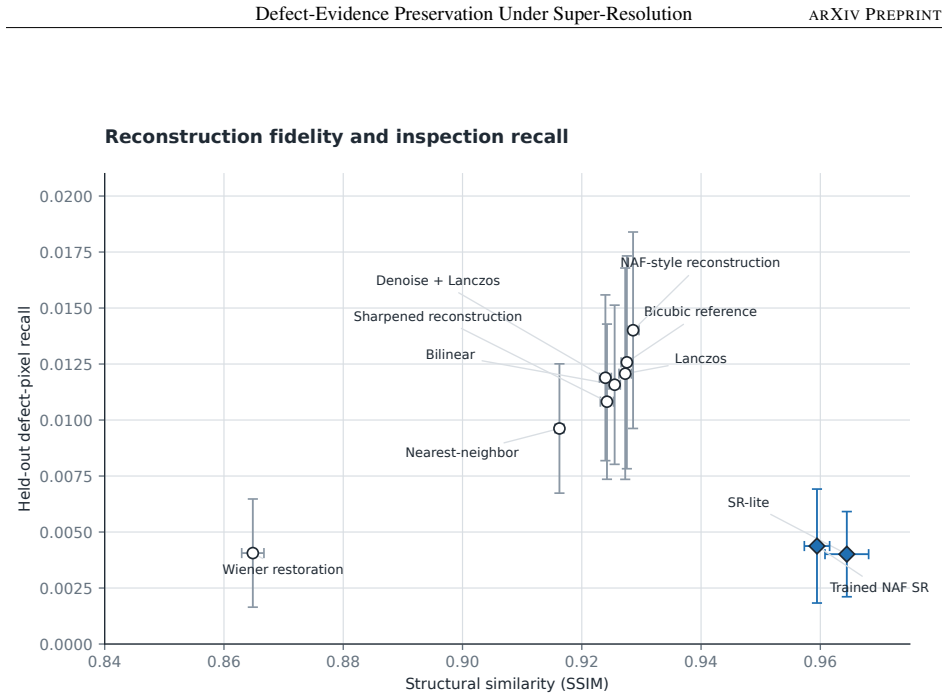
The paper's discovery is that reconstruction fidelity and inspection utility are separable and, in this benchmark, opposed. With the same local-residual detector scoring every image transformation at a predeclared low false-positive rate, the trained super-resolution models reach the highest structural similarity yet recover defect-pixel recall roughly one-third of plain bicubic interpolation, losing in every paired repetition. A direct mask-supervised detector shows substantially more nominal defect evidence exists in the low-resolution observation, while an illustrative joint reconstruction/detection model passes independent clean calibration in all ten repetitions and exceeds the held-out
What carries the argument
The load-bearing device is a controlled evaluation design rather than a new architecture. WaferInspectSR-Bench generates paired high- and low-resolution wafer-like images with exact defect, clean-region, and edge masks; one local residual detector is fixed across all reconstruction methods so that any paired recall change is attributable to the image transformation. A three-stage operating-point procedure — temperature fitting on validation, threshold selection on independent no-defect calibration images, and a single held-out evaluation — converts the false-positive limit into a transferable policy. Track A (image transformations under the common detector) and Track B (direct and joint pred
Load-bearing premise
The benchmark's simulated degradation uses hand-picked blur, noise, and downsampling settings rather than measurements from a real scanner; if actual wafer acquisition degrades images differently, the gap between image sharpness and defect recall reported here may not transfer to production lines.
What would settle it
Run the same benchmark on paired real low- and high-resolution wafer inspection images with exact defect masks and no-defect regions, applying the identical fixed detector and predeclared 3e-4 false-positive rule. The paper's central divergence is overturned if a learned super-resolution model both improves structural similarity and recovers more defect pixels than bicubic interpolation at a feasible operating point in most repetitions.
If this is right
- If the benchmark is right, PSNR and SSIM gains from super-resolution cannot be treated as evidence that inspection decisions improve; a sharper reconstruction can reduce defect-pixel recall under a fixed detector.
- An operating threshold is a policy: calibration success on clean data does not guarantee the same false-call rate on held-out nominal images, as the joint model fails the limit in all ten repetitions.
- Inspection-oriented super-resolution evaluation should include clean-only controls, weak defects, and an independent clean selection set, with held-out data scored only once after the policy is frozen.
- A direct mask-supervised detector can recover substantially more nominal defect evidence from the low-resolution image than reconstruction-only methods, showing that the observation itself carries task signal.
- Weak-defect recall is near zero for every feasible method, so nominal recall improvements do not imply robustness to faint or unseen defect morphologies.
Where Pith is reading between the lines
- The same split-track control logic extends beyond wafers: any imaging pipeline that reconstructs an intermediate image before a rare-event detection step, such as medical scans, aerial surveys, or materials microscopy, risks trading average fidelity for sparse evidence and could reuse this protocol.
- A natural next experiment, not run in the paper, is task-aware super-resolution in which the reconstruction loss is supplemented with defect and clean-region losses under the same low-false-call rule; the direct-detector result suggests such a model could recover weak defects without breaking false-call control.
- The external SEM shifts imply that a threshold selected on one background distribution can change behavior drastically on another, which suggests real deployments should revalidate any preselected policy on a sample of production images before use — a risk the paper states but does not quantify.
Editorial analysis
A structured set of objections, weighed in public.
Referee Report
Summary. The paper introduces WaferInspectSR-Bench, a controlled benchmark for evaluating super-resolution (SR) methods in semiconductor-defect inspection. It separates a Track A experiment, in which image transformations are compared under one fixed local-residual detector, from a Track B experiment, in which direct and joint task-trained predictors are evaluated under a common three-stage operating-policy selection rule. Ten predeclared seed-level repetitions generate synthetic line/space and contact-hole images with exact defect masks, clean controls, weak defects, and a held-out residue morphology; a 4,591-image Carinthia-S external split is used as an unchanged-policy stress test. The headline results are that the two trained reconstruction models achieve higher SSIM than bicubic but lower defect-pixel recall in all ten paired runs, that a direct DeepLabV3 detector recovers substantially more nominal defect evidence at a feasible false-positive rate, that the joint DPU-WaferSR model passes independent clean calibration yet exceeds the held-out FPR limit in all ten runs, and that weak-defect recall is near zero for every feasible method. The paper concludes that reconstruction fidelity and clean-calibration success do not, by themselves, establish inspection utility.
Significance. The benchmark's contribution is primarily methodological, and it is executed with unusual care. Strengths include predeclared seeds and split manifests, a three-stage selection procedure that separates temperature fitting, clean-calibration threshold selection, and held-out evaluation, seed-level paired statistics rather than pixel-pooled inference, exact masks and clean-region definitions, and separate weak/residue/external controls. The code and configuration files are released, which makes the benchmark reproducible. The central claim—that image-similarity metrics alone are insufficient evidence of inspection value—is established by a controlled counterexample in Track A, and the DPU-WaferSR result cleanly demonstrates that clean-calibration feasibility need not transfer to held-out images. The main limitation is the synthetic degradation model of Eq. (4) with hand-set parameters in Table 5 and the pseudo-low-resolution external layer; the authors explicitly acknowledge in Section 9 that paired production optical data would be required for scanner-specific conclusions. I regard this as a scope boundary rather than a flaw, because the paper does not claim fab-scale performance. T
minor comments (5)
- [Section 11] The repository URL is given as "github.com/nbbllxx0/W AFERINSPECTSR-BENCH" with an embedded space; it should be "WAFERINSPECTSR-BENCH" (or the actual repository name). Please correct so the availability statement is directly usable.
- [Section 7.4 / Table 13] The running text quotes the bicubic external clean-region FPR as 0.00935±0.00057 while Table 13 reports 93.48±5.67 in units of 10^-4. The two representations are consistent, but the text does not state the unit; add a parenthetical so readers are not misled.
- [Section 4.3 / Table 5] The headline finding is demonstrated under a single hand-set degradation configuration. A small sensitivity sweep over the blur, noise, and aliasing parameters of Eq. (4) would strengthen the benchmark's generalizability. The paper's conclusion is not contingent on such a sweep, so I do not view this as blocking.
- [Section 9] The text says a capacity-matched task-aware SR experiment is "identified as a next step," but Section 9 does not actually describe the next step. Either add a sentence specifying the ablation (same backbone, same training budget, task supervision varied) or correct the cross-reference.
- [Figure 9] The per-image recall values (e.g., 0.943 for DeepLabV3) are much higher than the ten-run aggregate 0.198. The caption already states the examples are not included in summaries, but adding the aggregate values on the panel would prevent over-interpretation of a single favorable image.
Circularity Check
No significant circularity; the benchmark's claims are measured outcomes under a predeclared holdout policy, not constructed equivalences.
full rationale
The paper's derivation chain does not contain any constructed equivalence between inputs and claimed predictions. In Track A, the detector h is fixed by Eq. (5) while only the image transformation g changes, and the divergence between SSIM and defect recall is a measured paired result across ten seeds (Tables 8–9), not a quantity fitted from the comparison target. In Track B, temperature and candidate thresholds are fit on validation data, the operating point is selected on independent clean calibration images using a predeclared rule (Algorithm 2, Eq. (12)), and held-out partitions are evaluated once without retuning; DPU-WaferSR's held-out infeasibility is an observed transfer failure (Table 11), not an imposed conclusion. The external Carinthia-S experiment is explicitly scoped as a stress test with unchanged policies, not as a paired reconstruction benchmark (Sections 4.4 and 7.4). No load-bearing self-citation, imported uniqueness theorem, or ansatz-smuggled citation appears, and the paper repeatedly disclaims novelty for the general fidelity–utility divergence. Section 9's statement that Eq. (4) is not a calibrated scanner model is a generalization limitation, not a circular step. The central conclusion—reconstruction quality alone does not establish inspection utility—is supported by controlled, predeclared empirical comparisons.
Axiom & Free-Parameter Ledger
free parameters (6)
- Degradation blur/defocus scales =
σ_b=1.2, σ_d=0.7 (k=2)
- Degradation noise magnitudes =
shot 0.025, Gaussian 0.020, Poisson peak 80, scan 0.030, aliasing 0.020, contrast U(0.85,1.15)
- False-positive target and tolerance =
α=3e-4, tolerance=4.5e-4
- Candidate threshold set =
{3,2,1.5,1,0.75,0.5,0.3}×10^-4
- Common detector hyperparameters =
σ=2.0, Q0.98, final smoothing 0.6
- DPU loss and prior weights =
positive weight 64, clean 2, edge 0.2, risk 0.05, fusion 0.5
axioms (5)
- domain assumption Synthetic line/space and contact-hole generator with hand-set degradation is representative of real wafer inspection structure.
- domain assumption The fixed local-residual detector is a valid measure of preserved defect evidence.
- domain assumption Ten seed-level repetitions capture enough pipeline variance for paired conclusions.
- domain assumption Carinthia-S pseudo-low-resolution SEM masks provide meaningful external stress evidence.
- standard math Standard probability, statistics, and image-processing background.
read the original abstract
Super-resolution can make inspection images appear sharper without preserving the evidence needed to detect a defect. We study this failure mode with a benchmark that separates reconstruction from detection and evaluates both at a predeclared low false-positive rate. Ten end-to-end repetitions combine independently generated line/space and contact-hole images with model training, calibration, clean controls, weak defects, and a held-out defect morphology. Every reconstruction is scored by the same local residual detector, while direct and jointly trained detectors form a separate comparison track. Reconstruction fidelity and inspection utility diverge: the two learned reconstruction models attain the highest structural similarity yet detect fewer defect pixels than bicubic interpolation in every paired repetition. A direct DeepLabV3 detector reaches $0.1984\pm0.0385$ recall at $0.000174\pm0.000084$ false-positive rate and satisfies the held-out feasibility criterion in all ten repetitions. An illustrative joint model, DPU-WaferSR, passes independent clean calibration but exceeds the held-out limit in all ten repetitions, demonstrating that calibration success does not guarantee transfer. Weak-defect recall remains near zero for every feasible method. Applying the unchanged policies to 4,591 public Carinthia-S masks further reveals large method-dependent shifts on real SEM texture. These results support a simple conclusion: super-resolution for inspection should be judged by preserved task evidence and operating-point transfer, not reconstruction quality alone.
Figures




Reference graph
Works this paper leans on
-
[1]
Chinmay Belthangady and Loic A. Royer. Applications, promises, and pitfalls of deep learning for fluorescence image reconstruction.Nature Methods, 16(12):1215–1225, 2019
2019
-
[2]
Martin Weigert, Uwe Schmidt, Tobias Boothe, Andreas Müller, Alexandr Dibrov, Akanksha Jain, Benjamin Wilhelm, Deborah Schmidt, Coleman Broaddus, Siân Culley, Mauricio Rocha-Martins, Fabián Segovia-Miranda, Caren Norden, Ricardo Henriques, Marino Zerial, Michele Solimena, Jochen Rink, Pavel Tomancak, Loic Royer, Florian Jug, and Eugene W. Myers. Content-aw...
2018
-
[3]
Evaluation and development of deep neural networks for image super-resolution in optical microscopy.Nature Methods, 18(2):194–202, 2021
Chang Qiao, Di Li, Yuting Guo, Chong Liu, Tao Jiang, Qionghai Dai, and Dong Li. Evaluation and development of deep neural networks for image super-resolution in optical microscopy.Nature Methods, 18(2):194–202, 2021
2021
-
[4]
Thibault Lechien, Enrique Dehaerne, Bappaditya Dey, Victor Blanco, Sandip Halder, Stefan De Gendt, and Wannes Meert. Auto- mated semiconductor defect inspection in scanning electron microscope images: A systematic review, 2023. arXiv:2308.08376
Pith/arXiv arXiv 2023
-
[5]
A multiscale attention mechanism super-resolution confocal microscopy for wafer defect detection.IEEE Transactions on Automation Science and Engineering, 22:1016–1027, 2025
Xuefeng Sun, Baoyuan Zhang, Yushan Wang, Jialuo Mai, Yuhang Wang, Jiubin Tan, and Weibo Wang. A multiscale attention mechanism super-resolution confocal microscopy for wafer defect detection.IEEE Transactions on Automation Science and Engineering, 22:1016–1027, 2025
2025
-
[6]
AI image enhancement for failure analysis in 3D quantum information technology.Scientific Reports, 15:24078, 2025
Raphael Wilhelmer, Fabian Laurent, Tatjana Djuric-Rissner, Max Glantschnig, Johann Strasser, Stefan Weinberger, Tobias Herrmann, Clemens Rössler, Peter Czurratis, and Roland Brunner. AI image enhancement for failure analysis in 3D quantum information technology.Scientific Reports, 15:24078, 2025
2025
-
[7]
Leisheng Chen, Kai Meng, Hangying Zhang, Junquan Zhou, and Peihuang Lou. SR-FABNet: Super-resolution branch guided fourier attention detection network for efficient optical inspection of nanoscale wafer defects.Advanced Engineering Informatics, 65:103200, 2025
2025
-
[8]
Super-resolution approach tailored for wafer transmission electron microscopy images.Scientific Reports, 16(1):10662, 2026
Sungsu Kim, Insung Baek, Hansam Cho, Yongwon Jo, Heejoong Roh, Kyunghye Kim, Munki Jo, Jaeung Tae, and Seoung Bum Kim. Super-resolution approach tailored for wafer transmission electron microscopy images.Scientific Reports, 16(1):10662, 2026
2026
-
[9]
Enhanced deep residual networks for single image super-resolution
Bee Lim, Sanghyun Son, Heewon Kim, Seungjun Nah, and Kyoung Mu Lee. Enhanced deep residual networks for single image super-resolution. InIEEE Conference on Computer Vision and Pattern Recognition Workshops, pages 1132–1140, 2017
2017
-
[10]
Image super-resolution using very deep residual channel attention networks
Yulun Zhang, Kunpeng Li, Kai Li, Lichen Wang, Bineng Zhong, and Yun Fu. Image super-resolution using very deep residual channel attention networks. InEuropean Conference on Computer Vision, volume 11211, pages 294–310, 2018
2018
-
[11]
Real-ESRGAN: Training real-world blind super-resolution with pure synthetic data
Xintao Wang, Liangbin Xie, Chao Dong, and Ying Shan. Real-ESRGAN: Training real-world blind super-resolution with pure synthetic data. InIEEE/CVF International Conference on Computer Vision Workshops, pages 1905–1914, 2021
1905
-
[12]
SwinIR: Image restoration using swin transformer
Jingyun Liang, Jiezhang Cao, Guolei Sun, Kai Zhang, Luc Van Gool, and Radu Timofte. SwinIR: Image restoration using swin transformer. InIEEE/CVF International Conference on Computer Vision Workshops, pages 1833–1844, 2021
2021
-
[13]
Activating more pixels in image super-resolution transformer
Xiangyu Chen, Xintao Wang, Jiantao Zhou, Yu Qiao, and Chao Dong. Activating more pixels in image super-resolution transformer. InIEEE/CVF Conference on Computer Vision and Pattern Recognition, pages 22367–22377, 2023
2023
-
[14]
Simple baselines for image restoration
Liangyu Chen, Xiaojie Chu, Xiangyu Zhang, and Jian Sun. Simple baselines for image restoration. InEuropean Conference on Computer Vision, volume 13667, pages 17–33, 2022. 25 Defect-Evidence Preservation Under Super-ResolutionARXIVPREPRINT
2022
-
[15]
The relationship between precision-recall and roc curves
Jesse Davis and Mark Goadrich. The relationship between precision-recall and roc curves. InInternational Conference on Machine Learning, pages 233–240, 2006
2006
-
[16]
Carinthia-S dataset, 2025
Corinna Kofler and Vahidin Hasi´c. Carinthia-S dataset, 2025. Also listed at https://hcai.etf.unsa.ba/datasets.html
2025
-
[17]
Statistical comparisons of classifiers over multiple data sets.Journal of Machine Learning Research, 7:1–30, 2006
Janez Demšar. Statistical comparisons of classifiers over multiple data sets.Journal of Machine Learning Research, 7:1–30, 2006
2006
-
[18]
Learning a deep convolutional network for image super- resolution
Chao Dong, Chen Change Loy, Kaiming He, and Xiaoou Tang. Learning a deep convolutional network for image super- resolution. InEuropean Conference on Computer Vision, volume 8692, pages 184–199, 2014
2014
-
[19]
Accurate image super-resolution using very deep convolutional networks
Jiwon Kim, Jung Kwon Lee, and Kyoung Mu Lee. Accurate image super-resolution using very deep convolutional networks. InIEEE Conference on Computer Vision and Pattern Recognition, pages 1646–1654, 2016
2016
-
[20]
Deep laplacian pyramid networks for fast and accurate super-resolution
Wei-Sheng Lai, Jia-Bin Huang, Narendra Ahuja, and Ming-Hsuan Yang. Deep laplacian pyramid networks for fast and accurate super-resolution. InIEEE Conference on Computer Vision and Pattern Recognition, pages 624–632, 2017
2017
-
[21]
Residual dense network for image super-resolution
Yulun Zhang, Yapeng Tian, Yu Kong, Bineng Zhong, and Yun Fu. Residual dense network for image super-resolution. InIEEE Conference on Computer Vision and Pattern Recognition, pages 2472–2481, 2018
2018
-
[22]
Pre-trained image processing transformer
Hanting Chen, Yunhe Wang, Tianyu Guo, Chang Xu, Yiping Deng, Zhenhua Liu, Siwei Ma, Chunjing Xu, Chao Xu, and Wen Gao. Pre-trained image processing transformer. InIEEE/CVF Conference on Computer Vision and Pattern Recognition, pages 12299–12310, 2021
2021
-
[23]
Toward real-world single image super-resolution: A new benchmark and a new model
Jianrui Cai, Hui Zeng, Hongwei Yong, Zisheng Cao, and Lei Zhang. Toward real-world single image super-resolution: A new benchmark and a new model. InIEEE/CVF International Conference on Computer Vision, pages 3086–3095, 2019
2019
-
[24]
Designing a practical degradation model for deep blind image super-resolution
Kai Zhang, Jingyun Liang, Luc Van Gool, and Radu Timofte. Designing a practical degradation model for deep blind image super-resolution. InIEEE/CVF International Conference on Computer Vision, pages 4791–4800, 2021
2021
-
[25]
Photo-realistic single image super-resolution using a generative adversarial network
Christian Ledig, Lucas Theis, Ferenc Huszar, Jose Caballero, Andrew Cunningham, Alejandro Acosta, Andrew Aitken, Alykhan Tejani, Johannes Totz, Zehan Wang, and Wenzhe Shi. Photo-realistic single image super-resolution using a generative adversarial network. InIEEE Conference on Computer Vision and Pattern Recognition, pages 4681–4690, 2017
2017
-
[26]
ESRGAN: Enhanced super-resolution generative adversarial networks
Xintao Wang, Ke Yu, Shixiang Wu, Jinjin Gu, Yihao Liu, Chao Dong, Yu Qiao, and Chen Change Loy. ESRGAN: Enhanced super-resolution generative adversarial networks. InComputer Vision – ECCV 2018 Workshops, volume 11133, pages 63–79, 2019
2018
-
[27]
Fleet, and Mohammad Norouzi
Chitwan Saharia, Jonathan Ho, William Chan, Tim Salimans, David J. Fleet, and Mohammad Norouzi. Image super-resolution via iterative refinement.IEEE Transactions on Pattern Analysis and Machine Intelligence, 45(4):4713–4726, 2023
2023
-
[28]
Bentolila, Comert Kural, and Aydogan Ozcan
Hongda Wang, Yair Rivenson, Yiyin Jin, Zhensong Wei, Ronald Gao, Harun Günaydın, Laurent A. Bentolila, Comert Kural, and Aydogan Ozcan. Deep learning enables cross-modality super-resolution in fluorescence microscopy.Nature Methods, 16(1):103–110, 2019
2019
-
[29]
Deep learning for sparse scanning electron microscopy
Patrick Trampert, Sabine Schlabach, Tim Dahmen, and Philipp Slusallek. Deep learning for sparse scanning electron microscopy. Microscopy and Microanalysis, 25(S2):158–159, 2019
2019
-
[30]
Defect Inspection & Review
KLA Corporation. Defect Inspection & Review. https://www.kla.com/products/chip-manufacturing/ defect-inspection-review. Chip manufacturing product portfolio page; accessed 2026-07-16
2026
-
[31]
KLA BBP 40th Anniversary.https://bbp.kla.com/, 2024
KLA Corporation. KLA BBP 40th Anniversary.https://bbp.kla.com/, 2024. Accessed 2026-06-01
2024
-
[32]
KLA-Tencor Introduces Comprehensive Wafer Inspection and Review Portfo- lio for Leading IC Technologies
KLA-Tencor Corporation. KLA-Tencor Introduces Comprehensive Wafer Inspection and Review Portfo- lio for Leading IC Technologies. https://ir.kla.com/news-events/press-releases/detail/121/ kla-tencor-introduces-comprehensive-wafer-inspection-and, 2016. Accessed 2026-06-01
2016
-
[33]
Fully convolutional networks for semantic segmentation
Jonathan Long, Evan Shelhamer, and Trevor Darrell. Fully convolutional networks for semantic segmentation. InIEEE Conference on Computer Vision and Pattern Recognition, pages 3431–3440, 2015
2015
-
[34]
U-Net: Convolutional networks for biomedical image segmentation
Olaf Ronneberger, Philipp Fischer, and Thomas Brox. U-Net: Convolutional networks for biomedical image segmentation. In Medical Image Computing and Computer-Assisted Intervention, volume 9351, pages 234–241, 2015
2015
-
[35]
Rethinking atrous convolution for semantic image segmentation, 2017
Liang-Chieh Chen, George Papandreou, Florian Schroff, and Hartwig Adam. Rethinking atrous convolution for semantic image segmentation, 2017. arXiv:1706.05587
Pith/arXiv arXiv 2017
-
[36]
MVTec AD: A comprehensive real-world dataset for unsupervised anomaly detection
Paul Bergmann, Michael Fauser, David Sattlegger, and Carsten Steger. MVTec AD: A comprehensive real-world dataset for unsupervised anomaly detection. InIEEE/CVF Conference on Computer Vision and Pattern Recognition, pages 9592–9600, 2019
2019
-
[37]
The MVTec AD 2 dataset: Advanced scenarios for unsupervised anomaly detection.International Journal of Computer Vision, 134(4):175, 2026
Lars Heckler-Kram, Jan-Hendrik Neudeck, Ulla Scheler, Rebecca König, and Carsten Steger. The MVTec AD 2 dataset: Advanced scenarios for unsupervised anomaly detection.International Journal of Computer Vision, 134(4):175, 2026
2026
-
[38]
PaDiM: A patch distribution modeling framework for anomaly detection and localization
Thomas Defard, Aleksandr Setkov, Angelique Loesch, and Romaric Audigier. PaDiM: A patch distribution modeling framework for anomaly detection and localization. InPattern Recognition. ICPR International Workshops and Challenges, volume 12664, pages 475–489, 2021
2021
-
[39]
Carinthia dataset, 2024
Corinna Kofler, Sabrina Strauß, Anja Zernig, Ernesto Lazaro Garcia, Michael Boxleitner, Beatrix Mayr, Isabell Dicillia- Kovatsch, and Claudia Anna Dohr. Carinthia dataset, 2024. 26 Defect-Evidence Preservation Under Super-ResolutionARXIVPREPRINT
2024
-
[40]
Task-driven super resolution: Object detection in low-resolution images
Muhammad Haris, Greg Shakhnarovich, and Norimichi Ukita. Task-driven super resolution: Object detection in low-resolution images. InNeural Information Processing, volume 1516 ofCommunications in Computer and Information Science, pages 387–395. Springer, 2021
2021
-
[41]
Beyond image super-resolution for image recognition with task-driven perceptual loss
Jaeha Kim, Junghun Oh, and Kyoung Mu Lee. Beyond image super-resolution for image recognition with task-driven perceptual loss. InIEEE/CVF Conference on Computer Vision and Pattern Recognition, pages 2651–2661, 2024
2024
-
[42]
Zhili Li, Kangyang Chai, Zhihao Wang, Xiaowei Jia, Yanhua Li, Gengchen Mai, Sergii Skakun, Dinesh Manocha, and Yiqun Xie. Beyond visual fidelity: Benchmarking super-resolution models for large-scale remote sensing imagery via downstream task integration, 2026. arXiv:2605.00310
Pith/arXiv arXiv 2026
-
[43]
Weinberger
Chuan Guo, Geoff Pleiss, Yu Sun, and Kilian Q. Weinberger. On calibration of modern neural networks. InInternational Conference on Machine Learning, pages 1321–1330, 2017
2017
-
[44]
Cooper, and Milos Hauskrecht
Mahdi Pakdaman Naeini, Gregory F. Cooper, and Milos Hauskrecht. Obtaining well calibrated probabilities using bayesian binning. InAAAI Conference on Artificial Intelligence, volume 29, pages 2901–2907, 2015. AAAI volume 29, issue 1
2015
-
[45]
Goodman.Introduction to Fourier Optics
Joseph W. Goodman.Introduction to Fourier Optics. Roberts and Company, 3 edition, 2005
2005
-
[46]
Gonzalez and Richard E
Rafael C. Gonzalez and Richard E. Woods.Digital Image Processing. Pearson Prentice Hall, 3 edition, 2008
2008
-
[47]
Janesick.Scientific Charge-Coupled Devices
James R. Janesick.Scientific Charge-Coupled Devices. SPIE Press, 2001. 27
2001
discussion (0)
Sign in with ORCID, Apple, or X to comment. Anyone can read and Pith papers without signing in.