REVIEW 3 major objections 5 minor 56 references
This paper argues that a 5D gauge theory containing only a U(1) field and two massive charged fermions can produce, through the Hosotani one-loop mechanism, a dark-matter scalar with repulsive self-interactions.
Reviewed by Pith at T0; open to challenge. T0 means a machine referee read the full paper against a public rubric. the ladder, T0–T4 →
T0 review · deepseek-v4-flash
2026-08-01 17:11 UTC pith:IISGYAHG
load-bearing objection Two-fermion Scherk-Schwarz twist makes repulsive ULDM concrete and testable, but the un-stabilized pre-inflationary fifth dimension is the missing link. the 3 major comments →
Repulsive dark matter from Hosotani mechanism
The pith
A machine-rendered reading of the paper's core claim, the machinery that carries it, and where it could break.
Core claim
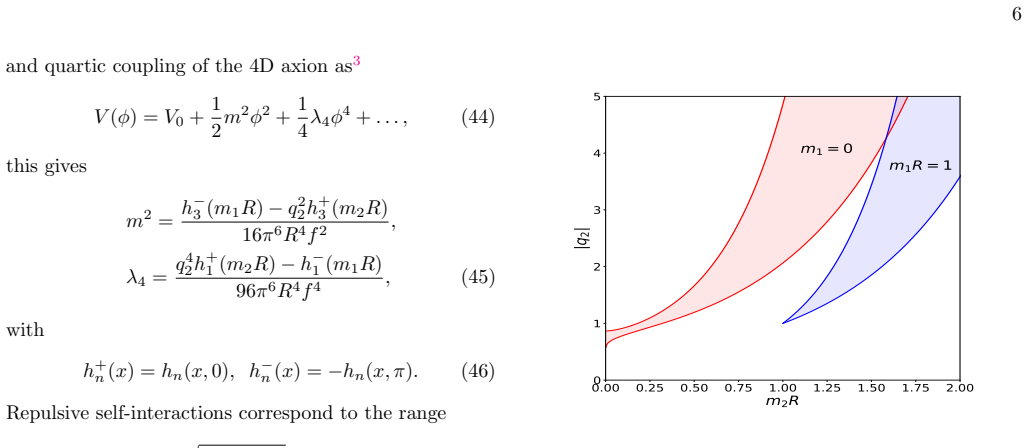
The central claim is that the one-loop Hosotani potential generated by two 5D fermions with masses m1<m2, charges q1=1, q2, and Scherk-Schwarz twists (α1,α2)=(1/2,0) gives a 4D scalar potential V(ϕ) with both m²>0 and λ4>0 in the window (47): √(h⁻₁(m1R)/h⁺₁(m2R)) < q₂² < h⁻₃(m1R)/h⁺₃(m2R), a window that exists as soon as m2>m1. This yields the sharper relation λ4 ≈ m²/(6f²), which then fixes the soliton radius R_s ≈ 3×10⁻¹² pc θ_i (m/10⁻⁶ eV)^{-3/4}. The authors verify that such a model passes inflationary isocurvature bounds, gravitational particle production limits, and theoretical self-consistency conditions, allowing scalar masses across the full range 10⁻²¹ eV < m < 1 eV.
What carries the argument
The central object is the Hosotani one-loop effective potential V(ϕ)=Σ_j (1/16π⁶R⁴)[3 Li₅(z_j)+6πm_jR Li₄(z_j)+(2πm_jR)² Li₃(z_j)], with z_j=e^{-2πm_jR+i(q_jϕ/f+2πα_j)}. It arises from integrating out the Kaluza-Klein towers of the two 5D fermions; the Scherk-Schwarz twists α_j shift the phase of each cosine-like contribution so that the two leading terms combine with opposite signs, flipping the sign of the quartic term. The potential is the lowest order of a derivative expansion, and the model's validity rests on the hierarchy 1/R ≪ Λ ≪ f, which makes the negligible photon-loop contribution and the derivative corrections small.
Load-bearing premise
The fifth dimension is treated as a rigid circle of fixed radius R, with no stabilization mechanism; if R is not actually fixed before inflation (or if compactification happens after inflation), the allowed-parameter window collapses because domain walls or a rolling radion would appear.
What would settle it
A lattice or higher-loop calculation of the effective potential for the two-fermion model at a point inside the claimed repulsive window (e.g., m1R=1, m2R=1.5, q2=2) that finds λ4<0, or an astrophysical measurement of soliton radii that rules out the scaling R_s ∝ m^{-3/4} at fixed initial misalignment angle, would directly falsify the central claim.
If this is right
- Repulsive self-interactions for ultralight dark matter do not require a balancing act among many boson and fermion fields: two fermions on a circle suffice, making such models more generic than previously thought.
- The dark-matter mass and quartic coupling are tied together through λ4 ≈ m²/(6f²), so the soliton radius scales as R_s ∝ m^{-3/4} θ_i; this is a testable relation, independent of the soliton mass.
- For m ≲ 10⁻¹² eV the self-interactions are subdominant and the model effectively reduces to fuzzy dark matter, so the usual Lyman-α constraints apply to that low-mass region.
- Because the fifth-dimensional radius R is fixed by the dark-matter mass relation (60), the model survives existing constraints on extra dimensions (R ≲ 10⁻⁵ m) and on inflation scale (1/R ≫ H_I).
- The same mechanism predicts a specific formation history via the misalignment mechanism, with abundance fixed by θ_i, f, and m, leaving only m as a free parameter for typical initial angles.
Where Pith is reading between the lines
- The tight relation λ4 ≈ m²/(6f²) may hold for any Hosotani-based dark matter scalar; if future observations find solitons significantly larger than predicted for a given mass and initial angle, it would point to additional contributions (e.g., monodromy) that decouple the quartic coupling from the mass.
- The metastability analysis in Section VIII suggests that even strictly massless 5D fermions could yield a viable dark matter model, with the false-vacuum lifetime vastly exceeding the age of the Universe; this extends the parameter space beyond the massive-fermion case.
- The pre-inflation compactification assumption (1/R ≫ H_I) is the main condition that suppresses domain walls; if a post-inflationary compactification is ever realized, a scaling solution might still dilute the walls, but that would require separate study.
- A direct lattice (or two-loop) computation of the effective potential at a representative point inside the claimed window, such as m1R=1, m2R=1.5, q2=2, would provide a first-principles test of whether the sign of λ4 survives beyond the one-loop, derivative-expanded approximation.
Editorial analysis
A structured set of objections, weighed in public.
Referee Report
Summary. The paper constructs an ultralight dark-matter scalar from a 5D U(1) gauge theory with two massive charged fermions compactified on a circle. The fifth component of the gauge field becomes the dark-matter scalar, and its effective potential is generated at one loop by the fermion Kaluza-Klein towers. With a Scherk-Schwarz twist choice (α1,α2)=(1/2,0), the authors show that the quartic self-coupling can be positive for a finite window of q2 (Eq. 47), unlike the single-fermion case. They then connect this potential to the usual misalignment abundance, derive the resulting soliton radius, and check a battery of constraints: small-scale gravity tests, pre-inflationary compactification, isocurvature bounds, gravitational production of KK dark fermions and photons, the derivative expansion of the effective potential, and the UV-cutoff regime. The main result is that scalar masses 10^-21 eV < m < 1 eV are allowed, with repulsive self-interactions producing astrophysical-size solitons for m ≳ 10^-12 eV, while lower masses behave as fuzzy dark matter.
Significance. If the derivation is correct, the paper gives an unusually economical origin for repulsive self-interacting ultralight dark matter: the dark-matter scalar and its self-interaction both come from the same one-loop Hosotani potential, with no ad-hoc scalar potential. The explicit analytic formulas are a clear strength: the mass and quartic coupling in Eq. (45), the repulsive window in Eq. (47), the abundance relation in Eq. (56), and the soliton radius in Eq. (70) are directly checkable and make the model falsifiable through soliton-size observations. The paper also goes beyond many previous constructions by checking gravitational particle production, isocurvature bounds, and the derivative-expansion validity of the effective potential. The central mechanism appears sound and the consistency checks are mostly standard. The main gap is that the fifth dimension is treated as a rigid circle with no stabilization mechanism, which makes the cosmological consistency claim conditional on an unexamined radion dynamics assumption.
major comments (3)
- [§V.A and Eq. (76); action (1)] The paper assumes a rigid S^1 of radius R with no stabilization mechanism in the 5D action. In any gravitational embedding, R is a dynamical radion. The condition 1/R ≫ H_I in Eq. (76) only prevents excitation of KK modes during inflation; it does not explain why R is fixed before inflation. If R rolls, the derived m and λ4 change with time, and the abundance and soliton-radius predictions are not robust. If compactification is instead post-inflationary, the manuscript itself notes (§V) that domain walls would form and states it will not discuss this possibility. This is not a flaw in the repulsive-mechanism derivation, but it is a load-bearing assumption for the paper's claim to have checked consistency 'from the inflation era to current times.' The authors should either add a concrete stabilization mechanism for R, or explicitly restrict the claim to a fixed-background effective calcul
- [Eq. (45), Eq. (51), and §VIII] The repulsive window Eq. (47) is formulated in terms of finite m^2 and λ4, but the massless-fermion limit m1=m2=0 gives λ4=∞ and a logarithmic singularity at ϕ=0. The paper handles this by discussing metastability and an effective logarithmic potential in §VIII, which is reasonable. However, the transition from the exact singular potential to the effective low-energy potential (118) should be stated more carefully as a separate branch of the model, not as part of the same quartic expansion used in Eq. (45). As written, an unwary reader could take Eq. (51)'s λ4=∞ as a physical prediction rather than an indication that the quartic expansion breaks down. This is a presentation/consistency issue rather than a fatal error, but it deserves clarification in a revision.
- [§VI.A, Eq. (108)] The derivative-expansion validity is verified only through the order-of-magnitude inequality mψ min(1,mψR) ≫ 10^13 m. While this is adequate for the broad parameter scan, the paper does not display the region of parameter space where Eq. (108) is actually violated, nor does it propagate this constraint into Figs. 1 and 3. Since the entire potential V(ϕ) rests on this expansion, a plot or explicit statement showing that the allowed (m,θ_i) regions also satisfy Eq. (108) would make the consistency check more convincing.
minor comments (5)
- [Abstract and §III] The abstract says 'two fermions can already give rise to repulsive self-interactions,' but the effect requires a specific Scherk-Schwarz twist and a finite window in q2. Consider phrasing this as 'two fermions, with a Scherk-Schwarz twist, can...' to avoid over-generalization.
- [§III.B, Eq. (39)] The two-cosine approximation (39) is strictly valid for mjR ≳ 1. For the low-mass regimes shown in Fig. 1, the full resummed potential (42) is used. The text should state this distinction at the point where Eq. (39) is introduced, since the figure includes m1=0.
- [§VIII, Eqs. (116)–(117)] The exponents are typeset as '1062' and '1036'; these should be 10^62 and 10^36. The same notation appears elsewhere (e.g., Eq. (55)). Please fix the superscript formatting throughout.
- [§V.B, Eq. (79)] The bound H_I ≤ 3×10^8 GeV (m/10^-6 eV)^(-1/4) is derived from Eq. (78), but the text immediately specializes to m=1 eV. It would be helpful to state the bound for the whole ULDM range 10^-21 eV < m < 1 eV, since that range is the paper's main focus.
- [General] The model is presented as having 'only one U(1) gauge field and two fermions,' but in the cosmological setting it also assumes a pre-existing inflationary phase and a gravity background. A sentence in the introduction or conclusion clarifying that the dark sector is decoupled from the Standard Model except gravitationally would prevent readers from over-interpreting the field content count.
Circularity Check
No circularity: the repulsive window and soliton-radius relation follow from the explicit one-loop potential, with the dark-matter abundance used only as an external calibration; the pre-inflation compactification assumption is a stated physical restriction rather than a fitted input.
full rationale
The paper's central claim is self-contained. The dark-matter potential is computed from the 5D action (1) via the one-loop determinant (Eqs. 27-35), and the repulsive window is an explicit algebraic inequality over the scan parameters (Eq. 47), derived from Eq. (45) for m^2 and lambda_4; no parameter is fitted to the quantity that is later called a prediction. The abundance matching in Eq. (56) fixes f from the measured Omega_DM, which is standard calibration, and then converts lambda_4 into a function of the remaining free parameters (m, theta_i) before computing soliton radii (Eqs. 67-71). This is a consequence of the model plus external cosmological data, not a circular reduction. The only self-citations that appear are for standard boson-star/Newtonian-Schrodinger physics [8] and for future extensions [42,43], neither of which carries the burden of proving repulsive self-interactions. The paper explicitly restricts to pre-inflationary compactification (Eq. 76) and declines to discuss post-inflation domain walls; this is an assumption and a recognized limitation, but it is not a self-referential derivation step. Thus no circular step can be exhibited, and the honest finding is no significant circularity.
Axiom & Free-Parameter Ledger
free parameters (5)
- initial misalignment angle θ_i
- Scherk-Schwarz twists (α₁, α₂) = (1/2, 0)
- second-fermion charge q₂
- 5D fermion mass scale m_1 ≈ m_2 ≈ m_ψ
- dark matter mass m (equivalently 1/R)
axioms (5)
- standard math Proper-time representation of the fermion determinant with Poisson resummation of the KK sum; the field-independent, UV-divergent ℓ=0 piece is discarded as vacuum-energy renormalization (Eqs. 29-34).
- domain assumption The massless dark-photon-exchange contribution V_I is negligible; this requires a 5D UV cutoff Λ with 1/R ≪ Λ ≪ f (Eq. 110).
- domain assumption The effective potential is local: derivative expansion truncated at second order; validity requires mψ min(1, mψR) ≫ 10¹³ m (Eq. 108).
- domain assumption Compactification occurs before inflation with 1/R ≫ H_I and the radius R is rigid and stabilized (Eq. 76); post-inflationary compactification with domain walls is excluded by fiat (§V).
- domain assumption The 50 μm torsion-balance bound is applied to R (Eq. 75), presuming gravity propagates in the fifth dimension, although the action (1) contains no 5D Einstein term; 4D FRW cosmology and standard misalignment formulas are used throughout.
invented entities (2)
-
5D U(1) dark gauge field A_M (massless 4D dark-photon zero mode + massive KK tower)
no independent evidence
-
Two 5D Dirac fermions ψ₁, ψ₂ with Scherk-Schwarz twists (α₁=1/2, α₂=0)
no independent evidence
read the original abstract
We build an ultralight dark matter model with repulsive self-interactions, starting from a 5D action that only includes a $U(1)$ gauge field and several massive and charged free fermions. The dark matter scalar field corresponds to the fifth component of the gauge field, after compactification to 4D. Although the single-fermion case only leads to attractive self-interactions, two fermions can already give rise to repulsive self-interactions, thanks to a Scherk-Schwarz twist around the fifth dimension. We check the observational and theoretical self-consistency of this scenario, from the inflation stage to the current time. We find that large ranges of model parameters are allowed. For scalar masses below $10^{-12}$ eV the self-interactions are negligible and the model behaves as fuzzy dark matter. For higher masses the repulsive self-interactions govern the formation of solitons of astrophysical size. Larger sizes require a large initial misalignment or small masses in the fuzzy dark matter regime.
Figures


Reference graph
Works this paper leans on
-
[1]
We show in Fig
Thus, the 5D shift-symmetric model with vanishing fermion masses still provides repulsive self-interactions if |q2|< √ 3/2. We show in Fig. 2 the potentialV(ϕ) for the three cases{m 1 =m 2 = 0},{m 1 = 0, m2R= 0.75}and {m1R= 1, m2R= 1.5}, with values ofq 2 that correspond to repulsive quartic self-interactions. The two terms in 7 the potential (42), associ...
-
[2]
The backgroundψ (n) j = 0 is a classical solution, as there is no source term in the total action
Relic energy density After integration over the fifth dimension on the cir- cle of radiusR, the 4D Lagrangian (5) includes a tower of Kaluza-Klein Dirac fermionsψ (n) j , of mass (20) as in Eq.(19). The backgroundψ (n) j = 0 is a classical solution, as there is no source term in the total action. However, the cosmological expansion of the Universe gives r...
-
[3]
We also consider modes that enter the horizon after the end of inflation,t H > te
Low massm ψ < HI We first consider the low-mass rangeH eq < mψ < HI , whencet e < tm < teq, wheret eq is the time at matter-radiation equality, withH eq ≃1.6×10 −37GeV. We also consider modes that enter the horizon after the end of inflation,t H > te. Defining the wavenumberk m = a(tm)mψ, we have k < km :t k < tm < tH , k > km :t H < tm < tk.(88) For low ...
-
[4]
This gives a(ti)mψ < k < km : ˜βk ∼1.(89) Higher wavenumbersk > km enter the horizon at a time tH witht H < tm < tk, when Φ k(tk)∼1 and ˜βk ∼ aH mψ/(2k)
Because the coefficients ˜α k(η) and ˜βk introduced in Eq.(C11) satisfy the normalization|˜αk|2 +| ˜βk|2 = 1, we have| ˜βk|2 ≤1, and| ˜βk|remains of the order of unity afterwards. This gives a(ti)mψ < k < km : ˜βk ∼1.(89) Higher wavenumbersk > km enter the horizon at a time tH witht H < tm < tk, when Φ k(tk)∼1 and ˜βk ∼ aH mψ/(2k). The growth of the coeff...
-
[5]
We first consider modes witht k < te, which corresponds tok < ke withk e =a(t e)m
High massm ψ > HI Ifm ψ ≫H I the particle production is again inefficient and we can use Eq.(84), which is again dominated by the timet k. We first consider modes witht k < te, which corresponds tok < ke withk e =a(t e)m. Using Eq.(82), during the inflationary stage the integral (84) reads ˜βk = 1 2 Z 0 −∞ du 1 +u 2 e2i(mψ/HI )[ √ 1+u2−ArcCoth √ 1+u2], (9...
-
[6]
For the zero-mode fermions with n= 0 andα j = 0 we require thatm j obeys the upper bound (93) or is aboveH I as in Eq.(98)
Constraints on the model We have seen in Eq.(19) that the compactification over S1 leads to the Kaluza-Klein towers of fermion with mass Mj,n given in Eq.(20). For the zero-mode fermions with n= 0 andα j = 0 we require thatm j obeys the upper bound (93) or is aboveH I as in Eq.(98). For the higher modes|n| ≥1 and for the zero-mode of the fermions with αj ...
-
[7]
L. Hui, J. P. Ostriker, S. Tremaine, and E. Witten, Phys. Rev. D95, 043541 (2017), 1610.08297
Pith/arXiv arXiv 2017
-
[8]
Goodman, New Astron.5, 103 (2000), astro- ph/0003018
J. Goodman, New Astron.5, 103 (2000), astro- ph/0003018
arXiv 2000
-
[9]
W. Hu, R. Barkana, and A. Gruzinov, Physical Review Letters85, 1158 (2000), ISSN 00319007
2000
- [10]
-
[11]
H. Kawai, A. Kamada, K. Kamada, and N. Yoshida, Phys. Rev. D110, 023519 (2024), 2312.10744
Pith/arXiv arXiv 2024
-
[12]
A. Del Popolo and M. Le Delliou, Galaxies5, 17 (2017), 1606.07790
Pith/arXiv arXiv 2017
-
[13]
E. Armengaud, N. Palanque-Delabrouille, C. Y` eche, D. J. E. Marsh, and J. Baur, Mon. Not. Roy. Astron. Soc.471, 4606 (2017), 1703.09126
Pith/arXiv arXiv 2017
-
[14]
P. Brax, J. A. R. Cembranos, and P. Valageas, Phys. Rev. D100, 023526 (2019), 1906.00730
Pith/arXiv arXiv 2019
-
[15]
P. Brax, P. Valageas, C. Burrage, and J. A. R. Cembra- nos, Phys. Rev. D110, 083515 (2024), 2402.04819
Pith/arXiv arXiv 2024
-
[16]
Wilczek, Phys
F. Wilczek, Phys. Rev. Lett.40, 279 (1978)
1978
-
[17]
Weinberg, Phys
S. Weinberg, Phys. Rev. Lett.40, 223 (1978)
1978
-
[18]
Preskill, M
J. Preskill, M. B. Wise, and F. Wilczek, Phys. Lett. B 120, 127 (1983)
1983
-
[19]
J. J. Fan, Physics of the Dark Universe14, 84 (2016), ISSN 22126864
2016
- [20]
-
[21]
Scherk and J
J. Scherk and J. H. Schwarz, Nucl. Phys. B153, 61 (1979)
1979
-
[22]
R. Sundrum,TASI 2004 Lectures: To the Fifth Di- mension and Back(2005), hep-th/0508134, URLhttps: //arxiv.org/abs/hep-th/0508134
Pith/arXiv arXiv 2004
-
[23]
J. Scherk and J. H. Schwarz, Physics Let- ters B82, 60 (1979), ISSN 0370-2693, URL https://www.sciencedirect.com/science/article/ pii/0370269379904258
arXiv 1979
-
[24]
J. Scherk and J. H. Schwarz, Nuclear Physics B153, 61 (1979), ISSN 0550-3213, URL https://www.sciencedirect.com/science/article/ pii/0550321379905923
arXiv 1979
-
[25]
M. Quiros,New Ideas in Symmetry Breaking(2003), hep- ph/0302189, URLhttps://arxiv.org/abs/hep-ph/ 0302189
arXiv 2003
-
[26]
Csaki,TASI Lectures on Extra Dimensions and Branes(2004), hep-ph/0404096, URLhttps://arxiv
C. Csaki,TASI Lectures on Extra Dimensions and Branes(2004), hep-ph/0404096, URLhttps://arxiv. org/abs/hep-ph/0404096
Pith/arXiv arXiv 2004
-
[27]
M. D. Schwartz,Quantum Field Theory and the Standard Model(Cambridge University Press, 2013)
2013
-
[28]
Srednicki,Quantum Field Theory(Cambridge Uni- versity Press, 2007)
M. Srednicki,Quantum Field Theory(Cambridge Uni- versity Press, 2007)
2007
-
[29]
Hosotani, Phys
Y. Hosotani, Phys. Lett. B126, 309 (1983)
1983
-
[30]
Olver, N
F. Olver, N. I. of Standards, and T. (U.S.), NIST Handbook of Mathematical Functions Hardback and CD-ROM(Cambridge University Press, 2010), ISBN 9780521192255, URLhttps://books.google.fr/ books?id=3I15Ph1Qf38C
2010
-
[31]
A. Delgado, A. Pomarol, and M. Quir´ os, Phys. Rev. D60, 095008 (1999), URLhttps://link.aps.org/doi/ 10.1103/PhysRevD.60.095008
-
[32]
J. E. Kim, Phys. Rept.150, 1 (1987)
1987
-
[33]
D. J. E. Marsh, Phys. Rept.643, 1 (2016), 1510.07633
Pith/arXiv arXiv 2016
-
[34]
O’Hare, PoSCOSMICWISPers, 040 (2024)
C. O’Hare, PoSCOSMICWISPers, 040 (2024). 20
2024
-
[35]
J., Barreiro, R
Planck Collaboration, Akrami, Y., Arroja, F., Ash- down, M., Aumont, J., Baccigalupi, C., Ballardini, M., Banday, A. J., Barreiro, R. B., Bartolo, N., et al., A&A641, A10 (2020), URLhttps://doi.org/10. 1051/0004-6361/201833887
2020
-
[36]
Madelung, Z
E. Madelung, Z. Phys.40, 322 (1927)
1927
-
[37]
P. J. E. Peebles, The Astrophysical Journal534, L127 (2000), URLhttps://dx.doi.org/10.1086/312677
doi:10.1086/312677 2000
-
[38]
Arbey, J
A. Arbey, J. Lesgourgues, and P. Salati, Physical Review D68, 023511 (2003), ISSN 05562821, URL https://journals.aps.org/prd/abstract/10.1103/ PhysRevD.68.023511
2003
-
[39]
K. K. Rogers and H. V. Peiris, Physical Review Letters. 126, 071302 (2021)
2021
-
[40]
J. G. Lee, E. G. Adelberger, T. S. Cook, S. M. Fleischer, and B. R. Heckel, Phys. Rev. Lett.124, 101101 (2020), 2002.11761
Pith/arXiv arXiv 2020
-
[41]
D. Baumann and L. McAllister,Inflation and String The- ory, Cambridge Monographs on Mathematical Physics (Cambridge University Press, 2015), ISBN 978-1-107- 08969-3, 978-1-316-23718-2, 1404.2601
Pith/arXiv arXiv 2015
-
[42]
Mukhanov,Physical Foundations of Cosmology(Cam- bridge University Press, Oxford, 2005), ISBN 978-0-521- 56398-7
V. Mukhanov,Physical Foundations of Cosmology(Cam- bridge University Press, Oxford, 2005), ISBN 978-0-521- 56398-7
2005
-
[43]
E. W. Kolb and A. J. Long, Rev. Mod. Phys.96, 045005 (2024), 2312.09042
Pith/arXiv arXiv 2024
-
[44]
D. J. H. Chung, L. L. Everett, H. Yoo, and P. Zhou, Phys. Lett. B712, 147 (2012), 1109.2524
Pith/arXiv arXiv 2012
-
[45]
E. W. Kolb and A. J. Long, JHEP03, 283 (2021), 2009.03828
Pith/arXiv arXiv 2021
-
[46]
L. Kofman, A. D. Linde, and A. A. Starobinsky, Phys. Rev. D56, 3258 (1997), hep-ph/9704452
Pith/arXiv arXiv 1997
- [47]
- [48]
- [49]
- [50]
-
[51]
A. Hees, O. Minazzoli, E. Savalle, Y. V. Stadnik, and P. Wolf, Phys. Rev. D98, 064051 (2018), 1807.04512
Pith/arXiv arXiv 2018
-
[52]
M. E. Peskin and D. V. Schroeder,An Introduction to quantum field theory(Addison-Wesley, Reading, USA, 1995), ISBN 978-0-201-50397-5, 978-0-429-50355-9, 978- 0-429-49417-8
1995
-
[53]
Fradkin,Quantum Field Theory: an integrated ap- proach(Princeton University Press, 2021)
E. Fradkin,Quantum Field Theory: an integrated ap- proach(Princeton University Press, 2021)
2021
-
[54]
I. S. Gradshteyn, I. M. Ryzhik, D. Zwillinger, and V. Moll,Table of integrals, series, and products(Aca- demic Press, Amsterdam, 2015)
2015
-
[55]
N. D. Birrell and P. C. W. Davies,Quantum Fields in Curved Space, Cambridge Monographs on Mathematical Physics (Cambridge University Press, 1982)
1982
-
[56]
L. Boyle, K. Finn, and N. Turok, Annals Phys.438, 168767 (2022), 1803.08930
Pith/arXiv arXiv 2022
discussion (0)
Sign in with ORCID, Apple, or X to comment. Anyone can read and Pith papers without signing in.