REVIEW 4 major objections 5 minor 94 references
The paper argues that optimization modeling should be trained as an interactive solve-debug-revise agent, and shows that a 4-billion-parameter model built this way outperforms a 685-billion-parameter general-purpose model on verified solver
Reviewed by Pith at T0; open to challenge. T0 means a machine referee read the full paper against a public rubric. the ladder, T0–T4 →
T0 review · deepseek-v4-flash
2026-08-02 14:01 UTC pith:AYCWK2CQ
load-bearing objection The agentic-RL setup is a real contribution, but the 4B-vs-685B headline is unsupported until the training/evaluation overlap is dealt with. the 4 major comments →
PEARL: Solver-in-the-Loop Interactive Optimization Modeling from Natural Language
The pith
A machine-rendered reading of the paper's core claim, the machinery that carries it, and where it could break.
Core claim
On the paper's own terms, the discovery is that training an LLM to interact with execution environments and solvers—instead of training it to emit a single complete answer—changes both what is learned and how errors are corrected. The base 4-billion-parameter model under direct prompting reaches 22.20% macro-averaged pass@1, while the agentically trained 4B policy reaches 69.71%; the same trained policy also reports 79.84% micro-averaged accuracy versus 77.07% for a 685-billion-parameter general-purpose model. The gains concentrate on harder benchmarks where specifications are underspecified or noisy, and failure attribution shifts from runtime and format errors toward objective mismatch and
What carries the argument
The load-bearing machinery is a tool-integrated agentic reinforcement learning loop formalized as a partially observable Markov decision process. The agent has two action classes—natural-language revision steps and tool invocations through Execute and Validate—and each tool call returns structured observations (runtime logs, solver status, objective values, feasibility and validation reports) that enter the next decision state. Rewards are decomposed into a format reward for valid tool-call and final-answer structure and a correctness reward that compares the solver-reported objective value with a reference within tolerance, giving sparse, solver-grounded credit over long solve-debug-revise
Load-bearing premise
The claim that learned interaction beats scale rests on the evaluation benchmarks not having been effectively seen in the roughly 14k-instance training corpus; if test instances or near-duplicates leaked into training, the reported 4B-versus-685B gap could reflect memorization rather than a generalizable interactive policy.
What would settle it
Run a decontamination audit: compute instance-level and near-duplicate overlap between the training corpus and the evaluation benchmarks, then retrain or re-evaluate on a disjoint split. If a 4B policy trained with no overlapping test instances no longer beats the 685B model on macro- and micro-averaged pass@1, the central claim is not supported.
If this is right
- Optimization-modeling competence can be instilled by training an interaction policy rather than by scaling the generator.
- Small models become practical for repeated solver-in-the-loop use, lowering serving cost for multi-turn agents.
- The most repairable errors are implementation-level; after training, residual failures are mostly objective mismatch and solver-side issues, so better validation oracles are the next bottleneck.
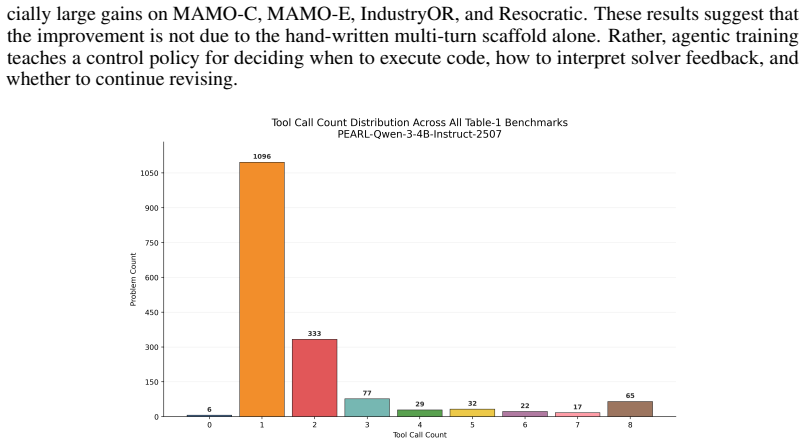
- Easy problems get solved with fewer tool calls and hard problems get more revision, so inference effort adapts to instance difficulty.
- Large gains on underspecified and noisy benchmarks suggest the approach is most useful in exactly the settings where one-shot generation tends to fail.
Where Pith is reading between the lines
- A natural extension the paper leaves implicit is to test whether the same recipe holds for stochastic, robust, and online optimization problems, which it names as under-represented.
- The 'execute, read diagnostics, revise' reward design may transfer to other verifiable coding tasks where partial execution feedback is available, though the paper does not claim that.
- The successful interaction traces could be distilled or converted into supervised training data for other backbones; the paper does not report such an experiment.
Editorial analysis
A structured set of objections, weighed in public.
Referee Report
Summary. The paper introduces PEARL, a system that treats natural-language-to-optimization modeling as a multi-turn, tool-integrated decision process. The agent is trained with GRPO-style reinforcement learning (with DAPO-style decoupled clipping) to draft formulations, execute Python/Pyomo code, observe solver diagnostics, revise, and terminate. The authors report substantial verified pass@1 improvements over one-shot and fixed-scaffold baselines on eight benchmarks, and claim that a 4B-parameter PEARL model outperforms DeepSeek-V3.2-685B in macro- and micro-averaged accuracy (69.71 vs. 66.51 and 79.84 vs. 77.07). Appendices provide training details, ablations, a failure-mode analysis, and a scaffold-control experiment.
Significance. If the headline empirical result is valid, the paper makes a significant contribution: it shows that optimization-specific agentic reinforcement learning with solver feedback can yield large gains over one-shot generation and can partially close the gap to much larger general-purpose models. The POMDP formalization and the design of a solver-grounded reward and observation loop are useful conceptual contributions, and the ablations on tool-use, SFT initialization, and trajectory filtering are informative. The paper also includes a careful discussion of limitations, a scaffold-control comparison, and a failure-mode attribution. However, the empirical claims rest on the integrity of the training/evaluation separation, which is not established; this is a load-bearing issue for every quantitative conclusion in the paper.
major comments (4)
- [§4.1 vs. Table 1] The training corpus and evaluation benchmarks overlap in source distribution. Section 4.1 states that PEARL is trained on “about 10k cleaned open-source instances drawn from OR-Instruct/ORLM, OptMATH, and OptiBench-style data,” plus 3.8k curated instances. Table 1 evaluates on OptMATH, IndustryOR, ComplexOR, and Resocratic, where Resocratic is from OptiBench/ReSocratic and OptMATH is the same dataset used for training. The paper does not describe exact-duplicate or near-duplicate removal, a disjoint split, or any decontamination procedure. If any benchmark instances or near-paraphrases appear in the training set, the headline 4B-vs-685B comparison (Takeaway 4) reflects adaptation or memorization of the test distribution rather than a generalizable interactive policy. Please provide a decontamination analysis (e.g., exact and fuzzy matching, n-gram overlap, or a held-out split) and report
- [Appendix D.3] The training dynamics section reports monitoring pass@1 on IndustryOR, MAMO-C, and NL4LP during training. These are also evaluation benchmarks in Table 1. This means the reported accuracies on those benchmarks may be development-set results, and the final checkpoint may have been selected using those metrics. The paper should clarify whether any model-selection or early-stopping decisions were based on these monitored benchmarks, and if so, report the selection procedure. Otherwise the Table 1 numbers for these datasets are not unbiased test-set estimates.
- [§4.1 and Appendix A.2] The correctness tolerance used in training differs from the tolerance used in evaluation. Section 4.1 defines a pass as |ypred−ylabel|/|ylabel|+1 < 1e-6, while Appendix A.2 states that training reward is granted when |vpred−vlabel| ≤ 1e-3. Thus the policy is optimized with a much looser numerical standard than the one used for the reported results. This is a mismatch that could affect the learned policy: a model may be rewarded for solutions that later fail the stricter evaluation criterion. Please use the same tolerance in training and evaluation, or explicitly justify the difference and quantify its impact.
- [Table 1] No statistical significance tests are reported. The headline comparison (PEARL-4B vs. DeepSeek-V3.2-685B) is based on means over three runs, and several aggregate differences are within one standard deviation of the baseline (e.g., macro 69.71 vs. 69.19 for DeepSeek-Think, or micro 79.84 vs. 80.31 for GPT-5). The claim that PEARL “outperforms” a much larger model would be more convincing with paired significance tests (or confidence intervals) across instances. Please report per-instance paired comparisons or a suitable statistical test, especially for the central 4B-vs-685B claim.
minor comments (5)
- [§4.1] Macro-averaged and micro-averaged accuracy are used throughout but never formally defined. Please give explicit definitions, including how per-dataset accuracy is averaged and whether micro-averaging is instance-weighted across all datasets.
- [Figure 1] The caption says PEARL “matches or exceeds” much larger models, but Table 1 shows that GPT-5-family models and DeepSeek-Think have higher macro averages. The caption should be softened or qualified (e.g., “exceeds DeepSeek-V3.2-685B but is below DeepSeek-Think and GPT-5 on aggregate metrics”).
- [Appendix D.4] The scaffold-control table reports the base model’s accuracy using the same tool interface, but the base model was not trained with the PEARL prompt format. This is a reasonable control, but the paper should note that the comparison conflates prompt-format familiarity with the learned policy; the base model may not know how to use the custom <code>/<answer> format. This caveat does not invalidate the control, but it should be stated.
- [Appendix A.2] The format reward gives 0.1 for a correctly formatted tool call and 0.2 for a final answer, while the correctness reward is 1.0. The relative weights are not justified. Since the reward decomposition is central to the RL design, a sentence explaining why these weights were chosen (or a sensitivity analysis) would help.
- [§3.4] The advantage normalization in Eq. (4) uses batch-level mean and standard deviation. The paper does not specify whether the same instances reappear across batches or how the batch composition affects credit assignment. A brief clarification would improve reproducibility.
Circularity Check
Training/evaluation overlap makes the headline 4B-vs-685B comparison partially fitted; no decontamination is described.
specific steps
-
fitted input called prediction
[Section 4.1 (Training corpus) and Table 1 (Evaluation benchmarks)]
"For PEARL training, we use a mixed corpus of roughly 14k optimization-modeling instances: about 10k cleaned open-source instances drawn from OR-Instruct/ORLM [Huang et al., 2025], OptMATH [Lu et al., 2025], and OptiBench-style data [Yang et al., 2024]... We evaluate on a range of established optimization modeling benchmarks, including ... OptMATH [Lu et al., 2025], IndustryOR [Huang et al., 2025], ComplexOR [Xiao et al., 2024], and Resocratic [Yang et al., 2024]."
The same dataset families are used both as training input and as evaluation targets. OptMATH is named explicitly as a training source and appears as an evaluation benchmark in Table 1; Resocratic is from the OptiBench/ReSocratic source named as 'OptiBench-style data.' The paper does not describe any exact-duplicate removal, near-duplicate removal, or disjoint train/eval split. Therefore the OptMATH column, and part of the Resocratic column, measure how well the model reproduces or adapts to its training distribution, so the reported macro/micro accuracy is partly a fitted quantity rather than an out-of-sample prediction.
-
fitted input called prediction
[Appendix D.3 (Training dynamics, Figure 10)]
"Throughout the training process, we monitor three key benchmarks (IndustryOR, MAMO-C, and NL4LP) as evaluation metrics."
These three benchmarks also appear in the final evaluation, Table 1. Monitoring them during training makes them development targets: the training loop can be stopped or adjusted according to performance on the same instances that are later reported as test-set pass@1. Unless those instances were strictly held out from any training-time decision, the final Table 1 numbers for IndustryOR, MAMO-C, and NL4LP are in-sample development measurements rather than independent predictions of generalization.
full rationale
The paper's central headline claim is empirical: PEARL-4B reaches 69.71/79.84 macro/micro accuracy and beats DeepSeek-V3.2-685B. The evaluation is partially circular because the training corpus explicitly includes OptMATH and OptiBench-style data, while Table 1 evaluates on OptMATH and Resocratic (from OptiBench/ReSocratic), with no described decontamination or disjoint split. In addition, Appendix D.3 says IndustryOR, MAMO-C, and NL4LP are monitored during training, yet these same benchmarks appear in the final evaluation table, so the final reported numbers are at least partly development-set measurements. The circularity is partial: several evaluated benchmarks (NL4Opt, MAMO-E, NLP4LP, ComplexOR) are not explicitly named as training sources, and the comparison against same-scale one-shot scaffolds has independent content. The score is 6 rather than higher because the claim is not mathematically forced by a self-citation chain, but one or more of the central 'predictions' reduce in part to fitting the training/evaluation distribution.
Axiom & Free-Parameter Ledger
free parameters (6)
- Evaluation correctness tolerance =
|ypred−ylabel|/(|ylabel|+1) < 10^-6
- Training reward tolerance =
|vpred−vlabel| ≤ 10^-3
- Format reward weights =
0.1 (tool format), 0.2 (final format), 1.0 (correctness)
- DAPO clipping thresholds =
epsilon=0.2, epsilon_high=0.28
- Max turns per rollout =
8
- Training corpus composition =
~14k instances: ~10k open-source + ~3.8k curated
axioms (4)
- domain assumption Correctness of a generated optimization model is adequately measured by executing code and comparing the reported objective value to a reference within tolerance.
- domain assumption The eight benchmark test sets are representative of natural-language-to-optimization modeling and are not contaminated by the PEARL training corpus.
- domain assumption GRPO with DAPO-style decoupled clipping optimizes the POMDP objective (Eq. 1) without destabilizing multi-turn tool-augmented training.
- domain assumption Solver feasibility and objective-value feedback provide enough signal for the policy to learn repair behavior.
read the original abstract
Optimization modeling is the process of translating real-world decision problems, often described in natural language, into formal mathematical formulations and executable solver code. While recent advances in large language models have shown promise in automating this process, most existing approaches remain one-shot: a model produces a formulation once, without executing it, conditioning on solver feedback, or iteratively revising errors. This stands in sharp contrast to real-world optimization modeling, which is inherently interactive and proceeds through repeated solve-debug-revise cycles. We introduce PEARL, a system for interactive optimization modeling that uses Python execution and mathematical programming solvers inside this loop. Rather than relying on a fixed repair workflow, PEARL learns when to test partial models, how to revise from solver diagnostics, and when to stop. It operates in a multi-turn tool-integrated setting where intermediate execution results, feasibility signals, and solution checks are used to improve both formulations and solver code before finalization. Across diverse optimization benchmarks, PEARL substantially improves verified solve rates over strong one-shot and tool-augmented baselines; notably, our PEARL-Qwen3-\textbf{4B} model outperforms the much larger DeepSeek-V3.2-\textbf{685B} in both macro- and micro-averaged accuracy on optimization modeling tasks.
Figures


Reference graph
Works this paper leans on
-
[1]
arXiv preprint arXiv:2412.19437 , year=
Deepseek-v3 technical report , author=. arXiv preprint arXiv:2412.19437 , year=
-
[2]
2021 , publisher=
Pyomo-optimization modeling in python , author=. 2021 , publisher=
2021
-
[3]
arXiv preprint arXiv:2402.03300 , year=
Deepseekmath: Pushing the limits of mathematical reasoning in open language models , author=. arXiv preprint arXiv:2402.03300 , year=
-
[4]
Autoformulation of Mathematical Optimization Models Using
Nicol. Autoformulation of Mathematical Optimization Models Using. Forty-second International Conference on Machine Learning , year=
-
[5]
Solver-Informed
Yitian Chen and Jingfan Xia and Siyu Shao and Dongdong Ge and Yinyu Ye , booktitle=. Solver-Informed. 2025 , url=
2025
-
[6]
Proceedings of the AAAI Conference on Artificial Intelligence , volume=
OR-R1: Automating modeling and solving of operations research optimization problem via test-time reinforcement learning , author=. Proceedings of the AAAI Conference on Artificial Intelligence , volume=
-
[7]
2025 , howpublished =
Zilin Zhu and Chengxing Xie and Xin Lv and slime Contributors , title =. 2025 , howpublished =
2025
-
[8]
Proceedings of the 61st annual meeting of the association for computational linguistics (volume 1: long papers) , pages=
Self-instruct: Aligning language models with self-generated instructions , author=. Proceedings of the 61st annual meeting of the association for computational linguistics (volume 1: long papers) , pages=
-
[9]
Journal of Statistics and Management Systems , volume=
A comparative analysis of optimization solvers , author=. Journal of Statistics and Management Systems , volume=. 2017 , publisher=
2017
-
[10]
2: Pushing the frontier of open large language models , author=
Deepseek-v3. 2: Pushing the frontier of open large language models , author=. arXiv preprint arXiv:2512.02556 , year=
-
[11]
Wu, Yang and Zhang, Yifan and Wu, Yurong and Wang, Yuran and Zhang, Junkai and Cheng, Jian , month = jun, year =. Step-. doi:10.48550/arXiv.2506.17637 , abstract =
-
[12]
doi:10.48550/arXiv.2508.20722 , abstract =
Shang, Ning and Liu, Yifei and Zhu, Yi and Zhang, Li Lyna and Xu, Weijiang and Guan, Xinyu and Zhang, Buze and Dong, Bingcheng and Zhou, Xudong and Zhang, Bowen and Xin, Ying and Miao, Ziming and Li, Scarlett and Yang, Fan and Yang, Mao , month = aug, year =. doi:10.48550/arXiv.2508.20722 , abstract =
-
[13]
ReTool: Reinforcement Learning for Strategic Tool Use in
Jiazhan Feng and Shijue Huang and Xingwei Qu and Ge Zhang and Yujia Qin and Baoquan Zhong and Chengquan Jiang and Jinxin Chi and Wanjun Zhong , booktitle=. ReTool: Reinforcement Learning for Strategic Tool Use in. 2026 , url=
2026
-
[14]
Wu, Fang and Xuan, Weihao and Qi, Heli and Lu, Ximing and Tu, Aaron and Li, Li Erran and Choi, Yejin , month = sep, year =
-
[15]
Zhang, Hanchen and Liu, Xiao and Lv, Bowen and Sun, Xueqiao and Jing, Bohao and Iong, Iat Long and Hou, Zhenyu and Qi, Zehan and Lai, Hanyu and Xu, Yifan and Lu, Rui and Wang, Hongning and Tang, Jie and Dong, Yuxiao , month = oct, year =
-
[16]
Stronger
Zhao, Yujie and Hu, Lanxiang and Wang, Yang and Hou, Minmin and Zhang, Hao and Ding, Ke and Zhao, Jishen , month = oct, year =. Stronger
-
[17]
Mai, Xinji and Xu, Haotian and Li, Zhong-Zhi and W, Xing and Wang, Weinong and Hu, Jian and Zhang, Yingying and Zhang, Wenqiang , month = aug, year =. Agent. doi:10.48550/arXiv.2505.07773 , abstract =
-
[18]
Cheng, Mingyue and Ouyang, Jie and Yu, Shuo and Yan, Ruiran and Luo, Yucong and Liu, Zirui and Wang, Daoyu and Liu, Qi and Chen, Enhong , month = nov, year =. Agent-. doi:10.48550/arXiv.2511.14460 , abstract =
-
[19]
doi:10.48550/arXiv.2504.11536 , abstract =
Feng, Jiazhan and Huang, Shijue and Qu, Xingwei and Zhang, Ge and Qin, Yujia and Zhong, Baoquan and Jiang, Chengquan and Chi, Jinxin and Zhong, Wanjun , month = apr, year =. doi:10.48550/arXiv.2504.11536 , abstract =
-
[20]
and Zhou, Denny and Chen, Xinyun , month = apr, year =
Yang, Chengrun and Wang, Xuezhi and Lu, Yifeng and Liu, Hanxiao and Le, Quoc V. and Zhou, Denny and Chen, Xinyun , month = apr, year =. Large
-
[21]
Evolutionary
Wu, Xingyu and Wu, Sheng-hao and Wu, Jibin and Feng, Liang and Tan, Kay Chen , month = may, year =. Evolutionary
-
[22]
Huang, Sen and Yang, Kaixiang and Qi, Sheng and Wang, Rui , month = may, year =. When
-
[23]
Zhang, Shujian and Gong, Chengyue and Wu, Lemeng and Liu, Xingchao and Zhou, Mingyuan , month = may, year =
-
[24]
2024 , editor =
Ahmaditeshnizi, Ali and Gao, Wenzhi and Udell, Madeleine , booktitle =. 2024 , editor =
2024
-
[25]
Mathematical discoveries from program search with large language models , volume =. Nature , author =. 2024 , pages =. doi:10.1038/s41586-023-06924-6 , abstract =
-
[26]
Position:
Song, Xingyou and Tian, Yingtao and Lange, Robert Tjarko and Lee, Chansoo and Tang, Yujin and Chen, Yutian , month = may, year =. Position:
-
[27]
Liu, Tennison and Astorga, Nicolas and Seedat, Nabeel , year =
-
[28]
and Desai, Nishkrit and Bae, Juhan and Lorraine, Jonathan and Ba, Jimmy , month = dec, year =
Zhang, Michael R. and Desai, Nishkrit and Bae, Juhan and Lorraine, Jonathan and Ba, Jimmy , month = dec, year =. Using
-
[29]
Li, Xiaobin and Wu, Kai and Li, Yujian Betterest and Zhang, Xiaoyu and Wang, Handing and Liu, Jing , month = may, year =
-
[30]
Data-driven
Majumder, Bodhisattwa Prasad and Surana, Harshit and Agarwal, Dhruv and Hazra, Sanchaita and Sabharwal, Ashish and Clark, Peter , month = feb, year =. Data-driven
-
[31]
2024 , url =
Xiao, Ziyang and Zhang, Dongxiang and Wu, Yangjun and Xu, Lilin and Wang, Yuan and Han, Xiongwei and Fu, Xiaojin and Zhong, Tao and Zeng, Jia and Song, Mingli and Chen, Gang , booktitle =. 2024 , url =
2024
-
[32]
Wasserkrug, Segev and Boussioux, Leonard and Hertog, Dick den and Mirzazadeh, Farzaneh and Birbil, Ilker and Kurtz, Jannis and Maragno, Donato , month = feb, year =. From
-
[33]
doi:10.48550/arXiv.2209.15565 , abstract =
[. doi:10.48550/arXiv.2209.15565 , abstract =
-
[34]
Yang, Hui and Yue, Sifu and He, Yunzhong , month = jun, year =. Auto-
-
[35]
2022 , publisher =
Ramamonjison, Rindranirina and Yu, Timothy and Li, Raymond and Li, Haley and Carenini, Giuseppe and Ghaddar, Bissan and He, Shiqi and Mostajabdaveh, Mahdi and Banitalebi-Dehkordi, Amin and Zhou, Zirui and Zhang, Yong , booktitle =. 2022 , publisher =
2022
-
[36]
Huang, Xuhan and Shen, Qingning and Hu, Yan and Gao, Anningzhe and Wang, Benyou , year =. Mamo: a. doi:10.48550/ARXIV.2405.13144 , abstract =
-
[37]
Technical
Nguyen, Duc M and Ko, Sungahn , file =. Technical
-
[38]
Zhang, Jihai and Wang, Wei and Guo, Siyan and Wang, Li and Lin, Fangquan and Yang, Cheng and Yin, Wotao , editor =. Solving. Proceedings of the 2024. 2024 , pages =
2024
-
[39]
Benchmarking
YANG, Zhicheng and Huang, Yinya and Shi, Wei and Feng, Liang and Song, Linqi and Wang, Yiwei and Liang, Xiaodan and Tang, Jing , month = jul, year =. Benchmarking
-
[40]
Fan, Zhenan and Ghaddar, Bissan and Wang, Xinglu and Xing, Linzi and Zhang, Yong and Zhou, Zirui , year =. Artificial. doi:10.48550/ARXIV.2401.03244 , abstract =
-
[41]
Gao, Guoxiong and Ju, Haocheng and Jiang, Jiedong and Qin, Zihan and Dong, Bin , month = mar, year =. A
-
[42]
Li, Junxuan and Wickman, Ryan and Bhatnagar, Sahil and Maity, Raj Kumar and Mukherjee, Arko , month = aug, year =
-
[43]
Synthesizing mixed-integer linear programming models from natural language descriptions , url =
Li, Qingyang and Zhang, Lele and Mak-Hau, Vicky , month = nov, year =. Synthesizing mixed-integer linear programming models from natural language descriptions , url =
-
[44]
Ye, Huigen and Xu, Hua and Wang, Hongyan , year =
-
[45]
Ma, Zeyuan and Guo, Hongshu and Chen, Jiacheng and Peng, Guojun and Cao, Zhiguang and Ma, Yining and Gong, Yue-Jiao , month = mar, year =
-
[46]
Xing, Linzi and Wang, Xinglu and Feng, Yuxi and Fan, Zhenan and Xiong, Jing and Guo, Zhijiang and Fu, Xiaojin and Ramamonjison, Rindra and Mostajabdaveh, Mahdi and Han, Xiongwei and Zhou, Zirui and Zhang, Yong , editor =. Towards. Proceedings of the 2024. 2024 , pages =
2024
-
[47]
LIPIcs, Volume 307, CP 2024 , author =
Constraint. LIPIcs, Volume 307, CP 2024 , author =. 2024 , note =. doi:10.4230/LIPICS.CP.2024.20 , abstract =
-
[48]
Training
Cobbe, Karl and Kosaraju, Vineet and Bavarian, Mohammad and Chen, Mark and Jun, Heewoo and Kaiser, Lukasz and Plappert, Matthias and Tworek, Jerry and Hilton, Jacob and Nakano, Reiichiro and Hesse, Christopher and Schulman, John , month = nov, year =. Training
-
[49]
Li, Sirui and Kulkarni, Janardhan and Menache, Ishai and Wu, Cathy and Li, Beibin , month = oct, year =. Towards
-
[50]
2026 , url=
Fan Liu and Zhe-Rui Yang and Cancheng Liu and Tianrui SONG and Xiaofeng Gao and Hao Liu , booktitle=. 2026 , url=
2026
-
[51]
doi:10.48550/arXiv.2411.17404 , abstract =
Wang, Teng and Yu, Wing-Yin and He, Zhenqi and Liu, Zehua and Han, Xiongwei and Gong, Hailei and Wu, Han and Shi, Wei and She, Ruifeng and Zhu, Fangzhou and Zhong, Tao , month = nov, year =. doi:10.48550/arXiv.2411.17404 , abstract =
-
[52]
Mostajabdaveh, Mahdi and Yu, Timothy T. and Dash, Samarendra Chandan Bindu and Ramamonjison, Rindranirina and Byusa, Jabo Serge and Carenini, Giuseppe and Zhou, Zirui and Zhang, Yong , month = dec, year =. Evaluating. doi:10.48550/arXiv.2412.17874 , abstract =
-
[53]
Operations Research , year=
Orlm: A customizable framework in training large models for automated optimization modeling , author=. Operations Research , year=
-
[54]
doi:10.48550/arXiv.2501.08406 , abstract =
Chen, Hao and Constante-Flores, Gonzalo Esteban and Mantri, Krishna Sri Ipsit and Kompalli, Sai Madhukiran and Ahluwalia, Akshdeep Singh and Li, Can , month = jan, year =. doi:10.48550/arXiv.2501.08406 , abstract =
-
[55]
doi:10.48550/arXiv.2501.00539 , abstract =
Szeider, Stefan , month = dec, year =. doi:10.48550/arXiv.2501.00539 , abstract =
-
[56]
Zhai, Haotian and Lawless, Connor and Vitercik, Ellen and Leqi, Liu , month = feb, year =
-
[57]
The Thirty-ninth Annual Conference on Neural Information Processing Systems , year =
MURKA: Multi-Reward Reinforcement Learning with Knowledge Alignment for Optimization Tasks , author=. The Thirty-ninth Annual Conference on Neural Information Processing Systems , year =
-
[58]
doi:10.48550/arXiv.2407.09887 , abstract =
Yang, Zhicheng and Wang, Yiwei and Huang, Yinya and Guo, Zhijiang and Shi, Wei and Han, Xiongwei and Feng, Liang and Song, Linqi and Liang, Xiaodan and Tang, Jing , month = oct, year =. doi:10.48550/arXiv.2407.09887 , abstract =
-
[59]
2025 , url=
Caigao Jiang and Xiang Shu and Hong Qian and Xingyu Lu and JUN ZHOU and Aimin Zhou and Yang Yu , booktitle=. 2025 , url=
2025
-
[60]
Zhenghai Xue and Longtao Zheng and Qian Liu and Yingru Li and Xiaosen Zheng and Zejun MA and Bo An , booktitle=. Simple. 2026 , url=
2026
-
[61]
Zhang, Bowen and Luo, Pengcheng , month = mar, year =
-
[62]
doi:10.48550/arXiv.2503.10642 , abstract =
Singirikonda, Akash and Kadioglu, Serdar and Uppuluri, Karthik , month = feb, year =. doi:10.48550/arXiv.2503.10642 , abstract =
-
[63]
Peng, Mingming and Chen, Zhendong and Yang, Jie and Huang, Jin and Shi, Zhengqi and Liu, Qihao and Li, Xinyu and Gao, Liang , month = mar, year =. Automatic. doi:10.48550/arXiv.2503.13813 , abstract =
-
[64]
doi:10.48550/arXiv.2504.16918 , abstract =
Thind, Raghav and Sun, Youran and Liang, Ling and Yang, Haizhao , month = apr, year =. doi:10.48550/arXiv.2504.16918 , abstract =
-
[65]
Yan, Jianhao and Li, Yafu and Hu, Zican and Wang, Zhi and Cui, Ganqu and Qu, Xiaoye and Cheng, Yu and Zhang, Yue , year =. Learning to. doi:10.48550/ARXIV.2504.14945 , abstract =
-
[66]
Yang, Tianxing and Ye, Huigen and Xu, Hua , month = may, year =. Code
-
[67]
doi:10.48550/arXiv.2503.14476 , abstract =
Yu, Qiying and Zhang, Zheng and Zhu, Ruofei and Yuan, Yufeng and Zuo, Xiaochen and Yue, Yu and Dai, Weinan and Fan, Tiantian and Liu, Gaohong and Liu, Lingjun and Liu, Xin and Lin, Haibin and Lin, Zhiqi and Ma, Bole and Sheng, Guangming and Tong, Yuxuan and Zhang, Chi and Zhang, Mofan and Zhang, Wang and Zhu, Hang and Zhu, Jinhua and Chen, Jiaze and Chen,...
-
[68]
Qian, Cheng and Du, Hongyi and Wang, Hongru and Chen, Xiusi and Zhang, Yuji and Sil, Avirup and Zhai, Chengxiang and McKeown, Kathleen and Ji, Heng , month = may, year =
-
[69]
OptiTree: Hierarchical Thoughts Generation with Tree Search for
Haoyang Liu and Jie Wang and Yuyang Cai and Xiongwei Han and Yufei Kuang and Jianye HAO , booktitle=. OptiTree: Hierarchical Thoughts Generation with Tree Search for. 2026 , url=
2026
-
[70]
Li, Xijun and Yang, Jiexiang and Wang, Jinghao and Peng, Bo and Yao, Jianguo and Guan, Haibing , month = may, year =
-
[71]
doi:10.48550/arXiv.2506.06052 , abstract =
Michailidis, Kostis and Tsouros, Dimos and Guns, Tias , month = jun, year =. doi:10.48550/arXiv.2506.06052 , abstract =
-
[72]
doi:10.48550/arXiv.2503.04625 , abstract =
Li, Chengpeng and Xue, Mingfeng and Zhang, Zhenru and Yang, Jiaxi and Zhang, Beichen and Wang, Xiang and Yu, Bowen and Hui, Binyuan and Lin, Junyang and Liu, Dayiheng , month = mar, year =. doi:10.48550/arXiv.2503.04625 , abstract =
-
[73]
Zhou, Chenyu and Yang, Jingyuan and Xin, Linwei and Chen, Yitian and He, Ziyan and Ge, Dongdong , month = jul, year =. Auto-. doi:10.48550/arXiv.2507.11737 , abstract =
-
[74]
Bouscary, Maxime and Amin, Saurabh , month = aug, year =
-
[75]
ORThought: Benchmarking and Automating Logistics Optimization Modeling
Yang, Beinuo and Zhou, Qishen and Li, Junyi and Su, Xingchen and Hu, Simon , month = aug, year =. Automated. doi:10.48550/arXiv.2508.14410 , abstract =
work page internal anchor Pith review Pith/arXiv arXiv doi:10.48550/arxiv.2508.14410
-
[76]
doi:10.48550/arXiv.2506.16499 , abstract =
Liu, Zexi and Cai, Yuzhu and Zhu, Xinyu and Zheng, Yujie and Chen, Runkun and Wen, Ying and Wang, Yanfeng and E, Weinan and Chen, Siheng , month = jun, year =. doi:10.48550/arXiv.2506.16499 , abstract =
-
[77]
doi:10.48550/arXiv.2506.10764 , abstract =
Li, Xiaozhe and Chen, Jixuan and Fang, Xinyu and Ding, Shengyuan and Duan, Haodong and Liu, Qingwen and Chen, Kai , month = jun, year =. doi:10.48550/arXiv.2506.10764 , abstract =
-
[78]
Forty-second International Conference on Machine Learning , year =
OptMATH: A Scalable Bidirectional Data Synthesis Framework for Optimization Modeling , author=. Forty-second International Conference on Machine Learning , year =
-
[79]
2026 , url =
Zhou, Chenyu and Xu, Tianyi and Lin, Jianghao and Ge, Dongdong , booktitle =. 2026 , url =
2026
-
[80]
A Survey of Optimization Modeling Meets
Xiao, Ziyang and Xie, Jingrong and Xu, Lilin and Guan, Shisi and Zhu, Jingyan and Han, Xiongwei and Fu, Xiaojin and Yu, WingYin and Wu, Han and Shi, Wei and Kang, Qingcan and Duan, Jiahui and Zhong, Tao and Yuan, Mingxuan and Zeng, Jia and Wang, Yuan and Chen, Gang and Zhang, Dongxiang , booktitle =. A Survey of Optimization Modeling Meets. 2025 , month =...
discussion (0)
Sign in with ORCID, Apple, or X to comment. Anyone can read and Pith papers without signing in.