REVIEW 3 major objections 4 minor 39 references
Water waves mimic the inverted harmonic oscillator, mapping its three scattering regimes in phase space.
Reviewed by Pith at T0; open to challenge. T0 means a machine referee read the full paper against a public rubric. the ladder, T0–T4 →
T0 review · deepseek-v4-flash
2026-08-02 07:36 UTC pith:HSDMPYBC
load-bearing objection Good experiment, credible qualitative dynamics, but the quantitative 'prediction' is a fit — ask the authors for an independently predicted Ω. the 3 major comments →
Observation of Phase Space Dynamics of Inverted Harmonic Oscillator
The pith
A machine-rendered reading of the paper's core claim, the machinery that carries it, and where it could break.
Core claim
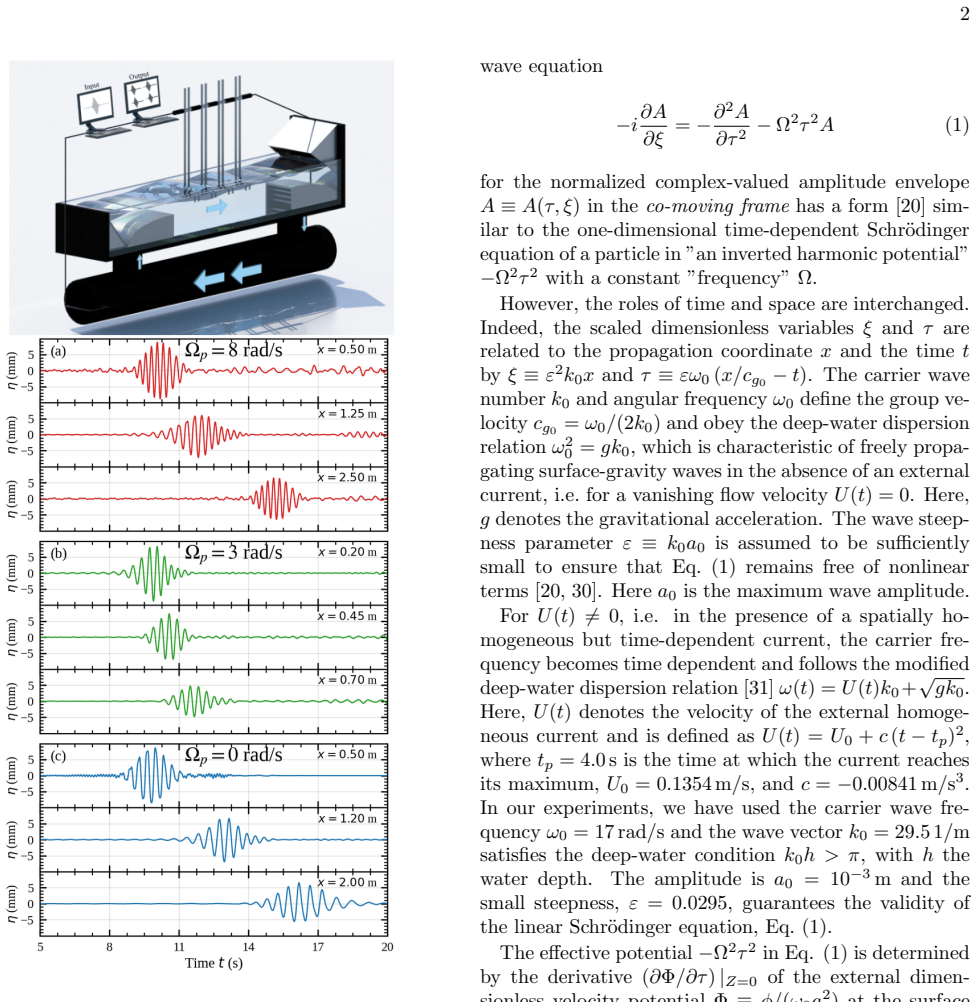
The paper claims to have experimentally realized a parabolic potential barrier for surface gravity water waves, exploiting the analogy between the water-wave envelope equation and the Schrödinger equation for the inverted harmonic oscillator. By using a homogeneous, quadratically time-dependent current, the authors map out the phase-space dynamics of Gaussian wave packets. For positive, zero, and negative classical energies E0, they observe transmission above the barrier, motion along the separatrix, and reflection below it, with measured trajectories ⟨τ⟩(ξ) and ⟨p⟩(ξ) following the predicted cosh/sinh curves. The independently extracted IHO frequency from coordinate and momentum fits agrees
What carries the argument
The central object is the Schrödinger-like envelope equation for surface gravity waves, −i∂A/∂ξ = −∂²A/∂τ² − Ω²τ²A, which is mathematically identical to the IHO equation with space and time interchanged. The parabolic barrier is realized by a time-dependent homogeneous current U(t) = U0 + c(t−tp)², creating an effective inverted parabolic potential −Ω²τ². The Gaussian wave-packet solutions remain Gaussian, and their center-of-mass trajectory and momentum follow the hyperbolic functions cosh(2Ωξ) and sinh(2Ωξ), with the classical energy E0 = p0² − Ω²τ0² determining whether the packet is transmitted, reflected, or follows the separatrix.
Load-bearing premise
The quantitative fits and the energy classification assume the effective potential is exactly parabolic over the entire measured propagation window; the paper itself states that the potential is truncated far from the barrier top, and the measurements are confined to the region where the parabolic approximation holds.
What would settle it
A direct measurement of the actual current velocity U(t) in the tank as a function of time would verify the assumed quadratic time dependence; if the realized current deviates significantly from an inverted parabola within the measurement window, the fitted Ω and the E0=0 tuning would be distorted, undermining the claimed agreement.
If this is right
- If correct, the water-wave platform provides a classical analog for probing quantum scattering phenomena such as tunneling and reflection in a controllable tabletop experiment.
- The quantitative agreement between coordinate and momentum fits validates the effective Schrödinger equation as a predictive tool for water-wave dynamics under time-dependent currents.
- The observed separatrix dynamics offers a direct experimental handle on the phase-space geometry of the IHO, which is related to black-hole horizons and Hawking radiation via logarithmic phase singularities.
- The platform can be extended to study the quantum-reflection regime where the potential width is comparable to the wave-packet size, a regime not explored in this work.
- The demonstrated analogy paves the way for implementing IHO-based experiments in optical, acoustic, or matter-wave systems, as suggested by the authors.
Where Pith is reading between the lines
- A natural extension is to directly measure the logarithmic phase singularity at the separatrix, which would provide an analog Hawking spectrum; this is a testable prediction of the underlying theory but is not performed here.
- The paper's own caveat that the effective potential is truncated far from the barrier top implies that the parabolic approximation holds only in a finite window; a systematic study varying the current ramp could quantify the robustness of the fitted Ω.
- One could also test the quantum-reflection regime by making the wave packet broader relative to the barrier, potentially observing partial reflection above the barrier—an effect the paper explicitly says it did not observe.
- The analogy suggests that the same experimental setup could be used to simulate time-dependent control protocols, such as Kostin-type feedback, to bring wave packets to rest, but this is only mentioned as an outlook.
Editorial analysis
A structured set of objections, weighed in public.
Referee Report
Summary. The paper reports an experimental realization of an inverted harmonic oscillator (IHO) for surface-gravity water waves by imposing a homogeneous current with quadratic time dependence. The authors launch Gaussian wave packets with three initial average energies, measure the propagation of the envelope in a co-moving frame, and reconstruct the analog time-coordinate trajectory ⟨τ⟩(ξ) and analog momentum ⟨p⟩(ξ). These are compared with the hyperbolic solutions of the effective Schrödinger-like equation. The data show the qualitative IHO regimes—transmission, separatrix motion, and reflection—and two independent fits of the IHO frequency from ⟨τ⟩ and ⟨p⟩ agree within uncertainties. The End Matter contains a clean derivation of Eq. (7). The paper also observes the expected amplitude decay for the zero-energy separatrix case.
Significance. If the quantitative claims are fully supported, the work would be a valuable demonstration of a classical water-wave platform for IHO phase-space dynamics, with potential connections to analogue Hawking radiation and scattering physics. The distinctive strengths are: (i) the qualitative behavior—blocking, transmission, and separatrix motion—is directly observed and does not depend on any fit; (ii) the End Matter derivation of ⟨p⟩ is careful and standard; (iii) the agreement between the IHO frequency extracted from coordinate and momentum fits is genuine internal consistency. However, the central quantitative conclusion is presently weaker than stated because the IHO frequency Ω is obtained by fitting Eqs. (4) and (7) to the same data that are then used to claim quantitative agreement. No independent prediction of Ω from the pump parameters or from a direct measurement of U(t) is provided. The restrictive parabolicity assumption is acknowledged in the text but its impact on the extracted Ω and on the E₀=0 tuning is not quantified. The result is therefore plausible and potentially significant, but the quantitative claim needs additional support before publication.
major comments (3)
- [§Results, Fig. 3 and the paragraph following Eq. (1)] The central quantitative test is not parameter-free. Equations (4) and (7) contain the IHO frequency Ω, and the reported values Ω=30.14±0.40 and Ω=30.55±0.21 are obtained by fitting those very equations to the measured data. The text defines Ω² τ² ≡ 4ε(∂Φ/∂τ)|_{Z=0} but never evaluates this expression using the stated pump parameters (U₀=0.1354 m/s, c=-0.00841 m/s³, t_p=4.0 s, k₀=29.5 m⁻¹, ω₀=17 rad/s, ε=0.0295). Without an independently predicted Ω, or a direct time-resolved measurement of U(t) from which Ω could be inferred, the agreement with the hyperbolic curves could simply reflect the flexibility of a fit. Please provide the predicted Ω with uncertainty and compare it to the fitted values, or explicitly rephrase the claim as a consistency test rather than a quantitative prediction.
- [Paragraph following Eq. (1): acknowledged truncation of the potential] The paper states that the effective potential is necessarily truncated and parabolic only near the barrier top, and that the measurements are confined to that region. This is a load-bearing assumption for both the extracted Ω and the preparation of the E₀=0 case (Ω_p=3 rad/s). The manuscript does not specify the τ-interval over which the fits are performed, nor does it provide a quantitative estimate of the deviation of the actual potential from -Ω² τ² within that interval. If the potential deviates from parabolicity inside the fitted window, the fitted Ω and the inferred energy classes are distorted. Please report the fitting window, test the sensitivity of the fitted Ω to the window boundaries, and justify the parabolic approximation with an independent estimate of the potential curvature.
- [§Results, fits to Eqs. (4) and (7); Fig. 2 caption] It is not stated which parameters are adjusted in the fits. The initial center τ₀ and initial momentum p₀ are formally related to the launch time and the imposed frequency shift, but if they are floated along with Ω the fit has additional freedom and the agreement is less meaningful. In addition, the E₀=0 case is prepared by choosing Ω_p=3 rad/s; if this choice uses the fitted Ω, the energy classification is circular. The manuscript should state explicitly that τ₀ and p₀ are held fixed at independently calibrated values, and should describe how Ω_p=3 rad/s is set without reference to the fitted Ω. Reporting the full covariance of the fit parameters would also help.
minor comments (4)
- [Fig. 2(b) caption] The caption says the phase-space curves are obtained by combining the measurements of Figs. 3(a) and 3(b) and eliminating ξ, but the procedure is not described. Please specify how common ξ-values are selected and how interpolation is performed.
- [Fig. 3] No error bars are shown on the experimental points, and the statistical uncertainties of the fitted frequencies are given without explaining how they are derived. Please define the error bars and state whether the fits are weighted.
- [End Matter, Eq. (8)] The sign convention for the momentum operator p̂=i∂/∂τ should be checked against the plane-wave phase convention used in Eq. (3). For a wave e^{ipτ}, this operator gives eigenvalue -p; the subsequent derivation is internally consistent, but a reader may find the sign surprising. A short remark on the convention would improve clarity.
- [General notation] The same symbol τ is used for the analog time coordinate and for the integration variable in Eqs. (5) and (6). This is standard but could be clarified in the text.
Circularity Check
Quantitative 'predictions' are fits: Ω is extracted from the same data and no pump-derived Ω is given, making the claimed agreement with Eqs. (4) and (7) partly circular.
specific steps
-
fitted input called prediction
[Results, fits to Eqs. (4) and (7), Fig. 3 and surrounding text]
"From these fits we obtain the values Ω = 29.80±0.65, 29.72±0.77, and 30.87±0.69, respectively, for the frequency of the IHO, resulting in the mean value Ω̄ = 30.14±0.40. ... Next, we fit these data by the corresponding theoretical prediction, Eq. (7), and again extract the effective IHO frequency Ω."
The 'theoretical predictions' Eqs. (4) and (7) both contain the IHO frequency Ω. The same Ω is obtained by least-squares fitting those equations to the measured ⟨τ⟩(ξ) and ⟨p⟩(ξ) curves that are then displayed as 'predictions' and cited as 'quantitative agreement'. No independently predicted Ω from the stated pump parameters (U0, c, tp, k0, ω0, ε) via Ω²τ² = 4ε(∂Φ/∂τ)|Z=0 is provided. Hence the agreement is a fit of the functional form with a free parameter, not a parameter-free confirmation; the cross-agreement of the two fitted means only shows internal consistency.
-
fitted input called prediction
[Fig. 4 caption and accompanying text (amplitude decay at barrier top)]
"the black solid line is the analytical prediction obtained by evaluating the Gaussian envelope of Eq. (15) at τ=0, i.e. |A^(G)(0,ξ)|= [Δτ/Δτ(ξ)]^{1/2} exp{−[⟨τ⟩(ξ)/Δτ(ξ)]^2}, with ⟨τ⟩(ξ) and Δτ(ξ) given by Eqs. (4) and (16)."
Eq. (16) for the propagated width Δτ(ξ) and Eq. (4) for ⟨τ⟩(ξ) both contain Ω. If Ω is taken from the fits of Fig. 3, this 'analytical prediction' is again evaluated with a data-fitted parameter, so the amplitude-decay agreement is not an independent test of the IHO mapping. The paper does not state an Ω predicted from the pump parameters.
full rationale
The central quantitative claim — agreement with the hyperbolic 'predictions' Eqs. (4) and (7) — is partially circular because the IHO frequency Ω appearing in those equations is extracted from the very measured trajectories that are then said to agree with the predictions. The paper honestly reports that it 'fit[s] these data' and 'extract[s] the effective IHO frequency', but the abstract and conclusion present the result as quantitative agreement with analytical predictions. Since no independently predicted Ω is derived from the pump parameters, the agreement is a consistency check of the assumed functional form plus one fitted parameter, not a parameter-free test. The two fitted values from coordinate and momentum agreeing within uncertainties is a useful internal cross-check but does not verify the mapping Ω²τ² = 4ε(∂Φ/∂τ)|Z=0. The paper also concedes that the effective potential is truncated and parabolic only near the barrier top, and no direct measurement of U(t) is given, further weakening the link between the fitted Ω and the imposed pump. No load-bearing self-citation chain was found: the cited prior work [16], [25] supplies methodology and phase expressions that are re-derived in the End Matter, and the Hilbert-transform reconstruction is a standard technique. The qualitative observation of transmission, stopping, and reflection is independent of the fitted Ω and supports the analogy, so the circularity is partial rather than total.
Axiom & Free-Parameter Ledger
free parameters (3)
- IHO frequency Ω =
30.14 ± 0.40 (from ⟨τ⟩ fits); 30.55 ± 0.21 (from ⟨p⟩ fits)
- Initial packet center τ₀ (via launch time t₀) =
not explicitly given for each case
- Initial momentum setting Ω_p =
8, 3, 0 rad/s for the three cases
axioms (6)
- domain assumption Deep-water surface gravity waves with small steepness in a time-dependent homogeneous current obey the linear Schrödinger-like equation (1) in the co-moving frame.
- ad hoc to paper The effective potential is parabolic, −Ω²τ², over the entire measured propagation window.
- standard math A Gaussian wave packet remains Gaussian under evolution, with its center following the classical trajectory.
- domain assumption The Hilbert transform of the measured surface elevation faithfully reconstructs the complex envelope A(τ, ξ).
- domain assumption The modified deep-water dispersion relation ω(t) = U(t)k₀ + √(gk₀) holds for the time-dependent current.
- domain assumption The current U(t) = U₀ + c(t−t_p)² with U₀ = 0.1354 m/s and c = −0.00841 m/s³ was actually realized and measured in the tank.
read the original abstract
We have experimentally realized a parabolic potential barrier for surface gravity water waves. The analogy between the resulting wave equation and the Schrodinger equation for the inverted harmonic oscillator (IHO) enables us to study the propagation of quantum-mechanical wave packets with different average energies in this iconic scattering model. We observe a clear boundary in the phase-space dynamics, namely the separatrix, which distinguishes wave packets with energies below the maximum of the IHO potential from those with energies above it. In the former case, the wave packet is blocked, whereas in the latter case, it is transmitted. We also measure the corresponding variation in momentum during this process.
Figures


Reference graph
Works this paper leans on
-
[1]
R. P. Feynman,Feynman Lectures on Physics. Volume 3: Quantum Mechanics(Addison-Wesley, Boston, 1965)
1965
-
[2]
Barton, Ann
G. Barton, Ann. Phys. (N. Y.)166, 322 (1986)
1986
-
[3]
The current velocity follows from the velocity potentialϕbyU=∂ϕ/∂x, as for an ir- rotational flow [32]
at the surface given by the dimensionless vertical coordinateZ= 0 withZ≡εk 0z[20]. The current velocity follows from the velocity potentialϕbyU=∂ϕ/∂x, as for an ir- rotational flow [32]. Hence, we can create the potential Ω2τ 2 ≡4ε(∂Φ/∂τ)| Z=0 by an externally operating water pump with the appropriate time-dependent current. We emphasize that the inverted...
-
[4]
Weidlich and G
W. Weidlich and G. Haag,Concepts and Models of a Quantitative Sociology: The Dynamics of Interacting Populations, Vol. 14 (Springer, Heidelberg, 2012)
2012
-
[5]
R. N. Mantegna and H. E. Stanley,Introduction to Econophysics: Correlations and Complexity in Finance (Cambridge University Press, Cambridge, 1999)
1999
-
[6]
In the field of quantum optics [3] the IHO also plays a prominent role
and provides deeper insight [7, 8] into the non-classical phenomenon of tunneling. In the field of quantum optics [3] the IHO also plays a prominent role. Energy eigenstates in the classically forbidden regime provide an elementary explanation for the gain in a laser [9]. Moreover, they are crucial for the understanding of the phenomenon of difference-fre...
-
[7]
W. P. Schleich,Quantum Optics in Phase Space(Wiley- VCH, Weinheim, 2011)
2011
-
[8]
Heim et al., Phys
D. Heim et al., Phys. Lett. A377, 1822 (2013)
2013
-
[9]
E. C. Kemble, Phys. Rev.48, 549 (1935)
1935
-
[10]
Balazs and A
N. Balazs and A. Voros, Ann. Phys. (N. Y.)199, 123 (1990)
1990
-
[11]
A. A. Svidzinsky, L. Yuan, and M. O. Scully, Phys. Rev. X3, 041001 (2013)
2013
-
[12]
R. J. Glauber,Quantum Theory of Optical Coherence (Wiley-VCH, Weinheim, 2007)
2007
-
[13]
Gal´ an Vioque, A
J. Gal´ an Vioque, A. R. Champneys, and M. Truman, SeMA J.51, 63 (2010)
2010
-
[14]
Ullinger et al., A VS Quantum Sci.4, 024402 (2022)
F. Ullinger et al., A VS Quantum Sci.4, 024402 (2022)
2022
-
[15]
C. B. Mølleret al., Nature547, 191 (2017)
2017
-
[16]
Subramanyan et al., Ann
V. Subramanyan et al., Ann. Phys. (N. Y.)435, 168470 (2021)
2021
-
[17]
and the scattering of co-current surface waves on an analogue black hole [18]. Motivated by its rich dynamics [19], we implement the IHO using classical surface-gravity water waves [20, 21], which obey a wave equation analogous to the Schr¨ odinger equation [22]. In our system, the parabolic barrier is realized by a homogeneous, time-dependent water cur- ...
Pith/arXiv arXiv 2026
-
[18]
S. W. Hawking, Nature248, 30 (1974)
1974
-
[19]
G. G. Rozenman, et al., Commun. Phys.7, 165 (2024)
2024
-
[20]
Weinfurtner, E
S. Weinfurtner, E. W. Tedford, M. C. J. Penrice, W. G. Unruh, and G. A. Lawrence, Phys. Rev. Lett.106, 021302 (2011)
2011
-
[21]
Euv´ e, S
L.-P. Euv´ e, S. Robertson, N. James, A. Fabbri, and G. Rousseaux, Phys. Rev. Lett.124, 141101 (2020)
2020
- [22]
-
[23]
C. C. Mei,The Applied Dynamics of Ocean Surface Waves(Wiley-Interscience, Hoboken, 1983)
1983
-
[24]
G. G. Rozenman et al., Fluids4, 96 (2019)
2019
-
[25]
S. Fu, Y. Tsur, J. Zhou, L. Shemer, and A. Arie, Phys. Rev. Lett.115, 034501 (2015)
2015
-
[26]
G. G. Rozenman et al., Phys. Scr.98, 044004 (2023)
2023
-
[27]
Rodrigues Gon¸ calves et al., Appl
M. Rodrigues Gon¸ calves et al., Appl. Phys. B128, 51 (2022)
2022
-
[28]
G. G. Rozenman et al., Phys. Rev. Lett.122, 124302 (2019)
2019
-
[29]
Weisman et al., Phys
D. Weisman et al., Phys. Rev. Lett.127, 014303 (2021)
2021
-
[30]
G. G. Rozenman et al., Phys. Rev. Lett.128, 214101 (2022)
2022
-
[31]
Chabchoub, N
A. Chabchoub, N. Hoffmann, M. Onorato, G. Genty, J. M. Dudley, and N. Akhmediev, Phys. Rev. Lett.111, 054104 (2013)
2013
-
[32]
Bar-Ziv et al., Phys
U. Bar-Ziv et al., Phys. Rev. B92, 100301 (2015). 6
2015
-
[33]
G. G. Rozenman et al., Phys. Rev. E101, 050201 (2020)
2020
-
[34]
A. B. Villas Bˆ oas and W. R. Young, J. Fluid Mech. 890, R3 (2020)
2020
-
[35]
L. D. Landau and E. M. Lifshitz,Fluid Mechanics, 2nd ed., Course of Theoretical Physics Vol. 6 (Pergamon, Ox- ford, 1987)
1987
-
[36]
Bestle, W
J. Bestle, W. P. Schleich, and J. A. Wheeler, Appl. Phys. B60, 289 (1995)
1995
-
[37]
Friedrich, G
H. Friedrich, G. Jacoby, and C. G. Meister, Phys. Rev. A65, 032902 (2002)
2002
-
[38]
Kostin, J
M. Kostin, J. Chem. Phys.57, 3589 (1972)
1972
-
[39]
Losert et al., J
H. Losert et al., J. Low Temp. Phys.210, 4 (2023). END MA TTER Expectation value of analog momentum In this section we summarize the derivation of the ex- pectation value⟨ˆp⟩of the analog momentum operator ˆp≡i ∂ ∂τ .(8) Starting from the Gaussian wave packet, Eq. (3), we write the complex amplitude envelope in the form A(G)(τ, ξ) =|A(G)(τ, ξ)|eiφ(G) A (τ...
2023
discussion (0)
Sign in with ORCID, Apple, or X to comment. Anyone can read and Pith papers without signing in.