REVIEW 3 major objections 4 minor 77 references
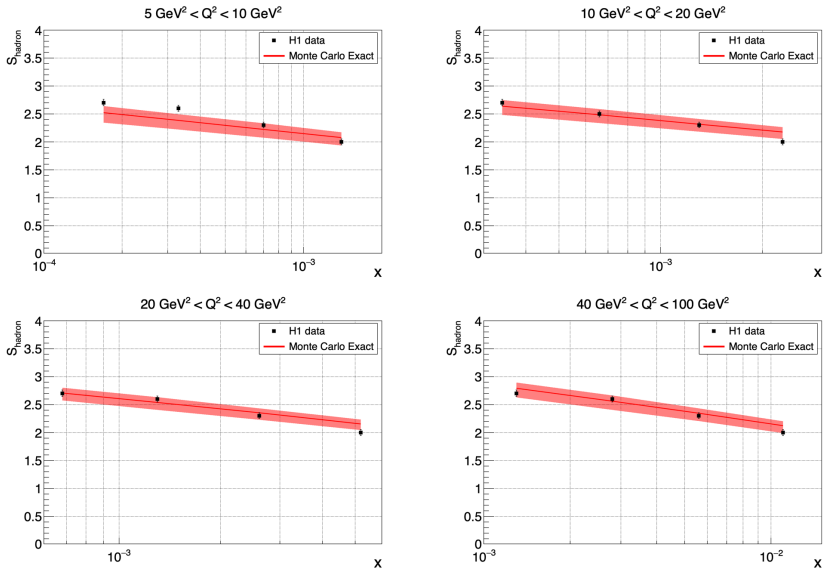
The entropy produced in low-x deep inelastic scattering equals the Shannon entropy of the QCD dipole multiplicity distribution, and the full dipole cascade reproduces the H1 hadron entropy data.
Reviewed by Pith at T0; open to challenge. T0 means a machine referee read the full paper against a public rubric. the ladder, T0–T4 →
T0 review · deepseek-v4-flash
2026-08-01 15:19 UTC pith:RNUFZIWP
load-bearing objection Full 2D solution of Levin-Lublinsky is solid and new; the entropy identification and H1 comparison rest on an unquantified purity assumption plus tuned parameters, but the paper is worth a serious referee. the 3 major comments →
Deep inelastic scattering as a probe of entanglement: the complete QCD dipole cascade
The pith
A machine-rendered reading of the paper's core claim, the machinery that carries it, and where it could break.
Core claim
The central claim is that the dipole cascade equation (the Levin–Lublinsky equation, Eq. 10) correctly describes the entropy generated from partonic color degrees of freedom into colorless hadrons as measured by the H1 collaboration. Starting from the reduced density matrix obtained by tracing over color, the entanglement entropy equals -Σ p_n ln p_n, the Shannon entropy of the dipole multiplicity distribution. Solving the full cascade (with transverse-size and azimuthal-angle dependence in the splitting kernel) numerically, the authors reproduce the H1 hadron entropy data with a fixed initial dipole size r = 1 fm, fixed coupling ᾱ_s = 0.1, and a universal additive constant C = 0.85 in the
What carries the argument
The Levin–Lublinsky equation (Eq. 10) for the probability densities P_n(Y; r_1, ..., r_n) of finding n dipoles at transverse sizes r_i, with the dipole splitting kernel K(r_i, r_n) = (ᾱ_s/2π)(r_i + r_n)^2/(r_i^2 r_n^2) θ(r_i^2 - ρ^2) θ(r_n^2 - ρ^2). This kernel includes both transverse-size and azimuthal-angle dependence, unlike simpler 1+0 or DLLA reductions. The reduced density matrix ρ_R = tr_color ρ is diagonal in dipole number, so the von Neumann entropy collapses to the Shannon entropy of the multiplicity distribution, S = -Σ p_n ln p_n. Two independent Monte Carlo programs solve the equation (one via Markov Chain, one via direct sampling), cross-checked to the percent level.
Load-bearing premise
The entire comparison rests on the assumption that the reduced density matrix, after tracing over color, is effectively diagonal in the continuous dipole-size basis (or that each n-dipole sector is internally pure), so that the von Neumann entropy collapses to the Shannon entropy of the multiplicity distribution alone.
What would settle it
A measurement at HERA or a future EIC that finds hadron entropy deviating from ln(2/3 ⟨n⟩) + C with a universal C and linear rapidity growth—especially a statistically significant curvature in S versus Y—would falsify the claimed relation. Alternatively, an ab initio calculation of the off-diagonal coherences in ρ_R showing that Σ p_n S(ρ_n) contributes non-negligibly to the von Neumann entropy would invalidate the equality S = -Σ p_n ln p_n and hence the interpretation of the H1 comparison.
If this is right
- If correct, H1's hadron entropy data are explained without fitting parameters per Q² bin; a single constant C ≈ 0.85 and a fixed initial dipole size suffice.
- The relation S = ln(2/3 xg(x, Q²)) + C connects the gluon density directly to measured final-state entropy, making entropy an observable probe of partonic structure.
- Entropy grows linearly with rapidity Y = ln(1/x), consistent with the maximal-entanglement hypothesis up to an additive constant.
- The double-logarithmic approximation overestimates entropy because it ignores the vector constraint on daughter dipole sizes; the full cascade is the preferred description.
Where Pith is reading between the lines
- The identification S = -Σ p_n ln p_n assumes that off-diagonal coherences in the continuous dipole-size/momentum basis are negligible; if they survive, the true von Neumann entropy would exceed the Shannon entropy by the average internal entropy Σ p_n S(ρ_n). A direct test is to compute the purity tr ρ_R² from the dipole wave functions.
- The success with fixed coupling ᾱ_s = 0.1 hints that an NLO-collinearly-improved kernel might yield a running-coupling description without an artificially low coupling; one could test whether a running-coupling version of the full cascade with a universal initial dipole size still describes the data.
- The framework suggests a direct prediction for electron-ion or proton-proton collisions: the hadron entropy should follow the same S = ln(2/3 ⟨n⟩) + C relation with the same C, providing an independent check of universality.
- The paper's aside connecting mean multiplicity to Krylov complexity, if taken seriously, implies that entropy and complexity are two faces of the same dipole cascade and could be probed simultaneously in event generators.
Editorial analysis
A structured set of objections, weighed in public.
Referee Report
Summary. The paper studies entanglement entropy in low-x deep inelastic scattering within the QCD dipole picture. The authors argue that tracing out unobserved color degrees of freedom produces a reduced density matrix whose von Neumann entropy reduces to the Shannon entropy of the dipole multiplicity distribution, S = −Σ_n p_n ln p_n. They compute the p_n by solving the Levin–Lublinsky equation (Eq. 10) with the full transverse-size and azimuthal-angle dependent kernel, and also in the double logarithmic approximation (DLLA), using two independent Monte Carlo programs (DIPMAR and LLMC). The resulting entropy is compared with H1 measurements of hadronic entropy through a binomial conversion model (q = 2/3) and an asymptotic formula S = ln(2/3⟨n⟩) + C, with the constant C extracted from data.
Significance. If the central identification is correct, the paper provides a computationally concrete connection between the QCD dipole cascade and experimentally accessible entropy, and it extends previous work by including the full 2+1-dimensional kernel. The numerical work is a clear strength: two independently written Monte Carlo programs agree at the percent level, and the DLLA mean multiplicity matches the analytical I_0 result. The theoretical core is not circular: the p_n are obtained by solving the evolution equations without fitting the entropy itself. However, the claimed derivation of the Shannon entropy from the reduced density matrix has a gap that is load-bearing for the paper's main interpretation, and the phenomenological comparison involves several tuned inputs. The paper is potentially valuable, but the central claim needs to be either proven more carefully or explicitly reframed as a model assumption.
major comments (3)
- [Sec. 2.1, Eqs. (2)–(4)] The step from the color-traced reduced density matrix to the Shannon entropy is not justified. Eq. (2) leaves matrix elements that are functions of {z_l,r_l} and {z'_l,r'_l}; tracing over color makes the state block-diagonal in parton number n, but not diagonal in the continuous size/momentum labels. Eq. (3) evaluates tr ρ_R^r as Σ_n p_n^r, which is valid only if each n-block is pure (or off-diagonal elements vanish). Otherwise S(ρ_R) = −Σ p_n ln p_n + Σ p_n S(ρ_n), with an additional positive term, and the H1 comparison would measure a different quantity. The pointer-state argument in Sec. 2.1 is qualitative; no rate or residual coherence is computed. The authors' own remark in Sec. 5 that the average over color degrees of freedom 'might be too simple in general' points to the same gap. Please either prove the suppression of the off-diagonal terms in a controlled approximation or clearl
- [Sec. 4, Eq. (26)] The binomial thinning model P_N = Σ_{n≥N} binom(n,N) q^N (1−q)^{n−N} P_n with q = 2/3 assumes that each dipole independently produces either zero or one charged hadron. This is a phenomenological input, not a consequence of the cascade evolution or of the reduced density matrix, and it directly changes the entropy compared with H1. The extracted constant C and the apparent quality of the description therefore depend on this hadronization model. No evidence is given for the binomial form or for q = 2/3 beyond matching the mean; a different thinning prescription would shift the curves. Please quantify the sensitivity of S_hadron and of C to this assumption.
- [Sec. 4 vs. Sec. 5, Eqs. (27)–(28)] The paper reports two different values for the additive constant: C = 0.85 in Sec. 4 and C = 0.81 in Sec. 5. If C is claimed to be universal, the discrepancy must be resolved. Moreover, the 'description' of H1 data is not parameter-free: ᾱ_s = 0.1 is chosen to mimic the effective BFKL intercept, the initial dipole size is set to 1 fm (exact) or 0.5 fm (DLLA), and C is extracted from the same H1 data. The concluding statement that Eq. (10) 'indeed describes correctly entropy ... as measured by the H1 collaboration' is therefore stronger than a fit with several adjusted inputs supports. Please separate genuine predictions (e.g., linear growth in Y) from fitted inputs.
minor comments (4)
- [Sec. 4] Typo: 'artifical' should be 'artificial'.
- [Ref. [68]] Typo: 'verion' should be 'version'.
- [Fig. 2 caption] State explicitly that the 1+0 curve is independent of Q², as explained in the text; the current caption may confuse readers.
- [Sec. 5] The caveat that the average over color degrees of freedom 'might be too simple in general' is important and should appear in Sec. 2.1 where the reduction is made, not only in the conclusions.
Circularity Check
Entanglement entropy 'derivation' assumes the diagonal/purity structure it claims to prove; the H1 normalization constant C is fit to the data it is later used to confirm.
specific steps
-
self definitional
[Section 2.1, Eqs. (2)-(4)]
"Due to the average over color degrees of freedom, the reduced density matrix is now diagonal in the number of partons. ... The latter can now be determined using the replica trick. With trρ_R^r = Σ_n p_n^r, p_n = ... |a|^2, and one finds ... S = ... = −Σ_n p_n ln p_n, which corresponds to the Shannon entropy of the dipole multiplicity distribution."
Eq. (2) is only a color trace: it retains off-diagonal position-basis elements ⟨{z,r}|ρ_R|{z',r'}⟩ ∝ Σ a(z,r)a*(z',r'). The trace formula trρ_R^r = Σ p_n^r used to obtain Eq. (4) is valid only if each n-dipole sector of ρ_R is pure (rank-one), i.e. if those coherences are absent or irrelevant. Even the preceding pointer-state argument, if accepted, would give a continuous entropy −∫P ln P, not the discrete Shannon form. Thus the claim that the von Neumann entropy equals the Shannon entropy of the dipole-number distribution is inserted into the trace formula, not derived from the color trace.
-
fitted input called prediction
[Section 4, after Eq. (27) (Figs. 6 and 8) and Conclusions]
"By the requirement to describe the data, we extract the value of C which reads C=0.85. ... The extracted value of the parameter C is the same as in the previous case, i.e. C=0.85, which suggests certain universality. ... we conclude that ... the dipole cascade equation, Eq. (10), indeed describes correctly entropy ... as measured by the H1 collaboration."
C is obtained by forcing ln(2/3⟨n⟩)+C through the H1 entropy data, and the same fitted C is then presented as evidence of universality and as part of the conclusion that Eq. (10) 'describes correctly' the H1 entropy. Since C absorbs the overall normalization, the agreement in Figs. 6 and 8 is partly constructed; it tests only the x-dependence, not the normalization. The repeated equality C=0.85 in the exact and DLLA cases is the same fitted value, not an independent prediction.
full rationale
Most of the paper is a self-contained numerical study: the two Monte Carlo programs DIPMAR and LLMC solve the Levin–Lublinsky equation (10), are cross-checked against each other and against the DLLA analytic result Eq. (23), and the computed multiplicities and entropies follow from the solution without further fits. That part is not circular. The circularity is concentrated in two places. (1) The derivation of S = −Σ p_n ln p_n from the color-traced density matrix (Eqs. (2)–(4)) assumes the replica trace formula trρ_R^r = Σ p_n^r, which holds only if each n-dipole sector of ρ_R is pure; Eq. (2) itself retains off-diagonal position coherences, and the pointer-state argument, if accepted, would give a continuous-position entropy rather than the discrete Shannon form. Thus the target identification is put into the trace formula by construction. (2) The phenomenological comparison with H1 data extracts C by requiring ln(2/3⟨n⟩)+C to describe the data, then uses the same fitted C as evidence of universality and as confirmation that Eq. (10) describes the H1 entropy; the normalization is therefore fit, not predicted. Self-citations are present but are not load-bearing for the main formula, and no uniqueness theorem is imported. These are partial, construction-level circularities; the rapidity dependence obtained from the evolution equation remains an independent, benchmarked calculation.
Axiom & Free-Parameter Ledger
free parameters (6)
- ᾱ_s (fixed coupling) =
0.1
- initial dipole size r (exact) =
1.0 fm
- initial dipole size r (DLLA) =
0.5 fm
- additive constant C in S = ln(2/3⟨n⟩)+C =
0.85 (also quoted as 0.81 in Sec. 5)
- UV regulator ρ =
1/Q
- IR cutoff Δ_IR =
r (initial dipole size)
axioms (7)
- domain assumption Large-N_c approximation maps a quark–antiquark pair plus n gluons into n+1 color dipoles.
- domain assumption Leading-logarithmic approximation in x (resummation of (α_s ln(1/x))^n); momentum fractions are strongly ordered 1>z_1>...>z_n>x.
- domain assumption Transverse positions of partons are eigenstates of the interaction Hamiltonian (pointer states); the interaction is non-diagonal only in color.
- ad hoc to paper The color-traced reduced density matrix is diagonal in parton number and its von Neumann entropy equals −Σ p_n ln p_n (off-diagonal coherences in {z,r} vanish or internal entropies are zero).
- ad hoc to paper Each dipole produces one charged hadron with probability q=2/3, giving hadron probabilities via the binomial distribution (Eq. 26).
- domain assumption A fixed ᾱ_s=0.1 effectively encodes NLO BFKL/renormalization-resummation corrections.
- domain assumption The proton at Y=0 is a single dipole of fixed size r.
read the original abstract
We study entanglement entropy in Deep Inelastic Scattering (DIS) using the dipole formulation of the high-energy limit of QCD. We argue that a reduced density matrix arises in low $x$ DIS due to a trace over unobserved color degrees of freedom and we obtain entanglement entropy in terms of dipole multiplicities, directly from the von Neumann entropy. Dipole multiplicities are obtained from a solution to low $x$ evolution equations, which we solve numerically. Unlike previous studies, we take into account both transverse-size and azimuthal-angle dependence in the dipole evolution kernel. We study both the exact solution of the equation as well as its double leading-logarithmic approximation (DLLA). We find that for the same initial dipole size, the DLLA solution generates a larger entropy. Finally, we calculate the dipole multiplicities and entanglement entropy and compare our results to the Shannon entropy of hadron multiplicities, as measured by the H1 collaboration.
Figures




Reference graph
Works this paper leans on
-
[1]
C. W. Bauer et al.,Quantum Simulation for High-Energy Physics,PRX Quantum4(2023) 027001, [2204.03381]
Pith/arXiv arXiv 2023
-
[2]
Abir et al.,The case for an EIC Theory Alliance: Theoretical Challenges of the EIC, 2305.14572
R. Abir et al.,The case for an EIC Theory Alliance: Theoretical Challenges of the EIC, 2305.14572
-
[3]
Y. Afik et al.,Quantum information meets high-energy physics: input to the update of the European strategy for particle physics,Eur. Phys. J. Plus140(2025) 855, [2504.00086]
arXiv 2025
-
[4]
M. Del Gratta, F. Fabbri, P. Lamba, F. Maltoni and D. Pagani,Quantum properties of H→V V ∗: precise predictions in the SM and sensitivity to new physics,2504.03841. [5]STARcollaboration,Probing QCD Confinement with Spin Entanglement,2506.05499
-
[6]
F. Maltoni, C. Severi, S. Tentori and E. Vryonidou,Quantum tops at circular lepton colliders, JHEP09(2024) 001, [2404.08049]
Pith/arXiv arXiv 2024
-
[7]
R. Aoude, E. Madge, F. Maltoni and L. Mantani,Probing new physics through entanglement in diboson production,JHEP12(2023) 017, [2307.09675]
Pith/arXiv arXiv 2023
-
[8]
J. Datta, A. Deshpande, D. E. Kharzeev, C. J. Na ¨ ım and Z. Tu,Entanglement as a Probe of Hadronization,Phys. Rev. Lett.134(2025) 111902, [2410.22331]
Pith/arXiv arXiv 2025
-
[9]
A. Florio, D. Frenklakh, S. Grieninger, D. E. Kharzeev, A. Palermo and S. Shi,Thermalization from quantum entanglement: jet simulations in the massive Schwinger model,2506.14983. 28
-
[10]
W. Qi, Z. Guo and B.-W. Xiao,Studying Maximal Entanglement and Bell Nonlocality at an Electron-Ion Collider,2506.12889
-
[11]
Y. Hatta and J. Montgomery,Maximally entangled gluons for any x,Phys. Rev. D111(2025) 014024, [2410.16082]
Pith/arXiv arXiv 2025
-
[12]
C. Altomonte, A. J. Barr, M. Eckstein, P. Horodecki and K. Sakurai,Prospects for quantum process tomography at high energies,Quantum Sci. Technol.10(2025) 045060, [2412.01892]
Pith/arXiv arXiv 2025
- [13]
-
[14]
M. Fucilla and Y. Hatta,Spin-spin entanglement in diffractive heavy-quark production,Phys. Rev. D113(2026) L031504, [2509.05267]
arXiv 2026
-
[15]
M. Fucilla, Y. Hatta and B.-W. Xiao,Quantum entanglement in electron-nucleus collisions: Role of the linearly polarized gluon distribution,2604.11697
-
[16]
R. Amorosso, S. Syritsyn and R. Venugopalan,Entanglement Enabled Tomography of Flux Tubes in (2+1)D Yang-Mills Theory,2601.17199
-
[17]
F. Liu and Z. Tu,Quantum decoherence of hyperon spin correlations in QCD hadronization, 2606.17240
-
[18]
Y.-X. Liu, W. Qi, L.-T. He and B.-W. Xiao,Polarization, Maximal Concurrence, and Pure States in High-Energy Collisions,2604.17756
-
[19]
A. Gautam, J. C. Martens, J. P. Ralston, G. Stejskal and J. D. Tapia Takaki,Mirror Quantum Tomography Finds Unexpected Polarization Phenomena in Z Boson Production in pp Collisions at the LHC,2605.03254
-
[20]
D. E. Kharzeev and E. M. Levin,Deep inelastic scattering as a probe of entanglement,Phys. Rev. D95(2017) 114008, [1702.03489]
Pith/arXiv arXiv 2017
-
[21]
D. E. Kharzeev,Quantum information approach to high energy interactions,Phil. Trans. A. Math. Phys. Eng. Sci.380(2021) 20210063, [2108.08792]
Pith/arXiv arXiv 2021
-
[22]
D. E. Kharzeev,The Maximal Entanglement Limit in Statistical and High-energy Physics,Acta Phys. Polon. B57(2026) 4–A1, [2601.00405]
Pith/arXiv arXiv 2026
-
[23]
M. Hentschinski and K. Kutak,Evidence for the maximally entangled lowxproton in deep inelastic scattering from h1 data,Eur. Phys. J. C82(2022) , [2110.06156]
Pith/arXiv arXiv 2022
-
[24]
Hentschinski, D
M. Hentschinski, D. E. Kharzeev, K. Kutak and Z. Tu,Probing the onset of maximal entanglement inside the proton in diffractive deep inelastic scattering,Phys. Rev. Lett.131 (2023) 241901
2023
-
[25]
M. Hentschinski, D. E. Kharzeev, K. Kutak and Z. Tu,Qcd evolution of entanglement entropy, Rep. Prog. Phys.87(2024) 120501, [2408.01259]
Pith/arXiv arXiv 2024
-
[26]
M. Hentschinski, H. Jung and K. Kutak,Entanglement entropy, Monte Carlo event generators, and soft gluon discovery,Phys. Rev. D113(2026) 054024, [2509.03400]
Pith/arXiv arXiv 2026
-
[27]
Kutak,Gluon saturation and entropy production in proton–proton collisions,Phys
K. Kutak,Gluon saturation and entropy production in proton–proton collisions,Phys. Lett. B 705(2011) 217–221, [1103.3654]
Pith/arXiv arXiv 2011
-
[28]
Peschanski,On the role of quantum entanglement in high energy hadron-hadron collisions, Phys
R. Peschanski,On the role of quantum entanglement in high energy hadron-hadron collisions, Phys. Rev. D87(2013) 034042, [1211.6911]. 29
Pith/arXiv arXiv 2013
-
[29]
A. Stoffers and I. Zahed,Holographic entropy and real-time dynamics of quarkonium dissociation in qcd,Phys. Rev. D87(2013) 075023, [1205.3223]
Pith/arXiv arXiv 2013
-
[30]
A. Kovner, M. Lublinsky and V. Skokov,Entanglement entropy, entropy production and time evolution in high energy qcd,Phys. Rev. D92(2015) 034045, [1506.05394]
Pith/arXiv arXiv 2015
-
[31]
A. Kovner and M. Lublinsky,Entanglement entropy and parton distributions in the color glass condensate framework,Phys. Rev. D99(2019) 074028, [1811.08507]
Pith/arXiv arXiv 2019
-
[32]
Peschanski,Quantum entanglement and parton distributions in high-energy collisions,Phys
R. Peschanski,Quantum entanglement and parton distributions in high-energy collisions,Phys. Rev. D101(2020) 034032, [1912.09661]
Pith/arXiv arXiv 2020
-
[33]
Y. Hagiwara, Y. Hatta, B.-W. Xiao and F. Yuan,Classical and quantum entropy of parton distributions,Phys. Rev. D97(2018) 094029, [1801.00087]
Pith/arXiv arXiv 2018
-
[34]
G. Chachamis, M. Hentschinski and A. Sabio Vera,Von Neumann entropy and Lindblad decoherence in the high-energy limit of strong interactions,Phys. Rev. D109(2024) 054015, [2312.16743]
Pith/arXiv arXiv 2024
-
[35]
J. Berges, S. Floerchinger and R. Venugopalan,Dynamics of entanglement in expanding quantum fields,JHEP04(2018) 145, [1712.09362]
Pith/arXiv arXiv 2018
-
[36]
K. Kutak and S. L¨ ok¨ os,Entropy and multiplicity of hadrons in the high energy limit within dipole cascade models,Phys. Rev. D112(2025) 096017, [2509.07898]
arXiv 2025
-
[37]
Golec-Biernat,Partonic Entropy of the Proton from DGLAP Evolution,2512.23102
K. Golec-Biernat,Partonic Entropy of the Proton from DGLAP Evolution,2512.23102
-
[38]
M. Ouchen and A. Prygarin,KNO scaling, memorylessness and maximal entanglement at universal fixed point,Nucl. Phys. B1025(2026) 117381, [2511.18446]
arXiv 2026
-
[39]
G. Rabelo-Soares, R. Francener, G. S. Ramos and G. Torrieri,QCD Wehrl and entanglement entropies in a gluon spectator model at smallx,Phys. Rev. D113(2026) 096022, [2512.24855]
Pith/arXiv arXiv 2026
-
[40]
S. L¨ ok¨ os,Charged-particle Multiplicity Distributions Derived from the Principle of Maximal Entropy,Acta Phys. Polon. Supp.18(2025) 5–A19, [2505.23491]
Pith/arXiv arXiv 2025
-
[41]
M. Ouchen and A. Prygarin,Reciprocal symmetry and Koba-Nielsen-Olesen scaling violation in proton-proton collisions,Phys. Rev. D114(2026) 016004, [2605.00128]
Pith/arXiv arXiv 2026
-
[42]
M. Ouchen, A. Prygarin and C. C. M. Sandeu,Higher-order local constraints from reciprocal symmetry and entanglement entropy of charged-particle multiplicity distributions inpp collisions,2605.08736
-
[43]
D. E. Kharzeev and K. Rajagopal,Looking at the Entropy in a Proton through a QGP Lens, 2605.19058
-
[44]
V. S. Fadin, E. A. Kuraev and L. N. Lipatov,On the Pomeranchuk Singularity in Asymptotically Free Theories,Phys. Lett. B60(1975) 50–52
1975
-
[45]
L. N. Lipatov,Reggeization of the Vector Meson and the Vacuum Singularity in Nonabelian Gauge Theories,Sov. J. Nucl. Phys.23(1976) 338–345
1976
-
[46]
E. A. Kuraev, L. N. Lipatov and V. S. Fadin,Multiregge processes in the Yang-Mills theory, Sov. Phys. JETP44(1976) 443–451
1976
-
[47]
I. I. Balitsky and L. N. Lipatov,The Pomeranchuk Singularity in Quantum Chromodynamics, Sov. J. Nucl. Phys.28(1978) 822–829. 30
1978
-
[48]
L. N. Lipatov,The Bare Pomeron in Quantum Chromodynamics,Sov. Phys. JETP63(1986) 904–912
1986
-
[49]
A. H. Mueller,Soft gluons in the infinite momentum wave function and the BFKL pomeron, Nucl. Phys. B415(1994) 373–385
1994
-
[50]
A. H. Mueller,Unitarity and the bfkl pomeron,Nuclear Physics B437(1995) 107–126, [hep-ph/9408245]
Pith/arXiv arXiv 1995
-
[51]
Y. Liu, M. A. Nowak and I. Zahed,Mueller’s dipole wave function in QCD: Emergent Koba-Nielsen-Olesen scaling in the double logarithm limit,Phys. Rev. D108(2023) 034017, [2211.05169]
Pith/arXiv arXiv 2023
-
[52]
M. Hentschinski, D. E. Kharzeev, K. Kutak and Z. Tu,Probing the Onset of Maximal Entanglement inside the Proton in Diffractive Deep Inelastic Scattering,Phys. Rev. Lett.131 (2023) 241901, [2305.03069]
Pith/arXiv arXiv 2023
-
[53]
Z. Tu, D. E. Kharzeev and T. Ullrich,Einstein-Podolsky-Rosen Paradox and Quantum Entanglement at Subnucleonic Scales,Phys. Rev. Lett.124(2020) 062001, [1904.11974]
Pith/arXiv arXiv 2020
-
[54]
P. Caputa and K. Kutak,Krylov complexity and gluon cascades in the high energy limit,Phys. Rev. D110(2024) 085011, [2404.07657]
Pith/arXiv arXiv 2024
-
[55]
K. Kutak and M. Prasza lowicz,Entropy, purity and gluon cascades at high energies with recombinations and transitions to vacuum,Eur. Phys. J. C85(2025) 1215, [2508.13781]
arXiv 2025
-
[56]
M. Ouchen and A. Prygarin,Pomeron evolution, entanglement entropy, and Abramovskii-Gribov-Kancheli cutting rules,Phys. Rev. D112(2025) 094027, [2508.12102]. [57]H1collaboration, V. Andreev et al.,Measurement of charged particle multiplicity distributions in DIS at HERA and its implication to entanglement entropy of partons,Eur. Phys. J. C81 (2021) 212, [2...
Pith/arXiv arXiv 2025
-
[58]
Y. Liu, M. A. Nowak and I. Zahed,Rapidity evolution of the entanglement entropy in quarkonium: Parton and string duality,Phys. Rev. D105(2022) 114028, [2203.00739]
Pith/arXiv arXiv 2022
-
[59]
Schlosshauer,Quantum decoherence,Phys
M. Schlosshauer,Quantum decoherence,Phys. Rept.831(2019) 1–57, [1911.06282]
Pith/arXiv arXiv 2019
-
[60]
G. Marchesini and A. H. Mueller,BFKL dynamics in jet evolution,Phys. Lett. B575(2003) 37–44, [hep-ph/0308284]
Pith/arXiv arXiv 2003
-
[61]
G. P. Salam,Multiplicity distribution of color dipoles at small x,Nucl. Phys. B449(1995) 589–604, [hep-ph/9504284]
Pith/arXiv arXiv 1995
-
[62]
T. Liou, A. H. Mueller and S. Munier,Fluctuations of the multiplicity of produced particles in onium-nucleus collisions,Phys. Rev. D95(2017) 014001, [1608.00852]
Pith/arXiv arXiv 2017
-
[63]
G. P. Salam,Studies of unitarity at small x using the dipole formulation,Nucl. Phys. B461 (1996) 512–538, [hep-ph/9509353]
Pith/arXiv arXiv 1996
-
[64]
E. Avsar, G. Gustafson and L. Lonnblad,Energy conservation and saturation in small-x evolution,JHEP07(2005) 062, [hep-ph/0503181]
Pith/arXiv arXiv 2005
-
[65]
C. Flensburg, G. Gustafson and L. Lonnblad,Inclusive and Exclusive Observables from Dipoles in High Energy Collisions,JHEP08(2011) 103, [1103.4321]
Pith/arXiv arXiv 2011
-
[66]
E. Levin and M. Lublinsky,A Linear evolution for nonlinear dynamics and correlations in realistic nuclei,Nucl. Phys. A730(2004) 191–211, [hep-ph/0308279]. 31
Pith/arXiv arXiv 2004
-
[67]
S. Baiguera, V. Balasubramanian, P. Caputa, S. Chapman, J. Haferkamp, M. P. Heller et al., Quantum complexity in gravity, quantum field theory, and quantum information science, 2503.10753
-
[68]
P laczek,DIPMAR verion 1.0.0: the Markov Chain Monte Carlo generator for solving gluon dipole evolution equations, 2026
W. P laczek,DIPMAR verion 1.0.0: the Markov Chain Monte Carlo generator for solving gluon dipole evolution equations, 2026
2026
-
[69]
G. P. Salam,OEDIPUS: Onium evolution, dipole interaction and perturbative unitarization simulation,Comput. Phys. Commun.105(1997) 62–76, [hep-ph/9601220]
Pith/arXiv arXiv 1997
-
[70]
L. Domin´ e, G. Giacalone, C. Lorc´ e, S. Munier and S. Pekar,Gluon density fluctuations in dilute hadrons,Phys. Rev. D98(2018) 114032, [1810.05049]
Pith/arXiv arXiv 2018
-
[71]
Rohrmoser,LLMC: the Monte Carlo program for solving the Levin–Lublinsky equation, 2026
M. Rohrmoser,LLMC: the Monte Carlo program for solving the Levin–Lublinsky equation, 2026
2026
-
[72]
S. J. Brodsky, V. S. Fadin, V. T. Kim, L. N. Lipatov and G. B. Pivovarov,The QCD pomeron with optimal renormalization,JETP Lett.70(1999) 155–160, [hep-ph/9901229]
Pith/arXiv arXiv 1999
-
[73]
M. Hentschinski, A. Sabio Vera and C. Salas,Hard to Soft Pomeron Transition in Small-x Deep Inelastic Scattering Data Using Optimal Renormalization,Phys. Rev. Lett.110(2013) 041601, [1209.1353]
Pith/arXiv arXiv 2013
-
[74]
M. Hentschinski, A. Sabio Vera and C. Salas,F 2 andF L at smallxusing a collinearly improved BFKL resummation,Phys. Rev. D87(2013) 076005, [1301.5283]
Pith/arXiv arXiv 2013
-
[75]
I. Bautista, A. Fernandez Tellez and M. Hentschinski,BFKL evolution and the growth with energy of exclusiveJ/ψandΥphotoproduction cross sections,Phys. Rev. D94(2016) 054002, [1607.05203]
Pith/arXiv arXiv 2016
-
[76]
A. Arroyo Garcia, M. Hentschinski and K. Kutak,QCD evolution based evidence for the onset of gluon saturation in exclusive photo-production of vector mesons,Phys. Lett. B795(2019) 569–575, [1904.04394]
Pith/arXiv arXiv 2019
-
[77]
M. Hentschinski and R. R. Ram ´ ırez,Energy dependence of exclusive heavy vector meson photoproduction cross sections and NLO BFKL evolution,Phys. Rev. D113(2026) 014043, [2508.11545]
Pith/arXiv arXiv 2026
-
[78]
U. G¨ ursoy, D. E. Kharzeev and J. F. Pedraza,Universal rapidity scaling of entanglement entropy inside hadrons from conformal invariance,Phys. Rev. D110(2024) 074008, [2306.16145]
Pith/arXiv arXiv 2024
-
[79]
R. A. Janik, M. A. Nowak, M. M. Rams and I. Zahed,Emergent Nonthermal Fluid from Jets in the Massive Schwinger Model Using Tensor Networks,Phys. Rev. Lett.135(2025) 211903, [2502.12901]. 32
Pith/arXiv arXiv 2025
discussion (0)
Sign in with ORCID, Apple, or X to comment. Anyone can read and Pith papers without signing in.