REVIEW 1 major objections 3 minor 30 references
Hidden states of a looped language model carry pre-answer information about the model's own eventual success.
Reviewed by Pith at T0; open to challenge. T0 means a machine referee read the full paper against a public rubric. the ladder, T0–T4 →
Strictly pre-answer hidden states of a looped transformer add significant AUROC over surface shortcuts for predicting correctness, and the readout yields decision-level gains but no generative control.
T0 review reviewed 2026-08-01 challenge →
load-bearing objection A careful, unusually honest empirical paper whose central pre-answer result is probably real but whose 'process-quality' interpretation still needs a prompt-only control. the 1 major comments →
Operational Proto-Introspection in Looped Language Models: Process-Quality Taps, Executable Branching, and the Readout-Control Boundary
The pith
A machine-rendered reading of the paper's core claim, the machinery that carries it, and where it could break.
The reading
Core claim
The central discovery is operational proto-introspection: hidden states of the frozen 2.6B looped transformer are operationally proto-introspective if, from the state alone, an external reader recovers information about the quality or likely outcome of the model's own ongoing computation before it resolves. The headline evidence is a strict pre-answer success-prediction probe. Features are extracted only from loop states strictly before the answer region, the gold value never enters the extraction path, and correctness labels are used only as training targets. Under that cut, hidden features add +0.066 AUROC over length/log-probability shortcuts on GSM8K (task-clustered 95% CI [+0.021, +0.11
What carries the argument
The load-bearing object is the looped trajectory: Ouro-RLTT applies the same 48-layer stack over four loop iterations, producing a per-position trajectory of hidden states and a 192-slot recurrent key/value cache (4 loops × 48 layers). Readouts are low-capacity external taps trained on frozen states, often on pairwise differences Δh, and the headline claim depends on the strict pre-answer cut, which excludes the answer region and gold value in code. On the control side, the paper builds an executable branch/carry/prune substrate that carries per-branch KV state across the 192-slot cache, plus a bit-exact suffix-recompute splice that reconstructs a mid-computation perturbed branch without a r
Load-bearing premise
The load-bearing premise is that the strict pre-answer cut is correctly implemented in code: features come only from tokens strictly before the answer region, the gold value never enters the extraction path, and correctness labels are used only as training targets. If any of these three code-level exclusions leaks, the headline pre-answer claim collapses.
What would settle it
Re-run the GSM8K pre-answer probe with the cutoff moved one token later, into the answer region, or with the gold value appended to the feature matrix. If the AUROC increment over shortcuts does not drop to zero, the claim that the effect comes from strictly pre-answer, gold-free states is falsified. Alternatively, a code audit of the preserved per-example features and extraction path showing any answer-region or gold-derived feature would settle it.
If this is right
- Pre-answer hidden-state scores improve risk–coverage over shortcut-only scores in four sealed abstention arms, so a frozen model can be made to abstain more accurately without any weight update.
- Forced terminal selection beats an exact matched-random null even when every candidate is well-formed (27/32 vs 64.8% expected), establishing content-sensitive selection from hidden states.
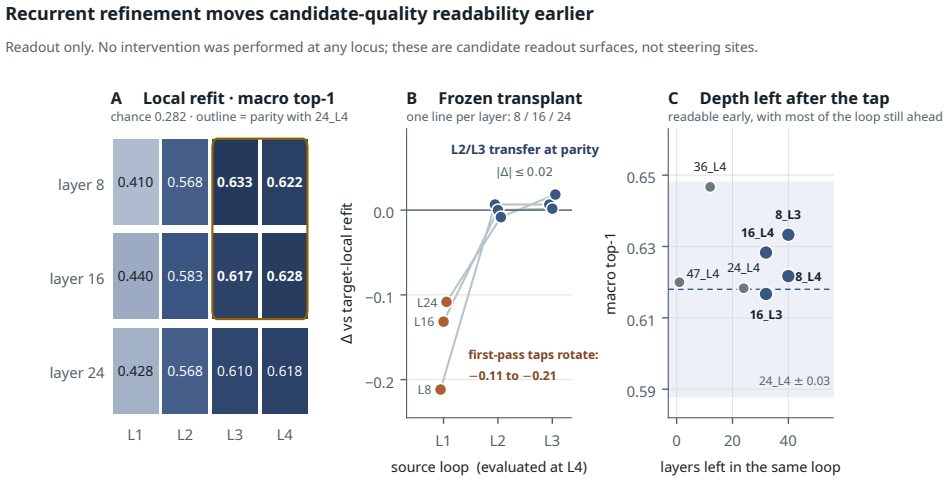
- Because readability moves earlier as loops refine, early loop/layer cells become candidate readout surfaces that leave most of the same-loop computation ahead; they are readout loci, not claimed steering loci.
- The reusable branch/carry substrate, validated by bit-exact identity, offers a way to explore branches inside a looped model's cache and recompute only affected suffixes, saving up to 88% of per-branch layer passes.
- The negative control results imply that obtaining generative control from these readouts would likely require training-time integration, and the paper's minimal binding pilot bounds only the cheapest form of that integration.
Where Pith is reading between the lines
- If the strict pre-answer signal survives further checkpoints and domains, it could become a practical self-monitoring signal for deciding when to abstain in deployment; current evidence is limited to one main backbone, with an unresolved replication on a sibling checkpoint.
- The asymmetry between readable and writable directions suggests that outcome-relevant information may live in a representation space the frozen model does not use for control; a testable extension would train a looped model with an auxiliary objective aligning the readable quality direction with a writable direction and measure whether the boundary moves.
- The non-looped control result implies that recurrence is not necessary for this class of readout; a matched architecture study (same data, objective, compute, looped vs non-looped) could separate what recurrence contributes to readout timing and level, which the current comparison cannot.
- The evaluation-integrity protocol's twin traps—source-item leakage and presentation-order priors—generalize well beyond looped models: any study that constructs multiple rows per source item or scores fixed-order pairs should adopt zero-crossing splits and antisymmetrized metrics before trusting its numbers.
Editorial analysis
A structured set of objections, weighed in public.
Referee Report
Summary. The paper studies a frozen 2.6B looped transformer, Ouro-RLTT, and asks whether hidden states read strictly before the answer region carry information about the quality of the ongoing computation, and whether an external reader can convert that information into better outcomes. On GSM8K and Horizon Logic, the authors report that pre-answer hidden features add statistically significant AUROC over length/log-probability shortcuts (+0.066, CI [+0.021,+0.112]; +0.111, CI [+0.056,+0.169], with an independent prospective replication on the second domain). They also report that recurrent refinement moves candidate-quality readability to earlier physical layers, that decision-level uses of the readout (abstention and terminal selection) produce validated gains, and that generative control (steering, frozen branching, loop allocation, minimal LoRA binding) does not. The paper includes a detailed evaluation-integrity protocol, corrected prior figures, sealed pre-registered arms, and explicit limitations.
Significance. If the central interpretive claim holds, the paper demonstrates that externally readable process-quality information exists in a frozen looped LM before the answer is written, and that this information can be used for decision-level reliability gains. The manuscript is unusually strong on methodology: it states an audited protocol, preserves raw features and predictions, uses task-clustered/bootstrap and exact matched-random nulls, pre-registers sealed arms, reports bit-exact machinery checks, and retracts its own earlier inflated figures. The pre-answer AUROC increments are credible as statistical findings. However, the paper's headline label 'process-quality' and 'operational proto-introspection' goes beyond what the current controls establish, because the pooled pre-answer features also contain prompt-level difficulty signals and near-answer state. This distinction is load-bearing for the interpretation, not for the bare pre-answer prediction claim.
major comments (1)
- [§5.1–5.2, Fig. 5, §5.4] The headline increment is computed from hidden-state features pooled over the entire pre-answer span, which the paper itself labels 'prompt+reasoning'. A linear probe over mean-pooled states can therefore exploit (i) task difficulty encoded in the model's initial representation of the prompt, and (ii) the near-resolution state of the reasoning immediately before the answer region, which may effectively encode the conclusion the model is about to write. The published controls (length, token log-probability), the task-clustered bootstrap, and the leave-one-task-out checks do not remove either channel. §5.4 explicitly leaves the composition of the increment open, but it does not list prompt difficulty or answer-proximity among the candidate drivers, and no prompt-only or early-token control is reported. The result as stated in the abstract and title ('process-quality taps', 'proto-introspec
minor comments (3)
- [§5.1 / Fig. 5] The feature span 'prompt+reasoning' should be stated explicitly in §5.1; the current phrasing 'loop states over the pre-answer span' could be misread as excluding prompt tokens.
- [§7.2–7.3] The word 'bit-exact' is used both for the suffix-recompute splice and loosely for cached decode; §7.2 correctly says cached decode is within bf16 drift (RMS≈0.05–0.2). Consider reserving 'bit-exact' for the splice to avoid confusion.
- [§5.3] The line 'Hidden + shortcuts 0.7261' and 'Incremental (combined−shortcuts) +0.1409' in the original-cohort table is potentially confusing because the pooled table uses different values; consider labeling the cohort explicitly in every table.
Circularity Check
No significant circularity: the central pre-answer and readout claims are supervised measurements against external verifier labels on held-out tasks, not derivations from their own inputs.
full rationale
The paper's load-bearing quantitative claims are all supervised probe evaluations against externally produced correctness/preference labels under source-item-disjoint splits. The pre-answer result rests on a strict code-level cut excluding the answer region and gold value, and the increment is measured by comparing hidden-feature probes with shortcut-only features on held-out tasks; this is a statistical fit, not a definitional reduction. The skeptic concern that mean-pooling prompt+reasoning features may encode task difficulty is a potential confound about what the hidden states carry, not circularity: the correctness labels are external to the features and the probe would not be forced by construction to produce the reported increment. The paper's own §5.4 explicitly leaves the composition of the increment open. The self-citations to Kirin (2026a) are predominantly corrective (three inflated figures are retracted and replaced with clean measurements), and the reused methodological components (feature extraction, head size, antisymmetric training) are tools rather than load-bearing evidence for the target conclusions. The non-looped architecture control and out-of-family Huginn replication provide independent checks. No equation, fitted parameter, or citation chain was found that reduces the stated results to their own inputs.
Axiom & Free-Parameter Ledger
axioms (4)
- domain assumption GSM8K exact-match and Horizon Logic truth-table verifier labels are correct.
- standard math Task-clustered bootstrap assumes tasks are independent exchangeable units.
- domain assumption The strict pre-answer cut is correctly implemented in code (answer region and gold value excluded).
- standard math Probes trained on frozen features and evaluated on task-disjoint held-out data are valid information-content measurements.
invented entities (2)
-
Operational proto-introspection
independent evidence
-
Readout–control boundary
independent evidence
Cite this review
Pith. "Pith review of Operational Proto-Introspection in Looped Language Models: Process-Quality Taps, Executable Branching, and the Readout-Control Boundary." pith.science (2026). https://pith.science/paper/UE5BEKKL
@misc{pith2026260718553,
  author       = {Pith},
  title        = {Pith review of: Operational Proto-Introspection in Looped Language Models: Process-Quality Taps, Executable Branching, and the Readout-Control Boundary},
  year         = {2026},
  howpublished = {\url{https://pith.science/paper/UE5BEKKL}},
  note         = {Machine review of arXiv:2607.18553}
}
read the original abstract
Can a language model read the quality of its ongoing computation, and can an external intervention turn that readout into better outcomes? We test both questions in a frozen 2.6B looped transformer, Ouro-RLTT. On GSM8K, a strict pre-answer probe excludes the answer region and gold value yet predicts success: hidden states plus length/log-probability features reach AUROC 0.797 versus 0.731 for those surface features alone (increment +0.066; task-clustered 95% CI [+0.021,+0.112]; 170 tasks). On Horizon Logic, a prospectively extended task-disjoint study gives an increment of +0.111 (CI [+0.056,+0.169]), independently replicated on the new cohort (+0.095) and robust to an adversarial malformed-sibling shortcut. Recurrence also moves candidate-quality readability to progressively earlier physical depth; the trend replicates across the Ouro family and qualitatively in out-of-family Huginn, although their transfer geometry differs. The readout converts into validated decision-level gains. Hidden-state-based scores improve risk-coverage over shortcut-only scores in four sealed selective-prediction arms, and terminal selection beats matched random even when every candidate is well formed (27/32 correct selections versus 64.8% expected; p = 0.0086). Generative control does not convert: directional steering is negative, a branch screen is bounded, and exact-compute loop allocation and minimal LoRA direction-binding detect no gain. These tests run through bit-exact branch/carry/prune machinery over Ouro's 192-slot recurrent cache, including a suffix-recompute splice saving up to 88% of per-branch layer passes. We call this decision-usable but not generatively controllable property operational proto-introspection. All load-bearing values use source-item-disjoint splits and antisymmetrized pairwise evaluation.
Figures



Reference graph
Works this paper leans on
-
[1]
Arditi, Andy, Oscar Obeso, Aaquib Syed, et al. 2024. Refusal in Language Models Is Mediated by a Single Direction. https://arxiv.org/abs/2406.11717
Pith/arXiv arXiv 2024
-
[2]
Bai, Yuntao, Andy Jones, Kamal Ndousse, et al. 2022. Training a Helpful and Harmless Assistant with Reinforcement Learning from Human Feedback. https://arxiv.org/abs/2204.05862
Pith/arXiv arXiv 2022
-
[3]
Betley, Jan, Xuchan Bao, Martín Soto, Anna Sztyber-Betley, James Chua, and Owain Evans. 2025. Tell Me about Yourself: LLMs Are Aware of Their Learned Behaviors . https://arxiv.org/abs/2501.11120
Pith/arXiv arXiv 2025
-
[4]
Binder, Felix J., James Chua, Tomek Korbak, et al. 2024. Looking Inward: Language Models Can Learn about Themselves by Introspection. https://arxiv.org/abs/2410.13787
Pith/arXiv arXiv 2024
-
[5]
Cobbe, Karl, Vineet Kosaraju, Mohammad Bavarian, et al. 2021. Training Verifiers to Solve Math Word Problems. https://arxiv.org/abs/2110.14168
Pith/arXiv arXiv 2021
-
[6]
Comşa, Iulia, and Murray Shanahan. 2025. Does It Make Sense to Speak of Introspection in Large Language Models? https://arxiv.org/abs/2506.05068
Pith/arXiv arXiv 2025
-
[7]
Conchello Vendrell, Victor, Arnau Padres Masdemont, Niccolò Grillo, Jordi Ros-Giralt, Arash Behboodi, and Fabio Valerio Massoli. 2026. Memory-Efficient Looped Transformer: Decoupling Compute from Memory in Looped Language Models. https://arxiv.org/abs/2605.07721
Pith/arXiv arXiv 2026
-
[8]
Fu, Tingchen, Yupeng Hou, Julian McAuley, and Rui Yan. 2024. Unlocking Decoding-Time Controllability: Gradient-Free Multi-Objective Alignment with Contrastive Prompts. https://arxiv.org/abs/2408.05094
Pith/arXiv arXiv 2024
-
[9]
Geiping, Jonas, Sean McLeish, Neel Jain, et al. 2025. Scaling up Test-Time Compute with Latent Reasoning: A Recurrent Depth Approach. https://arxiv.org/abs/2502.05171
Pith/arXiv arXiv 2025
-
[10]
Hao, Shibo, Sainbayar Sukhbaatar, DiJia Su, et al. 2024. Training Large Language Models to Reason in a Continuous Latent Space. https://arxiv.org/abs/2412.06769
Pith/arXiv arXiv 2024
-
[11]
Hendrycks, Dan, Collin Burns, Saurav Kadavath, et al. 2021. ``Measuring Mathematical Problem Solving with the MATH Dataset.'' Advances in Neural Information Processing Systems: Datasets and Benchmarks. https://arxiv.org/abs/2103.03874
Pith/arXiv arXiv 2021
-
[12]
Kirin, Jan. 2026a. Relational Preference Encoding in Looped Transformer Internal States. https://arxiv.org/abs/2604.09870
-
[13]
Korbak, Tomek, Mikita Balesni, Elizabeth Barnes, et al. 2025. Chain of Thought Monitorability: A New and Fragile Opportunity for AI Safety . https://arxiv.org/abs/2507.11473
Pith/arXiv arXiv 2025
-
[14]
Kutasov, Jon, Chloe Loughridge, Yuqi Sun, et al. 2025. Evaluating Control Protocols for Untrusted AI Agents . https://arxiv.org/abs/2511.02997
arXiv 2025
-
[15]
Kwon, Woosuk, Zhuohan Li, Siyuan Zhuang, et al. 2023. ``Efficient Memory Management for Large Language Model Serving with PagedAttention .'' Proceedings of the 29th Symposium on Operating Systems Principles. https://arxiv.org/abs/2309.06180
Pith/arXiv arXiv 2023
-
[16]
Lambert, Nathan, Valentina Pyatkin, Jacob Morrison, et al. 2024. RewardBench : Evaluating Reward Models for Language Modeling . https://arxiv.org/abs/2403.13787
Pith/arXiv arXiv 2024
-
[17]
Li, Ji-An, Hua-Dong Xiong, Robert C. Wilson, Marcelo G. Mattar, and Marcus K. Benna. 2025. Language Models Are Capable of Metacognitive Monitoring and Control of Their Internal Activations. https://arxiv.org/abs/2505.13763
arXiv 2025
-
[18]
Lightman, Hunter, Vineet Kosaraju, Yura Burda, et al. 2023. Let's Verify Step by Step. https://arxiv.org/abs/2305.20050
Pith/arXiv arXiv 2023
-
[19]
Lindsey, Jack. 2026. Emergent Introspective Awareness in Large Language Models. https://arxiv.org/abs/2601.01828
arXiv 2026
-
[20]
Macar, Uzay, Li Yang, Atticus Wang, Peter Wallich, Emmanuel Ameisen, and Jack Lindsey. 2026. Mechanisms of Introspective Awareness. https://arxiv.org/abs/2603.21396
Pith/arXiv arXiv 2026
-
[21]
Marks, Samuel, and Max Tegmark. 2023. The Geometry of Truth: Emergent Linear Structure in Large Language Model Representations of True/False Datasets. https://arxiv.org/abs/2310.06824
Pith/arXiv arXiv 2023
-
[22]
Miao, Xupeng, Gabriele Oliaro, Zhihao Zhang, et al. 2024. `` SpecInfer : Accelerating Generative LLM Serving with Tree-Based Speculative Inference and Verification.'' Proceedings of the 29th ACM International Conference on Architectural Support for Programming Languages and Operating Systems. https://arxiv.org/abs/2305.09781
Pith/arXiv arXiv 2024
-
[23]
Pearson-Vogel, Theia, Martin Vanek, Raymond Douglas, and Jan Kulveit. 2026. Latent Introspection: Models Can Detect Prior Concept Injections. https://arxiv.org/abs/2602.20031
arXiv 2026
-
[24]
Saunshi, Nikunj, Nishanth Dikkala, Zhiyuan Li, Sanjiv Kumar, and Sashank J. Reddi. 2025. Reasoning with Latent Thoughts: On the Power of Looped Transformers. https://arxiv.org/abs/2502.17416
Pith/arXiv arXiv 2025
-
[25]
Song, Siyuan, Harvey Lederman, Jennifer Hu, and Kyle Mahowald. 2025. Privileged Self-Access Matters for Introspection in AI . https://arxiv.org/abs/2508.14802
Pith/arXiv arXiv 2025
-
[26]
Williams, Jonathan, and Esin Tureci. 2026. Prioritize the Process, Not Just the Outcome: Rewarding Latent Thought Trajectories Improves Reasoning in Looped Language Models. https://arxiv.org/abs/2602.10520
Pith/arXiv arXiv 2026
-
[27]
Yao, Shunyu, Dian Yu, Jeffrey Zhao, et al. 2023. ``Tree of Thoughts: Deliberate Problem Solving with Large Language Models.'' Advances in Neural Information Processing Systems. https://arxiv.org/abs/2305.10601
Pith/arXiv arXiv 2023
-
[28]
Zheng, Lianmin, Liangsheng Yin, Zhiqiang Xie, Chuyue Sun, et al. 2024. SGLang : Efficient Execution of Structured Language Model Programs . https://arxiv.org/abs/2312.07104
Pith/arXiv arXiv 2024
-
[29]
Zhu, Rui-Jie, Zixuan Wang, Kai Hua, et al. 2025. Scaling Latent Reasoning via Looped Language Models. Project page: https://ouro-llm.github.io. https://arxiv.org/abs/2510.25741
Pith/arXiv arXiv 2025
-
[30]
Zou, Andy, Long Phan, Sarah Chen, et al. 2023. Representation Engineering: A Top-down Approach to AI Transparency . https://arxiv.org/abs/2310.01405. CSLReferences
Pith/arXiv arXiv 2023
This paper was first reviewed by deepseek-v4-flash on August 1, 2026.
discussion (0)
Sign in with ORCID, Apple, or X to comment. Anyone can read and Pith papers without signing in.