REVIEW 3 major objections 5 minor 73 references
Higgs and Z lepton-flavor decays scale with radiative lepton decays in a 3-3-1 leptoquark model.
Reviewed by Pith at T0; open to challenge. T0 means a machine referee read the full paper against a public rubric. the ladder, T0–T4 →
T0 review · deepseek-v4-flash
2026-08-01 14:35 UTC pith:CHDGHLOU
load-bearing objection The LFV h/Z versus radiative-decay correlation is real and analytic, but the near-limit rate claims rest on an unjustified CKM input freedom. the 3 major comments →
LFV decays in a 3-3-1 model with singlet leptoquarks
The pith
A machine-rendered reading of the paper's core claim, the machinery that carries it, and where it could break.
Core claim
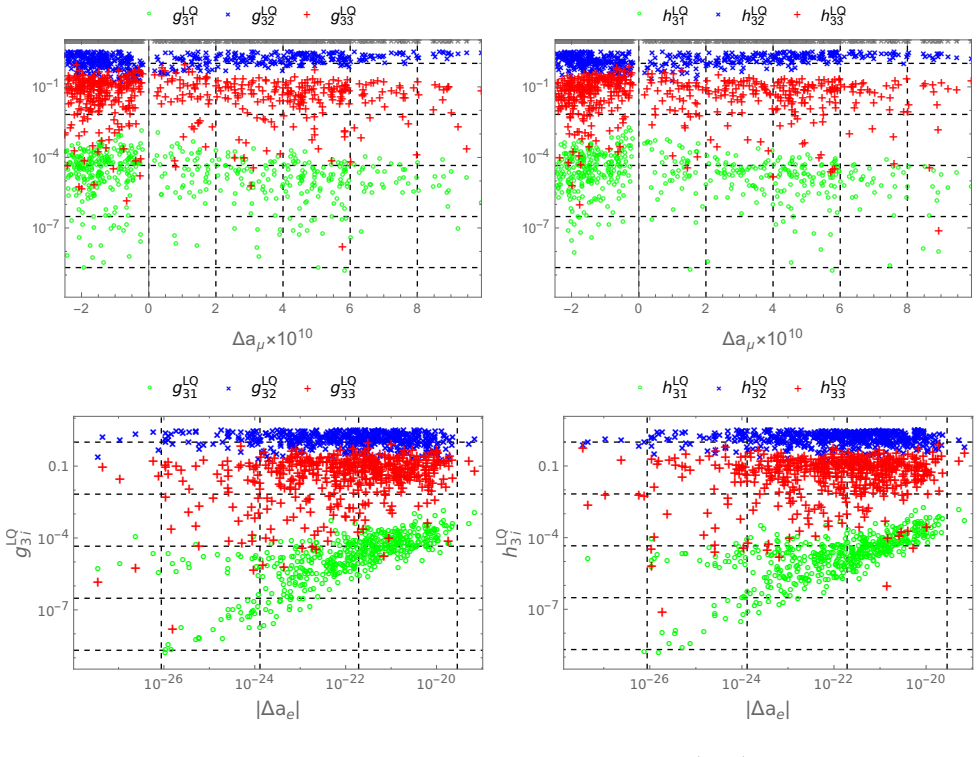
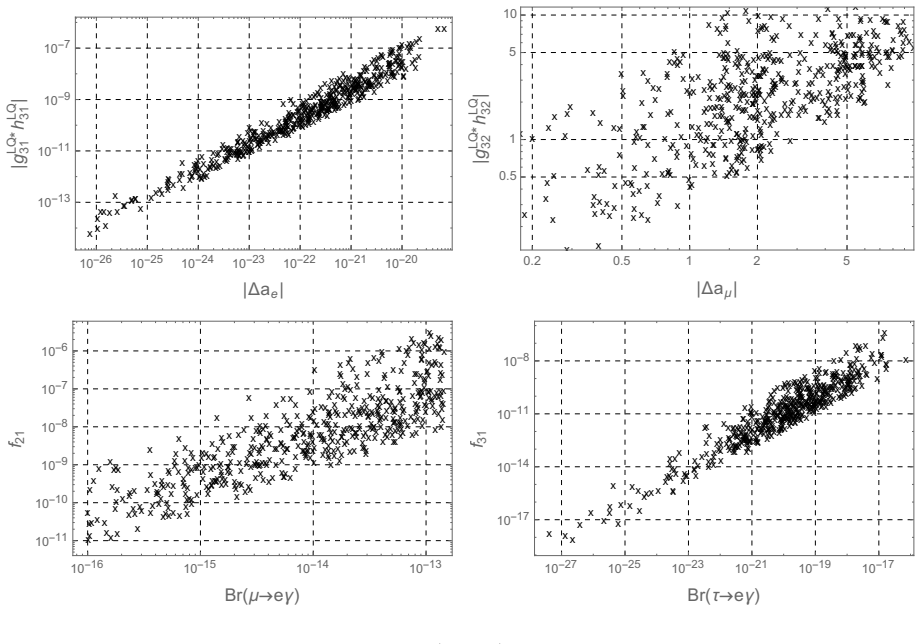
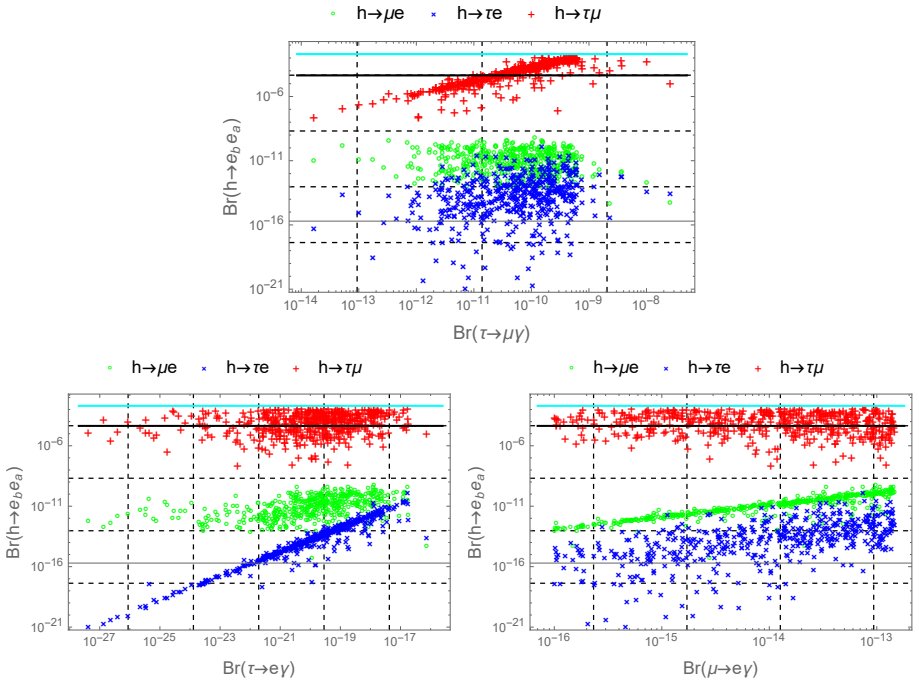
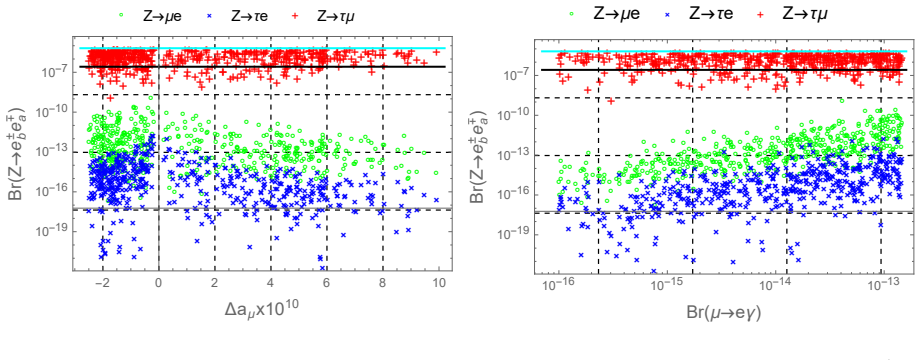
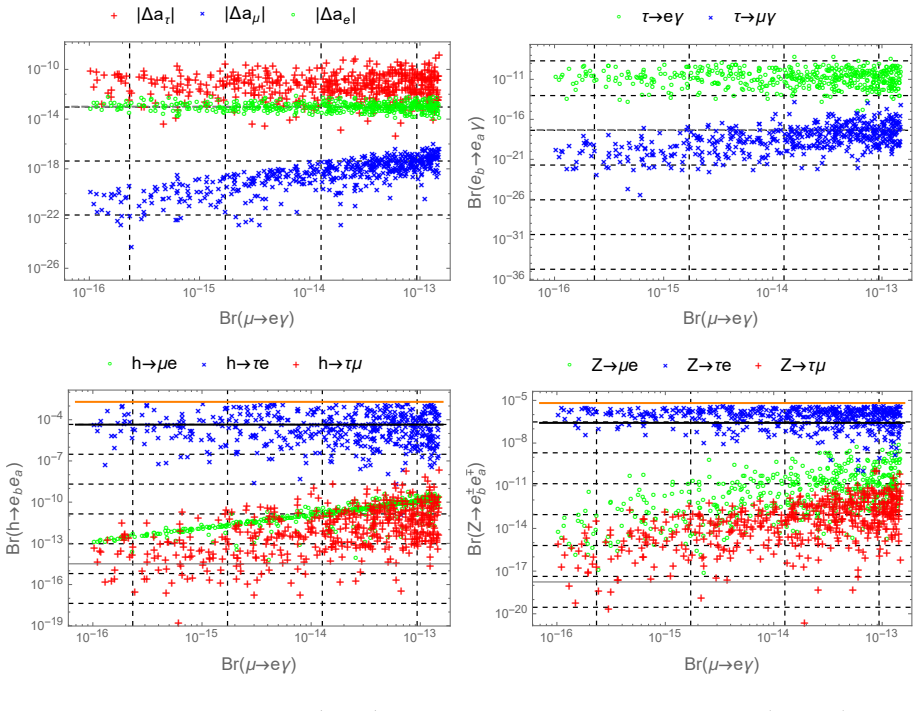
In the 331LQ model, the dominant one-loop contributions to charged-lepton flavor-violating decays, Higgs and Z lepton-flavor-violating decays, and the anomalous magnetic moments all share the same dependence on the top-quark leptoquark Yukawa couplings. Specifically, both Br(e_b→e_aγ) and Br(h,Z→e_b e_a) scale with f_ba = |g^LQ_{3a} h^LQ_{3b}|² + |h^LQ_{3a} g^LQ_{3b}|², producing a near-linear correlation. The numerical scan shows that the leptoquark cannot simultaneously generate large contributions to both Δa_μ and Δa_e: either Δa_μ ≥ 10⁻¹¹ and h→τμ near its current limit with Δa_e negligible, or 10⁻¹⁴ ≤ |Δa_e| ≤ 8×10⁻¹³ and h→τe, Z→τe near current sensitivities with Δa_μ suppressed to O(1
What carries the argument
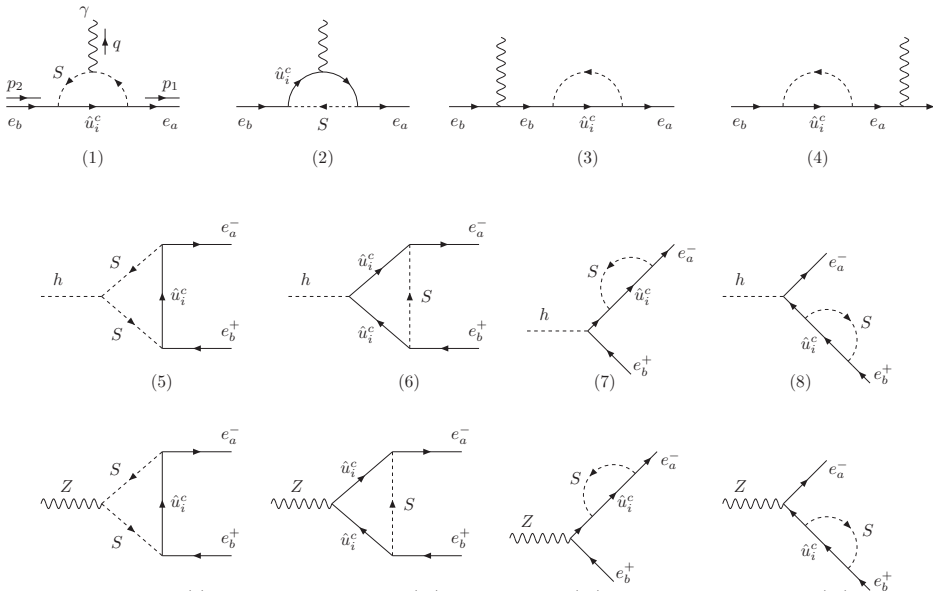
The central object is the singlet scalar leptoquark S with charge 1/3, which couples to up-type quarks and charged leptons through Yukawa couplings g^LQ and h^LQ. Because the light up-quark contributions are negligible, all observables are dominated by the top-quark couplings g^LQ_{3a} and h^LQ_{3b}. The one-loop form factors for cLFV, LFVh, and LFVZ decays are expressed in terms of Passarino-Veltman functions, and the divergent parts cancel between diagrams. The shared factor f_ba is what generates the approximate proportionality between the radiative and Higgs/Z decay rates.
Load-bearing premise
The scan assumes the unknown quark mixing matrices V_uL and V_dL can be chosen so that the effective top-family leptoquark couplings g^LQ_{3i} and h^LQ_{3i} are independently as large as sqrt(4π), with no constraint from CKM or other flavor observables limiting those combinations.
What would settle it
A future measurement of Br(μ→eγ) below about 10⁻¹⁴ together with a simultaneous observation of Br(h→τμ) near 10⁻³ would contradict the predicted linear correlation, since the tiny |g_{31}h_{32}| and |h_{31}g_{32}| required by μ→eγ would suppress h→τμ far below that level.
If this is right
- If the muon g-2 deviation is explained, Br(h→τμ) can reach the current upper limit of 1.5×10⁻³, while Br(h→τe) and Br(h→μe) remain below about 10⁻⁹.
- In the electron g-2 window, Br(h→τe) and Br(Z→τ±e∓) approach present experimental sensitivities, while Br(τ→μγ) and Br(h→τμ) stay suppressed.
- The stringent bound on Br(μ→eγ) forces the first-generation leptoquark couplings to be tiny, thereby suppressing both Δa_e and the h→μe, τ→eγ rates.
- Future improvements in the limits on μ→eγ and τ→eγ will directly translate into tighter predictions for the Higgs and Z flavor-violating decay rates.
- The correlations mean that a single measurement of one LFV channel would immediately determine the expected rates of several related channels, allowing strong cross-checks.
Where Pith is reading between the lines
- If a future experiment observes h→τμ at a rate near the current bound while MEG II pushes the μ→eγ limit below about 10⁻¹⁴, the predicted proportionality would be violated, signaling physics beyond this simple leptoquark framework.
- The model's inability to simultaneously explain both the electron and muon g-2 anomalies suggests that if future data require both deviations, an additional source beyond this singlet leptoquark would be needed.
- The proportionality between cLFV and LFVh/LFVZ rates could be tested even without directly producing the leptoquark, by comparing limits across channels at the HL-LHC and FCC-ee.
- A dedicated scan that fixes the CKM-related rotations rather than leaving them free would clarify whether the near-limit predictions survive when quark-mixing constraints are imposed.
Editorial analysis
A structured set of objections, weighed in public.
Referee Report
Summary. The paper studies lepton-flavor-violating decays h→ℓ_aℓ_b and Z→ℓ_b±ℓ_a∓ in the 3-3-1 model with a singlet scalar leptoquark, together with the charged LFV radiative decays and anomalous magnetic moments. It provides one-loop analytic formulas, verifies the cancellation of divergences in the h and Z amplitudes, and performs a numerical scan over the leptoquark mass, the hSS trilinear coupling, and the effective third-family Yukawa couplings. The central claims are a near-linear correlation Br(h,Z→e_b e_a) ∝ Br(e_b→e_aγ) and a complementarity between Δa_μ and Δa_e that selects different reachable LFV channels. The correlation is an analytic consequence of top-quark-dominated leptoquark couplings (Eq. (24)), not a fit; the numerical reach to current limits depends on scan assumptions and on the normalization of the h→ℓℓ' width.
Significance. If correct, the model yields channel-specific predictions testable at HL-LHC and FCC-ee, and it identifies which LFV channels are most promising. The paper's technical strengths are the complete one-loop PV-function expressions, the explicit demonstration of divergence cancellation, and the use of current experimental constraints including MEG II bounds on μ→eγ. However, the quantitative predictions rely on the scanning treatment of effective couplings and on a normalization issue in the h→ℓℓ' branching-ratio formula, so the numerical reach to the quoted 'near current limits' regions is not yet firmly established.
major comments (3)
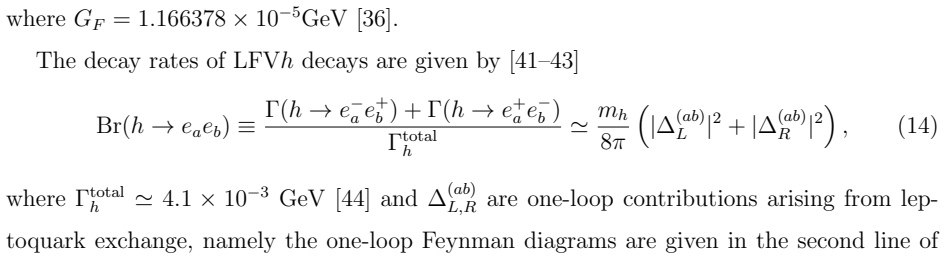
- [Eq. (14)] The formula for Br(h→e_a e_b) is dimensionally inconsistent: the right-hand side m_h/(8π)(|Δ_L|^2+|Δ_R|^2) has mass dimension, while the left side is a branching ratio. The text defines Br ≡ Γ/Γ_h^total with Γ_h^total ≃ 4.1×10^-3 GeV, but no 1/Γ_h^total appears in the displayed equality. If the numerical code evaluates Eq. (14) as written, all h→LFV results in Figs. 4 and 6 are overestimated by a factor ~244 GeV. The authors must correct the formula and confirm that the numerical analysis uses the correct normalization.
- [Eq. (8) and Sec. IV, Eq. (25)] The scan treats g^{LQ}_{3i} and h^{LQ}_{3i} as independent free parameters with only |g|≤√(4π). However, Eq. (8) expresses these as linear combinations of the fundamental couplings \tilde g^{LQ}_{ki} (k=1,2) through the CKM rotations V_uL,V_dL. The paper neither scans over V_uL,V_dL with unitarity constraints nor imposes low-energy flavor bounds on \tilde g^{LQ}_{ki} (which couple to first/second generation quarks and are constrained by e.g. K_L→μe, D^0→μe, B→Kνν). Because the rotation is unitary, large g^{LQ}_{3i} requires large \tilde g^{LQ}_{ki} in the same combination, so these constraints directly limit the effective couplings. Without demonstrating that the interesting near-limit regions survive after imposing these constraints, the quantitative predictions for Br(h,Z→τμ) and the Δa_e window are not established.
- [Sec. III (one-loop contributions)] The calculation includes only the scalar leptoquark S in the loops, while the 3-3-1 gauge bosons (Z', W') and the other charged scalars also generate LFV and AMM contributions at one loop. The paper does not quantify when these are negligible; e.g., the Z' couplings to leptons are not suppressed by the same Yukawa factors. Since the numerical selection of parameter points uses constraints on Br(μ→eγ) and Δa_e,μ, omitting these contributions could allow points that are actually excluded. Please state the conditions under which the LQ contribution dominates, or include the additional contributions.
minor comments (5)
- [Eq. (10)] The second line has 'cS_(ba)R = c_(ba)R'; the superscript S is missing on the right-hand side.
- [Sec. IV / Abstract] The quoted window for |Δa_e| differs: the text after Eq. (25) says '10^-14 ≤ |Δa_e| ≤ 5×10^-13' while the abstract says '8×10^-13'. Unify the value.
- [Eq. (8)] The index structure in Eq. (8) and the surrounding text is confusing. Define all indices (k,i,b,a) and the row/column convention for V_uL and V_dL explicitly.
- [Eq. (14)] After correcting the missing 1/Γ_h, the factor 1/(8π) should be cross-checked against the standard 1/(16π) for a final state with two different final-state particles; clarify the definition of Δ_L,R.
- [Figs. 2 and 3] In the typeset version, the axis labels and legends are dense and difficult to read. Please ensure legibility and label all panels unambiguously.
Circularity Check
No significant circularity: the advertised correlations are analytic consequences of common coupling combinations, and the numerical claims are conditional scan results under external constraints, not fitted predictions.
full rationale
The central correlation Br(h,Z→e_b e_a)∝Br(e_b→e_aγ) is not circular. Eq. (24) defines f_ba as the coupling combination that dominates Br(e_b→e_aγ), and the text says: 'We will also check the interesting fact that Br(h, Z→e_b e_a)∝f_ba ∝ Br(e_b→e_aγ) as consequences can be seen directly from analytic formulas.' That is a derived consequence, not a fitted input: the numerical scan varies m_S, λ_hSS, and g(h)^LQ_{3i} and imposes external experimental constraints; it never tunes couplings to reproduce the h/Z LFV rates from the radiative rates. The muon/electron AMM complementarity is likewise a consequence of the imposed Br(μ→eγ) bound forcing g_{31},h_{31} tiny, as the paper explains: 'small experimental upper bound of Br(μ→eγ) requires both small values of |g_{31}^{LQ*} h_{32}^{LQ}| and |g_{32}^{LQ*} h_{31}^{LQ}|'. The loop machinery is frequently cited to [37],[38],[50], which include current authors, but the explicit formulas are reproduced in the text and the correlation argument relies only on top-quark dominance through f_ba; no load-bearing claim reduces to an unverified self-citation, uniqueness theorem, or ansatz imported by citation. The one notable limitation — that g^LQ_{3i} is scanned up to √(4π) because 'the unknown property of V_uL (V_dL) still allows large values' — is an input-freedom/viability concern, not circularity, since the scan does not use the target h/Z branching ratios as inputs.
Axiom & Free-Parameter Ledger
free parameters (5)
- m_S (leptoquark mass) =
scanned 0.5–5 TeV
- λ_hSS (trilinear h–S–S coupling) =
scanned [-5,5]×v
- g^{LQ}_{31}, g^{LQ}_{32}, g^{LQ}_{33} =
|g| ≤ sqrt(4π)
- h^{LQ}_{31}, h^{LQ}_{32}, h^{LQ}_{33} =
|h| ≤ sqrt(4π)
- V_uL, V_dL quark rotation matrices =
chosen to permit large g^{LQ}_{3i}
axioms (6)
- domain assumption Z2 symmetry prevents SM-exotic quark mixing (Ref. [34])
- domain assumption Only top-quark contributions matter; light up-quark contributions are neglected
- domain assumption Master one-loop formulas from Ref. [37] are valid for light fermions
- domain assumption Large v_χ limit: Z couplings to SM fermions are SM-like
- ad hoc to paper Contributions of 3-3-1 gauge bosons and charged scalars to LFV are negligible/ignored
- domain assumption The leptoquark S does not mix with other charged scalars; λ_hSS from Appendix A
invented entities (1)
-
Singlet scalar leptoquark S ∼ (3,1,1/3)
no independent evidence
read the original abstract
Motivated by a recent study of the 3-3-1 model supplemented with a singlet scalar leptoquark, which successfully explains the muon anomalous magnetic moment and the decay $\mu\to e\gamma$ within current experimental constraints, we extend the phenomenological analysis of this framework to include the lepton-flavor-violating decays of the Standard Model-like Higgs and the $Z$ boson. An interesting feature is that the branching ratios of these decays exhibit a nearly linear correlation with the corresponding charged lepton flavor-violating radiative decays, namely $\mathrm{Br}(h,Z\to e_b^\pm e_a^\mp)\propto\mathrm{Br}(e_b\to e_a\gamma)$. Furthermore, the model exhibits a complementary interplay between the charged-lepton anomalous magnetic moments: parameter regions with $|\Delta a_{\mu}|\geq10^{-11}$ favor $\mathrm{Br}(h,Z\to\tau^\pm\mu^\mp)$ reaching their current experimental upper limits while keeping $|\Delta a_e|$ negligible, whereas regions with $10^{-14}\leq|\Delta a_e|\leq 8\times10^{-13}$ instead allow $\mathrm{Br}(h,Z\to\tau^\pm e^\mp)$ to approach the present experimental sensitivities but simultaneously suppress $|\Delta a_\mu|$ to the level of $\mathcal{O}(10^{-16})$.
Figures
Reference graph
Works this paper leans on
-
[1]
Singer, J
M. Singer, J. W. F. Valle and J. Schechter, Phys. Rev. D22, 738 (1980)
1980
-
[2]
P. H. Frampton, Phys. Rev. Lett.69, 2889-2891 (1992)
1992
-
[3]
V. Pleitez and M. D. Tonasse, Phys. Rev. D48, 2353-2355 (1993) [arXiv:hep-ph/9301232 [hep-ph]]
Pith/arXiv arXiv 1993
-
[4]
R. Foot, H. N. Long and T. A. Tran, Phys. Rev. D50, no.1, R34-R38 (1994) [arXiv:hep- ph/9402243 [hep-ph]]
arXiv 1994
-
[5]
Ozer, Phys
M. Ozer, Phys. Rev. D54, 1143-1149 (1996)
1996
-
[6]
D. Cogollo, H. Diniz, C. A. de S.Pires and P. S. Rodrigues da Silva, Eur. Phys. J. C58, 455-461 (2008) [arXiv:0806.3087 [hep-ph]]
Pith/arXiv arXiv 2008
-
[7]
M. E. Catano, R. Martinez and F. Ochoa, Phys. Rev. D86(2012), 073015 [arXiv:1206.1966 [hep-ph]]
Pith/arXiv arXiv 2012
-
[8]
A. G. Dias, C. A. de S.Pires, P. S. Rodrigues da Silva and A. Sampieri, Phys. Rev. D86 (2012), 035007 [arXiv:1206.2590 [hep-ph]]
Pith/arXiv arXiv 2012
-
[9]
S. M. Boucenna, J. W. F. Valle and A. Vicente, Phys. Rev. D92(2015) no.5, 053001 [arXiv:1502.07546 [hep-ph]]
Pith/arXiv arXiv 2015
-
[10]
C. A. de Sousa Pires, F. Ferreira De Freitas, J. Shu, L. Huang and P. Wagner Vasconcelos Oleg´ ario, Phys. Lett. B797(2019), 134827 [arXiv:1812.10570 [hep-ph]]
Pith/arXiv arXiv 2019
-
[11]
L. T. Hue, H. T. Hung, N. T. Tham, H. N. Long and T. P. Nguyen, Phys. Rev. D104, no.3, 033007 (2021) [arXiv:2104.01840 [hep-ph]]
Pith/arXiv arXiv 2021
-
[12]
T. T. Hong, P. T. Bich, L. T. T. Phuong, T. T. Thanh and N. H. Thao, Mod. Phys. Lett. A 37(2022) no.27, 2250181
2022
-
[13]
P. Escalona, J. P. Pinheiro, V. Oliveira, A. Doff and C. A. De Sousa Pires, Universe11, no.12, 396 (2025) [arXiv:2510.17979 [hep-ph]]
arXiv 2025
-
[14]
D. P. Aguillardet al.[Muon g-2], Phys. Rev. Lett.131(2023) no.16, 161802 [arXiv:2308.06230 [hep-ex]]
arXiv 2023
-
[15]
D. P. Aguillardet al.[Muon g-2], Phys. Rev. Lett.135(2025) no.10, 101802 [arXiv:2506.03069 21 [hep-ex]]
arXiv 2025
-
[16]
R. Aliberti, T. Aoyama, E. Balzani, A. Bashir, G. Benton, J. Bijnens, V. Biloshytskyi, T. Blum, D. Boito and M. Bruno,et al.Phys. Rept.1143, 1-158 (2025) [arXiv:2505.21476 [hep-ph]]
Pith/arXiv arXiv 2025
-
[17]
M. W. Li, X. G. He, A. Cheek and X. Chu, Phys. Lett. B871, 139949 (2025) [arXiv:2506.05511 [hep-ph]]
arXiv 2025
-
[18]
D. Hanneke, S. Fogwell and G. Gabrielse, Phys. Rev. Lett.100(2008), 120801 [arXiv:0801.1134 [physics.atom-ph]]
Pith/arXiv arXiv 2008
-
[19]
R. H. Parker, C. Yu, W. Zhong, B. Estey and H. M¨ uller, Science360(2018), 191 [arXiv:1812.04130 [physics.atom-ph]]
Pith/arXiv arXiv 2018
-
[20]
Morel, Z
L. Morel, Z. Yao, P. Clad´ e and S. Guellati-Kh´ elifa, Nature588(2020) no.7836, 61-65
2020
-
[21]
X. Fan, T. G. Myers, B. A. D. Sukra and G. Gabrielse, Phys. Rev. Lett.130(2023) no.7, 071801 [arXiv:2209.13084 [physics.atom-ph]]
Pith/arXiv arXiv 2023
-
[22]
A. M. Baldiniet al.[MEG II], Eur. Phys. J. C78(2018) no.5, 380 [arXiv:1801.04688 [physics.ins-det]]
Pith/arXiv arXiv 2018
-
[23]
E. Kouet al.[Belle-II], PTEP2019(2019) no.12, 123C01 [erratum: PTEP2020(2020) no.2, 029201] [arXiv:1808.10567 [hep-ex]]
arXiv 2019
-
[24]
K. Afanacievet al.[MEG II], Eur. Phys. J. C85, no.10, 1177 (2025) [erratum: Eur. Phys. J. C85, no.11, 1317 (2025)] [arXiv:2504.15711 [hep-ex]]
Pith/arXiv arXiv 2025
-
[25]
T. T. Hong, N. H. T. Nha, T. P. Nguyen, L. T. T. Phuong and L. T. Hue, PTEP2022, no.9, 093B05 (2022) [arXiv:2206.08028 [hep-ph]]
Pith/arXiv arXiv 2022
-
[26]
T. T. Hong, L. T. T. Phuong, T. P. Nguyen, N. H. T. Nha and L. T. Hue, Phys. Rev. D110, no.7, 075010 (2024) [arXiv:2404.05524 [hep-ph]]
Pith/arXiv arXiv 2024
-
[27]
T. T. Hong, L. T. Hue, L. T. T. Phuong, N. H. T. Nha and T. P. Nguyen, Phys. Scripta99, no.12, 125308 (2024) [arXiv:2406.11040 [hep-ph]]
Pith/arXiv arXiv 2024
-
[28]
T. T. Hieu, V. H. Binh, H. N. Long and H. T. Hung, [arXiv:2512.19636 [hep-ph]]
-
[29]
K. m. Cheung, Phys. Rev. D64, 033001 (2001) [arXiv:hep-ph/0102238 [hep-ph]]
Pith/arXiv arXiv 2001
-
[30]
U. Mahanta, Eur. Phys. J. C21, 171-173 (2001) [arXiv:hep-ph/0102176 [hep-ph]]
Pith/arXiv arXiv 2001
-
[31]
A. Doff and C. A. de S. Pires, Phys. Lett. B854, 138733 (2024) [arXiv:2403.19338 [hep-ph]]
Pith/arXiv arXiv 2024
-
[32]
A. Doff, C. A. de S.Pires and P. S. R. da Silva, Phys. Rev. D74, 015014 (2006) [arXiv:hep- ph/0604021 [hep-ph]]. 22
arXiv 2006
-
[33]
D. Chang and H. N. Long, Phys. Rev. D73(2006), 053006 [arXiv:hep-ph/0603098 [hep-ph]]
Pith/arXiv arXiv 2006
-
[34]
H. Okada, N. Okada, Y. Orikasa and K. Yagyu, Phys. Rev. D94(2016) no.1, 015002 [arXiv:1604.01948 [hep-ph]]
Pith/arXiv arXiv 2016
-
[35]
A. S. De Jesus, S. Kovalenko, F. S. Queiroz, C. Siqueira and K. Sinha, Phys. Rev. D102, no.3, 035004 (2020) [arXiv:2004.01200 [hep-ph]]
Pith/arXiv arXiv 2020
-
[36]
Navaset al.[Particle Data Group], Phys
S. Navaset al.[Particle Data Group], Phys. Rev. D110, no.3, 030001 (2024)
2024
-
[37]
L. T. Hue, K. H. Phan, T. T. Hong, T. P. Nguyen and N. H. T. Nha, Eur. Phys. J. C84 (2024) no.12, 1262 [arXiv:2409.01390 [hep-ph]]
Pith/arXiv arXiv 2024
-
[38]
L. T. Hue, H. N. Long, V. H. Binh, H. L. T. Mai and T. P. Nguyen, Nucl. Phys. B992(2023), 116244 [arXiv:2301.05407 [hep-ph]]
Pith/arXiv arXiv 2023
-
[39]
L. Lavoura, Eur. Phys. J. C29(2003), 191-195 [arXiv:hep-ph/0302221 [hep-ph]]
Pith/arXiv arXiv 2003
-
[40]
A. Crivellin, M. Hoferichter and P. Schmidt-Wellenburg, Phys. Rev. D98(2018) no.11, 113002 [arXiv:1807.11484 [hep-ph]]
Pith/arXiv arXiv 2018
-
[41]
Pilaftsis, Phys
A. Pilaftsis, Phys. Lett. B285(1992), 68-74
1992
-
[42]
E. Arganda, A. M. Curiel, M. J. Herrero and D. Temes, Phys. Rev. D71(2005), 035011 doi:10.1103/PhysRevD.71.035011 [arXiv:hep-ph/0407302 [hep-ph]]
Pith/arXiv arXiv 2005
-
[43]
E. Arganda, M. J. Herrero, X. Marcano and C. Weiland, Phys. Rev. D91(2015) no.1, 015001 doi:10.1103/PhysRevD.91.015001 [arXiv:1405.4300 [hep-ph]]
Pith/arXiv arXiv 2015
-
[44]
de Florianet al.[LHC Higgs Cross Section Working Group], CERN Yellow Rep
D. de Florianet al.[LHC Higgs Cross Section Working Group], CERN Yellow Rep. Monogr. 2, 1-869 (2017) [arXiv:1610.07922 [hep-ph]]
Pith/arXiv arXiv 2017
-
[45]
Passarino and M
G. Passarino and M. J. G. Veltman, Nucl. Phys. B160(1979), 151-207
1979
-
[46]
T. Hahn and M. Perez-Victoria, Comput. Phys. Commun.118(1999), 153-165 [arXiv:hep- ph/9807565 [hep-ph]]
arXiv 1999
-
[47]
J. G. Korner, A. Pilaftsis and K. Schilcher, Phys. Lett. B300(1993), 381-386 [arXiv:hep- ph/9301290 [hep-ph]]
arXiv 1993
-
[48]
V. De Romeri, M. J. Herrero, X. Marcano and F. Scarcella, Phys. Rev. D95(2017) no.7, 075028 [arXiv:1607.05257 [hep-ph]]
Pith/arXiv arXiv 2017
-
[49]
D. Jurˇ ciukonis and L. Lavoura, JHEP03(2022), 106 [arXiv:2107.14207 [hep-ph]]
Pith/arXiv arXiv 2022
-
[50]
T. T. Hong, Q. D. Tran, T. P. Nguyen, L. T. Hue and N. H. T. Nha, Eur. Phys. J. C84 (2024) no.3, 338 [erratum: Eur. Phys. J. C84(2024) no.5, 454] [arXiv:2312.11427 [hep-ph]]
Pith/arXiv arXiv 2024
-
[51]
H. N. Long, Phys. Rev. D53(1996), 437-445 [arXiv:hep-ph/9504274 [hep-ph]]. 23
Pith/arXiv arXiv 1996
-
[52]
H. T. Hung, T. T. Hong, H. H. Phuong, H. L. T. Mai and L. T. Hue, Phys. Rev. D100(2019) no.7, 075014 [arXiv:1907.06735 [hep-ph]]
Pith/arXiv arXiv 2019
-
[53]
H. K. Dreiner, H. E. Haber and S. P. Martin, Phys. Rept.494(2010), 1-196 [arXiv:0812.1594 [hep-ph]]
Pith/arXiv arXiv 2010
-
[54]
Abdesselamet al.[Belle], JHEP10, 19 (2021) [arXiv:2103.12994 [hep-ex]]
A. Abdesselamet al.[Belle], JHEP10, 19 (2021) [arXiv:2103.12994 [hep-ex]]
Pith/arXiv arXiv 2021
-
[55]
Venturini [MEG II], Nuovo Cim
A. Venturini [MEG II], Nuovo Cim. C47, no.5, 287 (2024)
2024
-
[56]
A. Hayrapetyanet al.[CMS], Phys. Rev. D108, no.7, 072004 (2023) [arXiv:2305.18106 [hep- ex]]
Pith/arXiv arXiv 2023
-
[57]
A. M. Sirunyanet al.[CMS], Phys. Rev. D104, no.3, 032013 (2021) [arXiv:2105.03007 [hep- ex]]
Pith/arXiv arXiv 2021
-
[58]
R. K. Barman, P. S. B. Dev and A. Thapa, Phys. Rev. D107, no.7, 075018 (2023) [arXiv:2210.16287 [hep-ph]]
Pith/arXiv arXiv 2023
-
[59]
M. Aoki, S. Kanemura, M. Takeuchi and L. Zamakhsyari, Phys. Rev. D107, no.5, 055037 (2023) [arXiv:2302.08489 [hep-ph]]
Pith/arXiv arXiv 2023
-
[60]
Q. Qin, Q. Li, C. D. L¨ u, F. S. Yu and S. H. Zhou, Eur. Phys. J. C78, no.10, 835 (2018) [arXiv:1711.07243 [hep-ph]]
Pith/arXiv arXiv 2018
-
[61]
Aadet al.[ATLAS], JHEP07, 166 (2023) [arXiv:2302.05225 [hep-ex]]
G. Aadet al.[ATLAS], JHEP07, 166 (2023) [arXiv:2302.05225 [hep-ex]]
Pith/arXiv arXiv 2023
-
[62]
G. Aadet al.[ATLAS], Phys. Rev. D108, 032015 (2023) [arXiv:2204.10783 [hep-ex]]
Pith/arXiv arXiv 2023
-
[63]
G. Aadet al.[ATLAS], Phys. Rev. Lett.127, 271801 (2022) [arXiv:2105.12491 [hep-ex]]
Pith/arXiv arXiv 2022
-
[64]
M. Dam, SciPost Phys. Proc.1, 041 (2019) [arXiv:1811.09408 [hep-ex]]
Pith/arXiv arXiv 2019
-
[65]
Abadaet al.[FCC], Eur
A. Abadaet al.[FCC], Eur. Phys. J. C79, no.6, 474 (2019)
2019
-
[66]
N. H. T. Nha, L. T. Hue, L. T. T. Phuong and T. T. Hong, Nucl. Phys. B1029(2026), 117575 [arXiv:2604.08444 [hep-ph]]
Pith/arXiv arXiv 2026
-
[67]
R. A. Diaz, R. Martinez and F. Ochoa, Phys. Rev. D69(2004), 095009 [arXiv:hep-ph/0309280 [hep-ph]]
Pith/arXiv arXiv 2004
-
[68]
L. Ninh and H. N. Long, Phys. Rev. D72, 075004 (2005) [arXiv:hep-ph/0507069 [hep-ph]]
Pith/arXiv arXiv 2005
-
[69]
L. T. Hue, H. N. Long, T. T. Thuc and T. Phong Nguyen, Nucl. Phys. B907, 37-76 (2016) [arXiv:1512.03266 [hep-ph]]
Pith/arXiv arXiv 2016
-
[70]
J. P. Pinheiro and C. A. de S. Pires, Phys. Lett. B836(2023), 137584 [arXiv:2210.05426 [hep-ph]]
Pith/arXiv arXiv 2023
-
[71]
H. N. Long, Mod. Phys. Lett. A13(1998), 1865-1874 [arXiv:hep-ph/9711204 [hep-ph]]. 24
Pith/arXiv arXiv 1998
-
[72]
K. Kannike, Eur. Phys. J. C72, 2093 (2012) [arXiv:1205.3781 [hep-ph]]
Pith/arXiv arXiv 2093
-
[73]
F. D’Eramo, N. Koˇ snik, F. Pobbe, A. Smolkoviˇ c and O. Sumensari, Phys. Rev. D104, no.1, 015035 (2021) [arXiv:2012.05743 [hep-ph]]. 25
Pith/arXiv arXiv 2021
discussion (0)
Sign in with ORCID, Apple, or X to comment. Anyone can read and Pith papers without signing in.