REVIEW 2 major objections 4 minor 41 references
Circuit extraction does not determine which mechanism a model uses: the same checkpoint pair can look circuit-sharing at the attention-head level and mechanism-different at the exact-edge level, so the reported comparison level decides the
Reviewed by Pith at T0; open to challenge. T0 means a machine referee read the full paper against a public rubric. the ladder, T0–T4 →
T0 review · deepseek-v4-flash
2026-08-01 13:57 UTC pith:FTPPNCZL
load-bearing objection Careful empirical paper on a known thesis, but its headline 'exact edges at chance' number is built on a derived bundle-ID grouping that is itself a comparison choice; raw node-level Jaccard is never reported, so the strongest quantitative claim is not yet supported. the 2 major comments →
Circuit Claims Depend on What Is Extracted and How It Is Compared
The pith
A machine-rendered reading of the paper's core claim, the machinery that carries it, and where it could break.
Core claim
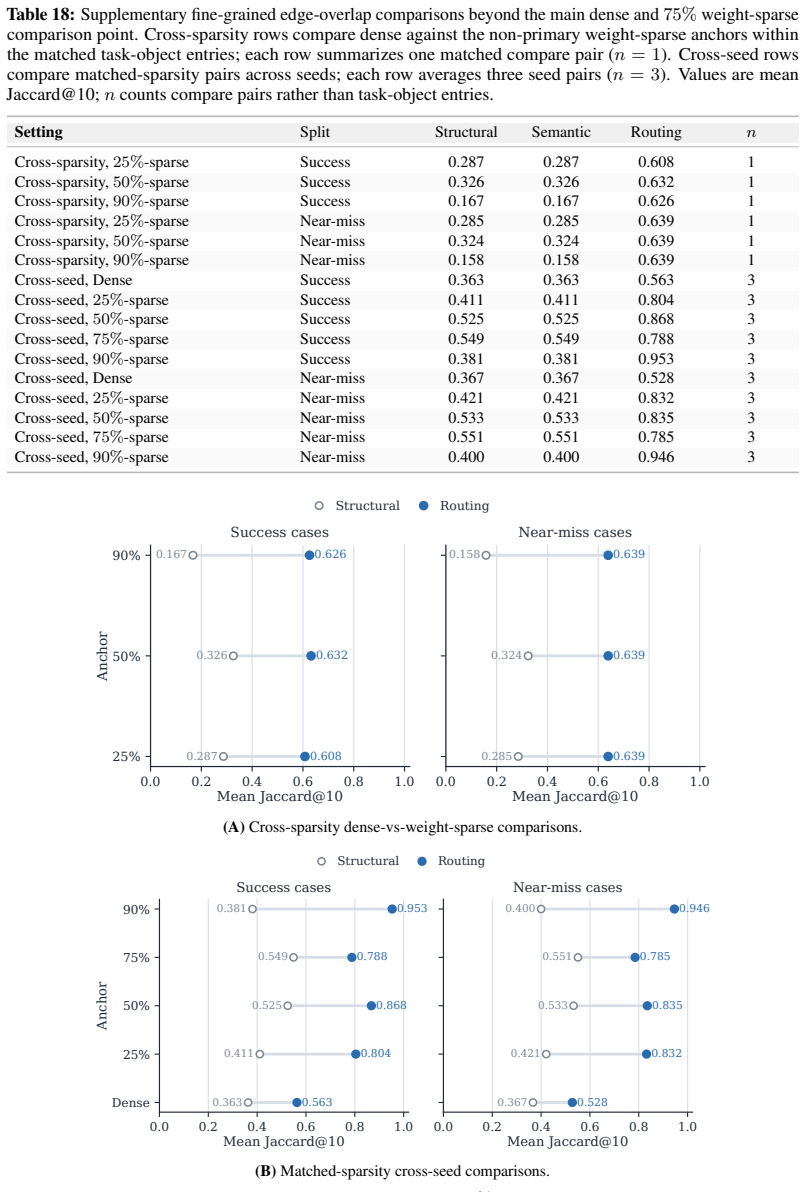
The paper's central discovery is that the same two checkpoints can be made to look as if they share a circuit, or not, purely by choosing the granularity at which the extracted graphs are compared. On the pre-specified dense versus 75% weight-sparse RL comparison, grouping top routing edges by attention head yields Jaccard@10 of 0.666 on the success split and 0.554 on the near-miss split, far above random top-k baselines of 0.199 and 0.185. Exact structural edge lists, by contrast, yield only 0.163 and 0.142; the near-miss edge overlap is at chance (p=0.106 against a 0.117 random baseline), while head-level overlap is clearly above chance. At the same time, object-level node-fraction summari
What carries the argument
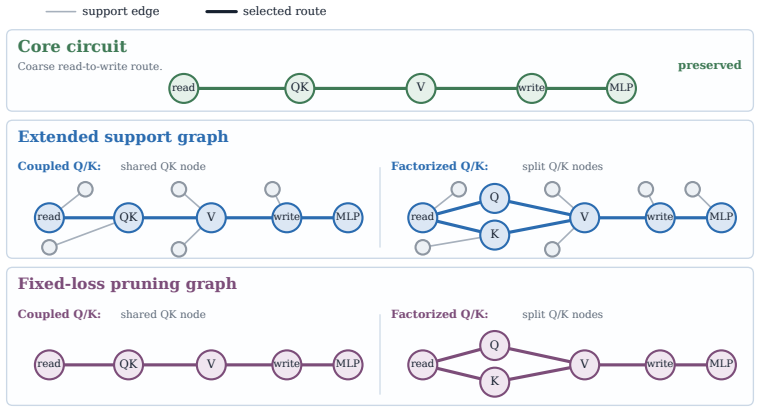
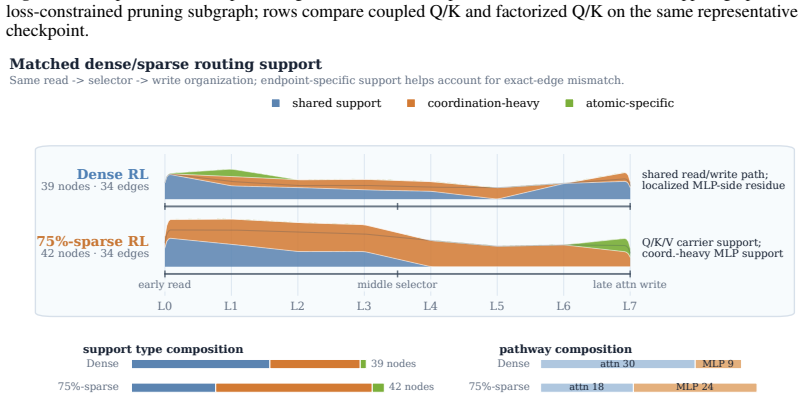
The load-bearing choice is the comparison level. The same extracted graph can be summarized either as an exact component-to-component edge list, formed by mapping edges to structural bundle IDs by layer, source/target membership category, and node family, or as a routing-head set, which groups top routing edges by attention-head identity before computing Jaccard@10. Both are measured against random top-k baselines and bootstrap intervals over 16 matched task-object entries per split. The benchmark—nine synthetic Lean tactic-prediction tasks with fixed proof rules and randomized names, distractors, and surface forms—is what lets differences between extracted circuits be attributed to extracti
Load-bearing premise
The claim that exact edges are not reproducible while attention-head sets are assumes that this synthetic setup—one 8-layer architecture, learned-mask extraction with post-ablation exact-match selection, and one edge-bundling convention—represents circuit extraction generally.
What would settle it
Re-run the dense-versus-75%-weight-sparse comparison with a different edge-bundling rule (for example, grouping edges by layer and attention head only, ignoring node family) or with a different pruning threshold; if exact-edge Jaccard@10 rises clearly above the random baseline while routing-head overlap stays high, the paper's central contrast between reproducible head sets and irreproducible edge lists would reverse.
If this is right
- Whether two checkpoints 'share a circuit' is not a settled fact about behavior; it is a statement about the comparison level, and the same pair can support opposite answers.
- Exact edge lists are not a dependable way to compare circuits across checkpoints in this setting: they hover near random overlap, while attention-head sets are substantially more reproducible.
- Object-level summaries—circuit size and the ranking of conditions by size—are robust to whether query and key support are merged or split, and to the tested loss-threshold range.
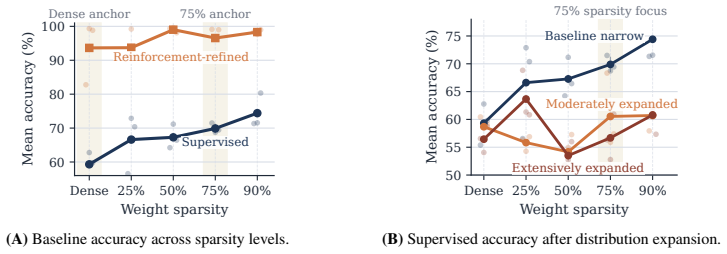
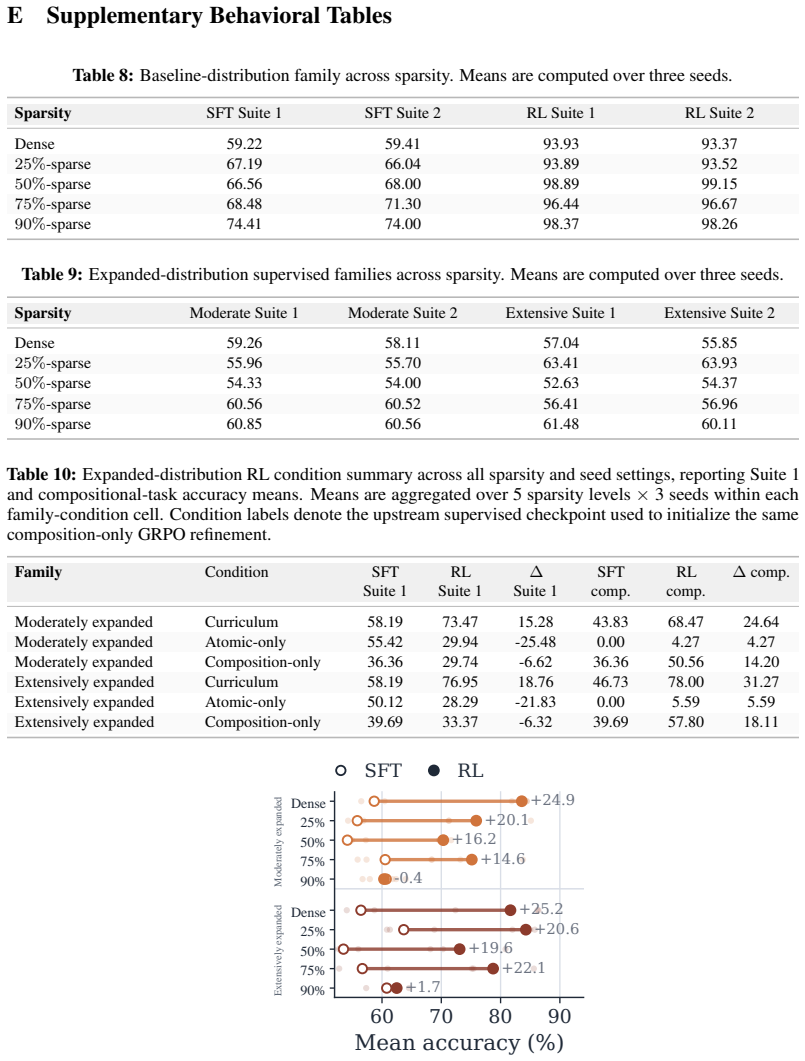
- In the RL comparisons, the largest compositional-task accuracy gains are accompanied by the largest fraction of circuit nodes outside the matched atomic-task circuits, as an observed association rather than a causal effect.
- Circuit-extraction studies should state which graph they report, how it was pruned, how attention heads are represented, and at what level the comparison is made, or the claim itself is under-specified.
Where Pith is reading between the lines
- If the coarse-versus-fine stability hierarchy holds more broadly, head-level or functional-path summaries should become the default for cross-checkpoint claims, and edge-level mismatches should be read as reporting artifacts rather than mechanistic differences.
- The reporting practice transfers naturally to other interpretability pipelines, such as activation patching or feature circuits: before publishing a circuit claim, one can audit whether changing the comparison granularity would reverse it.
- A testable extension is to run the same protocol on larger or heterogeneous architectures and check whether the exact-edge overlap stays near random while head-set overlap stays high; the paper's own cross-seed supplement already shows head-level above structural at every tested anchor.
- The bridge-fraction association suggests a cheap screening signal for whether RL will recruit structure beyond atomic circuits, but the paper's evidence rests on two curriculum cells, so a larger condition grid would be needed to turn that association into a quantitative rule.
Editorial analysis
A structured set of objections, weighed in public.
Referee Report
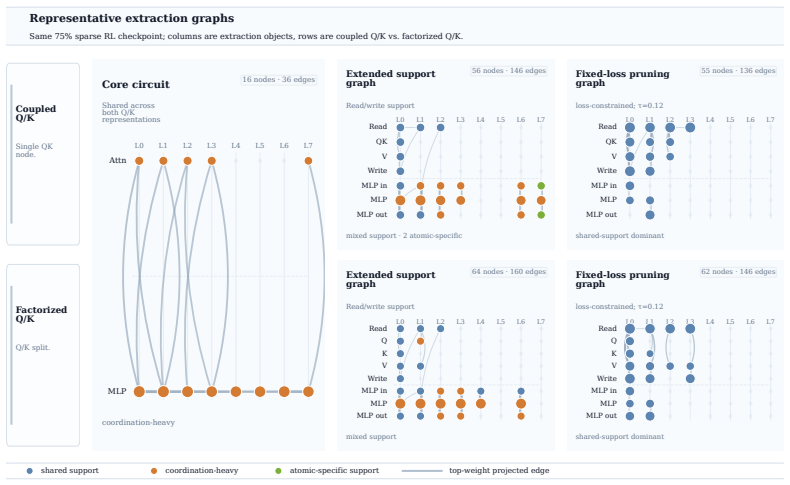
Summary. This paper argues that circuit-extraction claims are underdetermined by behavior preservation alone. In a synthetic Lean tactic-prediction benchmark with fixed proof rules and randomized surface form, the authors train dense and weight-sparse (25–90%) 8-layer transformers, extract three graph objects (core circuit, extended support graph, fixed-loss pruning graph) under coupled and factorized Q/K representations, and compare overlaps across dense/75%-sparse RL checkpoints. Finding 1: routing-head-set Jaccard@10 is high (0.666/0.554) while the reported 'exact-edge' structural Jaccard@10 is low (0.163/0.142, with near-miss not above a random baseline). Finding 2: Q/K factorization and loss-budget sweeps preserve RL-condition orderings by graph size. Finding 3: curriculum-initialized RL has the largest compositional gains and the largest core-circuit bridge fraction. The paper concludes by proposing a reporting practice that requires stating the extracted graph, extraction rule, pruning threshold, Q/K representation, and comparison level. Source code is released.
Significance. If the quantitative core holds, this is a valuable, carefully scoped empirical contribution: it demonstrates in a controlled setting that descriptive granularity can reverse whether two checkpoints appear to share a mechanism, and it provides bootstrap confidence intervals, Monte-Carlo random baselines, matched/mismatched/random negative controls, and explicit boundary tests. The proposed reporting practice is sensible and directly actionable for the circuit-extraction community. The main caveat is that the 'exact-edge' metric is not raw edge-to-edge identity as claimed in the abstract; the headline contrast therefore requires verification before the central claim can be accepted as stated.
major comments (2)
- [Section 3.4 / Table 11] The metric called 'exact-edge' or 'structural' Jaccard@10 is not a comparison of exact component-to-component edges. A structural bundle ID groups edges by layer, source membership category, target membership category, and source/target node family; membership category is a derived, checkpoint-dependent label (shared-with-atomic, reused-atomic, compositional-only). The same literal edge (same source and target component IDs at the same layer) can therefore receive different bundle IDs in the dense and 75%-sparse checkpoints because the atomic circuits differ. Since Finding 1 and the abstract contrast reproducible head sets with non-reproducible exact edge lists, the low structural Jaccard may be an artifact of the bundle-ID convention rather than of the edge structure itself. Please report the raw edge Jaccard (source node ID → target node ID), with and without top-10 truncation, for the
- [Section 4.2 / Table 15] The claim that the RL-condition orderings are 'preserved' rests on observed 3/3 agreement, but the bootstrap flip probability reaches 0.232 for the extensively expanded fixed-loss pruning graph (curriculum vs. composition-only). This means the ordering conclusion is not strongly supported in that cell; with only 15 sparsity-seed units, a failure to detect a flip is weak evidence of preservation. The paper should either provide a more powerful test or explicitly qualify the stability claim for this cell. The same caveat applies to the loss-budget sweep in Table 16, where no uncertainty is reported for the 3/3 agreements.
minor comments (4)
- [Abstract / Table 1] The phrase 'exact component-to-component edge overlap' is used in the abstract and Table 1, but Section 3.4 defines the metric over bundle IDs rather than raw edges. Terminology should be aligned once the raw edge metric is reported.
- [Table 18] In matched-sparsity cross-seed comparisons, structural Jaccard@10 is substantially higher (0.363–0.549) than in the dense-versus-75%-sparse comparison. The text should state explicitly that the 'exact edges do not reproduce' result is specific to cross-sparsity comparisons, not a global property of the two checkpoints.
- [Appendix H] The boundary tests show near-zero held-out transfer (0.4–6.7%), and Appendix J appropriately concedes the graph evidence is local. These are strengths in scoping, but the main text could point readers to Appendix J earlier to avoid over-generalization.
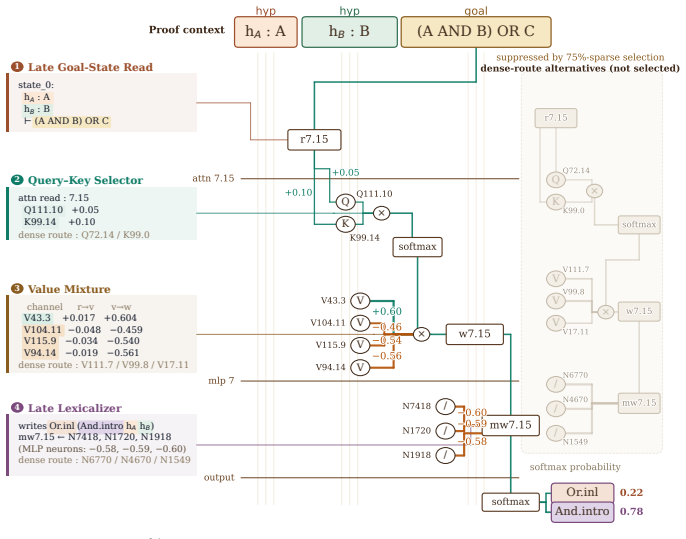
- [Figure 4 / Figure 11] The representative cases are selected by proximity to the pool mean, which is fine, but the caption should note that the figures are illustrative and that the aggregate evidence in Tables 11–16 is the basis for the quantitative claims.
Circularity Check
No significant circularity; the study is empirical, self-contained, and explicitly scopes its claims.
full rationale
This is an empirical paper, not a derivation: the reported overlaps, orderings, and bridge fractions are measured from fixed extraction pipelines with stated selection rules. The tau-sweep (Table 16) holds the fitted pruning ranking fixed while varying the loss budget, so ordering stability is a genuine sensitivity check rather than a fitted input relabeled as a prediction. There are no self-citations by the authors and no imported uniqueness theorem. The one metric-construction caveat is that 'structural' exact-edge Jaccard is computed on bundle IDs that include checkpoint-dependent membership categories (Section 3.4), so the low exact-edge overlap is not literally raw source/target edge identity and the paper never reports component-level edge Jaccard; however, this is a validity/operationalization limitation, not a case where a claimed result is equivalent by construction to its inputs. The paper itself flags the small n=16 graph-evidence scope in Appendix J and disclaims causal status for the bridge-fraction association (Section 4.3), and Appendix H documents that held-out shifts collapse. Consequently, no load-bearing circular step is present.
Axiom & Free-Parameter Ledger
free parameters (5)
- Fixed-loss pruning budget tau =
0.12 (main); swept 0.04-0.20
- Near-miss scoring weights =
0.5*token-acc + 0.3*first-tactic + 0.2*output-acc
- Top-k for Jaccard@10 =
k = 10
- Mask lambda_l0 and binarization threshold =
lambda_l0 = 0.05; threshold 0.5; pruning k-penalty 3e-5
- Graph-extraction anchor =
dense vs 75% weight-sparse
axioms (5)
- domain assumption Residual-stream node vocabulary (reads/writes, attention Q/K/V/write, MLP read/neuron/write) captures the model's mechanism
- domain assumption Exact-match tactic accuracy after ablation operationalizes 'behavior preserved'
- domain assumption Fixed proof-state generation rules make the atomic/compositional decomposition the 'true' task structure
- domain assumption GRPO with composition-only prompts is a valid RL refinement
- standard math Jaccard, bootstrap, and Monte-Carlo baselines are unbiased for comparing circuits
read the original abstract
Circuit extraction identifies a small set of model components whose presence preserves a target behavior under ablation, and the resulting circuit is often read as the mechanism behind that behavior. We argue that this reading is under-determined: preserving behavior does not single out one circuit, because the claim it supports depends on which circuit is reported and how two circuits are compared. We make this concrete in a synthetic Lean tactic-prediction benchmark -- predicting the next step of a proof -- where fixed proof rules with randomized surface form let differences between extracted circuits be attributed to these choices rather than to the task. Across dense and weight-sparse checkpoints (most weights constrained to zero) of the same transformer, evaluated on atomic (single-rule) and compositional (multi-rule) proofs, we vary which extracted object is reported (a compact prediction-preserving circuit, a broader graph that also keeps surrounding read, write, and routing structure, or the smallest subgraph meeting a post-ablation loss threshold), and whether each attention head's query and key are represented jointly or separately. Exact component-to-component edge overlap is low and sensitive to these choices, at times dropping to a random baseline, while two coarser summaries stay stable: the set of selected attention heads, and the circuit-size ranking of conditions that differ in which supervised checkpoint initializes reinforcement learning (RL). The largest accuracy gains from RL on compositional proofs come with the most structure beyond the atomic circuits. A circuit-level claim is therefore well defined only once one states which circuit is reported, the pruning threshold used to extract it, and the level at which circuits are compared. We distill these requirements into a reporting practice for circuit-extraction studies.
Figures




Reference graph
Works this paper leans on
-
[1]
Finding transformer circuits with edge pruning
Adithya Bhaskar, Alexander Wettig, Dan Friedman, and Danqi Chen. Finding transformer circuits with edge pruning. In Advances in Neural Information Processing Systems, volume 37, 2024. doi:10.52202/079017-0587
-
[2]
Metaxas, Zhaoran Wang, Yutao Yue, and Gerald Penn
Xi Chen, Mingyu Jin, Jingcheng Niu, Yutong Yin, Jinman Zhao, Bangwei Guo, Dimitris N. Metaxas, Zhaoran Wang, Yutao Yue, and Gerald Penn. All circuits lead to rome: Rethinking functional anisotropy in circuit and sheaf discovery for LLMs . arXiv preprint arXiv:2605.12671, 2026. URL https://arxiv.org/abs/2605.12671
Pith/arXiv arXiv 2026
-
[3]
Transformers as soft reasoners over language
Peter Clark, Oyvind Tafjord, and Kyle Richardson. Transformers as soft reasoners over language. In Proceedings of the Twenty-Ninth International Joint Conference on Artificial Intelligence, pages 3882--3890, 2020. doi:10.24963/ijcai.2020/537
-
[4]
Mavor-Parker, Aengus Lynch, Stefan Heimersheim, and Adri \`a Garriga-Alonso
Arthur Conmy, Augustine N. Mavor-Parker, Aengus Lynch, Stefan Heimersheim, and Adri \`a Garriga-Alonso. Towards automated circuit discovery for mechanistic interpretability. In Advances in Neural Information Processing Systems, volume 36, 2023
2023
-
[5]
Sparse interventions in language models with differentiable masking
Nicola De Cao, Leon Schmid, Dieuwke Hupkes, and Ivan Titov. Sparse interventions in language models with differentiable masking. In Proceedings of the Fifth BlackboxNLP Workshop on Analyzing and Interpreting Neural Networks for NLP, pages 16--27, 2022. doi:10.18653/v1/2022.blackboxnlp-1.2
-
[6]
Sparse attention post-training for mechanistic interpretability
Florent Draye, Anson Lei, Hsiao-Ru Pan, Ingmar Posner, and Bernhard Sch \"o lkopf. Sparse attention post-training for mechanistic interpretability. arXiv preprint arXiv:2512.05865, 2025
Pith/arXiv arXiv 2025
-
[7]
Transcoders find interpretable LLM feature circuits
Jacob Dunefsky, Philippe Chlenski, and Neel Nanda. Transcoders find interpretable LLM feature circuits. In Advances in Neural Information Processing Systems, volume 37, pages 24375--24410, 2024. doi:10.52202/079017-0768
-
[8]
Bootstrap methods: another look at the jackknife
Bradley Efron. Bootstrap methods: another look at the jackknife. The Annals of Statistics, 7 0 (1): 0 1--26, 1979. doi:10.1214/aos/1176344552
arXiv 1979
-
[9]
A mathematical framework for transformer circuits
Nelson Elhage, Neel Nanda, Catherine Olsson, Tom Henighan, Nicholas Joseph, Ben Mann, Amanda Askell, Yuntao Bai, Anna Chen, Tom Conerly, Nova DasSarma, Dawn Drain, Deep Ganguli, Zac Hatfield-Dodds, Danny Hernandez, Andy Jones, Jackson Kernion, Liane Lovitt, Kamal Ndousse, Dario Amodei, Tom Brown, Jack Clark, Jared Kaplan, Sam McCandlish, and Chris Olah. A...
2021
-
[10]
Weight-sparse transformers have interpretable circuits
Leo Gao, Achyuta Rajaram, Jacob Coxon, Soham V Govande, Bowen Baker, and Dan Mossing. Weight-sparse transformers have interpretable circuits. arXiv preprint arXiv:2511.13653, 2025
arXiv 2025
-
[11]
Causal abstraction: A theoretical foundation for mechanistic interpretability
Atticus Geiger, Duligur Ibeling, Amir Zur, Maheep Chaudhary, Sonakshi Chauhan, Jing Huang, Aryaman Arora, Zhengxuan Wu, Noah Goodman, Christopher Potts, and Thomas Icard. Causal abstraction: A theoretical foundation for mechanistic interpretability. Journal of Machine Learning Research, 26 0 (83): 0 1--64, 2025
2025
-
[12]
Localizing model behavior with path patching
Nicholas Goldowsky-Dill, Chris MacLeod, Lucas Sato, and Aryaman Arora. Localizing model behavior with path patching. arXiv preprint arXiv:2304.05969, 2023
Pith/arXiv arXiv 2023
-
[13]
InterpBench : Semi-synthetic transformers for evaluating mechanistic interpretability techniques
Rohan Gupta, Iv \'a n Arcuschin, Thomas Kwa, and Adri \`a Garriga-Alonso. InterpBench : Semi-synthetic transformers for evaluating mechanistic interpretability techniques. In Advances in Neural Information Processing Systems, volume 37, 2024. doi:10.52202/079017-2950
-
[14]
Rae, Oriol Vinyals, and Laurent Sifre
Jordan Hoffmann, Sebastian Borgeaud, Arthur Mensch, Elena Buchatskaya, Trevor Cai, Eliza Rutherford, Diego de Las Casas, Lisa Anne Hendricks, Johannes Welbl, Aidan Clark, Tom Hennigan, Eric Noland, Katie Millican, George van den Driessche, Bogdan Damoc, Aurelia Guy, Simon Osindero, Karen Simonyan, Erich Elsen, Jack W. Rae, Oriol Vinyals, and Laurent Sifre...
Pith/arXiv arXiv 2022
-
[15]
Dieuwke Hupkes, Verna Dankers, Mathijs Mul, and Elia Bruni. Compositionality decomposed: How do neural networks generalise? Journal of Artificial Intelligence Research, 67: 0 757--795, 2020. doi:10.1613/jair.1.11674
-
[16]
\'E tude comparative de la distribution florale dans une portion des alpes et des jura
Paul Jaccard. \'E tude comparative de la distribution florale dans une portion des alpes et des jura. Bulletin de la Soci \'e t \'e Vaudoise des Sciences Naturelles , 37: 0 547--579, 1901
1901
-
[17]
Brown, Benjamin Chess, Rewon Child, Scott Gray, Alec Radford, Jeffrey Wu, and Dario Amodei
Jared Kaplan, Sam McCandlish, Tom Henighan, Tom B. Brown, Benjamin Chess, Rewon Child, Scott Gray, Alec Radford, Jeffrey Wu, and Dario Amodei. Scaling laws for neural language models. arXiv preprint arXiv:2001.08361, 2020. URL https://arxiv.org/abs/2001.08361
Pith/arXiv arXiv 2001
-
[18]
Measuring compositional generalization: A comprehensive method on realistic data
Daniel Keysers, Nathanael Sch \"a rli, Nathan Scales, Hylke Buisman, Daniel Furrer, Sergii Kashubin, Nikola Momchev, Danila Sinopalnikov, Lukasz Stafiniak, Tibor Tihon, Dmitry Tsarkov, Xiao Wang, Marc van Zee, and Olivier Bousquet. Measuring compositional generalization: A comprehensive method on realistic data. In International Conference on Learning Rep...
2020
-
[19]
Cogs: A compositional generalization challenge based on semantic interpretation
Najoung Kim and Tal Linzen. Cogs: A compositional generalization challenge based on semantic interpretation. In Proceedings of the 2020 Conference on Empirical Methods in Natural Language Processing (EMNLP), pages 9087--9105, 2020. doi:10.18653/v1/2020.emnlp-main.731
-
[20]
AtP* : An efficient and scalable method for localizing LLM behaviour to components
J \'a nos Kram \'a r, Tom Lieberum, Rohin Shah, and Neel Nanda. AtP* : An efficient and scalable method for localizing LLM behaviour to components. arXiv preprint arXiv:2403.00745, 2024
Pith/arXiv arXiv 2024
-
[21]
The disagreement problem in explainable machine learning: A practitioner's perspective
Satyapriya Krishna, Tessa Han, Alex Gu, Steven Wu, Shahin Jabbari, and Himabindu Lakkaraju. The disagreement problem in explainable machine learning: A practitioner's perspective. arXiv preprint arXiv:2202.01602, 2022. URL https://arxiv.org/abs/2202.01602
Pith/arXiv arXiv 2022
-
[22]
Lake and Marco Baroni
Brenden M. Lake and Marco Baroni. Generalization without systematicity: On the compositional skills of sequence-to-sequence recurrent networks. In Proceedings of the 35th International Conference on Machine Learning, volume 80 of Proceedings of Machine Learning Research, pages 2873--2882, 2018
2018
-
[23]
Tracr: Compiled transformers as a laboratory for interpretability
David Lindner, J \'a nos Kram \'a r, Sebastian Farquhar, Matthew Rahtz, Tom McGrath, and Vladimir Mikulik. Tracr: Compiled transformers as a laboratory for interpretability. In Advances in Neural Information Processing Systems, 2023
2023
-
[24]
Michaud, Yonatan Belinkov, David Bau, and Aaron Mueller
Samuel Marks, Can Rager, Eric J. Michaud, Yonatan Belinkov, David Bau, and Aaron Mueller. Sparse feature circuits: Discovering and editing interpretable causal graphs in language models. In International Conference on Learning Representations, 2025
2025
-
[25]
Maxime M \'e loux, Silviu Maniu, Fran c ois Portet, and Maxime Peyrard. Everything, everywhere, all at once: Is mechanistic interpretability identifiable? arXiv preprint arXiv:2502.20914, 2025 a . URL https://arxiv.org/abs/2502.20914
Pith/arXiv arXiv 2025
-
[26]
Mechanistic interpretability as statistical estimation: A variance analysis
Maxime M \'e loux, Fran c ois Portet, and Maxime Peyrard. Mechanistic interpretability as statistical estimation: A variance analysis. arXiv preprint arXiv:2510.00845, 2025 b . URL https://arxiv.org/abs/2510.00845
Pith/arXiv arXiv 2025
-
[27]
Transformer circuit evaluation metrics are not robust
Joseph Miller, Bilal Chughtai, and William Saunders. Transformer circuit evaluation metrics are not robust. In First Conference on Language Modeling, 2024. URL https://openreview.net/forum?id=zSf8PJyQb2
2024
-
[28]
Circuit compositions: Exploring modular structures in transformer-based language models
Philipp Mondorf, Sondre Wold, and Barbara Plank. Circuit compositions: Exploring modular structures in transformer-based language models. In Proceedings of the 63rd Annual Meeting of the Association for Computational Linguistics (Volume 1: Long Papers), pages 14934--14955, 2025. doi:10.18653/v1/2025.acl-long.727
-
[29]
MIB : A mechanistic interpretability benchmark
Aaron Mueller, Atticus Geiger, Sarah Wiegreffe, Dana Arad, Iv \'a n Arcuschin, Adam Belfki, Yik Siu Chan, Jaden Fried Fiotto-Kaufman, Tal Haklay, Michael Hanna, Jing Huang, Rohan Gupta, Yaniv Nikankin, Hadas Orgad, Nikhil Prakash, Anja Reusch, Aruna Sankaranarayanan, Shun Shao, Alessandro Stolfo, Martin Tutek, Amir Zur, David Bau, and Yonatan Belinkov. MI...
2025
-
[30]
A pragmatic vision for interpretability
Neel Nanda, Josh Engels, Arthur Conmy, Senthooran Rajamanoharan, Bilal Chughtai, Callum McDougall, J \'a nos Kram \'a r, and Lewis Smith. A pragmatic vision for interpretability. Alignment Forum, 2025. URL https://www.alignmentforum.org/posts/StENzDcD3kpfGJssR/a-pragmatic-vision-for-interpretability
2025
-
[31]
Fine-tuning enhances existing mechanisms: A case study on entity tracking
Nikhil Prakash, Tamar Rott Shaham, Tal Haklay, Yonatan Belinkov, and David Bau. Fine-tuning enhances existing mechanisms: A case study on entity tracking. In International Conference on Learning Representations, 2024. URL https://arxiv.org/abs/2402.14811
Pith/arXiv arXiv 2024
-
[32]
Beyond accuracy: Behavioral testing of nlp models with checklist
Marco Tulio Ribeiro, Tongshuang Wu, Carlos Guestrin, and Sameer Singh. Beyond accuracy: Behavioral testing of nlp models with checklist. In Proceedings of the 58th Annual Meeting of the Association for Computational Linguistics, pages 4902--4912, 2020. doi:10.18653/v1/2020.acl-main.442
-
[33]
Laura Ruis, Jacob Andreas, Marco Baroni, Diane Bouchacourt, and Brenden M. Lake. A benchmark for systematic generalization in grounded language understanding. In Advances in Neural Information Processing Systems, 2020
2020
-
[34]
Zhihong Shao, Peiyi Wang, Qihao Zhu, Runxin Xu, Junxiao Song, Xiao Bi, Haowei Zhang, Mingchuan Zhang, Y. K. Li, Y. Wu, and Daya Guo. DeepSeekMath : Pushing the limits of mathematical reasoning in open language models. arXiv preprint arXiv:2402.03300, 2024. URL https://arxiv.org/abs/2402.03300
Pith/arXiv arXiv 2024
-
[35]
Claudia Shi, Nicolas Beltran-Velez, Achille Nazaret, Carolina Jiang Zheng, Adri \`a Garriga-Alonso, Andrew Jesson, Maggie Makar, and David M. Blei. Hypothesis testing the circuit hypothesis in LLM s. In Advances in Neural Information Processing Systems, volume 37, 2024. URL https://proceedings.neurips.cc/paper_files/paper/2024/hash/abccb8a90b30d45b948360b...
2024
-
[36]
ProofWriter : Generating implications, proofs, and abductive statements over natural language
Oyvind Tafjord, Bhavana Dalvi, and Peter Clark. ProofWriter : Generating implications, proofs, and abductive statements over natural language. In Findings of the Association for Computational Linguistics: ACL-IJCNLP 2021, pages 3621--3634, 2021. doi:10.18653/v1/2021.findings-acl.317
-
[37]
LLM circuit analyses are consistent across training and scale
Curt Tigges, Michael Hanna, Qinan Yu, and Stella Biderman. LLM circuit analyses are consistent across training and scale. In Advances in Neural Information Processing Systems, volume 37, 2024. doi:10.52202/079017-1287. URL https://proceedings.neurips.cc/paper_files/paper/2024/hash/47c7edadfee365b394b2a3bd416048da-Abstract-Conference.html
-
[38]
Interpretability in the wild: A circuit for indirect object identification in GPT-2 Small
Kevin Ro Wang, Alexandre Variengien, Arthur Conmy, Buck Shlegeris, and Jacob Steinhardt. Interpretability in the wild: A circuit for indirect object identification in GPT-2 Small . In The Eleventh International Conference on Learning Representations, 2023. URL https://openreview.net/forum?id=NpsVSN6o4ul
2023
-
[39]
Manning, and Christopher Potts
Zhengxuan Wu, Christopher D. Manning, and Christopher Potts. ReCOGS : How incidental details of a logical form overshadow an evaluation of semantic interpretation. Transactions of the Association for Computational Linguistics, 11: 0 1719--1733, 2023. doi:10.1162/tacl_a_00623
-
[40]
Swope, Alex Gu, Rahul Chalamala, Peiyang Song, Shixing Yu, Saad Godil, Ryan Prenger, and Anima Anandkumar
Kaiyu Yang, Aidan M. Swope, Alex Gu, Rahul Chalamala, Peiyang Song, Shixing Yu, Saad Godil, Ryan Prenger, and Anima Anandkumar. LeanDojo : Theorem proving with retrieval-augmented language models. In Thirty-seventh Conference on Neural Information Processing Systems Datasets and Benchmarks Track, 2023
2023
-
[41]
Sheaf discovery with joint computation graph pruning and flexible granularity
Lei Yu, Jingcheng Niu, Zining Zhu, Xi Chen, and Gerald Penn. Sheaf discovery with joint computation graph pruning and flexible granularity. In Proceedings of the 2025 Conference on Empirical Methods in Natural Language Processing, pages 8822--8837. Association for Computational Linguistics, 2025. doi:10.18653/v1/2025.emnlp-main.446. URL https://aclantholo...
discussion (0)
Sign in with ORCID, Apple, or X to comment. Anyone can read and Pith papers without signing in.