REVIEW 2 major objections 4 minor 20 references
Imaging through a rough interface is governed by a single blurring length, βint, that grows linearly with distance from the object to the interface.
Reviewed by Pith at T0; open to challenge. T0 means a machine referee read the full paper against a public rubric. the ladder, T0–T4 →
T0 review · deepseek-v4-flash
2026-08-01 13:48 UTC pith:BPIUQY7G
load-bearing objection The second-order imaging theory and the βint parameter are solid and worth reading; the optical SNR section rests on an invalid fourth-order moment in Appendix D and should not be trusted as-is. the 2 major comments →
Imaging through rough interfaces: The shower curtain effect
The pith
A machine-rendered reading of the paper's core claim, the machinery that carries it, and where it could break.
Core claim
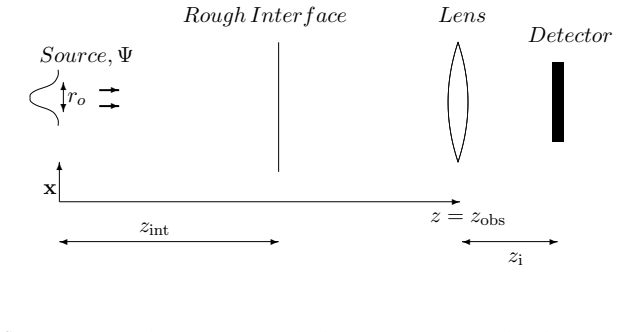
For a monochromatic paraxial source imaged through a single rough interface separating two homogeneous media, the paper derives a reduced observation model in which all random scattering enters through the operator Kε(τ,k,k′) = (2π)^(−2)∫ e^{i(k′−k)·x} e^{iτV(x/ε^{γ−1/2})} dx. In the critical regime γ=1/2 with strong scattering, the fourth-order statistics of this operator converge to a universal form that depends on the interface only through D, the curvature of its covariance at zero. As a consequence, the mean optical image is the ideal image convolved with a Gaussian kernel of width βint, and images at different frequencies fluctuate as if a single Gaussian random displacement were appli
What carries the argument
The load-bearing object is the interface scattering operator Kε(τ,k,k′), which maps a transverse Fourier mode k′ to k with random phase τV(x/ε^{γ−1/2}); the value τ = ωo|s0−s1| fixes the medium contrast. The critical step is the evaluation of the fourth moment of Kε in the strong-scattering limit using the local quadratic expansion of the covariance, C(x) ≈ C(0) − D|x|²/2, for a Gaussian V. This yields a universal Gaussian factor exp(−|Δ|²/(2τ²D))/(2πτ²D) with momentum-conserving delta functions, which in turn produces the Gaussian blur kernel of width βint and the representation of all image fluctuations by one effective Gaussian displacement X. The same kernel κ(Δk,k) already controls the
Load-bearing premise
The Gaussian blur formula and especially the SNR and covariance results assume the interface fluctuations are Gaussian and that their covariance is locally quadratic at the scattering scale; that quadratic-Gaussian condition is stated in Appendix D and is not guaranteed by the paper's general Assumption 1.
What would settle it
Take a point-like or chartered source, a rough interface with known D, and vary the object–interface distance zint while recording the image width and the covariance of images at two colors. If the blur width does not grow as zint|1−c0/c1|√D, or if the two-color covariance is not equivalent to a single Gaussian displacement (for instance, if frequency diversity decorrelates the fluctuations), the central claim fails. A targeted version uses a non-Gaussian rough surface with the same D: the mean image should still be Gaussian-blurred, but the SNR should deviate from the paper's formula.
If this is right
- Image blur grows linearly with object–interface distance: βint = zint |1−c0/c1| √D, so placing the scattering layer close to the object restores resolution while leaving the layer itself unchanged.
- In the strong-scattering critical regime the image statistics become frequency-independent and universal; neither multifrequency averaging nor local spatial smoothing reduces the fluctuations because a single random Gaussian displacement drives them.
- Optical intensity-only imaging is far more robust than matched-field imaging: random phase distortions barely affect intensity, so the dominant effect is the βint blur rather than phase noise.
- In the rapidly varying interface regime the image shape is preserved but contrast is reduced by |φV(Δk)|², while in the slowly varying regime the image approaches the flat-interface result; only the critical regime produces simultaneous blur and fluctuations.
Where Pith is reading between the lines
- The universality suggests a simple calibration strategy: measure the blur at one object distance and one contrast, extract D, and predict resolution and SNR at any other geometry without knowing the full interface spectrum.
- The same fourth-moment machinery should extend to stacked rough interfaces; if the βint contributions add in quadrature, a multilayer curtain would behave like one effective rough interface, which could be tested numerically.
- Because the randomness is effectively one-dimensional (a common displacement X), methods that scan frequency or detector position will not decorrelate the noise; only changing the interface realization itself—moving the curtain—can average it out.
- The mean Gaussian blur may survive for non-Gaussian interface fluctuations, but the SNR formula and the conclusion about averaging should not; an experiment comparing Gaussian and engineered non-Gaussian surfaces would separate the robust geometric part from the model-dependent part.
Editorial analysis
A structured set of objections, weighed in public.
Referee Report
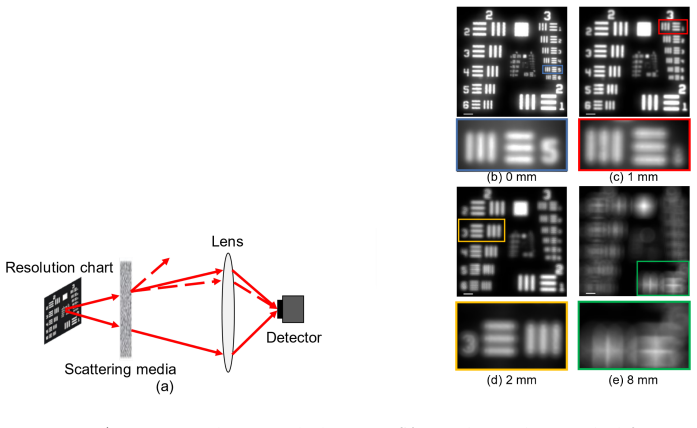
Summary. The manuscript develops an asymptotic theory of passive imaging through a single random rough interface in the paraxial, high-frequency regime. The source is a localized beam; the interface is modeled as a stationary random surface with amplitude σ and correlation length l_c, parameterized by a scaling exponent γ. The authors derive the transmitted field in terms of a random scattering operator, then analyze matched-field and optical imaging. In the critical scaling γ=1/2 and the strong-scattering regime, they claim that the optical image is the ideal image blurred by a Gaussian kernel of width β_int = z_int |1−c0/c1| √D, and that the image covariance is universal and driven by a single effective Gaussian displacement, so that frequency/position averaging is ineffective. A comparison with a published USAF-chart experiment shows approximately linear growth of the blur with source–interface separation.
Significance. If the fourth-order claims are correct, the paper would provide a rare tractable rough-interface model for the shower-curtain effect, with explicit formulas for resolution and SNR and a single dimensionless parameter β_int/ℓ_Ψ. The second-order matched-field and optical mean-image derivations are self-contained and have useful internal checks (flat-interface limit, the three γ-regimes). The manuscript also makes a concrete, falsifiable prediction—linear scaling of the blur with z_int—and connects it to data. However, the fourth-order statistical foundation is not sound in its current form, and the central 'universal Gaussian covariance' claim depends on that foundation.
major comments (2)
- [Appendix D, eqs. (D1)–(D3) and Proposition 4.2] The proof of the fourth-order moment is invalid. For S = V(0) − V(y1) − aV(y2) + aV(y3), on the noncompact manifold y1 = 0, y2 = y3 = R, S ≡ 0 for every R, so the characteristic function is identically 1 there. Near this manifold with |R| large, Var(S) ≈ D|y1|^2 + a^2 D|y2−y3|^2, not D|y1 + a(y2−y3)|^2; the cross term in the latter is absent when y2,y3 are outside the correlation length of the origin. Replacing the covariance by its local quadratic expansion for all y1,y2,y3 in (D3), then integrating over u = y2, v = y3, produces the extra delta δ(a(k′−k) − (k̃′−k̃)) in (45) and suppresses a separate Gaussian factor in the second momentum transfer. This is not a Gaussianity issue: the same failure occurs for Gaussian V with finite correlation length. Since Proposition 4.3’s covariance formula, Eqs. (47)–(48), and the SNR conclusions in Eq. (49) and Discussion 4.2 are direct consequences
- [Appendix D, Proposition D.1 vs §4.1] Proposition D.1 is stated for V satisfying only Assumption 1, but the proof uses Gaussianity at the step leading to (D3) ('as the interface fluctuations V are assumed to be Gaussian'). The Gaussian assumption is introduced informally in the text of §4.1, and the introduction claims that fourth-order statistics are computed 'without requiring a Gaussian approximation.' This is internally inconsistent. If the fourth-moment result is intended only for Gaussian V, the proposition statement, the text, and the abstract-level claims of universality must be revised accordingly.
minor comments (4)
- [Eq. (14)] The displayed identity T = 2s0/(s0+s1) = 2c0/(c0+c1) is algebraically false: with s_j = 1/c_j, one has 2s0/(s0+s1) = 2c1/(c0+c1), as correctly used in Appendix B. Please correct the displayed equality.
- [Example 1.1 Revisited and Figure 5] The linear fit α = 0.1 is used without error bars or a goodness-of-fit measure. The comparison is acceptable as an illustration, but the text should not describe it as 'direct evidence' without at least a rough quantitative assessment of the fit uncertainty.
- [Proof of Proposition 4.3, §4.1] The proof is only an outline; after applying Proposition 4.2, the text says 'then we can conclude in a similar fashion' and does not display the intermediate reduction. Given that the result is central, a fuller derivation (or a reference to a complete appendix) is needed.
- [Appendix D, notation] The curvature parameter D is defined in Remark 3.1 as −C″(0) and in Appendix D as −ρ″(0) σ_V^2/ℓ_V^2. These are consistent under the Gaussian model, but the notation should be harmonized to avoid confusion.
Circularity Check
Central derivation is self-contained; no circular reduction found. Only minor self-citations and a fitted experimental comparison appear, neither of which is load-bearing.
full rationale
The paper's main derivation chain is not circular. It starts from the wave equation and the rough-interface model, derives the effective scattering operator Kε (Appendix B), then computes second-order moments (Propositions 3.1, 3.2, 4.1) and a fourth-order moment (Appendix D) under explicit asymptotic assumptions. The Gaussian blurring kernel in (46) is obtained by a Laplace-type asymptotic evaluation of the covariance curvature parameter D, not by inserting the claimed blur as an input. βint is a derived combination of zint, contrast, and D; its reappearance in (46) and (49) is a consequence of the calculation, not a definitional tautology. The flat-interface limits (ϕV ≡ 1, κ(τ,k)=δ(k), βint=0) provide internal consistency checks. Reference [8] is by the same authors, but the paper reproduces the main steps in Appendices A.2 and B, so the self-citation is methodological rather than load-bearing. The experimental comparison in Section 4.2 uses a fitted slope α = 0.1 for βint = αzint; this is a consistency check with one free parameter, not a parameter-free confirmation, but it is ancillary and does not enter the derivation of the imaging formulas. The possible mathematical flaw in Appendix D, and the discrepancy between Proposition D.1's statement (Assumption 1 only) and the Gaussian assumption used in its proof, are correctness risks, not circularity.
Axiom & Free-Parameter Ledger
free parameters (2)
- experimental slope α =
0.1 (blur in mm per source separation in mm)
- scaling constant γ* in Appendix C =
O(1), unspecified
axioms (7)
- domain assumption Interface random field V is mean-zero, stationary, isotropic, bounded, rapidly mixing, smooth, with bounded second derivatives (Assumption 1).
- domain assumption Source profile Ψ is smooth and rapidly decaying (Assumption 2).
- domain assumption High-frequency paraxial scaling with ε≪1, r0∼√εL0, σ∼λ, and lc∼r0 in the critical regime γ=1/2.
- domain assumption Field and normal derivative are continuous across the rough interface (eq. 13); no shadowing or multiple-scattering at the interface.
- domain assumption The transmitted field across the interface is, at leading order, the incident field times T e^{iωo(s0−s1)Δz(x)} (Appendix B, eq. B5): a pure random phase-screen model.
- domain assumption V is Gaussian for the fourth-order moment and explicit examples (Section 4.1, Prop. 4.2; Appendix D).
- standard math Strong-scattering regime |σVΔk|≫1 and Laplace approximation with local quadratic expansion of the covariance (eq. 38, Appendix C).
read the original abstract
The quality of an image observed through a scattering layer, such as a shower curtain, depends strongly on the relative position of the scattering layer between the object and the observer. This well-known phenomenon is commonly referred to as the shower curtain effect. When the scattering layer is placed close to the observer, the image is strongly degraded, whereas if it is located close to the object, the object may still be observed with relatively high resolution. Previous analyses of the shower curtain effect have primarily modeled the scattering layer as a section of a random medium. In this work, we present a new analysis in which the scattering layer is modeled instead as a rough interface, a description that arises naturally in many physical configurations. Within this framework, we derive explicit characterizations of both the image resolution and the signal-to-noise ratio, and determine how these quantities depend on the statistical properties of the rough interface and on its relative location between the object and the observer.
Figures



Reference graph
Works this paper leans on
-
[1]
Acoustic scattering models from rough surfaces: A brief review and recent advances
Darmon M, Dorval V, Baqu´ e F. Acoustic scattering models from rough surfaces: A brief review and recent advances. Applied Sciences. 2020;10:8305
2020
-
[2]
Experimental investigation of the influence of the relative position of the scattering layer on image quality: The shower curtain effect
Dror I, Sandrov A, Kopeika NS. Experimental investigation of the influence of the relative position of the scattering layer on image quality: The shower curtain effect. Applied Optics. 1998;37:6495–6499
1998
-
[3]
Optical imaging through dynamic turbid media using the Fourier-domain shower-curtain effect
Edrei E, Scarcell, G. Optical imaging through dynamic turbid media using the Fourier-domain shower-curtain effect. Optica. 2016;3:71–74
2016
-
[4]
A critical survey of approximate scattering wave the- ories from random rough surfaces
Elfouhaily TM, Gu´ erin CA. A critical survey of approximate scattering wave the- ories from random rough surfaces. Waves in Random Media. 2004;14:R1–R40
2004
-
[5]
Wave Propagation and Time Reversal in Randomly Layered Media
Fouque, JP, Garnier J, Papanicolaou G, Sølna K. Wave Propagation and Time Reversal in Randomly Layered Media. Springer, New York; 2007
2007
-
[6]
Light scattering by periodic rough sur- faces: Equivalent jump conditions
Gallas B, Maurel A, Marigo JJ, Ourir A. Light scattering by periodic rough sur- faces: Equivalent jump conditions. Journal of the Optical Society of America A. 2017;34:2181–2188
2017
-
[7]
Shower curtain effect and source imaging
Garnier J, Sølna K. Shower curtain effect and source imaging. Inverse Problems and Imaging. 2024;18:993–1023
2024
-
[8]
Generalized Snell’s laws for rough interfaces
Gomez C, Sølna K. Generalized Snell’s laws for rough interfaces. 2026;arXiv:2603.17488. 29
arXiv 2026
-
[9]
Wave Propagation and Scattering in Random Media
Ishimaru A. Wave Propagation and Scattering in Random Media. Vols. I–II. Aca- demic Press, New York; 1978
1978
-
[10]
Wave propagation and scattering in random media and rough sur- faces
Ishimaru A. Wave propagation and scattering in random media and rough sur- faces. Proceedings of the IEEE. 1991;79:1359–1366
1991
-
[11]
Time reversal effects in random scatter- ing media on superresolution, shower curtain effects, and backscattering enhance- ment
Ishimaru A, Jaruwatanadilok S, Kuga Y. Time reversal effects in random scatter- ing media on superresolution, shower curtain effects, and backscattering enhance- ment. Radio Science. 2007;42:RS1001
2007
-
[12]
Optical imaging through clouds and fog
Jaruwatanadilok S, Ishimaru A, Kuga Y. Optical imaging through clouds and fog. IEEE Transactions on Geoscience and Remote Sensing. 2003;41:1834–1843
2003
-
[13]
Modulation transfer function of layered inhomogeneous random media using the small-angle approximation
Kuga Y, Ishimaru A. Modulation transfer function of layered inhomogeneous random media using the small-angle approximation. Applied Optics. 1986;25:4382– 4385
1986
-
[14]
Electromagnetic scattering by unbounded rough surfaces
Li P, Wu H, Zheng W. Electromagnetic scattering by unbounded rough surfaces. SIAM Journal on Mathematical Analysis. 2011;43:1205–1231
2011
-
[15]
Homogenization of rough boundaries and interfaces
Nevard J, Keller JB. Homogenization of rough boundaries and interfaces. SIAM Journal on Applied Mathematics . 1997;57:1660–1686
1997
-
[16]
Super-resolution imaging with large field of view for distant objects through scattering media
Pei X, Shan H, Xie X. Super-resolution imaging with large field of view for distant objects through scattering media. Optics and Lasers in Engineering. 2023;164:107502
2023
-
[17]
Optical coherence tomography: New analytical model and the shower curtain effect
Thrane L, Yura HT, Andersen PE. Optical coherence tomography: New analytical model and the shower curtain effect. Proceedings of SPIE. 2000;4001:202–208
2000
-
[18]
Analysis of optical coherence tomography systems based on the extended Huygens–Fresnel principle
Thrane L, Yura HT, Andersen PE. Analysis of optical coherence tomography systems based on the extended Huygens–Fresnel principle. Journal of the Optical Society of America A. 2000;17:484–490
2000
-
[19]
The shower curtain effect paradoxes
Tremblay G, Bernier R, Roy G. The shower curtain effect paradoxes. Proceedings of SPIE . 2015;9641:964107
2015
-
[20]
Non-invasive optical imaging using the extension of the Fourier-domain shower-curtain effect
Xie X, He Q, Liu Y, Liang Y, Zhou JY. Non-invasive optical imaging using the extension of the Fourier-domain shower-curtain effect. Optics Letters. 2021;46:98– 101. Appendix A. Proof of the Jump Conditions and Continuity Relations This appendix establishes the jump conditions induced by the source term at the plane z = 0 and the continuity relations satisfi...
2021
discussion (0)
Sign in with ORCID, Apple, or X to comment. Anyone can read and Pith papers without signing in.