REVIEW 3 major objections 5 minor 27 references
A task-specific ±1 code modulating learned features prevents catastrophic forgetting and drives confidence-based membership inference to chance in a continual gait identification system.
Reviewed by Pith at T0; open to challenge. T0 means a machine referee read the full paper against a public rubric. the ladder, T0–T4 →
T0 review · deepseek-v4-flash
2026-08-01 13:22 UTC pith:L5TEDXPL
load-bearing objection Plausible per-task feature modulation for continual gait ID, but the MIA claim only holds against code-blind attackers—abstract overstates it. the 3 major comments →
Code Division Modulation Layers Against Forgetting and Inference in Continual Gait Identification
The pith
A machine-rendered reading of the paper's core claim, the machinery that carries it, and where it could break.
Core claim
On its own terms, the paper's central claim is that a fixed, task-indexed binary modulation of the embedding space simultaneously keeps classification accuracy stable across incremental tasks and blocks confidence-based membership inference attacks in a black-box setting. Concretely, for four consecutive tasks of gait data (subjects 0–29, 30–59, 60–89, 90–118), a network trained with CDML maintains accuracy comparable to or better than replay baselines and yields attack ROC curves at chance level (EER always above 48%), whereas standard fine-tuning and replay leave the same attack substantially more successful. The authors further claim this is achieved with a 4-byte seed per task rather tha
What carries the argument
The Code Division Modulation Layer (CDML): an elementwise multiplication of the embedding vector h by a fixed pseudo-random sequence s_k ∈ {−1, +1} assigned to task k, with s_k · s_h ≈ 0 for k ≠ h. This mirrors code-division multiple access in communications: each task's features are spread into a distinct, nearly orthogonal region of the feature space. The sequence is generated from a seed sent over a secure channel and stays fixed during training, which prevents later fine-tuning stages from erasing earlier representations and obscures membership information from a black-box attacker who does not possess the sequence.
Load-bearing premise
The membership-inference defense collapses if the per-task modulation code s_k becomes known to the attacker, and the paper only tests attackers who do not know the code.
What would settle it
Run the same confidence-based membership inference attack as implemented in the paper against the CDML-trained network, but give the attacker the per-task seed s_k (as any enrolled user would have). If the attack's AUC rises materially above 50% or its EER falls below 48% on the task data, the central claim of membership-inference mitigation is refuted.
If this is right
- Continual biometric identification systems (e.g., smartphones enrolling new users over time) can be updated without storing or retransmitting old gait samples, because CDML removes the need for data replay.
- The same defense applies to any confidence-based black-box membership attack: if the modulation code is unknown, the attack statistic built on the true-label likelihood becomes essentially random, pushing AUC toward 50% and EER toward 50%.
- Per-user privacy tiers become possible: by selectively sharing code seeds, different terminals or users can be granted recognition capability only for specific subject subsets.
- The communication overhead of the defense is tiny—a single 32-bit seed per task—compared with the kilobyte-scale parameter transfer required by learned feature-modulation layers.
- Combining CDML with minimal replay (10%) further stabilizes accuracy with no measurable loss of membership-inference protection, according to the reported experiments.
Where Pith is reading between the lines
- If the per-task code seed is ever obtained by an adversary—as it must be for any legitimate user of that task—the tested membership inference attack would likely succeed; the paper's own conclusion acknowledges this, but no experiment measures it.
- A natural next test is an adaptive adversary who trains a shadow model on public data and uses the known code to compute likelihoods; the paper did not run this scenario, and it may erode the EER ≈ 50% result.
- Because the modulation sequences are near-orthogonal rather than perfectly orthogonal, cross-task interference could accumulate as the number of tasks grows; measuring accuracy and MIA over, say, 10 or 20 tasks would probe this scaling behavior.
- The mechanism was demonstrated on one CNN architecture and one sensor modality (phone IMU gait); its generality to transformer-based networks or face/iris biometrics remains untested, a point the authors themselves flag as future work.
Editorial analysis
A structured set of objections, weighed in public.
Referee Report
Summary. The paper proposes Code Division Modulation Layers (CDML) for class-incremental continual learning in smartphone-based gait identification. The classifier from [18] is trained sequentially on four subject groups, and the authors compare standard fine-tuning with replay, a FiLM adapter, and the proposed CDML. CDML multiplies the embedding features h by a per-task pseudo-random binary sequence s_k, producing modulated features m = s_k ⊙ h. The paper claims that CDML preserves accuracy across tasks while mitigating membership inference attacks (MIA), with Fig. 4 reporting accuracy and Table III reporting MIA AUC/EER. The authors conclude that CDML is effective with only a 4-byte seed transmission per task and no replay data.
Significance. If the stated claims are correct, CDML would be a noteworthy contribution: it would mitigate catastrophic forgetting and MIA at very low communication cost, without replaying data, while also enabling user-specific privacy levels. The paper also provides a useful comparative study of replay, adaptation, and modulation from a privacy perspective. However, the central privacy result is currently supported only for an adversary who does not know the per-task code s_k; since any legitimate user of a task must know that code, the unqualified claim of MIA mitigation is not yet established. The accuracy claim also lacks quantitative reporting. With additional experiments addressing the known-code adversary and with numerical accuracy results, the paper could be suitable for publication.
major comments (3)
- [Sec. II, Sec. IV-B, Sec. V, Table III] The privacy claim is load-bearing and is evaluated only against an adversary who does not know the modulation code. Sec. IV-A states that users must know the correct code s_k and that otherwise they can apply random or constant modulation; Sec. V concedes that the attack is mitigated 'since attackers need to know in advance the associated code.' Table III therefore reflects a scenario where the attacker queries with the wrong code, for which near-50% AUC and high EER are expected regardless of the model's learned properties. Any authorized user of a task legitimately knows s_k, and the paper reports no MIA results for such an adversary. Please add experiments with an attacker who uses the correct per-task code (or re-generates the seed after obtaining it). Without these results, the abstract's statement that CDML 'mitigat[es] membership inference attacks' is unsupported.
- [Sec. IV-B, Fig. 4] The accuracy component of the central claim, 'preserves accuracy on all the tasks,' is supported only by a plot with no numerical values, no standard deviations, and no explicit number of independent training runs. The text says accuracy is comparable to replay methods, but the comparison cannot be verified or reproduced from Fig. 4 alone. Please provide a table with mean and standard deviation of per-task classification accuracy for all configurations (Std, Adapt, CDML) at the replay percentages tested, with the number of runs and random seeds. This is necessary to substantiate the claim that CDML preserves accuracy while reducing replay.
- [Sec. III, Sec. IV-A] The MIA experimental setup is underspecified. The paper says the attack is 'confidence-based' and based on LiRA, but it does not describe the membership sets (how many member/non-member samples per task), how thresholds are chosen, whether the attacker has shadow models, how many queries are issued, or how the ROC curves are computed. Since Table III is the main evidence for the privacy claim, this level of detail is required for the results to be reproducible and for the reader to assess whether the attack is a meaningful instantiation of MIA.
minor comments (5)
- [Sec. IV-B] The text states 'EER is always higher than 48% in all configurations,' but Table III contains CDML 30% replay at Step 3, Task 3 with EER = 47.8. Please correct this statement or the table.
- [Sec. I] There is a typo in the abstract/introduction: 'iscatas' should be 'is catastrophic.'
- [Sec. IV-B, Table III] The table uses dark blue and light blue highlighting for 'best' and 'second best' results. In a monochrome print or for color-blind readers, this is ambiguous. Please add textual markers such as bold or asterisks.
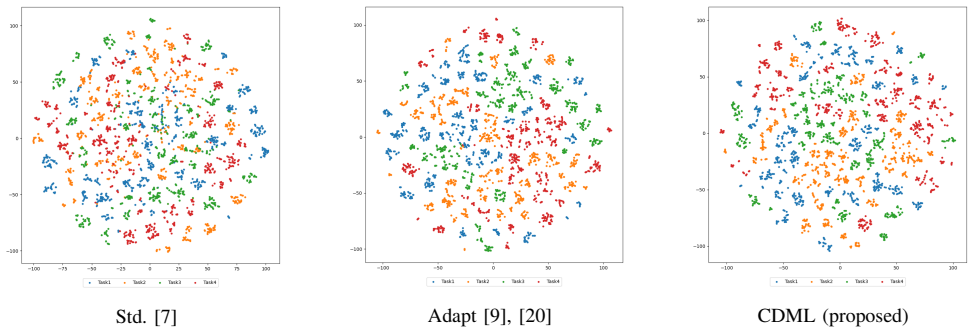
- [Sec. II, Fig. 3] The t-SNE comparison claims CDML 'achieves a better homogeneity in region organization,' but this is assessed visually only. A quantitative separability measure (e.g., inter-task/intra-task distance ratio) would make the claim more objective.
- [Sec. IV-A] The description of the ablation study is brief: it mentions 10%, 30%, and 50% replay in Fig. 4 but Table III only reports 0%, 10%, and 30%. Please clarify which percentages are used where.
Circularity Check
MIA mitigation is measured only against attackers who lack the per-task code; chance-level AUC follows from code secrecy, not from the model.
specific steps
-
self definitional
[Sec. II Eq. (1); Sec. IV-A; Sec. V]
"The modulated features m=s_k ⊙ h (1) ... In order to correctly-classify a sample, users must know the correct modulation code s_k, otherwise they can apply a random guessing or use a constant modulation. ... mitigates membership inference attacks under the considered black-box setting since attackers need to know in advance the associated code."
The MIA attack computes likelihoods l=g(m) with m=s_k⊙h. The CDML privacy result in Table III (AUC≈50%, EER>48%) is obtained for an attacker who does not know s_k; the paper states that such an attacker can only guess or use constant modulation. Querying the network with the wrong modulation code means the classifier output is not the trained function for the sample, so chance-level MIA follows from the missing secret by construction, not from any learned-model property. Any authorized user of the task must know s_k to classify samples, yet no MIA results are reported for an attacker who holds the correct code. Thus the central privacy claim reduces to the threat-model assumption that the attacker lacks the code.
full rationale
The accuracy component of the paper is empirical and self-contained: CDML is compared against replay and FiLM adaptation using the same gait classifier, and the reported classification-accuracy results do not reduce to the modulation-code secret. The t-SNE plots and uncorrelated-sequence tests are also independent evidence. However, the membership-inference claim is circular in the sense that the measured defense success is definitionally guaranteed by withholding s_k from the attacker. The paper's own conclusion admits this: attacks are mitigated 'since attackers need to know in advance the associated code.' Table III's AUC≈50% and EER>48% are therefore consequences of the attacker querying with a wrong/unknown code, not evidence that the model conceals membership information from a correctly-querying adversary. Since the paper's abstract states without qualification that CDML 'mitigates membership inference attacks,' the privacy result is partially forced by the chosen attack setting. This is not a fitted-parameter hidden-prediction case, and there is no load-bearing self-citation chain, so the appropriate score is 6 rather than higher.
Axiom & Free-Parameter Ledger
free parameters (4)
- Task split =
4 tasks: subjects 0–29, 30–59, 60–89, 90–118
- Learning rate schedule =
400 epochs, initial LR 0.001, decay factor 0.9
- Replay percentage sweep =
0%, 10%, 30%, 50%
- CDML pseudo-random generator =
not specified in experiments
axioms (4)
- domain assumption Task-specific random ±1 codes s_k are nearly orthogonal (s_k·s_h ≈ 0), separating tasks in feature space.
- domain assumption The modulation seed remains secret from the MIA attacker via a secure channel and cannot be inferred from the public model.
- domain assumption A confidence-threshold LiRA-style attack is a representative measure of MIA vulnerability for this network.
- ad hoc to paper Multiplying learned features pointwise by random ±1 signs preserves enough class-discriminative information for the classifier to separate all tasks.
invented entities (1)
-
Code Division Modulation Layer (CDML)
no independent evidence
Cite this review
Pith. "Pith review of Code Division Modulation Layers Against Forgetting and Inference in Continual Gait Identification." pith.science (2026). https://pith.science/paper/L5TEDXPL
@misc{pith2026260719122,
  author       = {Pith},
  title        = {Pith review of: Code Division Modulation Layers Against Forgetting and Inference in Continual Gait Identification},
  year         = {2026},
  howpublished = {\url{https://pith.science/paper/L5TEDXPL}},
  note         = {Machine review of arXiv:2607.19122}
}
read the original abstract
Continual learning (CL) has been recently employed in biometric identification systems thanks to its ability to integrate new knowledge within a pre-trained model and to the possibility of reducing the computational cost of training. Unfortunately, such approaches pose new challenges both in terms of final accuracy and privacy guarantees since a progressive fine-tuning of the model on small subsets expose them to catastrophic forgetting and successful inference attacks. This paper evaluates the efficiency of code division modulation layers (CDML) on a gait identification system which has been trained following a continual learning policy. The proposed approach preserves accuracy on all the tasks while mitigating membership inference attacks at the same time. Moreover, the impact of retransmission is minimized since replaying data is not necessary.
Figures



Reference graph
Works this paper leans on
-
[1]
Continual repre- sentation learning for biometric identification,
B. Zhao, S. Tang, D. Chen, H. Bilen, and R. Zhao, “Continual repre- sentation learning for biometric identification,”WACV, 2021
2021
-
[2]
Continual learning in sensor-based human activity recognition with dynamic mixture of experts,
F. Rahman, M. Schiemer, A. R. Sanabria, and J. Ye, “Continual learning in sensor-based human activity recognition with dynamic mixture of experts,”Pervasive and Mobile Computing, vol. 110, p. 102044, 2025. [Online]. Available: https://www.sciencedirect.com/ science/article/pii/S1574119225000331
2025
-
[3]
Enhancing biometric authentication privacy and security: A synergistic approach using cancelable biometrics and federated learning,
V . D. Katkar, R. Mandal, U. Biswas, M. Lunagaria, G. G. Tejani, and S. J. Mousavirad, “Enhancing biometric authentication privacy and security: A synergistic approach using cancelable biometrics and federated learning,”Alexandria Engineering Journal, vol. 135, pp. 36–63, 2026. [Online]. Available: https://www.sciencedirect.com/ science/article/pii/S11100...
2026
-
[4]
Privacy-preserving continuous authentication using behavioral biometrics,
A. F. Baig, S. Eskeland, and B. Yang, “Privacy-preserving continuous authentication using behavioral biometrics,”Int. J. Inf. Secur., vol. 22, p. 1833–1847, 2023
2023
-
[5]
Personalized federated continual learning for task-incremental biometrics,
D. Li, N. Huang, Z. Wang, and H. Yang, “Personalized federated continual learning for task-incremental biometrics,”IEEE Internet of Things Journal, vol. 10, no. 23, pp. 20 776–20 788, 2023
2023
-
[6]
Differential privacy preservation in robust continual learning,
A. Hassanpour, M. Moradikia, B. Yang, A. Abdelhadi, C. Busch, and J. Fierrez, “Differential privacy preservation in robust continual learning,”IEEE Access, vol. 10, pp. 1–1, 01 2022
2022
-
[7]
Survey on replay-based continual learning and empirical validation on feasibility in diverse edge devices using a representative method,
H.-S. Park, H.-C. Chu, M.-K. Sung, C. Kim, J. Lee, D.-W. Kim, and J. Lee, “Survey on replay-based continual learning and empirical validation on feasibility in diverse edge devices using a representative method,”Mathematics, vol. 13, no. 14, 2025. [Online]. Available: https://www.mdpi.com/2227-7390/13/14/2257
2025
-
[8]
Continual learning for lidar semantic segmentation: Class-incremental and coarse-to-fine strategies on sparse data,
E. Camuffo and S. Milani, “Continual learning for lidar semantic segmentation: Class-incremental and coarse-to-fine strategies on sparse data,”2023 IEEE/CVF Conference on Computer Vision and Pattern Recognition Workshops (CVPRW), pp. 2447–2456, 2023. [Online]. Available: https://api.semanticscholar.org/CorpusID:258048943
2023
-
[9]
Film: visual reasoning with a general conditioning layer,
E. Perez, F. Strub, H. de Vries, V . Dumoulin, and A. Courville, “Film: visual reasoning with a general conditioning layer,” inProceedings of the Thirty-Second AAAI Conference on Artificial Intelligence and Thirtieth Innovative Applications of Artificial Intelligence Conference and Eighth AAAI Symposium on Educational Advances in Artificial Intelligence, ...
2018
-
[10]
Combining variational continual learning with fiLM layers,
N. Loo, S. Swaroop, and R. E. Turner, “Combining variational continual learning with fiLM layers,” in4th Lifelong Machine Learning Workshop at ICML 2020, 2020. [Online]. Available: https://openreview.net/forum?id=fZBEGA1d-4Y
2020
-
[11]
Diffusion-driven data replay: A novel approach to combat forgetting in federated class continual learning,
J. Liang, J. Zhong, H. Gu, Z. Lu, X. Tang, G. Dai, S. Huang, L. Fan, and Q. Yang, “Diffusion-driven data replay: A novel approach to combat forgetting in federated class continual learning,” inECCV, 2024
2024
-
[12]
A survey on membership inference attacks and defenses in machine learning,
J. Niu, P. Liu, X. Zhu, K. Shen, Y . Wang, H. Chi, Y . Shen, X. Jiang, J. Ma, and Y . Zhang, “A survey on membership inference attacks and defenses in machine learning,”Journal of Information and Intelligence, vol. 2, no. 5, pp. 404–454, 2024. [Online]. Available: https://www.sciencedirect.com/science/article/pii/S2949715924000064
2024
-
[13]
M. Nasr, R. Shokri, and A. Houmansadr, “Comprehensive privacy analysis of deep learning: Stand-alone and federated learning under passive and active white-box inference attacks,”ArXiv, vol. abs/1812.00910, 2018. [Online]. Available: https://api.semanticscholar. org/CorpusID:54444175
Pith/arXiv arXiv 2018
-
[14]
Membership inference attacks from first principles,
N. Carlini, S. Chien, M. Nasr, S. Song, A. Terzis, and F. Tram `er, “Membership inference attacks from first principles,” in2022 IEEE Symposium on Security and Privacy (SP), 2022, pp. 1897–1914
2022
-
[15]
Privacy risk in machine learning: Analyzing the connection to overfitting,
S. Yeom, I. Giacomelli, M. Fredrikson, and S. Jha, “Privacy risk in machine learning: Analyzing the connection to overfitting,”2018 IEEE 31st Computer Security Foundations Symposium (CSF), pp. 268–282,
2018
-
[16]
Fingerprint membership and identity inference against generative adversarial networks,
S. Cavasin, D. Mari, S. Milani, and M. Conti, “Fingerprint membership and identity inference against generative adversarial networks,”Pattern Recognition Letters, vol. 185, pp. 184–189, 2024. [Online]. Available: https://www.sciencedirect.com/science/article/pii/S0167865524002216
2024
-
[17]
Is my data in your ai? membership inference test (mint) applied to face biometrics,
D. DeAlcala, A. Morales, J. Fierrez, G. Mancera, R. Tolosana, and J. Ortega-Garcia, “Is my data in your ai? membership inference test (mint) applied to face biometrics,”IEEE Access, vol. 13, pp. 163 805– 163 819, 2025
2025
-
[18]
Deep learning-based gait recognition using smartphones in the wild,
Q. Zou, Y . Wang, Q. Wang, Y . Zhao, and Q. Li, “Deep learning-based gait recognition using smartphones in the wild,”IEEE Transactions on Information Forensics and Security, vol. 15, pp. 3197–3212, 2020
2020
-
[19]
Ternary neural networks for gait identification in wearable devices,
G. Agnetti, A. Migliorati, D. Mari, T. Bianchi, S. Milani, and E. Magli, “Ternary neural networks for gait identification in wearable devices,” in2024 IEEE International Workshop on Information Forensics and Security (WIFS), 2024, pp. 1–6
2024
-
[20]
Gaitadapt: Continual learning for evolving gait recognition,
J. Wang, S. Zhang, X. Wei, and S. Tian, “Gaitadapt: Continual learning for evolving gait recognition,”ArXiv, vol. abs/2508.03375,
-
[21]
Comparing the powers of the wald- wolfowitz and kolmogorov-smirnov tests,
R. C. Magel and S. H. Wibowo, “Comparing the powers of the wald- wolfowitz and kolmogorov-smirnov tests,”Biometrical Journal, vol. 39, no. 6, pp. 665–668, 1997
1997
-
[22]
A two-dimensional mapping with a strange attractor,
M. H ´enon, “A two-dimensional mapping with a strange attractor,”The theory of chaotic attractors, pp. 94–102, 2004
2004
-
[23]
Simple mathematical models with very complicated dy- namics,
R. M. May, “Simple mathematical models with very complicated dy- namics,”Nature, vol. 261, no. 5560, pp. 459–467, 1976
1976
-
[24]
Analytic study of chaos of the tent map: band structures, power spectra, and critical behaviors,
T. Yoshida, H. Mori, and H. Shigematsu, “Analytic study of chaos of the tent map: band structures, power spectra, and critical behaviors,” Journal of statistical physics, vol. 31, pp. 279–308, 1983
1983
-
[25]
Computationally easy, spectrally good multipliers for congruential pseudorandom number generators,
G. L. Steele Jr and S. Vigna, “Computationally easy, spectrally good multipliers for congruential pseudorandom number generators,”Soft- ware: Practice and Experience, vol. 52, no. 2, pp. 443–458, 2022
2022
-
[2017]
Available: https://api.semanticscholar.org/CorpusID: 2656445
[Online]. Available: https://api.semanticscholar.org/CorpusID: 2656445
-
[2025]
Available: https://api.semanticscholar.org/CorpusID: 280526810
[Online]. Available: https://api.semanticscholar.org/CorpusID: 280526810
discussion (0)
Sign in with ORCID, Apple, or X to comment. Anyone can read and Pith papers without signing in.