REVIEW 2 major objections 4 minor 31 references
Standard RoPE applies one frequency schedule and attention scaling to every head; AdaRoPE claims each head needs its own learnable frequencies and scaling, and shows consistent gains in pretraining quality and 8k-to-64k context extension.
Reviewed by Pith at T0; open to challenge. T0 means a machine referee read the full paper against a public rubric. the ladder, T0–T4 →
T0 review · deepseek-v4-flash
2026-08-02 12:12 UTC pith:WKP4WYQR
load-bearing objection Useful drop-in RoPE variant with real pretraining evidence; the extrapolation claim needs one tuned-baseline control before the head-wise story holds. the 2 major comments →
AdaRoPE: Not All Attention Heads Should Rotate and Scale Equally
The pith
A machine-rendered reading of the paper's core claim, the machinery that carries it, and where it could break.
Core claim
On the paper's own terms, the central discovery is that attention heads in RoPE-based transformers are spectrally heterogeneous, and a uniform frequency schedule wastes embedding dimensions: heads with small target windows need high rotation frequencies, heads with large windows need low frequencies, and a single global schedule forces most heads into the wrong band (Theorem 1). Likewise, length extension requires head-specific attention scaling: retrieval heads must keep their effective sequence length constant to preserve sharp focus, while global aggregation heads must let effective length grow linearly with context (Theorems 2–3), so any single length-dependent temperature either over-sh
What carries the argument
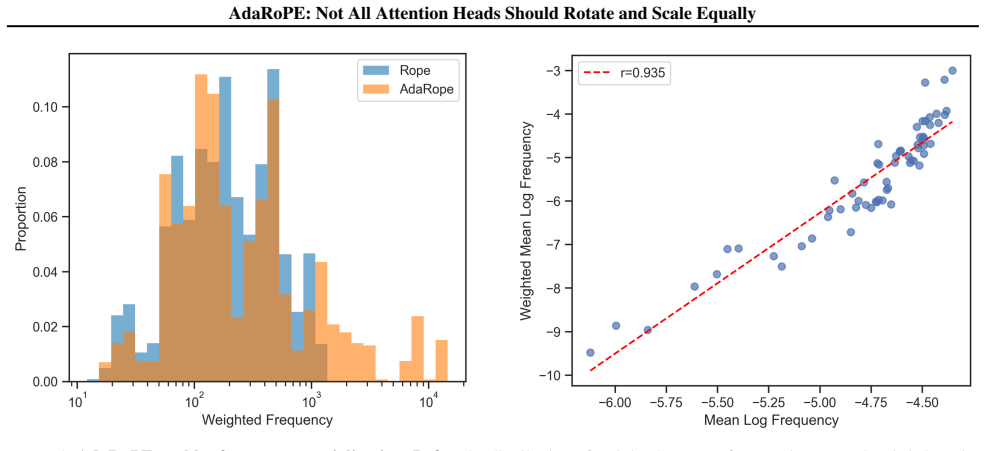
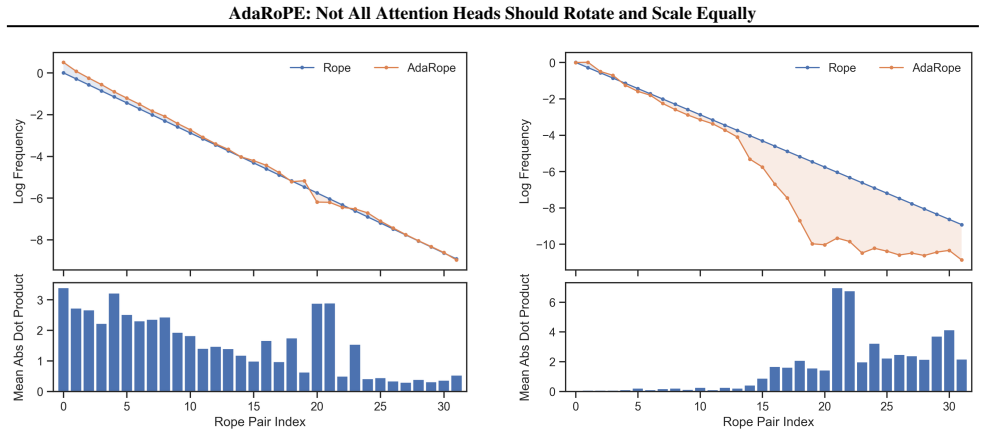
The two trainable components are AdaFreq, per-head per-dimension rotation frequencies θ_f^(h)=exp(ξ_f^(h)) replacing the fixed geometric schedule b^{-2f/d}, and AdaScale, a per-head length-dependent inverse temperature λ^(h)(L) = (1/τ^(h))[ln(1 + max{L,Lref}/Lref)]^{γ^(h)} applied to the query before attention. The theoretical core is a frequency-mass bound (Theorem 1) — the weighted average frequency M must lie roughly between C/(rW) and π/(W+1) for a window-retrieval task to be feasible — and an effective-sequence-length analysis using the generalized effective sample size E_β(α): retrieval heads need E_β constant in L, aggregation heads need E_β = Θ(L), and Theorems 4–5 derive the form of
Load-bearing premise
The load-bearing premise is that the gains come from head-wise structure itself, not from the simple act of fine-tuning positional parameters: the extrapolation experiments compare AdaRoPE against a YaRN baseline that is applied without any tuning, so a tuned global schedule on the same 100 samples could plausibly capture much of the improvement.
What would settle it
Run the same frozen-backbone extrapolation protocol but fine-tune a single global (shared) YaRN-style frequency and temperature schedule — the same first 100 PG19 samples, same optimizer, same parameter budget — and evaluate RULER at 64k on Llama-3-8B; if a tuned global schedule matches AdaRoPE's roughly 52 accuracy, the head-wise mechanism claim collapses to 'fine-tuning positional parameters helps.' A second check: fine-tune YaRN's global schedule, then continue with low-rank adapters, mirroring the paper's two-stage recipe, and compare against AdaRoPE→Joint.
If this is right
- If AdaRoPE is right, any RoPE-pretrained model can be extended to 64k context by fine-tuning only roughly 10–50K positional parameters with the backbone frozen, outperforming YaRN at all evaluated lengths while mostly preserving short-context accuracy.
- Pretraining with head-wise learnable frequencies and scaling becomes a directly better drop-in default than uniform RoPE across model scales up to 2.7B parameters, with no architectural change.
- The theoretical bound linking retrieval window W to feasible frequency mass implies that fixed frequency schedules are not just suboptimal but provably capacity-limited: they leave embedding dimensions unused for the window the head needs.
- The two-stage recipe — warm up AdaRoPE on 100 samples, then jointly train low-rank adapters — is a concrete, transferable protocol for long-context continued pretraining.
- The E_β(α) analysis gives a quantitative diagnostic — measuring each head's effective length — for deciding which heads need sharper versus broader attention during context extension.
Where Pith is reading between the lines
- Editorial inference: a testable extension the paper leaves implicit is to estimate each head's target effective length E_β from a few long-context samples and set the temperature schedule analytically from the paper's Theorem 4, removing the need to learn γ^(h) and τ^(h).
- Editorial inference: an untested corollary of the frequency-mass bound is that head-wise learnable frequencies could also help non-uniform retrieval (e.g., mid-context 'lost in the middle') because each head could specialize its own window; combining AdaFreq with position-dependent routing is a natural next step.
- Editorial inference: the 100-sample fine-tuning result raises a question the paper does not settle — how much of the context-extension gain is generic positional re-adaptation versus head-specific specialization; a tuned global baseline would decide whether the per-head structure is load-bearing, and that control is missing from the experiments.
- Editorial inference: if the heavy-tailed head-influence results generalize, head-level pruning or quantization should preserve heads with extreme learned frequencies, since the ablations show a small minority of retrieval-like heads are indispensable for long-context behavior.
Editorial analysis
A structured set of objections, weighed in public.
Referee Report
Summary. The paper argues that standard RoPE's uniform frequency schedule and uniform attention scaling across heads are suboptimal, because heads with different functional roles require different frequency bands and length-dependent scaling. It proposes AdaRoPE, consisting of AdaFreq (per-head, per-dimension learnable log-frequencies) and AdaScale (per-head, length-aware inverse temperatures of the form lambda(h)(L)=(1/tau(h))[ln(1+max{L,L_ref}/L_ref)]^{gamma(h)}). The authors support the proposal with (i) theoretical analyses of simplified retrieval and aggregation tasks (Theorems 1-5, proofs in Appendix F), (ii) pretraining experiments on four architectures up to 2.7B parameters comparing AdaRoPE against RoPE, PRoPE, ALiBi, and NoPE (Table 1), and (iii) context-extension experiments on SmolLM-2-1.7B and Llama-3-8B extending 8k to 64k via extrapolation (Table 2) and continued pretraining with LoRA (Table 3). The headline claims are that AdaRoPE consistently outperforms RoPE variants in pretraining and enables better context extension while preserving short-context performance.
Significance. If the claims are correct, AdaRoPE is a lightweight, plug-and-play replacement for RoPE that improves both pretraining and long-context extrapolation, adding only ~10-50K parameters. The paper includes formal theorems with proofs, a wide range of backbones, and internally consistent ablations. The main risk is that the context-extension comparisons are confounded by training protocol, so the central mechanism claim ('head-wise is why it works') is not yet established. The pretraining results are more solid but would benefit from variance reporting. Overall, the contribution is potentially significant for positional-embedding design, but the current evidence does not fully support the strongest claims.
major comments (2)
- [§5.2, Table 2] The extrapolation comparison is confounded. AdaRoPE is fine-tuned on the first 100 PG19 samples with the backbone frozen, while Backbone+YaRN is applied without any tuning. Consequently, the reported gains may reflect the mere act of fitting 10-50K positional parameters to 100 samples rather than the head-wise structure. The ablations (w/o AdaFreq, w/o AdaScale, Share Freq.) all tune a head-specific or partially head-specific set of parameters, so they do not control for tuned global alternatives. A control that tunes a global (shared across heads) frequency schedule and scaling on the same 100 samples is necessary to attribute the gains to head-specificity. Without it, the central mechanism claim collapses to 'fine-tuning position parameters helps'.
- [§5.3, Table 3] The two-stage benefit is confounded with warm-up. AdaRoPE→LoRA and AdaRoPE→Joint both include a 100-sample warm-up of AdaRoPE parameters before LoRA training, whereas YaRN→LoRA uses fixed YaRN without any warm-up. A control that performs a 100-sample warm-up of a global (non-head-wise) YaRN-style schedule before LoRA is missing. This is needed to separate the effect of positional warm-up from the effect of head-wise adaptation. As reported, the table cannot distinguish between 'AdaRoPE's head-wise structure helps' and 'any fine-tuning of positional parameters helps'.
minor comments (4)
- [Tables 1-3] No seeds or error bars are reported. Some per-benchmark entries are negative versus RoPE (e.g., LLaMA 430M Lambada and WinoGrande, LLaMA 1.3B PIQA), so the 'consistently outperforms' claim rests on average improvements. Reporting standard deviations over at least 3 seeds would strengthen the pretraining claim.
- [§3.3, Theorems 4-5] The stated motivation for the AdaScale log-polynomial form lambda = (1/tau)[ln(1+L/L_ref)]^gamma is not a direct derivation: Theorem 4(i) yields lambda ~ sqrt(log L) for constant E*, and Theorems 4-5 leave the head-specific E* unspecified. The chosen parameterization is a reasonable flexible family, but the text overstates how tightly the theorems constrain it. Please clarify the sense in which the theorems motivate this form.
- [Equation (12)] The upper bound in Theorem 1 contains an indicator function of theta_max > pi/(W+1). This is unusual for a bound; please make explicit whether the indicator is a constant or a function of W, and how C2 depends on it.
- [General] Minor typographical issues: Eq. (33) has an exponent '2^{1/max{beta,beta-1}-1}' that appears to be a formatting artifact; in Theorem 2, 'then' in the statement should be 'then'. Also, several appendix references (e.g., 'Section D', 'Section F.1') could use hyperlinks for readability.
Circularity Check
No significant circularity; the empirical claims rest on external benchmarks and the theoretical schedule leaves its free constants explicitly learnable.
full rationale
The derivation chain is self-contained. AdaFreq and AdaScale are new parameterizations evaluated against independent baselines (RoPE, PRoPE, ALiBi, NoPE, YaRN) on held-out NLU and RULER benchmarks, so the pretraining and context-extension gains are not definitional. The theoretical results (Theorems 1–5) derive frequency-mass bounds and scaling relations for toy retrieval/aggregation tasks rather than assuming the head-wise conclusion; the move to per-head parameters is additionally supported by direct head-level measurements. Remark 6 candidly states that the head-specific β and Ê_β(L) forms are unknown a priori and are absorbed into the learnable τ(h) and γ(h), meaning AdaScale is a fitted parametric family motivated by the theorems, not a predicted constant masquerading as a first-principles output—this weakens the theory-verification narrative but does not constitute a by-construction reduction. The main validity concern, that Table 2 compares fine-tuned AdaRoPE with untuned YaRN and Table 3 lacks a YaRN-with-warm-up control, is an experimental-fairness issue about attributing gains to head-wise structure; it is not a case where the fitted parameters and the reported prediction coincide by construction. No load-bearing self-citation chain appears: the only overlapping-author reference (Li et al., 2025a, HARoPE) is cited as related work and is not needed for any theorem or benchmark claim.
Axiom & Free-Parameter Ledger
free parameters (4)
- xi(h)_f (AdaFreq log-frequencies) =
learned; not tabulated—visualized as effective base Theta and per-layer spectra (Figs. 3, 9)
- gamma(h) (AdaScale growth exponent) =
learned; observed mostly ~0.1-0.37, init 0 (Fig. 3 Right, Fig. 11)
- tau(h) (AdaScale base temperature) =
learned; init 1, distribution centered near 1 with a right tail (Fig. 11 Middle)
- L_ref (AdaScale reference length) =
64 (pretraining), 8192 (context extension)
axioms (5)
- standard math Standard Fourier/analytic tools: Dirichlet-kernel bounds, Lipschitz continuity, Riemann-integrability facts, CLT/Hanson-Wright/Borel-Cantelli/Mills-ratio/von Bahr-Esseen inequalities
- domain assumption Correlated Gaussian query-key logit model: q ~ N(0,I_d), k_i = (rho/sqrt(d))q + sigma z_i with z_i i.i.d. N(0,I_d)
- domain assumption Real LLM heads can be mapped to the retrieval/aggregation dichotomy with well-defined window W and effective length E_beta
- ad hoc to paper The functional form lambda(h)(L) = (1/tau)[ln(1+max{L,L_ref}/L_ref)]^gamma contains the per-head optimal schedule
- domain assumption 100 PG19 samples suffice to fit head-wise positional parameters that transfer to RULER-64k
read the original abstract
Rotary Position Embedding (RoPE) is widely adopted in Transformers to encode positional information, yet standard implementations enforce a uniform frequency schedule and scaling across all attention heads. Using simplified retrieval tasks and length generalization scenarios, we show -- both empirically and theoretically -- that heads with different functional roles require distinct frequency ranges and attention scaling factors to operate effectively. Ignoring this structure leads to suboptimal utilization of embedding dimensions and degraded performance, particularly under long-context settings. To address these limitations, we propose AdaRoPE, which equips each attention head with learnable rotation frequencies and attention scaling factors. Pretrained LLMs with AdaRoPE consistently outperform existing RoPE variants, including partial RoPE and NoPE baselines. For context extension, we further show that uniform frequency and attention scaling, used in methods such as YaRN, are suboptimal. By applying head-specific scaling, AdaRoPE enables better context extension while better preserving short-context performance in both the extrapolation setting and the long-context continued pretraining setting. These results highlight the importance of optimizing rotary position embedding at the level of individual attention heads.
Figures




Reference graph
Works this paper leans on
-
[1]
At the window boundary, the Lipschitz property together with Eqs
Lower bound ofM.Note that |T ′(x)|= X f (−af θf ) sin(θf x+φ f ) ≤ X f af θf =M, 29 AdaRoPE: Not All Attention Heads Should Rotate and Scale Equally soTisM-Lipschitz. At the window boundary, the Lipschitz property together with Eqs. (11) and (42) implies l r 2 W m M≥T c− W 2 −T c− (1 +r) W 2 ≥T L c− W 2 −T U c− (1 +r) W 2 ≥T ∗ L −T ∗ U = 2 A⋆ ln 1−ε ε − ∥...
-
[2]
Upper bound ofM.Define the average ofT(x)over[c−W/2, c+W/2]as (AW T)(c) = 1 W+ 1 c+W/2X t=c−W/2 T(t). Then Eq. (11) implies (AW TL)(c)≤(A W T)(c).(44) By Lagrange’s trigonometric identity, (AW T)(c) = 1 W+ 1 c+W/2X t=c−W/2 d/2−1X f=0 af cos(θf t+φ f ) = 1 W+ 1 d/2−1X f=0 af W/2X k=−W/2 cos(θf (c+k) +φ f ) = 1 W+ 1 d/2−1X f=0 af W/2X k=−W/2 h cos(θf k) cos...
-
[3]
By the continuity ofx(t),tis an interior point ofI, soIis open
Openness ofI.For anyt∈I, substitutingx(t)≤2tAintox≤A+Bx γ gives x(t) =tA+B(x(t)) γ ≤tA+B(2tA) γ =tA 1 +B2 γtγ−1Aγ−1 ≤tA 1 +γB2 γAγ−1 <2tA, where the second inequality uses γ >1 and t∈[0,1] , and the last inequality follows from 0< A <(γB2γ) 1 1−γ . By the continuity ofx(t),tis an interior point ofI, soIis open. 4.Since I is nonempty, open and closed in th...
2026
-
[4]
org/CorpusID:258840844
URL https://api.semanticscholar. org/CorpusID:258840844. Chiang, D. and Cholak, P. A. Overcoming a theo- retical limitation of self-attention. InAnnual Meet- ing of the Association for Computational Linguistics,
-
[6]
URL https://api.semanticscholar. org/CorpusID:268357635. Haviv, A., Ram, O., Press, O., Izsak, P., and Levy, O. Trans- former language models without positional encodings still learn positional information.ArXiv, abs/2203.16634,
-
[7]
URL https://api.semanticscholar. org/CorpusID:247839823. Heo, B., Park, S., Han, D., and Yun, S. Rotary position embedding for vision transformer. InEuropean Conference on Computer Vision, 2024. URL https: //api.semanticscholar.org/CorpusID: 268536717. Hsieh, C.-P., Sun, S., Kriman, S., Acharya, S., Rekesh, D., Jia, F., and Ginsburg, B. Ruler: What’s the ...
Pith/arXiv arXiv 2024
-
[10]
URL https://api.semanticscholar. org/CorpusID:252532078. Oppenheim, A. V ., Willsky, A. S., and Nawab, S. H.Signals & Systems. Pearson Educaci ´on, 2 edition, 1997. Ostmeier, S., Axelrod, B., Varma, M., Moseley, M. E., Chaudhari, A. S., and Langlotz, C. P. Liere: Lie rotational positional encodings. InInternational Conference on Machine Learning, 2024. UR...
Pith/arXiv arXiv 1997
-
[12]
org/CorpusID:207930593
URL https://api.semanticscholar. org/CorpusID:207930593. Raffel, C., Shazeer, N., Roberts, A., Lee, K., Narang, S., Matena, M., Zhou, Y ., Li, W., and Liu, P. J. Exploring the limits of transfer learning with a unified text-to-text transformer.J. Mach. Learn. Res., 21:140:1–140:67,
-
[13]
org/CorpusID:204838007
URL https://api.semanticscholar. org/CorpusID:204838007. R´enyi, A. On measures of entropy and information. InPro- ceedings of the fourth Berkeley symposium on mathemati- cal statistics and probability, volume 1: contributions to the theory of statistics, volume 4, pp. 547–562. University of California Press, 1961. Sakaguchi, K., Bras, R. L., Bhagavatula,...
1961
-
[14]
URL https://api.semanticscholar. org/CorpusID:199370376. Shang, N., Zhang, L. L., Wang, S., Zhang, G., Lopez, G., Yang, F., Chen, W., and Yang, M. Lon- grope2: Near-lossless llm context window scal- ing.ArXiv, abs/2502.20082, 2025. URL https: //api.semanticscholar.org/CorpusID: 276647831. Shaw, P., Uszkoreit, J., and Vaswani, A. Self-attention with relati...
Pith/arXiv arXiv 2025
-
[16]
URL https://api.semanticscholar. org/CorpusID:269330144. Xiong, W., Liu, J., Molybog, I., Zhang, H., Bhargava, P., Hou, R., Martin, L., Rungta, R., Sankararaman, K. A., Oguz, B., et al. Effective long-context scaling of founda- tion models. InProceedings of the 2024 Conference of the North American Chapter of the Association for Com- putational Linguistic...
Pith/arXiv arXiv 2024
-
[17]
URL https://api.semanticscholar. org/CorpusID:159041722. Zhang, X., Chang, X., Li, M., Roy-Chowdhury, A., Chen, J., and Oymak, S. Selective attention: Enhancing trans- former through principled context control.Advances in Neural Information Processing Systems, 37:11061– 11086, 2024a. Zhang, Y ., Chen, Z., Liu, Y ., Qin, Z., Yuan, H., Xu, K., Yuan, Y ., Gu...
-
[18]
URL https://api.semanticscholar. org/CorpusID:283694164. Zhang, Z. A., Chen, R., Liu, S., Yao, Z., Ruwase, O., Chen, B., Wu, X., and Wang, Z. Found in the middle: How language models use long contexts better via plug- and-play positional encoding.ArXiv, abs/2403.04797, 2024b. URL https://api.semanticscholar. org/CorpusID:268296885. 13 AdaRoPE: Not All Att...
Pith/arXiv arXiv 2018
-
[21]
Sincex(t)≤2tA≤2Aand by the hypothesis0< A <(γB2 γ) 1 1−γ we have 1−γBx(t) γ−1 ≥1−γB(2A) γ−1 >1−γB(2γB) −1 = 1 2 >0, hencex ′(t)>0
Monotonicity ofx(t).For anyτ∈Iandt∈[0, τ], differentiateΨ(x(t), t) = 0to obtain x′(t) 1−γBx(t) γ−1 =A. Sincex(t)≤2tA≤2Aand by the hypothesis0< A <(γB2 γ) 1 1−γ we have 1−γBx(t) γ−1 ≥1−γB(2A) γ−1 >1−γB(2γB) −1 = 1 2 >0, hencex ′(t)>0. Thusx(t)is strictly increasing on[0, τ]
-
[22]
Then x(τn) is increasing and bounded by 2A, so by the monotone convergence theorem the limitx ∗ := limn→∞ x(τn)exists
Closedness of I.Let τn ∈I with τn ↑τ ∗. Then x(τn) is increasing and bounded by 2A, so by the monotone convergence theorem the limitx ∗ := limn→∞ x(τn)exists. Clearlyx ∗ ≤2τ ∗A. Hence ∂xΨ(x∗, τ∗) = 1−γB(x ∗)γ−1 ≥1−γB(2A) γ−1 >0. By the implicit function theorem the solution extends uniquely to x(τ ∗) :=x ∗. Therefore the property holds at τ ∗, and I is closed
-
[24]
By the union bound, P max 1≤i≤L zi > τ σ ≤ LX i=1 P(zi > τ σ) =LΦ(−τ σ)≤L· 1 τ σ √ 2π e− 1 2 τ 2σ2
Bounding S> L (τ).For any x >0, the Mills’ ratio gives Φ(−x)≤ϕ(x)/x , where Φ and ϕ denote the CDF and PDF of the standard normal distribution, respectively (see, e.g., Vershynin (2026, Proposition 2.1.2)). By the union bound, P max 1≤i≤L zi > τ σ ≤ LX i=1 P(zi > τ σ) =LΦ(−τ σ)≤L· 1 τ σ √ 2π e− 1 2 τ 2σ2 . 40 AdaRoPE: Not All Attention Heads Should Rotate...
2026
-
[25]
Then EY i = Z τ σ −∞ eτ σx 1√ 2π e− x2 2 dx=e 1 2 τ 2σ2 Z τ σ −∞ 1√ 2π e− (x−τ σ)2 2 dx= 1 2 e 1 2 τ 2σ2
BoundingS ≤ L (τ).SetY i :=e τ σzi 1{zi≤τ σ}. Then EY i = Z τ σ −∞ eτ σx 1√ 2π e− x2 2 dx=e 1 2 τ 2σ2 Z τ σ −∞ 1√ 2π e− (x−τ σ)2 2 dx= 1 2 e 1 2 τ 2σ2 . Hence ES ≤ L (τ) = LX i=1 eτ µi · 1 2 Ee τ σzi = 1 2 LX i=1 Ee τ σsi = 1 2 ES L(τ). Moreover, EY 2 i = Z τ σ −∞ e2τ σx 1√ 2π e− x2 2 dx=e 2τ 2σ2 Z τ σ −∞ 1√ 2π e− (x−2τ σ)2 2 dx=e 2τ 2σ2 Φ(−τ σ), By Mills...
2019
-
[26]
Let F(L)(z) := QL i=1 Fi(z) be the CDF of s(L)
Bounding s(L). Let F(L)(z) := QL i=1 Fi(z) be the CDF of s(L). Since F(L)(·) is non-decreasing, choose γL := min lnL, τ / √ lnL 1/2 and define s∗ := inf z:F (L)(z) =e −γL . Then P(s(L) < s∗) =e −γL →0 as L→ ∞. Moreover, γL =− LX i=1 lnF i(s∗) =− LX i=1 ln Φ s∗ −µ i σ ≥ −Lln Φ s∗ +∥µ∥ ∞ σ . 41 AdaRoPE: Not All Attention Heads Should Rotate and Scale Equall...
-
[27]
Thus, by Mills’ ratio, ln Φ s∗ − ∥µ∥∞ σ ≥ −2 1−Φ s∗ − ∥µ∥∞ σ ≥ −2 1 √ 2π s∗−∥µ∥∞ σ exp − 1 2 s∗ − ∥µ∥∞ σ 2! ≥ −exp − 1 2 s∗ − ∥µ∥∞ σ 2!
For x∈ 1 2 ,1 , we have lnx≥1− 1 x =− 1−x x ≥ −2(1−x). Thus, by Mills’ ratio, ln Φ s∗ − ∥µ∥∞ σ ≥ −2 1−Φ s∗ − ∥µ∥∞ σ ≥ −2 1 √ 2π s∗−∥µ∥∞ σ exp − 1 2 s∗ − ∥µ∥∞ σ 2! ≥ −exp − 1 2 s∗ − ∥µ∥∞ σ 2! . Therefore, forL≥3, 1≤γ L ≤Lexp − 1 2 s∗ − ∥µ∥∞ σ 2! , which implies s∗ ≤σ √ 2 lnL+∥µ∥ ∞. To obtain an upper bound for s(L), set s∗ := 2σ √ lnL+∥µ∥ ∞. By the union b...
-
[28]
By Markov’s inequality, P ζL > δ s(L) =z ≤ 1 δ E ζL s(L) =z
Boundingζ L.For anyδ >0, write P ζL > δ)≤P(ζ L > δ, s(L) ∈[s ∗, s∗]) +P(s (L) /∈[s∗, s∗] .(57) By the law of total probability, P(ζL > δ, s(L) ∈[s ∗, s∗]) = Z s∗ s∗ P ζL > δ s(L) =z f(L)(z) dz, wheref (L)(z)is the PDF ofs (L). By Markov’s inequality, P ζL > δ s(L) =z ≤ 1 δ E ζL s(L) =z . 43 AdaRoPE: Not All Attention Heads Should Rotate and Scale Equally ...
-
[29]
Sinceg(x, y) =x β β−1 /y 1 β−1 is continuous at(1,1), the continuous mapping theorem gives Eβ(α) ˆEβ(L) =g Z(s;λ) EZ(s;λ) , Z(s;βλ) EZ(s;βλ) P − →g(1,1) = 1asL→ ∞
By Lemma 2(i), Z(s;λ) EZ(s;λ) P − →1, Z(s;βλ) EZ(s;βλ) P − →1,asL→ ∞. Sinceg(x, y) =x β β−1 /y 1 β−1 is continuous at(1,1), the continuous mapping theorem gives Eβ(α) ˆEβ(L) =g Z(s;λ) EZ(s;λ) , Z(s;βλ) EZ(s;βλ) P − →g(1,1) = 1asL→ ∞. (ii)If Λ = √ 2 min{1/β,1} , then by Lemma 2(i) and (ii), there are two cases. If Λ = √ 2 and βΛ< √ 2, so that 0< β <1, then...
-
[30]
We estimate Ik using the cosine integral functionCi(z), defined by Ci(z) =− Z ∞ z cost t dt.(59) We first prove that, for any z∈[1,∞) , |Ci(z)| ≤1/z
Bounding Ik.We first show that, for any k≥b , |Ik| ≤(b+ 1)/(klnb) . We estimate Ik using the cosine integral functionCi(z), defined by Ci(z) =− Z ∞ z cost t dt.(59) We first prove that, for any z∈[1,∞) , |Ci(z)| ≤1/z. For any t >0, we have t−1 = R ∞ 0 e−ut du. Applying Fubini’s theorem on truncated intervals and then taking the limit gives Ci(z) =−lim K→∞...
-
[31]
Hence τ→ ∞and τlnL=o(e τ )for bothτ∈ {ρλ, ρβλ}
Bounding SL(τ).By assumption, λ(L)→ ∞and λ(L) lnL=o(e ρmin{1,β}λ(L) ) as L→ ∞. Hence τ→ ∞and τlnL=o(e τ )for bothτ∈ {ρλ, ρβλ}. Decompose the partial sum as SL(τ) = L−1X k=0 1 + L−1X k=0 eτ Ik −1 =L+ (e τ −1) + L−1X k=1 eτ Ik −1 . We bound the remaining sum by splitting the index set atk=⌊τ⌋. Recall that, for anyk∈N, Ik = 1 lnb Z 1 1/b cos(ku) u du. ThusI ...
2048
-
[2016]
URL https://api.semanticscholar. org/CorpusID:2381275. Penedo, G., Kydl´ıˇcek, H., Lozhkov, A., Mitchell, M., Raffel, C. A., V on Werra, L., Wolf, T., et al. The fineweb datasets: Decanting the web for the finest text data at scale.Ad- vances in Neural Information Processing Systems, 37: 30811–30849, 2024. Peng, B., Quesnelle, J., Fan, H., and Shippole, E...
Pith/arXiv arXiv 2024
-
[2018]
URL https://api.semanticscholar. org/CorpusID:3725815. Su, J., Ahmed, M., Lu, Y ., Pan, S., Bo, W., and Liu, Y . Roformer: Enhanced transformer with rotary position embedding, 2021. URL https://arxiv.org/abs/ 2104.09864. Team, G., Kamath, A., Ferret, J., Pathak, S., Vieillard, N., Merhej, R., Perrin, S., Matejovicova, T., Ram ´e, A., Rivi`ere, M., et al. ...
Pith/arXiv arXiv 2021
-
[2019]
URL https://api.semanticscholar. org/CorpusID:208290939. Capp´e, O., Douc, R., Guillin, A., Marin, J.-M., and Robert, C. P. Adaptive importance sampling in general mixture classes.Statistics and Computing, 18(4):447–459, 2008. Chen, S., Wong, S., Chen, L., and Tian, Y . Extending con- text window of large language models via positional inter- polation.arX...
Pith/arXiv arXiv 2008
-
[2021]
URL https://api.semanticscholar. org/CorpusID:235458009. Huggins, J. H. and Roy, D. M. Sequential Monte Carlo as approximate sampling: bounds, adaptive resampling via ∞-ESS, and an application to particle Gibbs.Bernoulli, 25(1):584–622, 2019. Kong, A. A note on importance sampling using standardized weights. Technical Report 348, Uni- versity of Chicago, ...
arXiv 2019
-
[2022]
URL https://api.semanticscholar. org/CorpusID:247084324. Chiang, T.-R. and Yogatama, D. The rotary position embedding may cause dimension inefficiency in atten- tion heads for long-distance retrieval.arXiv preprint arXiv:2502.11276, 2025. URL https://arxiv. org/abs/2502.11276. Submitted 16 February 2025. Clark, C., Lee, K., Chang, M.-W., Kwiatkowski, T., ...
Pith/arXiv arXiv 2025
-
[2023]
URL https://api.semanticscholar. org/CorpusID:263134555. Barbero, F., Vitvitskyi, A., Perivolaropoulos, C., Pas- canu, R., and Veli ´ckovi´c, P. Round and round we go! what makes rotary positional encodings useful? In International Conference on Learning Representations (ICLR), 2025. URL https://arxiv.org/abs/ 2410.06205. Published as a conference paper a...
Pith/arXiv arXiv 2025
-
[2024]
URL https://api.semanticscholar. org/CorpusID:270845965. Madaan, L., Singh, A. K., Schaeffer, R., Poulton, A., Koyejo, O., Stenetorp, P., Narang, S., and Hupkes, D. Quantifying variance in evaluation bench- marks.ArXiv, abs/2406.10229, 2024. URL https: //api.semanticscholar.org/CorpusID: 270521534. Martino, L., Elvira, V ., and Louzada, F. Effective sam- ...
Pith/arXiv arXiv 2024
-
[2025]
URL https://api.semanticscholar. org/CorpusID:276116722. Anson, B., Wang, X., and Aitchison, L. Scale-invariant 9 AdaRoPE: Not All Attention Heads Should Rotate and Scale Equally attention. InAdvances in Neural Information Processing Systems, 2025. Bai, J., Bai, S., Chu, Y ., Cui, Z., Dang, K., Deng, X., Fan, Y ., Ge, W., Han, Y ., Huang, F., Hui, B., Ji,...
Pith/arXiv arXiv 2025
discussion (0)
Sign in with ORCID, Apple, or X to comment. Anyone can read and Pith papers without signing in.