REVIEW 3 major objections 5 minor 39 references
Prefix-GRPO claims that a teacher trajectory, sliced into replay-validated prefixes that are themselves optimized with GRPO-style clipping, yields better small-model agents than distillation, response-only reinforcement learning, or replay-
Reviewed by Pith at T0; open to challenge. T0 means a machine referee read the full paper against a public rubric. the ladder, T0–T4 →
T0 review · deepseek-v4-flash
2026-08-02 08:51 UTC pith:73KA2Z6S
load-bearing objection A concrete, well-ablated method that turns one teacher trajectory into several replayable decision points; the main open questions are single-run results and whether replay validation selects an easier task distribution. the 3 major comments →
From Trajectories to Prefixes: Reusing Teacher Trajectories via Replayed Prefixes and Online Continuation
The pith
A machine-rendered reading of the paper's core claim, the machinery that carries it, and where it could break.
Core claim
Prefix-GRPO's central claim is that a single teacher trajectory can be decomposed into multiple replay-aligned cut states, each of which becomes a full RL training query: the teacher prefix is replayed in the environment to recover a validated intermediate observation, the prompt is canonicalized to end at that cut-state observation, the student rolls out the continuation online and receives task reward, and the same clipped GRPO surrogate is applied to the student's continuation tokens and to the teacher's historical assistant prefix tokens, whose old log-probabilities are cached from the policy-distilled SFT checkpoint. Continuation rewards use group-relative advantages; the prefix branch
What carries the argument
Three pieces carry the argument. (i) Replay validation and canonicalization: each candidate prefix is executed in a fresh environment instance and kept only if the replayed observations match the teacher continuation on shared structured fields (Inventory, Got..., Crafted...); the surviving prompt ends at the recovered cut-state observation so the student always starts from an environment-consistent state. (ii) Prompt-space prefix sidecar (span [b_i,e_i), mask m_i, cached old log-probs from the SFT checkpoint) which lets historical assistant tokens inside the middle of the prompt participate in a PPO/GRPO-style ratio-clipped objective despite not being sampled online. (iii) The unified clipp
Load-bearing premise
The method assumes that replaying the teacher's prefix actions in a fresh environment instance returns an intermediate state whose future task structure matches the cached teacher continuation, so that the teacher prefix remains a trustworthy learning signal; this is checked by matching a small set of shared observational fields, roughly 15–17% of candidate prefixes are discarded, and all reported RL performance is computed on the surviving subset.
What would settle it
On a deliberately randomized version of TextCraft (e.g., noisy initial inventories or randomized recipe orders) the replay-validation match becomes looser; if Prefix-GRPO's advantage over replay-only and SFT→GRPO shrinks or vanishes as replay fidelity degrades, then replay validation — not prefix optimization — is the load-bearing component. A complementary check: take prefix queries that failed replay validation, build their prompts anyway, and train with the same objective; if they train as well as validated queries, the filtering step is not essential, whereas if they collapse, replay valid
If this is right
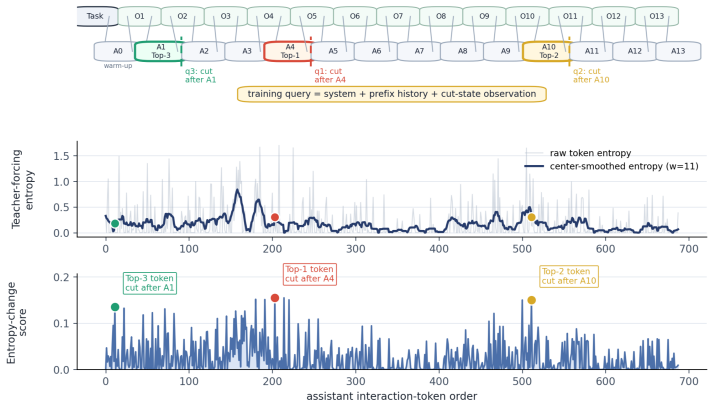
- One teacher trajectory can supply up to four training queries (entropy-change Top-3 cuts plus the raw no-prefix query), multiplying the decision-aware RL signal obtained from an expensive teacher rollout.
- Simply replaying a teacher prefix as context barely improves over response-only RL — explicit prefix-token optimization is needed (TextCraft Pass@8 78.79 to 96.00), so future methods should treat prefix tokens as optimization targets, not conditions.
- Prefix optimization primarily improves best-of-k recovery (Pass@8) rather than average rollout reliability (Avg@8); strongest SFT-initialized RL baselines often match or beat it on Avg@8, so the two metrics measure distinct skills and should both be reported.
- The same unified clipped-objective pattern can be reapplied wherever a replayed intermediate state and an offline old-policy estimate exist, not only for this specific environment set.
Where Pith is reading between the lines
- This reader's inference: if the effect transfers, the entropy-change cut rule implies a general curriculum principle — cut trajectories where the student's uncertainty changes most sharply, not where it is highest; this is a testable heuristic for any distillation-plus-RL pipeline.
- The SFT-old-policy anchor offers a generic fix for the 'missing old logits' problem in off-policy agent RL: cache old log-probs from a fixed reference checkpoint instead of trying to reconstruct them from asynchronous rollouts.
- The method's dependence on replay verification suggests a boundary: in stochastic or partially observable environments where replays diverge, the approach would need state abstraction or learned world models; the gains reported here may partly come from the fact that these three environments are deterministic enough to be replayed.
- A worthwhile ablation the paper leaves implicit is whether a random cut rule with matched replay-validation rate reproduces the entropy-change gains — that would isolate the contribution of cut selection from replay validation.
Editorial analysis
A structured set of objections, weighed in public.
Referee Report
Summary. The paper proposes Prefix-GRPO, an RL framework for small-model agents that decomposes teacher trajectories into multiple cut-state queries. Each query replays the teacher prefix in the environment, validates the resulting state by matching structured fields, then canonicalizes the prompt to end at the cut-state observation. The student continues online and receives task reward. The new ingredient is that historical assistant tokens in the replayed prefix are also optimized with a clipped GRPO-like surrogate, using a policy-distilled SFT checkpoint to provide old log-probabilities and the absolute continuation advantage as weight. Experiments on TextCraft, BabyAI, and ALFWorld with Qwen3-1.7B show that Prefix-GRPO achieves the best Pass@8 in all three environments; ablations show that entropy-change cut selection and explicit prefix optimization outperform replay-only and several design variants.
Significance. If the results hold, the paper contributes a novel and generally applicable way to reuse teacher trajectories: splitting trajectories into multiple replay-validated starting states and treating prefix tokens as optimization targets. The main internal ablation (Replay-GRPO vs. Prefix-GRPO) is well controlled and shows a large, credible gain on TextCraft (Pass@8 78.79→96.00). The paper also provides many useful ablations (construction family, advantage assignment, loss combination, clipping) and releases code, which are strengths. However, the improvements over the strongest full-trajectory baselines are small (at most ~1 point Pass@8), and all runs appear to be single-seed, so the headline comparison is fragile. The correctness of the method hinges on replay validation recovering states consistent with the teacher continuation; this is only partially validated in TextCraft and is not described at all for BabyAI/ALFWorld.
major comments (3)
- [§3.1, App. A.2, Table 10] The central premise is that replay validation recovers a state from which the environment's continuation is approximately the teacher's continuation. As written, validation is defined only for TextCraft and checks only shared structured fields (Inventory:, Got..., Crafted...) on one or two observations. No replay-validation procedure or success rate is reported for BabyAI or ALFWorld, although the method's results in Tables 2-3 are computed under the same premise. Table 10 shows that 15-17% of TextCraft prefix candidates fail validation, but the paper does not report which tasks, depths, or difficulty levels are dropped, nor whether the validated training distribution differs from the full-trajectory baseline distribution. If validation systematically removes harder cut states, the comparison with SFT→DAPO/GRPO baselines is confounded. Please provide per-environment validation protocols,
- [§3.2-3.3, Eq. (4), Eq. (6)] The prefix ratio in Eq. (4) is written as an importance ratio exp(log π_θ(z|x) − ℓ^old), with ℓ^old computed by teacher forcing under the SFT checkpoint. But the assistant prefix tokens were generated by the teacher (MiniMax-M2.1), not sampled from the SFT policy. The SFT log-probabilities are therefore not old-policy probabilities of the data-generating process, and clipping Eq. (6) does not inherit the theoretical justification of PPO/GRPO. The objective is closer to a reward-weighted supervised anchor on teacher tokens. The paper acknowledges this limitation in Section 5, but Sections 1 and 3.3 describe it as the 'same clipped policy-optimization form,' which overstates the theoretical status. Since the objective is the core novelty, the authors should either provide a principled derivation (e.g., as a KL-regularized objective) or run an ablation that replaces the SFT anchor with a po
- [§4.2, Tables 1-3, §5] The experiments appear to be single-run (Section 5: 'most results are single-run experiments'), and the differences from the strongest full-trajectory baseline are very small: TextCraft Pass@8 96.00 vs. 95.96 for SFT→DAPO; ALFWorld 94.50 vs. 93.50 for SFT→GRPO-MIS; BabyAI 100.00 vs. 97.78-98.89 for SFT→GRPO/GRPO-MIS/DAPO. No variance estimates or significance tests are reported. The internal Replay-GRPO vs. Prefix-GRPO gap on TextCraft (78.79→96.00) is large and well controlled, so the claim that explicit prefix optimization helps is credible. But the headline claim that Prefix-GRPO 'improves small-model agents over ... standard RL baselines' is not established from single runs with sub-point margins on two of three environments. Please report multiple seeds (or at least multiple evaluation seeds) and error bars, and state the number of runs explicitly.
minor comments (5)
- [App. A.2, Table 10] The columns 'Validated' and 'Trainable' are confusing: for Fixed-Ratio rows, Trainable > Validated. Clarify whether raw no-prefix queries are included in Trainable and define the relationship between the two columns in the caption.
- [App. A.1, Table 9] The caption uses 'prefix fullflow data,' which appears to be a typo for 'prefix fullflow' or 'Prefix-GRPO.' More importantly, the table does not state how many rows are raw no-prefix queries vs. prefix queries; add a breakdown.
- [§3.1, Figure 2] Figure 2 is referenced in the text, but the figure is not present in the main-text copy provided. Ensure that the final manuscript includes the figure with all referenced panels.
- [App. A.2, Eq. (7)] The entropy H_t is defined over the full vocabulary, but the text says scoring is restricted to the interaction_assistant token domain. Clarify whether the restriction applies to positions, to the vocabulary distribution, or to both.
- [App. D.3] The text states 'every failed rollout reaches the 30-turn limit,' then later says 'only one failed sample ends with an invalid action.' These statements are inconsistent if an invalid action terminates the rollout early; qualify the first sentence (e.g., 'nearly all failed rollouts').
Circularity Check
No significant circularity: Prefix-GRPO is an empirical training method whose objective and ablations are self-contained, and its main result does not reduce to a fitted parameter or to a self-citation chain.
full rationale
The paper does not claim a derivation in the sense of deriving a prediction from an input; it proposes a training objective (Eq. 6) and evaluates it empirically against external baselines (GRPO, DAPO, SFT) on three standard environments. The prefix branch uses the SFT checkpoint both to select cut points via teacher-forcing entropy (Eqs. 7-8) and to compute old log-probabilities for prefix tokens (Eq. 4 and Appendix A.2). This is a shared modeling choice, but it is not a definitional reduction: the reported outcomes (environment reward, Avg@8, Pass@8) are external to the SFT model, and the Replay-GRPO ablation (Table 5) isolates the effect of the prefix loss on the same data, so the central claim does not reduce to the construction. The self-citations [27]-[31] appear only in related work and motivation; no uniqueness theorem or ansatz is imported from them as load-bearing evidence. The replay-validation selection effect (Appendix A.2, Table 10) and the acknowledged single-run limitation are validity concerns, not circularity. No circular step can be exhibited by quoting an equation that is identical to its input by construction.
Axiom & Free-Parameter Ledger
free parameters (5)
- entropy smoothing window w =
11
- top-k distinct assistant turns =
3
- prefix loss weight lambda_pre =
1.0
- prefix clip low/high =
0.2/0.2
- SFT checkpoint old-policy anchor =
Qwen3-1.7B SFT 20 epochs, lr 1e-5
axioms (4)
- domain assumption Replay validation by matching shared structured fields (Inventory:, Got..., Crafted...) implies the recovered intermediate state is a valid starting state for the same task continuation.
- domain assumption The policy-distilled SFT checkpoint provides a valid old-policy estimate for teacher prefix tokens sampled by a different policy (MiniMax-M2.1), so the importance ratio in Eq. (4) is well-defined and unbiased.
- domain assumption Success of the environment rollout is fully captured by the reward function (one scalar success proxy), and the continuation advantage can be broadcast as token-level advantage.
- domain assumption The three environments (TextCraft, BabyAI, ALFWorld) are representative of long-horizon interactive agent tasks.
invented entities (2)
-
Prompt-space prefix span-mask-logprob sidecar (b_i, e_i, m_i, l^old_i, n_i)
no independent evidence
-
Replay-validated cut-state query
no independent evidence
read the original abstract
Small language models are attractive backbones for interactive agents, but direct distillation from strong teacher trajectories often turns rich multi-turn behavior into one-shot imitation targets. This is inefficient in long-horizon environments, where early decisions shape later states and rewards. We propose Prefix-GRPO, a reinforcement learning framework that decomposes teacher trajectories into replay-aligned prefix queries and online continuations. Each prefix is replayed in the environment to recover a valid intermediate state, after which the student continues online interaction and receives task reward. Unlike response-only GRPO, Prefix-GRPO also applies clipped policy updates to historical assistant tokens inside the replayed prefix, using a policy-distilled SFT checkpoint to estimate their old log-probabilities. This unifies prefix learning and continuation learning within the same policy-optimization form. Experiments on TextCraft, BabyAI, and ALFWorld show that Prefix-GRPO improves small-model agents over distillation and standard RL baselines, while ablations show that replay alone is insufficient without explicit prefix-token optimization. The implementation and reproduction scripts are available at https://github.com/HappynessI/Prefix_GRPO.
Figures



Reference graph
Works this paper leans on
-
[1]
Belcak, P., Heinrich, G., Diao, S., Fu, Y ., Dong, X., Muralidharan, S., Lin, Y . C., and Molchanov, P. (2025).Small Language Models are the Future of Agentic AI.CoRR, abs/2506.02153. https: //doi.org/10.48550/arXiv.2506.02153
-
[2]
Kang, M., Jeong, J., Lee, S., Cho, J., and Hwang, S. J. (2025).Distilling LLM Agent into Small Models with Retrieval and Code Tools.CoRR, abs/2505.17612. https://doi.org/10.48550/arXiv.2505.17612
-
[3]
G., Xia, T., Mao, H., Thumiger, N., Desai, A., Stoica, I., Klimovic, A., Neubig, G., and Gonzalez, J
Cuadron, A., Li, D., Ma, W., Wang, X., Wang, Y ., Zhuang, S., Liu, S., Schroeder, L. G., Xia, T., Mao, H., Thumiger, N., Desai, A., Stoica, I., Klimovic, A., Neubig, G., and Gonzalez, J. E. (2025).The Danger of Overthinking: Examining the Reasoning-Action Dilemma in Agentic Tasks.CoRR, abs/2502.08235. https://doi.org/10.48550/arXiv.2502.08235
-
[4]
Zhang, X., Huang, Z., Ni, C., Xiong, Z., Chen, J., and Oymak, S. (2025a).Making Small Language Models Efficient Reasoners: Intervention, Supervision, Reinforcement.CoRR, abs/2505.07961. https: //doi.org/10.48550/arXiv.2505.07961
-
[5]
Zhao, W., Sui, X., Guo, J., Hu, Y ., Deng, Y ., Zhao, Y ., Zhi, X., Huang, Y ., He, H., Che, W., Liu, T., and Qin, B. (2026).Trade-offs in Large Reasoning Models: An Empirical Analysis of Deliberative and Adaptive Reasoning over Foundational Capabilities. InProceedings of the AAAI Conference on Artificial Intelligence, pages 34976–34984. AAAI Press.https:...
-
[6]
Shao, Z., Wang, P., Zhu, Q., Xu, R., Song, J., Zhang, M., Li, Y . K., Wu, Y ., and Guo, D. (2024). DeepSeekMath: Pushing the Limits of Mathematical Reasoning in Open Language Models.CoRR, abs/2402.03300.https://doi.org/10.48550/arXiv.2402.03300
-
[7]
Huang, Z., Cheng, T., Qiu, Z., Wang, Z., Xu, Y ., Ponti, E. M., and Titov, I. (2025).Blending Supervised and Reinforcement Fine-Tuning with Prefix Sampling.CoRR, abs/2507.01679. https://doi.org/10. 48550/arXiv.2507.01679
-
[8]
Setlur, A., Wang, Z., Cohen, A., Rashidinejad, P., and Xie, S. M. (2026).Reuse your FLOPs: Scaling RL on Hard Problems by Conditioning on Very Off-Policy Prefixes.CoRR, abs/2601.18795. https: //doi.org/10.48550/arXiv.2601.18795
-
[9]
(2026).Well Begun, Half Done: Reinforcement Learning with Prefix Optimization for LLM Reasoning
Sun, Y ., Zhao, Z., Wei, Y ., Zhang, Y ., and Gong, C. (2026).Well Begun, Half Done: Reinforcement Learning with Prefix Optimization for LLM Reasoning. InProceedings of the AAAI Conference on Artificial Intelligence, pages 33144–33152. AAAI Press.https://doi.org/10.1609/aaai.v40i39.40598
-
[10]
Xi, Z., Huang, J., Liao, C., Huang, B., Guo, H., Liu, J., Zheng, R., Ye, J., Zhang, J., Chen, W., He, W., Ding, Y ., Li, G., Chen, Z., Du, Z., Yao, X., Xu, Y ., Chen, J., Gui, T., Wu, Z., Zhang, Q., Huang, X., and Jiang, Y .-G. (2025).AgentGym-RL: Training LLM Agents for Long-Horizon Decision Making through Multi-Turn Reinforcement Learning.CoRR, abs/2509...
-
[11]
Qiu, J., Juan, X., Wang, Y ., Yang, L., Qi, X., Zhang, T., Guo, J., Lu, Y ., Yao, Z., Wang, H., Liu, S., Jiang, X., Leqi, L., and Wang, M. (2025).AgentDistill: Training-Free Agent Distillation with Generalizable MCP Boxes.CoRR, abs/2506.14728.https://doi.org/10.48550/arXiv.2506.14728
-
[12]
Inference-Time Distillation: Cost-Efficient Agents Without Fine-Tuning or Manual Prompt Engineering
Sarukkai, V ., Gupta, A., Hong, J., Gharbi, M., and Fatahalian, K. (2025).In-Context Distillation with Self- Consistency Cascades: A Simple, Training-Free Way to Reduce LLM Agent Costs.CoRR, abs/2512.02543. https://doi.org/10.48550/arXiv.2512.02543
work page internal anchor Pith review Pith/arXiv arXiv doi:10.48550/arxiv.2512.02543 2025
-
[13]
Zhang, D., Yang, Z., Janghorbani, S., Han, J., Ressler, A., Qian, Q., Lyng, G. D., Batra, S. S., and Tillman, R. E. (2026).Fast and Effective On-policy Distillation from Reasoning Prefixes.CoRR, abs/2602.15260. https://doi.org/10.48550/arXiv.2602.15260
-
[14]
Xi, Z., Ding, Y ., Chen, W., Hong, B., Guo, H., Wang, J., Yang, D., Liao, C., Guo, X., He, W., Gao, S., Chen, L., Zheng, R., Zou, Y ., Gui, T., Zhang, Q., Qiu, X., Huang, X., Wu, Z., and Jiang, Y .-G. (2024).AgentGym: Evolving Large Language Model-based Agents across Diverse Environments.CoRR, abs/2406.04151. https://doi.org/10.48550/arXiv.2406.04151 10
-
[15]
(2024).ADaPT: As-Needed Decomposition and Planning with Language Models
Prasad, A., Koller, A., Hartmann, M., Clark, P., Sabharwal, A., Bansal, M., and Khot, T. (2024).ADaPT: As-Needed Decomposition and Planning with Language Models. InFindings of the Association for Computational Linguistics: NAACL 2024, pages 4226–4252. Association for Computational Linguistics. https://doi.org/10.18653/v1/2024.findings-naacl.264
-
[16]
(2021).ALFWorld: Aligning Text and Embodied Environments for Interactive Learning
Shridhar, M., Yuan, X., Cote, M.-A., Bisk, Y ., Trischler, A., and Hausknecht, M. (2021).ALFWorld: Aligning Text and Embodied Environments for Interactive Learning. InProceedings of the International Conference on Learning Representations. OpenReview.net. https://openreview.net/forum?id= 0IOX0YcCdTn
2021
-
[17]
Chevalier-Boisvert, M., Bahdanau, D., Lahlou, S., Willems, L., Saharia, C., Nguyen, T. H., and Bengio, Y . (2018).BabyAI: First Steps Towards Grounded Language Learning with a Human In the Loop.CoRR, abs/1810.08272.http://arxiv.org/abs/1810.08272
Pith/arXiv arXiv 2018
-
[18]
Wang, R. and Ammanabrolu, P. (2025).A Practitioner’s Guide to Multi-turn Agentic Reinforcement Learning.CoRR, abs/2510.01132.https://doi.org/10.48550/arXiv.2510.01132
-
[19]
L., Hou, Z., Qi, Z., Lai, H., Xu, Y ., Lu, R., Wang, H., Tang, J., and Dong, Y
Zhang, H., Liu, X., Lv, B., Sun, X., Jing, B., Iong, I. L., Hou, Z., Qi, Z., Lai, H., Xu, Y ., Lu, R., Wang, H., Tang, J., and Dong, Y . (2025b).AgentRL: Scaling Agentic Reinforcement Learning with a Multi-Turn, Multi-Task Framework.CoRR, abs/2510.04206.https://doi.org/10.48550/arXiv.2510.04206
-
[20]
Chai, J., Yin, G., Xu, Z., Yue, C., Jia, Y ., Xia, S., Wang, X., Jiang, J., Li, X., Dong, C., He, H., and Lin, W. (2025).RLFactory: A Plug-and-Play Reinforcement Learning Post-Training Framework for LLM Multi-Turn Tool-Use.CoRR, abs/2509.06980.https://doi.org/10.48550/arXiv.2509.06980
-
[21]
(2025).Agentic Reinforced Policy Optimization.CoRR, abs/2507.19849
Dong, G., Mao, H., Ma, K., Bao, L., Chen, Y ., Wang, Z., Chen, Z., Du, J., Wang, H., Zhang, F., Zhou, G., Zhu, Y ., Wen, J.-R., and Dou, Z. (2025).Agentic Reinforced Policy Optimization.CoRR, abs/2507.19849. https://doi.org/10.48550/arXiv.2507.19849
-
[22]
N., Liu, L., Gottlieb, E., Lu, Y ., Cho, K., Wu, J., Fei-Fei, L., Wang, L., Choi, Y ., and Li, M
Wang, Z., Wang, K., Wang, Q., Zhang, P., Li, L., Yang, Z., Jin, X., Yu, K., Nguyen, M. N., Liu, L., Gottlieb, E., Lu, Y ., Cho, K., Wu, J., Fei-Fei, L., Wang, L., Choi, Y ., and Li, M. (2025).RAGEN: Understanding Self-Evolution in LLM Agents via Multi-Turn Reinforcement Learning.CoRR, abs/2504.20073. https: //doi.org/10.48550/arXiv.2504.20073
-
[23]
Yu, Q., Zhang, Z., Zhu, R., Yuan, Y ., Zuo, X., Yue, Y ., Fan, T., Liu, G., Liu, L., Liu, X., Lin, H., Lin, Z., Ma, B., Sheng, G., Tong, Y ., Zhang, C., Zhang, M., Zhang, W., Zhu, H., Zhu, J., Chen, J., Chen, J., Wang, C., Yu, H., Dai, W., Song, Y ., Wei, X., Zhou, H., Liu, J., Ma, W.-Y ., Zhang, Y .-Q., Yan, L., Qiao, M., Wu, Y ., and Wang, M. (2025).DAP...
-
[24]
Li, G., Chen, Y ., Lin, M., and Yang, T. (2025).DRPO: Efficient Reasoning via Decoupled Reward Policy Optimization.CoRR, abs/2510.04474.https://doi.org/10.48550/arXiv.2510.04474
-
[25]
Kim, M., Shrestha, S., and Ross, K. W. (2026).Training Reasoning Models on Saturated Problems via Failure-Prefix Conditioning.CoRR, abs/2601.20829. https://doi.org/10.48550/arXiv.2601. 20829
-
[26]
(2026).A Step Back: Prefix Importance Ratio Stabilizes Policy Optimization
Lei, S., Cheng, Z., and Tao, D. (2026).A Step Back: Prefix Importance Ratio Stabilizes Policy Optimization. CoRR, abs/2601.22718.https://doi.org/10.48550/arXiv.2601.22718
-
[27]
Guan, Z., Wu, L., Zhao, H., Wang, J., and Wu, L. (2025a).Recall-Extend Dynamics: Enhancing Small Language Models through Controlled Exploration and Refined Offline Integration.CoRR, abs/2508.16677. https://doi.org/10.48550/arXiv.2508.16677
-
[28]
Guan, Z., Wu, L., Zhao, H., He, M., and Fan, J. (2025b).Attention Mechanisms Perspective: Exploring LLM Processing of Graph-Structured Data.CoRR, abs/2505.02130. https://doi.org/10.48550/ arXiv.2505.02130
-
[29]
(2025c).Enhancing Collaborative Semantics of Language Model-Driven Recommendations via Graph-Aware Learning.IEEE Transactions on Knowledge and Data Engineering
Guan, Z., Wu, L., Zhao, H., He, M., and Fan, J. (2025c).Enhancing Collaborative Semantics of Language Model-Driven Recommendations via Graph-Aware Learning.IEEE Transactions on Knowledge and Data Engineering. IEEE
-
[30]
(2025).Multi-view Empowered Structural Graph Wordification for Language Models
Liu, Z., Wu, L., He, M., Guan, Z., Zhao, H., and Feng, N. (2025).Multi-view Empowered Structural Graph Wordification for Language Models. InProceedings of the AAAI Conference on Artificial Intelligence, volume 39, number 23, pages 24714–24722
2025
-
[31]
Guan, Z., Guo, Y ., Sun, H., Huang, W., Di, S., Wu, L., Wu, X. J., and Zhao, H. (2026).Missing Old Logits in Asynchronous Agentic RL: Semantic Mismatch and Repair Methods for Off-Policy Correction.CoRR, abs/2605.12070.https://doi.org/10.48550/arXiv.2605.12070 11 Supplementary Material for Replayed Prefix Optimization for Small-Model Agents A Datasets. . ....
work page internal anchor Pith review Pith/arXiv arXiv doi:10.48550/arxiv.2605.12070 2026
-
[32]
THINK FIRST: before any action, analyze the current state
-
[33]
ONE ACTION: output exactly one action per turn
-
[34]
BOX FORMAT: wrap your command in [[ ]], e.g., Action: [[ inventory ]]
-
[35]
REASONING LOGIC: When trying to acquire an item [Target]:
NO HALLUCINATION: do not simulate the environment response. REASONING LOGIC: When trying to acquire an item [Target]:
-
[36]
If you already have [Target], proceed
Check inventory. If you already have [Target], proceed
-
[37]
If [Target] has a recipe, get missing ingredients first
Check recipe. If [Target] has a recipe, get missing ingredients first
-
[38]
If [Target] is a base material, use get [Target]
-
[39]
If get or craft fails, check recipes and exact item names again. CORE COMMAND SET: - craft [target] using [ingredients] - get [item] - inventory INTERACTION EXAMPLE: [Environment] Goal: craft powered rail Recipes: - craft 6 powered rail using 1 redstone, 1 stick, 6 gold ingot - craft 1 gold ingot using 9 gold nugget - craft 1 stick using 2 bamboo [You] Th...
discussion (0)
Sign in with ORCID, Apple, or X to comment. Anyone can read and Pith papers without signing in.