REVIEW 3 major objections 5 minor 113 references
The paper argues that light electron doping raises MgB2's Tc because an electron-phonon coupling term rooted in the geometry of the σ-band wavefunctions grows faster than the density of states falls.
Reviewed by Pith at T0; open to challenge. T0 means a machine referee read the full paper against a public rubric. the ladder, T0–T4 →
T0 review · deepseek-v4-flash
2026-08-01 12:40 UTC pith:QY4CJLDA
load-bearing objection A solid symmetry-based re-analysis of MgB2 with a genuinely new but under-supported prediction: clean light electron doping raises Tc, and the rise is attributed to quantum geometry. the 3 major comments →
Quantum geometry and critical temperature enhancement in MgB₂ superconductivity
The pith
A machine-rendered reading of the paper's core claim, the machinery that carries it, and where it could break.
Core claim
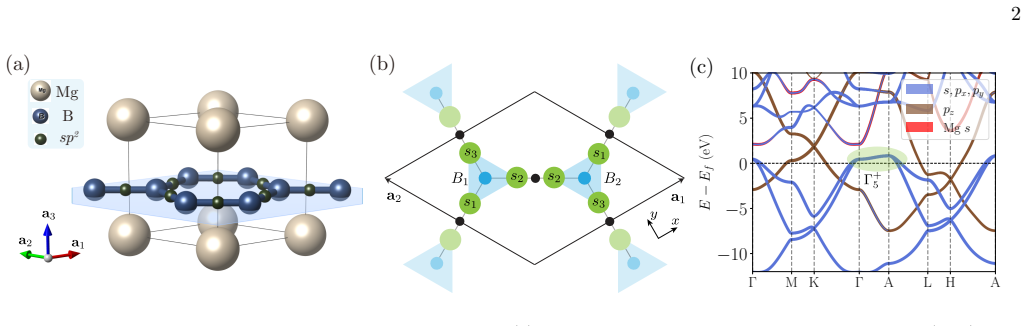
The paper shows that MgB2's small quasi-2D σ Fermi-surface cylinders are built from bond-centered B sp2 bonding states that form an obstructed kagome lattice, and that the Γ+5 B–B bond-stretching mode is the only Γ-point phonon symmetry-allowed to couple to them. Under light electron doping, ab initio calculations reveal a competition: the σ DOS at the Fermi level falls roughly linearly, while the band-basis electron-phonon coupling peaks at Γ and becomes stronger as the Fermi level approaches the doubly degenerate Γ+5 band edge. The paper's central discovery is that the EPC enhancement wins in the small-doping regime, raising Tc within the sp2-only calculation, and that this enhancement is
What carries the argument
The central object is the q=0 band-basis EPC G_m_k for the two σ bands, summed over the two Γ+5 bond-stretching phonon polarizations; it is sharply peaked at Γ, remains large toward K, and decays roughly as k^2. The analytical engine is the Gaussian approximation for electron hoppings, which writes each hopping as t(R)=t0 exp(-γ|R|^2/2), so the EPC tensor takes the compact form f_µ(k)=iγ ∂_{k_µ} h(k). Writing the Hamiltonian spectrally as h=Σ ε_n P_n splits f into an energetic part iγ(∂ε_n)P_n and a geometric part iγ ε_n ∂P_n; the geometric part is governed by momentum derivatives of the Bloch projectors, i.e. by quantum geometry, and grows near the symmetry-protected Γ+5 degeneracy. The pap
Load-bearing premise
The prediction rests on computing Tc with an isotropic Allen-Dynes McMillan formula applied only to the sp2 σ bands, leaving out the π Fermi surface; if the π bands or a different Coulomb pseudopotential µ* shift the balance between the falling DOS and the growing EPC, the predicted rise in Tc could disappear.
What would settle it
A full anisotropic Eliashberg calculation that includes the π bands with a realistic µ* and shows Tc falling monotonically under electron doping — or an experiment on a clean gated MgB2 film showing the same — would falsify the claim.
If this is right
- Clean light electron doping of MgB2 should raise Tc by roughly 2–3 K near +0.1 electron per unit cell, with Tc then dropping as doping exceeds the σ-band edge; experimental comparison requires disorder-free doping.
- Tensile strain acts as effective light electron doping: the calculation gives about 27.3 K at a=3.10 Å and 31.4 K at a=3.13 Å within the sp2-only model, qualitatively matching strained-film reports approaching 42 K.
- The Γ+5 bond-stretching branch is the unique dominant pairing channel for the σ Fermi surface, contributing over 70% of the total λ; this follows from a symmetry selection rule, not from fitting.
- The geometric component of the EPC, not the density of states, tracks the non-monotonic doping dependence of λ and Tc; this suggests searching for superconductors where band-edge degeneracies supply rapidly varying wavefunctions instead of large DOS.
Where Pith is reading between the lines
- Editorial inference: the same λgeo decomposition could be applied to other phonon-mediated materials with small Fermi surfaces near symmetry-enforced degeneracies (e.g., kagome or obstructed-lattice metals) to predict whether doping raises Tc even when DOS falls.
- Editorial inference: the paper's clean-limit prediction points to a specific experimental target — electrostatic gating or a disorder-free intercalation route — because substitutional electron doping has historically lowered Tc; the distinction between clean and dirty doping is where this prediction lives or dies.
- Editorial inference: the smallness of the geometric contribution to the superfluid weight, computed in the paper, suggests a clean separation — geometry can dominate the pairing strength while leaving phase stiffness conventional — which could be probed by measuring penetration depth and Tc together as functions of doping.
Editorial analysis
A structured set of objections, weighed in public.
Referee Report
Summary. The paper revisits MgB2 with a symmetry-based, minimal-input framework. It shows that the in-plane B sp2 bands realize an obstructed, bond-centered kagome lattice whose bonding states form the small quasi-2D σ Fermi surface; it builds analytic tight-binding models whose hoppings are reproduced by hydrogen-like orbital-overlap integrals without dedicated ab initio input. The phonon spectrum is interpreted as a graphene-like boron layer rigidly lifted into the optical sector by the heavy Mg sublattice, and representation theory (Eqs. 1–2) is used to prove that the Γ+5 bond-stretching mode is the only Γ-point phonon allowed to couple to the σ Fermi surface. From DFPT data the authors compute the doping dependence of the EPC, DOS, and Tc, reporting a non-monotonic Tc that rises by roughly 1–3 K under light electron doping before collapsing as the DOS depletes. Using the Gaussian approximation (GA) for the EPC, they decompose λ into geometric, energetic, and cross contributions and attribute the rise to the quantum-geometric part, which is sharply peaked at Γ. Superfluid-weight calculations are also presented; the geometric part is σ-dominated and peaks near the degenerate Γ+5 edge. The central claim is that light electron doping (or equivalent tensile strain) raises Tc in MgB2, and that this enhancement is overwhelmingly quantum geometric in origin.
Significance. If the result holds, the paper establishes a concrete mechanism by which quantum geometry controls a doping trend in a phonon-mediated superconductor, and it provides a symmetry-based blueprint for identifying such systems: small Fermi surfaces near symmetry-protected degeneracies with strong bond-stretching phonons. Strengths: (i) the symmetry selection rule for the Γ+5 channel is clean and testable; (ii) the hydrogenic hopping model reproduces Wannier hoppings with minimal input; (iii) the k2 scaling of the Γ-peaked EPC is derived analytically; (iv) the ab initio λ and Tc data come with reported convergence checks (Tc stable to <0.3 K under mesh refinement); (v) the claims are falsifiable — the predicted rise of Tc under clean light electron doping and the predicted dominance of λgeo over λE. The main caveat is that the quantitative Tc prediction rests on an sp2-only isotropic Allen-Dynes calculation that at zero doping gives 24.96 K against the experimental 39 K, and the π-band contribution is dropped. The paper's value for the field depends on whether the doping trend survives a two-band or anisotropic Eliashberg treatment; the present evidence establishes the mechanism within
major comments (3)
- [§d, Fig. 3(c), Table S8, Eq. (S1.57)] The Tc(doping) curve is computed with the isotropic Allen-Dynes formula restricted to the three sp2 bonding bands. At zero doping the model gives Tc=24.96 K, about 14 K below the experimental 39 K, and the predicted peak at +0.1 e per cell is only ~2 K above this baseline. This truncation is load-bearing for the abstract's material-level claim that light electron doping increases Tc: the π Fermi surface carries a large, roughly doping-independent DOS, and since λ is normalized by N(Ef), a full calculation dilutes the σ-band λ growth (λ_full ≈ (λ_σ N_σ + λ_π N_π)/(N_σ + N_π)). As electron doping shrinks N_σ, this dilution can offset the EPC enhancement and the predicted rise could disappear. The main text does disclose the sp2-only restriction, but the abstract does not. Please either add a two-band/anisotropic Eliashberg test with the π bands, or present the enhancement explicitly as a r
- [Eq. (S1.57), §d] The Coulomb pseudopotential µ* is never reported. In the Allen-Dynes formula, Tc is exponentially sensitive to µ*: for λ≈0.70–0.73 and ωlog≈700–730 K, Tc changes by nearly a factor of two as µ* goes from 0.10 to 0.16. Since the headline is a quantitative Tc enhancement, the value of µ* used for Fig. 3(c) and Table S8 must be stated, and the Tc(doping) curves should be shown for µ* over the standard 0.10–0.16 range so that the existence and size of the ~2 K rise can be assessed independently. If the same µ* is used at all dopings the relative trend is likely robust, but the reader cannot verify this from the manuscript as written.
- [§e, Eqs. (4)–(5), SI §VI 3 d] The GA analysis is described as providing 'independent confirmation' that the λ/Tc enhancement is geometric. This is a consistency check, not an independent test: the Gaussian decay constant γ in Eq. (4) is fitted to the very ab initio data whose doping trend the GA then reproduces (SI §VI 3 d). The algebraic split in Eq. (5) is sound and the geometric peak at Γ is informative, but the conclusion inherits the GA ansatz — including a common γ for all hoppings and the neglect of onsite EPC terms that the authors themselves state are comparable in magnitude to the bond EPC terms (SI §I 8). Please reword the 'independent confirmation' claim, report the fitted γ and its uncertainty, and show that the geometric dominance is stable when γ is varied within the fit uncertainty or when onsite EPC terms are included.
minor comments (5)
- [Abstract] The abstract states the Tc-enhancement claim without the sp2-sector qualifier that the main text introduces in §d. Add 'within our sp2-sector model' or equivalent, so the abstract matches the disclosed limitation.
- [Fig. 4 caption] The caption says the geometry-energy cross term is 'omitted' yet the decomposition in Eq. (7) includes it. Please state explicitly that the plotted 'total' in panel (a) is λ_geo + λ_E, not the full λ of Eq. (7), and clarify how the omitted negative cross term affects the comparison with the ab initio total in Fig. 3(d).
- [SI §V 2 a] The sentence 'as it has a small contribution (20% from Ref. [43])' is ambiguous: specify whether the 20% refers to λ, to the α2F spectral weight, or to the pairing kernel. This number is the only quantified justification for dropping the π Fermi surface and is used implicitly in the sp2-only argument.
- [SI §V 1] Typo: 'isotropoic Tc calculation' should read 'isotropic Tc calculation'.
- [§f] Typo: 'Mgb 2 would resemble a lightly doped semiconductor' should read 'MgB2'.
Circularity Check
The ab initio Tc-doping rise is self-contained, but the GA 'independent confirmation' of its quantum-geometric origin is partially circular: the GA is fitted to the same EPC data, and the q=0 intraband 'energetic' term vanishes by construction.
specific steps
-
fitted input called prediction
[Main text §e; SI §VI 3 d ('Fitting GA from ab initio data')]
"Using the GA parametrization, we further evaluate the doping dependence of the total EPC strength λ and superconducting properties ... Remarkably, the GA reproduces the same qualitative doping trend as the fully ab initio calculations ... This provides an independent confirmation that the enhancement of λ and Tc at light electron doping is controlled primarily by wavefunction (quantum-geometric) effects rather than by the DOS."
The GA's parameters (including the decay γ in Eq. 4) are fitted to the ab initio EPC data in SI §VI 3 d, as the section heading states. The 'independent confirmation' is therefore a consistency check of a fit against its own training data: the GA's λ-vs-doping trend is inherited from the very ab initio results it is said to independently confirm. The word 'independent' converts a fitted reproduction into a prediction.
-
self definitional
[SI §I 8 (Eq. S1.177); main text §e, Eqs. (4)-(5), Fig. 4]
"The geometric contribution exhibits an even sharper maximum at Γ (compared with the total EPC) and dominates the total signal, while the energetic part is much smaller and vanishes at Γ. ... (Gnn,ν_k,0)^E = ... = 0"
Equation (5) defines f^E_nµ = iγ(∂_kµ ε_nk)P_n and f^geo_nµ = iγ ε_nk ∂_kµ P_n. At the doubly degenerate Γ_5 band edge ∂_k ε=0, so the energetic part vanishes by definition. In SI §I 8 the paper further shows that for q=0 intraband coupling—exactly the quantity G_k of Eq. (3) used in Fig. 4—the energetic matrix element is identically zero in the GA. Thus the statement that 'the peak structure is overwhelmingly geometric in origin' follows from the chosen decomposition, not from an independent numerical competition between energetic and geometric terms.
full rationale
The paper's central quantitative claim—that light electron doping raises Tc in the sp2-only model—is an ab initio DFPT/Allen-Dynes result (Eq. S1.57, Fig. 3, Table S8) and does not depend on the Gaussian approximation. That part is not circular, though its sp2-only truncation, isotropic approximation, and unreported μ* are correctness risks, not circularity. The separately claimed 'quantum geometric origin' is a second layer built on the GA from Ref. [43], a prior paper with overlapping authors (Errea, Bernevig). The GA decomposition itself is an algebraic identity, and the 'energetic' term at the Γ band edge vanishes by construction (Eq. 5), making the geometric attribution at the peak definitional. The GA's reproduction of the ab initio doping trend is also called an 'independent confirmation,' but the GA is fitted to ab initio data (SI §VI 3 d), so this is a fitted input presented as a prediction. These issues are real but partial: the numerical dominance of λ_geo over λ_E in the total λ is a model output, and the ab initio Tc trend is independent of the GA. Hence score 4 rather than 6 or higher.
Axiom & Free-Parameter Ledger
free parameters (5)
- γ (Gaussian decay constant, common to all hoppings) =
fitted to ab initio EPC (SI §VI 3 d); value not given in visible text
- µ* (Coulomb pseudopotential in Allen-Dynes McMillan) =
not stated (canonical range 0.1–0.16)
- TB parameters εs, εp, t1–t4 of the 6-orbital boron model =
fitted to DFT dispersion (Table S5)
- Hydrogen-like orbital inputs Ze and a0 =
Ze(B)=3, a0=0.529 Å; Ze(Mg)=2, a0(Mg)=0.23 Å
- Phonon model force constants (Eqs. S4.4–S4.8) =
fitted to DFT phonons
axioms (6)
- domain assumption Gaussian approximation: hoppings t_ij(R) = t0 exp(−γ|R|²/2), with EPC obtained purely from hopping derivatives
- domain assumption Two-center approximation of the EPC tensor
- domain assumption Isotropic Allen-Dynes-McMillan formula for Tc with a single µ*
- domain assumption π-band sector omitted from the superconducting calculation
- standard math Spectral decomposition h = Σ εn Pn and the exact split of ∂μh into energetic and geometric parts
- domain assumption Migdal approximation and double-delta phonon linewidth
Cite this review
Pith. "Pith review of Quantum geometry and critical temperature enhancement in MgB$_2$ superconductivity." pith.science (2026). https://pith.science/paper/QY4CJLDA
@misc{pith2026260719458,
  author       = {Pith},
  title        = {Pith review of: Quantum geometry and critical temperature enhancement in MgB$_2$ superconductivity},
  year         = {2026},
  howpublished = {\url{https://pith.science/paper/QY4CJLDA}},
  note         = {Machine review of arXiv:2607.19458}
}
read the original abstract
MgB$_2$, a phonon-mediated superconductor with record-high critical temperature $T_c\simeq 39$ K, is revisited to obtain a comprehensive theory of electrons, phonons, and their coupling with minimal ab initio input. We construct compact analytic models for the electronic structure, phonons, and electron-phonon coupling (EPC) of MgB$_2$. We show that strong in-plane B $sp^2$ bonding realizes an obstructed band structure whose natural description is a bond-centered kagome lattice, yielding small quasi-2D $\sigma$-band Fermi-surface cylinders and pronounced quantum-geometric effects. The phonon spectrum is found to closely track that of a graphene-like boron layer, but the heavy intercalated Mg atoms dominate the three acoustic branches and rigidly lift the boron modes into the optical sector, while the in-plane B-B bond-stretching mode exhibits a pronounced softening along $\Gamma$-A. By symmetry, this $\Gamma$-point bond-stretching mode is the only $\Gamma$ phonon that can couple to the $\sigma$ Fermi surface, explaining its dominant contribution to the EPC. Upon electron doping toward the doubly degenerate band edge of the $\sigma$ sheets, we find that a reduced density of states competes with enhanced EPC matrix elements. At light electron doping, ab initio calculations show that the EPC enhancement dominates, leading to an increase in $T_c$ (within the clean doping limit without disorder effects). Using the Gaussian approximation for the EPC tensor, we further show that this enhancement is overwhelmingly quantum geometric in origin, arising from a geometric EPC contribution of the small $\sigma$ Fermi surface peaked at $\Gamma$. Overall, our results provide a transparent, symmetry-based account of superconductivity in MgB$_2$ and suggest that quantum-geometric effects can be essential for shaping doping trends in phonon-mediated superconductors.
Figures


Reference graph
Works this paper leans on
-
[1]
Nagamatsu , author N
author author J. Nagamatsu , author N. Nakagawa , author T. Muranaka , author Y. Zenitani ,\ and\ author J. Akimitsu ,\ @noop journal journal nature \ volume 410 ,\ pages 63 ( year 2001 ) NoStop
2001
-
[2]
Larbalestier , author L
author author D. Larbalestier , author L. Cooley , author M. Rikel , author A. Polyanskii , author J. Jiang , author S. Patnaik , author X. Cai , author D. Feldmann , author A. Gurevich , author A. Squitieri , et al. ,\ @noop journal journal Nature \ volume 410 ,\ pages 186 ( year 2001 ) NoStop
2001
-
[3]
author author S. L. \ Bud'ko , author G. Lapertot , author C. Petrovic , author C. Cunningham , author N. Anderson ,\ and\ author P. Canfield ,\ @noop journal journal Physical Review Letters \ volume 86 ,\ pages 1877 ( year 2001 ) NoStop
2001
-
[4]
Yildirim , author O
author author T. Yildirim , author O. G \"u lseren , author J. Lynn , author C. Brown , author T. Udovic , author Q. Huang , author N. Rogado , author K. Regan , author M. Hayward , author J. Slusky , et al. ,\ @noop journal journal Physical review letters \ volume 87 ,\ pages 037001 ( year 2001 ) NoStop
2001
-
[5]
Osborn , author E
author author R. Osborn , author E. Goremychkin , author A. Kolesnikov ,\ and\ author D. Hinks ,\ @noop journal journal Physical Review Letters \ volume 87 ,\ pages 017005 ( year 2001 ) NoStop
2001
-
[6]
Lorenz , author R
author author B. Lorenz , author R. Meng ,\ and\ author C. Chu ,\ @noop journal journal Physical Review B \ volume 64 ,\ pages 012507 ( year 2001 ) NoStop
2001
-
[7]
Buzea \ and\ author T
author author C. Buzea \ and\ author T. Yamashita ,\ @noop journal journal Superconductor Science and Technology \ volume 14 ,\ pages R115 ( year 2001 ) NoStop
2001
-
[8]
An \ and\ author W
author author J. An \ and\ author W. Pickett ,\ @noop journal journal Physical Review Letters \ volume 86 ,\ pages 4366 ( year 2001 a ) NoStop
2001
-
[9]
Kortus , author I
author author J. Kortus , author I. Mazin , author K. D. \ Belashchenko , author V. P. \ Antropov ,\ and\ author L. Boyer ,\ @noop journal journal Physical Review Letters \ volume 86 ,\ pages 4656 ( year 2001 ) NoStop
2001
-
[10]
author author A. Y. \ Liu , author I. I. \ Mazin ,\ and\ author J. Kortus ,\ https://doi.org/10.1103/PhysRevLett.87.087005 journal journal Phys. Rev. Lett. \ volume 87 ,\ pages 087005 ( year 2001 ) NoStop
-
[11]
Kong , author O
author author Y. Kong , author O. Dolgov , author O. Jepsen ,\ and\ author O. Andersen ,\ @noop journal journal Physical Review B \ volume 64 ,\ pages 020501 ( year 2001 ) NoStop
2001
-
[12]
Szab \'o , author P
author author P. Szab \'o , author P. Samuely , author J. Ka c mar c \' k , author T. Klein , author J. Marcus , author D. Fruchart , author S. Miraglia , author C. Marcenat ,\ and\ author A. Jansen ,\ @noop journal journal Physical review letters \ volume 87 ,\ pages 137005 ( year 2001 ) NoStop
2001
-
[13]
author author F. Bouquet , author R. Fisher , author N. Phillips , author D. Hinks ,\ and\ author J. Jorgensen ,\ @noop journal journal arXiv preprint cond-mat/0104206 \ ( year 2001 ) NoStop
Pith/arXiv arXiv 2001
-
[14]
Giubileo , author D
author author F. Giubileo , author D. Roditchev , author W. Sacks , author R. Lamy , author D. Thanh , author J. Klein , author S. Miraglia , author D. Fruchart , author J. Marcus ,\ and\ author P. Monod ,\ @noop journal journal Physical review letters \ volume 87 ,\ pages 177008 ( year 2001 ) NoStop
2001
-
[15]
Angst , author R
author author M. Angst , author R. Puzniak , author A. Wisniewski , author J. Jun , author S. Kazakov , author J. Karpinski , author J. Roos ,\ and\ author H. Keller ,\ @noop journal journal Physical review letters \ volume 88 ,\ pages 167004 ( year 2002 ) NoStop
2002
-
[16]
Souma , author Y
author author S. Souma , author Y. Machida , author T. Sato , author T. Takahashi , author H. Matsui , author S.-C. \ Wang , author H. Ding , author A. Kaminski , author J. Campuzano , author S. Sasaki , et al. ,\ @noop journal journal Nature \ volume 423 ,\ pages 65 ( year 2003 ) NoStop
2003
-
[17]
author author H. J. \ Choi , author D. Roundy , author H. Sun , author M. L. \ Cohen ,\ and\ author S. G. \ Louie ,\ @noop journal journal Nature \ volume 418 ,\ pages 758 ( year 2002 a ) NoStop
2002
-
[18]
author author H. J. \ Choi , author D. Roundy , author H. Sun , author M. L. \ Cohen ,\ and\ author S. G. \ Louie ,\ @noop journal journal Physical Review B \ volume 66 ,\ pages 020513 ( year 2002 b ) NoStop
2002
-
[19]
Mazin , author O
author author I. Mazin , author O. Andersen , author O. Jepsen , author O. Dolgov , author J. Kortus , author A. A. \ Golubov , author . f. A. \ Kuz’menko ,\ and\ author D. Van Der Marel ,\ @noop journal journal Physical review letters \ volume 89 ,\ pages 107002 ( year 2002 ) NoStop
2002
-
[20]
Gurevich ,\ @noop journal journal Physical Review B \ volume 67 ,\ pages 184515 ( year 2003 ) NoStop
author author A. Gurevich ,\ @noop journal journal Physical Review B \ volume 67 ,\ pages 184515 ( year 2003 ) NoStop
2003
-
[21]
Braccini , author A
author author V. Braccini , author A. Gurevich , author J. Giencke , author M. Jewell , author C. Eom , author D. Larbalestier , author A. Pogrebnyakov , author Y. Cui , author B. Liu , author Y. Hu , et al. ,\ @noop journal journal Physical Review B—Condensed Matter and Materials Physics \ volume 71 ,\ pages 012504 ( year 2005 ) NoStop
2005
-
[22]
author author H. J. \ Choi , author S. G. \ Louie ,\ and\ author M. L. \ Cohen ,\ @noop journal journal Physical Review B—Condensed Matter and Materials Physics \ volume 79 ,\ pages 094518 ( year 2009 ) NoStop
2009
-
[23]
author author S. X. \ Dou , author S. Soltanian , author J. Horvat , author X. Wang , author S. Zhou , author M. Ionescu , author H.-K. \ Liu , author P. Munroe ,\ and\ author M. Tomsic ,\ @noop journal journal Applied Physics Letters \ volume 81 ,\ pages 3419 ( year 2002 ) NoStop
2002
-
[24]
Slusky , author N
author author J. Slusky , author N. Rogado , author K. Regan , author M. Hayward , author P. Khalifah , author T. He , author K. Inumaru , author S. Loureiro , author M. Haas , author H. Zandbergen , et al. ,\ @noop journal journal Nature \ volume 410 ,\ pages 343 ( year 2001 ) NoStop
2001
-
[25]
Lee , author T
author author S. Lee , author T. Masui , author A. Yamamoto , author H. Uchiyama ,\ and\ author S. Tajima ,\ @noop journal journal Physica C: Superconductivity \ volume 397 ,\ pages 7 ( year 2003 ) NoStop
2003
-
[26]
Kazakov , author R
author author S. Kazakov , author R. Puzniak , author K. Rogacki , author A. Mironov , author N. Zhigadlo , author J. Jun , author C. Soltmann , author B. Batlogg ,\ and\ author J. Karpinski ,\ @noop journal journal Physical Review B—Condensed Matter and Materials Physics \ volume 71 ,\ pages 024533 ( year 2005 ) NoStop
2005
-
[27]
Pogrebnyakov , author J
author author A. Pogrebnyakov , author J. Redwing , author S. Raghavan , author V. Vaithyanathan , author D. Schlom , author S. Xu , author Q. Li , author D. Tenne , author A. Soukiassian , author X. Xi , et al. ,\ @noop journal journal Physical review letters \ volume 93 ,\ pages 147006 ( year 2004 ) NoStop
2004
-
[28]
Xi , author A
author author X. Xi , author A. Pogrebnyakov , author S. Xu , author K. Chen , author Y. Cui , author E. Maertz , author C. Zhuang , author Q. Li , author D. Lamborn , author J. M. \ Redwing , et al. ,\ @noop journal journal Physica C: Superconductivity \ volume 456 ,\ pages 22 ( year 2007 ) NoStop
2007
-
[29]
\ Zheng \ and\ author Y
author author J.-C. \ Zheng \ and\ author Y. Zhu ,\ @noop journal journal Physical Review B—Condensed Matter and Materials Physics \ volume 73 ,\ pages 024509 ( year 2006 ) NoStop
2006
-
[30]
author author J. Bekaert , author A. Aperis , author B. Partoens , author P. M. \ Oppeneer ,\ and\ author M. V. \ Milo s s evi c \' c ,\ https://doi.org/10.1103/PhysRevB.96.094510 journal journal Phys. Rev. B \ volume 96 ,\ pages 094510 ( year 2017 ) NoStop
-
[31]
Zhang \ and\ author X
author author C. Zhang \ and\ author X. Zhang ,\ @noop journal journal Computational Materials Science \ volume 50 ,\ pages 1097 ( year 2011 ) NoStop
2011
-
[32]
Johansson , author F
author author E. Johansson , author F. Tasn \'a di , author A. Ektarawong , author J. Rosen ,\ and\ author B. Alling ,\ @noop journal journal Journal of Applied Physics \ volume 131 ( year 2022 ) NoStop
2022
-
[33]
Resta ,\ @noop journal journal The European Physical Journal B \ volume 79 ,\ pages 121 ( year 2011 ) NoStop
author author R. Resta ,\ @noop journal journal The European Physical Journal B \ volume 79 ,\ pages 121 ( year 2011 ) NoStop
2011
-
[34]
Provost \ and\ author G
author author J. Provost \ and\ author G. Vallee ,\ @noop journal journal Communications in Mathematical Physics \ volume 76 ,\ pages 289 ( year 1980 ) NoStop
1980
-
[35]
Peotta \ and\ author P
author author S. Peotta \ and\ author P. T \"o rm \"a ,\ @noop journal journal Nature communications \ volume 6 ,\ pages 8944 ( year 2015 ) NoStop
2015
-
[36]
author author A. Julku , author S. Peotta , author T. I. \ Vanhala , author D.-H. \ Kim ,\ and\ author P. T\"orm\"a ,\ https://doi.org/10.1103/PhysRevLett.117.045303 journal journal Phys. Rev. Lett. \ volume 117 ,\ pages 045303 ( year 2016 ) NoStop
-
[37]
author author S. Peotta , author K.-E. \ Huhtinen ,\ and\ author P. T \"o rm \"a ,\ @noop journal journal arXiv preprint arXiv:2308.08248 \ ( year 2023 ) NoStop
arXiv 2023
-
[38]
T \"o rm \"a , author S
author author P. T \"o rm \"a , author S. Peotta ,\ and\ author B. A. \ Bernevig ,\ @noop journal journal Nature Reviews Physics \ volume 4 ,\ pages 528 ( year 2022 ) NoStop
2022
-
[39]
T \"o rm \"a ,\ @noop journal journal Physical Review Letters \ volume 131 ,\ pages 240001 ( year 2023 ) NoStop
author author P. T \"o rm \"a ,\ @noop journal journal Physical Review Letters \ volume 131 ,\ pages 240001 ( year 2023 ) NoStop
2023
-
[40]
Yu , author B
author author J. Yu , author B. A. \ Bernevig , author R. Queiroz , author E. Rossi , author P. T \"o rm \"a ,\ and\ author B.-J. \ Yang ,\ @noop journal journal npj Quantum Materials \ volume 10 ,\ pages 101 ( year 2025 ) NoStop
2025
-
[41]
Liu , author X.-B
author author T. Liu , author X.-B. \ Qiang , author H.-Z. \ Lu ,\ and\ author X. Xie ,\ @noop journal journal National Science Review \ volume 12 ,\ pages nwae334 ( year 2025 ) NoStop
2025
-
[42]
Verma , author P
author author N. Verma , author P. J. \ Moll , author T. Holder ,\ and\ author R. Queiroz ,\ @noop journal journal Nature Reviews Physics \ ,\ pages 1 ( year 2026 ) NoStop
2026
-
[43]
Yu , author C
author author J. Yu , author C. J. \ Ciccarino , author R. Bianco , author I. Errea , author P. Narang ,\ and\ author B. A. \ Bernevig ,\ @noop journal journal Nature Physics \ ,\ pages 1 ( year 2024 ) NoStop
2024
-
[44]
author author Y. Xu , author L. Elcoro , author G. Li , author Z.-D. \ Song , author N. Regnault , author Q. Yang , author Y. Sun , author S. Parkin , author C. Felser ,\ and\ author B. A. \ Bernevig ,\ @noop journal journal arXiv preprint arXiv:2111.02433 \ ( year 2021 ) NoStop
Pith/arXiv arXiv 2021
-
[45]
Xu , author L
author author Y. Xu , author L. Elcoro , author Z.-D. \ Song , author M. Vergniory , author C. Felser , author S. S. \ Parkin , author N. Regnault , author J. L. \ Ma \ n es ,\ and\ author B. A. \ Bernevig ,\ @noop journal journal Physical Review B \ volume 109 ,\ pages 165139 ( year 2024 a ) NoStop
2024
-
[46]
Yao , author F
author author Y. Yao , author F. Ye , author X.-L. \ Qi , author S.-C. \ Zhang ,\ and\ author Z. Fang ,\ @noop journal journal Physical Review B—Condensed Matter and Materials Physics \ volume 75 ,\ pages 041401 ( year 2007 ) NoStop
2007
-
[47]
Abergel , author V
author author D. Abergel , author V. Apalkov , author J. Berashevich , author K. Ziegler ,\ and\ author T. Chakraborty ,\ @noop journal journal Advances in Physics \ volume 59 ,\ pages 261 ( year 2010 ) NoStop
2010
-
[48]
author author M. I. \ Aroyo , author J. M. \ Perez-Mato , author D. Orobengoa , author E. Tasci , author G. de la Flor ,\ and\ author A. Kirov ,\ @noop journal journal Bulg. Chem. Commun \ volume 43 ,\ pages 183 ( year 2011 ) NoStop
2011
-
[49]
author author M. I. \ Aroyo , author J. M. \ Perez-Mato , author C. Capillas , author E. Kroumova , author S. Ivantchev , author G. Madariaga , author A. Kirov ,\ and\ author H. Wondratschek ,\ @noop journal journal Zeitschrift f \"u r Kristallographie-Crystalline Materials \ volume 221 ,\ pages 15 ( year 2006 a ) NoStop
2006
-
[50]
author author M. I. \ Aroyo , author A. Kirov , author C. Capillas , author J. Perez-Mato ,\ and\ author H. Wondratschek ,\ @noop journal journal Acta Crystallographica Section A: Foundations of Crystallography \ volume 62 ,\ pages 115 ( year 2006 b ) NoStop
2006
-
[51]
Gao , author Y
author author J. Gao , author Y. Qian , author H. Jia , author Z. Guo , author Z. Fang , author M. Liu , author H. Weng ,\ and\ author Z. Wang ,\ @noop journal journal Science bulletin \ volume 67 ,\ pages 598 ( year 2022 ) NoStop
2022
-
[52]
Yang , author H
author author Z. Yang , author H. Sheng , author Z. Guo , author R. Zhang , author Q. Wu , author H. Weng , author Z. Fang ,\ and\ author Z. Wang ,\ @noop journal journal npj Computational Materials \ volume 10 ,\ pages 25 ( year 2024 ) NoStop
2024
-
[53]
Wang , author Y
author author L. Wang , author Y. Jiang , author J. Liu , author S. Zhang , author J. Li , author P. Liu , author Y. Sun , author H. Weng ,\ and\ author X.-Q. \ Chen ,\ @noop journal journal Physical Review B \ volume 106 ,\ pages 155144 ( year 2022 ) NoStop
2022
-
[54]
author author D. C a lug a ru , author Y. Jiang , author H. Guo , author S. Sajan , author Y. Wang , author H. Hu , author J. Yu , author B. A. \ Bernevig , author F. de Juan ,\ and\ author M. M. \ Ugeda ,\ @noop journal journal arXiv preprint arXiv:2501.09063 \ ( year 2025 ) NoStop
Pith/arXiv arXiv 2025
-
[55]
author author M. Holbrook , author J. Ingham , author D. Kaplan , author L. Holtzman , author B. Bierman , author N. Olson , author L. Nashabeh , author S. Liu , author X. Zhu , author D. Rhodes , et al. ,\ @noop journal journal arXiv preprint arXiv:2412.02813 \ ( year 2024 ) NoStop
Pith/arXiv arXiv 2024
-
[56]
author author K. H. \ Hiorth , author M. Gutierrez-Amigo , author T. Cavignac , author K. Haule , author M. A. L. \ Marques ,\ and\ author P. T \"o rm \"a ,\ https://doi.org/10.1103/2xrg-6fy6 journal journal Phys. Rev. B \ volume 113 ,\ pages 224509 ( year 2026 ) NoStop
-
[57]
author author L. Liang , author T. I. \ Vanhala , author S. Peotta , author T. Siro , author A. Harju ,\ and\ author P. T\"orm\"a ,\ https://doi.org/10.1103/PhysRevB.95.024515 journal journal Phys. Rev. B \ volume 95 ,\ pages 024515 ( year 2017 ) NoStop
-
[58]
author author K.-E. \ Huhtinen , author J. Herzog-Arbeitman , author A. Chew , author B. A. \ Bernevig ,\ and\ author P. T\"orm\"a ,\ https://doi.org/10.1103/PhysRevB.106.014518 journal journal Phys. Rev. B \ volume 106 ,\ pages 014518 ( year 2022 ) NoStop
-
[59]
author author P. R. \ Pires , author T. H. \ da Silva , author K. Gao , author K. H. \ Hiorth , author T. F. \ Cerqueira , author T. Cavignac , author P.-P. \ De Breuck , author H.-C. \ Wang , author Đorđe Dangić , author Y.-W. \ Fang , author A. Sanna , author W. Cui , author I. Errea , author P. Törmä ,\ and\ author M. A. \ Marques ,\ https://doi.org/ht...
arXiv 2026
-
[60]
Giustino ,\ @noop journal journal Reviews of Modern Physics \ volume 89 ,\ pages 015003 ( year 2017 ) NoStop
author author F. Giustino ,\ @noop journal journal Reviews of Modern Physics \ volume 89 ,\ pages 015003 ( year 2017 ) NoStop
2017
-
[61]
Haoyu , author D
author author H. Haoyu , author D. Zenan , author B. B. Andrei ,\ and\ author et al ,\ @noop journal journal In preparation \ ( year 2026 ) NoStop
2026
-
[62]
Giustino , author M
author author F. Giustino , author M. L. \ Cohen ,\ and\ author S. G. \ Louie ,\ @noop journal journal Physical Review B—Condensed Matter and Materials Physics \ volume 76 ,\ pages 165108 ( year 2007 ) NoStop
2007
-
[63]
Lee , author S
author author H. Lee , author S. Ponc \'e , author K. Bushick , author S. Hajinazar , author J. Lafuente-Bartolome , author J. Leveillee , author C. Lian , author J.-M. \ Lihm , author F. Macheda , author H. Mori , et al. ,\ @noop journal journal npj Computational Materials \ volume 9 ,\ pages 156 ( year 2023 ) NoStop
2023
-
[64]
Ponc \'e , author E
author author S. Ponc \'e , author E. R. \ Margine , author C. Verdi ,\ and\ author F. Giustino ,\ @noop journal journal Computer Physics Communications \ volume 209 ,\ pages 116 ( year 2016 ) NoStop
2016
-
[65]
author author E. R. \ Margine \ and\ author F. Giustino ,\ @noop journal journal Physical Review B—Condensed Matter and Materials Physics \ volume 87 ,\ pages 024505 ( year 2013 ) NoStop
2013
-
[66]
\ Zhou , author J
author author J.-J. \ Zhou , author J. Park , author I.-T. \ Lu , author I. Maliyov , author X. Tong ,\ and\ author M. Bernardi ,\ @noop journal journal Computer Physics Communications \ volume 264 ,\ pages 107970 ( year 2021 ) NoStop
2021
-
[67]
Luo , author D
author author Y. Luo , author D. Desai , author B. K. \ Chang , author J. Park ,\ and\ author M. Bernardi ,\ @noop journal journal Physical Review X \ volume 14 ,\ pages 021023 ( year 2024 ) NoStop
2024
-
[68]
McMillan ,\ @noop journal journal Physical Review \ volume 167 ,\ pages 331 ( year 1968 ) NoStop
author author W. McMillan ,\ @noop journal journal Physical Review \ volume 167 ,\ pages 331 ( year 1968 ) NoStop
1968
-
[69]
Hopfield ,\ @noop journal journal Physical Review \ volume 186 ,\ pages 443 ( year 1969 ) NoStop
author author J. Hopfield ,\ @noop journal journal Physical Review \ volume 186 ,\ pages 443 ( year 1969 ) NoStop
1969
-
[70]
Hu , author Y
author author H. Hu , author Y. Jiang , author D. C a lug a ru , author X. Feng , author D. Subires , author M. G. \ Vergniory , author C. Felser , author S. Blanco-Canosa ,\ and\ author B. A. \ Bernevig ,\ @noop journal journal Physical Review B \ volume 111 ,\ pages 054113 ( year 2025 ) NoStop
2025
-
[71]
An \ and\ author W
author author J. An \ and\ author W. Pickett ,\ @noop journal journal Physical Review Letters \ volume 86 ,\ pages 4366 ( year 2001 b ) NoStop
2001
-
[72]
Mitra ,\ @noop journal journal Journal of Physics C: Solid State Physics \ volume 2 ,\ pages 52 ( year 1969 ) NoStop
author author T. Mitra ,\ @noop journal journal Journal of Physics C: Solid State Physics \ volume 2 ,\ pages 52 ( year 1969 ) NoStop
1969
-
[73]
Baroni , author S
author author S. Baroni , author S. De Gironcoli , author A. Dal Corso ,\ and\ author P. Giannozzi ,\ @noop journal journal Reviews of modern Physics \ volume 73 ,\ pages 515 ( year 2001 ) NoStop
2001
-
[74]
Li , author Z
author author H. Li , author Z. Tang , author J. Fu , author W.-H. \ Dong , author N. Zou , author X. Gong , author W. Duan ,\ and\ author Y. Xu ,\ @noop journal journal Physical Review Letters \ volume 132 ,\ pages 096401 ( year 2024 ) NoStop
2024
-
[75]
Kresse \ and\ author J
author author G. Kresse \ and\ author J. Furthm \"u ller ,\ @noop journal journal Computational materials science \ volume 6 ,\ pages 15 ( year 1996 a ) NoStop
1996
-
[76]
Kresse \ and\ author J
author author G. Kresse \ and\ author J. Hafner ,\ @noop journal journal Physical Review B \ volume 48 ,\ pages 13115 ( year 1993 a ) NoStop
1993
-
[77]
Kresse \ and\ author J
author author G. Kresse \ and\ author J. Hafner ,\ @noop journal journal Physical review B \ volume 47 ,\ pages 558 ( year 1993 b ) NoStop
1993
-
[78]
Kresse \ and\ author J
author author G. Kresse \ and\ author J. Hafner ,\ @noop journal journal Physical Review B \ volume 49 ,\ pages 14251 ( year 1994 ) NoStop
1994
-
[79]
Kresse \ and\ author J
author author G. Kresse \ and\ author J. Furthm \"u ller ,\ @noop journal journal Physical review B \ volume 54 ,\ pages 11169 ( year 1996 b ) NoStop
1996
-
[80]
author author J. P. \ Perdew , author K. Burke ,\ and\ author M. Ernzerhof ,\ @noop journal journal Physical review letters \ volume 77 ,\ pages 3865 ( year 1996 ) NoStop
1996
discussion (0)
Sign in with ORCID, Apple, or X to comment. Anyone can read and Pith papers without signing in.