REVIEW 4 major objections 6 minor 23 references
A storm-centered diffusion model with temporal inflation can generate physically consistent cyclone lifecycles from a single initial frame, outperforming global weather models on storm-structure realism.
Reviewed by Pith at T0; open to challenge. T0 means a machine referee read the full paper against a public rubric. the ladder, T0–T4 →
T0 review · deepseek-v4-flash
2026-08-01 12:29 UTC pith:SMVZAA76
load-bearing objection A well-built storm-centered diffusion pipeline whose headline numbers are inflated by uneven baselines and an abstract/table arithmetic mismatch. the 4 major comments →
Geospatial Diffusion-based Evolution Synthesis (GeoDES) for Storm-Centered Weather Augmentation
The pith
A machine-rendered reading of the paper's core claim, the machinery that carries it, and where it could break.
Core claim
GeoDES is an image-to-video denoising diffusion model built in three phases: train a 2D U-Net on storm-centered frames to learn multivariate atmospheric structure; temporally inflate those weights into a 3D U-Net, dividing them across the new time axis; then fine-tune on full storm videos with temporally correlated noise (ρ = 0.95) so adjacent frames cannot jump between impossible states. At sampling time, prompted with the real 0-hour storm state, it synthesizes the remaining frames simultaneously and non-autoregressively, re-anchoring each denoising step to the prompt. On 893 North Atlantic cyclones, the paper reports tighter rotation (Peak Vorticity Error 5.04 vs 7.86 for the next stronge
What carries the argument
The load-bearing object is the two-stage U-Net diffusion architecture with temporal inflation, supported by a variable-specific hybrid normalizer (log-scaling for long-tailed wind fields, robust linear scaling otherwise). A 2D spatial prior network is trained first, then its weights are copied and divided across a new temporal axis to initialize a 3D spatiotemporal network, which is fine-tuned with an SNR-weighted denoising objective and a correlated noise schedule linking each frame's noise to the previous frame. Temporal inflation does double duty: it preserves spatial physics learned in phase one (the paper's ablation shows training 3D from scratch drops Fractions Skill Score from 0.76 to
Load-bearing premise
The comparison assumes that storm-centered boxes extracted from global forecasts by tracking minimum sea-level pressure within a 10°×10° window give a fair measure of a global model's cyclone-core quality; if that tracking mislocates or misrepresents the core on coarse grids, GeoDES's reported advantage is partly an artifact of the extraction procedure.
What would settle it
Re-run the North Atlantic comparison using storm tracking constrained by the true ground-truth storm positions (or a finer global model), and check whether the global baselines' Peak Vorticity Error and High-Frequency Spectral Ratio approach GeoDES's values; if they do, the claimed 52% advantage is a tracking artifact rather than a generative advantage.
If this is right
- If GeoDES is right, rare extreme-storm datasets can be augmented with synthetic but physically plausible storm evolutions, giving forecast models more examples of the hard cases they currently underperform on.
- Because GeoDES recovers the kinetic energy spectrum of real storms, synthetic storms can be used to stress-test downstream hazard models without the smoothing that makes global-model outputs resemble climatology.
- The non-autoregressive, storm-cropped design means each 42-hour sample costs one prompt and one sampling pass on a single GPU, avoiding the compounding errors and thousands of autoregressive steps of continuous global forecasts.
- The ablation results imply that decoupling spatial learning from temporal learning is not just a computational shortcut: without the 2D pretraining phase, spatial overlap accuracy drops sharply, so the two-stage design is necessary for physical realism.
- Transfer across ocean basins suggests the method generalizes, with performance limited more by the observational fidelity of the training data than by data volume.
Where Pith is reading between the lines
- Because the model isolates a 1600-km storm-centered box, it implicitly assumes the local environment inside the box contains enough information to determine the storm's evolution; a natural test is to condition on larger-scale environmental fields such as background shear or sea-surface temperature and see whether longer-horizon fidelity improves.
- The correlated-noise trick is a simple, tunable prior for temporal autocorrelation; extending it to variable-specific or physics-informed noise schedules, which the paper lists as future work, could make generation even more coherent across multiple atmospheric fields.
- If the comparison hinged on coarse storm tracking of global forecasts, then a global model evaluated with an equally precise storm-centered tracker and a finer grid might close much of the reported gap; that would be a measurement artifact rather than a refutation of the generative method itself.
- The framing as data augmentation could also serve as a synthetic-control tool for climate attribution—generating counterfactual storm lifecycles from the same initial state under perturbed boundary conditions—though the paper does not explore this.
Editorial analysis
A structured set of objections, weighed in public.
Referee Report
Summary. The paper introduces GeoDES, a storm-centered image-to-video diffusion model for synthesizing 42-hour evolutions of extratropical cyclones. The method trains a 2D U-Net spatial prior on 32×32 storm-centered boxes, inflates the weights to a 3D spatiotemporal U-Net, fine-tunes with temporally correlated noise, and generates future frames conditioned on an initial observed frame. On a North Atlantic ERA5 test set (n=893, 2016–2024), GeoDES is compared against SVD, CoDiCast, CEF, ClimaX (zero-shot and fine-tuned), Aurora, and a composite climatology. The paper reports lower Peak Vorticity Error, near-unity High-Frequency Spectral Ratio and Frequency Bias Index, and higher Fractions Skill Score and Synoptic ACC, along with computational-cost measurements and ablations. The abstract claims 52% lower PVE and 8% higher ACC than the next strongest methods.
Significance. If the headline comparisons were made on a resolution- and tracking-matched basis, this would be a useful contribution: a localized diffusion model that avoids global-grid compute, produces sharper storm structures than coarse global baselines, and is evaluated with standard meteorological verification metrics against independent ERA5 ground truth. The two-stage 2D-to-3D training, hybrid normalization, and SNR-weighted noise schedule are clearly described and ablated. The paper also explicitly acknowledges limitations such as Aurora's temporal leakage and the clipping behavior of its normalizer. However, as submitted, the claimed state-of-the-art margins are confounded by resolution and tracking differences between GeoDES and the global baselines, and one of the two abstract headline numbers (8% higher ACC) is not supported by Table 2. The extreme-event augmentation claim is also weakened by the model's own 99th-percentile clipping and the absence of a downstream augmentation experiment.
major comments (4)
- [Abstract vs. Table 2] The abstract's '8% higher Anomaly Correlation Coefficient' is not supported by the reported numbers. Table 2 reports Synoptic ACC, not ACC: GeoDES 0.39 vs next-best dynamic baseline ClimaX FT 0.28 gives a 39% relative (0.11 absolute) improvement; Table 6's standard ACC gives 0.37 vs 0.27 (37% relative). No 8% figure appears anywhere in the results. The '52% lower Peak Vorticity Error' also depends on excluding Climatology (7.86), which would give only 36% lower; the 'next strongest' baseline should be explicitly identified. The abstract must be corrected to state the exact metric, baseline, and relative/absolute comparison.
- [§3.1/Table 2 and Appendix C.1] The headline comparison is not resolution- or tracking-matched. GeoDES is evaluated at approximately 0.45° effective resolution on 32×32 boxes, while CEF and CoDiCast natively produce 5.625° fields and ClimaX uses 1.40625°, all then interpolated to the 32×32 grid. PVE uses spatial derivatives of vorticity and HF Spectral Ratio integrates high-wavenumber power; both intrinsically penalize coarse native resolution regardless of model skill. In addition, global-model storm centers are located by tracking minimum SLP on their native coarse grids (ClimaX tracks derived SLP/geopotential), whereas GeoDES and SVD boxes are centered on MCMS ground-truth positions; a one-cell center error at 5.625° is about 625 km and will degrade FSS/ACC. A common-grid, common-center evaluation—for example, evaluating all methods on a common coarse grid or at least using MCMS ground-truth centers for every method
- [§3.3, §2.1, Appendix D.1 (Fig. 9)] The extreme-event claim is undercut by the model's own normalization. The hybrid normalizer clips at the 1st and 99th percentiles, and Appendix D.1/Figure 9 show GeoDES storm-lifetime maximum winds are bounded around 75 m/s, below many test-set extremes. Thus the model cannot generate the most extreme tail it is intended to augment. Table 3's top-10% subset may still be mostly representable, but the stated goal of 'expanding meteorological datasets' with rare high-intensity events and the contribution claim that GeoDES 'successfully generates physically consistent severe storms' are overstated. Moreover, the paper does not include any downstream augmentation or stress-test experiment, so the augmentation utility claimed in the title and abstract is not directly demonstrated.
- [§3.5/Table 5] The ablation section concludes that all components are 'critical,' but Table 5 shows several ablations overlapping GeoDES within uncertainty. For example, PVE for 3D W/Out 2D is 5.07±0.04 vs GeoDES 5.04±0.47, and Linear Norm. achieves 4.96±0.05; FSS is 0.76 for both GeoDES and Linear Norm. The 'Non-Stoch.' condition changes both the noise schedule and sampling stochasticity, so it does not isolate the contribution of correlated noise. No significance testing is provided, and no sensitivity analysis is given for ρ=0.95 or SNR=5. The conclusions should be softened to claim component contributions to specific metrics, or statistical comparisons and ρ sensitivity should be added.
minor comments (6)
- [§3.1 and Tables 2/6] The main text often says 'ACC' when Table 2 reports 'Synoptic ACC' (SACC), while standard ACC appears only in supplementary Table 6. Define the relationship and consistently use separate terms.
- [Table 4] The 'Inference Steps 893' entry for GeoDES/SVD is confusing: the table caption says 'to produce one 42-hour sample,' while 893 appears to be the number of test storms. Clarify whether this column reports per-sample or per-test-set inference calls and how the 50 DDIM steps relate.
- [Table 2] SVD's reported uncertainties are exactly 0.00 even though the paper says evaluations are averaged over three runs. State whether SVD sampling was deterministic or whether the standard deviation was below 0.005; otherwise the absence of variance looks like an oversight.
- [§2.3] The sampling phase sets non-initial frames to pure noise and re-injects the clean prompt at every step, but the paper does not discuss whether this creates a train/sample distribution mismatch or how the repaint-style anchoring interacts with the temporally correlated noise used in training.
- [Appendix C.2] Only the learning rate is searched; ρ, SNR weight, normalization percentiles, and DDIM η appear to be fixed. State how these were chosen (e.g., validation-set search or prior work) or add a short sensitivity discussion.
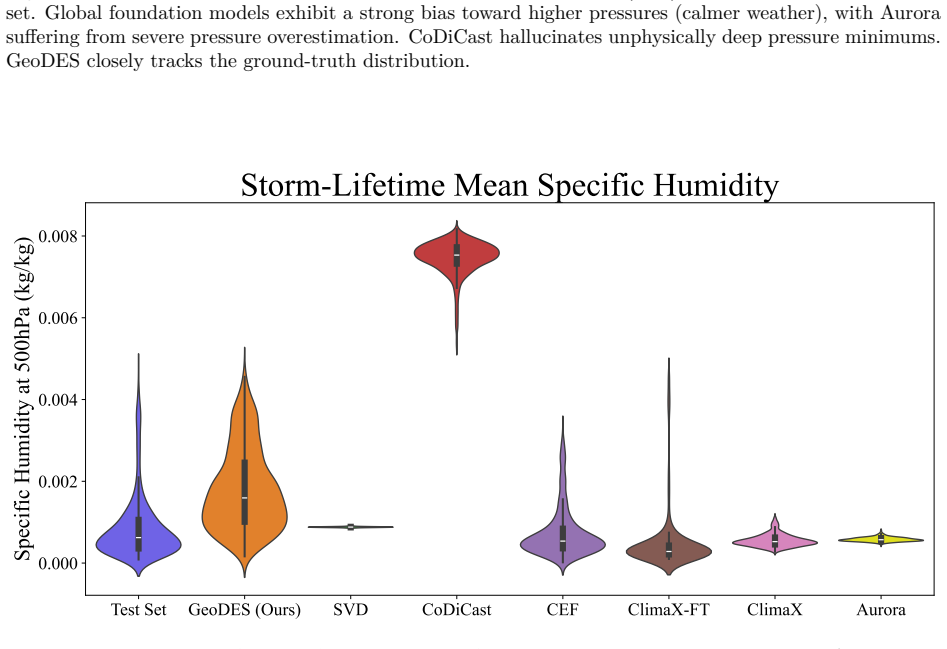
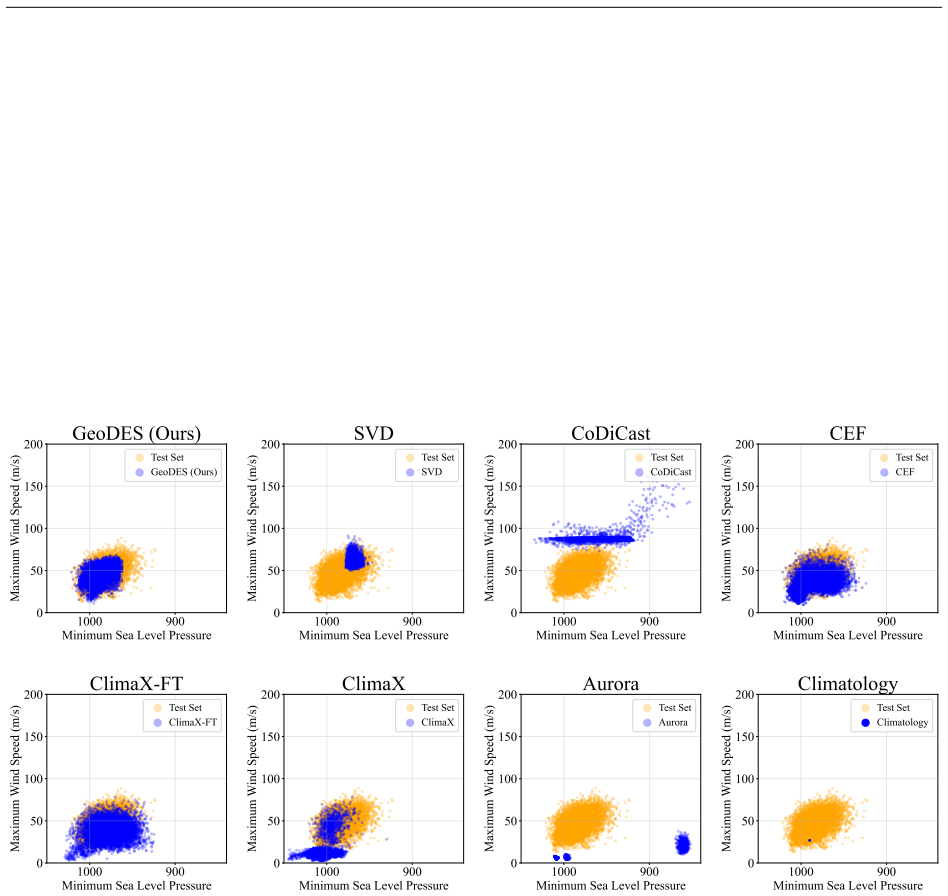
- [Appendix D.1] The visual discussion of Aurora's grouped SLP clusters and ClimaX's two-mode pressure behavior is qualitative. A quantitative center-tracking error analysis would help separate model bias from extraction artifacts.
Circularity Check
No significant circularity: GeoDES is an empirical ML paper whose claimed results are evaluated against independent ERA5 ground truth with standard metrics.
full rationale
GeoDES makes no first-principles derivation that reduces to its inputs. The central claims are empirical: a storm-centered spatiotemporal diffusion model trained on ERA5 data and evaluated on a held-out 2016-2024 test set with standard meteorological metrics (Peak Vorticity Error, HF Spectral Ratio, FBI, FSS, SACC/ACC). None of these metrics is defined in terms of GeoDES parameters, hyperparameters, or generated outputs; they all compare predictions against independent ground-truth ERA5 boxes. Hyperparameters (rho=0.95, SNR weight 5, learning rates) are selected on training/validation loss, and ablations compare fixed architecture variants rather than fitting and re-predicting the same quantity. The only overlapping-author citations are methodological (Booth et al. 2018 for storm-centered analysis and the MCMS tracking codebase); these are conventional, independently corroborated tools and are not used to supply a uniqueness theorem or to forbid alternative explanations. Resolution and storm-tracking differences between GeoDES and coarse global baselines are a comparison-fairness concern, not a circularity: interpolating a coarse baseline to a finer grid does not define GeoDES's score or make the baseline metrics equal to GeoDES's inputs. The paper is therefore self-contained with respect to its performance claims, with no fitted value renamed as a prediction and no derivation chain that terminates in its own assumptions.
Axiom & Free-Parameter Ledger
free parameters (6)
- temporal noise correlation rho =
0.95
- SNR weight =
5
- hybrid normalization percentiles (1st/99th) =
1st-99th percentiles of training distribution
- spatial grid (L1 x L2) =
32x32
- evolution timesteps T =
8
- DDIM sampling steps and eta =
50 steps, eta=1.0
axioms (5)
- standard math DDPM forward/reverse diffusions and mean-squared denoising objective are a valid generative model for weather fields
- domain assumption Storm-centered bounding boxes on five ERA5 variables at 32x32 resolution capture the essential cyclone physics
- ad hoc to paper Temporal autocorrelation in atmospheric state can be approximated by an AR(1) process with rho=0.95 on all variables
- domain assumption ERA5 reanalysis is ground truth for evaluation
- domain assumption Statistical distribution metrics (PVE, FBI, HF ratio, FSS, SACC) are adequate proxies for physical realism
read the original abstract
While machine learning-based weather models hold significant promise, they struggle to predict the detailed structure of large-scale weather systems such as cyclonic storms. Regional models are constrained by limited historical records within fixed geographic boundaries, while global models are computationally expensive and often operate at resolutions too coarse to capture fine-grained storm dynamics. To bridge this gap, we introduce the Geospatial Diffusion-based Evolution Synthesis (GeoDES) model, a custom image-to-video diffusion model. By focusing generation strictly on the evolving storm structure, GeoDES synthesizes physically consistent, high-fidelity weather events suitable for stress-testing forecast models and expanding meteorological datasets. Evaluations demonstrate that GeoDES outperforms prior methods on key metrics, achieving $52\%$ lower Peak Vorticity Error and $8\%$ higher Anomaly Correlation Coefficient than the next strongest methods on the North Atlantic test set.
Figures


Reference graph
Works this paper leans on
-
[1]
Continuous ensemble weather forecasting with diffusion models
Martin Andrae, Tomas Landelius, Joel Oskarsson, and Fredrik Lindsten. Continuous ensemble weather forecasting with diffusion models. InInternational Conference on Learning Representations, volume 2025, pp. 26392–26416,
2025
-
[3]
Appendix C.3 provides details on how computational requirements were determined as presented in Section 3.4
Appendix C.1 includes information on how non-synthetic data, as well as model outputs, were processed, while Appendix C.2 describes model hyperparameters. Appendix C.3 provides details on how computational requirements were determined as presented in Section 3.4. C.1 Data Processing Details Storm selection:Extratropical cyclones are identified within the ...
1940
-
[8]
double penalty
For each metric, best-performing models are bolded—as a naive baseline, we present climatology but do not bold its results. We analyze these results together, grouped by metric: RMSE and Skill:As stated in Section 3.1, RMSE suffers from the “double penalty” problem where synthesis methods that generate realistic novel storms are penalized twice (for the p...
2008
-
[11]
Lizao Li, Rob Carver, Ignacio Lopez-Gomez, Fei Sha, and John Anderson. Seeds: Emulation of weather forecast ensembles with diffusion models.arXiv preprint arXiv:2306.14066,
-
[12]
URLhttps://agupubs.onlinelibrary.wiley.com/doi/abs/10.1029/2025GL115153
doi: https://doi.org/10.1029/2025GL115153. URLhttps://agupubs.onlinelibrary.wiley.com/doi/abs/10.1029/2025GL115153. e2025GL115153 2025GL115153. Tung Nguyen, Johannes Brandstetter, Ashish Kapoor, Jayesh K Gupta, and Aditya Grover. Climax: A foundation model for weather and climate.arXiv preprint arXiv:2301.10343,
-
[13]
Ilan Price, Alvaro Sanchez-Gonzalez, Ferran Alet, Tom R Andersson, Andrew El-Kadi, Dominic Masters, Timo Ewalds, Jacklynn Stott, Shakir Mohamed, Peter Battaglia, et al. Gencast: Diffusion-based ensemble forecasting for medium-range weather.arXiv preprint arXiv:2312.15796,
-
[15]
Jimeng Shi, Bowen Jin, Jiawei Han, Sundararaman Gopalakrishnan, and Giri Narasimhan. Codicast: Con- ditional diffusion model for global weather forecasting with uncertainty quantification. International Joint Conferences on Artificial Intelligence Organization, 2025a. Jimeng Shi, Azam Shirali, Bowen Jin, Sizhe Zhou, Wei Hu, Rahuul Rangaraj, Shaowen Wang, ...
-
[16]
Yang Song, Jascha Sohl-Dickstein, Diederik P Kingma, Abhishek Kumar, Stefano Ermon, and Ben Poole. Score-based generative modeling through stochastic differential equations.arXiv preprint arXiv:2011.13456,
Pith/arXiv arXiv 2011
-
[21]
lower wind magnitudes, higher SLP and lower humidity)
Most methods fare acceptably with reproducing the general range and distribution of these single variables, except for the bias of global models towards calmer weather conditions (e.g. lower wind magnitudes, higher SLP and lower humidity). The two most notable exceptions are Aurora, with a strong bias towards high minimum SLP, and CoDiCast, with a bias to...
2011
-
[23]
SACC and ACC:Synoptic and non-synoptic ACC induce similar relative orderings of methods
Because outlier values skew the linear normalization scheme and prevent the model from making effective use of its dynamic range, it is reasonable that the model learns to generate smooth outputs that are more similar to the climatology or global baselines such as ClimaX and Aurora. SACC and ACC:Synoptic and non-synoptic ACC induce similar relative orderi...
1917
-
[1951]
The termq(x n−1|xn)is computed fromq(x n|xn−1)using Bayes theorem and the open-form equation for the forward process
between the predicted and ground-truth sample distribution at noise stepn−1, Ln =D KL(q(xn−1|xn)||pΘ(xn−1|xn)). The termq(x n−1|xn)is computed fromq(x n|xn−1)using Bayes theorem and the open-form equation for the forward process. Note that in practice, most diffusion implementations (including GeoDES) use mean squared error (MSE) loss in place of KL Diver...
2022
-
[2012]
ISSN 1944-8007. doi: 10.1029/2012GL053866. URLhttps://onlinelibrary.wiley.com/doi/abs/10.1029/2012GL053866. _eprint: https://onlinelibrary.wiley.com/doi/pdf/10.1029/2012GL053866. Hans Hersbach, Bill Bell, Paul Berrisford, Shoji Hirahara, András Horányi, Joaquín Muñoz-Sabater, Julien Nicolas, Carole Peubey, Raluca Radu, Dinand Schepers, et al. The era5 glo...
-
[2015]
Prithvi wxc: Foundation model for weather and climate.arXiv preprint arXiv:2409.13598,
Johannes Schmude, Sujit Roy, Will Trojak, Johannes Jakubik, Daniel Salles Civitarese, Shraddha Singh, Julian Kuehnert, Kumar Ankur, Aman Gupta, Christopher E Phillips, et al. Prithvi wxc: Foundation model for weather and climate.arXiv preprint arXiv:2409.13598,
-
[2016]
URLhttps://agupubs.onlinelibrary
doi: https://doi.org/10.1002/2016RG000519. URLhttps://agupubs.onlinelibrary. wiley.com/doi/abs/10.1002/2016RG000519. Aakanksha Chowdhery, Sharan Narang, Jacob Devlin, Maarten Bosma, Gaurav Mishra, Adam Roberts, Paul Barham, Hyung Won Chung, Charles Sutton, Sebastian Gehrmann, Parker Schuh, Kensen Shi, Sasha Tsvyashchenko, Joshua Maynez, Abhishek Rao, Park...
-
[2018]
ISSN 1944-8007. doi: 10.1029/2018GL078977. URLhttps://onlinelibrary.wiley.com/doi/abs/10.1029/ 2018GL078977. _eprint: https://onlinelibrary.wiley.com/doi/pdf/10.1029/2018GL078977. J. L. Catto. Extratropical cyclone classification and its use in climate studies.Reviews of Geophysics, 54(2): 486–520,
-
[2019]
URLhttps://www.science.org/doi/ abs/10.1126/science.aav9527
doi: 10.1126/science.aav9527. URLhttps://www.science.org/doi/ abs/10.1126/science.aav9527. ZhongweiZhang, ErichFischer, JakobZscheischler, andSebastianEngelke. Physics-basedmodelsoutperform ai weather forecasts of record-breaking extremes.Science Advances, 12(18):eaec1433,
-
[2020]
URL https://arxiv.org/abs/2001.08361. Dmitrii Kochkov, Janni Yuval, Ian Langmore, Peter Norgaard, Jamie Smith, Griffin Mooers, Milan Klöwer, James Lottes, Stephan Rasp, Peter Düben, et al. Neural general circulation models for weather and climate.Nature, 632(8027):1060–1066,
Pith/arXiv arXiv 2001
-
[2021]
doi: 10.5194/wcd-2-1073-2021. Andreas Blattmann, Tim Dockhorn, Sumith Kulal, Daniel Mendelevitch, Maciej Kilian, Dominik Lorenz, Yam Levi, Zion English, Vikram Voleti, Adam Letts, Varun Jampani, and Robin Rombach. Stable Video Diffusion: Scaling Latent Video Diffusion Models to Large Datasets, November
-
[2022]
Robin Clancy, Cecilia M Bitz, Edward Blanchard-Wrigglesworth, Marie C McGraw, and Steven M Cavallo
URLhttps://arxiv.org/abs/2204.02311. Robin Clancy, Cecilia M Bitz, Edward Blanchard-Wrigglesworth, Marie C McGraw, and Steven M Cavallo. A cyclone-centered perspective on the drivers of asymmetric patterns in the atmosphere and sea ice during arctic cyclones.Journal of Climate, 35(1):73–89,
-
[2023]
URLhttp: //arxiv.org/abs/2311.15127. arXiv:2311.15127 [cs]. Cristian Bodnar, Wessel P Bruinsma, Ana Lucic, Megan Stanley, Johannes Brandstetter, Patrick Garvan, Maik Riechert, Jonathan Weyn, Haiyu Dong, Anna Vaughan, et al. Aurora: A foundation model of the atmosphere.arXiv preprint arXiv:2405.13063, 1(8),
-
[2024]
Tiankai Hang, Shuyang Gu, Chen Li, Jianmin Bao, Dong Chen, Han Hu, Xin Geng, and Baining Guo
URLhttps://arxiv.org/abs/ 2311.05610. Tiankai Hang, Shuyang Gu, Chen Li, Jianmin Bao, Dong Chen, Han Hu, Xin Geng, and Baining Guo. Efficient diffusion training via min-snr weighting strategy. InProceedings of the IEEE/CVF international conference on computer vision, pp. 7441–7451,
-
[2025]
Deep learning for day forecasts from sparse observations.arXiv preprint arXiv:2306.06079,
Marcin Andrychowicz, Lasse Espeholt, Di Li, Samier Merchant, Alexander Merose, Fred Zyda, Shreya Agrawal, and Nal Kalchbrenner. Deep learning for day forecasts from sparse observations.arXiv preprint arXiv:2306.06079,
-
[2026]
A Glossary of Terms and Abbreviations We include definitions for common abbreviations in this section, as well as important technical terms. •ACC (Anomaly Correlation Coefficient):A standard meteorological metric that measures the spa- tial pattern correlation of predicted fields to evaluate spatial and navigational accuracy (Wilks, 2011). •Autoregressive...
2011
discussion (0)
Sign in with ORCID, Apple, or X to comment. Anyone can read and Pith papers without signing in.