REVIEW 2 major objections 5 minor 101 references
Sensing, Traffic, and Construction in Termites
T0 review · 2 major / 5 minor · reviewed 2026-08-01 · deepseek-v4-flash
Pith's one-line read Termites build the ground that guides their every move, coupling sensing, traffic, and construction into one feedback system.
desk verdict A careful, well-hedged review that usefully frames termite construction as coupled sensing-traffic-construction feedback, with the main caveat being the acknowledged thinness of the 2D-to-3D bridge. read the letter →
The pith
A machine-rendered reading of the paper's core claim, the machinery that carries it, and where it could break.
The reading
What carries the argument
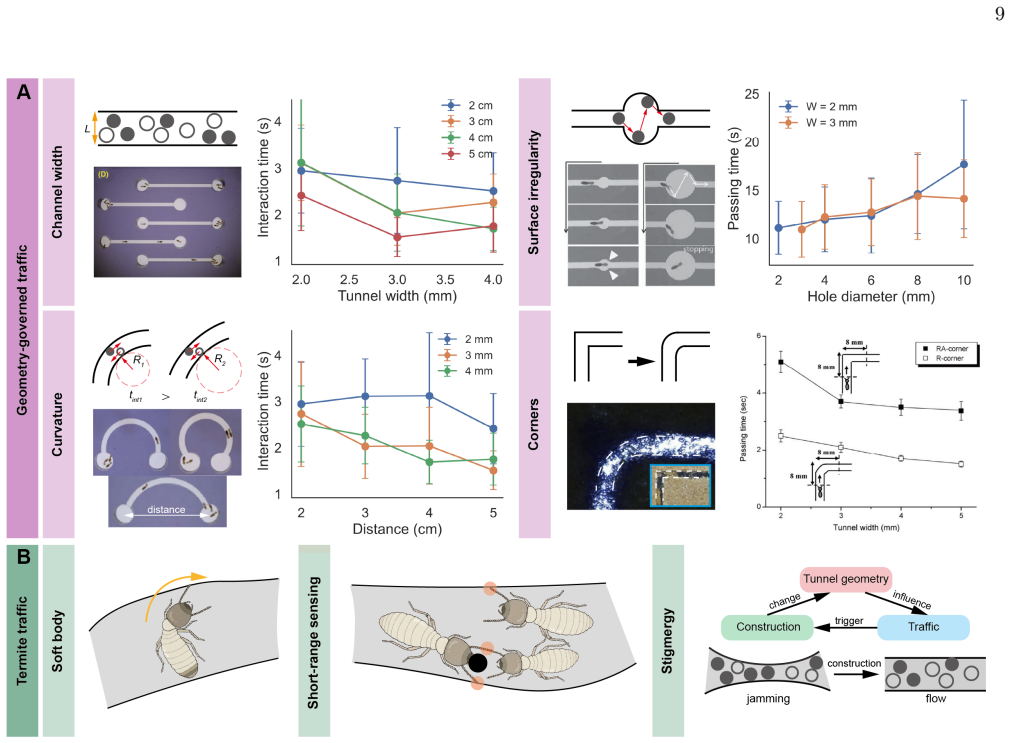
The central mechanism is stigmergic substrate feedback: a colony's own actions leave persistent geometric traces (tunnel width, curvature, roughness, branch angles) and transient cues (crowding, moisture, vibration) in the soil, and these traces bias subsequent sensing, movement, and construction, closing a feedback loop. The review identifies curvature-based excavation/deposition, queue-size-dependent widening, and moisture-mediated deposition as the experimentally grounded local rules that carry this mechanism.
What would settle it
One decisive check: observe an intact colony excavating in transparent three-dimensional soil and measure whether tunnel widening reliably follows queue formation and whether protrusions are preferentially excavated; if either fails in a naturalistic 3D setting, the claimed coupling does not generalize beyond planar assays.
Extended reading notes
Core claim
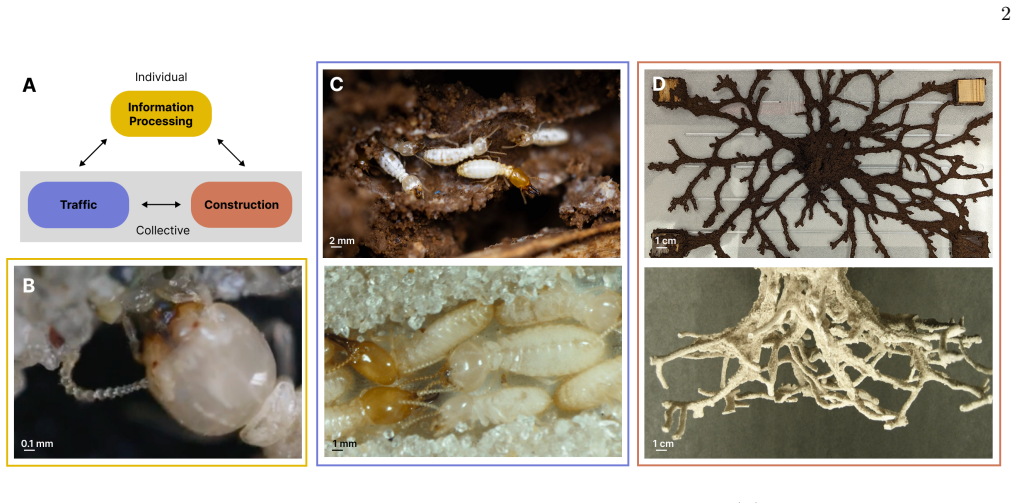
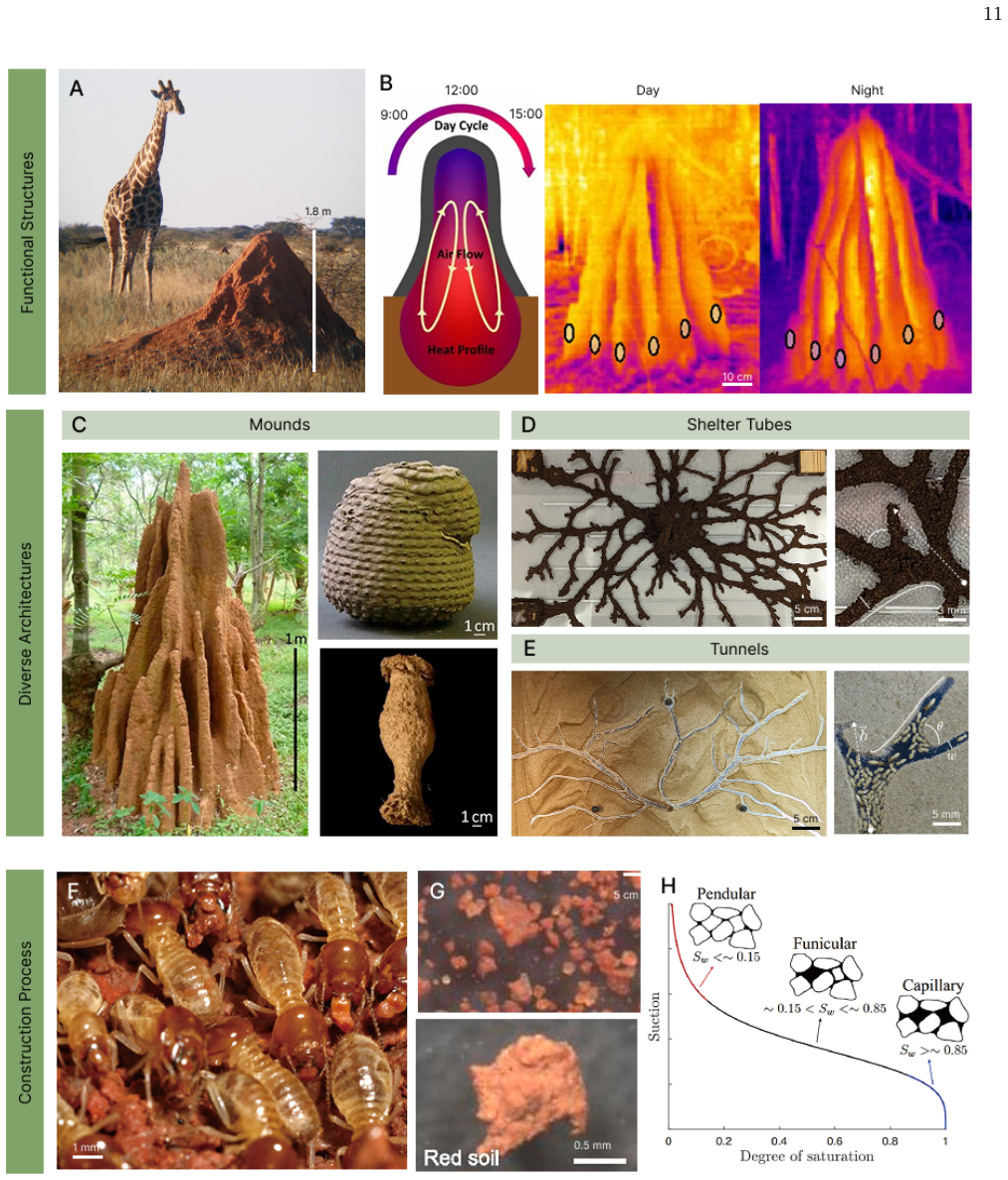
Subterranean and mound-building termites use the same granular medium as terrain, building material, and information channel. Across scales from antennal contacts to meter-scale architecture, the paper argues that colony-level structure emerges from stigmergic feedback: excavation and deposition change local curvature, width, and moisture, and those changes steer later movement, sensing, and construction. This makes a termite colony an active system that continuously rewrites its own boundary conditions, so understanding colony behavior requires treating transport resistance and confinement as dynamical variables rather than fixed inputs.
Load-bearing premise
The synthesis assumes that behavior measured in flat, simplified tunnel assays on a few subterranean species represents how colonies build natural three-dimensional soil and mound systems.
Editorial extensions
If this is right
- Tunnel geometry becomes a record of colony history, so architectural features can be read backward to infer the local rules that produced them.
- Traffic models for termites must treat conduit geometry as a dynamic variable shaped by use, not as a fixed boundary.
- If curvature-biased construction is general, sharp corners and protrusions in tunnels should smooth over time as the colony excavates and deposits.
- Throughput in a tunnel network is set by local encounter costs, meaning small changes in width or curvature can scale up to colony-level transport efficiency.
- Mechanistic models should replace diffuse chemical-field assumptions with geometry-, crowding-, and moisture-based cues when predicting network growth.
Reading between the lines
- Extension: If the coupling is as general as the review suggests, engineered collectives—robots or simulated agents—could generate branching networks using local curvature and crowding cues instead of global plans.
- Extension: The framework implies a testable prediction: artificially introducing surface irregularities into mature tunnels should measurably reduce food-transport speed, a consequence the paper leaves implicit.
- Extension: Similar queue-triggered widening and idle-worker regulation may operate in other confined social insects, so the termite case could exemplify a broader design principle for adaptive conduit networks.
Signed reviews
Editorial analysis
A structured set of objections, weighed in public.
Referee Report
Summary. This paper is a review of the experimental and theoretical literature on termite collective behavior, organized around three length scales: antennal-scale substrate sensing, body-scale bidirectional traffic in tunnels, and colony-scale construction. It argues that these processes are coupled because termites excavate, deposit, and remodel the very granular medium that later determines their sensory input, movement constraints, and traffic flow. The paper surveys empirical evidence (curvature-dependent excavation/deposition, queue-size-dependent widening, moisture-modulated digging, geometry-dependent passing delays), presents standard modeling hierarchies in two boxes, and identifies open questions and emerging tools (transparent soil, X-ray microtomography, tracking, transfer entropy). The central claim is that noisy local interactions across scales lead to emergent colony-level order via a shared, self-constructed substrate.
Significance. If this synthesis is accepted, it would integrate scattered findings from entomology, physics, and active matter into a coherent framework, and would identify termites as a model system for 'environmental memory' in living matter. The paper is valuable as a comprehensive, balanced review: it explicitly attributes model equations to the literature, and it candidly lists the limitations (Section V) that most mechanistic evidence comes from planar assays with few species and that the local-to-colony bridge is stronger in theory than in direct measurement. These strengths make the review useful despite the absence of new experiments. However, the headline claim of emergent colony-scale order goes beyond the evidence currently assembled; the paper's own caveats are the load-bearing point that needs to be managed in the framing.
major comments (2)
- [Abstract; Section V] The abstract states that 'noisy local interactions couple sensing, transport, and construction through a shared material medium, leading to emergent order at the colony scale.' Section V (first paragraph) acknowledges that 'most mechanistic evidence comes from a small number of subterranean termites ... studied in planar or otherwise simplified tunnel assays' and that 'the bridge from worker-scale rules to mound- or network-scale architecture remains much stronger in theory than in direct measurement.' These two statements are in direct tension: the headline conclusion asserts a colony-scale emergence that the evidence presented does not yet establish, because each local rule comes from a different assay/species and no study tracks all three processes simultaneously in 3D. I recommend rephrasing the abstract and conclusion to present the cross-scale coupling as an organizing hypothesis o
- [Section II.A] The review itself notes, in the paragraph after Fig. 2E, that 'direct measurements linking antennal kinematics or contact patterns to excavation decisions are still lacking.' Yet the abstract begins with 'From antennal-scale contacts...' and Section V lists sensing as the first of the three coupled processes. Because this manuscript's central contribution is the coupling of sensing, traffic, and construction, the absence of a measured sensorimotor link at the antennal scale is a load-bearing gap. The current text uses an analogy to star-nosed moles and cockroaches but does not connect termite antennal mechanics to excavation decisions. Please flag this gap explicitly in the abstract/synthesis, and avoid phrasing that implies the antennal channel is already wired into the feedback loop. A short subsection stating this as an open problem would be appropriate.
minor comments (5)
- [References] References [72] and [20] are the same paper; remove the duplicate and renumber, or cite a different source for the 'established tunnels' claim.
- [References] Several references lack complete bibliographic data: [55], [58], [59], [60], [61] have no journal names; [58] and [59] are missing volume/page context; [60] appears as '334:04021' without venue. Complete all entries to journal style.
- [Section IV.A] The claim that 'mound diameter often covaries with height, suggesting approximately self-similar growth' is presented without a citation; add a reference or qualify it as an observational description.
- [Section II.A] Reference [33] (Catania 2001) is about cortical development in star-nosed moles, not specifically about burrow geometry reconstruction; consider replacing with a more direct behavioral reference or clarifying the intended support.
- [Box 1, Eq. (6)] The notation for queue length is used as 'ell' but not defined in the main text; define it at first use. Also, the 'quantitative physics-of-life framework' promised in the abstract is not exemplified anywhere; if no concrete model is added, soften the wording to 'conceptual framework'.
Circularity Check
Review with no fitted predictions; acknowledged evidence gaps are not circularity.
full rationale
This is a review, not a derivation. It makes no parameter fits and no predictions from fitted values. The synthesis of sensing, traffic, and construction is an interpretation of independently reported experiments on curvature-dependent excavation, queue-dependent widening, moisture-dependent excavation, and geometry-dependent passing times. The modeling boxes present standard traffic-theory equations (social-force, Boltzmann, conservation laws, network resistance) with attribution to prior literature; Eq. (6) and Box 2 equations are schematic research agenda items, not outputs derived from termite data. The curvature feedback loop and stigmergic coupling are descriptions of cited empirical rules, not definitions that presuppose the conclusion. Self-citations (Bardunias and Su [21,43,44,49], Lee/Su [20,35], etc.) are load-bearing as evidence but are empirical results that are externally falsifiable and not derived from this review; no uniqueness theorem or ansatz is imported via self-citation. The paper explicitly acknowledges the 2D-to-3D and worker-to-colony bridge as incomplete in Section V, which is an evidentiary limitation rather than circularity. Therefore no step reduces an output to an input by construction.
Assumptions & free parameters
assumptions (5)
- domain assumption Persistent stigmergic geometry, rather than long-range chemical signaling, is the dominant coordination mechanism at the scales discussed.
- domain assumption Controlled planar/simplified assays of a few subterranean species are representative enough for colony-scale generalizations.
- domain assumption Traffic and interface models from pedestrian, ant, and granular-flow physics transfer to termite conduits.
- domain assumption Curvature-sensitive excavation/deposition (convex removal, concave deposition) is a valid local rule across taxa.
- standard math The standard equations in Box 1/Box 2 (social force, kinetic, LWR, network flow, interface growth) are accepted as valid mathematical descriptions.
Cite this review
Pith. "Pith review of Sensing, Traffic, and Construction in Termites." pith.science (2026). https://pith.science/paper/SNDVPB57
@misc{pith2026260719594,
  author       = {Pith},
  title        = {Pith review of: Sensing, Traffic, and Construction in Termites},
  year         = {2026},
  howpublished = {\url{https://pith.science/paper/SNDVPB57}},
  note         = {Machine review of arXiv:2607.19594}
}
read the original abstract
Subterranean and mound-building termites excavate, transport, and build within the same granular substrate that later regulates how they sense, move, and deposit material. From antennal-scale contacts through body-scale traffic to meter-scale architecture, this review synthesizes three linked problems: how workers sense local geometry and physical cues during search and excavation; how traffic moves through narrow, evolving conduits; and how excavation and deposition remodel the substrate that guides later behavior. Across these length scales, noisy local interactions couple sensing, transport, and construction through a shared material medium, leading to emergent order at the colony scale. We emphasize what is established experimentally, where evidence remains sparse or limited to a few model systems, and how emerging imaging, tracking, and modeling tools are making these feedbacks quantitatively accessible. We use this synthesis to motivate a quantitative physics-of-life framework for termite colonies that continually rewrite the medium through which they sense, move, and build.
Figures


Figures from the paper (3 more)

Reference graph
Works this paper leans on
-
[1]
Cristina Marchetti, Jean-François Joanny, Sriram Ramaswamy, Tanniemola B
M. Cristina Marchetti, Jean-François Joanny, Sriram Ramaswamy, Tanniemola B. Liverpool, Jacques Prost, Madan Rao, and R. Aditi Simha. Hydrodynamics of soft active matter.Reviews of Modern Physics, 85:1143–1189, 2013
2013
-
[2]
Active particles in complex and crowded environments.Reviews of Modern Physics, 88:045006, 2016
Clemens Bechinger, Roberto Di Leonardo, Hartmut Löwen, Charles Reichhardt, Giorgio Volpe, and Giovanni Volpe. Active particles in complex and crowded environments.Reviews of Modern Physics, 88:045006, 2016
2016
-
[3]
Computational models for active matter.Nature Reviews Physics, 2(4):181–199, 2020
M Reza Shaebani, Adam Wysocki, Roland G Winkler, Gerhard Gompper, and Heiko Rieger. Computational models for active matter.Nature Reviews Physics, 2(4):181–199, 2020
2020
-
[4]
Multi-scale organization in communicating active matter.Nature communications, 13(1):6727, 2022
Alexander Ziepke, Ivan Maryshev, Igor S Aranson, and Erwin Frey. Multi-scale organization in communicating active matter.Nature communications, 13(1):6727, 2022. 15
2022
-
[5]
Environmental memory boosts group formation of clueless individuals.Nature Communications, 14(1):7324, 2023
Cristóvão S Dias, Manish Trivedi, Giovanni Volpe, Nuno AM Araújo, and Giorgio Volpe. Environmental memory boosts group formation of clueless individuals.Nature Communications, 14(1):7324, 2023
2023
-
[6]
Where physics meets behavior in animal groups.PRX Life, 3:037001, 2025
Chantal Nguyen and Orit Peleg. Where physics meets behavior in animal groups.PRX Life, 3:037001, 2025
2025
-
[7]
James F. A. Traniello and Reinhard H. Leuthold. Behavior and Ecology of Foraging in Termites. In Takuya Abe, David Edward Bignell, and Masahiko Higashi, editors,Termites: Evolution, Sociality, Symbioses, Ecology, pages 141–
-
[8]
Helena Puche and Nan-Yao Su. Application of Fractal Analysis for Tunnel Systems of Subterranean Termites (Isoptera: Rhinotermitidae) Under Laboratory Conditions.Environmental Entomology, 30(3):545–549, 2001-06-01
2001
Show all 101 references
-
[9]
Helena Puche and Nan-Yao Su. Tunnel Formation byReticulitermes flavipesandCoptotermes formosanus(Isoptera: Rhinotermitidae) in Response to Wood in Sand.Journal of Economic Entomology, 94(6):1398–1404, 2001-12-01
2001
-
[10]
Thermoregulation and ventilation of termite mounds.Naturwissenschaften, 90(5):212–219, 2003-05
Judith Korb. Thermoregulation and ventilation of termite mounds.Naturwissenschaften, 90(5):212–219, 2003-05
2003
-
[11]
Mahadevan
Hunter King, Samuel Ocko, and L. Mahadevan. Termite mounds harness diurnal temperature oscillations for ventilation. Proceedings of the National Academy of Sciences, 112(37):11589–11593, 2015-09-15
2015
-
[12]
Finding shortcuts through collective tunnel excavations in a subterranean termite.Behavioral Ecology, 34(3):354–362, 2023-05-14
Zion Michael, Thomas Chouvenc, Nan-Yao Su, and Sang-Bin Lee. Finding shortcuts through collective tunnel excavations in a subterranean termite.Behavioral Ecology, 34(3):354–362, 2023-05-14
2023
-
[13]
Fouquet, A
D. Fouquet, A. M. Costa-Leonardo, R. Fournier, S. Blanco, and C. Jost. Coordination of construction behavior in the termite Procornitermes araujoi: Structure is a stronger stimulus than volatile marking.Insectes Sociaux, 61(3):253–264, 2014-08
2014
-
[14]
Kirstin Petersen, Paul Bardunias, Nils Napp, Justin Werfel, Radhika Nagpal, and Scott Turner. Arrestant property of recently manipulated soil on Macrotermes michaelseni as determined through visual tracking and automatic labeling of individual termite behaviors.Behavioural Pro...
2015
-
[15]
Excavationandaggregationasorganizing factors in de novo construction by mound-building termites.Proceedings
BenGreen, PaulBardunias, J.ScottTurner, RadhikaNagpal, andJustinWerfel. Excavationandaggregationasorganizing factors in de novo construction by mound-building termites.Proceedings. Biological Sciences, 284(1856):20162730, 2017- 06-14
2017
-
[16]
La reconstruction du nid et les coordinations interindividuelles chez bellicositermes natalensis et cubitermes sp
P P Grassé. La reconstruction du nid et les coordinations interindividuelles chez bellicositermes natalensis et cubitermes sp. la théorie de la stigmergie: Essai d’interprétation du comportement des termites constructeurs.Insectes Sociaux, 6:41–80, 1959
1959
-
[17]
A Brief History of Stigmergy.Artificial Life, 5(2):97–116, 1999-04
Guy Theraulaz and Eric Bonabeau. A Brief History of Stigmergy.Artificial Life, 5(2):97–116, 1999-04
1999
-
[18]
Con- trolled stigmergy in quasi-one-dimensional active particle systems.Physical Review E, 110(2):024605, 2024
Gregor Bánó, Cyril Slab` y, Alena Strejčková, Zoltán Tomori, Andrej Hovan, Pavol Miskovsky, and Denis Horvath. Con- trolled stigmergy in quasi-one-dimensional active particle systems.Physical Review E, 110(2):024605, 2024
2024
-
[19]
Kobayashi
Masaki Kato and Tetsuya J. Kobayashi. Optimality theory of stigmergic collective information processing by chemotactic cells.PRX Life, 3:043005, 2025
2025
-
[21]
Bardunias and Nan-Yao Su
Paul M. Bardunias and Nan-Yao Su. Queue Size Determines the Width of Tunnels in the Formosan Subterranean Termite (Isoptera: Rhinotermitidae).Journal of Insect Behavior, 23(3):189–204, 2010-05
2010
-
[22]
Calovi, Paul Bardunias, Nicole Carey, J
Daniel S. Calovi, Paul Bardunias, Nicole Carey, J. Scott Turner, Radhika Nagpal, and Justin Werfel. Surface curvature guidesearlyconstructionactivityinmound-buildingtermites.Philosophical Transactions of the Royal Society B: Biological Sciences, 374(1774):20180374, 2019-06-10
2019
-
[23]
Lévy Flights and Self- Similar Exploratory Behaviour of Termite Workers: Beyond Model Fitting.PLoS ONE, 9(10):e111183, 2014-10-29
Octavio Miramontes, Og DeSouza, Leticia Ribeiro Paiva, Alessandra Marins, and Sirio Orozco. Lévy Flights and Self- Similar Exploratory Behaviour of Termite Workers: Beyond Model Fitting.PLoS ONE, 9(10):e111183, 2014-10-29
2014
-
[24]
Simulation study on the tunnel networks of subterranean termites and the foraging behavior
S-H Lee and Nan-Yao Su. Simulation study on the tunnel networks of subterranean termites and the foraging behavior. Journal of Asia-Pacific Entomology, 13(2):83–90, 2010-06
2010
-
[25]
Almeida, Paulo F
Camilla S. Almeida, Paulo F. Cristaldo, Og Desouza, Leandro Bacci, Daniela F. Florencio, Nayara G. Cruz, Abraão A. Santos, Alisson S. Santana, Alexandre P. Oliveira, Ana P. S. Lima, and Ana P. A. Araújo. Resource density regulates the foraging investment in higher termite spec...
2018
-
[26]
Classification and distribution of antennal sensilla of the termite coptotermes formosanus (isoptera: Rhinotermitidae).Sociobiology, 54(2):327, 2009
Aya Yanagawa, Susumu Shimizu, Kana Noma, Michiko Nishikawa, Ogino Kazumasa, and Fumio Yokohari. Classification and distribution of antennal sensilla of the termite coptotermes formosanus (isoptera: Rhinotermitidae).Sociobiology, 54(2):327, 2009
2009
-
[27]
J. L. Heidecker and R. H. Leuthold. The organisation of collective foraging in the harvester termiteHodotermes mossam- bicus(Isoptera).Behavioral Ecology and Sociobiology, 14(3):195–202, 1984-03
1984
-
[28]
N. E. Carey, D. S. Calovi, P. Bardunias, J. S. Turner, R. Nagpal, and J. Werfel. Differential construction response to humidity by related species of mound-building termites.Journal of Experimental Biology, page jeb.212274, January 2019
2019
-
[29]
Information Processing in Living Systems.Annual Review of Condensed Matter Physics, 7(1):89–117, 2016-03-10
Gašper Tkačik and William Bialek. Information Processing in Living Systems.Annual Review of Condensed Matter Physics, 7(1):89–117, 2016-03-10
2016
-
[30]
Khodak, E
P. Khodak, E. Sulger, and S. O’Donnell. Into the black and back: the ecology of brain investment in neotropical army ants (formicidae: Dorylinae).The Science of Nature, 103(3–4):31, April 2016
2016
-
[31]
Howarth and Oana Teodora Moldovan.The Ecological Classification of Cave Animals and Their Adaptations, volume 235, page 41–67
Francis G. Howarth and Oana Teodora Moldovan.The Ecological Classification of Cave Animals and Their Adaptations, volume 235, page 41–67. Springer International Publishing, Cham, 2018
2018
-
[32]
Comparative Antennal Morphometry and Sensilla Organization in the Repro- ductive and Non-Reproductive Castes of the Formosan Subterranean Termite.Insects, 12(7):576, 2021-06-24
Paula Castillo, Nathan Le, and Qian Sun. Comparative Antennal Morphometry and Sensilla Organization in the Repro- ductive and Non-Reproductive Castes of the Formosan Subterranean Termite.Insects, 12(7):576, 2021-06-24
2021
-
[33]
Kenneth C. Catania. Early development of a somatosensory fovea: A head start in the cortical space race?Nat Neurosci, 4(4):353–354, 2001-04
2001
-
[34]
T. P. Chapman and B. Webb. A model of antennal wall-following and escape in the cockroach.Journal of Comparative 16 Physiology A, 192(9):949–969, 2006-09
2006
-
[35]
Tunneling Activity of Subterranean Termites (Isoptera: Rhinotermitidae) in Sand with Moisture Gradients.Journal of Economic Entomology, 96(1):88–93, 2003-02-01
Nan-yao Su and Helena Puche. Tunneling Activity of Subterranean Termites (Isoptera: Rhinotermitidae) in Sand with Moisture Gradients.Journal of Economic Entomology, 96(1):88–93, 2003-02-01
2003
-
[36]
Alastair M. Stuart. Alarm, Defense, and Construction Behavior Relationships in Termites (Isoptera).Science, 156(3778):1123–1125, 1967-05-26
1967
-
[37]
Engel, Thomas Bourguignon, and Jan Šobotník
David Sillam-Dussès, Vojtěch Jandák, Petr Stiblik, Olivier Delattre, Thomas Chouvenc, Ondřej Balvín, Josef Cvačka, Delphine Soulet, Jiří Synek, Marek Brothánek, Ondřej Jiříček, Michael S. Engel, Thomas Bourguignon, and Jan Šobotník. Alarm communication predates eusociality in ...
2023
-
[38]
Sansom, Joseph C
Travers M. Sansom, Joseph C. S. Lai, Benjamin J. Halkon, Theodore A. Evans, and Sebastian Oberst. Termite Vibration Sensing: The Chordotonal Organs and Their Appendages.Ecology and Evolution, 15(10):e72287, 2025-10
2025
-
[39]
Lai, and Theodore A
Sebastian Oberst, Glen Bann, Joseph C.S. Lai, and Theodore A. Evans. Cryptic termites avoid predatory ants by eavesdropping on vibrational cues from their footsteps.Ecology Letters, 20(2):212–221, 2017-02
2017
-
[40]
M. Kaib, O. Bruinsma, and R. H. Leuthold. Trail-following in termites: Evidence for a multicomponent system.Journal of Chemical Ecology, 8(9):1193–1205, 1982-09
1982
-
[41]
Reinhard, H
J. Reinhard, H. Hertel, and M. Kaib. Systematic search for food in the subterranean termiteReticulitermes santonensis De Feytaud (Isoptera, Rhinotermitidae).Insectes Sociaux, 44(2):147–158, 1997-05-01
1997
-
[42]
Path integration in desert ants,Cataglyphis fortis.Proceedings of the National Academy of Sciences, 85(14):5287–5290, 1988-07
Martin Müller and Rüdiger Wehner. Path integration in desert ants,Cataglyphis fortis.Proceedings of the National Academy of Sciences, 85(14):5287–5290, 1988-07
1988
-
[43]
Dead Reckoning in Tunnel Propagation of the Formosan Subterranean Termite (Isoptera:Rhinotermitidae).Annals of the Entomological Society of America, 102(1):158–165, 2009-01-01
Paul Bardunias and Nan-Yao Su. Dead Reckoning in Tunnel Propagation of the Formosan Subterranean Termite (Isoptera:Rhinotermitidae).Annals of the Entomological Society of America, 102(1):158–165, 2009-01-01
2009
-
[44]
Paul Bardunias and Nan-Yao Su. Change in Tunnel Heading in the Formosan Subterranean Termite (Isoptera: Rhinoter- mitidae) in Response to Movement Through Opened Space.Annals of the Entomological Society of America, 103(3):449– 454, 2010-05-01
2010
-
[45]
Shraiman
Massimo Vergassola, Emmanuel Villermaux, and Boris I. Shraiman. ‘Infotaxis’ as a strategy for searching without gradients.Nature, 445(7126):406–409, 2007-01
2007
-
[46]
Aguilar, D
J. Aguilar, D. Monaenkova, V. Linevich, W. Savoie, B. Dutta, H.-S. Kuan, M. D. Betterton, M. A. D. Goodisman, and D. I. Goldman. Collective clog control: Optimizing traffic flow in confined biological and robophysical excavation.Science, 361(6403):672–677, 2018-08-17
2018
-
[47]
Nonrandom search geometry in subterranean termites.Naturwissenschaften, 82:526–528, 1995
S K Robson, M G Lesniak, R V Kothandapani, J E A Traniello, B L Thorne, and V Fourcassi. Nonrandom search geometry in subterranean termites.Naturwissenschaften, 82:526–528, 1995
1995
-
[48]
C. E. Campora and J. K. Grace. Tunnel Orientation and Search Pattern Sequence of the Formosan Subterranean Termite (Isoptera: Rhinotermitidae).Journal of Economic Entomology, 94(5):1193–1199, 2001-10-01
2001
-
[49]
Opposing headings of excavating and depositing termites facilitate branch formation in the Formosan subterranean termite.Animal Behaviour, 78(3):755–759, 2009-09
Paul Bardunias and Nan-Yao Su. Opposing headings of excavating and depositing termites facilitate branch formation in the Formosan subterranean termite.Animal Behaviour, 78(3):755–759, 2009-09
2009
-
[50]
Measurement of the time required for termites to pass each other in tunnels of different curvatures.Insect science, 20(4):550–556, 2013
Seungwoo Sim and Sang-Hee Lee. Measurement of the time required for termites to pass each other in tunnels of different curvatures.Insect science, 20(4):550–556, 2013
2013
-
[51]
Measurement of the time required for a termite to pass through tunnels with different curvatures.Journal of Insect Science, 12(64):1–7, 2012-05
Seungwoo Sim and Sang-Hee Lee. Measurement of the time required for a termite to pass through tunnels with different curvatures.Journal of Insect Science, 12(64):1–7, 2012-05
2012
-
[52]
Rounding a corner of a bent termite tunnel and tunnel traffic efficiency
Sang-Hee Lee, Paul Bardunias, and Nan-Yao Su. Rounding a corner of a bent termite tunnel and tunnel traffic efficiency. Behavioural Processes, 77(1):135–138, 2008-01
2008
-
[53]
Movement efficiency and behavior of termites (isoptera) in tunnels with varying pore sizes.Florida Entomologist, 96(3):810–817, 2013-09
Sook Junk Ku, Nan-Yao Su, and Sang-Hee Lee. Movement efficiency and behavior of termites (isoptera) in tunnels with varying pore sizes.Florida Entomologist, 96(3):810–817, 2013-09
2013
-
[54]
Complex relationship between tunneling patterns and individual behaviors in termites.The American Naturalist, 196(5):555–565, 2020
Nobuaki Mizumoto, Paul M Bardunias, and Stephen C Pratt. Complex relationship between tunneling patterns and individual behaviors in termites.The American Naturalist, 196(5):555–565, 2020
2020
-
[55]
Bacik, Bogdan S
Karol A. Bacik, Bogdan S. Bacik, and Tim Rogers. Lane nucleation in complex active flows. 379(6635):923–928
-
[56]
Nick Gravish, Gregory Gold, Andrew Zangwill, Michael A. D. Goodisman, and Daniel I. Goldman. Glass-like dynamics in confined and congested ant traffic.Soft Matter, 11(33):6552–6561, 2015
2015
-
[57]
Social force model for pedestrian dynamics.Physical review E, 51(5):4282, 1995
Dirk Helbing and Peter Molnar. Social force model for pedestrian dynamics.Physical review E, 51(5):4282, 1995
1995
-
[58]
A cellular-automata model of flow in ant trails: non-monotonic variation of speed with density
Debashish Chowdhury, Vishwesha Guttal, Katsuhiro Nishinari, and Andreas Schadschneider. A cellular-automata model of flow in ant trails: non-monotonic variation of speed with density. 35(41):L573–L577
-
[59]
Cluster formation and anomalous fundamental diagram in an ant-trail model
Katsuhiro Nishinari, Debashish Chowdhury, and Andreas Schadschneider. Cluster formation and anomalous fundamental diagram in an ant-trail model. 67(3):036120
-
[60]
Faster-than-real-time simulation of multi-group pedestrian flow
Matthias Schmid, David Bernhardsgruetter, Robin Schwarz, Doris Bohnet, and Rebekka Axthelm. Faster-than-real-time simulation of multi-group pedestrian flow. 334:04021
-
[61]
Springer Nature Switzerland
Martin Treiber and Arne Kesting.Traffic Flow Dynamics: Data, Models and Simulation. Springer Nature Switzerland
-
[62]
Effects of the surface irregularity of termite tunnels on food transport efficiency: a simulation study.Journal of Insect Science, 23(2):7, 2023-03-01
Sang-Hee Lee, Cheol-Min Park, and Sang-Bin Lee. Effects of the surface irregularity of termite tunnels on food transport efficiency: a simulation study.Journal of Insect Science, 23(2):7, 2023-03-01
2023
-
[63]
On the modeling of traffic and crowds: A survey of models, speculations, and perspectives.SIAM review, 53(3):409–463, 2011
Nicola Bellomo and Christian Dogbe. On the modeling of traffic and crowds: A survey of models, speculations, and perspectives.SIAM review, 53(3):409–463, 2011
2011
-
[64]
I. D. Couzin and N. R. Franks. Self-organized lane formation and optimized traffic flow in army ants.Proceedings of the Royal Society of London. Series B: Biological Sciences, 270(1511):139–146, 2003-01-22
2003
-
[65]
Optimal traffic organization in ants under crowded conditions.Nature, 428(6978):70–73, 2004-03
Audrey Dussutour, Vincent Fourcassié, Dirk Helbing, and Jean-Louis Deneubourg. Optimal traffic organization in ants under crowded conditions.Nature, 428(6978):70–73, 2004-03
2004
-
[66]
Simulating dynamical features of escape panic.Nature, 407(6803):487–490, 17 2000-09
Dirk Helbing, Illés Farkas, and Tamás Vicsek. Simulating dynamical features of escape panic.Nature, 407(6803):487–490, 17 2000-09
2000
-
[67]
On kinematic waves ii
Michael James Lighthill and Gerald Beresford Whitham. On kinematic waves ii. a theory of traffic flow on long crowded roads.Proceedings of the royal society of london. series a. mathematical and physical sciences, 229(1178):317–345, 1955
1955
-
[68]
Shock waves on the highway.Operations research, 4(1):42–51, 1956
Paul I Richards. Shock waves on the highway.Operations research, 4(1):42–51, 1956
1956
-
[69]
Ant traffic rules.Journal of Experimental Biology, 213(14):2357–2363, 2010-07-15
Vincent Fourcassié, Audrey Dussutour, and Jean-Louis Deneubourg. Ant traffic rules.Journal of Experimental Biology, 213(14):2357–2363, 2010-07-15
2010
-
[70]
Movement efficiency and behavior of termites in tunnels with changing width.Applied Entomology and Zoology, 49(3):467–473, 2014
Jung-Hee Cho and Sang-Hee Lee. Movement efficiency and behavior of termites in tunnels with changing width.Applied Entomology and Zoology, 49(3):467–473, 2014
2014
-
[71]
Minimizing moving distance in deposition behavior of the subterranean termite.Ecology and Evolution, 10(4):2145–2152, 2020
Sang-Bin Lee, Nan-Yao Su, Hark-Soo Song, and Sang-Hee Lee. Minimizing moving distance in deposition behavior of the subterranean termite.Ecology and Evolution, 10(4):2145–2152, 2020
2020
-
[72]
Surface irregularity induced-tunneling behavior of the formosan subter- ranean termite.Behavioural Processes, 78(3):473–476, 2008-07
Sang-Hee Lee, Rou-Ling Yang, and Nan-Yao Su. Surface irregularity induced-tunneling behavior of the formosan subter- ranean termite.Behavioural Processes, 78(3):473–476, 2008-07
2008
-
[73]
Rou-Ling Yang, Nan-Yao Su, and Paul Bardunias. Individual Task Load in Tunnel Excavation by the Formosan Subter- ranean Termite (Isoptera: Rhinotermitidae).Annals of the Entomological Society of America, 102(5):906–910, 2009-09-01
2009
-
[74]
Behavioral variation among tunnelers in the Formosan subterranean termite.Journal of Asia-Pacific Entomology, 13(1):45–49, 2010-03
Paul Bardunias, Nan-Yao Su, and Rou-Ling Yang. Behavioral variation among tunnelers in the Formosan subterranean termite.Journal of Asia-Pacific Entomology, 13(1):45–49, 2010-03
2010
-
[75]
O’Toole, P.A
D.V. O’Toole, P.A. Robinson, and M.R. Myerscough. Self-organized Criticality in Termite Architecture: A Role for Crowding in Ensuring Ordered Nest Expansion.Journal of Theoretical Biology, 198(3):305–327, 1999-06
1999
-
[76]
Ocko, Alexander Heyde, and L
Samuel A. Ocko, Alexander Heyde, and L. Mahadevan. Morphogenesis of termite mounds.Proceedings of the National Academy of Sciences, 116(9):3379–3384, 2019-02-26
2019
-
[77]
King and William T
Edgar g. King and William T. Spink. Foraging galleries of the formosan subterranean termite, coptotermes formosanus, in louisiana.Annals of The Entomological Society of America, 62:536–542, 1969
1969
-
[78]
Evolution of life types in termites
Takuya Abe. Evolution of life types in termites. 1987
1987
-
[79]
Modern termites inherited the potential of collective construction from their common ancestor.Ecology and Evolution, 10(13):6775–6784, 2020-07
Nobuaki Mizumoto and Thomas Bourguignon. Modern termites inherited the potential of collective construction from their common ancestor.Ecology and Evolution, 10(13):6775–6784, 2020-07
2020
-
[80]
Nesting strategy reflects individual worker movement in termites.Movement Ecology, 13(1):88, 2025-12-29
Kensei Kikuchi, Thomas Bourguignon, and Nobuaki Mizumoto. Nesting strategy reflects individual worker movement in termites.Movement Ecology, 13(1):88, 2025-12-29
2025
-
[81]
The structure of gallery networks in the nests of termite Cubitermes spp
Andrea Perna, Christian Jost, Etienne Couturier, Sergi Valverde, Stéphane Douady, and Guy Theraulaz. The structure of gallery networks in the nests of termite Cubitermes spp. revealed by X-ray tomography.Naturwissenschaften, 95(9):877– 884, 2008-09
2008
-
[82]
Scheffrahn
Nan-Yao Su and Rudolf H. Scheffrahn. A review of subterranean termite control practices and prospects for integrated pest management programmes.Integrated Pest Management Reviews, 3(1):1–13, March 1998
1998
-
[83]
Control of foraging colonies of subterranean termites coptotermes travians (isoptera : Rhinotermitidae) in malaysia using hexaflumuron baits.Sociobiology, 39:411–416, 2002
Chow-Yang Lee. Control of foraging colonies of subterranean termites coptotermes travians (isoptera : Rhinotermitidae) in malaysia using hexaflumuron baits.Sociobiology, 39:411–416, 2002
2002
-
[84]
Shuichi Miyagawa, Yusaku Koyama, Mika Kokubo, Yuichi Matsushita, Yoshinao Adachi, Sengdeaune Sivilay, Nobumitsu Kawakubo, and Shinya Oba. Indigenous utilization of termite mounds and their sustainability in a rice growing village of the central plain of laos.Journal of Ethnobi...
2011
-
[85]
A theoretical study of the liquid bridge forces between two rigid spherical bodies.Journal of colloid and interface science, 161(1):138–147, 1993
Guoping Lian, Colin Thornton, and Michael J Adams. A theoretical study of the liquid bridge forces between two rigid spherical bodies.Journal of colloid and interface science, 161(1):138–147, 1993
1993
-
[86]
Wet granular materials.Advances in physics, 55(1-2):1–45, 2006
Namiko Mitarai and Franco Nori. Wet granular materials.Advances in physics, 55(1-2):1–45, 2006
2006
-
[87]
Building mud castles: a perspective from brick-laying termites.Scientific reports, 7(1):4692, 2017
Nikita Zachariah, Aritra Das, Tejas G Murthy, and Renee M Borges. Building mud castles: a perspective from brick-laying termites.Scientific reports, 7(1):4692, 2017
2017
-
[88]
Characterizationoftunnelinggeometryofsubterranean termites (Isoptera: Rhinotermitidae) by computer.Sociobiology, 44(3):471–483, 2004
Nan-YaoSu, BradleyMStith, HelmutPuche, andPaulBardunias. Characterizationoftunnelinggeometryofsubterranean termites (Isoptera: Rhinotermitidae) by computer.Sociobiology, 44(3):471–483, 2004
2004
-
[89]
Duncan Jackson, Mike Holcombe, and Francis L. W. Ratnieks. Trail geometry gives polarity to ant foraging networks. Nature, 432:907–909, 2004
2004
-
[90]
Theory of branching morphogenesis by local interactions and global guidance.Nat Commun, 12(1):6830, 2021-11-24
Mehmet Can Uçar, Dmitrii Kamenev, Kazunori Sunadome, Dominik Fachet, Francois Lallemend, Igor Adameyko, Saida Hadjab, and Edouard Hannezo. Theory of branching morphogenesis by local interactions and global guidance.Nat Commun, 12(1):6830, 2021-11-24
2021
-
[91]
Bonabeau, G
E. Bonabeau, G. Theraulaz, J. Deneubourg, N. R. Franks, O. Rafelsberger, J. Joly, and S. Blanco. A model for the emergence of pillars, walls and royal chambers in termite nests.Philosophical Transactions of the Royal Society of London. Series B: Biological Sciences, 353(1375):...
1998
-
[92]
Termite mound architecture and climate control: A review of X-ray tomography and flow field simulation approaches
Nengi Fiona Karibi-Botoye, Guy Theraulaz, Bagus Muljadi, Vasily Demyanov, and Kamaljit Singh. Termite mound architecture and climate control: A review of X-ray tomography and flow field simulation approaches. 22(231):20250263
-
[93]
Spiers, Tracy A
Helen Downie, Nicola Holden, Wilfred Otten, Andrew J. Spiers, Tracy A. Valentine, and Lionel X. Dupuy. Transparent Soil for Imaging the Rhizosphere. 7(9):e44276
-
[94]
Transparent soil microcosms for live-cell imaging and non-destructive stable isotope probing of soil microorganisms
Kriti Sharma, Márton Palatinszky, Georgi Nikolov, David Berry, and Elizabeth A Shank. Transparent soil microcosms for live-cell imaging and non-destructive stable isotope probing of soil microorganisms. 9:e56275
-
[95]
Minter, Nigel R
Nicholas J. Minter, Nigel R. Franks, and Katharine A. Robson Brown. Morphogenesis of an extended phenotype: Four- dimensional ant nest architecture. 9(68):586–595
-
[96]
Integrating real-time data analysis into automatic tracking of social insects
Alessio Sclocco, Shirlyn Jia Yun Ong, Sai Yan Pyay Aung, and Serafino Teseo. Integrating real-time data analysis into automatic tracking of social insects. 8(3):rsos.202033, 202033
-
[97]
Experimental investigation of ant traffic under crowded conditions.eLife, 8:e48945, 2019-10-22
Laure-Anne Poissonnier, Sebastien Motsch, Jacques Gautrais, Camille Buhl, and Audrey Dussutour. Experimental investigation of ant traffic under crowded conditions.eLife, 8:e48945, 2019-10-22. 18
2019
-
[98]
Basak, Sulimon Sattari, Motaleb Hossain, Kazuki Horikawa, and Tamiki Komatsuzaki
Udoy S. Basak, Sulimon Sattari, Motaleb Hossain, Kazuki Horikawa, and Tamiki Komatsuzaki. Transfer entropy depen- dent on distance among agents in quantifying leader-follower relationships.Biophysics and Physicobiology, 18:131–144, 2021
2021
-
[99]
Chase and Orit Peleg
Danielle L. Chase and Orit Peleg. The Physics of Sensing and Decision-Making by Animal Groups.Annual Review of Biophysics, 54(1):329–351, 2025-05-06
2025
-
[100]
Dynamics of cooperative excavation in ant and robot collectives.eLife, 11:e79638, 2022-10-10
S Ganga Prasath, Souvik Mandal, Fabio Giardina, Jordan Kennedy, Venkatesh N Murthy, and L Mahadevan. Dynamics of cooperative excavation in ant and robot collectives.eLife, 11:e79638, 2022-10-10
2022
-
[101]
Designing Collective Behavior in a Termite-Inspired Robot Con- struction Team.Science, 343(6172):754–758, 2014-02-14
Justin Werfel, Kirstin Petersen, and Radhika Nagpal. Designing Collective Behavior in a Termite-Inspired Robot Con- struction Team.Science, 343(6172):754–758, 2014-02-14
2014
-
[168]
Springer Netherlands, 2000
2000
Reviewed August 1, 2026 · model on record in the stance chip above.
Discussion (0). Continue with ORCID to comment.