REVIEW 4 major objections 4 minor 4 references
Muon removes the 1/||W|| brake on weight growth, and a spectral cap that projects out the top singular direction restores control of the spectrum without freezing learning.
Reviewed by Pith at T0; open to challenge. T0 means a machine referee read the full paper against a public rubric. the ladder, T0–T4 →
T0 review · deepseek-v4-flash
2026-08-01 11:48 UTC pith:BGT73LMP
load-bearing objection A clever, honestly-presented theory for a spectral cap on Muon, with one clean proof-of-concept and two case studies whose causal claims don't yet hold up; worth refereeing but not as settled evidence. the 4 major comments →
An Isotropy-Preserving Spectral Cap for Muon: Theory and Three Case Studies
The pith
A machine-rendered reading of the paper's core claim, the machinery that carries it, and where it could break.
Core claim
Under the idealization that the loss is exactly scale invariant, L(cW) = L(W), the gradient of a weight matrix is orthogonal to W and its Frobenius norm decays like 1/||W||_F; plain SGD inherits this brake, while Muon's matrix-sign step msign(G) is scale-invariant and annihilates the 1/||W||_F factor, so its update norm is O(eta) and the weight norm grows as t^{1/2} rather than t^{1/4}. The paper's second discovery is that the second-order perturbation of the spectral norm is always non-negative: after projecting out the first-order top-mode component of an update, the residual evolution still raises lower singular values, rotates the top singular vectors, or allows top switching. Hence a sp
What carries the argument
The spectral cap is the central device: at each step, estimate the top eigenpair (q, λ1) of the data-coupled covariance KY = W KX W^T (or its per-head attention analogue) by a few power iterations; form the rank-1 gradient direction B = 2 q g^T that increases λ1 fastest; then from the candidate Muon update H subtract max(0, ⟨B, H⟩ - ρλ1) · B/||B||^2. This kills first-order λ1 growth while leaving the orthogonal complement of the update free. The proof that the cap does not freeze training is the non-negative second-order spectral perturbation (derived via the symmetric dilation of W): every second-order term (aj + bj)^2/(4(σ1 - σj)) + (aj - bj)^2/(4(σ1 + σj)) is non-negative, so the cap conv
Load-bearing premise
The load-bearing premise is exact scale invariance of the loss under weight rescaling, L(cW)=L(W) for all c>0; if real networks deviate — through biases, weight decay, residual connections, or unnormalized layers — the predicted norm-growth rates and the claim that Muon is special versus SGD or Adam are no longer guaranteed to hold.
What would settle it
Test the scale-invariance assumption across a training run: measure the cosine alignment c_G = ⟨W, ∇L⟩/(||W|| ||∇L||) at many checkpoints and layers; if c_G systematically exceeds ~0.01, or if ||∇L||·||W|| is not roughly constant, the theory's quantitative predictions fail. More directly, train a Muon run without a cap in a small residual network with exact normalization and measure the exponent of ||W||_F growth; if it deviates from t^{1/2} (and the SGD control from t^{1/4}), the brake-removal mechanism is refuted.
If this is right
- If the theory holds, Muon-trained networks will drift weight norms and spectral norms faster than SGD-trained ones; the spectral cap is a cheap (sub-1% of FLOPs) way to control that drift and keep output covariances isotropic.
- Because the second-order term is non-negative, capping only the top singular direction automatically improves participation rank (H2) and Shannon entropy (H1) of the singular-value spectrum, at no extra cost.
- In mixture-of-experts routers, the cap prevents the rank-1 collapse where all tokens route to the same expert — a failure that loss-free bias cannot fix once the selection-score geometry is one-dimensional.
- In low-precision (bf16) attention, capping the per-head Q/K covariance keeps attention scores below the bf16 failure threshold, preventing the softmax biased-rounding crash without touching attention internals, and it provides a real-time counterfactual diagnostic (excess) that a patched softmax cannot.
- Under approximate scale invariance, the same cap should apply to other matrix-sign optimizers with the same orthogonality property, since the second-order non-negativity argument is optimizer-agnostic.
Where Pith is reading between the lines
- The cap's excess metric — the amount of first-order λ1 growth removed per step — is itself a real-time health diagnostic; one could schedule the cap tolerance ρ to relax when excess is small and tighten when excess spikes, turning the cap into an adaptive safety valve.
- The theory suggests a broader design space: any optimizer that keeps updates roughly orthogonal to W and has an O(1) update norm should be equally cap-able; AdamW without weight decay may also exhibit the drift-then-collapse pattern, and the same cap could be applied to it.
- A testable extension is to apply the cap to the input-covariance-normalized object A = W K_X^{1/2} for arbitrary K_X, as the paper sketches, and to compare against caps on W; the nanoGPT experiment already predicts the data-coupled cap is more on-target.
- The strict scale-invariance assumption could be relaxed: if one can bound the radial gradient component ⟨W, ∇L⟩/||W||, the rates become approximate but the cap mechanism and its second-order argument survive, so the cap is a robust practical device even where the theory's rates fail.
Editorial analysis
A structured set of objections, weighed in public.
Referee Report
Summary. This preliminary report proposes a unified theory of Muon training dynamics and a spectral cap, then applies the cap to three systems. Under Assumption 1 (exact scale invariance of the loss under positive weight rescaling), the paper derives that SGD updates scale as O(eta/||W||_F) while the Muon msign update is O(eta), giving norm growth rates t^{1/4} vs t^{1/2} (Section 1.4). It then observes that the second-order spectral perturbation is non-negative, so removing the first-order top-direction component of an update still permits learning through non-top directions, top-vector rotation, and top switching (Section 1.5). The cap is applied to data-coupled covariances: KY for the nanoGPT FFN projection, K_{z+b} for a 64-expert MoE router, and per-head Q/K covariances for a bf16 FlashAttention block. Reported results include loss-neutral increases in participation rank, prevention of a MoE rank-1 collapse, and stable traversal of the FA crash window. The paper explicitly labels the scale-invariance assumption as idealizing and the empirical results as preliminary.
Significance. The paper's strength is its explicit, partially verified mathematical framework: the perturbation calculation in Section 1.5.1 is concrete, the per-step cost estimates are transparent, and the norm-growth rates are falsifiable predictions. If the mechanism holds, the spectral cap is a cheap and attractive intervention for Muon training. However, the central theoretical claims rest on an idealization whose empirical support is a single checkpoint (Section 1.4.4), and the three case studies are small-scale, mostly single-seed, and measure isotropy partly on the very object the cap modifies. The paper is therefore a useful preliminary characterization rather than a settled demonstration; its practical claims need substantially more controlled evidence before they can be regarded as established.
major comments (4)
- [Sections 1.2, 1.4.2, 1.4.4] Assumption 1 is load-bearing for the 1/||W|| brake, the t^{1/4} vs t^{1/2} rates, and the claim that Muon is special. The empirical support is a single checkpoint at step 48K, with c_G and c_P averaged over 24 weight matrices; this does not verify the constancy of C=||H(Theta_t)|| over a trajectory, nor the near-zero <W,P> needed for the Muon radial term. In addition, the ODE reduction R-dot=a/R treats C as a constant, which does not follow from exact scale invariance. If Assumption 1 fails in real runs—biases, weight decay, residuals, last unnormalized layer—the quantitative predictions no longer describe actual Muon training. The caveats are acknowledged, but the load-bearing status of the assumption should be matched by broader validation or by rephrasing the rates as conditional statements.
- [Sections 3.3, 3.4, 3.7] The L0 hard-load results contradict the paper's phase-transition story. G3, which caps the selection-score covariance K_{z+b} directly, has the lowest top-share at L0 (0.272 vs G1's 0.479) but a hard-max of 0.219, roughly three times worse than G1's 0.071. If top-share is the control variable, G3 should be the best load balancer, not an intermediate one. The paper states that G3 is 'not as clean as G1' but offers no mechanism; this undermines the claim that the cap prevents the rank-1 collapse by controlling top-share. The discrepancy should be resolved, e.g., by characterizing the full distribution of K_{z+b} eigenvalues or identifying a different quantity that predicts hard-max.
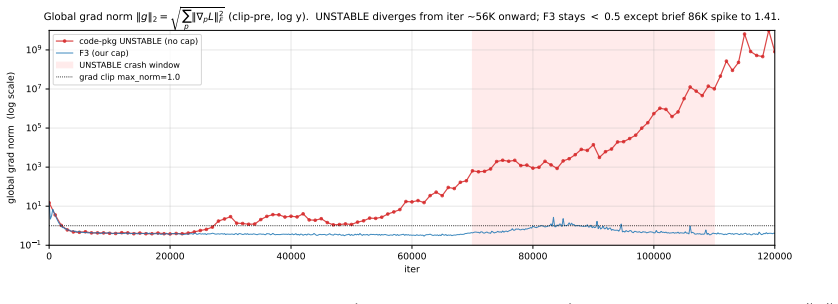
- [Sections 4.4, 4.5, 4.8] The FA case does not establish a causal role for the cap. The cap is claimed to 'stop lambda_max from reaching the failure threshold,' but lambda_max(K_K) grows from 873 at 60K to 133,208 at 86K (150x), and score.max reaches 27,264, about half the bf16 ceiling. The rescue is partly attributed to attention peaking that 'is not designed into the cap' (Section 4.4.3), and the comparison uses a single uncapped baseline with no seeds or error bars. The excess_mean counterfactual predicts an uncapped first-order rise of roughly 200K over 14K steps, while the capped lambda actually falls by 56K; this indicates the first-order projection is not the operative mechanism. The paper should either provide a matched ensemble, a direct ablation (cap on/off at the same seed), or a causal decomposition showing that the cap, not attention dynamics, prevents the crash.
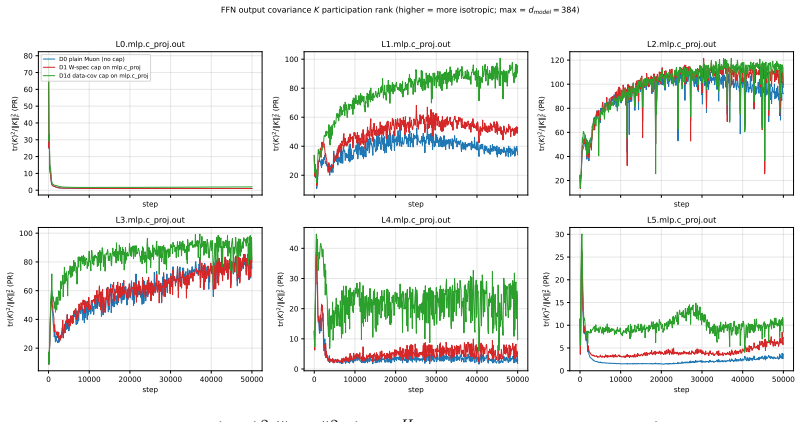
- [Sections 2.5, 3.3] Isotropy improvements are partially by construction. In the nanoGPT and MoE applications, the cap directly removes first-order growth of lambda_1(KY) or lambda_1(K_{z+b}), and the reported metrics (top-share, participation rank) are functions of the same covariance. A lower top-share is expected if the cap holds lambda_1 fixed while tr(K) grows; this does not by itself demonstrate that the model learns better or more diverse features. The meaningful evidence is loss-neutrality and failure avoidance, which are present, but the paper should avoid presenting the covariance metrics as independent evidence of improved isotropy. An independent probe (e.g., downstream task performance, gradient alignment, or a control where the cap is applied to a different direction) would strengthen the claim.
minor comments (4)
- [Section 3.3] The claim that G3 wins 16 of 18 cells and that the other two are 'PR at L2 / L1' appears inconsistent with the table: G3 actually wins PR at L1 (3.3 vs 2.2) and loses only PR at L2 (5.6 vs 6.6). Please correct the count and the cited cells.
- [Section 4.4.1] The index notation is confusing: the text says 'paper's L2 is our L1' but the table and figure captions use both 'L1 H2' and 'paper's L2'. Use a single indexing convention throughout, with a clear mapping to the reference paper's layer numbering.
- [Section 1.4.4] The table formatting for c_G and c_P (e.g., '+0.0000 0.0052') should show signs and standard errors explicitly. As written, the reader cannot tell which values are means and which are absolute values.
- [General] No code release or checkpoint availability is mentioned. Given the dependence on specific training details (RMS-matched Muon, bf16 attention, exact cap implementation), releasing the code used for the three case studies would materially improve reproducibility.
Circularity Check
Isotropy gains are partly by construction (the cap directly targets the eigenvalue used in the metrics), and the FA counterfactual excess_mean is computed from the capped run itself; the scale-invariance derivation and val-loss-neutrality findings are non-circular.
specific steps
-
self definitional
[Section 1.6; Section 2.5; Section 3.3]
"Because the second order is ≥ 0 (Section 1.5), capping only σ1 lets the remaining update pour energy into non-top directions, so trK_Y grows while σ1 is held — p1 falls, H∞ rises indirectly, and H2 and H1 improve for free."
The cap is implemented by projecting out the first-order growth of λ1 (Section 2.1: B=∂λ1/∂W, H←H−max(0,⟨B,H⟩−ρλ1)B/‖B‖²), so λ1 is the direct control target. The headline 'isotropy' metrics are direct functions of that same λ1: top-share = λ1/trK and participation rank = (trK)²/‖K‖²_F = e^{H2}. Holding λ1 while trK continues to grow mechanically lowers top-share and raises PR; the paper itself states this as an automatic consequence ('p1 falls, H∞ rises indirectly, and H2 and H1 improve for free'). Thus the reported isotropy improvements (e.g., Section 2.5: PR 34→96) are partly by construction, not independent empirical predictions. The non-trivial residue is val-loss neutrality, which is measured independently.
-
other
[Section 4.5 (excess_mean verification)]
"excess_mean=X⇔'if the cap did not act this step, the next step's λ1 would rise by X (LR included)'... Verification on L1 H2: at iter 86K, excess_mean=22. From 86K to 100K (14K steps), an uncapped expected rise of ∼10–22 per step (mean ∼15) would accumulate a first-order expected λ increase of ∼200,000+. Instead λfalls by 56K (133K→76K)."
The per-step excess is computed from the actual H and W of the capped run; integrating this local first-order quantity over 14K steps as 'what the uncapped run would do' assumes the capped trajectory's H sequence is the counterfactual uncapped trajectory, which it is not—the cap has already altered W at every previous step. This makes the accumulated counterfactual self-referential rather than an independent estimate of the baseline. The genuine evidence is the separately run uncapped baseline (Section 4.4.4), while the excess_mean arithmetic is a local diagnostic, not a valid long-horizon counterfactual.
full rationale
The central theoretical claims are self-contained derivations from Assumption 1 (Sections 1.2–1.5): the SGD 1/‖W‖ brake, Muon's removal of it via msign scale-invariance, and the non-negative second-order spectral perturbation are obtained by explicit calculation, not by presupposing the experimental results. The empirical check of cG/cP is a stated single-checkpoint sanity check and is not used as a circular proof. There is no load-bearing self-citation: references are external (Muon blog, nanoGPT, the FlashAttention paper). The partial circularity is confined to the empirical framing: because the cap is defined as a projection against the first-order growth of λ1, the metrics used as evidence of 'increased isotropy' (λmax, top-share=λ1/trK, PR=(trK)²/‖K‖²_F) are direct functions of the very eigenvalue being capped; improvements in those metrics follow in large part by construction. The paper's own statement that 'H2 and H1 improve for free' concedes this. The nontrivial, independently measured result is that val loss is essentially unchanged, which supports the 'second order still learns' mechanism. Additionally, the FA excess_mean counterfactual is computed from the capped run's own updates and then integrated over a long window, making it self-referential as a counterfactual; the separate uncapped baseline is the valid comparison. The MoE L0 result (G3 top-share 0.272 vs G1 0.479, but hard-max 0.219 vs 0.071) weakens the claimed geometry-to-load causal chain but is a correctness issue, not circularity. Overall, the derivation chain is not fundamentally circular; score 4 reflects the constructional isotropy metrics and the self-referential counterfactual diagnostic.
Axiom & Free-Parameter Ledger
free parameters (2)
- C = ||H(Theta_t)||_F (direction-only gradient norm)
- k = rank(G_t) (Muon update energy)
axioms (7)
- ad hoc to paper Exact scale invariance L(cW) = L(W) for all c > 0 (Assumption 1, Section 1.2)
- domain assumption C = ||H(Theta_t)||_F stays O(1) along the trajectory
- domain assumption <W_t, msign(G_t)>_F ~ 0 (Muon radial component vanishes)
- domain assumption k_t = rank(G_t) is roughly constant
- domain assumption Simple top singular value with spectral gap sigma_1 > sigma_2 throughout
- domain assumption Reference-paper bf16 failure mechanism applies (cross-block max-subtraction loses precision at large score scale with many near-max entries)
- domain assumption K_X = I pedagogical simplification (Section 1.1), relaxed in Section 1.7
read the original abstract
Muon and related matrix-sign optimizers are increasingly used to pre-train large language models, but their effect on the internal geometry of individual weight matrices is not well understood. This preliminary report proposes a unified framework built on a single idealizing assumption -- exact scale invariance of the loss under weight rescaling, which holds approximately in normalization-heavy networks. Under this assumption, plain SGD carries a built-in 1/||W|| brake on its update size, whereas Muon's matrix-sign step removes that brake, so both the Frobenius and spectral norms drift outward faster (t^{1/2} versus t^{1/4}). We further observe that the spectral-norm perturbation has a non-negative second-order term. This implies that a lightweight "spectral cap" -- which projects out only the first-order growth of the single top singular direction from each update -- can control the output covariance W K_X W^T without freezing training: the weight keeps learning through non-top directions, top-direction rotation, and top switching. We relate this cap to the min-entropy (H-infinity) of the singular-value spectrum. We then study three systems trained with Muon: a nanoGPT feed-forward projection, a 64-expert mixture-of-experts router, and the query/key projections of a bf16 FlashAttention block. In each case the cap increases isotropy and, at the margins -- a router collapsing to a single expert, and the near-divergence of one attention head -- prevents a concrete failure, while leaving validation loss essentially unchanged. We emphasize that the scale-invariance assumption is strong and that these small-scale results are preliminary; comments are welcome.
Figures





Reference graph
Works this paper leans on
-
[1]
H. Qiu and Q. Yao. Why low-precision transformer training fails: an analysis on Flash Atten- tion. InInternational Conference on Learning Representations (ICLR), 2026. arXiv preprint arXiv:2510.04212
Pith/arXiv arXiv 2026
-
[2]
J. Liu et al. Muon is scalable for LLM training. arXiv preprint arXiv:2502.16982, 2025
Pith/arXiv arXiv 2025
-
[3]
K. Jordan. Muon: an optimizer for hidden layers in neural networks.https://kellerjordan. github.io/posts/muon/, 2024
2024
-
[4]
Karpathy
A. Karpathy. nanoGPT.https://github.com/karpathy/nanoGPT, 2023. 26
2023
discussion (0)
Sign in with ORCID, Apple, or X to comment. Anyone can read and Pith papers without signing in.