REVIEW 4 major objections 5 minor 34 references
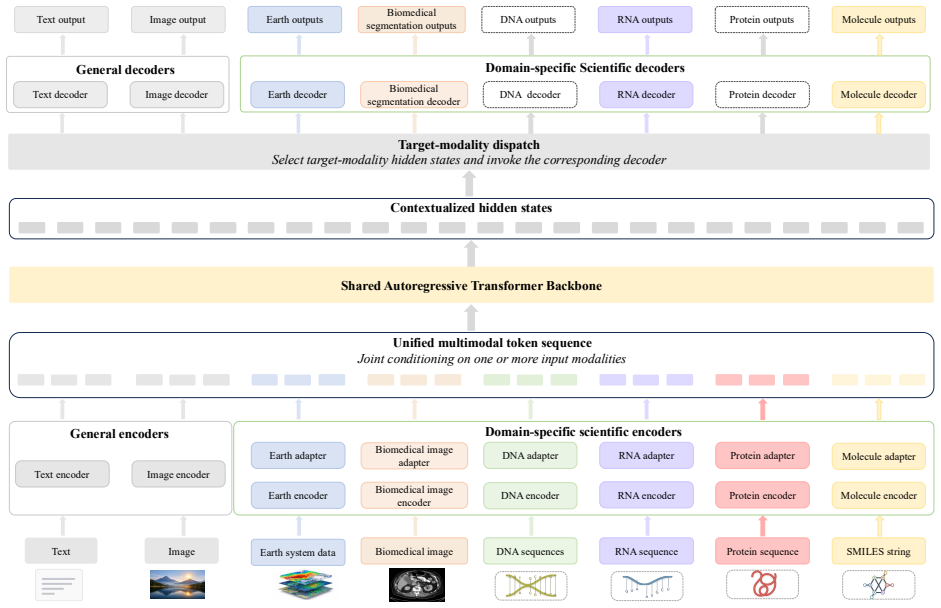
MKB is an 11-billion-parameter model that puts DNA, RNA, proteins, small molecules, weather fields, and medical images into one shared Transformer sequence and can emit each modality's native output format.
Reviewed by Pith at T0; open to challenge. T0 means a machine referee read the full paper against a public rubric. the ladder, T0–T4 →
T0 review · deepseek-v4-flash
2026-08-01 21:44 UTC pith:F7KRDPZH
load-bearing objection Serious engineering with strong biology numbers, but cross-modal generation and weather claims outrun the evidence. the 4 major comments →
Monkey King Bang: A Unified Scientific Multimodal Foundation Model
The pith
A machine-rendered reading of the paper's core claim, the machinery that carries it, and where it could break.
Core claim
MKB's central claim is that heterogeneous scientific data can be mapped into one shared representation space and decoded back into native formats by a single autoregressive language backbone. Sequence and graph modalities (DNA, RNA, proteins, molecules) are compressed by Perceiver-style resamplers into 64 backbone tokens each; Earth-system fields keep a dense latitude-longitude grid; medical images use a dual semantic-plus-spatial path. The shared Transformer contextualises whichever modalities appear in a task, and target-modality hidden states are routed to dedicated decoders for RNA sequences, SMILES strings, meteorological fields, and segmentation masks. On the paper's own evidence this
What carries the argument
The load-bearing mechanism is a shared autoregressive Transformer backbone flanked by modality-tailored encoders, adapters, and decoders. For sequence-like and graph-like inputs, a Perceiver-style resampler plus an MLP projector turns variable-length encoder features into a fixed 64-token interface; for dense fields, a Swin-style encoder keeps a full 120 by 240 latitude-longitude token grid; and for medical images a dual path combines instruction-conditioned hidden states with dense spatial features from a segmentation vision tower. The two-stage curriculum is the training mechanism: Stage 1 trains each modality's components against the frozen backbone, and Stage 2 unfreezes only the backbon
Load-bearing premise
The two-stage curriculum's load-bearing premise is that modality components trained against the frozen backbone in Stage 1 stay correctly aligned after the backbone is unfrozen in Stage 2; the paper states this design but reports no comparison of Stage-1-only versus Stage-2 performance, so a hidden representation shift would go undetected.
What would settle it
Run the Stage-1-only checkpoint and the Stage-2 unified checkpoint on the same biological, molecular, weather, and segmentation benchmarks and compare; if Stage-2 numbers drop substantially on any modality, or if the adapter outputs for identical inputs drift far in representation space after the backbone is unfrozen, the central alignment assumption fails.
If this is right
- On the reported 20-task biology suite the model takes a top-two finish on 17 tasks, surpassing the 16 top-two finishes of a trillion-parameter scientific LLM despite being roughly 100 times smaller.
- The same checkpoint can deliver native outputs, including RNA sequences, SMILES strings, global weather fields, and segmentation masks, so tasks that need dense predictions no longer require an external specialist model.
- In weather forecasting, the model's 10-day RMSE and anomaly correlation beat the operational high-resolution numerical weather-prediction system for 500-hPa geopotential, 2-metre temperature, and mean sea-level pressure, with the advantage growing at longer lead times.
- On pooled medical-image segmentation it reaches 91.20 average Dice, ahead of a leading text-grounded segmentation model (90.73) and far above the raw segmentation backbone (35.40).
- General capability checks show the model matches or exceeds its starting vision-language backbone on 7 of 11 evaluated tasks, with most differences within seed-level variation and only icon reasoning dropping by about three percentage points.
Where Pith is reading between the lines
- If the two-stage recipe generalises, adding a new scientific modality could become plug-and-play: train a new encoder-adapter against a frozen backbone, then run a short consolidation pass, which would change how scientific AI systems are extended.
- The paper does not report a Stage-1-only versus Stage-2 ablation, so the strongest test of the curriculum is to compare adapter outputs and per-modality task metrics before and after consolidation; a large drift would reveal that the frozen interfaces no longer match the unfrozen backbone.
- The acknowledged weakness on scalar regression (ADMET and some RNA/protein properties) suggests the fixed 64-token bottleneck is well matched to categorical and structural signals but may need a continuous regression head or finer token allocation for precise numbers.
- The enzyme-conditioned generation examples are only two curated cases; a systematic evaluation on held-out enzyme reactions would show whether cross-modal generation generalises beyond memorised chemistry.
Editorial analysis
A structured set of objections, weighed in public.
Referee Report
Summary. The paper presents MKB, an 11B scientific multimodal foundation model built on a Qwen3-VL-8B backbone, with modality-specific encoders, adapters, and decoders for DNA, RNA, proteins, small molecules, Earth-system data, and medical images. Training uses a two-stage curriculum: Stage 1 aligns each modality pathway with the frozen backbone, and Stage 2 unfreezes the language backbone and mixes scientific and general data. The central claim is that a single shared-backbone model can both understand and natively generate across these six scientific domains while largely retaining general-purpose capabilities. Evidence includes strong biology-understanding numbers (macro-average 60.11 vs 51.97 for Intern-S1-Pro), best pooled Dice on BiomedParse (91.20), molecule generation results comparable to LlaSMol, and some improvement over ECMWF HRES in medium-range weather forecasting.
Significance. If the central claims hold, the paper demonstrates an impressive and useful result: a compact 11B model can jointly handle biological sequences, molecular graphs, dense weather fields, and medical images, and can generate modality-native outputs, while keeping most of its general VLM ability. The public release of code and checkpoints is a concrete contribution. However, the strength of the paper is uneven. The biology and medical-segmentation results are the most convincing; the macro-average gain over a 1T-parameter model is substantial, and the segmentation comparison includes several strong baselines. The cross-modal generation claim, which is the model's main differentiation from text-centric scientific LLMs, rests on only two hand-picked qualitative examples. The weather evaluation compares only to HRES and lacks error bars and data-driven baselines. These gaps are load-bearing for the paper's strongest claims, and the benchmark provenance for Biology-Instructions needs explicit clarification.
major comments (4)
- [§5.2.2, Figure 3] Cross-modal native generation, the paper's central differentiator, is evaluated only by two qualitative examples. The text explicitly says 'we report representative cases rather than model-versus-model scores' and provides no aggregate validity, exact-match, Tanimoto, or held-out success-rate numbers on the reserved enzyme-catalysis split. Since the model's claimed advantage over text-centric scientific LLMs is precisely native cross-modal generation, this is load-bearing. The authors should report quantitative metrics on the full reserved split (e.g., RDKit-canonical exact match, validity, Tanimoto similarity) and, where possible, compare with a text-serialisation baseline.
- [§5.2.3, Figure 4] The weather-forecast claim 'better medium-range forecasts than HRES' is based only on a comparison to ECMWF HRES. Figure 4 reports no error bars, no statistical significance, and no data-driven baselines such as Pangu-Weather, GraphCast, or FourCastNet. Given the paper's emphasis on high-fidelity native Earth-system output, a single NWP baseline is insufficient. The authors should add standard data-driven baselines and report uncertainty or at least multiple initialisation dates, so the reader can judge whether the apparent advantage is robust.
- [§3.1, §5.1.2, Table 6] Biology-Instructions is used both as training data ('DNA, RNA, protein, and RNA–protein tasks are primarily drawn from Biology-Instructions') and as the evaluation benchmark for the main biology table. The paper does not state explicitly how the benchmark split was constructed or whether any Biology-Instructions training samples overlap the reported test tasks. Without a clear leakage-control statement, the macro-average improvement over Intern-S1-Pro could be inflated. The authors must specify the exact split protocol for each of the 20 tasks and confirm that no task-level training examples appear in the evaluation set.
- [§4.2, Table 3] The two-stage curriculum is a key design claim, but no ablation isolates the contribution of Stage 2. The paper says Stage 2 unfreezes the LLM backbone while freezing Stage-1 components, yet it never reports Stage-1-only numbers. The reader's concern that unfreezing the backbone could miscalibrate the frozen adapters is real; the reported results suggest this did not happen catastrophically, but the contribution of Stage 2 to the final numbers is unquantified. A Stage-1-only vs Stage-2 comparison for at least one biology, one molecule, and one dense-output task would support the curriculum claim.
minor comments (5)
- [§3.5] Stage-2 mixture down-sampling ratios are described only qualitatively. Since the mixture composition can affect both scientific and general performance, reporting the actual ratios (or a table of source sizes) would improve reproducibility.
- [§2.5, §5.2.2] The RNA generation result (BLEU 99.996, recovery 99.998%) is described as 'near-saturated' and largely deterministic. This should be stated more prominently in the results section; otherwise the reader may mistake this for a challenging generative benchmark.
- [Figure 4 and Table 10] The weather curves in Figure 4 would benefit from shading or confidence bands, and Table 10 should state the variance across the 102,855 test pairs. Even a single standard-deviation column would help assess whether the small gaps to BiomedParse on several modalities are meaningful.
- [§5.1.4] The relationship between Suiren (the molecule encoder used by MKB), the MoleHB benchmark, and the Suiren baseline in Table 7 should be clarified. Since both the encoder and benchmark are attributed to the same technical report, a reader needs to know whether the comparison is independent or partially circular.
- [Global] Minor typographical and formatting issues: 'Intern-S1-Pro' is spelled 'Intern-S1-Pro' in the text but the abstract/reference use 'Intern-S1-Pro'; a citation for the official split of Biology-Instructions (e.g., a URL or version) is missing; and the GitHub/HuggingFace links should include commit hashes to support reproducibility.
Circularity Check
Substrate-to-product cross-modal generation is circular: the Rhea reaction ID supplied in the prompt is the database key whose definition is the output; the rest of the paper is largely independent empirical evaluation.
specific steps
-
self definitional
[Section 5.2.2 (Scientific Generation Results), Figure 3(b); task constructed in Section 3.3, Table 2 (enzyme_substrate2product)]
"substrate-to-product prediction conditioned on enzyme sequence, substrate molecules, and a curated Rhea reaction identifier. ... This enzyme is annotated with Rhea:38488. For this specific Rhea reaction, predict the product molecule(s) from the substrate set. ... Matches the curated Rhea:38488 product exactly."
A Rhea identifier uniquely denotes one curated reaction, including its product set. The prompt gives the model Rhea:38488 as an input and asks for the products of 'this specific Rhea reaction'; the reference answer is the curated product set attached to that identifier. The 'prediction' is therefore not derived from the enzyme sequence and substrate by cross-modal reasoning; it reduces to retrieving/recalling the database entry named by the input. Correctness is scored as exact match to the same database record, so success on this representative case is forced by construction rather than evidence of joint protein-molecule generation. This is load-bearing because the same subsection is the only evidence for the enzyme-to-molecule cross-modal generation claim.
full rationale
MKB is primarily an empirical systems paper, and the bulk of its results are measured on external benchmarks (Biology-Instructions, SMolInstruct, MoleculeNet/TDC, BiomedParse, ERA5, MMLU/MMMU-Pro), so the default non-circularity verdict would be low. The identified circular step is confined to the substrate-to-product evaluation in Section 5.2.2/Figure 3(b): the input includes a curated Rhea reaction ID, and the output is the curated product set for that same ID, making the example a database lookup rather than a prediction from enzyme+substrate context. Because this example is one of only two supports for the paper's cross-modal native-generation claim, the circularity is partial but material. The cofactor prediction example, RNA generation, text-to-SMILES generation, weather forecasting, and medical segmentation do not exhibit this reduction. The MoleHB/Suiren overlap is a self-citation/provenance concern, but the paper is transparent that Suiren is used as a fixed encoder and is also a baseline; there is no demonstrated reduction, so it does not add to the score by itself. Overall: 6.
Axiom & Free-Parameter Ledger
free parameters (3)
- Weather loss channel weights (alpha_hum, alpha_sur, alpha_upper) =
0.3, 0.5, 1.0
- Latent token count K for sequence/graph adapters =
64
- Stage-2 mixture down-sampling ratios =
unspecified
axioms (3)
- domain assumption Pretrained ESM2, Suiren, and SAM3 representations are sufficiently rich and transferable to serve as encoders for the unified backbone.
- domain assumption Two-stage modality-then-language curriculum prevents cross-modality interference and preserves Stage-1 alignment after unfreezing the backbone.
- domain assumption Causal attention over 28,800 dense weather tokens with reserved placeholder positions preserves spatial information needed for field decoding.
read the original abstract
Scientific discovery is increasingly shifting from isolated disciplines to multi-domain reasoning, and AI for science faces a similar transition. Existing systems are either specialised for individual domains or unify scientific data mainly through text tokenisation and prompt-based interfaces, limiting their ability to handle diverse scientific inputs, produce modality-native outputs, and support joint understanding, reasoning, and generation across scientific domains. We introduce MKB, a unified scientific multimodal model for both understanding and generation, built around a shared Transformer backbone and modality-tailored encoders, adapters, and decoders. MKB covers six scientific branches, including DNA, RNA, proteins, small molecules, earth science, and medical images, and supports native outputs such as biological sequences, molecular strings, meteorological fields, and segmentation masks. Training follows a two-stage modality-then-language curriculum: Stage 1 aligns modality-specific components with the frozen backbone, and Stage 2 consolidates them with the language backbone using mixed scientific and general corpora. Experiments show that MKB achieves competitive scientific understanding across biological and molecular benchmarks, produces high-fidelity native outputs for weather forecasting, biological generation, and medical-image segmentation, and largely retains the general capabilities of its Qwen3-VL backbone. These results demonstrate the feasibility of the proposed paradigm, suggesting that shared-backbone models with modality-tailored components can provide a promising foundation for future cross-domain scientific multimodal exploration. The model and code are publicly available at https://github.com/Shanghai-Academy-of-AI-For-Science/MKB and https://huggingface.co/sais-org/MKB.
Figures



Reference graph
Works this paper leans on
-
[1]
Flamingo: a visual language model for few-shot learning
Jean-Baptiste Alayrac, Jeff Donahue, Pauline Luc, Antoine Miech, Iain Barr, Yana Hasson, Karel Lenc, Arthur Mensch, Katherine Millican, Malcolm Reynolds, et al. Flamingo: a visual language model for few-shot learning. Advances in neural information processing systems , 35:23716–23736, 2022
2022
-
[2]
Suiren-1.0 technical report: A family of molecular foundation models
Junyi An, Xinyu Lu, Yun-Fei Shi, Li-Cheng Xu, Nannan Zhang, Chao Qu, Yuan Qi, and Fenglei Cao. Suiren-1.0 technical report: A family of molecular foundation models. arXiv preprint arXiv:2603.21942 , 2026
Pith/arXiv arXiv 2026
-
[3]
Parit Bansal, Anne Morgat, Kristian B. Axelsen, Venkatesh Muthukrishnan, Elisabeth Coudert, Lucila Aimo, Nevila Hyka-Nouspikel, Elisabeth Gasteiger, Arnaud Kerhornou, Teresa B. Neto, Monica Poz- zato, Marie-Claude Blatter, Alan Ignatchenko, Nicole Redaschi, and Alan Bridge. Rhea, the reaction knowledgebase in 2022. Nucleic Acids Research, 50(D1):D693–D700...
-
[4]
Accurate medium-range global weather forecasting with 3d neural networks
Kaifeng Bi, Lingxi Xie, Hengheng Zhang, Xin Chen, Xiaotao Gu, and Qi Tian. Accurate medium-range global weather forecasting with 3d neural networks. Nature, 619(7970):533–538, 2023
2023
-
[5]
Sam 3: Segment anything with concepts
Nicolas Carion, Laura Gustafson, Yuan-Ting Hu, Shoubhik Debnath, Ronghang Hu, Didac Suris, Chai- tanya Ryali, Kalyan Vasudev Alwala, Haitham Khedr, Andrew Huang, et al. Sam 3: Segment anything with concepts. arXiv preprint arXiv:2511.16719 , 2025
Pith/arXiv arXiv 2025
-
[6]
Fuxi: A cascade machine learning forecasting system for 15-day global weather forecast
Lei Chen, Xiaohui Zhong, Feng Zhang, Yuan Cheng, Yinghui Xu, Yuan Qi, and Hao Li. Fuxi: A cascade machine learning forecasting system for 15-day global weather forecast. npj climate and atmospheric science, 6(1):190, 2023
2023
-
[7]
Nucleotide transformer: building and evaluating robust foundation models for human genomics
Hugo Dalla-Torre, Liam Gonzalez, Javier Mendoza-Revilla, Nicolas Lopez Carranza, Adam Henryk Grzywaczewski, Francesco Oteri, Christian Dallago, Evan Trop, Bernardo P De Almeida, Hassan Sirelkhatim, et al. Nucleotide transformer: building and evaluating robust foundation models for human genomics. Nature Methods, 22(2):287–297, 2025. 22
2025
-
[8]
Translation between molecules and natural language
Carl Edwards, Tuan Lai, Kevin Ros, Garrett Honke, Kyunghyun Cho, and Heng Ji. Translation between molecules and natural language. In Proceedings of the 2022 Conference on Empirical Methods in Natural Language Processing (EMNLP) , pages 375–413, Abu Dhabi, United Arab Emirates, 2022. Association for Computational Linguistics. doi: 10.18653/v1/2022.emnlp-main.26
-
[9]
Gilson, Tiqing Liu, Michael Baitaluk, George Nicola, Linda Hwang, and Jenny Chong
Michael K. Gilson, Tiqing Liu, Michael Baitaluk, George Nicola, Linda Hwang, and Jenny Chong. BindingDB in 2015: A public database for medicinal chemistry, computational chemistry and systems pharmacology. Nucleic Acids Research , 44(D1):D1045–D1053, 2016. doi: 10.1093/nar/gkv1072
-
[10]
Evaluation of ECMWF forecasts, including the 2021 upgrade
Thomas Haiden, Martin Janousek, Frederic Vitart, Zied Ben Bouallegue, Laura Ferranti, and Fernando Prates. Evaluation of ECMWF forecasts, including the 2021 upgrade. Technical Report 884, European Centre for Medium-Range Weather Forecasts, 2021. URL https://www.ecmwf.int/en/elibrary/ 81235-evaluation-ecmwf-forecasts-including-2021-upgrade
2021
-
[11]
Evaluation of ecmwf forecasts, including the 2021 upgrade, 09/2021 2021
Thomas Haiden, Martin Janousek, Frédéric Vitart, Zied Ben Bouallègue, Laura Ferranti, and Fernando Prates. Evaluation of ecmwf forecasts, including the 2021 upgrade, 09/2021 2021. URL  
2021
-
[12]
ChEBI in 2016: Improved services and an expanding collection of metabolites
Janna Hastings, Gareth Owen, Adriano Dekker, Marcus Ennis, Namrata Kale, Venkatesh Muthukrish- nan, Steve Turner, Neil Swainston, Pedro Mendes, and Christoph Steinbeck. ChEBI in 2016: Improved services and an expanding collection of metabolites. Nucleic Acids Research , 44(D1):D1214–D1219,
2016
-
[13]
Haonan He, Yuchen Ren, Yining Tang, Ziyang Xu, Junxian Li, Minghao Yang, Di Zhang, Yuan Dong, Tao Chen, Shufei Zhang, Yuqiang Li, Nanqing Dong, Wanli Ouyang, Dongzhan Zhou, and Peng Ye. Biology-instructions: A dataset and benchmark for multi-omics sequence understanding capability of large language models. In Findings of the Association for Computational ...
arXiv 2025
-
[14]
Hans Hersbach, Bill Bell, Paul Berrisford, Shoji Hirahara, András Horányi, Joaquín Muñoz-Sabater, Julien Nicolas, Carole Peubey, Raluca Radu, Dinand Schepers, Adrian Simmons, Cornel Soci, Saleh Abdalla, Xavier Abellan, Gianpaolo Balsamo, Peter Bechtold, Gionata Biavati, Jean Bidlot, Massimo Bonavita, Giovanna De Chiara, Per Dahlgren, Dick Dee, Michail Dia...
1999
-
[15]
Coley, Cao Xiao, Jimeng Sun, and Marinka Zitnik
Kexin Huang, Tianfan Fu, Wenhao Gao, Yue Zhao, Yusuf Roohani, Jure Leskovec, Connor W. Coley, Cao Xiao, Jimeng Sun, and Marinka Zitnik. Therapeutics data commons: Machine learning datasets and tasks for drug discovery and development. In Advances in Neural Information Processing Systems (NeurIPS) Track on Datasets and Benchmarks , 2021
2021
-
[16]
Berg, Wan-Yen Lo, Piotr Dollár, and Ross Girshick
Alexander Kirillov, Eric Mintun, Nikhila Ravi, Hanzi Mao, Chloe Rolland, Laura Gustafson, Tete Xiao, Spencer Whitehead, Alexander C. Berg, Wan-Yen Lo, Piotr Dollár, and Ross Girshick. Segment anything. In Proceedings of the IEEE/CVF International Conference on Computer Vision (ICCV) , pages 3992–4003, 2023. doi: 10.1109/ICCV51070.2023.00371
arXiv 2023
-
[17]
Learning skillful medium-range global weather forecasting
Remi Lam, Alvaro Sanchez-Gonzalez, Matthew Willson, Peter Wirnsberger, Meire Fortunato, Ferran Alet, Suman Ravuri, Timo Ewalds, Zach Eaton-Rosen, Weihua Hu, et al. Learning skillful medium-range global weather forecasting. Science, 382(6677):1416–1421, 2023
2023
-
[18]
Evolutionary-scale prediction of atomic-level protein structure with a language model
Zeming Lin, Halil Akin, Roshan Rao, Brian Hie, Zhongkai Zhu, Wenting Lu, Nikita Smetanin, Robert Verkuil, Ori Kabeli, Yaniv Shmueli, et al. Evolutionary-scale prediction of atomic-level protein structure with a language model. Science, 379(6637):1123–1130, 2023. 23
2023
-
[19]
Segment anything in medical images
Jun Ma, Yuting He, Feifei Li, Lin Han, Chenyu You, and Bo Wang. Segment anything in medical images. Nature communications, 15(1):654, 2024
2024
-
[20]
Language mod- els enable zero-shot prediction of the effects of mutations on protein function
Joshua Meier, Roshan Rao, Robert Verkuil, Jason Liu, Tom Sercu, and Alex Rives. Language mod- els enable zero-shot prediction of the effects of mutations on protein function. Advances in neural information processing systems , 34:29287–29303, 2021
2021
-
[21]
Dinov2: Learning robust visual features without supervision
Maxime Oquab, Timothée Darcet, Théo Moutakanni, Huy Vo, Marc Szafraniec, Vasil Khalidov, Pierre Fernandez, Daniel Haziza, Francisco Massa, Alaaeldin El-Nouby, et al. Dinov2: Learning robust visual features without supervision. arXiv preprint arXiv:2304.07193 , 2023
Pith/arXiv arXiv 2023
-
[22]
DeepDTA: deep drug–target binding affinity prediction
Hakime Öztürk, Arzucan Özgür, and Elif Ozkirimli. DeepDTA: deep drug–target binding affinity prediction. Bioinformatics, 34(17):i821–i829, 2018. doi: 10.1093/bioinformatics/bty593
-
[23]
Jaideep Pathak, Shashank Subramanian, Peter Harrington, Sanjeev Raja, Ashesh Chattopadhyay, Morteza Mardani, Thorsten Kurth, David Hall, Zongyi Li, Kamyar Azizzadenesheli, et al. FourCast- Net: A global data-driven high-resolution weather model using adaptive Fourier neural operators. arXiv preprint arXiv:2202.11214 , 2022
Pith/arXiv arXiv 2022
-
[24]
Qwen Team. Qwen3-VL technical report. arXiv preprint arXiv:2511.21631 , 2025
Pith/arXiv arXiv 2025
-
[25]
MMLU-Pro: A more robust and challenging multi-task language understanding benchmark
Yubo Wang, Xueguang Ma, Ge Zhang, Yuansheng Ni, Abhranil Chandra, Shiguang Guo, Weiming Ren, Aaran Arulraj, Xuan He, Ziyan Jiang, Tianle Li, Max Ku, Kai Wang, Alex Zhuang, Rongqi Fan, Xiang Yue, and Wenhu Chen. MMLU-Pro: A more robust and challenging multi-task language understanding benchmark. In Advances in Neural Information Processing Systems 37 (Neur...
2024
-
[26]
Feinberg, Joseph Gomes, Caleb Geniesse, Aneesh S
Zhenqin Wu, Bharath Ramsundar, Evan N. Feinberg, Joseph Gomes, Caleb Geniesse, Aneesh S. Pappu, Karl Leswing, and Vijay Pande. MoleculeNet: a benchmark for molecular machine learning. Chemical Science, 9(2):513–530, 2018. doi: 10.1039/C7SC02664A
-
[27]
Nature language model: deciphering the language of nature for scientific discovery
Yingce Xia, Peiran Jin, Shufang Xie, Liang He, Chuan Cao, Renqian Luo, Guoqing Liu, Yue Wang, Zequn Liu, Yuan-Jyue Chen, et al. Nature language model: deciphering the language of nature for scientific discovery. arXiv preprint arXiv:2502.07527 , 2025
Pith/arXiv arXiv 2025
-
[28]
Baker, Ziqi Chen, Xia Ning, and Huan Sun
Botao Yu, Frazier N. Baker, Ziqi Chen, Xia Ning, and Huan Sun. LlaSMol: Advancing large lan- guage models for chemistry with a large-scale, comprehensive, high-quality instruction tuning dataset. In Conference on Language Modeling (COLM) , 2024. Introduces the SMolInstruct dataset; preprint arXiv:2402.09391
Pith/arXiv arXiv 2024
-
[29]
MMMU-Pro: A more robust multi-discipline multimodal understanding benchmark
Xiang Yue, Tianyu Zheng, Yuansheng Ni, Yubo Wang, Kai Zhang, Shengbang Tong, Yuxuan Sun, Botao Yu, Ge Zhang, Huan Sun, Yu Su, Wenhu Chen, and Graham Neubig. MMMU-Pro: A more robust multi-discipline multimodal understanding benchmark. In Proceedings of the 63rd Annual Meeting of the Association for Computational Linguistics (ACL) , 2025. Preprint: arXiv:2409.02813
Pith/arXiv arXiv 2025
-
[30]
Theodore Zhao, Yu Gu, Jianwei Yang, Naoto Usuyama, Ho Hin Lee, Sid Kiblawi, Tristan Naumann, Jianfeng Gao, Angela Crabtree, Jacob Abel, Christine Moung-Wen, Brian Piening, Carlo Bifulco, Mu Wei, Hoifung Poon, and Sheng Wang. A foundation model for joint segmentation, detection and recognition of biomedical objects across nine modalities. Nature Methods , ...
-
[31]
Uni-Mol: A universal 3d molecular representation learning framework
Gengmo Zhou, Zhifeng Gao, Qiankun Ding, Hang Zheng, Hongteng Xu, Zhewei Wei, Linfeng Zhang, and Guolin Ke. Uni-Mol: A universal 3d molecular representation learning framework. ChemRxiv, 2022. doi: 10.26434/chemrxiv-2022-jjm0j-v4
-
[32]
DNABERT- 2: Efficient foundation model and benchmark for multi-species genome
Zhihan Zhou, Yanrong Ji, Weijian Li, Pratik Dutta, Ramana Davuluri, and Han Liu. DNABERT- 2: Efficient foundation model and benchmark for multi-species genome. In The Twelfth International Conference on Learning Representations (ICLR) , 2024. URL https://openreview.net/forum?id= oMLQB4EZE1. 24
2024
-
[33]
Intern-s1-pro: Scientific multimodal foundation model at trillion scale
Yicheng Zou, Dongsheng Zhu, Lin Zhu, Tong Zhu, Yunhua Zhou, Peiheng Zhou, Xinyu Zhou, Dongzhan Zhou, Zhiwang Zhou, Yuhao Zhou, et al. Intern-s1-pro: Scientific multimodal foundation model at trillion scale. arXiv preprint arXiv:2603.25040 , 2026. 25
arXiv 2026
-
[2016]
doi: 10.1093/nar/gkv1031
discussion (0)
Sign in with ORCID, Apple, or X to comment. Anyone can read and Pith papers without signing in.