REVIEW 2 major objections 4 minor 277 references
No theoretical explanation for the Hubble tension yet passes every consistency test, so the discrepancy remains an open problem.
Reviewed by Pith at T0; open to challenge. T0 means a machine referee read the full paper against a public rubric. the ladder, T0–T4 →
T0 review · deepseek-v4-flash
2026-08-01 07:14 UTC pith:ZANP2Y7Z
load-bearing objection A careful, well-hedged review of Hubble-tension explanations whose real value is the multiprobe consistency framework and the new EDE benchmark chains; the chains themselves are not fully reproducible, but the central synthesis holds. the 2 major comments →
Hubble tension: a short review of theoretical explanations
The pith
A machine-rendered reading of the paper's core claim, the machinery that carries it, and where it could break.
Core claim
On the paper's own terms, the central discovery is a negative one: after sorting all proposed explanations by the part of the cosmological inference chain they modify, no model simultaneously preserves the CMB acoustic peak structure, the baryon-acoustic-oscillation standard ruler, the supernova distance-redshift relation, lensing, structure growth, and local absolute calibration. Early-time models like early dark energy can shrink the pre-recombination sound horizon, which is the necessary direction for raising the CMB-inferred H0, but the paper's reference chains show that uncalibrated data keep the early component small (fEDE ≈ 0.02–0.04 with H0 ≈ 67.8–69.4) and only a direct local-H0 cal
What carries the argument
The paper's central object is the cosmological standard ruler — the sound horizon at last scattering and at baryon drag, rs and rd — because the Hubble tension is really a dispute about how far that ruler is. The CMB sets the angular size of the acoustic scale, BAO carries the same ruler to low redshift, and the distance ladder measures local distances directly; every proposed fix must change one of these while leaving the others consistent. The review's key machinery is the inference chain that connects these: a theoretical mechanism's viability is judged by whether it can shift the inferred H0 without breaking CMB peak heights, the damping tail, lensing, growth, or the calibrated supernova
Load-bearing premise
The entire assessment assumes the Hubble tension is a real physical discrepancy rather than a systematic error in the distance-ladder or CMB calibration; if the local calibrators or the CMB standard ruler are biased, the theoretical problem disappears.
What would settle it
Measure the local Hubble constant with an independent calibration chain (for instance, geometric distances from water masers or very-long-baseline astrometry feeding a two-rung ladder) and find a value near 67–69 km/s/Mpc; that would dissolve the tension the review takes as its target. Conversely, a single model that, in one joint likelihood, fits CMB spectra, BAO, supernovae, lensing, and growth while returning H0 near 73 would falsify the review's conclusion that no explanation works.
If this is right
- Any viable resolution of the Hubble tension must pass CMB spectra, BAO, supernovae, lensing, structure growth, and local calibrators as one joint likelihood; a model that fixes H0 by shifting only one of these fails.
- Early dark energy alone cannot deliver H0 near 72 unless the local distance-ladder calibration is included; without it, current data keep fEDE near 2–5 percent and H0 near 68–69 km/s/Mpc.
- Late-time dynamical dark energy or transitions cannot move H0 much while the sound horizon stays fixed, because the same distances are already measured by BAO and supernovae.
- Modified gravity proposals that change the effective Planck mass will also change lensing and growth, so their high-H0 fits must be checked against independent structure and lensing data, not just distances.
- Future progress requires standardized multi-probe likelihoods and model comparisons; the review's reference chains provide a benchmark for comparing parameter directions across datasets.
Where Pith is reading between the lines
- If the review's consistency standard is applied, the Hubble tension may be a calibration-network problem rather than new physics — a testable re-analysis of the local distance ladder with independent geometric anchors would settle this.
- A natural extension left implicit: the same benchmark framework could score every theoretical model by how many of the consistency requirements it satisfies, turning the qualitative conclusion into a quantitative ranking.
- The reference chains suggest a prior-driven transition: the high-H0 EDE mode emerges only after a local-H0 likelihood is added, so any model claiming a solution should be reported both with and without that calibration to expose where the information comes from.
- The review implies that early-time and late-time mechanisms could jointly solve the tension only if they share a microphysical origin; separate add-on fixes are likely to conflict with the same correlated observables.
Editorial analysis
A structured set of objections, weighed in public.
Referee Report
Summary. This review organizes theoretical responses to the Hubble tension by the part of the inference chain they modify: scalar-tensor and other modified-gravity models (Sec. 2), early-time solutions with axion-like EDE as the main representative (Sec. 3), and late-time/dark-sector/local-inhomogeneity mechanisms (Sec. 4). It also presents new reference EDE MCMC chains computed with Cobaya/CLASS/PolyChord for a set of Planck, ACT-DR6-lensing, BAO, and SN combinations, reported in Appendix B. The central claim is conservative: no existing proposal simultaneously satisfies the full network of CMB, BAO, SN, lensing, growth, screening, and stability constraints, so the Hubble tension remains an open problem.
Significance. If it holds, the paper provides a useful, well-hedged synthesis of a fast-moving literature. Its main strengths are the explicit organization by physical mechanism, the emphasis on multi-probe consistency rather than isolated H0 shifts, and the set of EDE reference constraints computed with public codes and likelihoods. The authors are appropriately cautious: the EDE chains are described as benchmark constraints, not as evidence favoring EDE, and the paper explicitly flags the dataset-dependence of the tension's statistical significance and the possibility of calibration systematics. These features make the review scientifically reliable and likely to be a useful entry point for researchers entering the field.
major comments (2)
- [Appendix A, Table B.1] The original EDE chains are a new quantitative contribution, but the methodological description is incomplete. The appendix lists likelihood labels but not prior ranges for fEDE, log10 zc, θi, or n, nor PolyChord settings, convergence diagnostics, or whether 68% intervals are equal-tailed or highest-posterior-density. This makes the quoted numbers (e.g., Table B.1, CMB+DESI DR2+PP+SH0ES: fEDE=0.113+0.022−0.021) non-reproducible. Please add a reproducibility table with priors, sampler settings, convergence criteria, and interval definition, and clearly state in every figure caption that 'CMB' denotes the Planck block plus ACT DR6 lensing only, not the ACT/SPT power spectra.
- [Sec. 3.1, Table B.1] Several uncalibrated EDE rows have posterior means effectively at the prior boundary, e.g., Planck-only fEDE=0.028+0.007−0.028 and CMB+PP fEDE=0.022+0.005−0.022. The text states that these combinations 'favor low fEDE'; since the lower 68% error bar hits zero, what is actually shown is an upper limit under a non-negative parameter. Please rephrase such statements as upper limits and, where useful, quote 95% upper bounds instead of boundary-truncated means. This is a local statistical-presentation issue, but it affects the quantitative reading of the EDE benchmark.
minor comments (4)
- [Throughout] 'FLRW' is typeset as 'FLR W' in several places (Secs. 2.4, 2.5, 4.1, 4.3). Please fix the spacing.
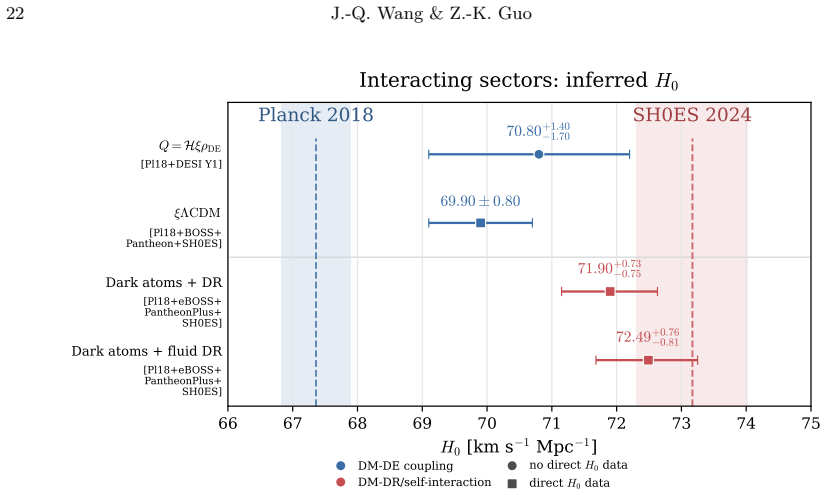
- [Fig. 2 caption] The caption calls the entries 'representative' but does not emphasize that the plotted H0 values come from heterogeneous data combinations and statistical procedures. Add a sentence warning that the points are not directly comparable as if from a single likelihood, especially because some include a local H0 prior and others do not.
- [Table B.1] The free-n rows are grouped under a 'free n' heading but no n column appears in the table body. The n values are only given in the text. Add an explicit n column (or a footnote) for clarity.
- [Sec. 3.1, Eq. (22)] The quantity Ωϕ(a_c) in Eq. (22) is not defined explicitly in the text. Define it as the maximum fractional density, or make the relation to fEDE precise, to avoid ambiguity.
Circularity Check
No significant circularity: the review's central conclusion is an independent synthesis, and its self-citations are illustrative rather than load-bearing.
full rationale
This is a review paper whose central claim is a conservative negative synthesis: no theoretical explanation has yet satisfied the full set of consistency requirements (Sec. 5). That claim is supported by a broad external literature and by the authors' own EDE reference chains, which are explicitly presented as benchmarks rather than as evidence for EDE: 'They are intended as benchmark constraints on parameter directions, not as evidence that the data favor EDE' (Sec. 5, and similarly Sec. 1 and Appendix B). The reference chains are new MCMC calculations, but they are not fitted to the review's conclusion; they are used to show how posteriors respond to different data combinations. No equation or fitted parameter is renamed as a prediction, and no load-bearing argument reduces to a self-citation. The paper cites the authors' own prior work (e.g., chameleon dark energy, NMCQ, intercept tension) only as examples within the landscape of proposals, and it explicitly notes the limitations of those proposals (e.g., Sec. 4.3 cites common local-structure tests that disfavor voids as full solutions). The acknowledged caveat that the tension's numerical severity is dataset-dependent and could partly reflect calibration systematics is self-flagged (Sec. 1) and is a limitation of the target, not a circular step. There are no uniqueness theorems imported from the authors, no ansatz smuggled via self-citation, and no renaming of a known result as organization. The main weakness is reproducibility of the new chains (Appendix A gives likelihood labels but not prior ranges or chain lengths), which affects precision of quoted EDE numbers but not the central synthetic conclusion. Overall, the derivation chain is self-contained for the purpose of the review, and no circularity is found.
Axiom & Free-Parameter Ledger
free parameters (4)
- fEDE (early dark energy peak fraction) =
0.113 (+0.022/−0.021) for CMB+DESI DR2+PP+SH0ES; ~0.02–0.05 for uncalibrated combinations
- log10 zc (EDE critical redshift) =
3.610 (+0.070/−0.123) for CMB+DESI DR2+PP+SH0ES
- θi (initial scalar displacement) =
2.71 (+0.24/−0.00) for CMB+DESI DR2+PP+SH0ES
- n (EDE potential exponent, free-n chains) =
3.10 (+0.26/−0.85) for CMB+DESI DR2+PP+SH0ES
axioms (5)
- standard math The CMB acoustic scale is θ_s = r_s(z*)/D_A(z*) (Eq. 1).
- standard math Sound horizons r_s and r_d obey the integrals in Eq. (20) with standard pre-recombination physics.
- domain assumption Public Boltzmann codes (CLASS/CAMB) and likelihoods used in Appendix A faithfully compute the relevant observables.
- domain assumption The local distance-ladder and CMB standard-ruler measurements are accepted as correctly calibrated.
- domain assumption Published posterior constraints cited in Figs. 2, 7, and 9 are trustworthy and use consistent likelihoods.
read the original abstract
The $\Lambda$ cold dark matter model successfully describes a wide range of cosmological observations. However, the persistent discrepancy between the value of the Hubble constant inferred from cosmic microwave background measurements within this model and that obtained from local distance-ladder determinations points to a significant inconsistency. This short review examines theoretical responses across the cosmological inference chain, from the gravitational field equations to the pre-recombination sound horizon and the late-time distance-redshift relation. We focus primarily on modified gravity, and briefly discuss early- and late-time mechanisms that can alter the acoustic ruler, distance measures, structure growth, or gravitational response. Current proposals can reduce the nominal tension, but often at the cost of correlated shifts in cosmic microwave background spectra, standard-ruler distances, lensing, structure growth, or calibrator information. Further progress requires unified likelihoods and multiprobe tests linking all key observables under the same model assumptions.
Figures


Reference graph
Works this paper leans on
-
[1]
A Homogeneous Universe of Constant Mass and Growing Radius Accounting for the Radial Velocity of Extragalactic Nebulae,
Georges Lemaitre, “A Homogeneous Universe of Constant Mass and Growing Radius Accounting for the Radial Velocity of Extragalactic Nebulae,” Annales Soc. Sci. Bruxelles A 47, 49–59 (1927)
1927
-
[2]
A relation between distance and radial velocity among extra-galactic nebu- lae,
Edwin Hubble, “A relation between distance and radial velocity among extra-galactic nebu- lae,” Proc. Nat. Acad. Sci. 15, 168–173 (1929)
1929
-
[3]
Final results from the Hubble Space Telescope key project to measure the Hubble constant,
W. L. Freedman et al. (HST), “Final results from the Hubble Space Telescope key project to measure the Hubble constant,” Astrophys. J. 553, 47–72 (2001) , arXiv:astro-ph/0012376
Pith/arXiv arXiv 2001
-
[4]
Wendy L. Freedman and Barry F. Madore, “The Hubble Constant,” Ann. Rev. Astron. Astrophys. 48, 673–710 (2010) , arXiv:1004.1856 [astro-ph.CO] . Hubble tension 29 0.05 0.10 0.15 fEDE 68 70 72 H0 1.5 2.0 2.5 3.0 µi 3.4 3.6 3.8 log10 zc 3.4 3.6 3.8 log10 zc 1.5 2.0 2.5 3.0 µi 68 70 72 H0 CMB+DESI DR2+PP CMB+DESI DR2+PP+SH0ES Fig. B.3: Model-parameter triangl...
Pith/arXiv arXiv 2010
-
[5]
Observational evidence from supernovae for an accelerating universe and a cosmological constant,
Adam G. Riess et al. (Supernova Search Team), “Observational evidence from supernovae for an accelerating universe and a cosmological constant,” Astron. J. 116, 1009–1038 (1998) , arXiv:astro-ph/9805201
Pith/arXiv arXiv 1998
-
[6]
Measurements of Ω and Λ from 42 High Redshift Supernovae,
S. Perlmutter et al. (Supernova Cosmology Project), “Measurements of Ω and Λ from 42 High Redshift Supernovae,” Astrophys. J. 517, 565–586 (1999) , arXiv:astro-ph/9812133
Pith/arXiv arXiv 1999
-
[7]
The Cosmological Constant and Dark Energy,
P. J. E. Peebles and Bharat Ratra, “The Cosmological Constant and Dark Energy,” Rev. Mod. Phys. 75, 559–606 (2003) , arXiv:astro-ph/0207347
Pith/arXiv arXiv 2003
-
[8]
Observational Probes of Cosmic Acceleration,
David H. Weinberg, Michael J. Mortonson, Daniel J. Eisenstein, Christopher Hirata, Adam G. Riess, and Eduardo Rozo, “Observational Probes of Cosmic Acceleration,” Phys. Rept. 530, 87–255 (2013) , arXiv:1201.2434 [astro-ph.CO]
Pith/arXiv arXiv 2013
-
[9]
Cosmic Microwave Background Anisotropies,
Wayne Hu and Scott Dodelson, “Cosmic Microwave Background Anisotropies,” Ann. Rev. Astron. Astrophys. 40, 171–216 (2002) , arXiv:astro-ph/0110414 . 30 J.-Q. Wang & Z.-K. Guo 138 140 142 144 146 148 rd 68 70 72 74 H0 CMB+DESI DR2+PP CMB+DESI DR2+PP+SH0ES free n, CMB+DESI DR2+PP free n, CMB+DESI DR2+PP+SH0ES Fig. B.4:H0–rd plane for the EDE reference chains...
Pith/arXiv arXiv 2002
-
[10]
Planck 2018 results. VI. Cosmological parameters,
N. Aghanim et al. (Planck), “Planck 2018 results. VI. Cosmological parameters,” Astron. Astrophys. 641, A6 (2020) , [Erratum: Astron.Astrophys. 652, C4 (2021)], arXiv:1807.06209 [astro-ph.CO]
Pith/arXiv arXiv 2018
-
[11]
Nine-Year Wilkinson Microwave Anisotropy Probe (WMAP) Observations: Cosmological Parameter Results,
G. Hinshaw et al. (WMAP), “Nine-Year Wilkinson Microwave Anisotropy Probe (WMAP) Observations: Cosmological Parameter Results,” Astrophys. J. Suppl. 208, 19 (2013) , arXiv:1212.5226 [astro-ph.CO]
Pith/arXiv arXiv 2013
-
[12]
L. Balkenhol et al. (SPT-3G), “Measurement of the CMB temperature power spectrum and constraints on cosmology from the SPT-3G 2018 TT, TE, and EE dataset,” Phys. Rev. D 108, 023510 (2023) , arXiv:2212.05642 [astro-ph.CO]
Pith/arXiv arXiv 2018
-
[13]
The Atacama Cosmology Telescope: DR6 power spectra, likelihoods and ΛCDM parameters,
Thibaut Louis et al. (Atacama Cosmology Telescope), “The Atacama Cosmology Telescope: DR6 power spectra, likelihoods and ΛCDM parameters,” JCAP 11, 062 (2025) , arXiv:2503.14452 [astro-ph.CO]
Pith/arXiv arXiv 2025
-
[14]
Tensions between the Early and the Late Universe,
L. Verde, T. Treu, and A. G. Riess, “Tensions between the Early and the Late Universe,” Nature Astron. 3, 891 (2019) , arXiv:1907.10625 [astro-ph.CO]
Pith/arXiv arXiv 2019
-
[15]
In the realm of the Hubble tension—a review of solutions,
Eleonora Di Valentino, Olga Mena, Supriya Pan, Luca Visinelli, Weiqiang Yang, Alessandro Melchiorri, David F. Mota, Adam G. Riess, and Joseph Silk, “In the realm of the Hubble tension—a review of solutions,” Class. Quant. Grav. 38, 153001 (2021) , arXiv:2103.01183 [astro-ph.CO] . Hubble tension 31
Pith/arXiv arXiv 2021
-
[16]
Elcio Abdalla et al. , “Cosmology intertwined: A review of the particle physics, astrophysics, and cosmology associated with the cosmological tensions and anomalies,” JHEAp 34, 49–211 (2022), arXiv:2203.06142 [astro-ph.CO]
Pith/arXiv arXiv 2022
-
[17]
DESI DR2 results. II. Measurements of baryon acoustic os- cillations and cosmological constraints,
M. Abdul Karim et al. (DESI), “DESI DR2 results. II. Measurements of baryon acoustic os- cillations and cosmological constraints,” Phys. Rev. D 112, 083515 (2025) , arXiv:2503.14738 [astro-ph.CO]
Pith/arXiv arXiv 2025
-
[18]
Adam G. Riess et al. , “A Comprehensive Measurement of the Local Value of the Hubble Constant with 1 km s −1 Mpc−1 Uncertainty from the Hubble Space Telescope and the SH0ES Team,” Astrophys. J. Lett. 934, L7 (2022) , arXiv:2112.04510 [astro-ph.CO]
Pith/arXiv arXiv 2022
-
[19]
Louise Breuval, Adam G. Riess, Stefano Casertano, Wenlong Yuan, Lucas M. Macri, Martino Romaniello, Yukei S. Murakami, Daniel Scolnic, Gagandeep S. Anand, and Igor Soszyński, “Small Magellanic Cloud Cepheids Observed with the Hubble Space Telescope Provide a New Anchor for the SH0ES Distance Ladder,” Astrophys. J. 973, 30 (2024) , arXiv:2404.08038 [astro-ph.CO]
Pith/arXiv arXiv 2024
-
[20]
Wendy L. Freedman, Barry F. Madore, Taylor J. Hoyt, In Sung Jang, Abigail J. Lee, and Kayla A. Owens, “Status Report on the Chicago-Carnegie Hubble Program (CCHP): Measurement of the Hubble Constant Using the Hubble and James Webb Space Telescopes,” Astrophys. J. 985, 203 (2025) , [Erratum: Astrophys.J. 993, 252 (2025)], arXiv:2408.06153 [astro-ph.CO]
Pith/arXiv arXiv 2025
-
[21]
The Hubble Constant from Infrared Surface Brightness Fluctuation Distances,
John P. Blakeslee, Joseph B. Jensen, Chung-Pei Ma, Peter A. Milne, and Jenny E. Greene, “The Hubble Constant from Infrared Surface Brightness Fluctuation Distances,” Astrophys. J. 911, 65 (2021) , arXiv:2101.02221 [astro-ph.CO]
Pith/arXiv arXiv 2021
-
[22]
Anupam Bhardwaj, Noriyuki Matsunaga, Caroline D. Huang, Adam G. Riess, and Marina Rejkuba, “Absolute Calibration of Cluster Mira Variables to Provide a New Anchor for the Hubble Constant Determination,” Astrophys. J. 990, 63 (2025) , arXiv:2507.10658 [astro- ph.GA]
Pith/arXiv arXiv 2025
-
[23]
The Megamaser Cosmology Project. XIII. Combined Hubble constant constraints,
D. W. Pesce et al. , “The Megamaser Cosmology Project. XIII. Combined Hubble constant constraints,” Astrophys. J. Lett. 891, L1 (2020) , arXiv:2001.09213 [astro-ph.CO]
Pith/arXiv arXiv 2020
-
[24]
A 5 per cent measurement of the Hubble–Lemaître constant from Type II super- novae,
T. de Jaeger, L. Galbany, A. G. Riess, B. E. Stahl, B. J. Shappee, A. V. Filippenko, and W. Zheng, “A 5 per cent measurement of the Hubble–Lemaître constant from Type II super- novae,” Mon. Not. Roy. Astron. Soc. 514, 4620–4628 (2022) , arXiv:2203.08974 [astro-ph.CO]
Pith/arXiv arXiv 2022
-
[25]
Kenneth C. Wong et al. (H0LiCOW), “H0LiCOW – XIII. A 2.4 per cent measurement of H0 from lensed quasars: 5.3 σ tension between early- and late-Universe probes,” Mon. Not. Roy. Astron. Soc. 498, 1420–1439 (2020) , arXiv:1907.04869 [astro-ph.CO]
Pith/arXiv arXiv 2020
-
[26]
S. Birrer et al. , “TDCOSMO - IV. Hierarchical time-delay cosmography – joint inference of the Hubble constant and galaxy density profiles,” Astron. Astrophys. 643, A165 (2020) , arXiv:2007.02941 [astro-ph.CO] . 32 J.-Q. Wang & Z.-K. Guo
Pith/arXiv arXiv 2020
-
[27]
Clecio R. Bom, V. Alfradique, A. Palmese, G. Teixeira, L. Santana-Silva, A. Santos, and P. Darc, “A dark standard siren measurement of the Hubble constant following LIGO/Virgo/KAGRA O4a and previous runs,” Mon. Not. Roy. Astron. Soc. 535, 961–975 (2024), arXiv:2404.16092 [astro-ph.CO]
Pith/arXiv arXiv 2024
-
[28]
R. Brent Tully et al., “Cosmicflows-4,” Astrophys. J. 944, 94 (2023), arXiv:2209.11238 [astro- ph.CO]
Pith/arXiv arXiv 2023
-
[29]
Stefano Casertano et al. (H0DN), “The Local Distance Network: A community consensus report on the measurement of the Hubble constant at ∼1% precision,” Astron. Astrophys. 708, A166 (2026) , arXiv:2510.23823 [astro-ph.CO]
Pith/arXiv arXiv 2026
-
[30]
Baryonic features in the matter transfer function,
Daniel J. Eisenstein and Wayne Hu, “Baryonic features in the matter transfer function,” Astrophys. J. 496, 605 (1998) , arXiv:astro-ph/9709112
Pith/arXiv arXiv 1998
-
[31]
Daniel J. Eisenstein et al. (SDSS), “Detection of the Baryon Acoustic Peak in the Large-Scale Correlation Function of SDSS Luminous Red Galaxies,” Astrophys. J. 633, 560–574 (2005) , arXiv:astro-ph/0501171
Pith/arXiv arXiv 2005
-
[32]
A 2.4% Determination of the Local Value of the Hubble Constant,
Adam G. Riess et al. , “A 2.4% Determination of the Local Value of the Hubble Constant,” Astrophys. J. 826, 56 (2016) , arXiv:1604.01424 [astro-ph.CO]
Pith/arXiv arXiv 2016
-
[33]
Adam G. Riess et al. , “Milky Way Cepheid Standards for Measuring Cosmic Distances and Application to Gaia DR2: Implications for the Hubble Constant,” Astrophys. J. 861, 126 (2018), arXiv:1804.10655 [astro-ph.CO]
Pith/arXiv arXiv 2018
-
[34]
Adam G. Riess, Stefano Casertano, Wenlong Yuan, Lucas M. Macri, and Dan Scolnic, “Large Magellanic Cloud Cepheid Standards Provide a 1% Foundation for the Determination of the Hubble Constant and Stronger Evidence for Physics beyond ΛCDM,” Astrophys. J. 876, 85 (2019), arXiv:1903.07603 [astro-ph.CO]
Pith/arXiv arXiv 2019
-
[35]
Adam G. Riess, Louise Breuval, Wenlong Yuan, Stefano Casertano, Lucas M. Macri, J. Bradley Bowers, Dan Scolnic, Tristan Cantat-Gaudin, Richard I. Anderson, and Mauricio Cruz Reyes, “Cluster Cepheids with High Precision Gaia Parallaxes, Low Zero- point Uncertainties, and Hubble Space Telescope Photometry,” Astrophys. J. 938, 36 (2022) , arXiv:2208.01045 [a...
Pith/arXiv arXiv 2022
-
[36]
Adam G. Riess, Gagandeep S. Anand, Wenlong Yuan, Stefano Casertano, Andrew Dolphin, Lucas M. Macri, Louise Breuval, Dan Scolnic, Marshall Perrin, and Richard I. Anderson, “Crowded No More: The Accuracy of the Hubble Constant Tested with High-resolution Observations of Cepheids by JWST,” Astrophys. J. Lett. 956, L18 (2023) , arXiv:2307.15806 [astro-ph.CO]
Pith/arXiv arXiv 2023
-
[37]
Adam G. Riess, Gagandeep S. Anand, Wenlong Yuan, Stefano Casertano, Andrew Dolphin, Lucas M. Macri, Louise Breuval, Dan Scolnic, Marshall Perrin, and I. Richard Anderson, “JWST Observations Reject Unrecognized Crowding of Cepheid Photometry as an Explanation for the Hubble Tension at 8 σ Confidence,” Astrophys. J. Lett. 962, L17 (2024), arXiv:2401.04773 [...
Pith/arXiv arXiv 2024
-
[38]
Wendy L. Freedman et al. , “The Carnegie-Chicago Hubble Program. VIII. An Independent Determination of the Hubble Constant Based on the Tip of the Red Giant Branch,” Astrophys. J. 882, 34 (2019) , arXiv:1907.05922 [astro-ph.CO]
Pith/arXiv arXiv 2019
-
[39]
Measurements of the Hubble Constant: Tensions in Perspective,
Wendy L. Freedman, “Measurements of the Hubble Constant: Tensions in Perspective,” Astrophys. J. 919, 16 (2021) , arXiv:2106.15656 [astro-ph.CO]
Pith/arXiv arXiv 2021
-
[40]
Concordance and Discordance in Cosmology,
Marco Raveri and Wayne Hu, “Concordance and Discordance in Cosmology,” Phys. Rev. D 99, 043506 (2019) , arXiv:1806.04649 [astro-ph.CO]
Pith/arXiv arXiv 2019
-
[41]
Quantifying tensions in cosmological parameters: Interpreting the DES evidence ratio,
Will Handley and Pablo Lemos, “Quantifying tensions in cosmological parameters: Interpreting the DES evidence ratio,” Phys. Rev. D 100, 043504 (2019) , arXiv:1902.04029 [astro-ph.CO]
Pith/arXiv arXiv 2019
-
[42]
Does the Hubble constant tension call for new physics?
Edvard Mörtsell and Suhail Dhawan, “Does the Hubble constant tension call for new physics?” JCAP 09, 025 (2018) , arXiv:1801.07260 [astro-ph.CO]
Pith/arXiv arXiv 2018
-
[43]
A Lockdown Perspective on the Hubble Tension (with comments from the SH0ES team),
G. Efstathiou, “A Lockdown Perspective on the Hubble Tension (with comments from the SH0ES team),” (2020), arXiv:2007.10716 [astro-ph.CO]
Pith/arXiv arXiv 2020
-
[44]
George Efstathiou, “To H0 or not to H0?” Mon. Not. Roy. Astron. Soc. 505, 3866–3872 (2021), arXiv:2103.08723 [astro-ph.CO]
Pith/arXiv arXiv 2021
-
[45]
David Camarena and Valerio Marra, “On the use of the local prior on the absolute magnitude of Type Ia supernovae in cosmological inference,” Mon. Not. Roy. Astron. Soc. 504, 5164– 5171 (2021) , arXiv:2101.08641 [astro-ph.CO]
Pith/arXiv arXiv 2021
-
[46]
Jose Luis Bernal, Licia Verde, and Adam G. Riess, “The trouble with H0,” JCAP 10, 019 (2016), arXiv:1607.05617 [astro-ph.CO]
Pith/arXiv arXiv 2016
-
[47]
Kevin Aylor, MacKenzie Joy, Lloyd Knox, Marius Millea, Srinivasan Raghunathan, and W. L. Kimmy Wu, “Sounds Discordant: Classical Distance Ladder & ΛCDM - based Determinations of the Cosmological Sound Horizon,” Astrophys. J. 874, 4 (2019) , arXiv:1811.00537 [astro-ph.CO]
Pith/arXiv arXiv 2019
-
[48]
Hubble constant hunter’s guide,
Lloyd Knox and Marius Millea, “Hubble constant hunter’s guide,” Phys. Rev. D 101, 043533 (2020), arXiv:1908.03663 [astro-ph.CO]
Pith/arXiv arXiv 2020
-
[49]
BAO+BBN revisited — growing the Hubble tension with a 0.7 km/s/Mpc constraint,
Nils Schöneberg, Licia Verde, Héctor Gil-Marín, and Samuel Brieden, “BAO+BBN revisited — growing the Hubble tension with a 0.7 km/s/Mpc constraint,” JCAP 11, 039 (2022) , arXiv:2209.14330 [astro-ph.CO]
Pith/arXiv arXiv 2022
-
[50]
The 2024 BBN baryon abundance update,
Nils Schöneberg, “The 2024 BBN baryon abundance update,” JCAP 06, 006 (2024) , arXiv:2401.15054 [astro-ph.CO]
arXiv 2024
-
[51]
PRyMordial: the first three minutes, within and beyond the standard model,
Anne-Katherine Burns, Tim M. P. Tait, and Mauro Valli, “PRyMordial: the first three minutes, within and beyond the standard model,” Eur. Phys. J. C 84, 86 (2024) , arXiv:2307.07061 [hep-ph]
Pith/arXiv arXiv 2024
-
[52]
The H0 Olympics: A fair ranking of proposed models,
Nils Schöneberg, Guillermo Franco Abellán, Andrea Pérez Sánchez, Samuel J. Witte, Vivian Poulin, and Julien Lesgourgues, “The H0 Olympics: A fair ranking of proposed models,” Phys. Rept. 984, 1–55 (2022) , arXiv:2107.10291 [astro-ph.CO] . 34 J.-Q. Wang & Z.-K. Guo
Pith/arXiv arXiv 2022
-
[53]
Is there an early Universe solution to Hubble tension?
C. Krishnan, Eoin Ó. Colgáin, Ruchika, Anjan A. Sen, M. M. Sheikh-Jabbari, and Tao Yang, “Is there an early Universe solution to Hubble tension?” Phys. Rev. D 102, 103525 (2020) , arXiv:2002.06044 [astro-ph.CO]
Pith/arXiv arXiv 2020
-
[54]
Why reducing the cosmic sound horizon alone can not fully resolve the Hubble tension,
Karsten Jedamzik, Levon Pogosian, and Gong-Bo Zhao, “Why reducing the cosmic sound horizon alone can not fully resolve the Hubble tension,” Commun. in Phys. 4, 123 (2021) , arXiv:2010.04158 [astro-ph.CO]
Pith/arXiv arXiv 2021
-
[55]
Weikang Lin, Xingang Chen, and Katherine J. Mack, “Early Universe Physics Insensitive and Uncalibrated Cosmic Standards: Constraints on Ωm and Implications for the Hubble Tension,” Astrophys. J. 920, 159 (2021) , arXiv:2102.05701 [astro-ph.CO]
Pith/arXiv arXiv 2021
-
[56]
Sunny Vagnozzi, “Consistency tests of ΛCDM from the early integrated Sachs-Wolfe effect: Implications for early-time new physics and the Hubble tension,” Phys. Rev. D 104, 063524 (2021), arXiv:2105.10425 [astro-ph.CO]
Pith/arXiv arXiv 2021
-
[57]
Multidimensionality of the Hubble tension: The roles of Ωm and ωc,
Davide Pedrotti, Jun-Qian Jiang, Luis A. Escamilla, Simony Santos da Costa, and Sunny Vagnozzi, “Multidimensionality of the Hubble tension: The roles of Ωm and ωc,” Phys. Rev. D 111, 023506 (2025) , arXiv:2408.04530 [astro-ph.CO]
Pith/arXiv arXiv 2025
-
[58]
Shadab Alam et al. (eBOSS), “Completed SDSS-IV extended Baryon Oscillation Spectroscopic Survey: Cosmological implications from two decades of spectroscopic surveys at the Apache Point Observatory,” Phys. Rev. D 103, 083533 (2021) , arXiv:2007.08991 [astro-ph.CO]
Pith/arXiv arXiv 2021
-
[59]
DESI 2024 VI: cosmological constraints from the measurements of baryon acoustic oscillations,
A. G. Adame et al. (DESI), “DESI 2024 VI: cosmological constraints from the measurements of baryon acoustic oscillations,” JCAP 02, 021 (2025) , arXiv:2404.03002 [astro-ph.CO]
Pith/arXiv arXiv 2024
-
[60]
The Pantheon+ Analysis: The Full Data Set and Light-curve Release,
Dan Scolnic et al. , “The Pantheon+ Analysis: The Full Data Set and Light-curve Release,” Astrophys. J. 938, 113 (2022) , arXiv:2112.03863 [astro-ph.CO]
Pith/arXiv arXiv 2022
-
[61]
The Pantheon+ Analysis: Cosmological Constraints,
Dillon Brout et al., “The Pantheon+ Analysis: Cosmological Constraints,” Astrophys. J. 938, 110 (2022) , arXiv:2202.04077 [astro-ph.CO]
Pith/arXiv arXiv 2022
-
[62]
T. M. C. Abbott et al. (DES), “The Dark Energy Survey: Cosmology Results with ∼1500 New High-redshift Type Ia Supernovae Using the Full 5 yr Data Set,” Astrophys. J. Lett. 973, L14 (2024) , arXiv:2401.02929 [astro-ph.CO]
Pith/arXiv arXiv 2024
-
[63]
Dark Energy Survey Year 3 results: Cosmological constraints from galaxy clustering and weak lensing,
T. M. C. Abbott et al. (DES), “Dark Energy Survey Year 3 results: Cosmological constraints from galaxy clustering and weak lensing,” Phys. Rev. D 105, 023520 (2022), arXiv:2105.13549 [astro-ph.CO]
Pith/arXiv arXiv 2022
-
[64]
Challenges for ΛCDM: An update,
Leandros Perivolaropoulos and Foteini Skara, “Challenges for ΛCDM: An update,” New Astron. Rev. 95, 101659 (2022) , arXiv:2105.05208 [astro-ph.CO]
Pith/arXiv arXiv 2022
-
[65]
Accelerating universes with scaling dark matter,
Michel Chevallier and David Polarski, “Accelerating universes with scaling dark matter,” Int. J. Mod. Phys. D 10, 213–224 (2001) , arXiv:gr-qc/0009008
Pith/arXiv arXiv 2001
-
[66]
Exploring the expansion history of the universe,
Eric V. Linder, “Exploring the expansion history of the universe,” Phys. Rev. Lett. 90, 091301 (2003) , arXiv:astro-ph/0208512
Pith/arXiv arXiv 2003
-
[67]
Edmund J. Copeland, M. Sami, and Shinji Tsujikawa, “Dynamics of dark energy,” Int. J. Mod. Phys. D 15, 1753–1936 (2006) , arXiv:hep-th/0603057 . Hubble tension 35
Pith/arXiv arXiv 1936
-
[68]
Evolving dark energy or supernovae systematics?
George Efstathiou, “Evolving dark energy or supernovae systematics?” Mon. Not. Roy. Astron. Soc. 538, 875–882 (2025) , arXiv:2408.07175 [astro-ph.CO]
Pith/arXiv arXiv 2025
-
[69]
The DESI DR1/DR2 evidence for dy- namical dark energy is biased by low-redshift supernovae,
Lu Huang, Rong-Gen Cai, and Shao-Jiang Wang, “The DESI DR1/DR2 evidence for dy- namical dark energy is biased by low-redshift supernovae,” Sci. China Phys. Mech. Astron. 68, 100413 (2025) , arXiv:2502.04212 [astro-ph.CO]
Pith/arXiv arXiv 2025
-
[70]
M. Vincenzi et al. (DES), “Comparing the DES-SN5YR and Pantheon+ SN cosmology anal- yses: investigation based on ‘evolving dark energy or supernovae systematics’?” Mon. Not. Roy. Astron. Soc. 541, 2585–2593 (2025) , arXiv:2501.06664 [astro-ph.CO]
Pith/arXiv arXiv 2025
-
[71]
A Reassessment of the Pantheon+ and DES 5YR Calibration Uncertainties: Dovekie,
B. Popovic et al. , “A Reassessment of the Pantheon+ and DES 5YR Calibration Uncertainties: Dovekie,” (2025), arXiv:2506.05471 [astro-ph.CO]
Pith/arXiv arXiv 2025
-
[72]
Dark energy at early times, the Hubble parameter, and the string axiverse,
Tanvi Karwal and Marc Kamionkowski, “Dark energy at early times, the Hubble parameter, and the string axiverse,” Phys. Rev. D 94, 103523 (2016) , arXiv:1608.01309 [astro-ph.CO]
Pith/arXiv arXiv 2016
-
[73]
Early Dark Energy Can Resolve The Hubble Tension,
Vivian Poulin, Tristan L. Smith, Tanvi Karwal, and Marc Kamionkowski, “Early Dark Energy Can Resolve The Hubble Tension,” Phys. Rev. Lett. 122, 221301 (2019) , arXiv:1811.04083 [astro-ph.CO]
Pith/arXiv arXiv 2019
-
[74]
The Hubble Tension and Early Dark Energy,
Marc Kamionkowski and Adam G. Riess, “The Hubble Tension and Early Dark Energy,” Ann. Rev. Nucl. Part. Sci. 73, 153–180 (2023) , arXiv:2211.04492 [astro-ph.CO]
Pith/arXiv arXiv 2023
-
[75]
Vivian Poulin, Tristan L. Smith, and Tanvi Karwal, “The Ups and Downs of Early Dark Energy solutions to the Hubble tension: A review of models, hints and constraints circa 2023,” Phys. Dark Univ. 42, 101348 (2023) , arXiv:2302.09032 [astro-ph.CO]
Pith/arXiv arXiv 2023
-
[76]
Neutrino puzzle: Anomalies, interactions, and cosmological tensions,
Christina D. Kreisch, Francis-Yan Cyr-Racine, and Olivier Doré, “Neutrino puzzle: Anomalies, interactions, and cosmological tensions,” Phys. Rev. D 101, 123505 (2020) , arXiv:1902.00534 [astro-ph.CO]
Pith/arXiv arXiv 2020
-
[77]
Modified Gravity and Cosmology,
Timothy Clifton, Pedro G. Ferreira, Antonio Padilla, and Constantinos Skordis, “Modified Gravity and Cosmology,” Phys. Rept. 513, 1–189 (2012) , arXiv:1106.2476 [astro-ph.CO]
Pith/arXiv arXiv 2012
-
[78]
B. Popovic et al. (DES), “The Dark Energy Survey Supernova Program: A Reanalysis Of Cosmology Results And Evidence For Evolving Dark Energy With An Updated Type Ia Supernova Calibration,” Mon. Not. Roy. Astron. Soc. 548, stag632 (2026) , arXiv:2511.07517 [astro-ph.CO]
Pith/arXiv arXiv 2026
-
[79]
Disentangling cosmic distance tensions with early and late dark energy,
Tanisha Jhaveri, Tanvi Karwal, Thomas Crawford, Wayne Hu, Ali Rida Khalife, Lennart Balkenhol, and Fei Ge, “Disentangling cosmic distance tensions with early and late dark energy,” (2026), arXiv:2604.08530 [astro-ph.CO]
Pith/arXiv arXiv 2026
-
[80]
Salvatore Capozziello and Mariafelicia De Laurentis, “Extended Theories of Gravity,” Phys. Rept. 509, 167–321 (2011) , arXiv:1108.6266 [gr-qc]
Pith/arXiv arXiv 2011
discussion (0)
Sign in with ORCID, Apple, or X to comment. Anyone can read and Pith papers without signing in.