REVIEW 4 major objections 5 minor 61 references
A training pipeline combining uncertainty-weighted multi-teacher distillation with POV-BEV radar fusion lets self-supervised depth estimators learn from real all-weather video, cutting absRel error by 26% on RADIATE and 23% at night on nuSc
Reviewed by Pith at T0; open to challenge. T0 means a machine referee read the full paper against a public rubric. the ladder, T0–T4 →
T0 review · deepseek-v4-flash
2026-08-01 07:10 UTC pith:T4BXXNO7
load-bearing objection A solid all-weather depth paper with a genuinely useful radar-fusion idea, but the uncertainty mechanism is not shown to catch errors all teachers share. the 4 major comments →
Boosting Robustness for All-Weather Self-Supervised Depth Estimation in Autonomous Driving
The pith
A machine-rendered reading of the paper's core claim, the machinery that carries it, and where it could break.
Core claim
The paper's central claim is that the usual failure of self-supervised depth estimation in adverse weather is not primarily a data problem requiring paired clear/adverse synthetic examples, but a training-objective problem: the photometric reprojection loss sends misleading gradients exactly where weather corrupts pixel correspondence. The proposed remedy is a self-training loop in which several teacher models, each trained on a different subset of real all-weather data plus clear data, generate pseudo-depth labels; a learned uncertainty branch jointly compares all teachers against one another and against the student's features to suppress unreliable labels; and a POV-BEV radar fusion module
What carries the argument
The load-bearing mechanism is the Uncertainty-Aware Multi-Teacher Distillation loss (Eq. 9), which combines the photometric self-supervision loss with per-teacher similarity losses reweighted by predicted log-variances: L_ud = L_p + sum_i (L_sim_i exp(-U_log_i) + 0.5 U_log_i). The uncertainty branch receives the concatenated pseudo-labels of all n teachers plus the student's multi-stage features, so a teacher is down-weighted whenever it disagrees with the others, making teacher disagreement itself the uncertainty signal. The second mechanism is POV-BEV radar fusion: rather than lifting camera features into a bird's-eye view, each camera pixel is treated as a ray, projected into BEV, and use
Load-bearing premise
The load-bearing premise is that teacher disagreement tracks pseudo-label error: the uncertainty branch down-weights a teacher only when its pseudo-depth deviates from the other teachers, so if all teachers share the same weather-induced bias — say, all reading a traffic-light glare as a solid object, the failure the paper itself reports in Section IV-F — disagreement stays low and the student is trained to reproduce the shared error.
What would settle it
Compare the predicted uncertainty maps against per-pixel depth error computed from LiDAR ground truth on the RADIATE or nuScenes validation sets: if pixels labelled high-uncertainty are often accurate, or pixels where all teachers agree are often far from ground truth (glare, wet ground, snow-covered surfaces), the joint teacher-disagreement premise fails. A minimal decisive test is to measure depth error specifically in the traffic-light-glare regions the paper identifies and check whether the uncertainty branch ever flags them.
If this is right
- Directly training on real all-weather video becomes viable: the student receives photometric gradients only where brightness consistency holds and teacher pseudo-labels elsewhere, avoiding the catastrophic night and fog failures of naive all-weather training.
- The benefit is architecture-agnostic: both single-frame and temporal multi-frame depth networks improve under the same distillation, with the largest gains in conditions that violate the photometric loss most.
- Synthetic adverse-weather data is not excluded: when teacher experts are trained on synthetic paired data as well, the same uncertainty-weighted distillation absorbs them and improves metric-scale depth further.
- Deployment cost stays low: teachers and the uncertainty branch are discarded at inference, so only the student plus radar fusion module run, with the reported camera-only student at 78 FPS and the fused version at 37 FPS.
- Robustness extends to an unseen weather condition (snow) in the reported setup, suggesting that the clear-domain anchor plus uncertainty weighting transfers across appearance shifts beyond the conditions used to build the teachers.
Where Pith is reading between the lines
- A decisive stress test for the method's core assumption would be to measure, against LiDAR ground truth, how often all teachers agree while being wrong; the paper's own glare-failure case suggests the rate is non-zero, but its frequency is not quantified.
- Because the fusion direction pulls dense BEV radar back into POV, the same ray-constrained attention could benefit other per-pixel perception tasks in bad weather, such as semantic segmentation or 2D object detection, without constructing a full BEV detection head.
- The paper's modality-imbalance analysis implies that camera-radar depth fusion needs capacity-aware designs rather than simple loss rebalancing; a testable alternative is a gating mechanism that lets radar take over only where camera uncertainty is high, instead of globally penalising the camera.
- If teacher diversity, rather than uncertainty weighting, is the principal driver, a single teacher trained on all adverse data with strong augmentation and the same uncertainty-aware student loss should match the multi-teacher result; this ablation would separate the two contributions.
Editorial analysis
A structured set of objections, weighed in public.
Referee Report
Summary. The paper proposes a self-supervised monocular depth estimation pipeline for all-weather driving. It introduces UAMTD, which trains multiple 'weather-expert' teacher models on different subsets of real all-weather data and distills them into a student with an uncertainty-weighted loss (Eq. 9, derived from Eq. 8 by predicting log variance). It also proposes PBCRF, which fuses camera features with radar features in both POV and BEV via a cross-attention that uses camera-pixel ray constraints to pull dense BEV radar features back into POV. The method is evaluated on RADIATE and nuScenes across four backbones, showing improvements over clear-only and direct all-weather baselines, and outperforming synthetic-data methods when combined with synthetic teacher training. Ablations examine teacher selection, uncertainty estimation methods, and radar fusion strategies.
Significance. If the claims hold, this is a practically useful contribution: it demonstrates that real all-weather data can be used without synthetic paired generation, that multi-teacher distillation can be made uncertainty-aware for depth, and that BEV radar can complement POV radar in a self-supervised setting. The strengths are the extensive architecture-agnostic validation (MonoDepth2, MonoViT, ManyDepth2, Lite-Mono), the real-data experiments on two benchmarks, and the public code/model release. The principal risk is that the uncertainty mechanism is not shown to measure what it claims; without a calibration analysis, the gain could come from averaging or from the clear-teacher anchor.
major comments (4)
- [§III-C, Eq. (9)] For a fixed set of residuals L_sim_i, the loss in Eq. (9) is minimized with respect to U_log_i when U_log_i = log(2 L_sim_i). Hence the uncertainty branch is trained to reproduce a transformed student–teacher residual; there is no term that rewards high uncertainty when all teachers agree on an erroneous depth. Because all teachers share the clear-domain anchor and are trained via STD on overlapping weather subsets, systematic biases (glare, texture-less ground) are invisible to this residual. The paper itself documents such a failure in Section IV-F (traffic-light glare predicted as a solid object), and no experiment calibrates uncertainty against depth error or validates teacher pseudo-labels against LiDAR/radar ground truth. This leaves the central novelty—'jointly assesses the pseudo-label quality of multiple teachers' (Contributions)—unsupported. Please add an uncertainty-vs-error c
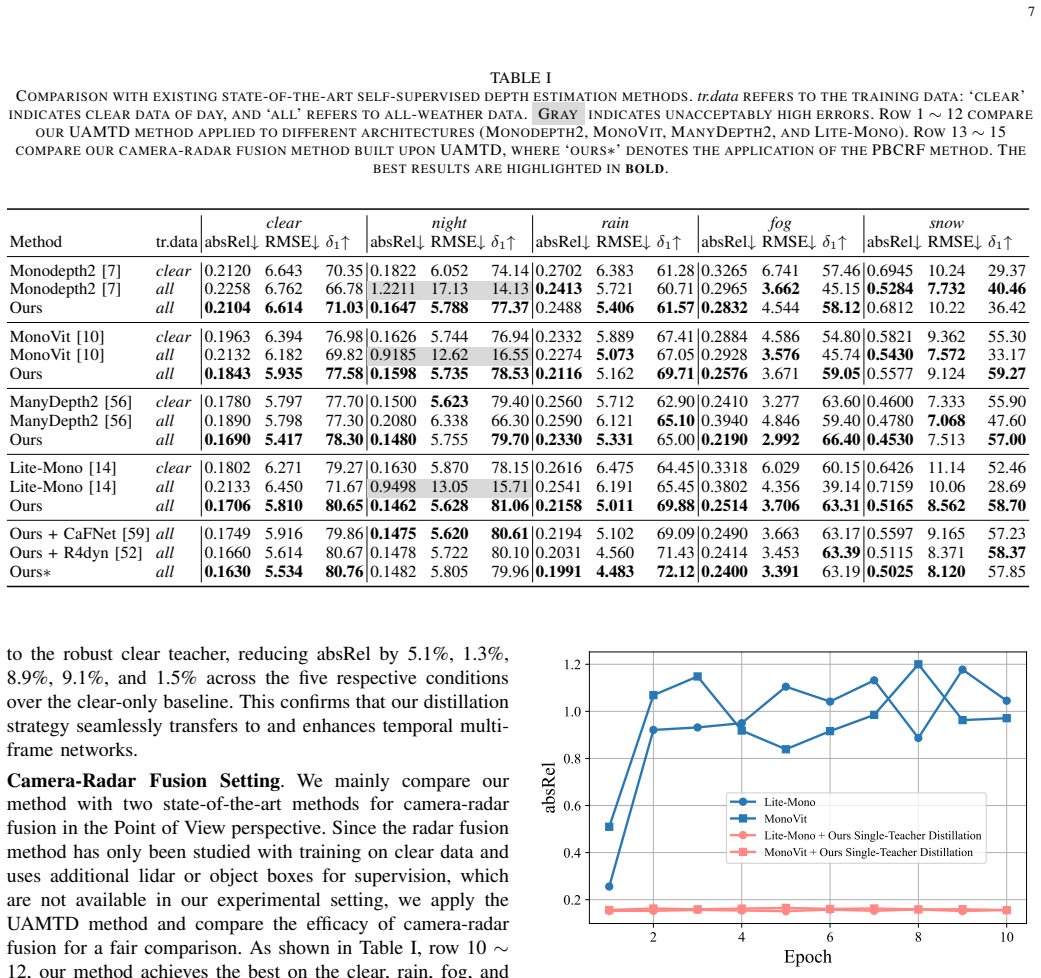
- [Abstract / Table I] The abstract states a 26% absRel reduction on RADIATE, but Table I does not directly support this. The largest per-condition improvement over the clear-only Lite-Mono baseline is 24.2% (fog), and over direct all-weather training it is 85% (night), so the 26% figure is not derivable from the reported single-condition numbers. Similarly, the 23% night reduction on nuScenes (Abstract) matches only the comparison against RNW in the median-scaled protocol (Table II), whereas under the metric-scale protocol (Table VI) the method underperforms md4all at night (0.2573 vs. 0.2335). Please specify the exact baseline and protocol behind each headline number and reconcile the Table VI result.
- [Tables I–IV] All experiments report single runs without error bars, but several conclusions rely on small differences: e.g., Table IV shows UAMTD vs. STD RMSE reductions of 1.2–2.1% (clear, night, rain) and 8.0% (rain), and row 12 vs. row 15 improvements of a few percent. These are within typical run-to-run noise for self-supervised depth. Report multiple seeds and/or significance tests for the principal comparisons, at least on the key tables (I, II, IV).
- [Appendix E] Appendix E states that 'our method underperforms md4all at night—an expected outcome given the disparity in data.' This is directly at odds with the abstract's '23% reduction in night conditions ... compared to state-of-the-art methods.' If the limitation is real, the abstract and contributions must be qualified; if the two tables use different protocols, the paper must explain why the metric-scale comparison is not the one used for headline claims. This is a load-bearing inconsistency that needs to be resolved.
minor comments (5)
- [§III-C / §IV-C] The number of teachers n is left general in Eq. 8, but the experiments use two-teacher configurations. State n=2 explicitly and give the exact teacher data splits (e.g., (clear,rain,fog) and (clear,rain,night)) in the main text, not only in Table IV.
- [Fig. 2 / §III-D] The label 'Model Different Train Data' under the teacher block is unclear. Also, the ray sampling parameters δ and |D| in Eq. 10 are never specified; please report the values used in the experiments.
- [Section II] The paragraph beginning 'UAMTD is not a mere combination...' appears in the middle of the radar discussion. It reads like a contribution summary and would fit better in the Introduction or at the end of Related Work.
- [Table I] The note about gray indicating unacceptably high errors is not visible in the rendered table; no cells appear gray. Either add gray shading or remove the note.
- [Appendix E] The claim that md4all training takes 'over 25 hours' is given without a citation or measurement. Since the paper emphasizes efficiency, provide the actual reported time or a reference for the compared method.
Circularity Check
No significant circularity: the central distillation and radar-fusion derivation is self-contained; the authors' self-citations are ancillary components, not load-bearing.
full rationale
I walked the derivation chain. Equations (1)-(2) define the standard photometric reprojection loss from external work (MonoDepth2), Eq. (3)-(4) define single-teacher distillation, and Eqs. (5)-(9) define the uncertainty-aware multi-teacher distillation loss. The uncertainty branch is learned end-to-end through the negative-log-likelihood term in Eq. (9), which down-weights large teacher residuals; this is a standard likelihood objective, not a fitted parameter that is later renamed as a test prediction. The reported test numbers in Tables I-III are depth predictions evaluated against LiDAR/radar-derived ground truth on held-out validation splits of RADIATE and nuScenes; no fitted uncertainty value is used to produce those numbers, and Table III uses metric-scale velocity supervision rather than median scaling. The UEB architecture is taken from the authors' prior work [53] and the AWC/Shapley analysis from [60], but these are training components rather than the central claim; [60] is in fact shown to degrade performance in Table IV rows 16-17. The documented glare failure in Section IV-F and the fact that uncertainty tracks student-teacher residual rather than true depth error are correctness and generalization concerns, not circularity: Eq. (9) is not by construction equal to the evaluation metric, and the paper does not rename a fitted quantity as a prediction. The derivation is therefore self-contained, with only minor, non-load-bearing self-citations.
Axiom & Free-Parameter Ledger
free parameters (3)
- Teacher ensemble configuration =
(clear,rain,fog)+(clear,rain,night)
- Number of teachers n =
2
- Depth interval δ and max range |D| for pixel-ray sampling
axioms (4)
- domain assumption Photometric reprojection loss Lp (Eq. 2) remains a usable training signal in regions where brightness consistency holds, and uncertainty weighting can identify corrupted regions.
- domain assumption Teacher pseudo-labels, generated from clear and weather-expert teachers, are reliable enough to supervise the student.
- domain assumption BEV radar points projected back along camera-pixel rays are spatially aligned with visible surfaces and contain usable depth cues.
- domain assumption Median-scaled evaluation is a valid proxy for metric depth quality in the claimed improvements.
Cite this review
Pith. "Pith review of Boosting Robustness for All-Weather Self-Supervised Depth Estimation in Autonomous Driving." pith.science (2026). https://pith.science/paper/T4BXXNO7
@misc{pith2026260721526,
  author       = {Pith},
  title        = {Pith review of: Boosting Robustness for All-Weather Self-Supervised Depth Estimation in Autonomous Driving},
  year         = {2026},
  howpublished = {\url{https://pith.science/paper/T4BXXNO7}},
  note         = {Machine review of arXiv:2607.21526}
}
read the original abstract
Self-supervised depth estimation is challenging for safe autonomous driving under various adverse weather conditions due to sensor perception degradation. These challenges arise from two main aspects. Firstly, adverse conditions can distort pixel correspondences and violate the assumptions embedded in the self-supervised loss function, leading to erroneous depth predictions. Secondly, while radar is a widely adopted sensor in adverse weather conditions, the sparse distribution of radar points in the Point of View (POV) poses challenges for self-supervised fusion. To address these issues, we introduce a novel self-training pipeline using unpaired real all-weather data through multi-teacher distillation and robust radar fusion. We propose the Uncertainty-Aware Multi-Teacher Distillation method to generate diverse teacher models with different adverse condition inputs, and then employ uncertainty modeling to weigh the knowledge distillation loss. Additionally, we design the POV-BEV Radar Fusion approach, which leverages camera-pixel ray constraints to establish connections between the camera's Point of View (POV) and the radar's Bird's-Eye View (BEV). This approach enables the utilization of denser radar points, effectively capturing the complementary perspectives of both POV and BEV. Extensive quantitative and qualitative experiments demonstrate the robustness of our proposed method on all-weather datasets, achieving state-of-the-art performance. Our code and models are available at https://github.com/MICLAB-BUPT/RobustDepth.
Figures




Reference graph
Works this paper leans on
-
[1]
Safedriverag: Towards safe autonomous driving with knowledge graph-based retrieval-augmented generation,
H. Ye, M. Qi, Z. Liu, L. Liu, and H. Ma, “Safedriverag: Towards safe autonomous driving with knowledge graph-based retrieval-augmented generation,” inProceedings of the 33rd ACM International Conference on Multimedia, 2025, pp. 11 170–11 178
2025
-
[2]
T2sg: Traffic topology scene graph for topology reasoning in autonomous driving,
C. Lv, M. Qi, L. Liu, and H. Ma, “T2sg: Traffic topology scene graph for topology reasoning in autonomous driving,” inProceedings of the Computer Vision and Pattern Recognition Conference, 2025, pp. 17 197– 17 206
2025
-
[3]
Improving batch normalization with test-time adaptation for robust object detection in self-driving,
D. Liao, M. Qi, L. Liu, and H. Ma, “Improving batch normalization with test-time adaptation for robust object detection in self-driving,” in Proceedings of the AAAI Conference on Artificial Intelligence, vol. 40, no. 9, 2026, pp. 6925–6933
2026
-
[4]
Deep learning- based robust positioning for all-weather autonomous driving,
Y . Almalioglu, M. Turan, N. Trigoni, and A. Markham, “Deep learning- based robust positioning for all-weather autonomous driving,”Nature machine intelligence, vol. 4, no. 9, pp. 749–760, 2022
2022
-
[5]
Active exploring like a pigeon: Reinforcing spatial reasoning via agentic vision-language models,
W. Deng, X. Zhang, and M. Qi, “Active exploring like a pigeon: Reinforcing spatial reasoning via agentic vision-language models,”arXiv preprint arXiv:2606.02459, 2026
Pith/arXiv arXiv 2026
-
[6]
Lift, splat, shoot: Encoding images from arbitrary camera rigs by implicitly unprojecting to 3d,
J. Philion and S. Fidler, “Lift, splat, shoot: Encoding images from arbitrary camera rigs by implicitly unprojecting to 3d,” inComputer Vision–ECCV 2020: 16th European Conference, Glasgow, UK, August 23–28, 2020, Proceedings, Part XIV 16. Springer, 2020, pp. 194–210
2020
-
[7]
Digging into self-supervised monocular depth estimation,
C. Godard, O. Mac Aodha, M. Firman, and G. J. Brostow, “Digging into self-supervised monocular depth estimation,” inProceedings of the IEEE/CVF International Conference on Computer Vision, 2019, pp. 3828–3838
2019
-
[8]
Unsupervised learning of depth and ego-motion from video,
T. Zhou, M. Brown, N. Snavely, and D. G. Lowe, “Unsupervised learning of depth and ego-motion from video,” inProceedings of the IEEE conference on computer vision and pattern recognition, 2017, pp. 1851–1858
2017
-
[9]
Prodepth: Boosting self-supervised multi-frame monocular depth with probabilistic fusion,
S. Woo, W. Lee, W. J. Kim, D. Lee, and S. Lee, “Prodepth: Boosting self-supervised multi-frame monocular depth with probabilistic fusion,” inEuropean Conference on Computer Vision. Springer, 2025, pp. 201– 217
2025
-
[10]
Monovit: Self-supervised monocular depth estimation with a vision transformer,
C. Zhao, Y . Zhang, M. Poggi, F. Tosi, X. Guo, Z. Zhu, G. Huang, Y . Tang, and S. Mattoccia, “Monovit: Self-supervised monocular depth estimation with a vision transformer,” in2022 international conference on 3D vision (3DV). IEEE, 2022, pp. 668–678
2022
-
[11]
Planedepth: Self-supervised depth estima- tion via orthogonal planes,
R. Wang, Z. Yu, and S. Gao, “Planedepth: Self-supervised depth estima- tion via orthogonal planes,” inProceedings of the IEEE/CVF Conference on Computer Vision and Pattern Recognition, 2023, pp. 21 425–21 434
2023
-
[12]
Channel-wise attention-based network for self-supervised monocular depth estimation,
J. Yan, H. Zhao, P. Bu, and Y . Jin, “Channel-wise attention-based network for self-supervised monocular depth estimation,” in2021 In- ternational Conference on 3D vision (3DV). IEEE, 2021, pp. 464–473
2021
-
[13]
Disentangling object motion and occlusion for unsupervised multi-frame monocular depth,
Z. Feng, L. Yang, L. Jing, H. Wang, Y . Tian, and B. Li, “Disentangling object motion and occlusion for unsupervised multi-frame monocular depth,” inEuropean Conference on Computer Vision. Springer, 2022, pp. 228–244
2022
-
[14]
Lite-mono: A lightweight cnn and transformer architecture for self-supervised monoc- ular depth estimation,
N. Zhang, F. Nex, G. V osselman, and N. Kerle, “Lite-mono: A lightweight cnn and transformer architecture for self-supervised monoc- ular depth estimation,” inProceedings of the IEEE/CVF Conference on Computer Vision and Pattern Recognition, 2023, pp. 18 537–18 546
2023
-
[15]
Self-supervised monocular depth estimation: Let’s talk about the weather,
K. Saunders, G. V ogiatzis, and L. J. Manso, “Self-supervised monocular depth estimation: Let’s talk about the weather,” inProceedings of the IEEE/CVF International Conference on Computer Vision, 2023, pp. 8907–8917
2023
-
[16]
Robust monocular depth estimation under challenging conditions,
S. Gasperini, N. Morbitzer, H. Jung, N. Navab, and F. Tombari, “Robust monocular depth estimation under challenging conditions,” in Proceedings of the IEEE/CVF international conference on computer vision, 2023, pp. 8177–8186
2023
-
[17]
Robust disentangled counterfactual learning for physical audiovisual commonsense reasoning,
M. Qi, C. Lv, and H. Ma, “Robust disentangled counterfactual learning for physical audiovisual commonsense reasoning,”IEEE TPAMI, vol. 48, no. 3, pp. 2514–2527, 2026
2026
-
[18]
Diffusion models for monocular depth estimation: Overcoming challenging conditions,
F. Tosi, P. Z. Ramirez, and M. Poggi, “Diffusion models for monocular depth estimation: Overcoming challenging conditions,”arXiv preprint arXiv:2407.16698, 2024
Pith/arXiv arXiv 2024
-
[19]
Weath- erdepth: Curriculum contrastive learning for self-supervised depth esti- mation under adverse weather conditions,
J. Wang, C. Lin, L. Nie, S. Huang, Y . Zhao, X. Pan, and R. Ai, “Weath- erdepth: Curriculum contrastive learning for self-supervised depth esti- mation under adverse weather conditions,” in2024 IEEE International Conference on Robotics and Automation (ICRA). IEEE, 2024, pp. 4976–4982
2024
-
[20]
Self-supervised monocular depth estimation for all day images using domain separation,
L. Liu, X. Song, M. Wang, Y . Liu, and L. Zhang, “Self-supervised monocular depth estimation for all day images using domain separation,” inProceedings of the IEEE/CVF international conference on computer vision, 2021, pp. 12 737–12 746
2021
-
[21]
Regu- larizing nighttime weirdness: Efficient self-supervised monocular depth estimation in the dark,
K. Wang, Z. Zhang, Z. Yan, X. Li, B. Xu, J. Li, and J. Yang, “Regu- larizing nighttime weirdness: Efficient self-supervised monocular depth estimation in the dark,” inProceedings of the IEEE/CVF international conference on computer vision, 2021, pp. 16 055–16 064
2021
-
[22]
When the sun goes down: Repairing photometric losses for all-day depth estimation,
M. Vankadari, S. Golodetz, S. Garg, S. Shin, A. Markham, and N. Trigoni, “When the sun goes down: Repairing photometric losses for all-day depth estimation,” inConference on Robot Learning. PMLR, 2023, pp. 1992–2003
2023
-
[23]
Radiate: A radar dataset for automotive perception in bad weather,
M. Sheeny, E. De Pellegrin, S. Mukherjee, A. Ahrabian, S. Wang, and A. Wallace, “Radiate: A radar dataset for automotive perception in bad weather,” in2021 IEEE International Conference on Robotics and Automation (ICRA). IEEE, 2021, pp. 1–7
2021
-
[24]
Dc-sam: In-context segment anything in images and videos via dual consistency,
M. Qi, P. Zhu, X. Li, X. Bi, L. Qi, H. Ma, and M.-H. Yang, “Dc-sam: In-context segment anything in images and videos via dual consistency,” IEEE TPAMI, vol. 48, no. 4, pp. 4642–4656, 2026
2026
-
[25]
Action quality assessment via hierarchical pose-guided multi-stage contrastive regression,
M. Qi, H. Ye, J. Peng, and H. Ma, “Action quality assessment via hierarchical pose-guided multi-stage contrastive regression,”IEEE Transactions on Image Processing, 2025
2025
-
[26]
Few- shot ensemble learning for video classification with slowfast memory networks,
M. Qi, J. Qin, X. Zhen, D. Huang, Y . Yang, and J. Luo, “Few- shot ensemble learning for video classification with slowfast memory networks,” inProceedings of the 28th ACM international conference on multimedia, 2020, pp. 3007–3015
2020
-
[27]
Depth map prediction from a single image using a multi-scale deep network,
D. Eigen, C. Puhrsch, and R. Fergus, “Depth map prediction from a single image using a multi-scale deep network,”Advances in neural information processing systems, vol. 27, 2014
2014
-
[28]
Deeper depth prediction with fully convolutional residual networks,
I. Laina, C. Rupprecht, V . Belagiannis, F. Tombari, and N. Navab, “Deeper depth prediction with fully convolutional residual networks,” in2016 Fourth international conference on 3D vision (3DV). IEEE, 2016, pp. 239–248
2016
-
[29]
Adabins: Depth estimation using adaptive bins,
S. F. Bhat, I. Alhashim, and P. Wonka, “Adabins: Depth estimation using adaptive bins,” inProceedings of the IEEE/CVF conference on computer vision and pattern recognition, 2021, pp. 4009–4018
2021
-
[30]
From big to small: Multi-scale local planar guidance for monocular depth estimation,
J. H. Lee, M.-K. Han, D. W. Ko, and I. H. Suh, “From big to small: Multi-scale local planar guidance for monocular depth estimation,”arXiv preprint arXiv:1907.10326, 2019
Pith/arXiv arXiv 1907
-
[31]
Deep ordinal regression network for monocular depth estimation,
H. Fu, M. Gong, C. Wang, K. Batmanghelich, and D. Tao, “Deep ordinal regression network for monocular depth estimation,” inProceedings of the IEEE conference on computer vision and pattern recognition, 2018, pp. 2002–2011
2018
-
[32]
Dynamo-depth: fixing unsupervised depth estimation for dynamical scenes,
Y . Sun and B. Hariharan, “Dynamo-depth: fixing unsupervised depth estimation for dynamical scenes,”Advances in Neural Information Processing Systems, vol. 36, 2024
2024
-
[33]
Towards scale-aware, robust, and generalizable unsupervised monocular depth estimation by integrating imu motion dynamics,
S. Zhang, J. Zhang, and D. Tao, “Towards scale-aware, robust, and generalizable unsupervised monocular depth estimation by integrating imu motion dynamics,” inEuropean Conference on Computer Vision. Springer, 2022, pp. 143–160
2022
-
[34]
Unsupervised scale-consistent depth and ego-motion learning from monocular video,
J. Bian, Z. Li, N. Wang, H. Zhan, C. Shen, M.-M. Cheng, and I. Reid, “Unsupervised scale-consistent depth and ego-motion learning from monocular video,”Advances in neural information processing systems, vol. 32, 2019
2019
-
[35]
Can scale-consistent monocular depth be learned in a self-supervised scale- invariant manner?
L. Wang, Y . Wang, L. Wang, Y . Zhan, Y . Wang, and H. Lu, “Can scale-consistent monocular depth be learned in a self-supervised scale- invariant manner?” inProceedings of the IEEE/CVF international con- ference on computer vision, 2021, pp. 12 727–12 736
2021
-
[36]
R. Zhu, Z. Song, C. Wang, J. He, and T. Zhang, “Ec-depth: Exploring the consistency of self-supervised monocular depth estimation under challenging scenes,”arXiv preprint arXiv:2310.08044, 2023. 12
Pith/arXiv arXiv 2023
-
[37]
Depth: Self- supervised two-frame multi-camera metric depth estimation,
Y . Zou, Y . Ding, X. Qiu, H. Wang, and H. Zhang, “Depth: Self- supervised two-frame multi-camera metric depth estimation,” inEuro- pean Conference on Computer Vision. Springer, 2025, pp. 269–285
2025
-
[38]
Self-supervised multi-frame monocular depth estimation for dynamic scenes,
G. Wu, H. Liu, L. Wang, K. Li, Y . Guo, and Z. Chen, “Self-supervised multi-frame monocular depth estimation for dynamic scenes,”IEEE Transactions on Circuits and Systems for Video Technology, 2023
2023
-
[39]
Ds-depth: Dynamic and static depth estimation via a fusion cost volume,
X. Miao, Y . Bai, H. Duan, Y . Huang, F. Wan, X. Xu, Y . Long, and Y . Zheng, “Ds-depth: Dynamic and static depth estimation via a fusion cost volume,”IEEE Transactions on Circuits and Systems for Video Technology, 2023
2023
-
[40]
Sports video captioning via attentive motion representation and group relationship modeling,
M. Qi, Y . Wang, A. Li, and J. Luo, “Sports video captioning via attentive motion representation and group relationship modeling,”IEEE Transactions on Circuits and Systems for Video Technology, vol. 30, no. 8, pp. 2617–2633, 2019
2019
-
[41]
Semantics-aware spatial- temporal binaries for cross-modal video retrieval,
M. Qi, J. Qin, Y . Yang, Y . Wang, and J. Luo, “Semantics-aware spatial- temporal binaries for cross-modal video retrieval,”IEEE Transactions on Image Processing, vol. 30, pp. 2989–3004, 2021
2021
-
[42]
Explainable action form assessment by exploiting multimodal chain-of-thoughts reasoning,
M. Qi, Y . Wu, W. Yun, X. Zhang, and H. Ma, “Explainable action form assessment by exploiting multimodal chain-of-thoughts reasoning,” IEEE Transactions on Image Processing, 2026
2026
-
[43]
Unikd: Uncertainty-filtered incremental knowledge distillation for neural implicit representation,
M. Guo, C. Li, H. Chen, and G. H. Lee, “Unikd: Uncertainty-filtered incremental knowledge distillation for neural implicit representation,” European Conference on Computer Vision (ECCV), 2024
2024
-
[44]
Class incremental learning with multi-teacher distillation,
H. Wen, L. Pan, Y . Dai, H. Qiu, L. Wang, Q. Wu, and H. Li, “Class incremental learning with multi-teacher distillation,” inProceedings of the IEEE/CVF Conference on Computer Vision and Pattern Recognition, 2024, pp. 28 443–28 452
2024
-
[45]
On the uncertainty of self-supervised monocular depth estimation,
M. Poggi, F. Aleotti, F. Tosi, and S. Mattoccia, “On the uncertainty of self-supervised monocular depth estimation,” inProceedings of the IEEE/CVF conference on computer vision and pattern recognition, 2020, pp. 3227–3237
2020
-
[46]
What uncertainties do we need in bayesian deep learning for computer vision?
A. Kendall and Y . Gal, “What uncertainties do we need in bayesian deep learning for computer vision?”Advances in neural information processing systems, vol. 30, 2017
2017
-
[47]
Multi-task learning using uncer- tainty to weigh losses for scene geometry and semantics,
A. Kendall, Y . Gal, and R. Cipolla, “Multi-task learning using uncer- tainty to weigh losses for scene geometry and semantics,” inCVPR, 2018, pp. 7482–7491
2018
-
[48]
Radar-camera pixel depth association for depth completion,
Y . Long, D. Morris, X. Liu, M. Castro, P. Chakravarty, and P. Narayanan, “Radar-camera pixel depth association for depth completion,” inPro- ceedings of the IEEE/CVF Conference on Computer Vision and Pattern Recognition, 2021, pp. 12 507–12 516
2021
-
[49]
Depth estimation from monocular images and sparse radar using deep ordinal regression network,
C.-C. Lo and P. Vandewalle, “Depth estimation from monocular images and sparse radar using deep ordinal regression network,” in2021 IEEE International Conference on Image Processing (ICIP). IEEE, 2021, pp. 3343–3347
2021
-
[50]
Depth estimation from camera image and mmwave radar point cloud,
A. D. Singh, Y . Ba, A. Sarker, H. Zhang, A. Kadambi, S. Soatto, M. Srivastava, and A. Wong, “Depth estimation from camera image and mmwave radar point cloud,” inProceedings of the IEEE/CVF Conference on Computer Vision and Pattern Recognition, 2023, pp. 9275–9285
2023
-
[51]
Sparse beats dense: Re- thinking supervision in radar-camera depth completion,
H. Li, M. Jing, J. Liang, H. Fan, and R. Ji, “Sparse beats dense: Re- thinking supervision in radar-camera depth completion,”arXiv preprint arXiv:2312.00844, 2023
Pith/arXiv arXiv 2023
-
[52]
R4dyn: Exploring radar for self-supervised monocular depth estimation of dynamic scenes,
S. Gasperini, P. Koch, V . Dallabetta, N. Navab, B. Busam, and F. Tombari, “R4dyn: Exploring radar for self-supervised monocular depth estimation of dynamic scenes,” in2021 International Conference on 3D Vision (3DV). IEEE, 2021, pp. 751–760
2021
-
[53]
Unsupervised self-driving attention prediction via uncertainty mining and knowledge embedding,
P. Zhu, M. Qi, X. Li, W. Li, and H. Ma, “Unsupervised self-driving attention prediction via uncertainty mining and knowledge embedding,” inProceedings of the IEEE/CVF International Conference on Computer Vision, 2023, pp. 8558–8568
2023
-
[54]
Multi-source uncer- tainty mining for deep unsupervised saliency detection,
Y . Wang, W. Zhang, L. Wang, T. Liu, and H. Lu, “Multi-source uncer- tainty mining for deep unsupervised saliency detection,” inProceedings of the IEEE/CVF conference on computer vision and pattern recognition, 2022, pp. 11 727–11 736
2022
-
[55]
nuscenes: A multimodal dataset for autonomous driving,
H. Caesar, V . Bankiti, A. H. Lang, S. V ora, V . E. Liong, Q. Xu, A. Krishnan, Y . Pan, G. Baldan, and O. Beijbom, “nuscenes: A multimodal dataset for autonomous driving,” inProceedings of the IEEE/CVF conference on computer vision and pattern recognition, 2020, pp. 11 621–11 631
2020
-
[56]
Manydepth2: Motion-aware self-supervised monocular depth estimation in dynamic scenes,
K. Zhou, J.-W. Bian, J.-Q. Zheng, J. Zhong, Q. Xie, N. Trigoni, and A. Markham, “Manydepth2: Motion-aware self-supervised monocular depth estimation in dynamic scenes,”IEEE Robotics and Automation Letters, 2025
2025
-
[57]
Synthetic-to-real self-supervised robust depth estimation via learning with motion and structure priors,
W. Yan, M. Li, H. Li, S. Shao, and R. T. Tan, “Synthetic-to-real self-supervised robust depth estimation via learning with motion and structure priors,” inProceedings of the Computer Vision and Pattern Recognition Conference, 2025, pp. 21 880–21 890
2025
-
[58]
Learning depth from past selves: Self-evolution contrast for robust depth estimation,
J. Cao, K. Jiang, S. Li, X. Feng, and Y . Huang, “Learning depth from past selves: Self-evolution contrast for robust depth estimation,” in Proceedings of the AAAI Conference on Artificial Intelligence, vol. 40, no. 4, 2026, pp. 2580–2588
2026
-
[59]
Cafnet: A confidence-driven framework for radar camera depth estimation,
H. Sun, H. Feng, J. Ott, L. Servadei, and R. Wille, “Cafnet: A confidence-driven framework for radar camera depth estimation,” in 2024 IEEE/RSJ International Conference on Intelligent Robots and Systems (IROS). IEEE, 2024, pp. 2734–2740
2024
-
[60]
Towards balanced multi- modal learning in 3d human pose estimation,
M. Qi, J. Peng, X. Zhang, and H. Ma, “Towards balanced multi- modal learning in 3d human pose estimation,”arXiv preprint arXiv:2501.05264, 2025
arXiv 2025
-
[61]
Depth estimation from monocular images and sparse radar data,
J.-T. Lin, D. Dai, and L. Van Gool, “Depth estimation from monocular images and sparse radar data,” in2020 IEEE/RSJ International Con- ference on Intelligent Robots and Systems (IROS). IEEE, 2020, pp. 10 233–10 240. 13 APPENDIXA OVERVIEW In the supplementary materials, we first provide a detailed explanation of the metric definitions in Section B. Section...
2020
discussion (0)
Sign in with ORCID, Apple, or X to comment. Anyone can read and Pith papers without signing in.