REVIEW 2 major objections 3 minor 1 cited by
Barzilai-Borwein Fails Superlinear Convergence on an Open Set of Quadratics for Every Dimension $n\geq 4$
T0 review · 2 major / 3 minor · reviewed 2026-08-01 · deepseek-v4-flash
Pith's one-line read BB1 gradient method provably loses superlinear convergence on an open, positive-measure family of quadratics in every dimension n≥4, via a certified attracting seven-cycle.
desk verdict A real answer to a long-open BB question, but the entire proof leans on a single interval-arithmetic certificate that, as printed, is not independently runnable. read the letter →
The pith
A machine-rendered reading of the paper's core claim, the machinery that carries it, and where it could break.
The reading
What carries the argument
The engine of the proof is a certified nonresonant attracting seven-cycle of the projectivized BB1 dynamics in dimension four. The projective state (a_k, p_k), where a_k is the reciprocal step size and p_k the normalized squared spectral weights, evolves under a rational map F_λ; the authors find an exact root of eight rational equations—a seven-cycle F^7(z)=z together with a fifteen-step landing F^{15}(D(r))=z from admissible initial data—by interval Newton/Banach contraction inside a 10^{-55} box. A Lyapunov pair P≻0, P−A_7^T P A_7≻0 proves the cycle is Schur stable and hence attracting in an open basin; a translation by four makes the spectral width small enough to force the 0.61 upper ra
What would settle it
Re-run the supplied interval_cert.py script in arbitrary-precision interval arithmetic and check that the printed Krawczyk containment, contraction bound <7.200691e-27, positive pivots of P, positive diagonal-dominance margins of Q_7, and all separation and denominator certificates reproduce exactly; a single violated assertion would falsify the certified root and with it the theorem. Independently, a long high-precision BB1 simulation on the central translated spectrum with the described initial weights should show the four gradient components decaying in parallel between the two geometric en
Extended reading notes
Core claim
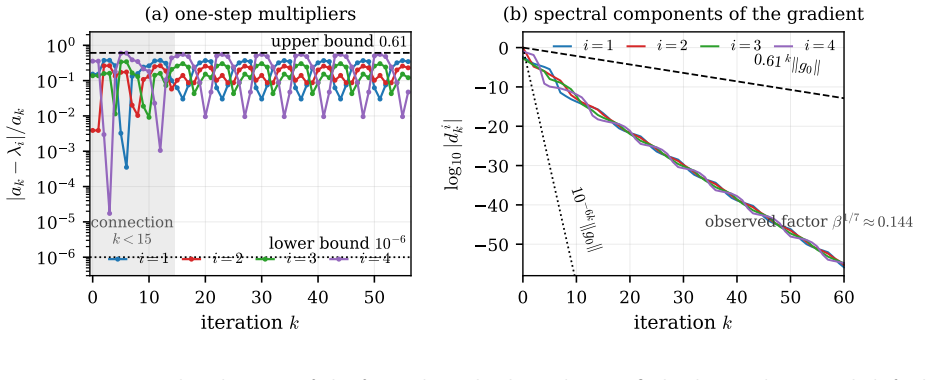
The central claim, Theorem 2.1, is that for every n≥4 and every b∈R^n there exist nonempty open sets A_n⊂S^n_{++} of simple-spectrum strictly convex quadratics and open sets X_n(A) of initial points such that every admissibly initialized BB1 trajectory satisfies the two-sided geometric bound 10^{-6k}∥Π_i(A)g_0∥ ≤ ∥Π_i(A)g_k∥ ≤ 0.61^k∥Π_i(A)g_0∥ for each spectral component i and all k. Consequently the gradient norm, energy norm of the error, and objective gap all decay at a rate bounded below by a positive geometric sequence, giving liminf ∥g_k∥^{1/k} ≥ 10^{-6} > 0. This rules out root-superlinear and Q-superlinear convergence and refutes any almost-everywhere superlinearity statement for BB
Load-bearing premise
The whole theorem rests on the computer-assisted certificate (Certificate 5.1): the interval-arithmetic script must genuinely prove that the exact root exists, that the cycle is attracting (P≻0 and P−A_7^T P A_7≻0), and that the separation bounds hold; any error in the hard-coded rational preconditioner, Lyapunov matrix, or arithmetic evaluation would collapse the open-family construction.
Editorial extensions
If this is right
- If correct, the longstanding conjecture of almost-everywhere superlinear convergence for BB1 on strictly convex quadratics is false in every dimension n≥4; the slow behavior is open and positive-measure, not a null-set exception.
- Linear-rate behavior for BB1 is caused by a stable recurrent attractor (a period-seven orbit), not merely by invariance of coordinate subspaces; four spectral modes remain active, producing a seven-periodic normalized spectral measure rather than collapse to two endpoint modes.
- The construction answers the specific open question raised by prior R-linear upper bound work: generic initialization does not automatically accelerate BB1, even on an open set of spectra.
- The rate constants 10^{-6} and 0.61 are uniform across all finite dimensions n≥4, even though the size of the open neighborhood is dimension-dependent, so the obstruction to superlinearity is authentically n-dimensional.
- The method of proof—computer-assisted certification of a periodic orbit plus analytic continuation—offers a template for proving robust lower bounds on convergence rates in other history-dependent gradient methods.
Reading between the lines
- Because the construction is open in joint problem-data space (A,x_0), a natural testable extension would be to check whether small random perturbations of the certified spectrum and initial point, in simulations of BB1 on n=4 quadratics, actually display the predicted geometric decay with the certified seven-cycle as an attractor.
- The same projective-attractor mechanism may explain observed slow phases of BB-type steps in nonquadratic problems and in spectral/safeguarded variants: wherever the delayed Rayleigh quotient locks onto a resonant cycle of step sizes, superlinear escape is precluded.
- The gap between the certified lower rate 10^{-6} and the observed asymptotic factor β^{1/7}≈0.144 along the cycle suggests the true obstruction may be stronger than the conservative theorem states; sharper constants might be obtained by optimizing the Lyapunov certificate.
- The translation trick reveals how the lower rate emerges from separation (nonresonance) while the upper rate emerges from spectral width; this split may transfer to other spectral gradient rules whose projective dynamics is translation-invariant.
Editorial analysis
A structured set of objections, weighed in public.
Referee Report
Summary. The paper proves that for every dimension n≥4 and every linear term b, there exists a nonempty open set of strictly convex quadratic problems and initial points on which the Barzilai–Borwein method BB1 converges, but every spectral component of the gradient decays at a two-sided geometric rate with explicit constants 10^{-6} and 0.61. Consequently liminf ||g_k||^{1/k} ≥ 10^{-6}, ruling out root-superlinear and Q-superlinear convergence on a positive-measure family. The proof reduces BB1 on quadratics to a projective rational map, certifies by interval arithmetic an attracting seven-cycle with an exact fifteen-step admissible connection in dimension four, proves Schur stability via a Lyapunov inequality, translates the spectrum to obtain the rate constants, continues the construction by the implicit-function theorem, embeds it into every n>4 via transverse Floquet bounds, and finally lifts the projective family to problem data by changes of variables. Theorem 2.1 states the result; Sections 4–9 supply the proof.
Significance. If the computer-assisted certificate is correct, this is a substantial negative answer to the almost-everywhere superlinearity question for BB1 on strictly convex quadratics. The paper identifies a robust dynamical mechanism — an attracting nonresonant seven-cycle — rather than a null-measure exceptional example, and it gives explicit, if conservative, rate constants. The analytic parts of the proof are careful and mostly standard: the reduction to the projective map, the translation conjugacy, the IFT continuation, and the Floquet embedding into higher dimensions are coherent and appear sound. A particular strength is the honest statement of limitations and the explicit acknowledgement that the construction is an existence result, not a universal rate formula. The main weakness is entirely at the computer-assisted certificate: the supplied script is the sole evidence for the strict inequalities that feed every later implication, and as printed it is not reproducible. The paper also discloses AI-assisted proof development, which is not a scientific defect but increases the need for machine-checkable artifacts.
major comments (2)
- [Appendix A, interval_cert.py; Certificate 5.1(C1)–(C7)] The central claim of Theorem 2.1 is conditional on the interval certificate in §5.2. As printed, the script is not executable: the triple-quoted strings RSTR and PSTR contain line-break artifacts ('↪→' and '⌋') and split numeric literals across lines, so the intended exact entries of the preconditioner R and Lyapunov matrix P cannot be recovered unambiguously. No output transcript is included. A single digit error in R could destroy the contraction bound (38), and an error in P could destroy P≻0 or P−A7ᵀPA7≻0. The certificate therefore currently functions as an unverifiable black box. Please supply a clean ancillary source file and the full output of the script (Krawczyk ratios, contraction bound, LDLT pivots, Gershgorin margins, separation values, and the transverse τ interval).
- [§5.2, (C5)–(C7); §6, Lemma 6.2] The rigorous existence and stability of the seven-cycle depend on strict inequalities that are asserted from the script but not independently reproduced. In particular, P≻0 and P−A7ᵀPA7≻0 are certified by interval LDLT pivots and Gershgorin margins, and the transverse Floquet bound (45) is certified by one interval computation, but the paper does not report the script's actual printed values for these quantities. Because every downstream conclusion — the open basin, the rate bounds, and the n>4 embedding — consumes these inequalities as black boxes, the authors should either include a full verification transcript or an independent cross-check (e.g., interval arithmetic in another language or a formal proof assistant) before the theorem can be considered established.
minor comments (3)
- [Abstract; Eq. (6)] The two rate constants are both rendered as ρ in several places; in the main text they are denoted with under/overbars. Please ensure the final PDF clearly distinguishes \underline{\rho}=10^{-6} from \overline{\rho}=0.61.
- [Figs. 1 and 3] The caption of Fig. 1 states that the transient minimum of the one-step multiplier is approximately 1.7×10^{-5}, while Certificate 5.1(C4) reports a separation lower bound of 1.388×10^{-4}. This is not contradictory if Fig. 1 refers to the shifted spectrum and to the ratio |a_k−λ_i|/a_k, but the captions should say so explicitly to avoid apparent inconsistency.
- [§1; Appendix B] The statement that Li and Sun's 'generic initialization' question is 'answered in the negative on an open set of matrices' could be misread as disproving almost-everywhere fast convergence for a fixed matrix. The theorem actually gives a positive-measure set of joint (A,x0) pairs. Please phrase this as 'on a positive-measure set of joint problem-data pairs' to match the theorem. The LLM prompt in Appendix B is long and not part of the mathematical proof; consider moving it to supplementary material or an acknowledgments note.
Circularity Check
No circularity: the rate bounds are derived from a certified periodic orbit and separation inequalities, not assumed or fitted.
full rationale
The derivation chain is self-contained. §4 reduces BB1 on a quadratic to the exact projective multiplier identity d^i_{k+1}=d^i_k(a_k−λ_i)/a_k, so the desired two-sided geometric bound (6) follows as soon as one proves 10^{-6} ≤ |a_k−λ_i|/a_k ≤ 0.61 for all i,k. The paper proves this by (a) solving, via interval Newton, eight rational equations G(u*)=0 that express exact seven-cycle periodicity F^7(z*)=z* and an exact fifteen-step admissible landing F^15(D(r*))=z* (Lemma 5.2, Certificate 5.1); (b) proving Schur stability of A_7 from the certified Lyapunov inequality P−A_7^T P A_7≻0 (Lemmas 6.1–6.3); and (c) deriving the numerical constants from translation by 4 and certified separation: λ4−λ1<3.02, λ1>4.99, and |a_k−λ_i|>10^{-5}, giving upper 3.02/4.99<0.61 and lower 10^{-5}/8.01>10^{-6}. The constants 10^{-6} and 0.61 are not inputs to the root-finding or to the construction; they are consequences of the certified strict inequalities and of free, explicitly stated spectral choices. The open sets A_n and X_n(A) are obtained by continuity and the implicit-function theorem from the certified cycle, not defined as the set where (6) is assumed. References to Li–Sun and other prior work are contextual and are not used to establish the cycle, stability, or rates. The one significant risk — that interval_cert.py as printed contains line-break artifacts and is not independently run — is a verification/reproducibility concern about Certificate 5.1, not a circularity: even if the certificate failed, the failure would be a missing or wrong proof component, not an equation equivalent to its own conclusion. No step in the paper reduces a claimed prediction to a fitted parameter, a renamed empirical pattern, or a load-bearing self-citation. Under the proportionality rule, the correct circularity score is 0.
Assumptions & free parameters
free parameters (5)
- central spectrum λ = (1, λ2, λ3*, 4) =
λ2=1.8786699041860466; λ3*≈2.7127814910653372
- admissible initial weights r* =
c6≈1.34e-5, c7≈0.98917, c8≈3.49e-6, r4≈0.01081
- interval-Newton preconditioner R =
hard-coded 8×8 rational matrix in Appendix A
- Lyapunov matrix P =
hard-coded 4×4 rational matrix in Appendix A
- extra-eigenvalue interval (7.49,7.51) for n>4 =
central νℓ equally spaced in (7.49,7.51)
assumptions (5)
- standard math Interval arithmetic enclosure principle: directed rounding with 120-digit decimal precision produces valid real inclusions for every arithmetic expression over interval inputs.
- standard math Banach fixed-point theorem in (R^8, ‖·‖∞).
- standard math Implicit function theorem for continuation of the seven-cycle under eigenvalue perturbations.
- standard math Weyl eigenvalue continuity and the spectral projector formula Π_i(A)=∏_{j≠i}(A−λ_j I)/(λ_i−λ_j) on simple-spectrum matrices.
- domain assumption The supplied Python script's hard-coded rational constants R and P are exactly as intended, and the printed transcription is faithful.
Cite this review
Pith. "Pith review of Barzilai-Borwein Fails Superlinear Convergence on an Open Set of Quadratics for Every Dimension $n\geq 4$." pith.science (2026). https://pith.science/paper/ESY6GGZ4
@misc{pith2026260721579,
  author       = {Pith},
  title        = {Pith review of: Barzilai-Borwein Fails Superlinear Convergence on an Open Set of Quadratics for Every Dimension $n\geq 4$},
  year         = {2026},
  howpublished = {\url{https://pith.science/paper/ESY6GGZ4}},
  note         = {Machine review of arXiv:2607.21579}
}
abstract
Barzilai--Borwein (BB) method has shown strong practical performance in continuous optimization, yet its convergence dynamics remains poorly understood. In particular, a central unresolved question is whether BB converges superlinearly for almost every strictly convex quadratic problem and initialization. We provide a negative answer to this question. Specifically, for every finite dimension $n\geq4$, we construct a nonempty open, hence positive-Lebesgue-measure, family of strictly convex quadratic problems and initial points for which the long Barzilai--Borwein method (BB1) converges but cannot converge root-superlinearly. More precisely, with the explicit constants $\rho_{\min}=10^{-6},\rho_{\max}=0.61$, every spectral component of the gradient is bounded above and below by the corresponding geometric sequence. Consequently, the gradient norm and the energy norm of the error satisfy two-sided geometric estimates with the same rates, while the objective gap satisfies the corresponding estimates with squared rates. In particular, all three quantities are bounded below by geometric sequences, ruling out superlinear convergence. The construction is highly nontrivial, based on a computer-assisted proof of a nonresonant, attracting seven-cycle of the projectivized BB dynamics in dimension four.
Figures


Forward citations
Cited by 1 Pith paper
-
The Sharp Worst-Case Asymptotic Rate of the Barzilai--Borwein Method in $\mathbb R^d$ and Hilbert Spaces
For either Barzilai-Borwein rule, the worst asymptotic gradient root factor on strongly convex quadratics is exactly (κ(H)-1)/(κ(H)+1), and the same constant governs local nonlinear convergence under strict differentiability.
Reference graph
Works this paper leans on
-
[1]
Annals of the Institute of Statistical Mathematics , volume=
On a successive transformation of probability distribution and its application to the analysis of the optimum gradient method , author=. Annals of the Institute of Statistical Mathematics , volume=. 1959 , publisher=
1959
-
[2]
IMA Journal of Numerical Analysis , volume=
Spectral projected gradient and variable metric methods for optimization with linear inequalities , author=. IMA Journal of Numerical Analysis , volume=. 2005 , publisher=
2005
-
[3]
Journal of Optimization Theory and Applications , volume=
Analysis of the Barzilai-Borwein step-sizes for problems in Hilbert spaces , author=. Journal of Optimization Theory and Applications , volume=. 2020 , publisher=
2020
-
[4]
IMA Journal of Numerical Analysis , volume=
On the convergence and mesh-independent property of the Barzilai--Borwein method for PDE-constrained optimization , author=. IMA Journal of Numerical Analysis , volume=. 2022 , publisher=
2022
-
[5]
IMA journal of numerical analysis , volume=
Two-point step size gradient methods , author=. IMA journal of numerical analysis , volume=. 1988 , publisher=
1988
-
[6]
SIAM Journal on Optimization , volume=
Nonmonotone spectral projected gradient methods on convex sets , author=. SIAM Journal on Optimization , volume=. 2000 , publisher=
2000
-
[7]
ACM Transactions on Mathematical Software (TOMS) , volume=
Algorithm 813: SPG—software for convex-constrained optimization , author=. ACM Transactions on Mathematical Software (TOMS) , volume=. 2001 , publisher=
2001
-
[8]
Journal of Statistical Software , volume=
Spectral projected gradient methods: review and perspectives , author=. Journal of Statistical Software , volume=
Show all 45 references
-
[9]
Inverse problems , volume=
A scaled gradient projection method for constrained image deblurring , author=. Inverse problems , volume=
-
[10]
Journal of Computational Mathematics , pages=
Stabilized barzilai-borwein method , author=. Journal of Computational Mathematics , pages=. 2019 , publisher=
2019
-
[11]
Optimization , volume=
Alternate step gradient method , author=. Optimization , volume=. 2003 , publisher=
2003
-
[12]
Journal of the operations Research Society of China , volume=
A new analysis on the Barzilai-Borwein gradient method , author=. Journal of the operations Research Society of China , volume=. 2013 , publisher=
2013
-
[13]
Mathematical Programming , volume=
On the asymptotic behaviour of some new gradient methods , author=. Mathematical Programming , volume=. 2005 , publisher=
2005
-
[14]
Numerische Mathematik , volume=
Projected Barzilai-Borwein methods for large-scale box-constrained quadratic programming , author=. Numerische Mathematik , volume=. 2005 , publisher=
2005
-
[15]
IMA Journal of Numerical Analysis , volume=
The cyclic Barzilai---Borwein method for unconstrained optimization , author=. IMA Journal of Numerical Analysis , volume=. 2006 , publisher=
2006
-
[16]
arXiv preprint arXiv:1812.02974 , year=
A family of spectral gradient methods for optimization , author=. arXiv preprint arXiv:1812.02974 , year=
-
[17]
IMA Journal of numerical analysis , volume=
R-linear convergence of the Barzilai and Borwein gradient method , author=. IMA Journal of numerical analysis , volume=. 2002 , publisher=
2002
-
[18]
Optimization and control with applications , pages=
On the barzilai-borwein method , author=. Optimization and control with applications , pages=. 2005 , publisher=
2005
-
[19]
IEEE Journal of selected topics in signal processing , volume=
Gradient projection for sparse reconstruction: Application to compressed sensing and other inverse problems , author=. IEEE Journal of selected topics in signal processing , volume=. 2007 , publisher=
2007
-
[20]
Numerische Mathematik , volume=
On the asymptotic directions of the s-dimensional optimum gradient method , author=. Numerische Mathematik , volume=. 1968 , publisher=
1968
-
[21]
SIAM Journal on Numerical Analysis , volume=
Gradient method with retards and generalizations , author=. SIAM Journal on Numerical Analysis , volume=. 1998 , publisher=
1998
-
[22]
Science China
Achieving geometric convergence for distributed optimization with Barzilai-Borwein step sizes , author=. Science China. Information Sciences , volume=. 2022 , publisher=
2022
-
[23]
Computational Optimization and Applications , volume=
Nonmonotone globalization techniques for the Barzilai-Borwein gradient method , author=. Computational Optimization and Applications , volume=. 2002 , publisher=
2002
-
[24]
SIAM Journal on Optimization , volume=
Equipping the Barzilai--Borwein method with the two dimensional quadratic termination property , author=. SIAM Journal on Optimization , volume=. 2021 , publisher=
2021
-
[25]
Journal of Scientific Computing , volume=
On the asymptotic convergence and acceleration of gradient methods , author=. Journal of Scientific Computing , volume=. 2022 , publisher=
2022
-
[26]
Data mining and knowledge discovery , volume=
Quadratic regularization projected Barzilai--Borwein method for nonnegative matrix factorization , author=. Data mining and knowledge discovery , volume=. 2015 , publisher=
2015
-
[27]
IMA Journal of Numerical Analysis , volume=
The Riemannian Barzilai--Borwein method with nonmonotone line search and the matrix geometric mean computation , author=. IMA Journal of Numerical Analysis , volume=. 2018 , publisher=
2018
-
[28]
On a Faster
Li, Dawei and Sun, Ruoyu , journal=. On a Faster
-
[29]
IEEE Transactions on Signal Processing , volume=
Coordinated beamforming for MISO interference channel: Complexity analysis and efficient algorithms , author=. IEEE Transactions on Signal Processing , volume=. 2010 , publisher=
2010
-
[30]
Asymptotic Behaviour of a Family of Gradient Algorithms in
Pronzato, Luc and Wynn, Henry P and Zhigljavsky, Anatoly A , journal=. Asymptotic Behaviour of a Family of Gradient Algorithms in. 2006 , publisher=
2006
-
[31]
IMA Journal of Numerical Analysis , volume=
On the Barzilai and Borwein choice of steplength for the gradient method , author=. IMA Journal of Numerical Analysis , volume=. 1993 , publisher=
1993
-
[32]
SIAM Journal on Optimization , volume=
The Barzilai and Borwein gradient method for the large scale unconstrained minimization problem , author=. SIAM Journal on Optimization , volume=. 1997 , publisher=
1997
-
[33]
Optimization Methods and Software , volume=
Gradient projection methods for quadratic programs and applications in training support vector machines , author=. Optimization Methods and Software , volume=. 2005 , publisher=
2005
-
[34]
Advances in neural information processing systems , volume=
Barzilai-Borwein step size for stochastic gradient descent , author=. Advances in neural information processing systems , volume=
-
[35]
Siam journal on scientific computing , volume=
Probing the Pareto frontier for basis pursuit solutions , author=. Siam journal on scientific computing , volume=. 2009 , publisher=
2009
-
[36]
Inverse Problems in Science and Engineering , volume=
Projected Barzilai--Borwein method for large-scale nonnegative image restoration , author=. Inverse Problems in Science and Engineering , volume=. 2007 , publisher=
2007
-
[37]
Mathematical Programming , volume=
A feasible method for optimization with orthogonality constraints , author=. Mathematical Programming , volume=. 2013 , publisher=
2013
-
[38]
SIAM Journal on Scientific Computing , volume=
A fast algorithm for sparse reconstruction based on shrinkage, subspace optimization, and continuation , author=. SIAM Journal on Scientific Computing , volume=. 2010 , publisher=
2010
-
[39]
IEEE Transactions on signal processing , volume=
Sparse reconstruction by separable approximation , author=. IEEE Transactions on signal processing , volume=. 2009 , publisher=
2009
-
[40]
Journal of Computational Mathematics , pages=
A new stepsize for the steepest descent method , author=. Journal of Computational Mathematics , pages=. 2006 , publisher=
2006
-
[41]
SIAM journal on Optimization , volume=
A nonmonotone line search technique and its application to unconstrained optimization , author=. SIAM journal on Optimization , volume=. 2004 , publisher=
2004
-
[42]
Mathematics of Operations Research , volume=
AdaBB: Adaptive Barzilai-Borwein method for convex optimization , author=. Mathematics of Operations Research , volume=. 2026 , publisher=
2026
-
[43]
Proceedings of the 2010 International Symposium on Symbolic and Algebraic Computation , pages=
Verification methods: Rigorous results using floating-point arithmetic , author=. Proceedings of the 2010 International Symposium on Symbolic and Algebraic Computation , pages=
2010
-
[44]
Computing , volume=
Newton-algorithmen zur bestimmung von nullstellen mit fehlerschranken , author=. Computing , volume=. 1969 , publisher=
1969
-
[45]
arXiv preprint arXiv:2512.06231 , year=
New Results on the Polyak Stepsize: Tight Convergence Analysis and Universal Function Classes , author=. arXiv preprint arXiv:2512.06231 , year=
Reviewed August 1, 2026 · model on record in the stance chip above.
Discussion (0). Continue with ORCID to comment.