REVIEW 4 major objections 4 minor 39 references
The paper claims that transformers commit to their multiple-choice answer at a single fixed layer—the Hard Decision Layer—and that this layer is invariant to fine-tuning, making later layers largely redundant for answer selection.
Reviewed by Pith at T0; open to challenge. T0 means a machine referee read the full paper against a public rubric. the ladder, T0–T4 →
T0 review · deepseek-v4-flash
2026-08-02 13:11 UTC pith:AFVTO7CE
load-bearing objection The rank-collapse measurement is probably real and the positional stability is the genuine contribution, but the committed-inference framing, fine-tuning 'invariance,' and pruning implications outrun the evidence; deserves review, needs a validated readout and honest layer-to-layer deltas. the 4 major comments →
The Hard Decision Layer: Evidence for Committed Inference in Transformers
The pith
A machine-rendered reading of the paper's core claim, the machinery that carries it, and where it could break.
Core claim
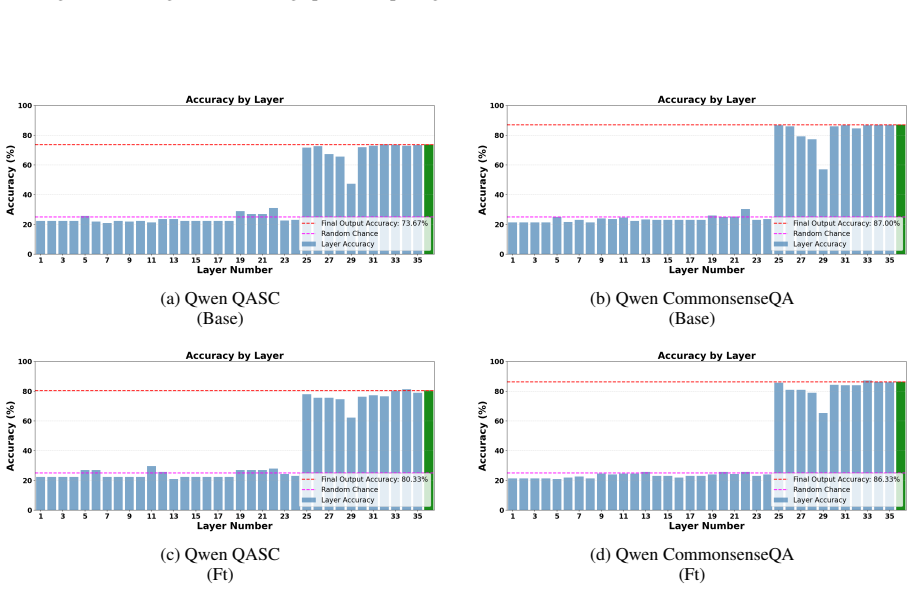
The paper's central claim is that there exists a natural, static architectural property—the Hard Decision Layer—at which a transformer's ordering of answer options abruptly stabilizes to its final ranking. The authors define HDL precisely as the layer causing the steepest drop in the average rank of the token that will ultimately be chosen (Eq. 8), measure it with the standard logit-lens projection (applying the final layer norm and unembedding at each layer) across four recent instruction-tuned models on four multiple-choice benchmarks, and find the layer fixed per model at 56–80% depth, with accuracy jumping from roughly chance to near-final at that layer. They then show the HDL position i
What carries the argument
The Hard Decision Layer (HDL): the layer where the average rank of the eventual answer token drops most steeply, formally ℓHDL = argmaxℓ [rankℓ(1) − rankℓ−1(1)]. It is measured by the logit-lens procedure: at every layer, the paper applies the final layer norm and the final unembedding matrix to the residual stream and ranks the four option tokens. The HDL is the object that carries the argument: it turns the vague idea of 'where the model commits' into a single computable layer, and the paper's claims—invariance to fine-tuning, robustness to option count, label-format sensitivity—are all statements about this layer's position and sharpness.
Load-bearing premise
The whole phenomenon is measured by reading intermediate layers with the final unembedding head (the logit lens), which assumes those states are faithfully interpretable as predictions; if mid-layer states are not readable by that head, the chance-level pre-HDL accuracy and the abrupt jump would be a projection artifact rather than a genuine commitment.
What would settle it
Train a tuned or learned linear probe per layer to predict the answer from residual states; if the abrupt jump to near-final accuracy disappears or shifts, the logit-lens reading is an artifact. Alternatively, causally prune or zero out all layers after the HDL and measure accuracy on the same multiple-choice sets—if accuracy drops by more than a few points, the model was not actually committed at the HDL.
If this is right
- For multiple-choice workloads, layers after the HDL can be pruned with little accuracy loss; the paper measures up to 43.75% layer savings for Llama.
- Because the HDL is fixed per model and dataset, it provides a concrete depth at which to inject or read interventions for steering model answers.
- The inverse relation between model size and HDL depth implies larger models reach commitment proportionally earlier, which could guide model selection for latency-sensitive inference.
- Label-format sensitivity means prompt design—alphabetic or numeric labels versus roman numerals—directly changes how early and how sharply a model commits.
- The weaker but present stabilization in open-ended generation suggests 'committed inference' may be a general property, not just an MCQA artifact.
Where Pith is reading between the lines
- If the HDL survives full-parameter fine-tuning (the paper only tests low-rank adaptation), it would suggest the commitment layer is an emergent pretraining invariant rather than a task-specific adapter behavior—worth testing.
- The chance-level pre-HDL accuracy is exactly the signature of a logit-lens artifact; a tuned lens or per-layer probe could test whether the model genuinely lacks the answer before the HDL or merely cannot express it through the final unembedding head.
- The pruning headroom measured on MCQA likely does not transfer to open-ended generation, because post-HDL layers may be responsible for fluency and multi-token coherence; the paper's own open-ended plots show a less pronounced HDL.
- A natural next experiment: ablate or rerandomize post-HDL layers and measure answer flip rates—if flipping is near zero, the commitment claim is mechanically confirmed; if not, the HDL is a reading artifact.
Editorial analysis
A structured set of objections, weighed in public.
Referee Report
Summary. The paper introduces the 'Hard Decision Layer' (HDL), defined as the transformer layer at which the average rank of the token that will ultimately be the model's multiple-choice answer undergoes its largest single-layer drop (Eq. 8). Using the logit lens—projecting every intermediate residual stream through the final layer norm and unembedding matrix (Eqs. 2–3)—the authors report that, across four instruction-tuned models and four MCQA datasets, answer-option rankings stabilize abruptly at a fixed layer per model, pre-HDL accuracy hovers near chance, and post-HDL accuracy is close to final-layer accuracy. They further claim that the HDL is invariant to LoRA fine-tuning and to option-count variations, and that the phenomenon is a natural architectural property enabling post-HDL layer pruning. The paper includes descriptive tables, appendix figures, and a public code repository.
Significance. If the HDL were a genuine internal commitment point, it would be a practically useful finding: it would localize decision-making in the network, provide a target for interpretability and steering, and suggest that late layers are prunable. The paper's strengths are its broad empirical sweep (4 models × 4 datasets), its explicit operationalization, and the availability of code. However, the central claim rests entirely on logit-lens measurements, a technique known to produce poorly calibrated mid-layer predictions. The pre-HDL chance-level accuracy is precisely the pattern expected from a readout artifact, and the paper provides no validation (e.g., tuned lens, probe, or causal intervention) that the rankings reflect the model's actual internal commitments. A second issue is circularity: the HDL is selected as the layer of maximum rank drop, and the accuracy spike at that same layer is then reported as a finding. These measurement and selection issues undermine the architectural and pruning conclusions as currently stated.
major comments (4)
- [§3.1.1, Eqs. (2)–(3); §4, Finding 1] The entire phenomenon is measured with the logit lens: every intermediate representation is projected through LN_final and W_U. It is well documented that mid-layer logit-lens predictions are poorly calibrated (Belrose et al., 2023; the tuned lens exists for this reason). The paper's signature result—pre-HDL accuracy at ≈25% (chance) followed by an abrupt jump at one layer—is exactly the expected signature of a layer at which residual states become linearly readable by the final unembedding head, not necessarily evidence that the model internally commits there. The claim 'the model essentially selects its answer, for most questions, at the HDL' (Section 4, Finding 1) and the pruning recommendation in Section 5 require independent validation. I request a tuned-lens replication, a probe-based check, or a causal test (e.g., ablating or replacing post-HDL layers) to show that the 'HDL' is a
- [§3.1.3, Eq. (8); Table 1] The definition of the HDL creates a circularity for the accuracy-spike claim. Eq. (8) selects the layer ℓ with the maximum drop in the average rank of the final predicted answer token. Table 1 then reports 'Accuracy (Post-HDL)' at that same selected layer and contrasts it with the average of all earlier layers. If the rank of the correct answer collapses abruptly at ℓ, the accuracy at ℓ is almost mechanically high relative to the pre-HDL average, which includes many layers before the drop. The 'striking accuracy improvements' are therefore largely by construction. To support the claim, the authors should compare the observed accuracy jump to a null distribution (e.g., layers chosen at random, or the layer of the second-largest rank drop), and should report accuracy at the layer immediately before the HDL as well as the average over a window before it.
- [Table 3; §4, Finding 2] The claim that the 'HDL is invariant to fine-tuning' is directly contradicted by the paper's own data. In Table 3, Llama on SuperGPQA has base HDL=23 and finetuned HDL=18—a shift of 5 layers. This is not a small effect relative to the 32-layer model. The text in Finding 2 states 'the HDL itself does not shift across base and finetuned variants', which is false for that row. The authors must either correct the claim, report a quantified summary (e.g., mean and max shift across all 8 (model, dataset) pairs), or explain why SuperGPQA is an exception. As written, the invariance result is overstated and the reader cannot assess its reliability.
- [§5, Discussion: pruning] The claim that 'layers beyond the HDL can be pruned without sacrificing performance on multiple-choice tasks' and the specific 'up to 43.75% of layers' figure are not supported by any pruning or ablation experiment. The evidence is only that post-HDL logit-lens accuracy is sometimes close to final accuracy; however, Table 1 shows nontrivial gaps in several rows (e.g., Llama QASC: 0.59 vs 0.74; Granite QASC: 0.51 vs 0.67) and a negative gap in another (Llama SuperGPQA: 0.41 vs 0.32). The paper should either remove the pruning claims or add actual layer-removal experiments that measure end-to-end accuracy after dropping layers past the HDL.
minor comments (4)
- [§4, Finding 1] The sentence 'Citing a specific example of one dataset and model' is a typo; 'Citing' should be 'As a' or 'Consider'. Also, the claim that pre-HDL accuracy 'hovers around 25%' would benefit from standard deviations or confidence intervals across the 100-question samples.
- [§3.1.3, Eq. (8)] The notation rank_ℓ(1) is used to mean two things: the rank of the answer option that has output rank 1 at the final layer, and later in the same paragraph as the average rank. Please clarify the difference between the token-level rank and the dataset-average rank, and denote them distinctly (e.g., r_ℓ(v*) vs. R̄_ℓ(1)).
- [§3.2.3 and Appendix B] The fine-tuning section says the LoRA adapter uses 'the Tinker library', but no citation or URL is given. Please provide a reference or details of the implementation so the results are reproducible.
- [Appendix F, Figure 14] The open-ended generation plots are described only briefly. It is unclear how the 'blank' tokens not in the top-10 at intermediate layers are treated in the average ranking, and whether the 'top-1 token stabilizes' observation is quantified anywhere. Please clarify the method or remove the speculative claim.
Circularity Check
The HDL is defined as the layer of maximum rank drop, and the paper then reports the accuracy spike at exactly that layer as an independent discovery; the spike is partly a restatement of the selection rule. Some empirical content (pre-HDL chance accuracy, cross-dataset stability) remains, so the circularity is partial.
specific steps
-
self definitional
[§3.1.3, Eq. (8); Table 1; Finding 1 (§4)]
"HDL is formally defined as the layer where the largest decrease in average rank occurs: ℓHDL = arg max_{ℓ∈{1,...,L}} (rank_ℓ(1) − rank_{ℓ−1}(1)). ... 'The HDL Layer (Predicted) is predicted as the layer that causes the largest drop in Option 1’s average rank.' (Table 1 caption); 'Table 1 also demonstrates a sharp jump in the accuracy of intermediate layer outputs at the HDL.'"
The 'hard decision layer' is not an independently located commitment point; it is the argmax of the average-rank-drop series. Reporting Option-1 Rank (Pre-HDL) vs (Post-HDL) and Accuracy (Pre-HDL) vs (Post-HDL) around exactly that argmax, then citing the resulting 'sharp jump' as evidence of commitment, restates the selection rule in accuracy language. Because any rank sequence has an argmax, the existence of some HDL and a locally maximal drop are guaranteed by Eq. (8); only the jump's magnitude and the stability of the chosen layer across datasets/fine-tuning are genuinely empirical.
-
fitted input called prediction
[Table 1 caption; Table 3 caption; §3.1.3]
"'The HDL Layer (Predicted) is predicted as the layer that causes the largest drop in Option 1’s average rank.' Accuracy columns are 'mean accuracies of the logit-lens projection at layers before the predicted HDL, at and after the predicted HDL.'"
The 'predicted' HDL is estimated on the same 100-question sample that is then used to compute Accuracy(Pre-HDL) and Accuracy(Post-HDL); no held-out split or cross-validation is described. Calling the in-sample argmax a 'prediction' and measuring the accuracy gain around it on that same sample makes the table's reported jump a fitted summary rather than an out-of-sample forecast, inflating the gain by construction.
full rationale
The central constructional issue is in §3.1.3. Eq. (8) chooses the HDL as the layer with the largest one-layer drop in the average rank of the final predicted answer token. Table 1 then labels that chosen layer 'HDL Layer (Predicted)' and reports Accuracy(Pre-HDL) vs Accuracy(Post-HDL) around it, and Finding 1 reads the resulting spike as evidence of an abrupt internal commitment. The rank collapse at the HDL is definitional; the adjacent accuracy spike is the same selection rule viewed through a highly correlated metric (the final predicted answer is the correct answer for most questions). I therefore score this as partial circularity, not total: the magnitude of the jump is data-dependent, and the paper contains independent empirical content in the chance-level pre-HDL accuracy, the stability of the chosen layer across datasets, and some fine-tuning comparisons. I do not count the logit-lens readout (§3.1.1, Eqs. 2–3) as circularity; it is a validity threat about whether intermediate residual states represent true preferences, but it is an assumption about measurement, not a reduction of the result to its inputs. Separately flagged as support gap rather than circularity: Finding 2 claims fine-tuning invariance, but the paper's own Table 3 shows Llama/SuperGPQA HDL moving from 23 in the base model to 18 after fine-tuning, so that claim is not fully supported by the presented data.
Axiom & Free-Parameter Ledger
free parameters (3)
- HDL layer location per (model, dataset) =
Qwen 25; Llama 18 (23 on SuperGPQA); Granite 32 (33 on SuperGPQA); Mistral 20
- Pre/Post-HDL averaging windows =
Pre = mean over all layers < HDL; Post = mean over all layers ≥ HDL
- Option-set resampling for >4-option datasets =
4 random options per question, correct answer retained
axioms (4)
- domain assumption Logit lens (final-layer LN + unembedding applied to every intermediate residual state) faithfully reveals the model's commitment at each layer
- domain assumption The single 100-question sample per (model, dataset) is representative, and the arg-max HDL location is stable under sampling noise
- domain assumption Four instruction-tuned decoder-only models (2B-8B) license the conclusion that the HDL is 'fundamental to model architecture' and not a training artifact
- domain assumption Answer labels A/B/C/D are single tokens, and surface-form variants such as 'b', 'second', 'B)' can be ignored
invented entities (1)
-
Hard Decision Layer (HDL)
no independent evidence
Cite this review
Pith. "Pith review of The Hard Decision Layer: Evidence for Committed Inference in Transformers." pith.science (2026). https://pith.science/paper/AFVTO7CE
@misc{pith2026260721613,
  author       = {Pith},
  title        = {Pith review of: The Hard Decision Layer: Evidence for Committed Inference in Transformers},
  year         = {2026},
  howpublished = {\url{https://pith.science/paper/AFVTO7CE}},
  note         = {Machine review of arXiv:2607.21613}
}
read the original abstract
We investigate where and how transformer-based language models commit to predictions in multiple-choice question answering. We identify the _Hard Decision Layer_ (HDL), a natural architectural property where answer option rankings stabilize abruptly during inference. Empirical validation across four language models (Qwen, Llama, Granite, Mistral) and four benchmark datasets demonstrates consistent HDL emergence without learned routing policies. We also show that the HDL is invariant to fine-tuning. Our results reveal striking accuracy improvements at the HDL: up to +0.61 (Qwen on CommonsenseQA), after which performance stabilizes. Systematic ablations on label formats and problem complexity confirm the phenomenon is fundamental to model architecture. These findings offer mechanistic insights into transformer inference and suggest opportunities for efficient reasoning and model steering. All code and results required to reproduce this work are available in https://github.com/Mystic-Slice/hard-decision-layer
Figures




Reference graph
Works this paper leans on
-
[1]
, note =
nostalgebraist , title =. , note =
-
[2]
, author=
Lora: Low-rank adaptation of large language models. , author=. Iclr , volume=
-
[3]
arXiv preprint arXiv:2510.18871 , year=
How Do LLMs Use Their Depth? , author=. arXiv preprint arXiv:2510.18871 , year=
-
[4]
Scalable training of
Andrew, Galen and Gao, Jianfeng , booktitle=. Scalable training of
-
[5]
Tetreault , title =
Mohammad Sadegh Rasooli and Joel R. Tetreault , title =. Computing Research Repository , volume =. 2015 , url =
2015
-
[6]
Tom B. Brown and Benjamin Mann and Nick Ryder and Melanie Subbiah and Jared Kaplan and Prafulla Dhariwal and Arvind Neelakantan and Pranav Shyam and Girish Sastry and Amanda Askell and Sandhini Agarwal and Ariel Herbert-Voss and Gretchen Krueger and Tom Henighan and Rewon Child and Aditya Ramesh and Daniel M. Ziegler and Jeffrey Wu and Clemens Winter and ...
-
[7]
Zhao and Eric Wallace and Shi Feng and Dan Klein and Sameer Singh , title =
Tony Z. Zhao and Eric Wallace and Shi Feng and Dan Klein and Sameer Singh , title =. Proceedings of the 38th International Conference on Machine Learning (. 2021 , url =
2021
-
[8]
The Twelfth International Conference on Learning Representations (
Han Zhou and Xingchen Wan and Lev Proleev and Diana Mincu and Jilin Chen and Katherine Heller and Subhrajit Roy , title =. The Twelfth International Conference on Learning Representations (. 2024 , url =
2024
-
[9]
A Framework for Learning Predictive Structures from Multiple Tasks and Unlabeled Data , Volume =
Ando, Rie Kubota and Zhang, Tong , Issn =. A Framework for Learning Predictive Structures from Multiple Tasks and Unlabeled Data , Volume =. Journal of Machine Learning Research , Month = dec, Numpages =
-
[10]
Transformer Circuits Thread , year =
A Mathematical Framework for Transformer Circuits , author =. Transformer Circuits Thread , year =
-
[11]
2022 , howpublished =
In-context learning and induction heads , author =. 2022 , howpublished =
2022
-
[12]
Proceedings of the 57th Annual Meeting of the Association for Computational Linguistics , pages =
BERT Rediscovers the Classical NLP Pipeline , author =. Proceedings of the 57th Annual Meeting of the Association for Computational Linguistics , pages =
-
[13]
Proceedings of the 2019 Conference of the North American Chapter of the Association for Computational Linguistics: Human Language Technologies , pages =
A structural probe for finding syntax in word representations , author =. Proceedings of the 2019 Conference of the North American Chapter of the Association for Computational Linguistics: Human Language Technologies , pages =
2019
-
[14]
Proceedings of the IEEE/CVF Conference on Computer Vision and Pattern Recognition , pages =
On the intrinsic dimensionality of image representations , author =. Proceedings of the IEEE/CVF Conference on Computer Vision and Pattern Recognition , pages =
-
[15]
Thirty-seventh Conference on Neural Information Processing Systems , year =
The geometry of hidden representations of large transformer models , author =. Thirty-seventh Conference on Neural Information Processing Systems , year =
-
[16]
The Thirteenth International Conference on Learning Representations , year =
Emergence of a high-dimensional abstraction phase in language transformers , author =. The Thirteenth International Conference on Learning Representations , year =
-
[17]
LessWrong , year=
interpreting GPT: the logit lens , author=. LessWrong , year=
-
[18]
Proceedings of the 17th Conference of the European Chapter of the Association for Computational Linguistics , pages=
Understanding transformer memorization recall through idioms , author=. Proceedings of the 17th Conference of the European Chapter of the Association for Computational Linguistics , pages=
-
[19]
Proceedings of the 61st Annual Meeting of the Association for Computational Linguistics , pages =
Analyzing transformers in embedding space , author =. Proceedings of the 61st Annual Meeting of the Association for Computational Linguistics , pages =
-
[20]
Proceedings of the 2021 Conference on Empirical Methods in Natural Language Processing , pages=
Transformer feed-forward layers are key-value memories , author=. Proceedings of the 2021 Conference on Empirical Methods in Natural Language Processing , pages=
2021
-
[21]
Advances in Neural Information Processing Systems , volume =
Locating and editing factual associations in GPT , author =. Advances in Neural Information Processing Systems , volume =
-
[22]
Proceedings of the 2024 Joint International Conference on Computational Linguistics, Language Resources and Evaluation (LREC-COLING 2024) , pages=
Jump to conclusions: Short-cutting transformers with linear transformations , author=. Proceedings of the 2024 Joint International Conference on Computational Linguistics, Language Resources and Evaluation (LREC-COLING 2024) , pages=
2024
-
[23]
arXiv preprint arXiv:2303.08112 , year=
Eliciting latent predictions from transformers with the tuned lens , author=. arXiv preprint arXiv:2303.08112 , year=
-
[24]
Extended Abstracts of the 2023 CHI Conference on Human Factors in Computing Systems , pages=
Edu-larp@ CHI , author=. Extended Abstracts of the 2023 CHI Conference on Human Factors in Computing Systems , pages=
2023
-
[25]
International Conference on Learning Representations , year =
Answer, assemble, ace: Understanding how transformers answer multiple choice questions , author =. International Conference on Learning Representations , year =
-
[26]
arXiv preprint arXiv:2403.02181 , year=
Not all layers of llms are necessary during inference , author=. arXiv preprint arXiv:2403.02181 , year=
-
[27]
Proceedings of the 2022 conference on empirical methods in natural language processing , pages=
Transformer feed-forward layers build predictions by promoting concepts in the vocabulary space , author=. Proceedings of the 2022 conference on empirical methods in natural language processing , pages=
2022
-
[28]
arXiv preprint arXiv:2410.20210 , year=
Looking beyond the top-1: Transformers determine top tokens in order , author=. arXiv preprint arXiv:2410.20210 , year=
-
[29]
2024 , howpublished =
Mechanistic interpretability for AI safety: A review , author =. 2024 , howpublished =
2024
-
[30]
arXiv preprint arXiv:2009.03300 , year =
Measuring massive multitask language understanding , author =. arXiv preprint arXiv:2009.03300 , year =
Pith/arXiv arXiv 2009
-
[31]
ArXiv , year=
Mistral 7B , author=. ArXiv , year=
-
[32]
arXiv preprint arXiv:2407.21783 , year=
The llama 3 herd of models , author=. arXiv preprint arXiv:2407.21783 , year=
-
[33]
2024 , howpublished =
Granite: Advancing LLMs with Advanced Architectures and Optimization , author =. 2024 , howpublished =
2024
-
[34]
arXiv preprint arXiv:2110.14168 , year=
Training Verifiers to Solve Math Word Problems , author=. arXiv preprint arXiv:2110.14168 , year=
-
[35]
arXiv preprint arXiv:2505.09388 , year=
Qwen3 technical report , author=. arXiv preprint arXiv:2505.09388 , year=
-
[36]
C ommonsense QA : A Question Answering Challenge Targeting Commonsense Knowledge
Talmor, Alon and Herzig, Jonathan and Lourie, Nicholas and Berant, Jonathan. C ommonsense QA : A Question Answering Challenge Targeting Commonsense Knowledge. Proceedings of the 2019 Conference of the North A merican Chapter of the Association for Computational Linguistics: Human Language Technologies, Volume 1 (Long and Short Papers). 2019. doi:10.18653/...
Pith/arXiv arXiv 2019
-
[37]
Tushar Khot and Peter Clark and Michal Guerquin and Peter Jansen and Ashish Sabharwal , title =. arXiv:1910.11473v2 , year =
Pith/arXiv arXiv 1910
-
[38]
Advances in Neural Information Processing Systems , volume=
Mmlu-pro: A more robust and challenging multi-task language understanding benchmark , author=. Advances in Neural Information Processing Systems , volume=
-
[39]
arXiv preprint arXiv:2502.14739 , year=
Supergpqa: Scaling llm evaluation across 285 graduate disciplines , author=. arXiv preprint arXiv:2502.14739 , year=
discussion (0)
Sign in with ORCID, Apple, or X to comment. Anyone can read and Pith papers without signing in.