REVIEW 2 major objections 5 minor 12 references
Ordered Action Tokens for Visuomotor Policy Learning
T0 review · 2 major / 5 minor · reviewed 2026-08-01 · deepseek-v4-flash
Pith's one-line read A learned tokenizer lets robot policies stop at any token prefix and still execute a valid action.
desk verdict OAT gives the field a genuinely useful ordered action tokenizer with a broad experimental sweep, but the VLM-scale 'plan-like first token' story lacks a matched ablation and the novelty claim needs an explicit new-vs-prior split. read the letter →
The pith
A machine-rendered reading of the paper's core claim, the machinery that carries it, and where it could break.
The reading
What carries the argument
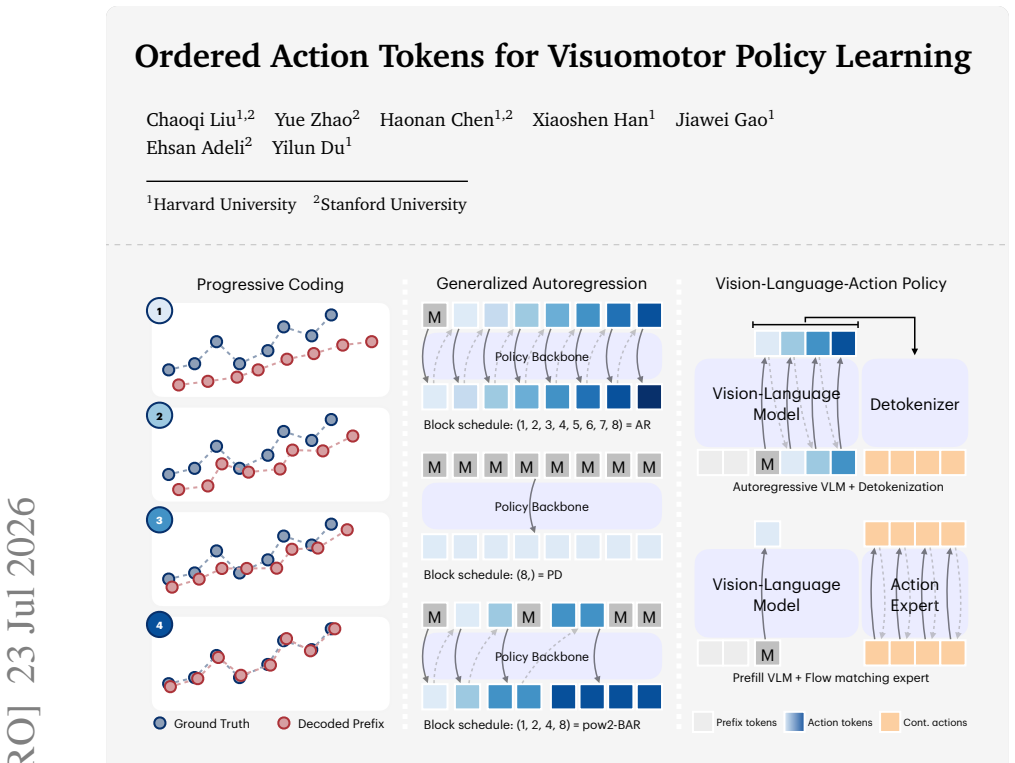
The central object is the OAT tokenizer itself: a learned discrete autoencoder with register tokens for compression, finite scalar quantization for the discrete bottleneck, and nested dropout for ordered prefix training. The ordering emerges from the interaction of two mechanisms: survival-weighted reconstruction budgets, which assign higher weight to earlier tokens, and the register self-attention mask, which controls whether tokens introduced at the same budget form a serial chain (token-wise mask) or an independent block (power-of-two mask). The power-of-two mask is what makes block autoregressive decoding work at reduced depth while preserving progressive decoding quality.
What would settle it
Remove nested dropout from OAT while keeping architecture and budgets fixed, and evaluate closed-loop success in the vision-language autoregressive and token co-training settings; if success does not fall meaningfully relative to full OAT, then the ordered-prefix mechanism is not the cause of the reported gains.
Extended reading notes
Core claim
OAT is presented as the first action tokenizer satisfying three interface desiderata simultaneously: high compression, total decodability, and an ordered token space. The tokenizer is an autoencoder — a transformer encoder with learnable registers compresses an action chunk into register states, finite scalar quantization turns each state into a discrete token, and a cross-attention decoder reconstructs the action chunk from any prefix of the token sequence with the suffix replaced by learned masks. Nested dropout during training samples the prefix budget, forcing early tokens to support full-chunk reconstruction and later tokens to supply residual detail. Two register attention masks instan
Load-bearing premise
The ordering induced by nested dropout is the actual driver of the downstream policy gains, not only in the lightweight autoregressive setting where it is ablated, but also in the vision-language and token co-training settings, where the paper does not isolate the ordering factor.
Editorial extensions
If this is right
- A single OAT tokenizer can serve both low-cost and high-fidelity control: any prefix decodes to an executable action chunk, so a policy can stop after one token for a quick sketch or continue to the full sequence for a refined motion.
- In autoregressive policies, increasing the token budget improves success, and the power-of-two schedule matches token-wise generation with far fewer policy calls (5 instead of 16 at full budget in the evaluated backbone).
- In token co-training, the tokenizer choice matters even though tokens are never decoded at inference; the first-token target imposes a chunk-summary objective on the VLM representation that conditions the action expert.
- Removing nested dropout (and hence the ordering) degrades policy success in the lightweight setting, so compact latent capacity alone is insufficient; the ordered prefix objective itself is what helps next-token prediction.
- Grouped generation only pays off when the tokenizer's register dependencies match the generation blocks: applying power-of-two schedules post hoc to a causally ordered tokenizer drops success, while the matched tokenizer keeps it.
Reading between the lines
- If the ordering is the driver, the same prefix-training recipe should transfer to other continuous sequence interfaces (motion plans, video frames, low-level control streams) wherever a coarse-to-fine discrete representation is wanted; this is a direct but unstated extension.
- The anytime property invites an adaptive-computation policy that decides online whether to request another token block based on predicted difficulty or uncertainty — the paper lists this as future work, but the representation makes it a concrete, testable controller.
- A sharper test of the plan-like supervision story would be to correlate the VLM's first-token cross-entropy with the flow expert's downstream action error; if they track each other, the chunk-summary objective is genuinely shaping the representation.
- The power-of-two block mask, which removes within-block serial dependence, suggests OAT tokens may also be compatible with masked-prediction or non-autoregressive policy heads, not only the AR and TC interfaces evaluated.
Editorial analysis
A structured set of objections, weighed in public.
Referee Report
Summary. The paper proposes Ordered Action Tokenization (OAT), a learned action tokenizer that combines transformer registers, finite scalar quantization, and nested dropout to produce token sequences whose prefixes decode into valid action chunks. The authors formalize three desiderata for action tokenization — high compression, total decodability, and ordered structure — and introduce block autoregressive decoding (BAR) as a way to trade off policy-call depth against parallel prediction. OAT is evaluated in two policy roles: autoregressive (AR) policies that generate and detokenize action tokens, and token co-training (TC) policies in which token losses supervise a VLM while a flow-matching expert produces continuous actions from detached VLM context. Experiments span lightweight Transformer policies, two VLM backbones, five simulation benchmarks, and real-world rollouts, comparing OAT against Bin, FAST, QueST, and ACodec. The central claims are that OAT improves closed-loop policy performance and that the learned token ordering, especially the first-token chunk-summary objective, is responsible for the gains in both AR and TC settings.
Significance. If the ordering claim is sustained, OAT is a practically useful action tokenizer: the same token sequence supports both cheap coarse control and expensive fine control, and the first-token objective provides a plausible mechanism for supervising VLM representations in token co-training. The paper has notable strengths: broad benchmark coverage, two VLM backbones, real-world rollouts, a rate–distortion diagnostic, and a matched lightweight ordering ablation (Fig. 10) that directly tests the ordering mechanism against a no-nested-dropout control. The released code and explicit protocol details are also valuable. However, the load-bearing gap is that the ordering mechanism is not isolated in the VLM/TC setting: the only nested-dropout ablation is in the lightweight Transformer AR regime, while the TC comparisons vary entire tokenizer families and therefore cannot identify the first-token summary objective as the cause of the observed gains. The central tokenizer design is sound, but the paper currently overstates the mechanistic support for its VLM-scale conclusions.
major comments (2)
- [§5.2, §6.4.1, Fig. 9–10] The paper's mechanistic explanation for the token co-training results is not isolated. §6.4.1 removes nested dropout only in the lightweight Transformer AR policy (Fig. 10); no equivalent ablation is run in the VLM/TC setting of §5.2. Fig. 9 compares OAT to Bin, FAST, QueST, and ACodec, which differ not only in ordering but also in compression, codebook size, token horizon, and detokenizer structure. Thus the observed TC gains do not specifically support the claim that the first-token chunk-summary objective in Eq. (5.1) is responsible. A matched ablation (OAT with nested dropout disabled under TC, or a tokenizer with the same architecture but no prefix training) is needed to support the 'plan-like first-token' claim; otherwise the conclusion in §6.3.3 should be tempered to 'tokenizer choice matters' rather than attributing the gain to ordering.
- [§6.3, Appendix C.1, Figs. 8–9, Table 10] All closed-loop success rates are point estimates with 50 episodes per task (20 for real-world), and no confidence intervals or significance tests are reported. Many comparisons used to support the central claims are small relative to this noise: e.g., PaliGemma2 TC average success 59.0 (OAT) vs 59.4 (QueST); SimplerEnv OAT 34.0 vs QueST 33.0; Qwen3VL AR OATsing8 50.5 vs OATpow2 8 50.2. The paper itself says it treats small gaps as ties, but later uses average ranks and 'supports Sec. 5.2' language. Please provide uncertainty quantification or restrict conclusions to differences that survive it.
minor comments (5)
- [Fig. 1 and general text] Several figure labels and display strings are garbled ('Preaix', 'Generflized Autoregression', 'Vision-Lfngufge', '/g♀beWebsite'). These should be cleaned before publication.
- [§3.2, Table 1, Ref. [47]] The row 'OATsing [47]' cites an earlier 'OAT' paper by overlapping authors without explaining the relation. If this manuscript extends [47], the novelty should be stated explicitly; if the citation is to the authors' own prior work, this should be disclosed and the differences clarified.
- [Appendix C.1, Table 5] FAST decoding is described as 'strict decoding' in the lightweight comparison (Table 5) but as nonstrict in simulated rollouts elsewhere in the appendix. Please clarify which protocol applies to which experiment.
- [Eq. (5.1), Appendix B] The notation \(\tilde a^\tau\) is used in Eq. (5.1) but only defined in Appendix B. Define it in the main text or defer the notation to first use.
- [Table 6 caption] The caption contains a stray citation marker 'vary[51]' that appears to be a formatting artifact.
Circularity Check
No significant circularity: the ordering is induced by design but validated by a matched ablation and external baselines; the TC mechanism gap is an evidence question, not circularity.
full rationale
The paper's central derivation is self-contained rather than circular. OAT's ordered-prefix property is induced by nested dropout, so the rate-distortion curves in Fig. 7 partly restate the training objective; however, the paper does not present those curves as a novel prediction. The load-bearing claim that the learned ordering helps downstream control is tested by an ablation (Fig. 10) that removes nested dropout while fixing the tokenizer architecture and policy interface, and by closed-loop comparisons against external tokenizers (Bin, FAST, QueST, ACodec) in both lightweight and VLM-scale settings. The Sec. 5.2 'plan-like first-token objective' is an analytic description of the first token's training target, not a derived empirical result; the TC experiments compare full tokenizer families and therefore do not isolate the mechanism, but that is a support gap, not circularity. Self-citations (e.g., [47]) point to prior versions of OAT but no load-bearing theorem or uniqueness argument is imported from them. No step reduces an output to an input by construction.
Assumptions & free parameters
free parameters (4)
- Token horizon H_l =
8 (lightweight), 16 (VLM)
- Reconstruction budget set K =
{1,2,4,...,H_l}
- FSQ levels =
[8,8,6,5] = 1920 codes
- TC loss weight lambda =
1.0
assumptions (4)
- domain assumption Minimizing nested-dropout reconstruction at prefix budgets transfers to better policy learning.
- standard math Finite scalar quantization with straight-through or equivalent gradient flow provides a usable discrete bottleneck.
- domain assumption Action chunks with receding-horizon execution are a sufficient control interface.
- domain assumption Detached VLM KV cache preserves useful context while insulating VLM knowledge from the flow loss.
Cite this review
Pith. "Pith review of Ordered Action Tokens for Visuomotor Policy Learning." pith.science (2026). https://pith.science/paper/NJ3Y6NS7
@misc{pith2026260721670,
  author       = {Pith},
  title        = {Pith review of: Ordered Action Tokens for Visuomotor Policy Learning},
  year         = {2026},
  howpublished = {\url{https://pith.science/paper/NJ3Y6NS7}},
  note         = {Machine review of arXiv:2607.21670}
}
read the original abstract
Action tokenization maps continuous robot action chunks to discrete tokens and has become an important interface for modern visuomotor policies. Existing approaches either rely on analytical discretization methods that produce prohibitively long token sequences or learned latent tokenizers that lack structure, limiting their compatibility with downstream policies. In this work, we identify three desiderata for action tokenization - high compression, total decodability, and an ordered token space - and introduce Ordered Action Tokenization (OAT), a learned action tokenizer that satisfies all three. OAT discretizes action chunks into an ordered sequence of tokens using a transformer with registers, finite scalar quantization, and ordering-inducing training mechanisms. By training each token prefix to decode into a valid action chunk, OAT places coarse control information in early tokens and uses later tokens to refine residual detail, yielding an anytime tradeoff between inference cost and action fidelity. We validate OAT in two prevailing uses of action tokens: autoregressive policies that generate tokens for control, and token co-training policies that use token losses to shape the vision-language model context consumed by a flow-based action expert. Across three policy backbones and more than 60 tasks spanning five simulation benchmarks and real-world settings, OAT consistently delivers strong policy performance while offering significantly greater flexibility at inference time.
Figures


Figures from the paper (9 more)


Reference graph
Works this paper leans on
-
[3]
18 [33]Jaeyeon Kim, Kulin Shah, Vasilis Kontonis, Sham M
doi: 10.15607/RSS.2024.XX.120. 18 [33]Jaeyeon Kim, Kulin Shah, Vasilis Kontonis, Sham M. Kakade, and Sitan Chen. Train for the worst, plan for the best: Understanding token ordering in masked diffusions. In Aarti Singh, Maryam Fazel, Daniel Hsu, Simon Lacoste-Julien, Felix Berkenkamp, Tegan Maharaj, Kiri Wagstaff, and Jerry Zhu, editors,Proceedings of the...
arXiv 2024
-
[4]
Uvim: A unified modeling approach for vision with learned guiding codes
2, 3, 18, 39, 41 [35]Alexander Kolesnikov, André Susano Pinto, Lucas Beyer, Xiaohua Zhai, Jeremiah Harmsen, and Neil Houlsby . Uvim: A unified modeling approach for vision with learned guiding codes. In S. Koyejo, S. Mohamed, A. Agarwal, D. Belgrave, K. Cho, and A. Oh, editors, Advances in Neural Information Processing Systems, volume 35, pages 26295–2630...
2022
-
[9]
11, 12 [54]Soroush Nasiriany , Sepehr Nasiriany , Abhiram Maddukuri, and Yuke Zhu
doi: 10.15607/RSS.2024.XX.050. 11, 12 [54]Soroush Nasiriany , Sepehr Nasiriany , Abhiram Maddukuri, and Yuke Zhu. RoboCasa365: A large-scale simulation framework for training and benchmarking generalist robots. In The Fourteenth International Conference on Learning Representations, 2026. URLhttps: //openreview.net/forum?id=tQJYKwc3n4. 11, 12 [55]NVIDIA, J...
arXiv 2024
-
[11]
URLhttps://arxiv.org/abs/2507.01925. 18 [80]Brianna Zitkovich, Tianhe Yu, Sichun Xu, Peng Xu, Ted Xiao, Fei Xia, Jialin Wu, Paul Wohlhart, Stefan Welker, Ayzaan Wahid, Quan Vuong, Vincent Vanhoucke, Huong Tran, Radu Soricut, Anikait Singh, Jaspiar Singh, Pierre Sermanet, Pannag R. Sanketi, Grecia Salazar, Michael S. Ryoo, Krista Reymann, Kanishka Rao, Kar...
arXiv 2023
-
[12]
uses its universal tokenizer with vocabulary size 2048.QueST(Mete et al., 2024) compresses action chunks with a temporal convolution with a downsampling factor of 2 before learned tok- enization.ACodec(Dong et al., 2026) uses learnable registers that cross-attend to the action chunk without attending to one another, forming a one-shot parallel decoding en...
-
[2017]
URLhttps://proceedings.neurips.cc/paper_files/paper/2017/hash/ 3f5ee243547dee91fbd053c1c4a845aa-Abstract.html. 6 [69]An Dinh Vuong, Minh Nhat Vu, Dong An, and Ian Reid. Action tokenizer matters in in-context imitation learning. In2025 IEEE/RSJ International Conference on Intelligent Robots and Systems (IROS), pages 13490–13496. IEEE, October 2025. doi: 10...
arXiv 2017
-
[2018]
Association for Computational Linguistics. doi: 10.18653/v1/D18-1149. URLhttps: //aclanthology.org/D18-1149/. 19, 34 [38]Seungjae Lee, Yibin Wang, Haritheja Etukuru, H. Jin Kim, Nur Muhammad Mahi Shafiullah, and Lerrel Pinto. Behavior generation with latent actions. InProceedings of the 41st Inter- national Conference on Machine Learning, volume 235 ofPro...
arXiv 2024
-
[2022]
7, 19 [37]Jason Lee, Elman Mansimov, and Kyunghyun Cho
URLhttps://proceedings.neurips.cc/paper_files/paper/2022/file/ c32319f4868da7613d78af9993100e42-Paper-Conference.pdf. 7, 19 [37]Jason Lee, Elman Mansimov, and Kyunghyun Cho. Deterministic non-autoregressive neu- ral sequence modeling by iterative refinement. In Ellen Riloff, David Chiang, Julia Hock- enmaier, and Jun’ichi Tsujii, editors,Proceedings of th...
2022
Show all 12 references
-
[2023]
URLhttps://proceedings.neurips.cc/paper_files/paper/2023/hash/ 8c3c666820ea055a77726d66fc7d447f-Abstract-Datasets_and_Benchmarks. html. 11, 12 [46]Chaoqi Liu, Haonan Chen, Sigmund H. Høeg, Shaoxiong Yao, Yunzhu Li, Kris Hauser, and Yilun Du. Flexible multitask learning with fa...
2023
-
[2024]
18 [29]Alex Graves
doi: 10.15607/RSS.2024.XX.090. 18 [29]Alex Graves. Adaptive computation time for recurrent neural networks, 2016. URLhttps: //arxiv.org/abs/1603.08983. 19 [30]Sigmund H. Høeg, Aksel Vaaler, Chaoqi Liu, Olav Egeland, and Yilun Du. Hybrid diffusion for simultaneous symbolic and ...
2024 arXiv
-
[2025]
18 [9]Yochai Blau and Tomer Michaeli
URLhttps://openreview.net/forum?id=UkR2zO5uww. 18 [9]Yochai Blau and Tomer Michaeli. Rethinking lossy compression: The rate-distortion-perception tradeoff. In Kamalika Chaudhuri and Ruslan Salakhutdinov, editors,Proceedings of the 36th International Conference on Machine Learn...
2019 arXiv
-
[3728]
URLhttps://proceedings.mlr.press/v270/li25c
PMLR, 06–09 Nov 2025. URLhttps://proceedings.mlr.press/v270/li25c. html. 11, 12 [43]Zhixuan Liang, Yizhuo Li, Tianshuo Yang, Chengyue Wu, Sitong Mao, Liuao Pei, Tian Nian, Shunbo Zhou, Xiaokang Yang, Jiangmiao Pang, Yao Mu, and Ping Luo. Discrete diffusion VLA: Bringing discre...
2025 arXiv
Reviewed August 1, 2026 · model on record in the stance chip above.
Discussion (0). Sign in to comment.