REVIEW 4 major objections 4 minor 104 references
This paper claims that for a charged black hole in Einstein-Maxwell theory with a non-minimal logarithmic coupling, a single parameter B controls the Hawking temperature, the Dirac ringdown spectrum, the photon sphere and shadow, the ISCO a
Reviewed by Pith at T0; open to challenge. T0 means a machine referee read the full paper against a public rubric. the ladder, T0–T4 →
T0 review · deepseek-v4-flash
2026-08-01 06:43 UTC pith:LUW4MX4T
load-bearing objection Broad, clearly written catalogue of standard observables for the ln(R)F² black hole, but the topological centerpiece is definitional and the WKB tables do not survive scrutiny. the 4 major comments →
Quantum-Corrected Thermodynamics, Dirac Perturbations, Geodesic Structure, and Topological Phases of Black Holes with Non-Minimal Logarithmic Coupling
The pith
A machine-rendered reading of the paper's core claim, the machinery that carries it, and where it could break.
Core claim
The central claim is that the logarithmic term in the metric function f(r) = 1 − 2M/r + (B Q²/r²) ln(r/r0) + Q²(1+5B)/(4r²) leaves a scale r0 in the geometry, and that this scale sets the near-horizon slope f'(r+), which is the surface gravity and therefore the temperature. Because the same slope deepens the effective potential well for null and timelike orbits and raises the barrier for Dirac perturbations, the photon sphere, the shadow radius, the ISCO, the QNM frequencies, the greybody factor, and the Hawking emission power all respond to the single parameter B in a correlated way. The paper further claims that the Barrow-entropy effective pressure PB and the radial component of the topol
What carries the argument
The central object is the logarithmic metric function f(r) = 1 − 2M/r + (B Q²/r²) ln(r/r0) + Q²(1+5B)/(4r²), with scale r0⁴ = B Q²/R0. The mechanism is that f'(r+) — the near-horizon slope of the lapse — simultaneously sets the surface gravity (temperature), the effective potential V+(r) for Dirac perturbations, the null effective potential V_ph(r) = f(r)/r², the timelike effective potential V_eff(r) = f(r)(1+L²/r²), and the topological vector field component φr = ∂F/∂r. The identity PB = φr/(4πr²) connects the thermodynamic pressure to the topological defect line.
Load-bearing premise
The entire suite of predictions rests on the imported claim that metric (12), taken from earlier work, is the stable, physically admissible static spherically symmetric solution of the ln(R)F² Einstein-Maxwell theory and that constraint (8) truly removes the higher-order derivative instabilities; if the background is not the physical spacetime of the model, all temperature, QNM, shadow, and phase results are computed on the wrong geometry.
What would settle it
Perform a full linear stability analysis of metric (12) within the ln(R)F² theory for B in [0.1, 1.0] and Q = 0.5. If any ghost or tachyon mode persists in this parameter range, the background is not a physical solution of the theory and the paper's observables do not apply. Alternatively, a time-domain solution of the Dirac equation at low multipoles that disagrees with the third-order WKB frequencies beyond a few percent would invalidate the spectral predictions, and a shadow measurement matching Schwarzschild to better than ~5% would disfavour B > 0.5.
If this is right
- A measurement of the shadow size at the few-percent level would constrain the upper range of the coupling B, since the shadow radius contracts by about eleven percent across B = 0.1 to 1.0.
- The 3:2 twin-peak QPO resonance radius moves inward as B grows, so a measured QPO pair combined with an independent mass estimate translates into a coupling band.
- The ringdown frequency and the shadow size both derive from the same photon sphere, so a joint fit of the two observables must yield a consistent B.
- The identity PB = φr/(4πr²) makes the sign of the effective pressure, local thermodynamic stability, and the winding number a single condition; the Barrow deformation shifts the defect location only mildly.
- The exponential extension of Barrow entropy preserves the equatorial defect count but can move the defect radius, so the qualitative stability picture survives the extension.
Where Pith is reading between the lines
- The paper's 'same slope' logic suggests that existing multi-messenger data—shadow size plus a ringdown frequency—could already be used to produce a joint probability distribution for B, rather than treating each observable separately.
- The identity PB = φr/(4πr²) may hold for a broader class of Barrow-deformed charged holes, and the paper's own request for a first-principles derivation hints that this is an open structural question, not a coincidence of this specific background.
- The rotating generalization is the natural next test: because the exact correlation relies on spherical symmetry, a Kerr-like extension might break the clean relation, and the shadow shape and QNM splitting would then separately constrain B.
- The non-monotonic quality factors across B and κ mean a single ringdown mode may be degenerate in B, but a multi-mode observation (e.g., two overtones) could break this degeneracy.
Editorial analysis
A structured set of objections, weighed in public.
Referee Report
Summary. The manuscript studies a static, spherically symmetric charged black hole in Einstein–Maxwell theory with a non-minimal ln(R)F² coupling, using the metric (12) imported from Ref. [4]. It derives a Hawking temperature from fermionic tunnelling, computes Dirac quasinormal-mode frequencies with third-order WKB, bounds the greybody factor and uses it in emission integrals, solves null and timelike geodesics to obtain shadow, ISCO, QPO, and deflection observables, and finally builds Barrow-entropy thermodynamics with a topological phase analysis. The advertised central claim, stated in Sec. XIV, is that the logarithmic coupling B coherently controls the thermal, radiative, orbital, and topological sectors, and that the effective pressure and the topological defect line are joined by the identity P_B = φ_r/(4πr²). All closed forms are said to be symbolically verified and the numerical pipelines are checked against Schwarzschild limits.
Significance. If the results were sound, the paper would provide a broad catalogue of correlated observables for a modified-gravity black hole and would add a novel pressure–topology relation. The geodesic, shadow, and deflection sections are internally plausible and include useful Schwarzschild-limit checks. However, the QNM tables are unphysical, the greybody lower bound is used as an exact transmission coefficient, and the topological identity is constructed rather than derived. Because these issues affect the paper's central claims, the current version cannot be accepted.
major comments (4)
- [§V, Tables II–VI] The third-order WKB frequencies are not credible. For fixed B and n, Re(ω) should increase with κ (in the eikonal limit Re ω ∼ κΩ_c, Eq. (55)). Instead, for B=0.1, n=0, Re(ω)=0.526, 0.470, 0.370 for κ=2,3,4, and for B=0.3, n=0 it jumps 1.088→0.266→1.204. The damping also varies erratically, e.g. −Im(ω)=0.169, 0.888, 0.244 at B=0.3, n=0. This contradicts the text's own statement that increasing κ raises the real part of the frequency. These tables cannot support the quality-factor analysis of Table VII or any conclusion about B-dependent ringdown; the WKB implementation must be redone and validated.
- [§VI and §XI B, Eqs. (47), (59)–(60)] Equation (47) is a strict lower bound, T_b(ω) ≤ T(ω). Equations (59)–(60) insert this lower bound as though it were the transmission coefficient in the Fermi–Dirac integrals, and Table XVIII and Fig. 10 report the result as the Hawking power and particle rate. Convolving a lower bound with the thermal factor gives, at best, a lower bound on the luminosity; the claimed ~16% decrease of P with B is therefore not established. The authors concede in Sec. XIII that the greybody results are 'strict lower bounds rather than exact transmission coefficients'; this caveat must be attached to Eqs. (59)–(60) and Table XVIII, not only to the discussion.
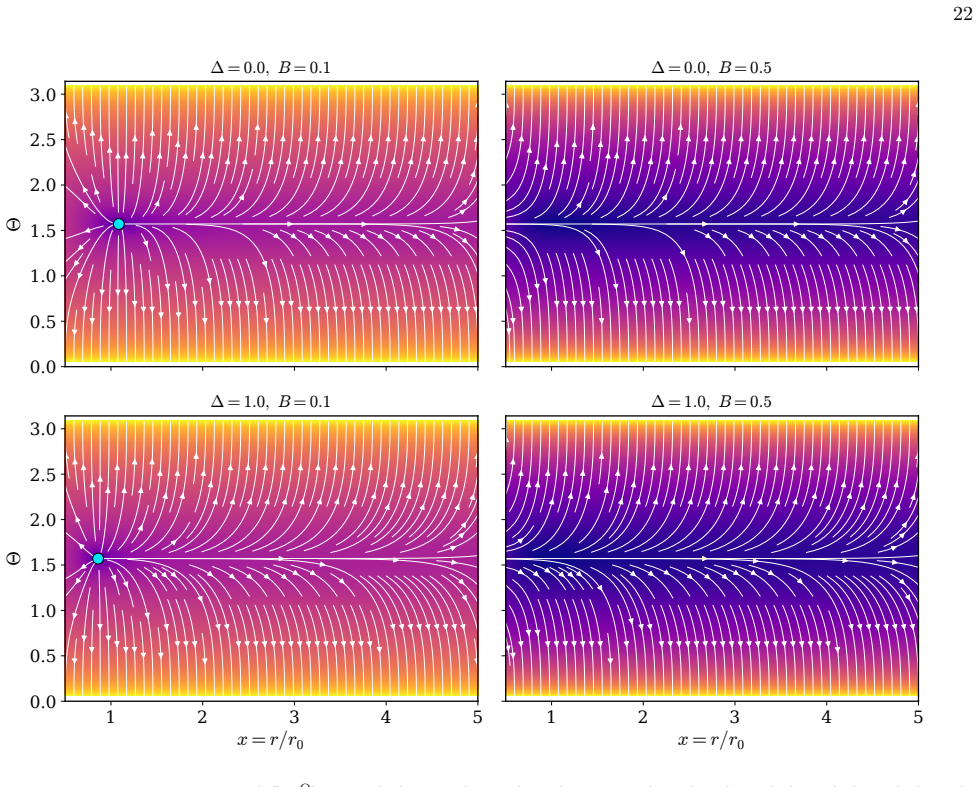
- [§XII B, Eqs. (71)–(73)] The radial component φ_r in Eq. (73) is not ∂F/∂r. With F=M−S_B/τ and S_B=(πr²)^{1+Δ/2}, the derivative contains −(2+Δ)π^{1+Δ/2} r^{1+Δ}/τ, a term absent from Eq. (73), which contains no τ and no π-dependent factor. Consequently the defect condition (74) is not the on-shell condition of the off-shell free energy of Eq. (71), and the winding numbers in Fig. 14 are not derived from the standard topological construction. The identity P_B=φ_r/(4πr²), Eq. (67), is then an algebraic coincidence: Eq. (73) was assembled to share the numerator of Eq. (66). Since this identity is the paper's 'tightest link', the central claim is circular rather than derived.
- [§II, Eq. (12)] Every subsequent calculation is performed on the metric Eq. (12), imported from Ref. [4], with the admissibility of the solution attributed to the constraint (8). The manuscript does not verify that the k=−2 solution with Y(R)=1/(1−B ln(R/R0)) satisfies the full field equations and constraint, nor does it address the stability of the background. If this metric is not the physical, stable solution of the theory, then the temperature, QNM, greybody, geodesic, and thermodynamic results are all computed on an inadmissible geometry. This premise should be checked explicitly, or stated clearly as an assumption, before the results can be accepted.
minor comments (4)
- [§V, Eq. (45)] The WKB quantization condition is written with Λ2 and Λ3 subtracted and with the prefactor i(ω²−V0)/√(−2V0''). Please check the sign conventions against Iyer–Will and Konoplya, since the tables suggest a possible misimplementation.
- [Fig. 3 inset and Fig. 10] The inset in Fig. 3 and the peak/tail insets in Fig. 10 lack readable axes and units. The caption mentions units of 10⁻³, but the plot bounds are not labeled; this makes the claimed B-ordering hard to verify.
- [Reference [27]] Reference [27] is incomplete: 'Class. Quantum Grav. 34, 063001 (2017)' has no authors. Please supply the full citation.
- [Sec. XIII] The caveat that the background is static and spherically symmetric and that the greybody factor is only bounded is placed at the end of the paper. These limitations should be stated in the introduction and repeated where the quantities are first used.
Circularity Check
The headline identity P_B = φ_r/(4πr²) is constructed: Eq. (66) defines P_B with the same numerator as the defect condition (74), and the 'φ_r' of Eq. (73) is not ∂F/∂r of the off-shell free energy (71).
specific steps
-
self definitional
[Sec. XI C, Eqs. (66)-(67); Sec. XII B, Eqs. (73)-(74)]
"A symbolic comparison brings out a relation that we use below: the numerator of P_B is identical to the numerator of the topological vector-field component ϕ_r of Sec. XII, so that P_B = ϕ_r/(4πr²). The pressure therefore vanishes exactly on the defect line where ϕ_r = 0."
Eq. (66) defines P_B with numerator −4BQ²(Δ+3)ln(r/r0)+[(−B−1)Δ+B−3]Q²+4r²(Δ+1), and Eq. (74) defines the defect line by exactly that expression set to zero. Eq. (73) is arranged to have the same zero set. Therefore P_B=φ_r/(4πr²) and 'the pressure vanishes on the defect line' are true by construction, not derived from the off-shell free energy. The paper's own Sec. XIII calls this 'the relation we most want to understand from first principles,' conceding that no derivation is supplied.
-
other
[Sec. XII B, Eqs. (71)-(73)]
"The off-shell free energy is F=M−S_B/τ ... Following the standard construction, we define the vector field Φ=(ϕ_r,ϕ_Θ), ϕ_r=∂F/∂r ... We verified Eqs. (73) and (74) symbolically, and we confirmed that Eq. (74) is the numerator identity behind P_B=ϕ_r/4πr² of Sec. XI C."
Differentiating F=M−S_B/τ with S_B=(πr²)^{1+Δ/2} gives ∂F/∂r = ∂M/∂r − (1/τ)(2+Δ)π^{1+Δ/2}r^{1+Δ}, which contains τ and a π factor absent from Eq. (73). Eq. (73) has no τ at all. Thus φ_r is not the derivative of the off-shell free energy; the standard topological construction is not being followed. The defect condition (74) is instead chosen to match the numerator of P_B, so the winding numbers and the advertised thermodynamic-topological identity are algebraic artifacts of matching numerators.
full rationale
The QNM, greybody, geodesic, shadow, ISCO, and emission sectors are genuine calculations from the metric (12): they are evaluated numerically and checked against Schwarzschild/RN limits, so they are not circular. The imported metric (12) from Ref. [4] (with Refs. [5,6] by coauthor Sert for the constraint) is a citation of prior work, not a circular reduction within this paper; without evidence that the cited result merely restates the target claim, it does not raise the score. The circularity is confined to the thermodynamic-topological bridge. Eq. (66) defines the effective pressure P_B with a numerator that is exactly the defect condition (74), and Eq. (73) is then written so that φ_r has the same zero set; Eq. (67) presents the resulting identity as a discovery. Worse, Eq. (73) is not ∂F/∂r of the off-shell free energy (71), so the topological vector field is not the standard one and the defect line is an algebraic artifact. Because the identity P_B=φ_r/(4πr²) is advertised as the tightest link between exterior thermodynamics and phase topology, a central claim reduces by construction; the rest of the paper is independent. Score 6.
Axiom & Free-Parameter Ledger
free parameters (4)
- logarithmic coupling B =
0.1, 0.3, 0.5, 0.7, 1.0 (varied by hand)
- electric charge Q =
0.5 (fixed in all numerics)
- curvature scale R0 =
1 (fixed in all numerics)
- Barrow fractal parameter Δ =
0, 0.5, 1 (varied)
axioms (7)
- domain assumption Metric (12) is a stable, physically admissible solution of the ln(R)F² Einstein-Maxwell theory.
- domain assumption Constraint (8) removes the higher-order derivative instabilities of the theory.
- ad hoc to paper Barrow entropy S_B=(πr²)^{1+Δ/2} governs the horizon microstates of this black hole.
- ad hoc to paper The exponential Barrow entropy extension is a valid deformation.
- standard math Third-order WKB condition (45) gives accurate QNM frequencies for the listed Dirac modes.
- standard math Eikonal correspondence (55)–(56) applies to Dirac QNMs with ℓ=κ.
- ad hoc to paper The Boonserm–Visser lower bound (47) can stand in for the transmission coefficient in luminosity integrals.
invented entities (2)
-
Effective pressure P_B
no independent evidence
-
Exponential Barrow entropy correction
no independent evidence
read the original abstract
We study the thermodynamic and dynamical properties of static, spherically symmetric BHs in Einstein-Maxwell theory modified by a non-minimal $\ln(R)F^{2}$ coupling. The Hawking temperature follows from the Hamilton-Jacobi form of the fermionic tunnelling method for spin-$\tfrac12$ particles, and it carries scale-dependent logarithmic corrections. We then analyze the propagation of massless Dirac fields, compute the quasinormal-mode (QNM) spectrum with the third-order WKB approximation, and read off a quality factor whose balance between oscillation and damping depends on the logarithmic coupling in a mode-dependent way. Moving outward from the horizon, we work out the transmission of the fermionic field and its Hawking emission, and we solve the null and timelike geodesic problems to obtain the photon sphere, the shadow radius, the innermost stable circular orbit (ISCO), the associated zoom-whirl bound orbits, and the orbital and epicyclic frequencies that set the twin-peak quasiperiodic-oscillation (QPO) ratio. A photon-sphere reading of the eikonal QNM frequencies ties the geodesic sector back to the field perturbations. On the thermodynamic side, we build the phase space with quantum-geometric corrections through the Barrow entropy, and we characterize the global phase structure with the topological method, where the winding numbers of the off-shell free energy are governed by the interplay of the fractal Barrow deformation, the electric charge, and the logarithmic coupling. We find that the effective pressure vanishes exactly on the topological defect line, which links the pressure sign to the local stability of each branch.
Figures



Reference graph
Works this paper leans on
-
[1]
S. W. Hawking, Communications in mathematical physics43, 199 (1975)
1975
-
[2]
J. D. Bekenstein, Phys. Rev. D7, 2333 (1973)
1973
-
[3]
J. D. Bekenstein, Physics Today33, 24 (1980)
1980
-
[4]
Dereli and ¨O
T. Dereli and ¨O. Sert, Eur. Phys. J. C71, 1589 (2011)
2011
-
[5]
Sert, Eur
¨O. Sert, Eur. Phys. J. C77, 97 (2017)
2017
-
[6]
Adak, ¨O
M. Adak, ¨O. Akarsu, T. Dereli, and ¨O. Sert, J. Cosmol. Astropart. Phys.2017(11), 026
2017
-
[7]
A. Bonanno and M. Reuter, Phys. Rev. D62, 043008 (2000), arXiv:hep-th/0002196
Pith/arXiv arXiv 2000
-
[8]
A. Ishibashi, N. Ohta, and D. Yamaguchi, Phys. Rev. D104, 066016 (2021), arXiv:2106.05015 [hep-th]. 25
Pith/arXiv arXiv 2021
-
[9]
J. M. Ladino, C. A. Benavides-Gallego, E. Larra˜ naga, J. Rayimbaev, and F. Abdulxamidov, Eur. Phys. J. C 83, 989 (2023), arXiv:2305.15350 [gr-qc]
Pith/arXiv arXiv 2023
-
[10]
A. Jana, S. Sen, and S. Gangopadhyay, Phys. Rev. D 110, 026029 (2024), arXiv:2405.13087 [gr-qc]
Pith/arXiv arXiv 2024
-
[11]
Sert, Mod
¨O. Sert, Mod. Phys. Lett. A28, 1350049 (2013)
2013
-
[12]
Sert, The European Physical Journal Plus127, 152 (2012)
¨O. Sert, The European Physical Journal Plus127, 152 (2012)
2012
-
[13]
Sucu, zzet Sakall, zcan Sert, and Y
E. Sucu, zzet Sakall, zcan Sert, and Y. Sucu, Physics of the Dark Universe50, 102063 (2025)
2025
-
[14]
Sucu, Phys
E. Sucu, Phys. Scripta101, 155001 (2026)
2026
-
[15]
Sucu, Gen
E. Sucu, Gen. Rel. Grav.58, 51 (2026)
2026
-
[16]
E. Sucu, . Sakall, and Y. Sucu, Annalen der Physik538, e00588 (2026)
2026
-
[17]
Gecim and Y
G. Gecim and Y. Sucu, Astrophys. Space Sci.357, 105 (2015)
2015
-
[18]
G. Gecim and Y. Sucu, Adv. High Energy Phys.2017, 2056131 (2017), arXiv:1603.00352 [gr-qc]
Pith/arXiv arXiv 2017
-
[19]
J. D. Barrow, Phys. Lett. B808, 135643 (2020), arXiv:2004.09444 [gr-qc]
Pith/arXiv arXiv 2020
-
[20]
Sucu and zzet Sakall, Physics of the Dark Universe 52, 102295 (2026)
E. Sucu and zzet Sakall, Physics of the Dark Universe 52, 102295 (2026)
2026
-
[21]
Sucu, Physics Letters A590, 131851 (2026)
E. Sucu, Physics Letters A590, 131851 (2026)
2026
-
[22]
Sucu, Nucl
E. Sucu, Nucl. Phys. B1026, 117421 (2026)
2026
-
[23]
E. Sucu, ˙I. Sakallı, and Y. Sucu, International Journal of Geometric Methods in Modern Physics 10.1142/s0219887826501161 (2026)
-
[24]
Al-Badawi, F
A. Al-Badawi, F. Ahmed, and ˙I. Sakallı, Nucl. Phys. B 1029, 117531 (2026)
2026
-
[25]
Kastor, S
D. Kastor, S. Ray, and J. Traschen, Class. Quantum Grav.26, 195011 (2009)
2009
-
[26]
B. P. Dolan, Class. Quantum Grav.28, 235017 (2011)
2011
-
[27]
Quantum Grav.34, 063001 (2017)
Class. Quantum Grav.34, 063001 (2017)
2017
-
[28]
K. Srinivasan and T. Padmanabhan, Phys. Rev. D60, 024007 (1999), arXiv:gr-qc/9812028
Pith/arXiv arXiv 1999
-
[29]
M. K. Parikh and F. Wilczek, Phys. Rev. Lett.85, 5042 (2000)
2000
-
[30]
M. Angheben, M. Nadalini, L. Vanzo, and S. Zerbini, JHEP05, 014, arXiv:hep-th/0503081
-
[31]
R. Kerner and R. B. Mann, Phys. Lett. B665, 277 (2008), arXiv:0803.2246 [hep-th]
Pith/arXiv arXiv 2008
-
[32]
R. A. Konoplya and O. S. Stashko, Phys. Rev. D111, 104055 (2025), arXiv:2408.02578 [gr-qc]
Pith/arXiv arXiv 2025
-
[33]
K. H. C. Castello-Branco, R. A. Konoplya, and A. Zhi- denko, Phys. Rev. D71, 047502 (2005), arXiv:hep- th/0411055
arXiv 2005
-
[34]
Herceg, N
N. Herceg, N. Konjik, A. N. Kumara, and A. Samsarov, Eur. Phys. J. C86, 180 (2026)
2026
-
[35]
Sucu, Phys
E. Sucu, Phys. Lett. A585, 131627 (2026)
2026
-
[36]
B. F. Schutz and C. M. Will, Astrophysical Journal Let- ters291, L33 (1985)
1985
-
[38]
Iyer, Phys
S. Iyer, Phys. Rev. D35, 3632 (1987)
1987
-
[40]
Sucu and C
Y. Sucu and C. Tekincay, Astrophysics and Space Sci- ence364, 56 (2019)
2019
-
[41]
W. G. Unruh, Phys. Rev. D14, 3251 (1976)
1976
-
[42]
S. R. Das, G. W. Gibbons, and S. D. Mathur, Phys. Rev. Lett.78, 417 (1997), arXiv:hep-th/9609052
Pith/arXiv arXiv 1997
-
[43]
P. Boonserm, C. H. Chen, T. Ngampitipan, and P. Wongjun, Phys. Rev. D104, 084054 (2021), arXiv:2105.07589 [gr-qc]
Pith/arXiv arXiv 2021
-
[44]
Event Horizon Telescope Collaboration, Astrophys. J. Lett.875, L1 (2019)
2019
-
[45]
S. Vagnozziet al., Class. Quantum Grav.40, 165007 (2023), arXiv:2205.07787 [gr-qc]
Pith/arXiv arXiv 2023
-
[46]
Perlick, O
V. Perlick, O. Y. Tsupko, and G. S. Bisnovatyi-Kogan, Phys. Rev. D92, 104031 (2015)
2015
-
[47]
Ahmed, A
F. Ahmed, A. Al-Badawi, and ˙I. Sakallı, Eur. Phys. J. C85, 668 (2025)
2025
-
[48]
K. S. Virbhadra and G. F. R. Ellis, Phys. Rev. D62, 084003 (2000)
2000
- [49]
-
[50]
G. W. Gibbons and M. C. Werner, Class. Quant. Grav. 25, 235009 (2008), arXiv:0807.0854 [gr-qc]
Pith/arXiv arXiv 2008
-
[51]
N. Tsukamoto, Phys. Rev. D113, 104016 (2026), arXiv:2512.01688 [gr-qc]
Pith/arXiv arXiv 2026
-
[52]
E. Sucu and I. Sakalli, NUCLEAR PHYSICS B1018, 10.1016/j.nuclphysb.2025.116982 (2025)
arXiv 2025
-
[53]
E. Sucu and I. Sakalli, HIGH ENERGY DENSITY PHYSICS56, 10.1016/j.hedp.2025.101220 (2025)
arXiv 2025
-
[54]
L. Stella and M. Vietri, Phys. Rev. Lett.82, 17 (1999), arXiv:astro-ph/9812124 [astro-ph]
Pith/arXiv arXiv 1999
-
[55]
Rogers, Monthly Notices of the Royal Astronomical Society451, 17 (2015)
A. Rogers, Monthly Notices of the Royal Astronomical Society451, 17 (2015)
2015
-
[57]
Manton and S
T. Manton and S. Alexander, Phys. Rev. D110, 044067 (2024)
2024
-
[58]
Shahzad, W
M. Shahzad, W. Habib, H. Nazar, A. Ashraf, A. H. Hakami, and A. M. Mubaraki, The European Physical Journal Plus140, 469 (2025)
2025
-
[59]
Duan, J.-Y
Z.-Q. Duan, J.-Y. Zhao, and K. Yang, Eur. Phys. J. C 84, 798 (2024)
2024
-
[60]
Doyran, ¨O
B. Doyran, ¨O. Sert, and M. Adak, Physica Scripta99, 085041 (2024)
2024
-
[61]
Soroushfar, B
S. Soroushfar, B. Pourhassan, and ˙I. Sakallı, Phys. Dark Univ.44, 101457 (2024)
2024
-
[62]
Lessa, J
L. Lessa, J. Silva, R. Maluf, and C. Almeida, Eur. Phys. J. C80, 1 (2020)
2020
-
[63]
Lessa, R
L. Lessa, R. Oliveira, J. E. G. d. Silva, and C. Almeida, Ann. Phys. (N.Y.)433, 168604 (2021)
2021
-
[64]
E. Sucu, S. Dengiz, and ˙I. Sakallı, Annals of Physics 490, 170494 (2026)
2026
-
[65]
Ahmed, A
F. Ahmed, A. Al-Badawi, and ˙I. Sakallı, Mod. Phys. Lett. A41, 2650061 (2026)
2026
-
[66]
S.-W. Wei, Y.-X. Liu, and R. B. Mann, Phys. Rev. Lett. 129, 191101 (2022), arXiv:2208.01932 [gr-qc]
Pith/arXiv arXiv 2022
-
[67]
S.-W. Wei and Y.-X. Liu, Phys. Rev. D105, 104003 (2022), arXiv:2112.01706 [gr-qc]
Pith/arXiv arXiv 2022
-
[68]
T. S. Bir´ o, V. G. Czinner, H. Iguchi, and P. V´ an, Phys. Lett. B782, 228 (2018)
2018
-
[69]
Sahan, E
N. Sahan, E. Sucu, and Y. Sucu, Physics of the Dark Universe49, 102005 (2025)
2025
-
[70]
Y. Sucu and N. Unal, JOURNAL OF MATHEMATI- CAL PHYSICS48, 10.1063/1.2735442 (2007)
-
[71]
Chandrasekhar, Proc
S. Chandrasekhar, Proc. Roy. Soc. Lond. A349, 571 (1976)
1976
-
[72]
D. N. Page, Phys. Rev. D14, 1509 (1976)
1976
-
[73]
H. T. Cho, Phys. Rev. D68, 024003 (2003), arXiv:gr- qc/0303078
arXiv 2003
-
[74]
E. Berti, V. Cardoso, and A. O. Starinets, Class. Quan- tum Grav.26, 163001 (2009), arXiv:0905.2975 [gr-qc]. 26
Pith/arXiv arXiv 2009
-
[75]
R. A. Konoplya and A. Zhidenko, Rev. Mod. Phys.83, 793 (2011), arXiv:1102.4014 [gr-qc]
Pith/arXiv arXiv 2011
-
[76]
K. D. Kokkotas and B. G. Schmidt, Living Rev. Relativ. 2, 2 (1999), arXiv:gr-qc/9909058 [gr-qc]
Pith/arXiv arXiv 1999
-
[77]
Gecim and Y
G. Gecim and Y. Sucu, Eur. Phys. J. C79, 1 (2019)
2019
-
[78]
Ahmed, A
F. Ahmed, A. Al-Badawi, and ˙I. Sakallı, Int. J. Geom. Methods Mod. Phys.23, 2650020 (2026)
2026
-
[79]
Iyer and C
S. Iyer and C. M. Will, Phys. Rev. D35, 3621 (1987)
1987
-
[80]
R. A. Konoplya, Phys. Rev. D68, 024018 (2003), arXiv:gr-qc/0303052 [gr-qc]
Pith/arXiv arXiv 2003
- [81]
-
[82]
Javed, Physics of the Dark Universe44, 101450 (2024)
F. Javed, Physics of the Dark Universe44, 101450 (2024)
2024
- [83]
discussion (0)
Sign in with ORCID, Apple, or X to comment. Anyone can read and Pith papers without signing in.