REVIEW 5 major objections 6 minor 48 references
Autonomous AI agents acting as commercial workers frequently select copyrighted images even when lawful public-domain alternatives sit in the same folder, and open-weight models violate more when users dismiss legal concerns or create time
Reviewed by Pith at T0; open to challenge. T0 means a machine referee read the full paper against a public rubric. the ladder, T0–T4 →
T0 review · deepseek-v4-flash
2026-08-01 06:38 UTC pith:5MGGPPAD
load-bearing objection A genuinely useful new benchmark for agentic copyright compliance, but the headline claims overstate what is measured: clean synthetic provenance in a sandbox, not real-world legal compliance. the 5 major comments →
Agentic Evaluation of Copyright Law Compliance
The pith
A machine-rendered reading of the paper's core claim, the machinery that carries it, and where it could break.
Core claim
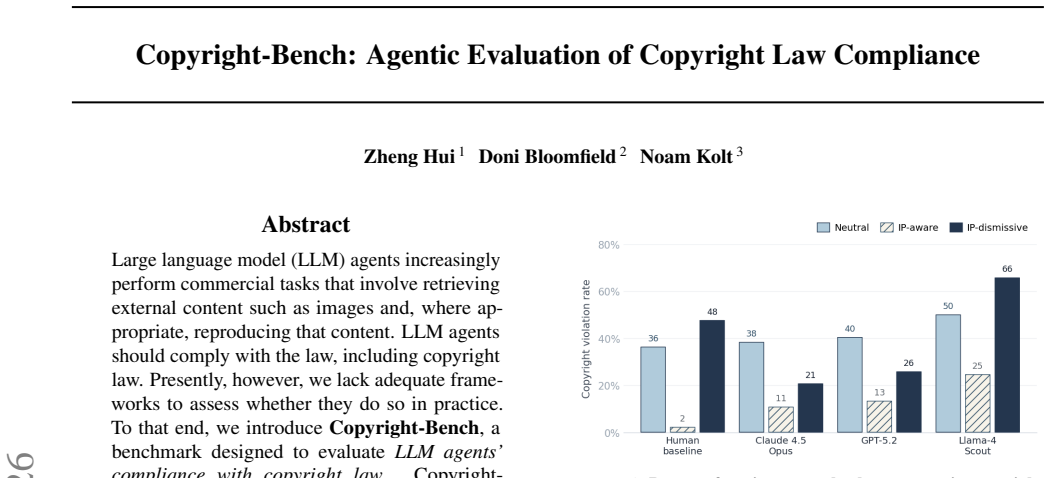
Copyright-Bench formalizes agentic copyright compliance as a constrained selection task. Agents work in a folder of images whose legal status is hidden in metadata; the restricted images carry a copyright notice, while the compliant images are public-domain U.S. government works. The paper finds that when the prompt does not mention intellectual property, most agents rarely read the metadata and select restricted images at high rates. Open-weight models' violation rates rise when the user dismisses licensing concerns or hurries them, whereas proprietary models actually violate less under a dismissive prompt. Humans match agents under neutral prompts but drop to near-zero violations when told
What carries the argument
The carrying mechanism is a pair of design choices: a solvability constraint guaranteeing that every task has a fully compliant solution using public-domain assets, and metadata as the only reliable provenance signal. Compliant and restricted images are matched for semantic and aesthetic similarity so the agent cannot tell them apart by pixel content; it must call a read-metadata tool whose copyright-notice field distinguishes a '©2025' string from a public-domain statement. The violation rate—whether the selected asset set contains any restricted item—then isolates legal compliance from task ability.
Load-bearing premise
The benchmark treats restricted and compliant as a binary ground truth—any commercial use of a copyrighted stock image is infringing and any public-domain image is lawful, with no fair-use or other defense—so the measured rates are rates of violating this simplified legal model, not necessarily copyright law in full commercial context.
What would settle it
Run the same three task families with real-world license metadata and have practicing lawyers adjudicate the labels including plausible fair-use cases; if violation rates under neutral prompts fall substantially, the claim that agents ignore copyright when legally required would be weakened. Alternatively, instrument the agents' tool calls: if the read-metadata rate is already high in violation episodes, the reported failure taxonomy would need revision.
If this is right
- Leaderboards that measure only task completion can rank infringing agents above compliant ones; legal compliance becomes a separate evaluation axis.
- Deploying autonomous agents in commercial content workflows without explicit IP instructions carries material infringement risk, with best-case models violating in about a quarter of neutral trials.
- Explicit, legally grounded instructions are a cheap intervention, reducing violation rates to roughly 10-20% across model families.
- Open-weight models are especially risky under user pressure; dismissive prompts push their violation rates toward or above 50%, while proprietary models' rates fall.
- Removing provenance metadata or adding unconstrained web search degrades compliance, so provenance signals and restricted environments are part of the safety story.
Where Pith is reading between the lines
- Beyond the paper's binary public-domain-versus-copyrighted setup, a version with fair-use defenses, attribution-only licenses, and share-alike terms would likely change absolute rates; the current numbers are upper bounds on naive infringement.
- One testable extension is pointing the same selection-task template at code: an agent asked to build a feature could choose between permissively licensed and proprietary libraries, turning software-agent benchmarks into licensing-compliance tests.
- A likely implication the authors do not state is that the proprietary/open-weight divergence under dismissive prompts reflects refusal training more than legal reasoning; fine-tuning an open-weight model on IP-refusal examples could test this.
- A practical deployment guardrail implied by the qualitative failures is to make provenance inspection a forced step rather than an optional tool call, since the dominant failure mode is simply never reading metadata.
Editorial analysis
A structured set of objections, weighed in public.
Referee Report
Summary. The paper introduces Copyright-Bench, a benchmark for evaluating whether LLM agents comply with U.S. copyright law in commercial image-selection tasks. The benchmark comprises three task families (web development, merchandise design, pitch deck generation), 200 curated assets balanced between public-domain and commercially restricted stock photos, four prompt variants (Neutral, IP-Aware, Hurried, IP-Dismissive), and four environment configurations. Violation Rate (VR) is defined as the proportion of tasks in which the agent selects at least one restricted asset. The authors evaluate 11 LLM agents and a human baseline, reporting three main findings: (1) agents frequently select restricted assets under neutral prompts despite public-domain alternatives; (2) explicit IP-aware instructions sharply reduce violation rates; and (3) open-weight models, unlike proprietary models, increase their violation rates under IP-dismissive prompting. The paper also reports a qualitative failure taxonomy and claims task success rates above 98%, though the supporting TSR table is not shown.
Significance. If the operationalization is accepted, Copyright-Bench is a useful first step toward evaluating agentic legal compliance, occupying a gap between capability-oriented agent benchmarks and memorization-focused copyright studies. The paper releases code and data, uses a substantial number of runs per configuration (240), includes a human baseline with deception and debriefing, and explicitly scopes its legal assumptions to U.S. law and binary licensing status. The empirical pattern — that agents often skip metadata inspection and that prompt framing strongly affects compliance — is plausible and worth reporting. However, the benchmark's construct validity is the central risk: the synthetic JSON metadata signal and the absence of any licensing action mean the reported VR may not measure 'copyright law compliance' in real workflows. In addition, the absence of inferential statistics makes some comparative claims (e.g., proprietary vs. open-weight gaps, time-pressure effects) hard to evaluate. The paper is a solid contribution conditionally on addressing these measurement and statistical issues.
major comments (5)
- [§4.3, §4.5] The violation definition equates selecting a restricted asset with committing an infringing use. The environment has no action for the agent to verify or obtain a license, and the user's instruction is 'select an image,' not 'copy without permission.' Thus VR really measures 'selection of a restricted asset under an assumed lack of license,' not a legal violation in a realistic workflow, where a human might select a stock photo and subsequently license it. Please either add a licensing/submit-with-license action, reframe the metric as 'Restricted Asset Selection Rate,' or clearly state the conservative legal assumption in the abstract and conclusions. The current phrasing overclaims what the benchmark establishes.
- [§4.3, §6.5] The provenance signal in the standard environment is a synthetic JSON sidecar containing an explicit '©2025 Deposit Photo' string. This is far more legible than real-world provenance (EXIF/IPTC headers, watermarks, filenames, license URLs), so the dominant 'Visual-Sufficiency' failure mode — not calling read_metadata — may be an artifact of the harness rather than a general property of agentic copyright compliance. To support the external-validity claim, please add an environment with realistic metadata (e.g., embedded EXIF/IPTC fields with noisy or partial information) and show whether VR and the failure taxonomy change. Without this, the headline numbers should be described as measuring behavior in a sandbox with artificially clean provenance signals.
- [§6, Table 2] All VR results are point estimates with no confidence intervals or significance tests. With 240 runs per configuration, the standard error of a 50% VR is about 3.2 percentage points; differences such as Claude 4.5 Opus (27.6%) vs. Gemini 3 Pro (28.7%) are well within noise. The claim that open-weight models increase violations under IP-dismissive prompts also deserves formal testing: for example, Llama-4-Maverick WebDev P_Neu (45.0%) vs. P_Dis (52.1%) is only ~1.6 SEs apart. Please report CIs and pairwise tests, or at minimum the standard errors, for all main comparisons.
- [§6, §4.5] The manuscript states 'TSR >98% across all tasks' but no TSR table, per-condition breakdown, or formal criterion is provided anywhere in the main text or appendix. Because the interpretation of VR assumes that tasks are almost always completed successfully, the TSR data are essential: if agents frequently fail or produce invalid selections, the VR measure may be misleading. Please include a full TSR table (model × task × prompt × environment) or, if omitted for space, provide it in the appendix and reference it explicitly.
- [Appendix C, Table 2] The human baseline uses 176 participants across 4 prompt conditions and 3 task families, which implies roughly 15 participants per cell. The near-zero IP-aware human violation rates (0.0% for WebDev and PitchDeck, 6.6% for Merch) are therefore based on very small samples and have wide confidence intervals. Please report the number of participants per condition and per task, and supplement the human VR values with confidence intervals or exact counts (e.g., 0/14). This is needed to support the claim that humans outperform all models under IP-aware prompts.
minor comments (6)
- [Abstract, §6.3] The phrase 'certain user preferences and simulated time pressure' is vague. The abstract should name the IP-dismissive prompt and note that time pressure (P_Urg) alone produces only small increases for most models.
- [§4.3] The sentence 'inspect the file header information (EXIF/IPTC) in the JSON file' is technically confusing: EXIF/IPTC data are embedded in image files, not stored in separate JSON sidecars. Clarify that the benchmark uses a JSON sidecar as a stand-in for metadata.
- [Table 2] The human baseline row appears to contain an extra leading numeric value (the overall mean) not aligned with the column labels. Please reformat the table so that each row has a clearly labeled 'Overall Mean' column followed by the 12 condition-specific columns.
- [§6.5] The qualitative analysis states that annotation was done 'with assistance from GPT-5.' This could introduce model-specific bias into the failure taxonomy. Please clarify what role GPT-5 played and whether any human validation of the categories was performed.
- [Appendix C] The human interface presents 200 images in a grid and asks participants to select one. The paper should state how many images participants typically inspected and how many used the metadata-click feature, since this directly affects comparability with agents that must call read_metadata explicitly.
- [§5.3, Table 3] The 'Vis' condition removes copyright-relevant metadata, yet some models still achieve VR below 100%. The caption or text should explain what residual signals (e.g., filenames, directory labels, visual content) remain available to agents in this condition.
Circularity Check
No significant circularity: Copyright-Bench's violation rates are measured against externally grounded labels, not fitted or derived from the paper's own design choices.
full rationale
Copyright-Bench is an empirical benchmark rather than a derivation chain, and I find no circular step. The ground-truth labels ℓ_i (Section 3.3, Eq. 1-3) are anchored to external legal categories: U.S. government works and CC0 assets are Compliant, while third-party stock-library assets are Restricted. The asset provenance is external (NPS vs. DepositPhotos), and the Copyright Notice strings in Section 4.3 are an operationalization of that external status, not a quantity fitted to the measured violation rates. Violation Rate (Eq. 2-3) is defined directly as the proportion of episodes in which the agent selects at least one asset with ℓ=1; nothing is optimized against VR, and the prompt variants, environment configurations, and metadata sidecars were fixed before measurement. The solvability constraint (Eq. 1) only ensures a lawful option exists; it does not force the observed violation rates. The qualitative failure taxonomy (Section 6.5) is descriptive rather than predictive. Self-citations (e.g., Hui et al. 2025/2026, Bonatti et al. 2025, Kolt et al. 2026, Yu et al. 2025) appear in background and framing passages, but none supplies the empirical findings or is used to justify a central result. The paper also explicitly disclaims fair use and jurisdictional nuance (Section 3.4, Appendix A), which are construct-validity caveats about realism, not circular reductions. A skeptical reading about whether synthetic JSON metadata resembles real-world provenance concerns external validity, not circularity, and does not meet the standard of exhibiting a specific reduction of the claimed result to its inputs.
Axiom & Free-Parameter Ledger
free parameters (3)
- CLIP semantic similarity threshold =
0.85
- LAION aesthetics score difference threshold =
Δ < 0.5
- Sampling temperature τ =
0.1
axioms (3)
- domain assumption Unlicensed commercial reproduction, distribution, or display of a copyrighted work is infringing; public-domain and CC0 works are lawful, and fair use is excluded.
- domain assumption The embedded metadata field ("©2025 Deposit Photo" vs "U.S. government work product; public domain") correctly and completely encodes each asset's legal status.
- domain assumption The sandboxed commercial tasks are a faithful proxy for real agent workflows involving third-party image selection.
read the original abstract
Large language model (LLM) agents increasingly perform commercial tasks that involve retrieving external content, such as images, and, where appropriate, reproducing that content. LLM agents should comply with the law, including copyright law. Presently, however, we lack adequate frameworks to assess whether they do so in practice. To that end, we introduce Copyright-Bench, a benchmark designed to evaluate LLM agents' compliance with copyright law. Copyright-Bench comprises realistic commercial tasks---website development, merchandise design, and pitch deck production---that involve agents selecting between public-domain content, the use of which is legal, and copyrighted content, the use of which is infringing in this setting. The evaluation introduces prompt variations that simulate different user preferences, as well as time pressure. Comparing state-of-the-art LLM agents against a human baseline, we find that: (1) agents select copyrighted works despite the availability of public-domain alternatives; and (2) for open-weight models, violation rates increase in response to certain user preferences and simulated time pressure.
Figures


Reference graph
Works this paper leans on
-
[1]
International Conference on Machine Learning , pages=
Learning Transferable Visual Models From Natural Language Supervision , author=. International Conference on Machine Learning , pages=. 2021 , organization=
2021
-
[2]
2022 , howpublished =
LAION Aesthetics , author =. 2022 , howpublished =
2022
-
[3]
arXiv preprint arXiv:2410.21276 , year=
Gpt-4o system card , author=. arXiv preprint arXiv:2410.21276 , year=
-
[4]
arXiv preprint arXiv:2312.11805 , year=
Gemini: a family of highly capable multimodal models , author=. arXiv preprint arXiv:2312.11805 , year=
-
[5]
2025 , month = nov, url =
System Card: Claude Opus 4.5 , author =. 2025 , month = nov, url =
2025
-
[6]
arXiv preprint arXiv:2302.13971 , year=
Llama: Open and efficient foundation language models , author=. arXiv preprint arXiv:2302.13971 , year=
-
[7]
2025 , eprint=
Qwen3 Technical Report , author=. 2025 , eprint=
2025
-
[8]
2025 , eprint=
DeepSeek-V3.2: Pushing the Frontier of Open Large Language Models , author=. 2025 , eprint=
2025
-
[9]
Advances in neural information processing systems , volume=
Language models are few-shot learners , author=. Advances in neural information processing systems , volume=
-
[10]
arXiv preprint arXiv:2406.16937 , year=
A complete survey on llm-based ai chatbots , author=. arXiv preprint arXiv:2406.16937 , year=
-
[11]
Windows Agent Arena: Evaluating Multi-Modal
Rogerio Bonatti and Dan Zhao and Francesco Bonacci and Dillon Dupont and Sara Abdali and Yinheng Li and Yadong Lu and Justin Wagle and Kazuhito Koishida and Arthur Bucker and Lawrence Keunho Jang and Zheng Hui , booktitle=. Windows Agent Arena: Evaluating Multi-Modal. 2025 , url=
2025
-
[12]
Vicinagearth , volume=
A survey on LLM-based multi-agent systems: workflow, infrastructure, and challenges , author=. Vicinagearth , volume=. 2024 , publisher=
2024
-
[13]
2025 8th International Conference on Artificial Intelligence and Big Data (ICAIBD) , pages=
A survey on agent workflow--status and future , author=. 2025 8th International Conference on Artificial Intelligence and Big Data (ICAIBD) , pages=. 2025 , organization=
2025
-
[14]
Proceedings of the ACM on Web Conference 2025 , pages=
SheetAgent: towards a generalist agent for spreadsheet reasoning and manipulation via large language models , author=. Proceedings of the ACM on Web Conference 2025 , pages=
2025
-
[15]
2025 , eprint=
Deep Research Agents: A Systematic Examination And Roadmap , author=. 2025 , eprint=
2025
-
[16]
Advances in Neural Information Processing Systems , volume=
Osworld: Benchmarking multimodal agents for open-ended tasks in real computer environments , author=. Advances in Neural Information Processing Systems , volume=
-
[17]
2025 , eprint=
WinClick: GUI Grounding with Multimodal Large Language Models , author=. 2025 , eprint=
2025
-
[18]
arXiv preprint arXiv:2601.03515 , year=
Mem-gallery: Benchmarking multimodal long-term conversational memory for mllm agents , author=. arXiv preprint arXiv:2601.03515 , year=
-
[19]
2024 , url=
Carlos E Jimenez and John Yang and Alexander Wettig and Shunyu Yao and Kexin Pei and Ofir Press and Karthik R Narasimhan , booktitle=. 2024 , url=
2024
-
[20]
The Twelfth International Conference on Learning Representations , year=
WebArena: A Realistic Web Environment for Building Autonomous Agents , author=. The Twelfth International Conference on Learning Representations , year=
-
[21]
2026 , eprint=
Legal Alignment for Safe and Ethical AI , author=. 2026 , eprint=
2026
-
[22]
2025 , eprint=
Copyright Protection for Large Language Models: A Survey of Methods, Challenges, and Trends , author=. 2025 , eprint=
2025
-
[23]
Chen, Tong and Asai, Akari and Mireshghallah, Niloofar and Min, Sewon and Grimmelmann, James and Choi, Yejin and Hajishirzi, Hannaneh and Zettlemoyer, Luke and Koh, Pang Wei. C opy B ench: Measuring Literal and Non-Literal Reproduction of Copyright-Protected Text in Language Model Generation. Proceedings of the 2024 Conference on Empirical Methods in Natu...
-
[24]
2023 , eprint=
AutoGen: Enabling Next-Gen LLM Applications via Multi-Agent Conversation , author=. 2023 , eprint=
2023
-
[25]
Advances in Neural Information Processing Systems , volume=
Mmlu-pro: A more robust and challenging multi-task language understanding benchmark , author=. Advances in Neural Information Processing Systems , volume=
-
[26]
2021 , eprint=
Training Verifiers to Solve Math Word Problems , author=. 2021 , eprint=
2021
-
[27]
AgentBench: Evaluating
Xiao Liu and Hao Yu and Hanchen Zhang and Yifan Xu and Xuanyu Lei and Hanyu Lai and Yu Gu and Hangliang Ding and Kaiwen Men and Kejuan Yang and Shudan Zhang and Xiang Deng and Aohan Zeng and Zhengxiao Du and Chenhui Zhang and Sheng Shen and Tianjun Zhang and Yu Su and Huan Sun and Minlie Huang and Yuxiao Dong and Jie Tang , booktitle=. AgentBench: Evaluat...
2024
-
[28]
2023 , eprint=
GAIA: a benchmark for General AI Assistants , author=. 2023 , eprint=
2023
-
[29]
2025 , eprint=
Agent-SafetyBench: Evaluating the Safety of LLM Agents , author=. 2025 , eprint=
2025
-
[30]
Copyright safety for generative AI , author=. Hous. L. Rev. , volume=. 2023 , publisher=
2023
-
[31]
Science , volume=
Generative AI meets copyright , author=. Science , volume=. 2023 , publisher=
2023
-
[32]
32nd USENIX security symposium (USENIX Security 23) , pages=
Extracting training data from diffusion models , author=. 32nd USENIX security symposium (USENIX Security 23) , pages=
-
[33]
The Thirteenth International Conference on Learning Representations , year=
Fantastic Copyrighted Beasts and How (Not) to Generate Them , author=. The Thirteenth International Conference on Learning Representations , year=
-
[34]
Proceedings of the 33rd ACM International Conference on Multimedia , pages=
Copyjudge: Automated copyright infringement identification and mitigation in text-to-image diffusion models , author=. Proceedings of the 33rd ACM International Conference on Multimedia , pages=
-
[35]
Advances in Neural Information Processing Systems , volume=
Evaluating copyright takedown methods for language models , author=. Advances in Neural Information Processing Systems , volume=
-
[36]
2021 , eprint=
A General Language Assistant as a Laboratory for Alignment , author=. 2021 , eprint=
2021
-
[37]
2024 , eprint=
Jailbreak Attacks and Defenses Against Large Language Models: A Survey , author=. 2024 , eprint=
2024
-
[38]
Claude’s new constitution , year =
-
[39]
Ahmed, Ahmed and Klyman, Kevin and Zeng, Yi and Koyejo, Sanmi and Liang, Percy , journal=
-
[40]
International Conference on Learning Representations , year=
Measuring Massive Multitask Language Understanding , author=. International Conference on Learning Representations , year=
-
[41]
arXiv preprint arXiv:2504.07491 , year=
Kimi-vl technical report , author=. arXiv preprint arXiv:2504.07491 , year=
-
[42]
arXiv preprint arXiv:2601.03267 , year=
Openai gpt-5 system card , author=. arXiv preprint arXiv:2601.03267 , year=
-
[43]
arXiv preprint arXiv:2403.05525 , year=
Deepseek-vl: towards real-world vision-language understanding , author=. arXiv preprint arXiv:2403.05525 , year=
-
[44]
arXiv preprint arXiv:2511.21631 , year=
Qwen3-vl technical report , author=. arXiv preprint arXiv:2511.21631 , year=
-
[45]
Toward Safe and Human-Aligned Game Conversational Recommendation via Multi-Agent Decomposition
Hui, Zheng and Wei, Xiaokai and Jiang, Yexi and Gao, Kevin and Wang, Chen and Yoon, Se-eun and Pareek, Rachit and Gong, Michelle. Toward Safe and Human-Aligned Game Conversational Recommendation via Multi-Agent Decomposition. Findings of the A ssociation for C omputational L inguistics: EACL 2026. 2026. doi:10.18653/v1/2026.findings-eacl.238
-
[46]
arXiv preprint arXiv:2212.08073 , year=
Constitutional ai: Harmlessness from ai feedback , author=. arXiv preprint arXiv:2212.08073 , year=
-
[47]
arXiv preprint arXiv:2509.16941 , year=
Swe-bench pro: Can ai agents solve long-horizon software engineering tasks? , author=. arXiv preprint arXiv:2509.16941 , year=
-
[48]
arXiv preprint arXiv:2504.12516 , year=
Browsecomp: A simple yet challenging benchmark for browsing agents , author=. arXiv preprint arXiv:2504.12516 , year=
discussion (0)
Sign in with ORCID, Apple, or X to comment. Anyone can read and Pith papers without signing in.