REVIEW 3 major objections 5 minor 38 references
KaPilot claims that a documentation-grounded, multi-agent LLM pipeline can generate Kani specifications for most unsafe Rust functions, reporting 88.9% success on a 54-function benchmark and 57.4% of outputs semantically equivalent to or st
Reviewed by Pith at T0; open to challenge. T0 means a machine referee read the full paper against a public rubric. the ladder, T0–T4 →
T0 review · deepseek-v4-flash
2026-08-01 06:13 UTC pith:22GIY4WN
load-bearing objection KaPilot is a workmanlike, honestly-evaluated LLM pipeline for Kani spec generation; the 88.9% pass rate is weaker than it looks, and the number to watch is 57.4% genuinely good specs. the 3 major comments →
KaPilot: LLM-Assisted Generation of Kani Specifications for Unsafe Rust Verification
The pith
A machine-rendered reading of the paper's core claim, the machinery that carries it, and where it could break.
Core claim
The paper's central claim is that grounding specification generation in documentation-derived safety requirements—rather than in source code—lets LLMs produce Kani contracts for unsafe Rust that are both verifiable and semantically faithful. The authors argue that safety properties are usually hidden in natural-language docs, while code-centric generation inherits implementation flaws. They demonstrate this through KaPilot: SafetyReq extracts atomic, traceable safety requirements from docs; SpecGenerate writes contracts without seeing the implementation; SpecPrecheck filters weak or incomplete drafts; SpecVerify runs Kani with vacuity checks; and shuffle-and-implication selects the best veri
What carries the argument
The load-bearing machinery is the documentation-grounded safety-requirement list plus the shuffle-and-implication selection strategy. The safety-requirement list is a concise, atomic, source-traceable inventory of every memory-safety and panic constraint mentioned in the function's docs and cross-references; it converts unstructured prose into a stable target that SpecGenerate must satisfy. The shuffle-and-implication strategy takes the set of verified candidate specifications (each a precondition, postcondition, and loop invariant), ranks preconditions from weakest to strongest and postconditions from strongest to weakest, and uses Kani to test combinations—including conjoined loop invarian
Load-bearing premise
The whole pipeline assumes the function's documentation—Safety and Panics sections plus cross-references—contains every safety-relevant constraint; if a required property is missing from the docs, the generated specification can pass Kani and still miss a real memory-safety violation.
What would settle it
Take a set of unsafe Rust functions whose documentation has a known safety-relevant omission (for example, a missing Panics condition or an unwritten in-bounds requirement), run the full pipeline, and check whether the generated specification both passes Kani and fails to prove the omitted property—if it does, the documentation-completeness assumption is violated and the claimed 88.9% success rate would drop on that set.
If this is right
- If correct, unsafe-Rust memory-safety verification can scale beyond hand-written specs, since documentation already exists for most public functions.
- Deliberately withholding source code from the spec generator reduces the risk of inheriting implementation bugs in preconditions and postconditions.
- The vacuity check (appending a deliberately false ensures clause) gives an automated way to catch contradictory preconditions that would otherwise pass verification vacuously.
- The shuffle-and-implication selection can recover a correct contract from a set of individually imperfect candidates, removing the need to restart generation from scratch.
- The documented pipeline transfers to other contract-based verifiers beyond Kani, as long as they support preconditions, postconditions, and loop invariants.
Where Pith is reading between the lines
- Editorial inference: the pipeline's ceiling is documentation quality—if a required safety property is missing from the docs, the generated spec can pass Kani yet miss a real memory-safety violation; the authors acknowledge this dependence but do not quantify how much it bounds the headline success rates.
- A testable extension would be to run the pipeline on deliberately underdocumented functions and check whether the generated spec admits undefined behavior that Kani would catch with a stronger spec; if so, documentation completeness is the binding constraint.
- Because the spec-writing agent never sees the implementation, the intermediate safety-requirement lists double as auditable natural-language artifacts that human reviewers or other tools could consume independently.
- The shuffle-and-implication idea is not limited to LLMs: any pool of verified-but-incomplete Hoare-triple candidates could be recombined by implication checking to recover a stronger overall contract.
Editorial analysis
A structured set of objections, weighed in public.
Referee Report
Summary. The paper presents KaPilot, a multi-agent LLM pipeline that automatically generates Kani specifications (preconditions, postconditions, loop invariants) for unsafe Rust functions. The pipeline extracts safety requirements from documentation via SafetyReq, generates candidate specifications via SpecGenerate, refines them through a generate–precheck–verify loop involving SpecPrecheck and SpecVerify, and finally selects the best candidate using a shuffle-and-implication strategy. The evaluation covers 54 unsafe Rust functions with ground truth (GoldSet) and 70 without (ULSet), reporting 88.9% and 71.4% Kani-pass rates respectively, with 57.4% of GoldSet specifications judged semantically equivalent to or stronger than ground truth, and reporting improvements over an AutoSpec baseline adapted to Kani. The central claim is that documentation-grounded multi-agent LLM pipelines can automate most unsafe-Rust specification writing well enough to be practically useful.
Significance. If the results hold, KaPilot is a meaningful step forward: it demonstrates that an LLM-based multi-agent pipeline can produce non-vacuous, Kani-verifiable contracts for a nontrivial set of standard-library unsafe functions, with ablations isolating the contribution of each agent and inter-rater agreement supporting the qualitative labels. The use of an external ground-truth source (verify-rust-std), the verifier anchor (Kani), and the public artifact are clear strengths. However, the significance is bounded by two caveats that the paper itself partly discloses: Kani pass is a bounded-verification result and does not certify memory safety independently of the documentation-derived requirements, and the ULSet success rates are pass rates rather than quality rates. These caveats do not eliminate the practical value, but they must be reflected in the central claims.
major comments (3)
- [§3.3–§3.4 and §5] The central validity of the results is conditional on documentation completeness. SafetyReq is constrained to the Safety/Panics sections plus cross-references, and SpecGenerate is deliberately withheld from the source code (§3.4). Kani pass only proves that the implementation satisfies the generated specification; it does not prove that the specification entails the intended memory-safety properties. If a constraint is missing or ambiguous in the documentation, neither SafetyReq nor SpecPrecheck can recover it, and Kani will still pass. The paper concedes this in §5 ('Poor documentation may lead to missing or underspecified constraints') and attributes the higher ULSet failure rate in §4.1 to lower-quality descriptions. The headline 88.9% and 57.4% rates therefore describe generation of verifiable specifications of documented requirements, not verified memory-safety coverage. An independ
- [§3.7, Algorithm 1] The shuffle-and-implication algorithm as printed does not implement the exhaustive search the text claims. The inner loop over postconditions exits with j=M and Q empty, and j is not reset in the outer loop; therefore only the first selected weakest precondition is ever paired with postconditions, and later preconditions are never combined with any Q. The statement that the two-layer loop covers all combinations whenever M≥|SP| is therefore false. The selection criteria at lines 4 and 8 are also not the standard weakest-precondition/strongest-postcondition definitions: the disjunction (p_m⇒p_k)∨(p_k⇏p_m) is satisfied by incomparable predicates and does not identify a unique weakest element. Please correct the pseudocode or specify the actual search procedure, and confirm that the implementation matches the corrected version.
- [§4.1, Table 3; Abstract] The term 'specification generation success' conflates Kani-verifiability with specification quality. On ULSet there is no ground truth and no good/bad classification, so the 71.4% pass rate is not evidence that the specifications are correct. On GoldSet, good/bad labels come from the two co-authors' blind review; the reported Cohen's κ (0.81–0.95) demonstrates inter-rater consistency, not validity against an independent oracle. Because Table 3 counts bad specifications as Pass (e.g., 17 bad for GPT-5), the 88.9% is a bounded-verifiability rate: Kani pass is subject to unwind and harness bounds (§5), not a safety proof. The abstract and conclusion should use qualified wording (e.g., 'Kani-verifiable' and 'manually judged good or better'), and the paper should state the bounded nature in the headline results.
minor comments (5)
- [§3.3] The sentence 'or encoded implicitly as behavioural constraints rather than explicitly stated in Safety or Panics sections' appears twice in almost identical form; remove the duplicate.
- [§4.2, Table 6] The 'Surpass' row is hard to interpret because the percentages are given with mixed signs and no explicit baseline; specify for each column whether the delta is relative to AutoSpec's count and what 'Surpass' means.
- [§4.4, Case Study 2] The text says 'Fig. 6 shows the safety requirement list' but the referenced listing appears to be Fig. 8; check the cross-reference.
- [§4.1, Table 5] The model name is given as 'Claude-4-Sonnet' in the text and 'Claude-Sonnet-4' in the table; standardize the spelling.
- [§5] The heading 'Why comparing with AutoSpec' is ungrammatical; 'Why We Compare with AutoSpec' is clearer.
Circularity Check
No central circularity: external Kani and verify-rust-std ground truth anchor the claims; residual limitation is documentation completeness, not circularity.
full rationale
KaPilot's derivation chain is: docs -> SafetyReq list -> SpecGenerate -> SpecPrecheck -> SpecVerify (Kani) -> candidate set -> shuffle-and-implication -> final spec. The headline empirical claims are anchored externally rather than by construction. The 88.9% GoldSet and 71.4% ULSet success rates are Kani-verifiability results, and Kani is an independent bounded model checker. The 57.4% 'equivalent-or-stronger' rate is determined by manual comparison against human-written verify-rust-std ground truth ([11]), with reported inter-rater agreement (Cohen's kappa 0.81-0.95), not against KaPilot's own SafetyReq output. SpecPrecheck does check coverage and strength relative to the SafetyReq list, so it would not independently catch a systematic LLM misreading of documentation; however, this is a quality-assurance limitation, and the paper explicitly concedes it in Sec. 5: 'Poor documentation may lead to missing or underspecified constraints.' That is a threat-to-validity assumption, not a by-construction equivalence. The shuffle-and-implication strategy selects weakest preconditions/strongest postconditions and re-verifies the combined candidate in Kani, so the selection is not accepted merely by definition. The only self-citations ([32] artifact, [33] UnsafeCop related work) appear in data-availability/related-work context and are not load-bearing; no uniqueness theorem or ansatz is imported from the authors' prior work. No specific prediction is fitted to the data it claims to predict. Residual circularity is therefore minor and non-central.
Axiom & Free-Parameter Ledger
free parameters (4)
- SafetyReq acceptance threshold =
6 (harmonic-mean rule score)
- SpecPrecheck quality threshold =
6 on 1–10 scale
- Iteration limits and candidate counts =
SafetyReq 3, SpecGenerate–SpecPrecheck 5, SpecVerify 3, shuffle M=2, candidates 2
- Kani unwind/harness bounds =
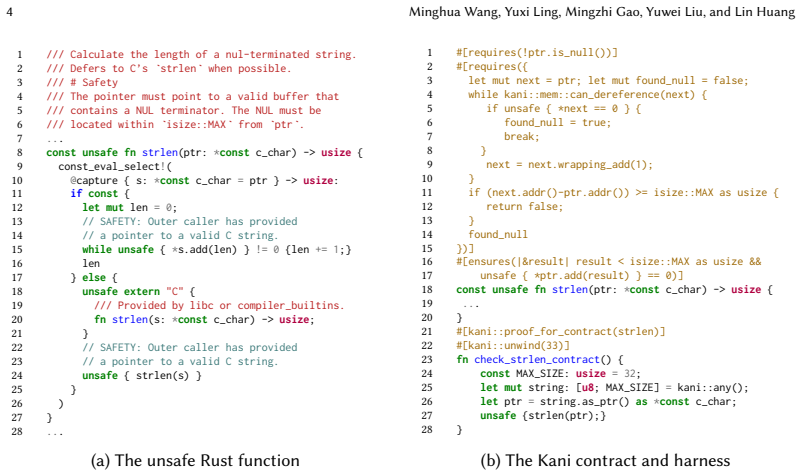
e.g., #[kani::unwind(33)], MAX_SIZE=32; bounded unwind when full unwinding is costly
axioms (6)
- domain assumption Kani's contract checking is a sound formal verification of the checked properties within the given unwind bounds.
- domain assumption Documentation (Safety/Panics sections plus cross-references) contains all safety requirements relevant to the target function.
- domain assumption Two co-authors' manual blind labeling reliably distinguishes good from bad specifications relative to ground truth.
- domain assumption The adapted AutoSpec baseline faithfully represents the original AutoSpec pipeline.
- ad hoc to paper The invariant candidates (i_w, i_s, i_w∧i_s) suffice to find a correct loop invariant.
- domain assumption LLM outputs (safety req lists, specs, precheck scores) are reliable enough after iterative refinement.
read the original abstract
Rust's ownership and type system provide strong memory safety guarantees, but unsafe code still presents memory safety risks. Formal verification is crucial for ensuring memory safety, but writing precise specifications for unsafe Rust is challenging and largely manual. Large language models (LLMs) have shown promise in generating formal specifications but are often code-centric, prone to inheriting implementation flaws, and lack systematic quality assessment. In this paper, we present KaPilot, a multi-agent framework for automatically generating specifications to verify unsafe Rust memory safety using Kani. The process begins with lightweight program analysis and proof harness generation. The SafetyReq agent extracts a concise, refined list of safety requirements from the target Rust function's documentation, which guides the SpecGenerate agent in producing initial specifications that specify memory safety concerns. Then, the specifications are iteratively refined through a generate-precheck-verify loop involving SpecGenerate, SpecPrecheck, and SpecVerify agents, which assess quality and feed errors back. By executing this loop multiple times, KaPilot generates a set of candidate specifications. Finally, the shuffle-and-implication strategy is applied to systematically determine the best specification from these candidates. We evaluated KaPilot on 54 unsafe Rust functions with ground truth and 70 without. KaPilot achieved 88.9% and 71.4% specification generation success, respectively, with 57.4% of generated specifications equivalent to or stronger than the ground truth. Compared with AutoSpec, KaPilot produces 14.8% more verifiable specifications and 25.9% more equivalent-or-better specifications.
Figures


Reference graph
Works this paper leans on
-
[1]
Pranjal Aggarwal, Bryan Parno, and Sean Welleck. 2024. AlphaVerus: Bootstrapping Formally Verified Code Generation through Self-Improving Translation and Treefinement. arXiv:2412.06176 [cs.LG] https://arxiv.org/abs/2412.06176
Pith/arXiv arXiv 2024
-
[2]
Sacha-Élie Ayoun, Xavier Denis, Petar Maksimović, and Philippa Gardner. 2025. A hybrid approach to semi-automated Rust verification. Proceedings of the ACM on Programming Languages9, PLDI (2025), 970–992. doi:10.5281/zenodo.15183201
-
[3]
Sarmad Bashir, Alessio Ferrari, Abbas Khan, Per Erik Strandberg, Zulqarnain Haider, Mehrdad Saadatmand, and Markus Bohlin. 2025. Requirements ambiguity detection and explanation with llms: An industrial study. In2025 IEEE International Conference on Software Maintenance and Evolution (ICSME). IEEE, 620–631. doi:10.1109/ICSME64153.2025.00063
arXiv 2025
-
[4]
2026.The Rust Book - Unsafe Rust
The Rust Book. 2026.The Rust Book - Unsafe Rust. Retrieved Janurary 20, 2026 from https://doc.rust-lang.org/book/ch20-01-unsafe- rust.html
2026
-
[5]
Saikat Chakraborty, Shuvendu Lahiri, Sarah Fakhoury, Akash Lal, Madanlal Musuvathi, Aseem Rastogi, Aditya Senthilnathan, Rahul Sharma, and Nikhil Swamy. 2023. Ranking llm-generated loop invariants for program verification. InFindings of the Association for Computational Linguistics: EMNLP 2023. 9164–9175. doi:10.18653/v1/2023.findings-emnlp.614
-
[6]
Tianyu Chen, Shuai Lu, Shan Lu, Yeyun Gong, Chenyuan Yang, Xuheng Li, Md Rakib Hossain Misu, Hao Yu, Nan Duan, Peng Cheng, Fan Yang, Shuvendu K Lahiri, Tao Xie, and Lidong Zhou. 2026. Automated Proof Generation for Rust Code via Self-Evolution. arXiv:2410.15756 [cs.SE] https://arxiv.org/abs/2410.15756
arXiv 2026
-
[7]
Jacob Cohen. 1960. A Coefficient of Agreement for Nominal Scales.Educational and Psychological Measurement20, 1 (1960), 37–46. doi:10.1177/001316446002000104
-
[8]
Jackson, Shaz Qadeer, Sriram K
Ankush Desai, Vivek Gupta, Ethan K. Jackson, Shaz Qadeer, Sriram K. Rajamani, and Damien Zufferey. 2013. P: safe asynchronous event-driven programming. InACM SIGPLAN Conference on Programming Language Design and Implementation, PLDI ’13, Seattle, W A, USA, June 16-19, 2013, Hans-Juergen Boehm and Cormac Flanagan (Eds.). ACM, 321–332. doi:10.1145/2491956.2462184
arXiv 2013
-
[9]
Frama-C developers
"Frama-C developers". 2026. "Frama-C". Retrieved Janurary 20, 2026 from https://frama-c.com/
2026
-
[10]
Kani developers
"Kani developers". 2026. "Automatic Harness Generation". Retrieved Janurary 20, 2026 from https://model-checking.github.io/kani/ reference/experimental/autoharness.html
2026
-
[11]
Kani developers
"Kani developers". 2026. "Verify Rust Standard Library Effort". Retrieved Janurary 20, 2026 from https://model-checking.github.io/verify- rust-std
2026
-
[12]
The Coq developers. 2026. The Coq proof assistant. Retrieved Janurary 20, 2026 from https://rocq-prover.org
2026
-
[13]
The RVT developers
"The RVT developers". 2026. "Rust Verification Tools". Retrieved Janurary 20, 2026 from https://project-oak.github.io/rust-verification- tools/about.html
2026
-
[14]
Lennard Gäher, Michael Sammler, Ralf Jung, Robbert Krebbers, and Derek Dreyer. 2024. Refinedrust: A type system for high-assurance verification of Rust programs.Proceedings of the ACM on Programming Languages8, PLDI (2024), 1115–1139. doi:10.1145/3656422
doi:10.1145/3656422 2024
-
[15]
Arie Gurfinkel, Temesghen Kahsai, and Jorge A Navas. 2015. SeaHorn: A framework for verifying C programs (competition contribution). InInternational Conference on Tools and Algorithms for the Construction and Analysis of Systems. Springer, 447–450. doi:10.1007/978-3- 662-46681-0_41
doi:10.1007/978-3- 2015
-
[16]
Mike He, Zhendong Ang, Ankush Desai, and Aarti Gupta. 2025. Ranking Formal Specifications using LLMs. InProceedings of the 1st ACM SIGPLAN International Workshop on Language Models and Programming Languages. 51–56. doi:10.1145/3759425.3763386
arXiv 2025
-
[17]
Ralf Jung, Jacques-Henri Jourdan, Robbert Krebbers, and Derek Dreyer. 2017. RustBelt: Securing the foundations of the Rust programming language.Proceedings of the ACM on Programming Languages2, POPL (2017), 1–34. https://dl.acm.org/doi/10.1145/3158154
doi:10.1145/3158154 2017
-
[18]
Shuvendu K. Lahiri. 2024. Evaluating LLM-driven User-Intent Formalization for Verification-Aware Languages. doi:10.34727/2024/ISBN. 978-3-85448-065-5_19
-
[19]
Andrea Lattuada, Travis Hance, Chanhee Cho, Matthias Brun, Isitha Subasinghe, Yi Zhou, Jon Howell, Bryan Parno, and Chris Hawblitzel
-
[20]
K Rustan M Leino. 2008. This is boogie 2.manuscript KRML178, 131 (2008), 9. https://www.microsoft.com/en-us/research/wp- content/uploads/2016/12/krml178.pdf
2008
-
[21]
K Rustan M Leino. 2010. Dafny: An automatic program verifier for functional correctness. InInternational conference on logic for programming artificial intelligence and reasoning. Springer, 348–370. https://link.springer.com/chapter/10.1007/978-3-642-17511-4_20
-
[22]
Huan Li, Bei Wang, Xing Hu, and Xin Xia. 2025. Safe4U: Identifying Unsound Safe Encapsulations of Unsafe Calls in Rust using LLMs. Proc. ACM Softw. Eng.2, ISSTA (2025), 457–480. doi:10.1145/3728890
doi:10.1145/3728890 2025
-
[23]
Lezhi Ma, Shangqing Liu, Yi Li, Xiaofei Xie, and Lei Bu. 2025. SpecGen: Automated Generation of Formal Program Specifications via Large Language Models. In2025 IEEE/ACM 47th International Conference on Software Engineering (ICSE). IEEE Computer Society, 666–666. https://dl.acm.org/doi/10.1109/ICSE55347.2025.00129
arXiv 2025
-
[24]
Yusuke Matsushita, Xavier Denis, Jacques-Henri Jourdan, and Derek Dreyer. 2022. RustHornBelt: a semantic foundation for functional verification of Rust programs with unsafe code. InProceedings of the 43rd ACM SIGPLAN International Conference on Programming Language Design and Implementation. 841–856. https://dl.acm.org/doi/10.1145/3519939.3523704
arXiv 2022
-
[25]
Md Rakib Hossain Misu, Cristina V Lopes, Iris Ma, and James Noble. 2024. Towards ai-assisted synthesis of verified dafny methods. Proceedings of the ACM on Software Engineering1, FSE (2024), 812–835. https://dl.acm.org/doi/10.1145/3643763
doi:10.1145/3643763 2024
-
[26]
Lahbib Naimi, Abdeslam Jakimi, Rachid Saadane, Abdellah Chehri, et al. 2024. Automating software documentation: Employing llms for precise use case description.Procedia Computer Science246 (2024), 1346–1354. doi:10.1016/j.procs.2024.09.568
-
[27]
Kexin Pei, David Bieber, Kensen Shi, Charles Sutton, and Pengcheng Yin. 2023. Can Large Language Models Reason about Program Invariants?. InProceedings of the 40th International Conference on Machine Learning (Proceedings of Machine Learning Research, Vol. 202), Andreas Krause, Emma Brunskill, Kyunghyun Cho, Barbara Engelhardt, Sivan Sabato, and Jonathan ...
2023
-
[28]
Stuart Pernsteiner, Iavor S. Diatchki, Robert Dockins, Mike Dodds, Joe Hendrix, Tristan Ravich, Patrick Redmond, Ryan Scott, and Aaron Tomb. 2024. Crux, a Precise Verifier for Rust and Other Languages. arXiv:2410.18280 [cs.PL] https://arxiv.org/abs/2410.18280 , Vol. 1, No. 1, Article . Publication date: July 2026. 22 Minghua Wang, Yuxi Ling, Mingzhi Gao, ...
Pith/arXiv arXiv 2024
-
[29]
Zvonimir Rakamarić and Michael Emmi. 2014. SMACK: Decoupling source language details from verifier implementations. InComputer Aided Verification: 26th International Conference, CA V 2014, Held as Part of the Vienna Summer of Logic, VSL 2014, Vienna, Austria, July 18-22, 2014. Proceedings 26. Springer, 106–113. doi:10.1007/978-3-319-08867-9_7
-
[30]
2026.The Rust Reference
The Rust Reference. 2026.The Rust Reference. Retrieved Janurary 20, 2026 from https://doc.rust-lang.org/reference/behavior-considered- undefined.html
2026
-
[31]
Alexa VanHattum, Daniel Schwartz-Narbonne, Nathan Chong, and Adrian Sampson. 2022. Verifying dynamic trait objects in rust. In Proceedings of the 44th International Conference on Software Engineering: Software Engineering in Practice(Pittsburgh, Pennsylvania) (ICSE-SEIP ’22). Association for Computing Machinery, New York, NY, USA, 321–330. doi:10.1145/351...
arXiv 2022
-
[32]
Minghua Wang, Yuxi Ling, Mingzhi Gao, Yuwei Liu, and Lin Huang. 2026. KaPilot Artifact. doi:10.6084/m9.figshare.32834699.v3
-
[33]
Minghua Wang, Jingling Xue, Lin Huang, Yuan Zi, and Tao Wei. 2025. UnsafeCop: Towards Memory Safety for Real-World Unsafe Rust Code with Practical Bounded Model Checking. InFormal Methods, Andre Platzer, Kristin Yvonne Rozier, Matteo Pradella, and Matteo Rossi (Eds.). Springer Nature Switzerland, Cham, 307–324. https://link.springer.com/chapter/10.1007/97...
-
[34]
Cheng Wen, Jialun Cao, Jie Su, Zhiwu Xu, Shengchao Qin, Mengda He, Haokun Li, Shing-Chi Cheung, and Cong Tian. 2024. Enchanting program specification synthesis by large language models using static analysis and program verification. InInternational Conference on Computer Aided Verification. Springer, 302–328. https://doi.org/10.1007/978-3-031-65630-9_16
-
[35]
Chenyuan Yang, Xuheng Li, Md Rakib Hossain Misu, Jianan Yao, Weidong Cui, Yeyun Gong, Chris Hawblitzel, Shuvendu Lahiri, Jacob R Lorch, Shuai Lu, et al. 2025. Autoverus: Automated proof generation for rust code.Proceedings of the ACM on Programming Languages9, OOPSLA2 (2025), 3454–3482. https://dl.acm.org/doi/abs/10.1145/3763174
doi:10.1145/3763174 2025
-
[36]
Mohammad Amin Zadenoori, Jacek Dąbrowski, Waad Alhoshan, Liping Zhao, and Alessio Ferrari. 2025. Large Language Models (LLMs) for Requirements Engineering (RE): A Systematic Literature Review. arXiv:2509.11446 [cs.SE] https://arxiv.org/abs/2509.11446
arXiv 2025
-
[37]
Ying Zhang, Peng Li, Yu Ding, Lingxiang Wang, Dan Williams, and Na Meng. 2024. Broadly Enabling KLEE to Effortlessly Find Unrecoverable Errors in Rust. InProceedings of the 46th International Conference on Software Engineering: Software Engineering in Practice (Lisbon, Portugal)(ICSE-SEIP ’24). Association for Computing Machinery, New York, NY, USA, 441–4...
arXiv 2024
-
[2023]
https://dl.acm.org/doi/10.1145/3586037
Verus: Verifying rust programs using linear ghost types.Proceedings of the ACM on Programming Languages7, OOPSLA1 (2023), 286–315. https://dl.acm.org/doi/10.1145/3586037
doi:10.1145/3586037 2023
discussion (0)
Sign in with ORCID, Apple, or X to comment. Anyone can read and Pith papers without signing in.