REVIEW 4 major objections 6 minor 29 references
EVL-MCoT, a multi-chain-of-thought vision-language method with prototype- and context-guided decoding, claims state-of-the-art harmful meme detection on HatefulMemes and MultiOFF.
Reviewed by Pith at T0; open to challenge. T0 means a machine referee read the full paper against a public rubric. the ladder, T0–T4 →
T0 review · deepseek-v4-flash
2026-08-01 06:03 UTC pith:PH3U6CFF
load-bearing objection Credible integration but the label-conditioned CoT generation is a real confound — deserves a referee, but only after a neutral-CoT control. the 4 major comments →
EVL-MCoT: Enhanced Vision-Language Multi-CoT for Harmful Meme Detection
The pith
A machine-rendered reading of the paper's core claim, the machinery that carries it, and where it could break.
Core claim
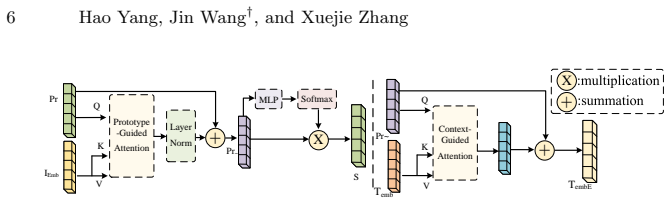
EVL-MCoT establishes that generating multiple, contrasting chain-of-thought rationales for each meme—one set explaining why the meme is hateful, one why it is benign—and then conditioning classification on both through prototype-guided and context-guided cross-attention yields state-of-the-art harmful meme detection. The prototype-guided decoder uses learnable prototypes as queries over visual tokens to form a global visual representation, while the context-guided decoder uses those same prototypes as queries over the text embeddings, injecting visual context into textual features. The final prediction is an alignment score between the fused visual representation and the concatenated enhance
What carries the argument
Multi-CoT generation paired with a dual-decoder framework. For each meme, a multimodal LLM is prompted to produce several hateful and several benign textual explanations; pairing every hateful explanation with every benign one creates n×m comparative reasoning pairs. The visual and text encoders are based on Long-CLIP, which handles the long CoT text. A prototype-guided decoder applies cross-attention where learnable prototypes query the visual tokens, then an attention-based fusion compresses them into one visual vector. A context-guided decoder applies cross-attention where the same prototypes query the text embeddings, producing visually-conditioned hateful and benign text representations
Load-bearing premise
The approach assumes the chain-of-thought explanations generated by the multimodal LLM are faithful descriptions of what is actually in the meme; the paper's own Figure 5 shows an explanation that attributes discriminatory language to an image that does not contain it, so if hallucinated rationales are common, the reported gains may not transfer.
What would settle it
Take the EVL-MCoT model and replace the MLLM-generated CoT explanations with (1) the meme's original text only, (2) random sentences, or (3) paraphrased but content-free explanations, while keeping the decoders unchanged. If accuracy on HatefulMemes and MultiOFF does not drop substantially relative to the reported numbers, the CoT content is not the source of the improvement; if it drops sharply, fidelity of the rationales is the load-bearing assumption.
If this is right
- If correct, multi-CoT offers a practical way to inject commonsense and cultural background into meme detection without extra labeled data.
- The prototype- and context-guided decoder design suggests a general recipe for aligning long textual rationales with visual evidence, transferable to other multimodal classification tasks.
- The strong results on TestUnseen indicate that this approach generalizes better to novel image-text combinations than previous dual-stream fusion models.
- Ablations show that both multiple reasoning paths and multiple steps are necessary, implying the reported performance is not from one component alone.
Where Pith is reading between the lines
- The reported gains may depend heavily on whether the MLLM-generated chain-of-thought explanations are faithful to the actual meme content; the paper's own Figure 5 shows a generated offensive rationale describing anti-Muslim language that does not appear in the meme, so if such hallucinations are common, the model could be fitting generated noise rather than genuine multimodal evidence.
- A simpler alternative—ensembling predictions from several single chain-of-thought runs—might capture part of the robustness gain without the added decoder complexity; the paper does not compare against that baseline.
- A direct test of the mechanism would be to replace MLLM-generated CoTs with random or content-free texts while keeping the decoders unchanged; if performance holds, the CoT content is not the source of the improvement, and if it drops, faithfulness is load-bearing.
- The approach naturally extends to related tasks such as identifying the target of a harmful meme or classifying hateful text with imagery, where multiple rationales could also help robustness.
Editorial analysis
A structured set of objections, weighed in public.
Referee Report
Summary. The paper proposes EVL-MCoT, a harmful meme detection method that generates multiple chain-of-thought (CoT) explanations from an MLLM under both hateful and benign prompts, encodes them with a frozen Long-CLIP text encoder, and fuses them with visual features via a prototype-guided decoder and a context-guided decoder. The authors report state-of-the-art results on HatefulMemes (75.88 ACC / 79.25 AUROC TestSeen; 75.57 ACC / 79.40 AUROC TestUnseen) and MultiOFF (70.0 ACC / 63.8 F1), with ablations showing the contribution of each component.
Significance. If the central empirical claim is valid, the combination of multi-perspective CoT with prototype/context-guided decoding is a plausible and potentially valuable direction for multimodal meme classification, and the public release of source code is a concrete strength. However, the current evidence is undermined by a training objective that is not well-defined as written, a label-conditioned CoT generation protocol that introduces a shortcut risk, demonstrated hallucination in generated CoTs, and numerical inconsistencies between the main tables and the ablation table. These issues must be resolved before the claimed superiority over baselines can be accepted.
major comments (4)
- [§3.4, Eq. (7)] The loss in Eq. (7) is not well-defined. Concat(AvgPool(T^h), AvgPool(T^b)) is in R^{2D} (each pooled feature is D-dimensional), while S is in R^D (from Eq. (5)), so the dot product is undefined. Moreover, cross-entropy is applied to a single scalar cosine similarity, not to a two-class logit vector. Please specify the projection (e.g., a linear layer to D) and the exact logit construction; if the implementation differs from the equation, the equation must be corrected. As written, the training objective cannot be executed.
- [§3.1 and Figure 2] CoT generation uses the prompt 'Please explain why this meme is hateful/benign' for every meme, and both a hateful and a benign chain are always provided to the classifier. The text encoder therefore sees rationales explicitly generated under opposite label hypotheses; differences in fluency, specificity, or even the presence of the words 'hateful'/'benign' can act as a soft label. Table 3's w/o-CoT ablation removes both chains but does not test a label-agnostic generation. Please add a control where CoTs are generated with a neutral instruction (e.g., 'explain this meme') or with the label words masked, and report whether the gains over that control are still substantial.
- [Figure 5] The offense_1 CoT in Figure 5 attributes to the meme 'strongly discriminatory language, including insulting remarks about Muslims' while the visible text is 'Go home, snail your are drunk' and the image is a goat/'eating dreams' motif. This is fabricated content. If such hallucination is common, the classifier may be fitting to generated narratives rather than to multimodal evidence. Please quantify the fidelity of the generated CoTs (e.g., by human evaluation or automatic consistency checks) and discuss the impact on the claimed improvement.
- [Table 1 vs. Table 3] Table 1 reports TestUnseen ACC=75.57 for EVL-MCoT; Table 3 reports 76.57 for the same condition. Similarly, MultiOFF ACC/F1 differ between Table 2 (70.0/63.8) and Table 3 (69.95/63.68). Please clarify whether these are different runs/settings or correct the values; the central SOTA claim rests on these numbers.
minor comments (6)
- [§4.4] The text says 'Removing CoT reasoning entirely (n=1, m=1)' but n=1,m=1 still uses one hateful and one benign CoT; either rename the condition or explain the intended meaning.
- [§3.1 and Figure 2] The prompt uses 'hateful/benign' while Figure 2 and the architecture labels use 'offensive'; please keep terminology consistent.
- [Figure 4] Figure 4 contains unresolved character strings (e.g., '/uni00000013/...') that should be removed; they appear to be PDF artifacts.
- [§3.2–3.3, Eq. (2), Eq. (6)] Tensor shapes for batch and sequence dimensions are not specified in Eqs. (2) and (6); clarify to make the dimensions reproducible.
- [§4.2] Report variance across multiple seeds or significance tests; as presented, the improvements may be within noise, especially for MultiOFF where the gains over VisualBERT are small.
- [References] Some references are incomplete or misformatted (e.g., [13] with only an arXiv URL); check the bibliography for consistency.
Circularity Check
No significant circularity: the empirical pipeline is externally benchmarked; label-conditioned CoT is a validity concern, not a definitional reduction.
full rationale
The paper makes no formal derivation claim that reduces to its inputs. The classifier loss (Eq. 7) uses ground-truth labels only in the cross-entropy term, not as a model input; both hateful and benign CoTs are generated for every meme (Fig. 2), so the class label is not a direct input feature. The prompt 'Please explain why this meme is hateful/benign' (Sec. 3.1) is label-conditioned, and Figure 5 shows one CoT hallucinating anti-Muslim content absent from the image; this is a legitimate concern about shortcut learning and faithfulness, but it is not an equation-level identity or a fitted-parameter-renamed-as-prediction. The reported gains are evaluated on held-out TestSeen/TestUnseen and MultiOFF against external baselines, so the central SOTA claim is empirically falsifiable rather than forced by construction. Self-citations (e.g., refs 14, 15, 25, 27, 28) appear only in related work or backbone selection and are not load-bearing. No uniqueness theorem or ansatz is imported from the authors' prior work. Hence no circular step meets the evidentiary bar.
Axiom & Free-Parameter Ledger
free parameters (7)
- Number of visual prototypes P =
Not reported in paper
- Number of hateful CoTs n =
3
- Number of benign CoTs m =
3
- Learnable temperature tau =
Learned during training
- Learning rate =
5e-5
- Weight decay =
0.01
- Batch size =
8
axioms (5)
- domain assumption Long-CLIP's extension of CLIP to 248-token context preserves cross-modal alignment needed for meme detection.
- domain assumption MLLMs (LLaVA/GPT-4) generate faithful, diverse CoT explanations relevant to the meme's actual content.
- domain assumption Cross-attention with learnable prototypes (Eqs. 2-6) improves alignment rather than simply overfitting the training set.
- domain assumption Hateful and benign CoT features are complementary and both needed; concatenating them (Eq. 7) yields class-discriminative signal.
- standard math Standard softmax attention and cross-entropy loss are valid optimization objectives.
invented entities (1)
-
Learnable visual prototype vectors P_r
no independent evidence
read the original abstract
MEMEs are widely used on the internet and often carry strong elements of sarcasm or irony. Understanding their hidden meanings typically requires a joint interpretation of text and vision. Existing methods focus on the dual-stream vision-language model to extract the visual and text simultaneously, which lacks background information and prior knowledge about the comprehensive explanation of MEME. One feasible option is to adopt chain-of-thought (CoT). However, the simple CoT approach lacks multi-perspective thinking, which may compromise the reliability of the resulting answers. Moreover, it often relies on shallow feature fusion, lacking the fusion of local details and fine-grained visual-prompt text alignment. This limitation prevents a deeper understanding of the intricate connections between the visual and the text. Herein, an enhanced vision-language multi-CoT (EVL-MCoT) approach is proposed to address these limitations. By promoting multi-CoT, EVL-MCoT enhances consistency and reduces bias in the decision-making process. Additionally, we design a prototype-guided and context-guided decoding framework, which incorporates visual prototypes to guide the fusion process and enables the model to align textual and visual information more precisely. We achieve promising results on the HatefulMemes and MultiOff datasets. The source code has been publicly released and is available at https://github.com/BGWH123/EVL-MCoT.
Figures




Reference graph
Works this paper leans on
-
[1]
Advances in Neural Information Processing Systems35, 23716–23736 (2022) 12 Hao Yang, Jin Wang †, and Xuejie Zhang
Alayrac, J.B., Donahue, J., Luc, P., Miech, A., Barr, I., Hasson, Y., Lenc, K., Mensch, A., Millican, K., Reynolds, M., et al.: Flamingo: a visual language model for few-shot learning. Advances in Neural Information Processing Systems35, 23716–23736 (2022) 12 Hao Yang, Jin Wang †, and Xuejie Zhang
2022
-
[2]
arXiv preprint arXiv:2306.16410 (2023)
Berrios, W., Mittal, G., Thrush, T., Kiela, D., Singh, A.: Towards language models that can see: Computer vision through the lens of natural language. arXiv preprint arXiv:2306.16410 (2023)
Pith/arXiv arXiv 2023
-
[3]
International Journal of Computer Vision132(2), 581–595 (2024)
Gao, P., Geng, S., Zhang, R., Ma, T., Fang, R., Zhang, Y., Li, H., Qiao, Y.: Clip-adapter: Better vision-language models with feature adapters. International Journal of Computer Vision132(2), 581–595 (2024)
2024
-
[4]
arXiv preprint arXiv:1705.00652 (2017)
Henderson, M., Al-Rfou, R., Strope, B., Sung, Y.H., Luk´ acs, L., Guo, R., Kumar, S., Miklos, B., Kurzweil, R.: Efficient natural language response suggestion for smart reply. arXiv preprint arXiv:1705.00652 (2017)
Pith/arXiv arXiv 2017
-
[5]
Kiela, D., Bhooshan, S., Firooz, H., Perez, E., Testuggine, D.: Super- vised multimodal bitransformers for classifying images and text (2020), https://arxiv.org/abs/1909.02950
Pith/arXiv arXiv 2020
-
[6]
Advances in Neural Information Processing Systems33, 2611–2624 (2020)
Kiela, D., Firooz, H., Mohan, A., Goswami, V., Singh, A., Ringshia, P., Testuggine, D.: The hateful memes challenge: Detecting hate speech in multimodal memes. Advances in Neural Information Processing Systems33, 2611–2624 (2020)
2020
-
[7]
In: Proceedings of the Second Workshop on NLP for Positive Impact (NLP4PI)
Kumar, G.K., Nandakumar, K.: Hate-CLIPper: Multimodal hateful meme classi- fication based on cross-modal interaction of CLIP features. In: Proceedings of the Second Workshop on NLP for Positive Impact (NLP4PI). pp. 171–183 (2022)
2022
-
[8]
In: Proceedings of the 2024 Confer- ence on Empirical Methods in Natural Language Processing
Kumari, G., Jain, K., Ekbal, A.: M3Hop-CoT: Misogynous meme identification with multimodal multi-hop chain-of-thought. In: Proceedings of the 2024 Confer- ence on Empirical Methods in Natural Language Processing. pp. 22105–22138 (Nov 2024)
2024
-
[9]
Lauren¸ con, H., Tronchon, L., Cord, M., Sanh, V.: What matters when building vision-language models? Advances in Neural Information Processing Systems37, 87874–87907 (2024)
2024
-
[10]
arXiv preprint arXiv:1908.03557 (2019)
Li, L.H., Yatskar, M., Yin, D., Hsieh, C.J., Chang, K.W.: Visualbert: A simple and performant baseline for vision and language. arXiv preprint arXiv:1908.03557 (2019)
Pith/arXiv arXiv 1908
-
[11]
In: Proceedings of the IEEE/CVF conference on computer vision and pattern recognition
Li, Y., Fan, H., Hu, R., Feichtenhofer, C., He, K.: Scaling language-image pre- training via masking. In: Proceedings of the IEEE/CVF conference on computer vision and pattern recognition. pp. 23390–23400 (2023)
2023
-
[12]
In: Proceedings of the ACM Web Conference 2024
Lin, H., Luo, Z., Gao, W., Ma, J., Wang, B., Yang, R.: Towards explainable harmful meme detection through multimodal debate between large language models. In: Proceedings of the ACM Web Conference 2024. pp. 2359–2370 (2024)
2024
-
[13]
Loshchilov, I., Hutter, F.: Decoupled weight decay regularization (2019), https://arxiv.org/abs/1711.05101
Pith/arXiv arXiv 2019
-
[14]
In: Proceedings of the 62nd Annual Meeting of the Association for Computational Linguistics (Volume 1: Long Papers)
Luo, X., Tang, Z., Wang, J., Zhang, X.: Zero-shot cross-domain dialogue state tracking via dual low-rank adaptation. In: Proceedings of the 62nd Annual Meeting of the Association for Computational Linguistics (Volume 1: Long Papers). pp. 5746–5765 (Aug 2024)
2024
-
[15]
In: Proceedings of the 2023 Conference on Empirical Methods in Natural Language Processing
Ma, X., Liu, J., Wang, J., Zhang, X.: FedID: Federated interactive distillation for large-scale pretraining language models. In: Proceedings of the 2023 Conference on Empirical Methods in Natural Language Processing. pp. 8566–8577 (Dec 2023)
2023
-
[16]
In: Findings of the Association for Computational Linguistics: ACL 2024
Nguyen, M.V., Luo, L., Shiri, F., Phung, D., Li, Y.F., Vu, T.T., Haffari, G.: Direct evaluation of chain-of-thought in multi-hop reasoning with knowledge graphs. In: Findings of the Association for Computational Linguistics: ACL 2024. pp. 2862– 2883 (2024)
2024
-
[17]
In: Findings of the Association for Computational Linguistics: ACL-IJCNLP 2021
Pramanick, S., Dimitrov, D., Mukherjee, R., Sharma, S., Akhtar, M.S., Nakov, P., Chakraborty, T.: Detecting harmful memes and their targets. In: Findings of the Association for Computational Linguistics: ACL-IJCNLP 2021. pp. 2783–2796 (2021) EVL-MCoT 13
2021
-
[18]
In: Proceedings of the 57th Annual Meeting of the Association for Computational Linguistics
Qiu, L., Xiao, Y., Qu, Y., Zhou, H., Li, L., Zhang, W., Yu, Y.: Dynamically fused graph network for multi-hop reasoning. In: Proceedings of the 57th Annual Meeting of the Association for Computational Linguistics. pp. 6140–6150 (2019)
2019
-
[19]
Advances in Neural Information Processing Systems36, 67551–67564 (2023)
Qu, L., Fu, K., Wang, M., Song, Z., et al.: The rise of ai language pathologists: Ex- ploring two-level prompt learning for few-shot weakly-supervised whole slide image classification. Advances in Neural Information Processing Systems36, 67551–67564 (2023)
2023
-
[20]
In: Proceedings of the 38th International Conference on Machine Learning
Radford, A., Kim, J.W., Hallacy, C., Ramesh, A., Goh, G., Agarwal, S., Sastry, G., Askell, A., Mishkin, P., Clark, J., Krueger, G., Sutskever, I.: Learning transfer- able visual models from natural language supervision. In: Proceedings of the 38th International Conference on Machine Learning. vol. 139, pp. 8748–8763 (2021)
2021
-
[21]
Advances in Neural Information Processing Systems28(2015)
Ren, S., He, K., Girshick, R., Sun, J.: Faster r-cnn: Towards real-time object de- tection with region proposal networks. Advances in Neural Information Processing Systems28(2015)
2015
-
[22]
In: Pro- ceedings of the Second Workshop on Trolling, Aggression and Cyberbullying
Suryawanshi, S., Chakravarthi, B.R., Arcan, M., Buitelaar, P.: Multimodal meme dataset (MultiOFF) for identifying offensive content in image and text. In: Pro- ceedings of the Second Workshop on Trolling, Aggression and Cyberbullying. pp. 32–41 (2020)
2020
-
[23]
In: Proceedings of the 2023 Conference on Empirical Methods in Natural Language Processing
Yoran, O., Wolfson, T., Bogin, B., Katz, U., Deutch, D., Berant, J.: Answering questions by meta-reasoning over multiple chains of thought. In: Proceedings of the 2023 Conference on Empirical Methods in Natural Language Processing. pp. 5942–5966 (2023)
2023
-
[24]
IEEE Transactions on Knowledge and Data Engineering37(1), 1–14 (2025)
Yuan, L., Cai, Y., Xu, J., Li, Q., Wang, T.: A fine-grained network for joint mul- timodal entity-relation extraction. IEEE Transactions on Knowledge and Data Engineering37(1), 1–14 (2025). https://doi.org/10.1109/TKDE.2024.3485107
arXiv 2025
-
[25]
IEEE Transactions on Affective Computing15(2), 722–735 (2024)
Yuan, L., Wang, J., Yu, L.C., Zhang, X.: Encoding syntactic infor- mation into transformers for aspect-based sentiment triplet extrac- tion. IEEE Transactions on Affective Computing15(2), 722–735 (2024). https://doi.org/10.1109/TAFFC.2023.3291730
arXiv 2024
-
[26]
In: European Conference on Computer Vision
Zhang, B., Zhang, P., Dong, X., Zang, Y., Wang, J.: Long-clip: Unlocking the long- text capability of clip. In: European Conference on Computer Vision. pp. 310–325 (2024)
2024
-
[27]
Zheng, G., Wang, J., Yu, L.C., Zhang, X.: Instruction tuning with retrieval-based examples ranking for aspect-based sentiment analysis (2024), https://arxiv.org/abs/2405.18035
Pith/arXiv arXiv 2024
-
[28]
In: Proceedings of the 2024 Joint International Conference on Computational Linguistics, Language Resources and Evaluation (LREC-COLING 2024)
Zheng, G., Wang, J., Zhou, X., Zhang, X.: Enhancing semantics in multimodal chain of thought via soft negative sampling. In: Proceedings of the 2024 Joint International Conference on Computational Linguistics, Language Resources and Evaluation (LREC-COLING 2024). pp. 6059–6076. Torino, Italia (May 2024)
2024
-
[29]
International Journal of Computer Vision130(9), 2337–2348 (2022)
Zhou, K., Yang, J., Loy, C.C., Liu, Z.: Learning to prompt for vision-language models. International Journal of Computer Vision130(9), 2337–2348 (2022)
2022
discussion (0)
Sign in with ORCID, Apple, or X to comment. Anyone can read and Pith papers without signing in.