REVIEW 4 major objections 5 minor 20 references
The paper establishes that in native multimodal pre-training, the compute-optimal allocation for language is invariant to data composition, while the multimodal allocation shifts sharply toward more tokens as the image-text ratio rises.
Reviewed by Pith at T0; open to challenge. T0 means a machine referee read the full paper against a public rubric. the ladder, T0–T4 →
T0 review · deepseek-v4-flash
2026-08-01 05:59 UTC pith:Z7RM57C2
load-bearing objection A competent per-objective scaling study whose headline asymmetry is not supported by its own envelope numbers — text and multimodal exponents decline by similar amounts, and the joint model assumes the conclusion. the 4 major comments →
Scaling Native Multimodal Pre-Training From Scratch
The pith
A machine-rendered reading of the paper's core claim, the machinery that carries it, and where it could break.
Core claim
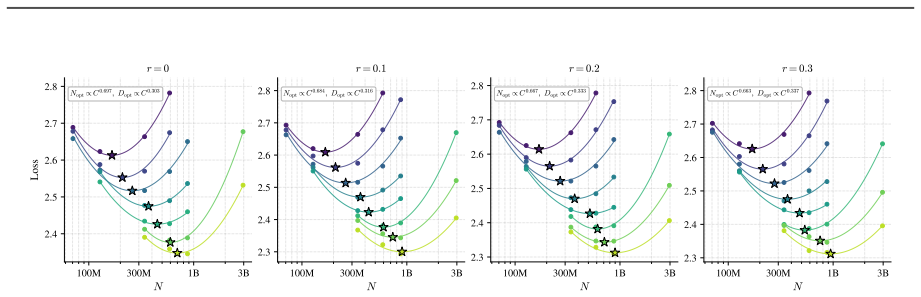
IsoFLOP profiles and training-curve envelopes show each objective's minimal loss follows a predictable compute law, with compute-optimal model size and token counts obeying Nopt(C)∝C^a and Dopt(C)∝C^b (a+b=1). The central discovery is an asymmetry: language allocation exponents stay nearly constant as the multimodal ratio r varies over {0,0.1,0.2,0.3}, while the multimodal exponent a declines from ≈0.71 (r=0.1) to ≈0.64 (r=0.3), flattening parameter scaling and pushing compute toward tokens. Pairing the invariant language law with the variant multimodal law traces a Pareto efficiency frontier: for any total compute, each point specifies optimal model size, text token count, and multimodal to
What carries the argument
The central machinery is the decoupled compute-optimal allocation: the joint objective is split into language loss Ltext and multimodal loss Lmm, each assigned its own effective compute C_text=6ND_text and C_mm=6ND_mm, with D_text=D/(1+r) and D_mm=rD/(1+r)—as if each objective trained under its own budget despite shared parameters. Two independent estimators—IsoFLOP profiles (parabola fit to loss vs log N at fixed compute) and training-curve envelopes (pooled lower envelope over all runs)—determine Nopt(C)∝C^a and Dopt(C)∝C^b. The load-bearing identity is a+b=1; its variation with r is the whole story. The joint Pareto analysis imposes an asymmetric model, pairing the invariant language law
Load-bearing premise
The paper assumes the language loss depends only on the effective text compute C_text=6ND_text and the multimodal loss only on C_mm=6ND_mm, treating the shared parameters as if each objective had its own budget; if text learning actually depends on the full token mix, the claimed invariance and variance are artifacts of that split.
What would settle it
Train two models at the same effective text compute C_text and model size N, one with r=0.1 and one with r=0.3, and compare the final text loss Ltext at identical (N, D_text); a systematic difference beyond noise would falsify the composition-invariant language law.
If this is right
- The efficiency frontier gives a concrete recipe: for any total compute budget and any target multimodal ratio r, it specifies the model size, text token count, and multimodal token count that minimize combined loss.
- The language allocation law is stable across r up to 0.3, so adding multimodal data does not force a re-optimization of text scaling or sacrifice text benchmark accuracy.
- As r increases, compute-optimal training shifts from parameter scaling to token scaling; for image-heavy mixtures, extra tokens reduce loss more than extra parameters.
- Native multimodal pre-training produces positive cross-modal transfer: abstract spatial reasoning in pure text improves with visual pretraining, and the gain widens with model scale.
- Multimodal in-context learning emerges with scale and data: few-shot gains over zero-shot rise from near zero at 71M parameters to +2.43 points at 3B, concentrated on spatial and relational tasks.
Where Pith is reading between the lines
- The invariance of the language law suggests the data ratio r could itself be a tunable knob, making the efficiency frontier imply an optimal r(C) strategy—at very large budgets, text-heavy mixtures may be preferred because parameter scaling is more compute-efficient; the paper does not derive this explicitly.
- Because the text loss is masked to text tokens only, image tokens may act as context rather than direct training signal; a natural extension is to test whether the composition invariance survives changes in sequence-level interleaving at fixed r.
- The concentration of in-context gains on spatial/relational tasks predicts that visual pretraining transfers to other abstract relational text tasks (geometry, graph reasoning, navigation); this is a testable downstream prediction beyond the paper's benchmarks.
- The two-law picture could be an artifact of the decoupled budget split; comparing against a model trained with a single aggregate loss under the same compute would show whether the asymmetry is real or coordinate-induced.
Editorial analysis
A structured set of objections, weighed in public.
Referee Report
Summary. The paper studies compute-optimal scaling for native multimodal pre-training from scratch. It decouples the training budget by modality (Ctext=6NDtext, Cmm=6NDmm, with Dtext=D/(1+r), Dmm=rD/(1+r)) and uses IsoFLOP profiles and training-curve envelopes to estimate allocation exponents a and b in Nopt∝C^a, Dopt∝C^b for each objective. The central claim is that the language allocation law is largely invariant to the multimodal ratio r, while the multimodal allocation law is highly composition-sensitive; the paper then derives a joint Pareto frontier and reports downstream text preservation, cross-modal transfer to spatial reasoning, and multimodal in-context learning. The empirical core is the asymmetry between the two objectives' scaling exponents as r varies over {0,0.1,0.2,0.3}.
Significance. If the claimed language/multimodal asymmetry were established, the paper would provide practically valuable guidance for allocating parameters and tokens in native multimodal pre-training, and the two-estimator design plus the broad downstream benchmark suite are genuine strengths. However, the present manuscript does not establish the asymmetry: the same estimator that allegedly shows a sharp multimodal decline shows a nearly identical envelope decline for text, no uncertainty intervals are reported, and the joint Pareto model hard-codes the invariance it claims to discover. The decoupling assumption and the undefined multimodal loss further undermine the central conclusion. With substantial revision, the study could become a useful contribution, but the current evidence is not sufficient for acceptance.
major comments (4)
- [§3.1, §3.2, Figs. 2 and 5] The central asymmetry is not supported by the paper's own envelope estimates. Text envelope a-values are 0.671 (r=0), 0.643 (r=0.1), 0.644 (r=0.2), 0.639 (r=0.3), a decline of ≈0.032; multimodal envelope a-values are 0.665 (r=0.1), 0.641 (r=0.2), 0.634 (r=0.3), a decline of ≈0.031. These declines are virtually identical in magnitude. Section 3.1 dismisses the text decrease as 'minor numerical drift' with 'no monotonic downward trend', while Section 3.2 calls the same-size multimodal decrease a 'sharp downward trajectory' and a 'robust scaling law.' No bootstrap intervals or standard errors are provided anywhere, and the multimodal fits cover only three r values (0.1, 0.2, 0.3) whereas the text fits include r=0. The paper therefore applies different evidentiary standards to the two objectives; as written, the headline invariance/sensitivity dichotomy is an unsupported interpretation of th
- [§3.3] The joint Pareto analysis assumes the asymmetry rather than testing it. The text explicitly says the framework 'pair[s] a composition-invariant language objective with a composition-variant multimodal objective' and that forcing the text exponent to fluctuate would introduce 'overfitting and localized optimization noise.' Figures 7(b) and 7(c) then display text as r-free and multimodal as r-dependent, but these outputs are consequences of the modeling assumption, not independent evidence. To validate the central claim, the authors need to fit a model that allows both exponents to depend on r and compare it to the constrained model, e.g., with a likelihood-ratio or information criterion. As it stands, §3.3 cannot corroborate the language-invariance result.
- [§2.1, Appendix A] The decoupling premise is load-bearing and is not tested. Equation (1) and the surrounding text define Ctext and Cmm by splitting the token budget according to r, as if each objective were trained under a separate compute budget despite fully shared parameters. All invariance/variance conclusions live inside this coordinate system. Moreover, Appendix A states that 'the training loss is computed only on text tokens, with vision tokens masked out from loss computation,' yet the paper analyzes a multimodal objective Lmm in Figures 4–6. The operational definition of Lmm is never given, and if vision tokens do not contribute to the loss, it is unclear what objective the multimodal scaling law describes. A concrete test of the decoupling assumption would fit Ltext as a function of Ctext and r (or Dmm) and test whether r enters significantly; the same should be done for Lmm. Without such a test
- [§2.2, §3.3, Figs. 2–7] No uncertainty quantification is provided for any fitted quantity—exponents a,b, the frontier parameters E, Cc, β, or the projected Pareto frontier. The paper extrapolates from compute budgets around 10^19–10^21 to 10^25 in Figure 7(a), but these 'predictions' are simply the fitted power laws of Eqs. (2)–(3) evaluated at larger C; they are not validated on held-out budgets. The authors should report standard errors or bootstrap confidence intervals for the exponent differences (especially the text-vs-multimodal declines) and perform an out-of-sample check, such as fitting on lower compute budgets and predicting a held-out higher budget. Without this, the sharpness of the claimed asymmetry and the reliability of the efficiency frontier cannot be assessed.
minor comments (5)
- [Eq. (3)] Equation (3) is called a 'power law,' but the additive irreducible loss E makes it a shifted power law. Please adjust the terminology for precision.
- [Figs. 3 and 6] The panel labels '(flat)' and '(vary with r)' in Figures 3(c) and 6(c) are interpretive conclusions, not neutral descriptions. Consider relabeling them descriptively (e.g., 'exponent estimates by r').
- [Appendix B] The benchmark name 'MMBenchen' appears to be a typo for 'MMBench-en.' Please correct it in Tables 6–8.
- [Fig. 8] Figure 8(b) labels the horizontal axis 'Text tokens Ntext (B)', but tokens are usually denoted D in this paper; please use consistent notation.
- [§4.2] The cross-modal transfer claim in Section 4.2 is based on two SpatialEval subtasks, and no significance testing or variance across seeds is reported. This is a supporting result, but the 'widening gap' statement should be softened or supplemented with error bars.
Circularity Check
The joint Pareto frontier hard-codes the claimed text-invariant / multimodal-variant asymmetry, and the projected efficiency frontier is the fitted power-law surface re-expressed as a prediction.
specific steps
-
self definitional
[Section 3.3, Joint Pareto Frontier (page 5)]
"To rigorously define this global architectural trade-off, we employ an asymmetric modeling framework based on our primary IsoFLOP estimator. Specifically, we pair a composition-invariant language objective with a composition-variant multimodal objective."
The Pareto model is built by assuming, not testing, the paper's central asymmetry. The subsequent frontier and the 'text (r-free)' versus multimodal exponents in Figure 7 are consequences of this assumed pairing, so the joint analysis cannot serve as evidence for the claimed language-invariance / multimodal-sensitivity duality. 'By capturing this empirical duality' presents the construction input as an empirical output.
-
fitted input called prediction
[Section 3.3 / Figure 7 (pages 5-6)]
"Projecting the globally optimal allocation exponents, a(r) and b(r), reveals that under a low multimodal ratio (r=0.1 ), optimal parameter scaling follows Nopt ∝C 0.69 total. However, increasing the multimodal allocation to r=0.3 imposes the substantial data requirements of dense multimodal inputs onto the entire system. This reduces the parameter scaling proportionality to C0.66 total, concurrently necessitating a more aggressive scaling of the system-wide token allocation (∝C 0.34 total)."
The numbers quoted are the fitted exponents a(r) from Equations (2)-(3) and Figures 1-6, re-expressed in the total-compute coordinate. The 'efficiency frontier' and the claim that text-heavy mixtures become compute-efficient only at larger scales are therefore evaluations of the fitted power law rather than independent predictions. The predictive content is forced by the fitted constants by construction.
full rationale
The paper's core decoupled fits are not themselves circular: models are actually trained at different multimodal ratios r, the language and multimodal losses are measured, and allocation exponents are fitted directly to those runs. Downstream evaluations on external benchmarks are also independent evidence for the transfer and in-context-learning claims. There is no load-bearing self-citation chain, and the decoupled-budget assumption (Ltext as a function only of Ctext, Lmm only of Cmm) is a strong modeling assumption rather than a definitional identity hiding the result. However, the joint Pareto section is circular with respect to its own headline asymmetry: it constructs the model by pairing a composition-invariant language objective with a composition-variant multimodal objective, then presents the resulting frontier as a derivation. Moreover, the projected large-compute frontier is just the fitted power-law surface evaluated at larger C; no withheld data or external check distinguishes it from the fit. Hence the central 'efficiency frontier' reduces by construction to the fitted exponents, while the decoupled empirical fits retain independent content. This warrants a partial circularity score rather than a full 8-10.
Axiom & Free-Parameter Ledger
free parameters (3)
- Frontier parameters E, Cc, β (per objective, per r) =
text r=0: E=1.503, Cc=9.7e19, β=0.130; mm r=0.3: E=0.001, Cc=4.5e26, β=0.070
- Allocation exponents a(r), b(r)=1-a(r) =
text a: 0.697→0.663 (IsoFLOP), 0.671→0.639 (envelope) across r=0→0.3; mm a: 0.709→0.643 (IsoFLOP), 0.665→0.634 (envelope
- Composition model (r-dependence of exponents and frontier) =
r ∈ {0, 0.1, 0.2, 0.3} (4 text, 3 multimodal support points)
axioms (8)
- standard math FLOPs(C) = 6ND with N the number of activated non-embedding parameters
- domain assumption The smoothed training loss proxies the objective loss under single-pass training
- domain assumption Functional forms L(C)=E+(Cc/C)^β and Nopt∝C^a, Dopt∝C^b
- ad hoc to paper Decoupling: Ltext depends only on Ctext=6NDtext and Lmm only on Cmm=6NDmm, with Dtext=D/(1+r), Dmm=rD/(1+r)
- domain assumption Loss masking: gradients flow only from text tokens; vision tokens contribute compute but no loss
- domain assumption The optimal loss vs log N at fixed compute is a parabola
- domain assumption MoE scaling tracks dense scaling as a function of activated parameters
- standard math Dopt = C/(6Nopt), so a+b=1
read the original abstract
Although large language models (LLMs) exhibit remarkable reasoning capabilities, their reliance on text-only pre-training restricts the perception of the multimodal physical world. Native multimodal pre-training avoids this limitation by training models from scratch on multimodal inputs, thereby achieving deep cross-modal integration and mitigating optimization asymmetries inherent to traditional late-fusion architectures. Despite these advantages, the scaling properties of this paradigm remain systematically uncharacterized. To address this gap, we investigate the optimal model size and token count for training a transformer-based vision-language model under a fixed computational budget. We demonstrate that minimal objective loss adheres to a predictable compute law, whereas compute-optimal model sizes and token counts scale as power laws. Notably, language and multimodal objectives manifest distinct scaling behaviors. The language allocation law is largely invariant to the composition of the data, indicating stable language learning regardless of the multimodal data ratio. Conversely, the multimodal allocation law is highly sensitive to this composition. Specifically, text-heavy mixtures become compute-efficient only at larger model scales, shifting the optimal resource allocation toward greater model capacity. Additionally, by modeling the influence of data composition on compute laws and allocation exponents, we derive an efficiency frontier specifying precise configurations of model size, token count, and data mixture. Downstream evaluations further reveal that native multimodal pre-training induces positive cross-modal transfer, thereby enhancing pure-text spatial reasoning and enabling robust multimodal in-context learning. In summary, this empirical research establishes the essential groundwork for predictably scaling multimodal foundation models.
Figures


Reference graph
Works this paper leans on
-
[1]
B Experiment Results This section details the comprehensive per-benchmark results supporting the analyses presented in Section 4, organized into three primary categories
A71M A128M A340M A590M A874M A3B Architecture Configurations layers 11 15 19 23 27 48 hidden size 640 768 1152 1280 1536 2048 FFN hidden size 2048 2048 3072 4096 4096 6912 attention heads 8 12 16 20 24 32 query groups 4 kv channels 128 total experts 128 activated experts 8 expert FFN hidden size 256 256 384 512 512 768 shared-expert hidden size 256 256 38...
2048
-
[3]
SuperGPQA: Scaling LLM Evaluation Across 285 Graduate Disciplines.arXiv preprint arXiv:2502.14739,
Xinrun Du, Yifan Yao, Kaijing Ma, Bingli Wang, Tianyu Zheng, King Zhu, Minghao Liu, Yiming Liang, Xiaolong Jin, Zhenlin Wei, et al. SuperGPQA: Scaling LLM Evaluation Across 285 Graduate Disciplines.arXiv preprint arXiv:2502.14739,
-
[7]
Mandar Joshi, Eunsol Choi, Daniel S Weld, and Luke Zettlemoyer. TriviaQA: A Large Scale Distantly Supervised Challenge Dataset for Reading Comprehension.arXiv preprint arXiv:1705.03551,
-
[11]
SocialiQA: Commonsense Reasoning about Social Interactions.arXiv preprint arXiv:1904.09728,
Maarten Sap, Hannah Rashkin, Derek Chen, Ronan LeBras, and Yejin Choi. SocialiQA: Commonsense Reasoning about Social Interactions.arXiv preprint arXiv:1904.09728,
Pith/arXiv arXiv 1904
-
[13]
CountQA: How Well Do MLLMs Count in the Wild?arXiv preprint arXiv:2508.06585,
11 Jayant Sravan Tamarapalli, Rynaa Grover, Nilay Pande, and Sahiti Yerramilli. CountQA: How Well Do MLLMs Count in the Wild?arXiv preprint arXiv:2508.06585,
-
[14]
Beyond Language Modeling: An Exploration of Multimodal Pretraining
Shengbang Tong, David Fan, John Nguyen, Ellis Brown, Gaoyue Zhou, Shengyi Qian, Boyang Zheng, Th´eophane Vallaeys, Junlin Han, Rob Fergus, et al. Beyond Language Modeling: An Exploration of Multimodal Pretraining. arXiv preprint arXiv:2603.03276,
-
[15]
Michael Tschannen, Alexey Gritsenko, Xiao Wang, Muhammad Ferjad Naeem, Ibrahim Alabdulmohsin, Nikhil Parthasarathy, Talfan Evans, Lucas Beyer, Ye Xia, Basil Mustafa, et al. SigLIP 2: Multilingual Vision- Language Encoders with Improved Semantic Understanding, Localization, and Dense Features.arXiv preprint arXiv:2502.14786,
-
[16]
Yijia Xiao, Edward Sun, Tianyu Liu, and Wei Wang. Logicvista: Multimodal LLM Logical Reasoning Benchmark in Visual Contexts.arXiv preprint arXiv:2407.04973,
-
[17]
Hellaswag: Can A Machine Really Finish Your Sentence?arXiv preprint arXiv:1905.07830,
Rowan Zellers, Ari Holtzman, Yonatan Bisk, Ali Farhadi, and Yejin Choi. Hellaswag: Can A Machine Really Finish Your Sentence?arXiv preprint arXiv:1905.07830,
Pith/arXiv arXiv 1905
-
[18]
AGIEval: A Human-Centric Benchmark for Evaluating Foundation Models.arXiv preprint arXiv:2304.06364,
Wanjun Zhong, Ruixiang Cui, Yiduo Guo, Yaobo Liang, Shuai Lu, Yanlin Wang, Amin Saied, Weizhu Chen, and Nan Duan. AGIEval: A Human-Centric Benchmark for Evaluating Foundation Models.arXiv preprint arXiv:2304.06364,
-
[2016]
Kimi K2.5: Visual Agentic Intelligence.arXiv preprint arXiv:2602.02276,
Kimi, Tongtong Bai, Yifan Bai, Yiping Bao, SH Cai, Yuan Cao, Y Charles, HS Che, Cheng Chen, Guanduo Chen, et al. Kimi K2.5: Visual Agentic Intelligence.arXiv preprint arXiv:2602.02276,
-
[2017]
Scaling Laws for Neural Language Models.arXiv preprint arXiv:2001.08361,
Jared Kaplan, Sam McCandlish, Tom Henighan, Tom B Brown, Benjamin Chess, Rewon Child, Scott Gray, Alec Radford, Jeffrey Wu, and Dario Amodei. Scaling Laws for Neural Language Models.arXiv preprint arXiv:2001.08361,
Pith/arXiv arXiv 2001
-
[2019]
Mirac Suzgun, Nathan Scales, Nathanael Sch¨arli, Sebastian Gehrmann, Yi Tay, Hyung Won Chung, Aakanksha Chowdhery, Quoc V Le, Ed H Chi, Denny Zhou, et al. Challenging Big-Bench Tasks and Whether Chain-of- Thought Can Solve Them.arXiv preprint arXiv:2210.09261,
-
[2020]
Training Compute-Optimal Large Language Models.arXiv preprint arXiv:2203.15556,
Jordan Hoffmann, Sebastian Borgeaud, Arthur Mensch, Elena Buchatskaya, Trevor Cai, Eliza Rutherford, DDL Casas, Lisa Anne Hendricks, Johannes Welbl, Aidan Clark, et al. Training Compute-Optimal Large Language Models.arXiv preprint arXiv:2203.15556,
-
[2021]
Emu3.5: Native Multimodal Models are World Learners.arXiv preprint arXiv:2510.26583,
Yufeng Cui, Honghao Chen, Haoge Deng, Xu Huang, Xinghang Li, Jirong Liu, Yang Liu, Zhuoyan Luo, Jin- sheng Wang, Wenxuan Wang, et al. Emu3.5: Native Multimodal Models are World Learners.arXiv preprint arXiv:2510.26583,
-
[2022]
Mengdi Jia, Zekun Qi, Shaochen Zhang, Wenyao Zhang, Xinqiang Yu, Jiawei He, He Wang, and Li Yi. OmniS- patial: Towards Comprehensive Spatial Reasoning Benchmark for Vision Language Models.arXiv preprint arXiv:2506.03135,
-
[2024]
Measuring Massive Multitask Language Understanding.arXiv preprint arXiv:2009.03300,
Dan Hendrycks, Collin Burns, Steven Basart, Andy Zou, Mantas Mazeika, Dawn Song, and Jacob Steinhardt. Measuring Massive Multitask Language Understanding.arXiv preprint arXiv:2009.03300,
Pith/arXiv arXiv 2009
-
[2025]
Training Verifiers to Solve Math Word Problems.arXiv preprint arXiv:2110.14168,
Karl Cobbe, Vineet Kosaraju, Mohammad Bavarian, Mark Chen, Heewoo Jun, Lukasz Kaiser, Matthias Plappert, Jerry Tworek, Jacob Hilton, Reiichiro Nakano, et al. Training Verifiers to Solve Math Word Problems.arXiv preprint arXiv:2110.14168,
-
[2026]
DeepSeek-V3 Technical Report.arXiv preprint arXiv:2412.19437, 2024a
Aixin Liu, Bei Feng, Bing Xue, Bingxuan Wang, Bochao Wu, Chengda Lu, Chenggang Zhao, Chengqi Deng, Chenyu Zhang, Chong Ruan, et al. DeepSeek-V3 Technical Report.arXiv preprint arXiv:2412.19437, 2024a. Haotian Liu, Chunyuan Li, Qingyang Wu, and Yong Jae Lee. Visual Instruction Tuning. InAnnual Conference on Neural Information Processing Systems (NIPS), 202...
-
[4096]
We detail the specific architecture configurations and training settings in Table
The training loss is computed only on text tokens, with vision tokens masked out from loss computation (Kimi et al., 2026). We detail the specific architecture configurations and training settings in Table
2026
discussion (0)
Sign in with ORCID, Apple, or X to comment. Anyone can read and Pith papers without signing in.