REVIEW 4 major objections 3 minor 47 references
Training physics-informed networks on a shared latent geometry, with PDE residuals pulled back through the deformation gradient, yields large accuracy gains on unseen rotated geometries when training data is scarce.
Reviewed by Pith at T0; open to challenge. T0 means a machine referee read the full paper against a public rubric. the ladder, T0–T4 →
T0 review · deepseek-v4-flash
2026-08-01 05:26 UTC pith:JJ7OPHBJ
load-bearing objection The pullback idea is standard, but this is a careful, honestly reported test of it on a hard nonlinear PDE with limited data; the big wins on rotations are real but rest on single runs, and the advertised shape-gradient mechanism is not what was actually implemented. the 4 major comments →
Latent PDE mapping for efficient physics-informed learning across geometries with limited data
The pith
A machine-rendered reading of the paper's core claim, the machinery that carries it, and where it could break.
Core claim
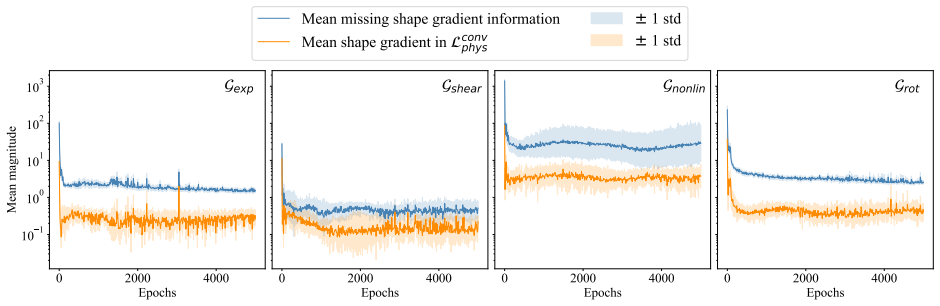
Latent PDE mapping turns a geometry-dependent training problem into a parametric one: the PDE residual and boundary conditions are rewritten on a fixed reference domain with the deformation gradient F and Jacobian J encoding each geometry. The authors show that conventional physics losses implicitly drop a boundary-motion term when taking shape derivatives, whereas the mapped formulation lets the network's geometry sensitivity flow through the solution on a fixed domain. On the Aliev-Panfilov model, this yields error reductions of 4.3x in 2D rotation families and 3.9-5.1x in 3D rotations about the y- and z-axes, where rotations alter the fiber orientation and therefore the solution most.
What carries the argument
The deformation gradient F(X,s)=∇_X Φ^{-1}(X,s) and its determinant J, used to pull back the strong-form PDE, boundary conditions, and data from each physical geometry to a preselected latent domain. In the implementation, F and J are precomputed per geometry and treated as constant coefficient fields during training, so the shape gradient actually computed is the solution sensitivity ∂V/∂s and ∂W/∂s, not the deformation-map sensitivity ∂F/∂s and ∂J/∂s.
Load-bearing premise
The method assumes an exact deformation gradient from each physical geometry to the latent one, and the implemented training treats F and J as frozen constants, so if real geometries lack known maps or the map's own sensitivity matters, the advertised shape-gradient mechanism and practical applicability are unsupported.
What would settle it
Compute the two deformation-map sensitivity terms ∂R/∂F · ∂F/∂s and ∂R/∂J · ∂J/∂s for the rotation families and check whether their magnitudes are negligible against the solution-sensitivity terms; alternatively, run latent PDE mapping on geometries whose deformation gradient is approximated by noisy or estimated maps and see whether the 4-6x advantage over baselines disappears.
If this is right
- In geometric families where boundary motion is large and the PDE solution changes substantially, latent PDE mapping gives roughly 4-6x lower mean relative L2 error than latent-geometry-only baselines, across two network architectures and two geometric descriptors.
- Because the PDE is evaluated on a fixed latent domain, collocation points can be shared across geometries, and the added cost is modest during training and negligible at inference since F and J are computed once during meshing.
- The framework is architecture-agnostic and formulated for diffeomorphic geometries, so the same pull-back construction can be attached to graph networks, neural operators, or other physics-informed backbones.
- The paper's numerical quantification shows that the boundary-motion term neglected by conventional physics losses is larger than the retained shape gradient in every 2D family tested, giving a concrete diagnostic for when latent PDE mapping should help.
- Effectiveness persists when geometries are described by PCA scores rather than explicit deformation parameters, which is the more realistic setting for anatomical populations.
Where Pith is reading between the lines
- The theoretical motivation advertises the full shape gradient including ∂F/∂s and ∂J/∂s, but the experiments freeze F and J; if those deformation-map sensitivity terms are non-negligible, the empirical gains may come less from 'accurate shape gradients' than from simply evaluating residuals on a fixed reference domain.
- A testable screening rule follows from the paper's own measurements: latent PDE mapping should help most when the boundary-motion term ∂x/∂s·n is large and the residual on the boundary is non-negligible, which is consistent with the small gains on expansion and shear families.
- For real-world anatomies without closed-form deformation maps, the method would need numerically estimated F and J; performance likely degrades with map-error, and the paper leaves this unquantified.
- Static deformations are assumed throughout; time-dependent or moving-boundary problems would require reinstating the dropped ∂F/∂s and ∂J/∂s terms, so the practical extension to morphing geometries is an open question.
Editorial analysis
A structured set of objections, weighed in public.
Referee Report
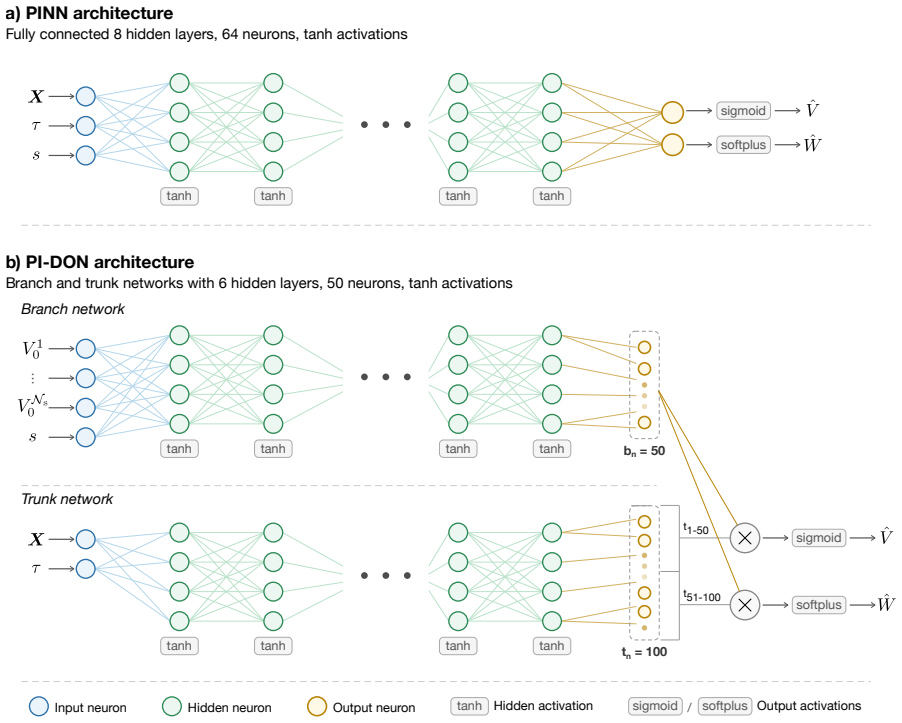
Summary. This paper proposes latent PDE mapping (LPM), a method for training physics-informed neural networks (PINNs and PI-DONs) on families of geometries. The PDE residual and boundary terms are pulled back from physical domains Ω(s) to a fixed latent domain Ω0 using the deformation gradient F and Jacobian J, and the solution is represented as a function of latent coordinates and a shape descriptor s. The method is instantiated on the anisotropic Aliev–Panfilov cardiac electrophysiology model in 2D and 3D, with training on 10 geometries per family and evaluation on held-out internal and external parameter ranges. The reported mean relative L2 errors show consistent but modest gains on expansion/shear families and large gains on rotation families, with a ~4–6× reduction claimed on external rotations. Ablations include LG-PINN/DON (latent geometry but no residual pullback), PA-PINN, and Basic-PINN, with either deformation parameters or PCA scores as shape descriptors.
Significance. The underlying pullback construction is mathematically standard and clearly presented; if the empirical claims hold, LPM would be a useful, architecture-agnostic ingredient for geometry-generalizable physics-informed models. The paper deserves credit for a detailed derivation, public synthetic data, and a broader comparison than many PINN papers. However, the headline quantitative claims hinge on experimental details that are not yet established: the external rotation families may not actually be outside the training distribution under 180° symmetry, all results are single-seed, and the implemented loss does not exercise the full advertised shape gradient. The significance of the contribution therefore remains conditional.
major comments (4)
- [Section 2.2 / Table 1 / Tables 3–4] The claimed out-of-distribution gains on rotation families are undermined by a symmetry degeneracy. Under the natural centered-coordinate interpretation of the latent square/cube, rotation by θ+180° maps Ω0 to itself, and since the diffusion tensor D is invariant under R180 (D = R180 D R180^T), the physical problem for θ+180° is identical to that for θ. Because G*_rot / H*_rot are defined only by θ ∉ [-90,90], every external angle is equivalent to an internal one (e.g., 120° ≡ -60°). Thus the ~4.3–5.1× improvements on G*_rot, Hy*_rot, Hz*_rot in Tables 3–4 do not demonstrate generalization to unseen geometries. Please either use a latent geometry without 180° symmetry or choose an external range within one symmetry period (e.g., internal [-45,45], external [45,135] with endpoints excluded).
- [Section 4.1 / Tables 3–4] No multi-seed evaluation is reported. The ± values in Tables 3 and 4 are standard deviations across test geometries for a single training run; the paired Wilcoxon tests treat each geometry as an independent observation from that one run and cannot quantify stochastic variability. As the authors acknowledge in Section 4.1, the influence of random initialization is unquantified. The central claim of 'generalizable models from limited data' requires at least 3–5 seeds per configuration with the resulting error distributions reported, especially for the headline rotation-family comparisons.
- [Section 2.1.2 / Eq. (12) / Appendix A.1, Eq. (34)] The implemented shape gradient drops the deformation-map sensitivity terms. The text claims Eq. (12) computes the shape gradient directly and that 'the integrand does not vary with s', but R_LPM in Eq. (6) depends on s through F and J; the full chain rule in Eq. (33) includes ∂R/∂F ∂F/∂s and ∂R/∂J ∂J/∂s. In training these terms are absent because F and J are precomputed and treated as constant coefficient fields (Appendix A.1). Consequently, the advertised mechanism—accurate shape-gradient calculation—is not what is exercised in the experiments; only the solution-sensitivity part (34) remains. Please either implement the full gradient or revise the motivation/claims to state that the benefit of LPM in these experiments comes from the residual pullback itself, not from deformation-map gradients.
- [Section 2.2] The PCA descriptors are constructed using all 85 geometries, including the 35 external test geometries ('The sampled geometries covered the full parameter ranges of the internal and external geometric families... n=85'). The test points therefore influence the PCA basis and the scores used as network inputs. This is a form of test leakage for the PCA experiments in Tables 3 and 4 and weakens the claim that LPM works with low-dimensional descriptors on unseen geometries. PCA should be fit on the training geometries only, or the experiment should be repeated in a fully nested fashion.
minor comments (3)
- [Appendix A, Eq. (30)] The boundary-condition integral should be over ∂Ω0 with dS, not over Ω0 with dΩ0; the current equation is dimensionally inconsistent.
- [Section 2.1.2] The sentence 'the integrand does not vary with s' is inaccurate: R_LPM depends on s through F, J, and u. Consider rephrasing to 'the integration domain does not vary with s'.
- [Tables 3–4] The text refers to 'best and second-best performing models'; please clarify explicitly that comparisons are within each architecture (PINN vs PINN, DON vs DON), as a reader may otherwise attempt cross-architecture comparisons that the paper says are out of scope.
Circularity Check
No circularity: latent PDE mapping is standard pullback calculus with predictions scored against independent FEM solutions; acknowledged limitations are robustness issues, not circular reasoning.
full rationale
The central derivation (Eq. 5-8; Appendix A) is a textbook change-of-variables: the residual on Ω(s) is pulled back to Ω0 via F = ∇X Φ^{-1} and J = det F, giving Eq. 8. This is not defined in terms of the quantity being predicted: the prediction target is the FEM transmembrane potential from openCARP, and accuracy is measured with the independent relative L2 error in Eq. 20. No fitted constant is renamed as a prediction, no self-citation carries the argument (the authors do not cite their own prior work as load-bearing), and no uniqueness theorem is imported to force the choice of mapping. The paper's stated limitations are real but not circular: Section 4.1 acknowledges 'reported experiments were conducted without a systematic evaluation across multiple random seeds' (statistical robustness); Appendix A.1 states F and J 'were not part of the computational graph' so the implemented shape gradient is Eq. 34, not the full Eq. 33 (theory-implementation gap); and the PCA descriptors in Section 2.2 are computed over the combined internal/external sample, a possible leakage concern. Each of these affects how strongly the empirical claims can be trusted, but none makes the derivation equivalent to its inputs. The pullback is a genuine transformation of the PDE residual, and the claimed improvements are evaluated against an external FEM benchmark, not against the method's own outputs.
Axiom & Free-Parameter Ledger
free parameters (4)
- latent geometry choice =
10×10 mm square (2D); 10×10×10 mm cube (3D)
- loss weights =
equal weights (1) on data/phys/bc/ic terms
- PCA descriptor dimension =
2 principal components
- train/validation/test split sizes =
10 train / 5 validation / 35 internal test / 35 external test per family
axioms (6)
- domain assumption A diffeomorphic map Φ(s): x(s)→X exists between each physical geometry and the latent geometry
- domain assumption F is invertible
- domain assumption The mapping is time-independent
- ad hoc to paper F and J can be treated as constant coefficient fields during training
- domain assumption FEM solutions from openCARP are accurate enough as ground truth
- standard math Neural network training reaches a low enough loss for generalization comparisons to be meaningful
read the original abstract
In this study, we introduce latent PDE mapping, a broadly applicable physics-informed learning technique designed to enable efficient geometric generalization with sparse training data. Latent PDE mapping pulls back geometry-specific PDE residuals and boundary conditions to a predefined latent geometry via the deformation gradient, thereby enabling the automated calculation of geometry-consistent shape gradients that are missing in conventional physics-informed machine learning formulations. We demonstrate the utility of latent PDE mapping in solving the anisotropic Aliev-Panfilov PDE of cardiac electrophysiology using both physics-informed neural networks and physics-informed deep operator networks. The Aliev-Panfilov PDE serves as a challenging exemplar: a nonlinear, time-dependent PDE benchmark with sharp gradients that are expensive to capture using traditional numerical solvers. To represent the limited data regime, we train the networks using just fifteen geometric samples drawn from parameterized distributions in two and three spatial dimensions. While modest improvements appear for geometries parameterized by affine and shear deformations, latent PDE mapping demonstrates significant benefits on select geometric families, achieving a factor ~4-6 reduction in mean relative L2 error. Furthermore, our results show that the computational cost of applying latent PDE mapping was modest during network training, and negligible at inference. Taken together, our study highlights how latent PDE mapping facilitates the creation of generalizable physics-informed machine learning models from limited sets of training geometries.
Figures





Reference graph
Works this paper leans on
-
[1]
Meshless physics-informed deep learning method for three-dimensional solid mechanics
Abueidda, D.W., Lu, Q., Koric, S., 2021. Meshless physics-informed deep learning method for three-dimensional solid mechanics. International Journal for Numerical Methods in Engineering 122, 7182–7201
2021
-
[2]
Machine learning in fluid dynamics—physics- informed neural networks (pinns) using sparse data: A review
Ali, M., Miron, P., Mönnigmann, M., Nikolay, B., et al., 2025. Machine learning in fluid dynamics—physics- informed neural networks (pinns) using sparse data: A review. Fluids 10, 226
2025
-
[3]
A simple two-variable model of cardiac excitation
Aliev, R.R., Panfilov, A.V ., 1996. A simple two-variable model of cardiac excitation. Chaos, Solitons & Fractals 7, 293–301
1996
-
[4]
Uncovering near-wall blood flow from sparse data with physics- informed neural networks
Arzani, A., Wang, J.X., D’Souza, R.M., 2021. Uncovering near-wall blood flow from sparse data with physics- informed neural networks. Physics of Fluids 33
2021
-
[5]
Physics-informed neural networks for transformed geometries and manifolds
Burbulla, S., 2023. Physics-informed neural networks for transformed geometries and manifolds. arXiv preprint arXiv:2311.15940
Pith/arXiv arXiv 2023
-
[6]
Solved in unit domain: Jacobinet for differentiable coordinate-transformed pinns
Chen, X., Yang, J., Zhang, J., Yang, R., Liu, X., Wang, H., Zheng, T., Ren, Z., Hu, W., 2026. Solved in unit domain: Jacobinet for differentiable coordinate-transformed pinns. Journal of Computational Physics 563, 115074
2026
-
[7]
Engineering Applications of Artificial Intelligence 127, 107324
Costabal, F.S., Pezzuto, S., Perdikaris, P., 2024.δ-pinns: physics-informed neural networks on complex geometries. Engineering Applications of Artificial Intelligence 127, 107324
2024
-
[8]
Scientific machine learning through physics–informed neural networks: Where we are and what’s next
Cuomo, S., Di Cola, V .S., Giampaolo, F., Rozza, G., Raissi, M., Piccialli, F., 2022. Scientific machine learning through physics–informed neural networks: Where we are and what’s next. Journal of Scientific Computing 92, 88
2022
-
[9]
Physics-informed graph neural network emulation of soft-tissue mechanics
Dalton, D., Husmeier, D., Gao, H., 2023. Physics-informed graph neural network emulation of soft-tissue mechanics. Computer Methods in Applied Mechanics and Engineering 417, 116351
2023
-
[10]
Pinning cerebral blood flow: analysis of perfusion mri in infants using physics-informed neural networks
Galazis, C., Chiu, C.E., Arichi, T., Bharath, A.A., Varela, M., 2025. Pinning cerebral blood flow: analysis of perfusion mri in infants using physics-informed neural networks. Frontiers in network physiology 5, 1488349
2025
-
[11]
Phygeonet: Physics-informed geometry-adaptive convolutional neural networks for solving parameterized steady-state pdes on irregular domain
Gao, H., Sun, L., Wang, J.X., 2021. Phygeonet: Physics-informed geometry-adaptive convolutional neural networks for solving parameterized steady-state pdes on irregular domain. Journal of Computational Physics 428, 110079
2021
-
[12]
Physics-informed graph neural galerkin networks: A unified framework for solving pde-governed forward and inverse problems
Gao, H., Zahr, M.J., Wang, J.X., 2022. Physics-informed graph neural galerkin networks: A unified framework for solving pde-governed forward and inverse problems. Computer Methods in Applied Mechanics and Engineering 390, 114502
2022
-
[13]
Physics-informed deep neural operator networks, in: Machine learning in modeling and simulation: methods and applications
Goswami, S., Bora, A., Yu, Y ., Karniadakis, G.E., 2023. Physics-informed deep neural operator networks, in: Machine learning in modeling and simulation: methods and applications. Springer, pp. 219–254
2023
-
[14]
B-spline curve theory: An overview and applications in real life
Hasan, M.S., Alam, M.N., Fayz-Al-Asad, M., Muhammad, N., Tunç, C., 2024. B-spline curve theory: An overview and applications in real life. Nonlinear Engineering 13, 20240054
2024
-
[15]
Nonlinear Solid Mechanics: A Continuum Approach for Engineering
Holzapfel, G.A., 2000. Nonlinear Solid Mechanics: A Continuum Approach for Engineering. Wiley
2000
-
[16]
Principal component analysis: a review and recent developments
Jolliffe, I.T., Cadima, J., 2016. Principal component analysis: a review and recent developments. Philosophical transactions of the royal society A: Mathematical, Physical and Engineering Sciences 374, 20150202
2016
-
[17]
Physics-informed machine learning
Karniadakis, G.E., Kevrekidis, I.G., Lu, L., Perdikaris, P., Wang, S., Yang, L., 2021. Physics-informed machine learning. Nature Reviews Physics 3, 422–440
2021
-
[18]
Physics-informed latent neural operator for real-time predictions of time-dependent parametric pdes
Karumuri, S., Graham-Brady, L., Goswami, S., 2026. Physics-informed latent neural operator for real-time predictions of time-dependent parametric pdes. Computer Methods in Applied Mechanics and Engineering 450, 118599. 23
2026
-
[19]
Physics-informed pointnet: A deep learning solver for steady-state incompressible flows and thermal fields on multiple sets of irregular geometries
Kashefi, A., Mukerji, T., 2022. Physics-informed pointnet: A deep learning solver for steady-state incompressible flows and thermal fields on multiple sets of irregular geometries. Journal of Computational Physics 468, 111510
2022
-
[20]
Fourier neural operator with learned deformations for pdes on general geometries
Li, Z., Huang, D.Z., Liu, B., Anandkumar, A., 2023a. Fourier neural operator with learned deformations for pdes on general geometries. Journal of Machine Learning Research 24, 1–26
-
[21]
Geometry-informed neural operator for large-scale 3d pdes
Li, Z., Kovachki, N., Choy, C., Li, B., Kossaifi, J., Otta, S., Nabian, M.A., Stadler, M., Hundt, C., Azizzadenesheli, K., et al., 2023b. Geometry-informed neural operator for large-scale 3d pdes. Advances in Neural Information Processing Systems 36, 35836–35854
-
[22]
Lu, L., Jin, P., Karniadakis, G.E., 2019. Deeponet: Learning nonlinear operators for identifying differential equations based on the universal approximation theorem of operators. arXiv preprint arXiv:1910.03193
Pith/arXiv arXiv 2019
-
[23]
Aerodynamic shape optimization investigations of the common research model wing benchmark
Lyu, Z., Kenway, G.K., Martins, J.R., 2015. Aerodynamic shape optimization investigations of the common research model wing benchmark. AIAA journal 53, 968–985
2015
-
[24]
Right ventricular shape and function: cardiovascular magnetic resonance reference morphology and biventricular risk factor morphometrics in uk biobank
Mauger, C., Gilbert, K., Lee, A.M., Sanghvi, M.M., Aung, N., Fung, K., Carapella, V ., Piechnik, S.K., Neubauer, S., Petersen, S.E., et al., 2019. Right ventricular shape and function: cardiovascular magnetic resonance reference morphology and biventricular risk factor morphometrics in uk biobank. Journal of Cardiovascular Magnetic Resonance 21, 41
2019
-
[25]
A framework for physics-informed deep learning over freeform domains
Mezzadri, F., Gasick, J., Qian, X., 2023. A framework for physics-informed deep learning over freeform domains. Computer-Aided Design 160, 103520
2023
-
[26]
A bi-atrial statistical shape model for large-scale in silico studies of human atria: model development and application to ecg simulations
Nagel, C., Schuler, S., Dössel, O., Loewe, A., 2021. A bi-atrial statistical shape model for large-scale in silico studies of human atria: model development and application to ecg simulations. Medical Image Analysis 74, 102210
2021
-
[27]
Verification of cardiac tissue electrophysiology simulators using an n-version benchmark
Niederer, S.A., Kerfoot, E., Benson, A.P., Bernabeu, M.O., Bernus, O., Bradley, C., Cherry, E.M., Clayton, R., Fenton, F.H., Garny, A., et al., 2011. Verification of cardiac tissue electrophysiology simulators using an n-version benchmark. Philosophical Transactions of the Royal Society A: Mathematical, Physical and Engineering Sciences 369, 4331–4351
2011
-
[28]
Scaling digital twins from the artisanal to the industrial
Niederer, S.A., Sacks, M.S., Girolami, M., Willcox, K., 2021. Scaling digital twins from the artisanal to the industrial. Nature Computational Science 1, 313–320
2021
-
[29]
An active strain electromechanical model for cardiac tissue
Nobile, F., Quarteroni, A., Ruiz-Baier, R., 2012. An active strain electromechanical model for cardiac tissue. International journal for numerical methods in biomedical engineering 28, 52–71
2012
-
[30]
Geometry aware physics informed neural network surrogate for solving navier–stokes equation (gapinn)
Oldenburg, J., Borowski, F., Öner, A., Schmitz, K.P., Stiehm, M., 2022. Geometry aware physics informed neural network surrogate for solving navier–stokes equation (gapinn). Advanced Modeling and Simulation in Engineering Sciences 9, 8
2022
-
[31]
openCARP consortium, Augustin, C., Boyle, P.M., Loechner, V ., Colin, R., Huppé, A., Gsell, M., Houillon, M., Huang, Y .L.C., Hustad, K.G., Karabelas, E., Loewe, A., Myklebust, L., Neic, A., Nothstein, M., Plank, G., Prassl, A., Sánchez, J., Seemann, G., Stary, T., Thangamani, A., Tippmann, N., Trevisan Jost, T., Vigmond, E., Wülfers, E.M., Linder, M., 20...
-
[32]
Exploration of continuous variability in collections of 3d shapes
Ovsjanikov, M., Li, W., Guibas, L., Mitra, N.J., 2011. Exploration of continuous variability in collections of 3d shapes. ACM Transactions on Graphics (TOG) 30, 1–10
2011
-
[33]
Physics-informed graph convolutional neural network for modeling geometry-adaptive steady-state natural convection
Peng, J.Z., Aubry, N., Li, Y .B., Mei, M., Chen, Z.H., Wu, W.T., 2023. Physics-informed graph convolutional neural network for modeling geometry-adaptive steady-state natural convection. International Journal of Heat and Mass Transfer 216, 124593
2023
-
[34]
The openCARP simulation environment for cardiac electrophysiology
Plank*, G., Loewe*, A., Neic*, A., Augustin, C., Huang, Y .L.C., Gsell, M., Karabelas, E., Nothstein, M., Sánchez, J., Prassl, A., Seemann*, G., Vigmond*, E., 2021. The openCARP simulation environment for cardiac electrophysiology. Computer Methods and Programs in Biomedicine 208, 106223. doi: 10.1016/j.cmpb.2021. 106223
-
[35]
Physics-informed neural networks: A deep learning frame- work for solving forward and inverse problems involving nonlinear partial differential equations
Raissi, M., Perdikaris, P., Karniadakis, G.E., 2019. Physics-informed neural networks: A deep learning frame- work for solving forward and inverse problems involving nonlinear partial differential equations. Journal of Computational physics 378, 686–707
2019
-
[36]
Universal solution manifold networks (usm-nets): non-intrusive mesh-free surrogate models for problems in variable domains
Regazzoni, F., Pagani, S., Quarteroni, A., 2022. Universal solution manifold networks (usm-nets): non-intrusive mesh-free surrogate models for problems in variable domains. Journal of Biomechanical Engineering 144, 121004
2022
-
[37]
Deeponet-enhanced bayesian inference for biphasic tumor growth modeling
Sotiropoulos, G., Litvinov, S., Kaltenbach, S., Harkos, C., Atzarakis, K., Stylianopoulos, T., Koumoutsakos, P., Papadopoulos, V ., 2026. Deeponet-enhanced bayesian inference for biphasic tumor growth modeling. Computer Methods in Applied Mechanics and Engineering 456, 118919. 24
2026
-
[38]
Physics-informed deep learning for simultaneous surrogate modeling and pde-constrained optimization of an airfoil geometry
Sun, Y ., Sengupta, U., Juniper, M., 2023. Physics-informed deep learning for simultaneous surrogate modeling and pde-constrained optimization of an airfoil geometry. Computer Methods in Applied Mechanics and Engineering 411, 116042
2023
-
[39]
Latentpinns: Generative physics-informed neural networks via a latent representation learning
Taufik, M.H., Alkhalifah, T., 2025. Latentpinns: Generative physics-informed neural networks via a latent representation learning. Artificial Intelligence in Geosciences , 100115
2025
-
[40]
Artificial intelligence in cardiac electrophysiology: enhancing mapping and ablation precision
Tran, H.H.V ., Thu, A., Twayana, A.R., Fuertes, A., Gonzalez, M., Harrison, J.L., Mehta, K.A., James, M., Basta, M., Frishman, W.H., et al., 2025. Artificial intelligence in cardiac electrophysiology: enhancing mapping and ablation precision. Cardiology in Review , 10–1097
2025
-
[41]
Exact dirichlet boundary physics-informed neural network epinn for solid mechanics
Wang, J., Mo, Y ., Izzuddin, B., Kim, C.W., 2023a. Exact dirichlet boundary physics-informed neural network epinn for solid mechanics. Computer Methods in Applied Mechanics and Engineering 414, 116184
-
[42]
An expert’s guide to training physics-informed neural networks
Wang, S., Sankaran, S., Wang, H., Perdikaris, P., 2023b. An expert’s guide to training physics-informed neural networks. arXiv preprint arXiv:2308.08468
-
[43]
Learning the solution operator of parametric partial differential equations with physics-informed deeponets
Wang, S., Wang, H., Perdikaris, P., 2021. Learning the solution operator of parametric partial differential equations with physics-informed deeponets. Science advances 7, eabi8605
2021
-
[44]
Individual comparisons by ranking methods
Wilcoxon, F., 1945. Individual comparisons by ranking methods. Biometrics bulletin 1, 80–83
1945
-
[45]
Physics-informed meshgraphnets (pi- mgns): Neural finite element solvers for non-stationary and nonlinear simulations on arbitrary meshes
Würth, T., Freymuth, N., Zimmerling, C., Neumann, G., Kärger, L., 2024. Physics-informed meshgraphnets (pi- mgns): Neural finite element solvers for non-stationary and nonlinear simulations on arbitrary meshes. Computer Methods in Applied Mechanics and Engineering 429, 117102
2024
-
[46]
A scalable framework for learning the geometry-dependent solution operators of partial differential equations
Yin, M., Charon, N., Brody, R., Lu, L., Trayanova, N., Maggioni, M., 2024. A scalable framework for learning the geometry-dependent solution operators of partial differential equations. Nature Computational Science 4, 928–940
2024
-
[47]
Physics-informed geometry-aware neural operator
Zhong, W., Meidani, H., 2025. Physics-informed geometry-aware neural operator. Computer Methods in Applied Mechanics and Engineering 434, 117540. 25
2025
discussion (0)
Sign in with ORCID, Apple, or X to comment. Anyone can read and Pith papers without signing in.