REVIEW 2 major objections 3 minor 50 references
Augmenting Bayesian optimization with polynomial-regression pseudo-data cuts required iterations by a median of 42% in 20 dimensions and 96% on a simulated alloy task.
Reviewed by Pith at T0; open to challenge. T0 means a machine referee read the full paper against a public rubric. the ladder, T0–T4 →
T0 review · deepseek-v4-flash
2026-08-01 05:21 UTC pith:VUSPRFL7
load-bearing objection Promising pseudo-data BO idea with broad BBOB coverage, but the high-D results rest on an underspecified normal equation that is singular as written, so verify the code before trusting the 42%/96% speedups. the 2 major comments →
Optimization of time-consuming experimental conditions using pseudo-experimental data guided by adaptive polynomial regression
The pith
A machine-rendered reading of the paper's core claim, the machinery that carries it, and where it could break.
Core claim
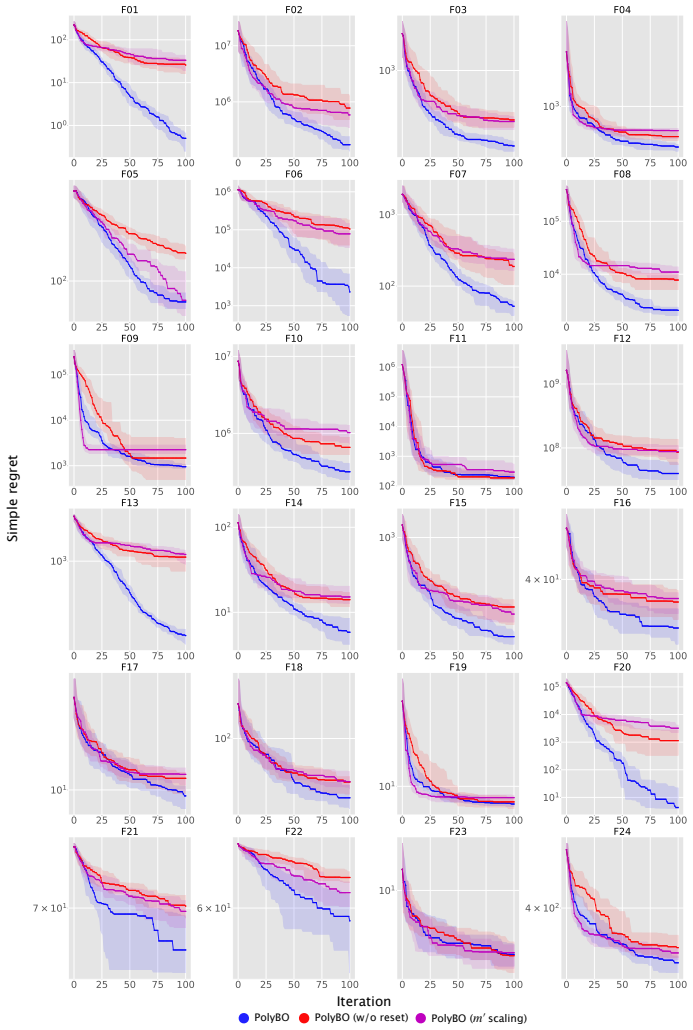
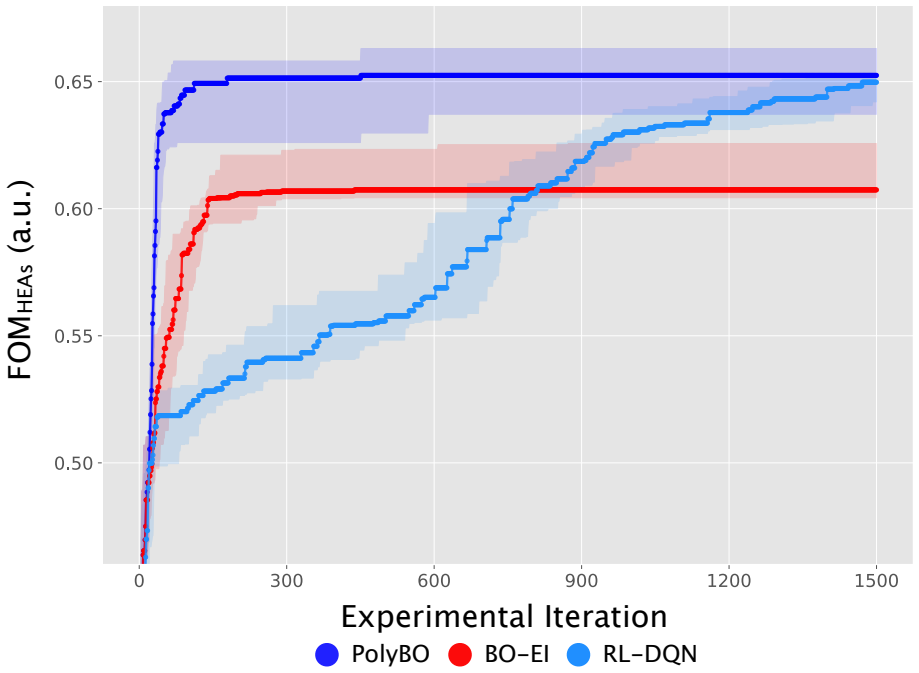
The paper's central claim is that a per-iteration refresh of pseudo-experimental data generated by an adaptively updated polynomial regression model shifts Bayesian optimization toward earlier exploration in high-dimensional search spaces, letting it locate promising regions within the first 20–40 iterations and reach the simple regret that vanilla BO attains in 50 iterations after a median of 29 iterations at D=20 (a 42% reduction). On the simulated 10-element high-entropy-alloy composition problem with discrete and constrained search space, PolyBO reached the performance of the reinforcement-learning baseline after a median of 59 iterations versus 1500, a 96% reduction. The mechanism is th
What carries the argument
The load-bearing object is the p-th degree polynomial regression model fp(x) with power and interaction terms, fit by solving the normal equation on the current experimental data. At each iteration it produces m' pseudo-experimental points (x', fp(x')) at uniformly sampled locations in the search space; the Gaussian process surrogate is trained on D0:t-1 ∪ D'_t, and the pseudo-set is regenerated from scratch each iteration with constant size m'. The polynomial is chosen because its low capacity keeps it stable when the experimental sample is tiny (initial set size k=2), while its flexibility still reshapes the posterior in high dimensions; the per-iteration reset prevents early low-quality p
Load-bearing premise
The load-bearing premise is that the neural-network predictor used for the high-entropy-alloy problem reproduces the true experimental response surface; if the simulator does not match real synthesis behavior, the measured 96% reduction in iterations will not carry over to the laboratory.
What would settle it
An independent re-implementation on the same 24 noiseless benchmark functions at D=20 should reproduce a median I50 near 29 (interquartile range comparable to Table 1); a median above 50 would refute the core claim. For the alloy result, a reader could run PolyBO and the reinforcement-learning baseline on 50–100 real high-entropy alloy syntheses and check whether the median number of real experiments to match the baseline's final figure of merit is still near 59 rather than near 1500.
If this is right
- If the claim is correct, on 20-dimensional benchmark landscapes PolyBO reaches the simple regret of vanilla BO at 50 iterations after a median of 29 iterations, implying nearly half the number of real experiments for the same outcome.
- On the discrete 10-element alloy composition problem, PolyBO reaches the performance of the reinforcement-learning baseline after a median 59 iterations rather than 1500—a 96% reduction—which would translate into drastically fewer synthesis runs if the simulator is faithful.
- The performance gain is robust to the acquisition function (EI vs GP-UCB) and to the pseudo-set size up to m'=200, with an optimum around m'=5–25, so the method does not require fine-tuning of these hyperparameters.
- The polynomial degree should be even (p=4,6,8) for best results on the tested functions; p=1 is competitive only when the true response is nearly linear, and degree increases memory cost roughly as the square of the number of polynomial terms.
- Both parts of the update mechanism—discarding previous pseudo-data and keeping m' constant—are necessary; ablations that keep old pseudo-data or scale m' by iteration converge worse.
Where Pith is reading between the lines
- A direct extension the paper leaves implicit is that the same pseudo-data augmentation should transfer to any surrogate (not only a Gaussian process) whenever the pseudo-labels come from a low-capacity regressor refit each round; the argument depends on the update structure, not on the particular kernel.
- The paper's 42% and 96% figures are guarantees only in iteration counts; converting them to wall-clock savings requires the per-iteration overhead of fitting the polynomial and sampling m' points to be negligible relative to the experiment time, which is plausible for multi-week experiments but unproven.
- The strong real-world claim rests on the neural-network alloy predictor; a direct test would be to run PolyBO against the reinforcement-learning baseline on a small set of physical syntheses. If the simulator overestimates smoothness, the iteration advantage should shrink on rugged response surfaces, consistent with the paper's own observation that gains are smallest on functions like Sharp Ridge
- A practically useful calibration rule would be to set m' in the 5–25 range and choose an even degree p—but the paper's memory scaling warning suggests that in very high dimensions (D≫20) even p=4 may be computationally prohibitive, so adaptive degree selection remains an open problem.
Editorial analysis
A structured set of objections, weighed in public.
Referee Report
Summary. The paper introduces PolyBO, a Bayesian optimization method that augments the GP surrogate with pseudo-experimental points generated by an adaptively refit polynomial regression model. At each iteration, a degree-p polynomial is fit to the observed experimental data, m' input locations are sampled uniformly in the search space, their responses are predicted by the polynomial, and the resulting pseudo-data are combined with the experimental data to train the GP; EI (or GP-UCB) is then used to select the next point. The method is evaluated on 24 BBOB functions in D=2,5,10,20 with 30 seeds against vanilla BO, BOPP, and (at D=20) TSBO, reporting a median 42% reduction in iterations at D=20. It is also applied to a high-entropy-alloy composition problem using a neural-network simulator, reporting a 96% reduction relative to BO-EI/RL-DQN. The paper includes hyperparameter sensitivity and ablation studies.
Significance. If the mechanism is sound, PolyBO is an attractive low-cost way to inject exploration into BO in high-dimensional, small-data settings, and the benchmark evaluation is extensive: 24 BBOB functions, 30 seeds, four dimensions, several baselines, plus sensitivity and ablation analyses. The authors state that the code is available. However, the central algorithmic specification is incomplete: Eq. (4) is singular in the exact regime where the headline speedup is reported, and the 'real-world' application rests on an unvalidated neural-network simulator. The significance is therefore conditional on resolving these specification and validation gaps.
major comments (2)
- [Materials and Methods, Eq. (4); Algorithm 1; Tables 1-3] The normal equation w = (Phi^T Phi)^{-1} Phi^T y is not well-defined for the reported settings. With D=20, p=4, the polynomial feature map has C(24,4)=10,626 coefficients; with initial dataset size k=2 and at most 100 iterations, the number of training points is at most 101, so Phi^T Phi is rank-deficient and has no inverse. The same holds for the D=10 HEA experiment (C(14,4)=1,001 parameters, k=20) throughout the early iterations in which the reported I1500 is achieved. The paper never mentions a pseudo-inverse, ridge term, or rank-deficiency handling. Consequently, Algorithm 1 as written cannot be executed in the regime where the 42% median speedup is reported. Moreover, the label 'low-capacity polynomial regression' (Abstract, Methods) is misleading for p=4,D=20: the model has far more parameters than data. The authors must specify the actual solver (e.g., Moore-Penrose pseudoinverse,
- [Application to a real-world material composition optimization problem; Results] The 'real-world' claim is unsupported. The objective values come from the neural-network predictor of Xian et al. [46], not from physical synthesis experiments, and the paper provides no evidence that this predictor reproduces the true response surface of high-entropy alloys. The reported 96% reduction is a reduction in simulator iterations, not in wall-clock experiment time; the Methods define optimization time solely as the number of optimization iterations. Without validation against physical measurements or at least a clear statement of the simulator's fidelity, the abstract's claim that PolyBO 'achieves efficient optimization in settings where each experiment requires a long time' and the 'real-world' language in the Results overstate what is demonstrated. Please either temper the real-world framing or add validation/discussion of the simulator's accuracy.
minor comments (3)
- [Performance comparison with vanilla BO; Table 1] The I50 metric is computed relative to the simple regret of vanilla BO at iteration 50, but for many functions at D=5 (and some at D=2) the reference regret is never reached within the 100-iteration budget, producing dashes in Table 1. The reported median reduction of 6% at D=5 is based on only four calculable functions (F04, F05, F06, F16), so the statement that PolyBO's low-dimensional performance is poor is much less robust than the high-dimensional claim. Please report the number of functions used for each median and discuss the censoring (unreached reference) explicitly.
- [Methods, Eq. (7)] The proposed-point entropy PE is defined as the differential entropy of the predictive distribution at the proposed point; the formula assumes a Gaussian predictive distribution. Please state that assumption explicitly when introducing PE.
- [Supplementary Algorithm 1] For the discrete constrained HEA problem, the pseudo-data sampling step says 'uniformly sample from G_delta' but does not specify how the equality constraint is enforced for pseudo-data. Please clarify the sampling procedure.
Circularity Check
No material circularity: PolyBO's pseudo-data are an auxiliary augmentation, and the claimed speedups are measured against external benchmarks and an external simulator.
full rationale
The paper's central claim is that augmenting the GP surrogate with polynomial-regression pseudo-data reduces the number of BO iterations needed to reach a reference performance level. That reference level is defined externally: for BBOB it is the simple regret achieved by vanilla BO after 50 iterations, and for the materials problem it is the FOM reached by RL-DQN after 1500 iterations. Neither success criterion is defined in terms of the polynomial fit or the pseudo-data. The pseudo-data are generated from the same experimental data, but they are explicitly auxiliary: the paper states that 'PolyBO uses pseudo-experimental data only as auxiliary information for constructing the Gaussian process posterior and defines the incumbent value f(x+) in Eq. 2 solely from the experimental data,' so the pseudo-data cannot by construction set the improvement target. The headline results are evaluated against external BBOB/COCO functions, vanilla BO, random search, BOPP, TSBO, and the Xian et al. neural-network simulator for high-entropy alloys, none of which are fitted or defined by PolyBO's parameters. The only self-citation is the I50 metric from reference [39] (same research group), but it is a descriptive comparison metric, not a load-bearing assumption; the paper also reports full simple-regret curves, so the conclusion does not reduce to that metric. No uniqueness theorem is imported from the authors' prior work, and the polynomial ansatz is presented as a stated hypothesis rather than smuggled in by citation. Separately, and not a circularity issue, Eq. 4 as written is rank-deficient in the reported high-dimensional regime (D=20, p=4 gives 10,626 coefficients with an initial dataset of size 2; no regularization or pseudo-inverse is described), which is a reproducibility/specification concern but does not make the derivation circular. Overall, the derivation chain is not self-referential: the method's inputs are experimental data, the pseudo-data are an intermediate model, and the performance claims are externally benchmarked.
Axiom & Free-Parameter Ledger
free parameters (3)
- pseudo-experimental dataset size m' =
10
- maximum polynomial degree p =
4
- initial dataset size k =
2
axioms (5)
- domain assumption BBOB benchmark functions are representative of real experimental-science objective landscapes.
- domain assumption The HEA neural-network predictor faithfully simulates real material-composition experimental outcomes.
- domain assumption Number of optimization iterations is an adequate proxy for optimization time.
- domain assumption Polynomial regression model provides useful pseudo-data without biasing the GP surrogate.
- ad hoc to paper The normal equation solution for the polynomial regression is well-defined at every iteration.
read the original abstract
Bayesian optimization (BO) is an optimization method that sequentially proposes the next candidate explainable variables for optimizing target variables by balancing exploration and exploitation. BO is often used under a limited evaluation budget, such as hyperparameter tuning of deep learning. Despite its effectiveness, conventional BO may have poor convergence in practical experimental science where each evaluation is often costly and time-consuming. Recently, BO methods have been proposed that accelerate optimization by using pseudo-experimental data that simulate experimental data. However, when only a limited number of experimental data are available, the generated pseudo-experimental data may be of insufficient quality. In this study, we developed PolyBO to improve optimization time by generating high-quality pseudo-experimental data even when the number of trials is limited. PolyBO performs BO efficiently by generating pseudo-experimental data with an adaptively updated versatile parametric model. This low-capacity polynomial regression model is intended to enable efficient BO even with limited experimental data. PolyBO updates the BO surrogate model with a combined dataset consisting of experimental data and pseudo-experimental data and then performs optimization. Using synthetic benchmark functions with diverse landscapes, we found that PolyBO reduced the optimization time by a median of 42\%. For a real-world material composition optimization problem, PolyBO reduced the optimization time by a median of 96\% compared with conventional methods. Overall, PolyBO achieves efficient optimization in settings where each experiment requires a long time.
Figures


Reference graph
Works this paper leans on
-
[1]
Scientific discovery in the age of artificial intelligence.Nature, 620(7972):47–60, 2023
Hanchen Wang, Tianfan Fu, Yuanqi Du, Wenhao Gao, Kexin Huang, Ziming Liu, Payal Chandak, Shengchao Liu, Peter Van Katwyk, Andreea Deac, et al. Scientific discovery in the age of artificial intelligence.Nature, 620(7972):47–60, 2023
2023
-
[2]
TurabLookman,PrasannaV.Balachandran,DezhenXue,andRuihaoYuan.Activelearninginmaterialsscience with emphasis on adaptive sampling using uncertainties for targeted design.npj Computational Materials, 5(1):21, 2019
2019
-
[3]
Schmid, Sterling G
Gary Tom, Stefan P. Schmid, Sterling G. Baird, Yang Cao, Kourosh Darvish, Han Hao, Stanley Lo, Sergio Pablo-García, Ella M. Rajaonson, Marta Skreta, Naruki Yoshikawa, Samantha Corapi, Gun Deniz Akkoc, Felix Strieth-Kalthoff, Martin Seifrid, and Alán Aspuru-Guzik. Self-Driving Laboratories for Chemistry and Materials Science.Chemical Reviews, 124(16):9633–...
2024
-
[4]
Directedevolution: bringingnewchemistrytolife.AngewandteChemie(InternationalEd.in English), 57(16):4143, 2017
FrancesHArnold. Directedevolution: bringingnewchemistrytolife.AngewandteChemie(InternationalEd.in English), 57(16):4143, 2017
2017
-
[5]
Exploring cost reduction strategies for serum free media development
JunPingQuek,AzraAnwarGaffoor,YuXuanTan,TessaRuiMinTan,YuFengChua,DawnSowZongLeong, Alif Sufiyan Ali, and Say Kong Ng. Exploring cost reduction strategies for serum free media development. npj Science of Food, 8(1):107, 2024
2024
-
[6]
Biopharmaceutical benchmarks 2022.Nature Biotechnology, 40(12):1722–1760, 2022
Gary Walsh and Eithne Walsh. Biopharmaceutical benchmarks 2022.Nature Biotechnology, 40(12):1722–1760, 2022
2022
-
[7]
Employing active learning in the optimization of culture medium for mammalian cells.npj Systems Biology and Applications, 9(1):20, 2023
Takamasa Hashizume, Yuki Ozawa, and Bei-Wen Ying. Employing active learning in the optimization of culture medium for mammalian cells.npj Systems Biology and Applications, 9(1):20, 2023
2023
-
[8]
Talanta, 76(5):965–977, 2008
Marcos Almeida Bezerra, Ricardo Erthal Santelli, Eliane Padua Oliveira, Leonardo Silveira Villar, and Lu- cianeAméliaEscaleira.Responsesurfacemethodology(RSM)asatoolforoptimizationinanalyticalchemistry. Talanta, 76(5):965–977, 2008
2008
-
[9]
Stogios, Margrethe Therkildsen, and Martin Krøyer Rasmussen
StigSkrivergaard,JetteFeveileYoung,NavidSahebekhtiari,CameronSemper,MeenakshiVenkatesan,Alexei Savchenko, Peter J. Stogios, Margrethe Therkildsen, and Martin Krøyer Rasmussen. A simple and robust serum-free media for the proliferation of muscle cells.Food Research International, 172:113194, 2023
2023
-
[10]
Frazier, Keith Baar, and David E
Zachary Cosenza, Raul Astudillo, Peter I. Frazier, Keith Baar, and David E. Block. Multi-information source Bayesian optimization of culture media for cellular agriculture.Biotechnology and Bioengineering, 119(9):2447– 2458, 2022
2022
-
[11]
Challengesindevelopingcellculturemediausingmachinelearning
TakamasaHashizumeandBei-WenYing. Challengesindevelopingcellculturemediausingmachinelearning. Biotechnology Advances, 70:108293, 2024. 15
2024
-
[12]
IntegrationofBayesianoptimizationandsolutionthermodynamicstooptimizemediadesignformammalian biomanufacturing.iScience, 28(8):112944, 2025
Nelson Ndahiro, Edward Ma, Tom Bertalan, Marc Donohue, Yannis Kevrekidis, and Michael Betenbaugh. IntegrationofBayesianoptimizationandsolutionthermodynamicstooptimizemediadesignformammalian biomanufacturing.iScience, 28(8):112944, 2025
2025
-
[13]
Policy optimization in dynamic Bayesian network hybrid models of biomanufacturing processes.INFORMS Journal on Computing, 35(1):66–82, 2023
Hua Zheng, Wei Xie, Ilya O Ryzhov, and Dongming Xie. Policy optimization in dynamic Bayesian network hybrid models of biomanufacturing processes.INFORMS Journal on Computing, 35(1):66–82, 2023
2023
-
[14]
Harold J. Kushner. A New Method of Locating the Maximum Point of an Arbitrary Multipeak Curve in the Presence of Noise.J. Basic Eng., 86(1):97–106, 1964
1964
-
[15]
Cambridge University Press, 2023
Roman Garnett.Bayesian optimization. Cambridge University Press, 2023
2023
-
[16]
Machine-learning-guideddirectedevolutionforprotein engineering.Nature Methods, 16(8):687–694, 2019
KevinK.Yang, ZacharyWu, andFrancesH.Arnold. Machine-learning-guideddirectedevolutionforprotein engineering.Nature Methods, 16(8):687–694, 2019
2019
-
[17]
Protein Engineering via Bayesian Optimization-Guided Evolutionary Algorithm and Robotic Experiments.Briefings in Bioinformat- ics, 24(1):bbac570, 2022
Ruyun Hu, Lihao Fu, Yongcan Chen, Junyu Chen, Yu Qiao, and Tong Si. Protein Engineering via Bayesian Optimization-Guided Evolutionary Algorithm and Robotic Experiments.Briefings in Bioinformat- ics, 24(1):bbac570, 2022
2022
-
[18]
Bayesian Optimization in Bioprocess Engineering—Where Do We Stand Today?Biotechnology and Bioengineering, 122(6):1313–1325, 2025
Florian Gisperg, Robert Klausser, Mohamed Elshazly, Julian Kopp, Eva Přáda Brichtová, and Oliver Spa- diut. Bayesian Optimization in Bioprocess Engineering—Where Do We Stand Today?Biotechnology and Bioengineering, 122(6):1313–1325, 2025
2025
-
[19]
Recent Advances in Bayesian Optimization
Xilu Wang, Yaochu Jin, Sebastian Schmitt, and Markus Olhofer. Recent Advances in Bayesian Optimization. ACM Comput. Surv., 55(13s), 2023
2023
-
[20]
Hinckley, Rachel Barry, Brendan Dang, Lenna A
Harini Narayanan, Joshua A. Hinckley, Rachel Barry, Brendan Dang, Lenna A. Wolffe, Adel Atari, Yuen-Yi Tseng, and J. Christopher Love. Accelerating cell culture media development using Bayesian optimization- based iterative experimental design.Nature Communications, 16(1):6055, 2025
2025
-
[21]
High Dimensional Bayesian Optimisation and Bandits via Additive Models
Kirthevasan Kandasamy, Jeff Schneider, and Barnabas Poczos. High Dimensional Bayesian Optimisation and Bandits via Additive Models. In Francis Bach and David Blei, editors,Proceedings of the 32nd International Conference on Machine Learning, volume 37 ofProceedings of Machine Learning Research, pages 295–304, Lille, France, 2015. PMLR
2015
-
[22]
Sample-efficientoptimizationinthelatent space of deep generative models via weighted retraining
AustinTripp,ErikDaxberger,andJoséMiguelHernández-Lobato. Sample-efficientoptimizationinthelatent space of deep generative models via weighted retraining. In H. Larochelle, M. Ranzato, R. Hadsell, M.F. Balcan, and H. Lin, editors,Advances in Neural Information Processing Systems, volume 33, pages 11259–11272. Curran Associates, Inc., 2020
2020
-
[23]
Wei, David Duvenaud, José Miguel Hernández-Lobato, Benjamín Sánchez-Lengeling,DennisSheberla,JorgeAguilera-Iparraguirre,TimothyD.Hirzel,RyanP.Adams,andAlán 16 Aspuru-Guzik
Rafael Gómez-Bombarelli, Jennifer N. Wei, David Duvenaud, José Miguel Hernández-Lobato, Benjamín Sánchez-Lengeling,DennisSheberla,JorgeAguilera-Iparraguirre,TimothyD.Hirzel,RyanP.Adams,andAlán 16 Aspuru-Guzik. Automatic Chemical Design Using a Data-Driven Continuous Representation of Molecules. ACS Central Science, 4(2):268–276, 2018
2018
-
[24]
Antoine Grosnit, Rasul Tutunov, Alexandre Max Maraval, Ryan-Rhys Griffiths, Alexander I Cowen-Rivers, Lin Yang, Lin Zhu, Wenlong Lyu, Zhitang Chen, Jun Wang, et al. High-dimensional Bayesian optimisation with variational autoencoders and deep metric learning.arXiv preprint arXiv:2106.03609, 2021
Pith/arXiv arXiv 2021
-
[25]
Auto-encoding variational bayes.arXiv preprint arXiv:1312.6114, 2013
Diederik P Kingma and Max Welling. Auto-encoding variational bayes.arXiv preprint arXiv:1312.6114, 2013
Pith/arXiv arXiv 2013
-
[26]
Development of the membrane ceiling method for in vitro spermatogenesis.Scientific Reports, 15(1):625, Jan 2025
Maki Kamoshita, Hiroki Shirai, Hiroko Nakamura, Tetsuya Kishimoto, Yuki Hatanaka, Daisuke Mashiko, KatsuhiroEsashika,JingjingYang,SatoshiYamasaki,TakehikoOgawa,HiroshiKimura,andMasahitoIkawa. Development of the membrane ceiling method for in vitro spermatogenesis.Scientific Reports, 15(1):625, Jan 2025
2025
-
[27]
B. P. MacLeod, F. G. L. Parlane, T. D. Morrissey, F. Häse, L. M. Roch, K. E. Dettelbach, R. Moreira, L. P. E. Yunker, M. B. Rooney, J. R. Deeth, V. Lai, G. J. Ng, H. Situ, R. H. Zhang, M. S. Elliott, T. H. Haley, D. J. Dvorak, A. Aspuru-Guzik, J. E. Hein, and C. P. Berlinguette. Self-driving laboratory for accelerated discovery of thin-film materials.Scie...
2020
-
[28]
Mater., 37(17):6629–6641, 2025
NealMunyebvu,SteveDunn,andPhilipD.Howes.Multiobjectiveplatformforautonomouspropertytargeting and optimization of colloidal lead halide perovskite quantum dots.Chem. Mater., 37(17):6629–6641, 2025
2025
-
[29]
AnirudhM.K.Nambiar,ChristopherP.Breen,TravisHart,TimothyKulesza,TimothyF.Jamison,andKlavsF. Jensen. Bayesianoptimizationofcomputer-proposedmultistepsyntheticroutesonanautomatedroboticflow platform.ACS Cent. Sci., 8(6):825–836, 2022
2022
-
[30]
High-DimensionalBayesianOptimizationviaSemi-SupervisedLearning withOptimizedUnlabeledDataSampling
YuxuanYin,YuWang,andPengLi. High-DimensionalBayesianOptimizationviaSemi-SupervisedLearning withOptimizedUnlabeledDataSampling. InInternationalConferenceonMachineLearning,pages57085–57100. PMLR, 2024
2024
-
[31]
Bayesian optimization using pseudo-points
Chao Qian, Hang Xiong, and Ke Xue. Bayesian optimization using pseudo-points. InProceedings of the Twenty-NinthInternationalConferenceonInternationalJointConferencesonArtificialIntelligence,pages3044–3050, 2021
2021
-
[32]
Real-Parameter Black-Box Optimization Benchmarking 2009: Noiseless Functions Definitions
Nikolaus Hansen, Steffen Finck, Raymond Ros, and Anne Auger. Real-Parameter Black-Box Optimization Benchmarking 2009: Noiseless Functions Definitions. [Research Report] RR-6829, INRIA. inria-00362633v2, 16p., 2009
2009
-
[33]
Močkus.On Bayesian Methods for Seeking the Extremum, pages 400–404
J. Močkus.On Bayesian Methods for Seeking the Extremum, pages 400–404. Springer Berlin Heidelberg, Berlin, Heidelberg, 1975. 17
1975
-
[34]
Gaussian process optimization in the bandit setting: no regret and experimental design
Niranjan Srinivas, Andreas Krause, Sham Kakade, and Matthias Seeger. Gaussian process optimization in the bandit setting: no regret and experimental design. InProceedings of the 27th International Conference on International Conference on Machine Learning, volume 1015–1022. Omnipress, 2010
2010
-
[35]
A limited memory algorithm for bound constrained optimization.SIAM Journal on scientific computing, 16(5):1190–1208, 1995
Richard H Byrd, Peihuang Lu, Jorge Nocedal, and Ciyou Zhu. A limited memory algorithm for bound constrained optimization.SIAM Journal on scientific computing, 16(5):1190–1208, 1995
1995
-
[36]
Hansen, A
N. Hansen, A. Auger, R. Ros, O. Mersmann, T. Tušar, and D. Brockhoff. COCO: A Platform for Comparing Continuous Optimizers in a Black-Box Setting.Optim. Methods and Softw., 36:114–144, 2021
2021
-
[37]
Salmon, Mark A
John K. Salmon, Mark A. Moraes, Ron O. Dror, and David E. Shaw. Parallel random numbers: as easy as 1, 2, 3. InProceedings of 2011 International Conference for High Performance Computing, Networking, Storage and Analysis, SC ’11, New York, NY, USA, 2011. Association for Computing Machinery
2011
-
[38]
Jiang, Samuel Daulton, Benjamin Letham, Andrew Gordon Wilson, and Eytan Bakshy
Maximilian Balandat, Brian Karrer, Daniel R. Jiang, Samuel Daulton, Benjamin Letham, Andrew Gordon Wilson, and Eytan Bakshy. BoTorch: A Framework for Efficient Monte-Carlo Bayesian Optimization. In Advances in Neural Information Processing Systems 33, 2020
2020
-
[39]
Yamada, and Akira Funahashi
Yujin Taguchi, Yusuke Shibuya, Yusuke Hiki, Takashi Morikura, Takahiro G. Yamada, and Akira Funahashi. Asynchronous batch Bayesian optimization with pipelining evaluations in experimental equipment-limited situations.SLAS Technology, 37:100396, 2026
2026
-
[40]
Visualizing data using t-SNE.Journal of machine learning research, 9(Nov):2579–2605, 2008
Laurens van der Maaten and Geoffrey Hinton. Visualizing data using t-SNE.Journal of machine learning research, 9(Nov):2579–2605, 2008
2008
-
[41]
LelandMcInnes,JohnHealy,andJamesMelville. Umap: Uniformmanifoldapproximationandprojectionfor dimension reduction.arXiv preprint arXiv:1802.03426, 2018
Pith/arXiv arXiv 2018
-
[42]
HaomingLiang,FuqingZhao,TianpengXu,andJianlinZhang.ADeepLearning-DrivenBlack-BoxBenchmark Generation Method via Exploratory Landscape Analysis.Applied Sciences, 15(15), 2025
2025
-
[43]
Exploring Exploration in Bayesian Optimization
Leonard Papenmeier, Nuojin Cheng, Stephen Becker, and Luigi Nardi. Exploring Exploration in Bayesian Optimization. InThe 41st Conference on Uncertainty in Artificial Intelligence, 2025
2025
-
[44]
Jenna Fromer, Runzhong Wang, Mrunali Manjrekar, Austin Tripp, José Miguel Hernández-Lobato, and Con- nor W. Coley. Batched Bayesian optimization with correlated candidate uncertainties, 2025
2025
-
[45]
Unleashing the Potential of Acquisition Functions in High-Dimensional Bayesian Optimization.Transactions on Machine Learning Research, 2024
Jiayu Zhao, Renyu Yang, Shenghao Qiu, and Zheng Wang. Unleashing the Potential of Acquisition Functions in High-Dimensional Bayesian Optimization.Transactions on Machine Learning Research, 2024
2024
-
[46]
Unlocking the black box beyond Bayesian global optimization for materials design using reinforcement learning.npj Computational Materials, 11(1):143, 2025
YuehuiXian,XiangdongDing,XueJiang,YumeiZhou,JunSun,DezhenXue,andTurabLookman. Unlocking the black box beyond Bayesian global optimization for materials design using reinforcement learning.npj Computational Materials, 11(1):143, 2025. 18
2025
-
[47]
A neural network model for high entropy alloy design.npj Computational Materials, 9(1):60, 2023
Jaemin Wang, Hyeonseok Kwon, Hyoung Seop Kim, and Byeong-Joo Lee. A neural network model for high entropy alloy design.npj Computational Materials, 9(1):60, 2023
2023
-
[48]
Multi-fidelity gaussian process bandit optimisation.Journal of Artificial Intelligence Research, 66:151–196, 2019
KirthevasanKandasamy,GautamDasarathy,JunierOliva,JeffSchneider,andBarnabasPoczos. Multi-fidelity gaussian process bandit optimisation.Journal of Artificial Intelligence Research, 66:151–196, 2019
2019
-
[49]
Multi-fidelity cost- aware Bayesian optimization.Computer Methods in Applied Mechanics and Engineering, 407:115937, 2023
Zahra Zanjani Foumani, Mehdi Shishehbor, Amin Yousefpour, and Ramin Bostanabad. Multi-fidelity cost- aware Bayesian optimization.Computer Methods in Applied Mechanics and Engineering, 407:115937, 2023
2023
-
[50]
Multifidelity Bayesian Optimization: A Review.AIAA Journal, 63(6):2286–2322, 2025
Bach Do and Ruda Zhang. Multifidelity Bayesian Optimization: A Review.AIAA Journal, 63(6):2286–2322, 2025. Code availability The source code of this study is available fromhttps://github.com/funalab/PolyBO. Acknowledgements The research was funded by JST CREST, Japan Grant Number JPMJCR21N1 to A.F. We are grateful to Asst. Prof. Yuki TSUKADA for helpful d...
2025
discussion (0)
Sign in with ORCID, Apple, or X to comment. Anyone can read and Pith papers without signing in.