REVIEW 2 major objections 5 minor 86 references
Memory-bearing thermal noise changes how heavy quarks relax but leaves their diffusion coefficient unchanged.
Reviewed by Pith at T0; open to challenge. T0 means a machine referee read the full paper against a public rubric. the ladder, T0–T4 →
T0 review · deepseek-v4-flash
2026-08-01 04:51 UTC pith:J7SVTRKH
load-bearing objection A clean non-relativistic result, a plausible relativistic extension, and a Green-Kubo extraction that needs one more numerical check before I'd take tau_m-independence as established. the 2 major comments →
Non-Markovian heavy-quark equilibration and equilibrium correlation function in a thermal medium
The pith
A machine-rendered reading of the paper's core claim, the machinery that carries it, and where it could break.
Core claim
The central claim is that the heavy-quark spatial diffusion coefficient is insensitive to the memory time of the thermal noise. In the non-relativistic limit the momentum correlation function C_p(t) satisfies a second-order differential equation whose exact solution is an overdamped or underdamped oscillation, yet its Laplace transform yields ∫₀^∞ dt C_p(t) = C_p(0)/A. Since the current-correlation function is proportional to C_p(t), the Green–Kubo integral gives exactly D_s = T/(mA), with no dependence on τ_m. In the relativistic regime no closed form is available, but simulations of the generalized Langevin equation with a static box, fitted with the same non-relativistic functional forms,
What carries the argument
The key object is the exponentially decaying memory kernel γ(t) = (A/τ_m) exp(−|t|/τ_m), modeled through an auxiliary Ornstein–Uhlenbeck process h(t) that generates colored noise with correlation ⟨η(t)η(s)⟩ = (B/τ_m) exp(−|t−s|/τ_m). This turns the generalized Langevin equation into a damped harmonic-oscillator equation of motion. The proof of transport-coefficient invariance uses the Laplace transform of the momentum correlation function, whose integral is fixed by the zero-frequency limit. A second critical mechanism is the Wong–Zakai theorem, which forces the Stratonovich–Fisk discretization for the relativistic multiplicative colored-noise case; using the Itô prescription produced deviat
Load-bearing premise
The relativistic conclusion rests on assuming that the non-relativistic functional forms for the correlation function — exponential for white noise, damped cosine/sine for memory — remain accurate for the relativistic current correlator, so that integrating the fitted curves gives the true Green–Kubo integral.
What would settle it
Compute the relativistic current–current correlation function with memory in a static box and integrate it directly in time without any fitted form, pushing to a plateau; if D_s obtained this way changes with τ_m beyond statistical error, the memory-independence claim fails. The paper reports such a direct check only for the white-noise case (Appendix C).
If this is right
- Heavy-quark diffusion coefficients extracted from Green–Kubo are robust to the choice of memory kernel, provided the correlation function is integrated to infinity, so lattice and phenomenological extractions need not be re-interpreted when memory is included.
- Memory postpones thermalization and causes damped oscillations of the momentum distribution, so effective diffusion coefficients in short-lived systems are smaller than the hydrodynamic D_s.
- The relativistic estimate D_s = T/(A(⟨E⟩+T)) appears valid for the Stratonovich–Fisk prescription, offering a practical formula for simulations.
- The equal-time correlator C(0) is independent of memory and can be used to calibrate simulations against the equilibrium Jüttner distribution.
- For a QGP fireball with a lifetime of a few fm, the finite-time integrated D_s(t*) should be used instead of the asymptotic value.
Where Pith is reading between the lines
- The non-relativistic result that the zero-frequency integral is independent of τ_m holds for any memory kernel with finite first moment, not just exponential, suggesting the diffusion coefficient is generically robust to memory while thermalization is not.
- If the oscillatory approach to equilibrium is seen in data on R_AA and v_2, memory times of order the relaxation time would imprint even with the same D_s, a testable prediction for heavy-ion phenomenology.
- The paper's relativistic τ_m-independence depends on fitting non-relativistic forms to the relativistic correlator; a direct numerical integration of the memory-kernel correlator (as done in Appendix C for white noise) would verify the claim without the ansatz.
Editorial analysis
A structured set of objections, weighed in public.
Referee Report
Summary. The paper studies heavy-quark diffusion in a thermal medium using a generalized Langevin equation with an exponentially decaying memory kernel. In the non-relativistic limit it derives exact momentum and current correlation functions, proving analytically that the time integral of the correlation function is independent of the memory time and that the Green–Kubo spatial diffusion coefficient D_s = T/(mA) is unchanged by memory. It then extends the study to relativistic Langevin dynamics, fitting the numerically computed current–current correlators with the non-relativistic functional forms, and extracts D_s from the fitted parameters. The paper also compares non-equilibrium solutions of a generalized Fokker–Planck equation with generalized Langevin simulations and reports damped oscillatory thermalization in the presence of memory. The main claimed results are that memory effects modify transient correlations but leave D_s unchanged, and that the relativistic D_s is independent of τ_m and consistent with D_s = T/[A(⟨E⟩+T)].
Significance. The non-relativistic analytical result—Eqs. (81)–(83)—is clean, exact, and a useful formal reference point for heavy-quark transport in non-Markovian media. The numerical implementation of correlated multiplicative noise with the Stratonovich–Fisk prescription and the Wong–Zakai consistency check is also a valuable technical contribution. If the relativistic τ_m-independence of D_s were established by an independent numerical integration, the paper would provide a robust practical message for heavy-ion phenomenology: memory affects the transient but not the hydrodynamic transport coefficient. However, as it stands, the relativistic claim rests on an assumed fit ansatz and a self-consistency comparison, so the significance is conditional on additional verification.
major comments (2)
- [Sec. III B and IV B 2, Fig. 10] The central claim that D_s is independent of τ_m in the relativistic case is obtained by assuming the non-relativistic correlation forms (79)–(80) for the relativistic current correlator and integrating the fitted functions analytically (Eq. 88). The paper explicitly states that no independent numerical integration was performed in the memory case (App. C covers only the white-noise case). Because the underdamped tail decays as exp[-t/(2τ_m)] (Eq. 80), for τ_m=8 fm the tail time is ~16 fm, comparable to the displayed window; a mismatch between the true relativistic tail and the NR ansatz could be absorbed in α,β,γ and bias the Green–Kubo integral. I ask for a direct numerical integration D_s(t*) (as in App. C) for at least the memory cases, with error bars on Fig. 10 and fit-quality metrics. Without this, the τ_m-independence is an assumption-check, not a verified result.
- [Sec. II D, Eq. (48)] The expression D_s = T/[A(⟨E⟩+T)] is obtained by substituting the imposed Einstein relation B(E)=A(E+T)T (Eq. 10) into D_s=T^2/B with E→⟨E⟩. Its agreement with the Green–Kubo extraction in Figs. 7 and 10 therefore tests internal consistency, not the validity of the model or the extraction. Please label it as a self-consistency estimate, and soften the statement that the agreement 'gives confidence that Eq. (48) is close to the exact expression'; an independent comparison (e.g., with a microscopic calculation or lattice data) would be needed for that.
minor comments (5)
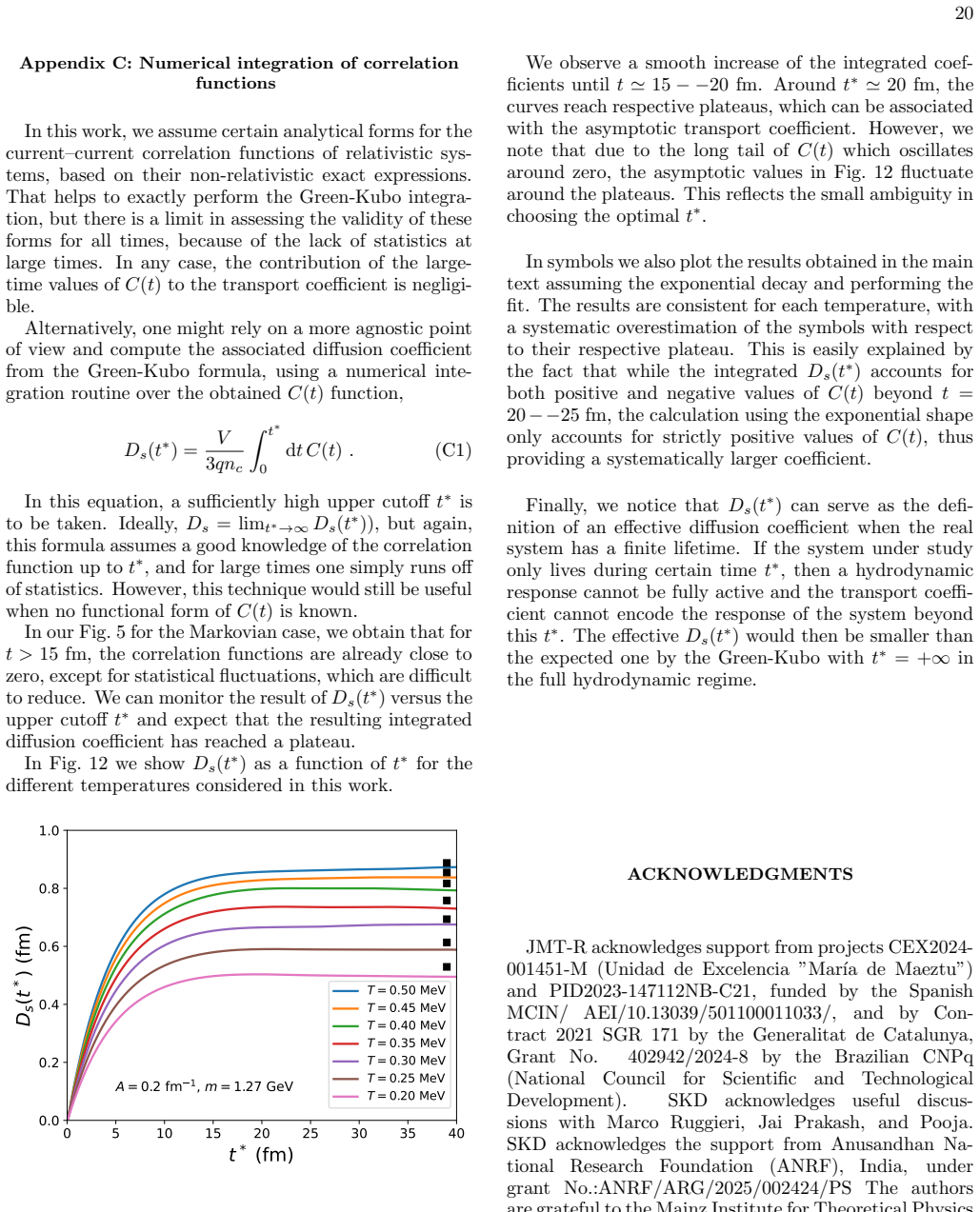
- [Fig. 5 and Fig. 12] The temperature axis labels read 'T = 0.50 MeV' etc.; the units should be GeV (the values 0.20–0.50 are in GeV).
- [Fig. 8] The legend entries 'm = 0.5 fm', 'm = 1 fm', etc. should read 'τ_m = ...' to avoid confusion with the heavy-quark mass.
- [Sec. V] In the summary, 'where τ_m is treated as a fit parameter' in the white-noise case should refer to the decay time τ, since τ_m denotes the memory time; in the white-noise case there is no memory time.
- [Sec. III B] The phrase 'checking case by case that it is sensible to do that' is vague. Please specify the validation criterion (e.g., chi-squared per degree of freedom, inspection of residuals, or an F-test against alternative forms).
- [General] The paper would benefit from defining the fit parameters α, β, γ explicitly in the text (they are introduced only in Eqs. (86)–(87)), and from stating whether the reported fits are four-parameter or three-parameter fits for each curve in Fig. 8.
Circularity Check
Exact non-relativistic memory result is self-contained; main circularity is limited to presenting the input Einstein relation as a confirmed prediction (Eq. 48) in the relativistic GK comparison.
specific steps
-
fitted input called prediction
[Sec. II D, Eq. (48); compared in Sec. IV B 1, Fig. 7]
"Nevertheless, we can make an educated guess using Eq. (38) and exploiting the relativistic version of the Einstein relation in Eq. (10). We get D_s = T/(A(⟨E⟩+T)). ... We observe excellent agreement between this expression for D_s and the one calculated numerically from the Green-Kubo relation. This gives confidence that Eq. (48) is close to the exact expression in the relativistic domain."
Eq. (10), B(E)=A(E+T)T, is imposed as the fluctuation-dissipation input, and Eq. (38), D_s=T^2/B, is the non-relativistic overdamped relation. Substituting the input B into the input relation gives Eq. (48) by construction. The numerical GK D_s is extracted from the same Langevin model with the same A and B(E). Therefore the 'excellent agreement' is an internal self-consistency check—verifying that the model's current correlator reproduces a transport coefficient already encoded in the chosen FD relation—rather than an independent first-principles prediction. It cannot by itself validate Eq. (48) as the exact relativistic expression.
full rationale
The paper's central non-relativistic claim—that ∫0∞ Cp(t)dt = Cp(0)/A independently of τ_m (Eq. 81) and hence D_s is unchanged by memory (Eq. 83)—is derived from the generalized Langevin equation and its Laplace transform without fitting or importing the target result. This part is self-contained. The generalized Fokker–Planck comparison is also an exact model check and is not circular. The only mild circularity is the relativistic white-noise comparison: Eq. (48) is obtained by substituting the input Einstein relation B(E)=A(E+T)T into a non-relativistic formula, and the GK extraction uses the same input, so the agreement is a consistency check rather than external confirmation. The additional relativistic τ_m-independence conclusion (Fig. 10) is fit-based: the paper explicitly uses the non-relativistic functional forms to fit relativistic correlation functions and provides no direct numerical-integration check for the memory case. This is a verification/assumption gap, not a circular reduction, because the fit parameters are not algebraically forced to the NR values. No load-bearing self-citation chain was found; citations to prior work by the authors are for numerical schemes or context and are rederived or checked here. Overall, the paper does not have severe circularity; the moderate concern is that one 'agreement' and the central relativistic τ_m-independence claim rest on inputs or ansatze already present in the model.
Axiom & Free-Parameter Ledger
free parameters (4)
- A (drag coefficient) =
0.4 fm^-1 (NR), 0.2 fm^-1 (R)
- τ_m (memory time) =
0.5, 1, 3, 5, 8 fm
- C(0), τ (exponential fit, white-noise R case) =
Temperature-dependent fitted values (Fig. 6)
- C(0), α, β, γ (damped-oscillatory fits, memory R case) =
Temperature- and τ_m-dependent fitted values (Figs. 8–9)
axioms (6)
- ad hoc to paper Exponential memory kernel γ(t) = A/τ_m e^{-|t|/τ_m} (Eq. 65)
- ad hoc to paper Relativistic Einstein relation with constant A: B(E) = A(E+T)T (Eq. 10)
- standard math Green–Kubo formula (Eq. 40) from linear response / hydrodynamic fluctuations
- standard math Fluctuation–dissipation relation between γ(t) and the noise correlator (Eq. 52)
- domain assumption Neglect of the non-stationary noise transient (Eq. 59→60: drop e^{-α(t+s)} term)
- ad hoc to paper Relativistic current correlator has the NR functional forms (Eqs. 86–87)
invented entities (1)
-
None
no independent evidence
read the original abstract
We compute the charm-quark current-current correlation function within the Langevin framework and extract the heavy-quark diffusion coefficient using the Green--Kubo formula. The formalism is further extended to evaluate the correlation function using a generalized Langevin equation that incorporates memory effects via an exponentially decaying memory kernel. We find that while memory effects qualitatively modify the transient structure of the current correlations, the value of the transport coefficient remains unchanged in the non-relativistic limit. In addition, we investigate heavy-quark thermalization in the presence of memory and compare the non-equilibrium solution of a generalized Fokker--Planck equation with the one obtained from the generalized Langevin equation in the non-relativistic limit. We also consider the relativistic version of the correlated noise case and observe that memory effects can give rise to a damped, oscillatory equilibration of the heavy quark in a non-Markovian bath.
Figures


Reference graph
Works this paper leans on
-
[1]
From the definition ofh(t), it is straightforward to see that⟨h(t)⟩= 0
= 0, that obeys the Langevin equation, dh(t) dt =−αh(t) +αξ(t),(56) whereξ(t) is a Gaussian white noise with vanishing mean, ⟨ξ(t)⟩= 0,(57) 7 and two-point correlation, ⟨ξ(t)ξ(t ′)⟩= 1 α δ(t−t ′).(58) Here,h(t) is the ancillary process, introduced as an auxiliary stochastic variable to generate the colored noise for the Langevin equation governing the HQs...
-
[2]
For the latter, an analytical solution of the time evolution, with a Dirac’s delta initial condition, has been given in Eq
Non-relativistic evolution with white noise First of all, we test the non-relativistic evolution out of equilibrium using the Langevin and Fokker–Planck equa- tions. For the latter, an analytical solution of the time evolution, with a Dirac’s delta initial condition, has been given in Eq. (20). The simulation runs in a cubic box of sizeL= 16 fm, with peri...
-
[3]
Relativistic evolution with white noise We now consider a more realistic scenario and study the dynamical relaxation of heavy quarks of massm= 1.27 GeV, described by the same Langevin Eq. (2). The drag coefficient is reduced toA= 0.2 fm −1, but the tem- perature is higher,T= 0.4 GeV, and the cubic box has a sideL= 16 fm. The diffusion coefficientB(E) is n...
-
[4]
equilibrium
Non-relativistic evolution with colored noise: Ornstein-Uhlenbeck process We now introduce the exponential memory time in the equilibration process and solve the same system with a memory timeτ m = 5 fm in the generalized Langevin equation of Eq. (66) in the non-relativistic case. The code now contains the ancillary (Ornstein-Uhlenbeck) pro- cess, which p...
-
[5]
equilibrium
Relativistic evolution with colored noise To conclude the non-equilibrium evolution, we provide the solution of the generalized Langevin equation for the relativistic case with particles of massm= 1.27 GeV and a bath temperature ofT= 0.4 GeV. In this case we do not compare to the solution of the generalized Fokker– Planck equation, since, as for the memor...
-
[6]
We start by applying the standard Langevin equation with uncorrelated noise
Equilibrium in the white noise case In this section, we perform a series of calculations in the same box, but at thermal equilibrium at a fixed tem- peratureT. We start by applying the standard Langevin equation with uncorrelated noise. In the rest of this work, we exclusively work in the relativistic case withm= 1.27 GeV and drag coefficientA= 0.2 fm −1....
-
[7]
large-time limit
Equilibrium in the colored noise case We present our results in the case with an exponen- tial memory kernel, with a characteristic memory time τm. In the non-relativistic case, we have checked that the momentum correlation functions describe either the overdamped or the underdamped solution as in Eqs. (79) and (80), depending on the value ofτ m. The curr...
2021
-
[8]
E. V. Shuryak, Phys. Rept.61, 71 (1980)
1980
-
[9]
B. V. Jacak and B. Muller, Science337, 310 (2012)
2012
-
[10]
S. K. Das, J. M. Torres-Rincon, and R. Rapp, Phys. Rept.1129-1131, 1 (2025), arXiv:2406.13286 [hep-ph]
Pith/arXiv arXiv 2025
-
[11]
M. He, H. van Hees, and R. Rapp, Prog. Part. Nucl. Phys.130, 104020 (2023), arXiv:2204.09299 [hep-ph]
Pith/arXiv arXiv 2023
-
[12]
A. Beraudoet al., Nucl. Phys. A979, 21 (2018), arXiv:1803.03824 [nucl-th]
Pith/arXiv arXiv 2018
-
[13]
Dong and V
X. Dong and V. Greco, Prog. Part. Nucl. Phys.104, 97 (2019)
2019
-
[14]
S. Caoet al., Phys. Rev. C99, 054907 (2019), arXiv:1809.07894 [nucl-th]
Pith/arXiv arXiv 2019
-
[15]
Svetitsky, Phys
B. Svetitsky, Phys. Rev. D37, 2484 (1988)
1988
-
[16]
G. D. Moore and D. Teaney, Phys. Rev. C71, 064904 (2005), arXiv:hep-ph/0412346
Pith/arXiv arXiv 2005
-
[17]
H. van Hees, M. Mannarelli, V. Greco, and R. Rapp, Phys. Rev. Lett.100, 192301 (2008), arXiv:0709.2884 [hep-ph]
Pith/arXiv arXiv 2008
-
[18]
T. Lang, H. van Hees, J. Steinheimer, G. Inghirami, and M. Bleicher, Phys. Rev. C93, 014901 (2016), arXiv:1211.6912 [hep-ph]
Pith/arXiv arXiv 2016
-
[19]
S. K. Das, F. Scardina, S. Plumari, and V. Greco, Phys. Lett. B747, 260 (2015), arXiv:1502.03757 [nucl-th]
Pith/arXiv arXiv 2015
-
[20]
S. Cao, G.-Y. Qin, and S. A. Bass, Phys. Rev. C92, 024907 (2015), arXiv:1505.01413 [nucl-th]
Pith/arXiv arXiv 2015
-
[21]
A. Beraudo, A. De Pace, M. Monteno, M. Nardi, and F. Prino, Eur. Phys. J. C75, 121 (2015), arXiv:1410.6082 [hep-ph]
Pith/arXiv arXiv 2015
- [22]
-
[23]
M. He, R. J. Fries, and R. Rapp, Phys. Rev. Lett.110, 112301 (2013), arXiv:1204.4442 [nucl-th]
Pith/arXiv arXiv 2013
-
[24]
V. Ozvenchuk, J. M. Torres-Rincon, P. B. Gossiaux, L. Tolos, and J. Aichelin, Phys. Rev. C90, 054909 (2014), arXiv:1408.4938 [hep-ph]
Pith/arXiv arXiv 2014
-
[25]
S. K. Das, J. M. Torres-Rincon, L. Tolos, V. Minissale, F. Scardina, and V. Greco, Phys. Rev. D94, 114039 (2016), arXiv:1604.05666 [nucl-th]
Pith/arXiv arXiv 2016
-
[26]
F. Scardina, S. K. Das, V. Minissale, S. Plumari, and V. Greco, Phys. Rev. C96, 044905 (2017), arXiv:1707.05452 [nucl-th]
Pith/arXiv arXiv 2017
-
[27]
I. Grishmanovskii, T. Song, C. Greiner, and E. Bratkovskaya, Phys. Rev. D112, 014042 (2025), arXiv:2503.22311 [hep-ph]
Pith/arXiv arXiv 2025
-
[28]
Acharyaet al.(ALICE), JHEP01, 174 (2022), arXiv:2110.09420 [nucl-ex]
S. Acharyaet al.(ALICE), JHEP01, 174 (2022), arXiv:2110.09420 [nucl-ex]
Pith/arXiv arXiv 2022
-
[29]
M. L. Sambataro, S. Plumari, S. K. Das, and V. Greco, Phys. Rev. Lett.136, 212302 (2026), arXiv:2510.19448 [hep-ph]
arXiv 2026
-
[30]
B. Schenke and C. Greiner, Phys. Rev. Lett.98, 022301 (2007), arXiv:hep-ph/0608032
Pith/arXiv arXiv 2007
-
[31]
J. I. Kapusta, B. Muller, and M. Stephanov, Phys. Rev. C85, 054906 (2012), arXiv:1112.6405 [nucl-th]
Pith/arXiv arXiv 2012
-
[32]
J. I. Kapusta and J. M. Torres-Rincon, Phys. Rev. C86, 054911 (2012), arXiv:1209.0675 [nucl-th]
Pith/arXiv arXiv 2012
-
[33]
J. Schmidt, A. Meistrenko, H. van Hees, Z. Xu, and C. Greiner, Phys. Rev. E91, 032125 (2015), arXiv:1407.6528 [cond-mat.stat-mech]
Pith/arXiv arXiv 2015
-
[34]
K. Murase and T. Hirano, Nucl. Phys. A956, 276 (2016), arXiv:1601.02260 [nucl-th]
Pith/arXiv arXiv 2016
-
[35]
J. I. Kapusta and C. Plumberg, Phys. Rev. C97, 014906 (2018), [Erratum: Phys.Rev.C 102, 019901 (2020)], arXiv:1710.03329 [nucl-th]
Pith/arXiv arXiv 2018
-
[36]
J. Hammelmann, J. M. Torres-Rincon, J.-B. Rose, M. Greif, and H. Elfner, Phys. Rev. D99, 076015 (2019), arXiv:1810.12527 [hep-ph]
Pith/arXiv arXiv 2019
-
[37]
B. Sch¨ uller, A. Meistrenko, H. Van Hees, Z. Xu, and C. Greiner, Annals Phys.412, 168045 (2020), arXiv:1905.09652 [cond-mat.stat-mech]
Pith/arXiv arXiv 2020
-
[38]
W. Chen, C. Greiner, and Z. Xu, Phys. Rev. E107, 064131 (2023), arXiv:2301.12450 [hep-ph]
Pith/arXiv arXiv 2023
-
[39]
F. A. Oliveira, R. M. S. Ferreira, L. C. Lapas, and M. H. Vainstein, Chin. Phys. C7, 19 (2019), arXiv:1902.03157 [cond-mat.stat-mech]
Pith/arXiv arXiv 2019
-
[40]
M. Ruggieri, M. Frasca, and S. K. Das, Chin. Phys. C 43, 094105 (2019), arXiv:1903.11302 [nucl-th]
Pith/arXiv arXiv 2019
-
[41]
M. Ruggieri, Pooja, J. Prakash, and S. K. Das, Phys. Rev. D106, 034032 (2022), arXiv:2203.06712 [hep-ph]
Pith/arXiv arXiv 2022
-
[42]
Pooja, S. K. Das, V. Greco, and M. Ruggieri, Phys. Rev. D108, 054026 (2023), arXiv:2306.13749 [hep-ph]
Pith/arXiv arXiv 2023
-
[43]
J. Prakash, Phys. Rev. D109, 114004 (2024), arXiv:2401.03757 [hep-ph]
Pith/arXiv arXiv 2024
-
[44]
J. Prakash, Phys. Rev. C110, 044902 (2024), arXiv:2406.18714 [hep-ph]
Pith/arXiv arXiv 2024
-
[45]
J. Prakash, L. H. Li, Y. S. Zhao, and Y. Sun, (2026), arXiv:2604.07982 [hep-ph]
Pith/arXiv arXiv 2026
-
[46]
Metzler and J
R. Metzler and J. Klafter, Phys. Rep.339, 1 (2000)
2000
-
[47]
K. Boguslavski, A. Kurkela, T. Lappi, and J. Peuron, JHEP09, 077 (2020), arXiv:2005.02418 [hep-ph]
Pith/arXiv arXiv 2020
-
[48]
J. H. Liu, S. Plumari, S. K. Das, V. Greco, and M. Rug- gieri, Phys. Rev. C102, 044902 (2020), arXiv:1911.02480 [nucl-th]
Pith/arXiv arXiv 2020
-
[49]
J.-H. Liu, S. K. Das, V. Greco, and M. Ruggieri, Phys. Rev. D103, 034029 (2021), arXiv:2011.05818 [hep-ph]
Pith/arXiv arXiv 2021
-
[50]
P. Khowal, S. K. Das, L. Oliva, and M. Ruggieri, Eur. Phys. J. Plus137, 307 (2022), arXiv:2110.14610 [hep-ph]
Pith/arXiv arXiv 2022
-
[51]
D. Avramescu, V. B˘ aran, V. Greco, A. Ipp, D. I. M¨ uller, and M. Ruggieri, Phys. Rev. D107, 114021 (2023), arXiv:2303.05599 [hep-ph]
Pith/arXiv arXiv 2023
-
[52]
S. A. Adelman, The Journal of Chemical Physics64, 124 (1976)
1976
-
[53]
R. F. Fox, Journal of Mathematical Physics18, 2331 (1977)
1977
-
[54]
R. F. Fox, Physics Reports48, 179 (1978)
1978
-
[55]
J. Dunkel and P. H¨ anggi, Phys. Rept.471, 1 (2009), arXiv:0812.1996 [cond-mat.stat-mech]
Pith/arXiv arXiv 2009
-
[56]
Wong and M
E. Wong and M. Zakai, Zeitschrift f¨ ur Wahrschein- lichkeitstheorie und verwandte Gebiete12, 87 (1969)
1969
-
[57]
Landau and E
L. Landau and E. Lifshitz,Statistical Physics Part 2: Landau and Lifshitz: Course of Theoretical Physics, Vol- ume 9, Vol. 9 (Pergamon Press Ltd., 1980)
1980
-
[58]
Stochastic processes in physics and chemistry,
N. G. Van Kampen and W. P. Reinhardt, “Stochastic processes in physics and chemistry,” (1983)
1983
-
[59]
M. He, H. van Hees, P. B. Gossiaux, R. J. Fries, and R. Rapp, Phys. Rev. E88, 032138 (2013), arXiv:1305.1425 [nucl-th]
Pith/arXiv arXiv 2013
-
[60]
Dunkel and P
J. Dunkel and P. H¨ anggi, Physical Review E—Statistical, Nonlinear, and Soft Matter Physics72, 036106 (2005)
2005
-
[61]
Toral and P
R. Toral and P. Colet,Stochastic numerical methods: an introduction for students and scientists(John Wiley & Sons, 2014). 22
2014
-
[62]
N. Oei, N. Krenz, H. van Hees, C. Greiner, and J. M. Torres-Rincon, Phys. Rev. D111, 074012 (2025), arXiv:2410.19619 [hep-ph]
Pith/arXiv arXiv 2025
-
[63]
D. B. Walton and J. Rafelski, Phys. Rev. Lett.84, 31 (2000), arXiv:hep-ph/9907273
Pith/arXiv arXiv 2000
-
[64]
S. K. Das, F. Scardina, S. Plumari, and V. Greco, Phys. Rev. C90, 044901 (2014), arXiv:1312.6857 [nucl-th]
Pith/arXiv arXiv 2014
-
[65]
L. D. Landau and E. M. Lifschits,The Classical Theory of Fields, Course of Theoretical Physics, Vol. Volume 2 (Pergamon Press, Oxford, 1975)
1975
-
[66]
L. D. Landau, E. M. Lifshitz, and L. P. Pitaevskii, Course of Theoretical Physics, Vol. 10: Physical Kinetics (Pergamon Press, Oxford, 1981)
1981
-
[67]
M. Toda, R. Kubo, and N. Saito,Statistical Physics I (Springer-Verlag, Berlin, 1992)
1992
-
[68]
D. N. Zubarev, V. Morozov, and G. R¨ opke,Statisti- cal Mechanics of Nonequilibrium Processes, Vol. 2: Re- laxation and Hydrodynamic Processes(Akademie Verlag, Berlin, 1996)
1996
- [69]
-
[70]
N. Demir and S. A. Bass, Phys. Rev. Lett.102, 172302 (2009), arXiv:0812.2422 [nucl-th]
Pith/arXiv arXiv 2009
-
[71]
C. Wesp, A. El, F. Reining, Z. Xu, I. Bouras, and C. Greiner, Phys. Rev. C84, 054911 (2011), arXiv:1106.4306 [hep-ph]
Pith/arXiv arXiv 2011
-
[72]
S. Plumari, A. Puglisi, F. Scardina, and V. Greco, Phys. Rev. C86, 054902 (2012), arXiv:1208.0481 [nucl-th]
Pith/arXiv arXiv 2012
-
[73]
J. B. Rose, J. M. Torres-Rincon, A. Sch¨ afer, D. R. Oli- inychenko, and H. Petersen, Phys. Rev. C97, 055204 (2018), arXiv:1709.03826 [nucl-th]
Pith/arXiv arXiv 2018
-
[74]
J. B. Rose, J. M. Torres-Rincon, and H. Elfner, J. Phys. G48, 015005 (2020), arXiv:2005.03647 [hep-ph]
Pith/arXiv arXiv 2020
-
[75]
J. Hammelmann, J. Staudenmaier, and H. Elfner, Phys. Rev. C111, 054910 (2025), arXiv:2307.15606 [nucl-th]
Pith/arXiv arXiv 2025
-
[76]
Greiner, L
W. Greiner, L. Neise, and H. St¨ ocker,Thermodynamics and statistical mechanics(Springer Science & Business Media, 2012)
2012
-
[77]
H¨ anggi and P
P. H¨ anggi and P. Jung, Advances in chemical physics89, 239 (1994)
1994
-
[78]
C. Greiner and S. Leupold, Annals Phys.270, 328 (1998), arXiv:hep-ph/9802312
Pith/arXiv arXiv 1998
-
[79]
H. J. Sussmann, The Annals of Probability , 19 (1978)
1978
-
[80]
Øksendal, inStochastic differential equations: an in- troduction with applications(Springer, 2003) pp
B. Øksendal, inStochastic differential equations: an in- troduction with applications(Springer, 2003) pp. 38–50
2003
discussion (0)
Sign in with ORCID, Apple, or X to comment. Anyone can read and Pith papers without signing in.