REVIEW 2 major objections 3 minor 300 references
Holography shows that when a confining gauge theory's line of first-order phase transitions ends at a critical point, a light dilaton — a scalar bound state with arbitrarily diallable mass — appears in the spectrum.
Reviewed by Pith at T0; open to challenge. T0 means a machine referee read the full paper against a public rubric. the ladder, T0–T4 →
T0 review · deepseek-v4-flash
2026-08-01 04:32 UTC pith:QQX66XQS
load-bearing objection Useful but self-referential review of the authors' holographic dilaton programme; the central identification of the light scalar as a dilaton rests on a diagnostic that is necessary but not sufficient. the 2 major comments →
Dilatonic states, phase transitions, and criticality in holography
The pith
A machine-rendered reading of the paper's core claim, the machinery that carries it, and where it could break.
Core claim
The central claim, stated in Section VI, is that holography as a calculation technique has provided evidence — "proven explicitly both in top-down and bottom-up holographic constructions" — that if a confining quantum field theory has a line of first-order, zero-temperature phase transitions in its parameter space and that line ends at a critical point, then in close proximity of that point the spectrum of bound states contains a light scalar whose mass can be dialled to be arbitrarily light by choosing the control parameters closer to the critical point. The scalar qualifies as a dilaton because it is sourced by the trace of the energy-momentum tensor: in the probe approximation, which negl
What carries the argument
The argument rests on three tools. First, the gauge-gravity dictionary (Eqs. (1)–(3)): the quantum generating functional of the strongly coupled boundary field theory equals the classical on-shell action of a weakly coupled higher-dimensional gravity theory; the review explicitly postulates this equivalence rather than deriving it. Second, the probe approximation (Section III.D), a diagnostic that recomputes the scalar spectrum while neglecting the fluctuation of the trace of the metric — a light scalar that disappears or shifts grossly under this test is declared a dilaton, since it is sourced by the dilatation operator. Third, holographic renormalisation of the free energy as a function of
Load-bearing premise
The load-bearing premise is the gauge-gravity dictionary itself — the postulate that the classical, weakly coupled supergravity saddle point reliably computes the strong-coupling physics of the dual field theory — together with the expectation that the lower-dimensional examples reproduce the physics of a four-dimensional confining gauge theory; the paper states the dictionary as an assumption in Section II, and everything in the review stands or falls on it.
What would settle it
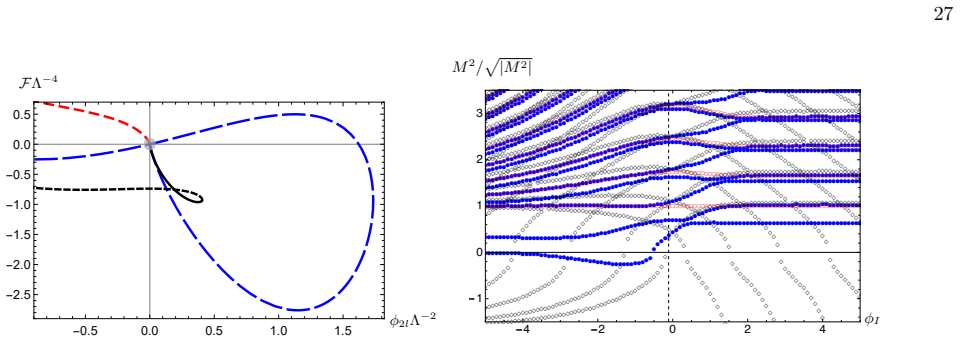
Compute or simulate a confining gauge theory whose zero-temperature phase diagram contains a line of first-order transitions ending at a critical point, and measure the lightest scalar-singlet mass as the control parameters approach that point: if the mass does not tend to zero as the free energy becomes continuous with divergent second derivative, the paper's central claim is wrong for that case. The sharpest in-paper target is the Section IV.F construction — the claim predicts an exactly massless scalar at the point where the free energy's second derivative diverges, so recomputing that spec
If this is right
- A light dilaton in a confining theory signals proximity to the critical end point of a first-order transition line, and its mass relative to the confinement scale can be dialled continuously by tuning the control parameters — arbitrarily small near the critical point.
- The pattern is stable across the nine surveyed examples, which differ in spacetime dimension, field content, and confinement mechanism (shrinking circles vs. magnetic fluxes), so the effect is not an artifact of a single construction.
- At the critical point itself the dilaton is exactly massless, and it remains a physically realised, stable state as the parameters approach the point along the stable branch.
- For composite-Higgs model building, the mechanism supplies what dilaton effective field theory cannot: an origin for the small, unprotected quartic coupling and the light mass, tied to proximity to criticality rather than to a tuned potential.
- The survey sets a concrete agenda — in four-dimensional lattice or field-theory settings, look for a light scalar singlet appearing where a zero-temperature first-order line weakens toward a critical point.
Where Pith is reading between the lines
- Editor's inference: read in reverse, the survey predicts that the natural hunting ground for a light dilaton is not the edge of the conformal window per se but the vicinity of a weak first-order transition; a walking theory with no nearby critical point is the case the mechanism says is unlikely to produce a parametrically light scalar.
- Editor's inference: the spectra shown imply the dilaton mass should vanish with a definite power of the distance to the critical point; extracting that critical exponent from the plotted data is a direct, doable extension the paper does not perform.
- Editor's inference: if the mechanism survives the move to four dimensions, the control parameter that tunes the dilaton mass would double as a dial for the electroweak hierarchy — a concrete route from TeV-scale strong dynamics to a 125 GeV scalar without fine-tuning.
- Editor's inference: the probe-approximation criterion could be translated into a lattice observable — a scalar singlet whose mass responds strongly to the insertion that couples to the trace of the stress tensor — giving a spectroscopy-based test of the mechanism independent of holography.
Editorial analysis
A structured set of objections, weighed in public.
Referee Report
Summary. This is a review of a holographic research programme that asks whether a light dilaton can appear as a dynamical bound state in confining gauge theories, in particular when a line of first-order zero-temperature phase transitions ends at a critical point. The paper assembles the necessary technology (domain-wall/soliton backgrounds, fluctuation spectra, free-energy computation, and a probe approximation intended to detect coupling to the trace of the energy-momentum tensor), then summarizes several top-down and bottom-up examples. The central conclusion, stated most explicitly in Section VI, is that in the two known examples with a critical endpoint the spectrum contains a parametrically light scalar that the authors identify as a dilaton, while acknowledging that all examples have dual QFTs of dimension lower than four and that some branches involve singular or large-curvature solutions.
Significance. The paper is a useful and fairly presented status report. Its strengths are the systematic comparison of different constructions, the explicit documentation of limitations (metastable branches, singular domain-wall solutions, large curvature near some transitions, absence of a four-dimensional example), and the self-contained technology section. If the identification of the light critical-endpoint scalar as a dilaton is accepted, the review provides concrete evidence for a mechanism that is difficult to test by other means and connects holography to the dEFT/lattice literature. However, the central claim rests on a relatively narrow basis: two endpoint examples and a single diagnostic for dilaton nature. The paper would be strengthened by either additional evidence for the Goldstone-boson character of the scalar or a more cautious wording of the conclusion.
major comments (2)
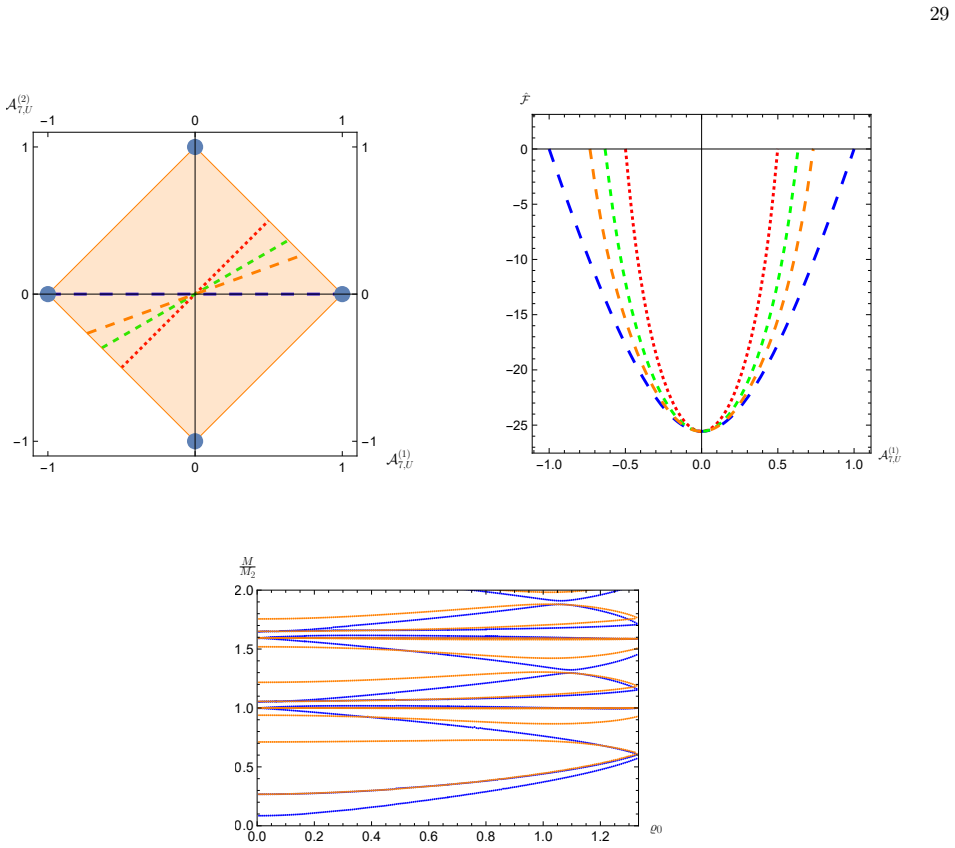
- [Section III.D, Eqs. (59)-(60), and Section VI] The probe approximation identifies a state as a dilaton by the fact that it disappears or changes mass when the metric fluctuation h is neglected. Sections IV.F and V.C use this to call the critical-point scalar 'undoubtedly a dilaton' and 'clear evidence'. Overlap with T^μ_μ is necessary but not sufficient for a pseudo-Goldstone dilaton: at a second-order endpoint a massless scalar is generic from diverging susceptibility, and any holographic scalar can mix with h. The paper reports no independent check such as a decay constant F_d as m_d→0, the m_d^2 F_d^2/trace-anomaly relation, or a dEFT comparison. Since the central conclusion in Section VI depends on identifying the scalar as a dilaton, the authors should supply such evidence or explicitly restrict the claim to 'a light scalar with strong overlap with T^μ_μ'.
- [Section VI, first paragraph] The sentence 'if there is a line of first-order phase transitions ... then ... contains a light scalar' is stated as a general result, but the supporting endpoint examples are exactly two, Refs. [253] and [254], both with lower-dimensional dual QFTs. The open questions listed immediately after make clear that this is not a theorem, yet the wording of the central claim does not carry that caveat. I recommend adding an explicit sentence distinguishing the verified lower-dimensional examples from the conjectural generalization to four-dimensional QFT, and noting the absence of independent confirmation.
minor comments (3)
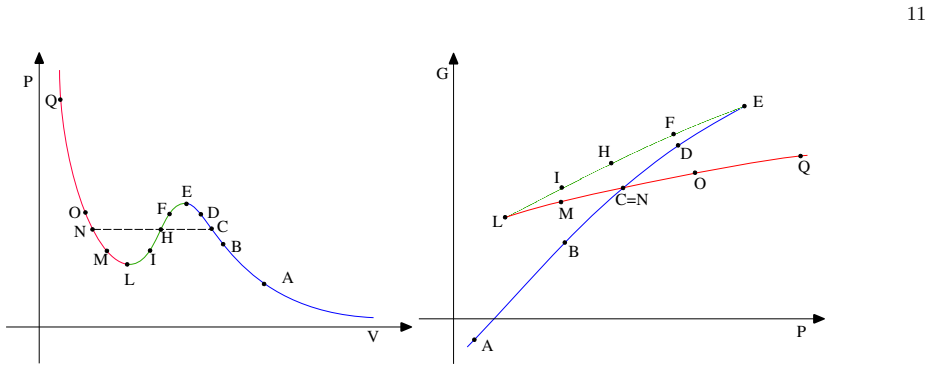
- [Section IV.F] The critical value b_0^CP is quoted as 0.9815 in the text, while the caption of Fig. 7 and the subsequent text give b_0^CP ≃ 0.6815. Please reconcile this numerical inconsistency.
- [Section IV.C] The text contains a long unmarked excerpt from Ref. [250], including equations (146)-(148), figure captions, and page numbers. This should be removed or clearly set off as a quotation with attribution; as it stands it disrupts the narrative and raises copyright/permission issues.
- [Sections IV.B and IV.C] Minor typos: 'spce' in Section IV.B should be 'space', and 'brunch' in Section IV.C should be 'branch'.
Circularity Check
Genuine spectral computations, but the identification of the light scalar as a dilaton is fixed by the paper's own probe-approximation criterion rather than independently derived.
specific steps
-
self definitional
[Section III.D (probe approximation), applied in Sections IV.F and V.C, and summarized in Section VI]
"if one finds that the light scalar state mentioned above no longer is present after the approximation has been made, or that its mass is greatly different, one can conclude that the state, computed correctly with the gauge-invariant formalism, is a dilaton, as it is sourced by the dilatation operator. ... This state is undoubtedly a dilaton, as shown by the fact that the probe approximation fails completely to capture its very existence."
The probe approximation is introduced as the very criterion for being a dilaton: a mode that disappears when the metric fluctuation h is neglected is declared 'sourced by the dilatation operator' and hence a dilaton. The flagship top-down and bottom-up examples then use exactly that criterion as the only evidence that the light state at the critical endpoint is a dilaton. No independent check of dilaton low-energy properties (e.g. a finite decay constant F_d in the m_d -> 0 limit, or a relation m_d^2 F_d^2 to the trace anomaly) is reported. At a second-order critical point a massless scalar is expected on generic grounds, so the non-trivial content is the identification of that scalar as a dilaton; that identification is imposed by the diagnostic itself rather than derived from independent
full rationale
This is a review of a computational programme rather than a new derivation. Within each model, the mass spectra are obtained by solving the linearized gauge-invariant fluctuation equations (Eqs. (55)-(58)) and the free energy from holographic renormalization (Eq. (65)); the phase diagrams are not produced by fitting the dilaton mass. Thus the existence and parametric lightness of a scalar near a critical endpoint is a genuine, calculation-heavy result, and the frequent self-citations to Refs. [248-256] refer to explicit computations rather than to a bare assertion. The circularity is concentrated in the interpretation step: the paper's only operative criterion for 'this light scalar is a dilaton' is the probe approximation of Section III.D, whose diagnostic output (the state is missed when h is neglected) is equated with 'sourced by the dilatation operator' and hence with dilatonhood. The review does not report an independent check of dilaton low-energy theorems, so the central identification reduces to the authors' own diagnostic. The paper itself flags the main caveats: the dual field theories are lower-dimensional, some solutions approach singular or large-curvature regions, and the bottom-up model has no known microscopic origin. Those are limitations on the strength of the evidence, not additional circularity. Overall score 4: substantial independent spectral content, but the load-bearing identification of the scalar as a dilaton is supplied by the paper's own definitional criterion rather than by independent evidence.
Axiom & Free-Parameter Ledger
free parameters (3)
- Bottom-up superpotential coefficients (e.g., degree-six polynomial of Model B in [253]; quadratic superpotential in [251
- Fixed/scanned model parameters in bottom-up Model B [253] =
phi_Q = 10 fixed; phi_M^c ~ 1.088, ell_Lambda^c ~ 5.186
- Operator scaling dimension Delta in the bottom-up model of [251] =
scanned; special value Delta = 5/2 (BF-bound saturation)
axioms (4)
- domain assumption Gauge-gravity duality dictionary, Eqs. (1)-(3)
- domain assumption Classical supergravity approximation is valid for the dual QFTs of interest
- domain assumption Truncation to a few scalar fields captures the relevant light spectrum and phase structure
- ad hoc to paper Probe approximation identifies the dilaton
read the original abstract
The dilaton is the hypothetical scalar particle associated with spontaneous breaking of approximate scale invariance. It has been predicted to arise dynamically, as a bound state, in special extensions of the standard model of particle physics based on composite dynamics. In confining gauge theories, generic arguments suggest that the scale of explicit symmetry breaking coincides with the confinement scale, that governs also its spontaneous breaking, by setting the size of all the condensates, as well as the masses of bound states and their excitations. Whether a light dilaton can nevertheless exist in such a context is an open question in quantum field theory, answering which has potentially transformative implications from a conceptual viewpoint, besides having striking phenomenological ramifications. It has been suggested that the mass of the dilaton might be suppressed, in respect to the confinement scale, in the special case in which the underlying strongly coupled dynamics undergoes a zero-temperature (weak) phase transition. Identifying the special conditions under which this happens is the subject of ongoing investigations. A dedicated programme of exploration, carried out within the context of gauge-gravity dualities (holography), has been set up to test the viability of this mechanism. We review the relevant technology within holography, and the status of such a programme, by comparing results obtained in a survey of explicit examples. We do so both within the bottom-up, simplified version of gauge-gravity dualities, but also within the more refined, and complete, top-down approach to holography, in which the gravity theory is known to have a more fundamental origin. We highlight the first examples of confining theories in which a parametrically light holographic dilaton forms as a bound state in a region of parameter space in proximity to a critical point of the field theory.
Figures




Reference graph
Works this paper leans on
-
[1]
Migdal and M.A
A.A. Migdal and M.A. Shifman,Dilaton Effective Lagrangian in Gluodynamics,Phys. Lett. B114(1982) 445
1982
-
[2]
Coleman,Aspects of Symmetry: Selected Erice Lectures, Cambridge University Press, Cambridge, U.K
S. Coleman,Aspects of Symmetry: Selected Erice Lectures, Cambridge University Press, Cambridge, U.K. (1985), 10.1017/CBO9780511565045
-
[3]
W.D. Goldberger, B. Grinstein and W. Skiba,Distinguishing the Higgs boson from the dilaton at the Large Hadron Collider,Phys. Rev. Lett.100(2008) 111802 [0708.1463]
Pith/arXiv arXiv 2008
-
[4]
Djouadi,The Anatomy of electro-weak symmetry breaking
A. Djouadi,The Anatomy of electro-weak symmetry breaking. I: The Higgs boson in the standard model,Phys. Rept. 457(2008) 1 [hep-ph/0503172]. 42 [5]ATLAScollaboration,Observation of a new particle in the search for the Standard Model Higgs boson with the ATLAS detector at the LHC,Phys. Lett. B716(2012) 1 [1207.7214]. [6]CMScollaboration,Observation of a Ne...
Pith/arXiv arXiv 2008
-
[7]
Leung, S.T
C.N. Leung, S.T. Love and W.A. Bardeen,Spontaneous Symmetry Breaking in Scale Invariant Quantum Electrodynamics,Nucl. Phys. B273(1986) 649
1986
-
[8]
Bardeen, C.N
W.A. Bardeen, C.N. Leung and S.T. Love,The Dilaton and Chiral Symmetry Breaking,Phys. Rev. Lett.56(1986) 1230
1986
-
[9]
Yamawaki, M
K. Yamawaki, M. Bando and K.-i. Matumoto,Scale Invariant Technicolor Model and a Technidilaton,Phys. Rev. Lett. 56(1986) 1335
1986
-
[10]
L. Randall and R. Sundrum,A Large mass hierarchy from a small extra dimension,Phys. Rev. Lett.83(1999) 3370 [hep-ph/9905221]
Pith/arXiv arXiv 1999
-
[11]
W.D. Goldberger and M.B. Wise,Modulus stabilization with bulk fields,Phys. Rev. Lett.83(1999) 4922 [hep-ph/9907447]
Pith/arXiv arXiv 1999
-
[12]
O. DeWolfe, D.Z. Freedman, S.S. Gubser and A. Karch,Modeling the fifth-dimension with scalars and gravity,Phys. Rev. D62(2000) 046008 [hep-th/9909134]
Pith/arXiv arXiv 2000
-
[13]
W.D. Goldberger and M.B. Wise,Phenomenology of a stabilized modulus,Phys. Lett. B475(2000) 275 [hep-ph/9911457]
Pith/arXiv arXiv 2000
-
[14]
C. Csaki, M.L. Graesser and G.D. Kribs,Radion dynamics and electroweak physics,Phys. Rev. D63(2001) 065002 [hep-th/0008151]
Pith/arXiv arXiv 2001
-
[15]
N. Arkani-Hamed, M. Porrati and L. Randall,Holography and phenomenology,JHEP08(2001) 017 [hep-th/0012148]
Pith/arXiv arXiv 2001
-
[16]
R. Rattazzi and A. Zaffaroni,Comments on the holographic picture of the Randall-Sundrum model,JHEP04(2001) 021 [hep-th/0012248]
Pith/arXiv arXiv 2001
-
[17]
L. Kofman, J. Martin and M. Peloso,Exact identification of the radion and its coupling to the observable sector,Phys. Rev. D70(2004) 085015 [hep-ph/0401189]
Pith/arXiv arXiv 2004
-
[18]
D.K. Hong, S.D.H. Hsu and F. Sannino,Composite Higgs from higher representations,Phys. Lett. B597(2004) 89 [hep-ph/0406200]
Pith/arXiv arXiv 2004
-
[19]
D.D. Dietrich, F. Sannino and K. Tuominen,Light composite Higgs from higher representations versus electroweak precision measurements: Predictions for CERN LHC,Phys. Rev. D72(2005) 055001 [hep-ph/0505059]
Pith/arXiv arXiv 2005
-
[20]
Vecchi,Phenomenology of a light scalar: the dilaton,Phys
L. Vecchi,Phenomenology of a light scalar: the dilaton,Phys. Rev. D82(2010) 076009 [1002.1721]
Pith/arXiv arXiv 2010
-
[21]
M. Hashimoto and K. Yamawaki,Techni-dilaton at Conformal Edge,Phys. Rev. D83(2011) 015008 [1009.5482]
Pith/arXiv arXiv 2011
-
[22]
T. Appelquist and Y. Bai,A Light Dilaton in Walking Gauge Theories,Phys. Rev. D82(2010) 071701 [1006.4375]
Pith/arXiv arXiv 2010
-
[23]
Z. Chacko and R.K. Mishra,Effective Theory of a Light Dilaton,Phys. Rev. D87(2013) 115006 [1209.3022]
Pith/arXiv arXiv 2013
-
[24]
B. Bellazzini, C. Csaki, J. Hubisz, J. Serra and J. Terning,A Higgslike Dilaton,Eur. Phys. J. C73(2013) 2333 [1209.3299]
Pith/arXiv arXiv 2013
-
[25]
T. Abe, R. Kitano, Y. Konishi, K.-y. Oda, J. Sato and S. Sugiyama,Minimal Dilaton Model,Phys. Rev. D86(2012) 115016 [1209.4544]
Pith/arXiv arXiv 2012
-
[26]
E. Eichten, K. Lane and A. Martin,A Higgs Impostor in Low-Scale Technicolor,1210.5462
-
[27]
D. Elander and M. Piai,The decay constant of the holographic techni-dilaton and the 125 GeV boson,Nucl. Phys. B 867(2013) 779 [1208.0546]
Pith/arXiv arXiv 2013
-
[28]
P. Hernandez-Leon and L. Merlo,Distinguishing A Higgs-Like Dilaton Scenario With A Complete Bosonic Effective Field Theory Basis,Phys. Rev. D96(2017) 075008 [1703.02064]
Pith/arXiv arXiv 2017
-
[29]
B. Bellazzini, C. Csaki, J. Hubisz, J. Serra and J. Terning,A Naturally Light Dilaton and a Small Cosmological Constant,Eur. Phys. J. C74(2014) 2790 [1305.3919]
Pith/arXiv arXiv 2014
-
[30]
G. Cacciapaglia, C. Pica and F. Sannino,Fundamental Composite Dynamics: A Review,Phys. Rept.877(2020) 1 [2002.04914]
Pith/arXiv arXiv 2020
-
[31]
Cohen and H
A.G. Cohen and H. Georgi,Walking Beyond the Rainbow,Nucl. Phys. B314(1989) 7
1989
-
[32]
Caswell,Asymptotic Behavior of Nonabelian Gauge Theories to Two Loop Order,Phys
W.E. Caswell,Asymptotic Behavior of Nonabelian Gauge Theories to Two Loop Order,Phys. Rev. Lett.33(1974) 244
1974
-
[33]
Banks and A
T. Banks and A. Zaks,On the Phase Structure of Vector-Like Gauge Theories with Massless Fermions,Nucl. Phys. B 196(1982) 189
1982
-
[34]
Holdom and J
B. Holdom and J. Terning,A Light Dilaton in Gauge Theories?,Phys. Lett. B187(1987) 357
1987
-
[35]
Holdom and J
B. Holdom and J. Terning,No Light Dilaton in Gauge Theories,Phys. Lett. B200(1988) 338
1988
-
[36]
B. Grinstein and P. Uttayarat,A Very Light Dilaton,JHEP07(2011) 038 [1105.2370]
Pith/arXiv arXiv 2011
-
[37]
F. Sannino and K. Tuominen,Orientifold theory dynamics and symmetry breaking,Phys. Rev. D71(2005) 051901 43 [hep-ph/0405209]
Pith/arXiv arXiv 2005
-
[38]
D.D. Dietrich and F. Sannino,Conformal window of SU(N) gauge theories with fermions in higher dimensional representations,Phys. Rev. D75(2007) 085018 [hep-ph/0611341]
Pith/arXiv arXiv 2007
-
[39]
T.A. Ryttov and F. Sannino,Supersymmetry inspired QCD beta function,Phys. Rev. D78(2008) 065001 [0711.3745]
Pith/arXiv arXiv 2008
-
[40]
C. Pica and F. Sannino,Beta Function and Anomalous Dimensions,Phys. Rev. D83(2011) 116001 [1011.3832]
Pith/arXiv arXiv 2011
-
[41]
C. Pica and F. Sannino,UV and IR Zeros of Gauge Theories at The Four Loop Order and Beyond,Phys. Rev. D83 (2011) 035013 [1011.5917]
Pith/arXiv arXiv 2011
-
[42]
B.S. Kim, D.K. Hong and J.-W. Lee,Into the conformal window: Multirepresentation gauge theories,Phys. Rev. D101 (2020) 056008 [2001.02690]
Pith/arXiv arXiv 2020
-
[43]
Lee,Conformal window from conformal expansion,Phys
J.-W. Lee,Conformal window from conformal expansion,Phys. Rev. D103(2021) 076006 [2008.12223]
Pith/arXiv arXiv 2021
-
[44]
T.A. Ryttov and R. Shrock,Infrared Zero ofβand Value ofγ m for an SU(3) Gauge Theory at the Five-Loop Level, Phys. Rev. D94(2016) 105015 [1607.06866]
Pith/arXiv arXiv 2016
-
[45]
Ryttov,Consistent Perturbative Fixed Point Calculations in QCD and Supersymmetric QCD,Phys
T.A. Ryttov,Consistent Perturbative Fixed Point Calculations in QCD and Supersymmetric QCD,Phys. Rev. Lett.117 (2016) 071601 [1604.00687]
Pith/arXiv arXiv 2016
-
[46]
T.A. Ryttov and R. Shrock,Scheme-independent calculation ofγ ¯ψψ,IR for an SU(3) gauge theory,Phys. Rev. D94 (2016) 105014 [1608.00068]
Pith/arXiv arXiv 2016
-
[47]
T.A. Ryttov and R. Shrock,Scheme-Independent Series Expansions at an Infrared Zero of the Beta Function in Asymptotically Free Gauge Theories,Phys. Rev. D94(2016) 125005 [1610.00387]
Pith/arXiv arXiv 2016
-
[48]
T.A. Ryttov and R. Shrock,Higher-Order Scheme-Independent Calculations of Physical Quantities in the Conformal Phase of a Gauge Theory,Phys. Rev. D95(2017) 085012 [1701.06083]
Pith/arXiv arXiv 2017
-
[49]
T.A. Ryttov and R. Shrock,Higher-order scheme-independent series expansions ofγ ¯ψψ,IR andβ ′ IR in conformal field theories,Phys. Rev. D95(2017) 105004 [1703.08558]
Pith/arXiv arXiv 2017
-
[50]
T.A. Ryttov and R. Shrock,Infrared fixed point physics in SO(N c) and Sp(N c) gauge theories,Phys. Rev. D96(2017) 105015 [1709.05358]
Pith/arXiv arXiv 2017
-
[51]
J.A. Gracey, T.A. Ryttov and R. Shrock,Scheme-Independent Calculations of Anomalous Dimensions of Baryon Operators in Conformal Field Theories,Phys. Rev. D97(2018) 116018 [1805.02729]
Pith/arXiv arXiv 2018
-
[52]
T.A. Ryttov and R. Shrock,Scheme-Independent Calculations of Properties at a Conformal Infrared Fixed Point in Gauge Theories with Multiple Fermion Representations,Phys. Rev. D98(2018) 096003 [1809.02242]
Pith/arXiv arXiv 2018
-
[53]
T.A. Ryttov and R. Shrock,Scheme-Independent Series for Anomalous Dimensions of Higher-Spin Operators at an Infrared Fixed Point in a Gauge Theory,Phys. Rev. D101(2020) 076018 [2002.08979]
Pith/arXiv arXiv 2020
-
[54]
T.A. Ryttov and R. Shrock,Anomalous dimensions at an infrared fixed point in an SU(Nc) gauge theory with fermions in the fundamental and antisymmetric tensor representations,Phys. Rev. D108(2023) 056007 [2307.12426]
Pith/arXiv arXiv 2023
-
[55]
Chetyrkin,Quark mass anomalous dimension to O (alpha-s**4),Phys
K.G. Chetyrkin,Quark mass anomalous dimension to O (alpha-s**4),Phys. Lett. B404(1997) 161 [hep-ph/9703278]
Pith/arXiv arXiv 1997
-
[56]
J.A.M. Vermaseren, S.A. Larin and T. van Ritbergen,The 4-loop quark mass anomalous dimension and the invariant quark mass,Phys. Lett. B405(1997) 327 [hep-ph/9703284]
Pith/arXiv arXiv 1997
-
[57]
P.A. Baikov, K.G. Chetyrkin and J.H. K¨ uhn,Five-Loop Running of the QCD Coupling Constant,Phys. Rev. Lett.118 (2017) 082002 [1606.08659]
Pith/arXiv arXiv 2017
-
[58]
F. Herzog, B. Ruijl, T. Ueda, J.A.M. Vermaseren and A. Vogt,The five-loop beta function of Yang-Mills theory with fermions,JHEP02(2017) 090 [1701.01404]
Pith/arXiv arXiv 2017
-
[59]
K. Rummukainen and K. Tuominen,Lattice Computations for Beyond Standard Model Physics,Universe8(2022) 188. [60]LatKMIcollaboration,Light composite scalar in eight-flavor QCD on the lattice,Phys. Rev. D89(2014) 111502 [1403.5000]
Pith/arXiv arXiv 2022
-
[61]
Appelquist et al.,Strongly interacting dynamics and the search for new physics at the LHC,Phys
T. Appelquist et al.,Strongly interacting dynamics and the search for new physics at the LHC,Phys. Rev. D93(2016) 114514 [1601.04027]. [62]LatKMIcollaboration,Light flavor-singlet scalars and walking signals inN f = 8QCD on the lattice,Phys. Rev. D96 (2017) 014508 [1610.07011]
Pith/arXiv arXiv 2016
-
[63]
A.D. Gasbarro and G.T. Fleming,Examining the Low Energy Dynamics of Walking Gauge Theory,PoS LA TTICE2016(2017) 242 [1702.00480]. [64]Lattice Strong Dynamicscollaboration,Nonperturbative investigations of SU(3) gauge theory with eight dynamical flavors,Phys. Rev. D99(2019) 014509 [1807.08411]. [65]Lattice Strong Dynamics (LSD)collaboration,Goldstone boson...
Pith/arXiv arXiv 2017
-
[66]
A. Hasenfratz,Emergent strongly coupled ultraviolet fixed point in four dimensions with eight K¨ ahler-Dirac fermions, 44 Phys. Rev. D106(2022) 014513 [2204.04801]. [67]Lattice Strong Dynamicscollaboration,Light scalar meson and decay constant in SU(3) gauge theory with eight dynamical flavors,Phys. Rev. D110(2024) 054501 [2306.06095]. [68]LSDcollaboratio...
Pith/arXiv arXiv 2022
-
[70]
A.Y. Kotov, D. Nogradi, K.K. Szabo and L. Szikszai,More on the flavor dependence of m ρ/fπ,JHEP07(2021) 202 [2107.05996]
Pith/arXiv arXiv 2021
-
[71]
H.S. Chung and D. Nogradi,fϱ/mϱand fπ/mϱratios and the conformal window,Phys. Rev. D107(2023) 074039 [2302.06411]
Pith/arXiv arXiv 2023
-
[72]
D. Nogradi and H.S. Chung,Mesonic decay constant and mass ratios and the conformal window,PoSLA TTICE2023 (2024) 084 [2311.08668]
Pith/arXiv arXiv 2024
-
[73]
Z. Fodor, K. Holland, J. Kuti, D. Nogradi, C. Schroeder and C.H. Wong,Can the nearly conformal sextet gauge model hide the Higgs impostor?,Phys. Lett. B718(2012) 657 [1209.0391]
Pith/arXiv arXiv 2012
-
[74]
Z. Fodor, K. Holland, J. Kuti, S. Mondal, D. Nogradi and C.H. Wong,Toward the minimal realization of a light composite Higgs,PoSLA TTICE2014(2015) 244 [1502.00028]
Pith/arXiv arXiv 2015
-
[75]
Z. Fodor, K. Holland, J. Kuti, S. Mondal, D. Nogradi and C.H. Wong,Status of a minimal composite Higgs theory,PoS LA TTICE2015(2016) 219 [1605.08750]
Pith/arXiv arXiv 2016
-
[76]
Z. Fodor, K. Holland, J. Kuti, D. Nogradi and C.H. Wong,The twelve-flavorβ-function and dilaton tests of the sextet scalar,EPJ Web Conf.175(2018) 08015 [1712.08594]
Pith/arXiv arXiv 2018
-
[77]
Z. Fodor, K. Holland, J. Kuti and C.H. Wong,Tantalizing dilaton tests from a near-conformal EFT,PoS LA TTICE2018(2019) 196 [1901.06324]
Pith/arXiv arXiv 2019
-
[78]
Z. Fodor, K. Holland, J. Kuti and C.H. Wong,Dilaton EFT from p-regime to RMT in theϵ-regime,PoS LA TTICE2019(2020) 246 [2002.05163]
Pith/arXiv arXiv 2020
-
[79]
A. Athenodorou, E. Bennett, G. Bergner and B. Lucini,Infrared regime of SU(2) with one adjoint Dirac flavor,Phys. Rev. D91(2015) 114508 [1412.5994]
Pith/arXiv arXiv 2015
-
[80]
A. Athenodorou, E. Bennett, G. Bergner, D. Elander, C.J.D. Lin, B. Lucini et al.,Large mass hierarchies from strongly-coupled dynamics,JHEP06(2016) 114 [1605.04258]
Pith/arXiv arXiv 2016
-
[81]
A. Athenodorou, E. Bennett, G. Bergner and B. Lucini,Investigating the conformal behavior of SU(2) with one adjoint Dirac flavor,Phys. Rev. D104(2021) 074519 [2103.10485]
Pith/arXiv arXiv 2021
-
[82]
A. Athenodorou, E. Bennett, G. Bergner, P. Butti, J. Lenz and B. Lucini,SU(2) gauge theory with one and two adjoint fermions towards the continuum limit,2408.00171
-
[83]
E. Bennett et al.,Symplectic lattice gauge theories in the grid framework: Approaching the conformal window,Phys. Rev. D108(2023) 094508 [2306.11649]
Pith/arXiv arXiv 2023
-
[84]
E. Bennett, D.K. Hong, H. Hsiao, J.-W. Lee, C.J.D. Lin, B. Lucini et al.,Meson spectroscopy in the Sp(4) gauge theory with three antisymmetric fermions,Phys. Rev. D111(2025) 074511 [2412.01170]
Pith/arXiv arXiv 2025
-
[85]
S. Matsuzaki and K. Yamawaki,Dilaton Chiral Perturbation Theory: Determining the Mass and Decay Constant of the Technidilaton on the Lattice,Phys. Rev. Lett.113(2014) 082002 [1311.3784]
Pith/arXiv arXiv 2014
-
[86]
Y.-L. Li, Y.-L. Ma and M. Rho,Chiral-scale effective theory including a dilatonic meson,Phys. Rev. D95(2017) 114011 [1609.07014]
Pith/arXiv arXiv 2017
-
[87]
M. Golterman and Y. Shamir,Low-energy effective action for pions and a dilatonic meson,Phys. Rev. D94(2016) 054502 [1603.04575]
Pith/arXiv arXiv 2016
-
[88]
A. Kasai, K.-i. Okumura and H. Suzuki,A dilaton-pion mass relation,1609.02264
-
[89]
M. Hansen, K. Langæble and F. Sannino,Extending Chiral Perturbation Theory with an Isosinglet Scalar,Phys. Rev. D 95(2017) 036005 [1610.02904]
Pith/arXiv arXiv 2017
discussion (0)
Sign in with ORCID, Apple, or X to comment. Anyone can read and Pith papers without signing in.